Iowa State University Patents
Iowa State University Research Foundation, Inc.
8-4-1998
Catalyst system comprising a first catalyst system
tethered to a supported catalyst
Robert J. Angelici
Iowa State University, [email protected]
Hanrong Gao
Iowa State UniversityFollow this and additional works at:
http://lib.dr.iastate.edu/patents
Part of the
Chemistry Commons
This Patent is brought to you for free and open access by the Iowa State University Research Foundation, Inc. at Iowa State University Digital Repository. It has been accepted for inclusion in Iowa State University Patents by an authorized administrator of Iowa State University Digital Repository. For more information, please [email protected].
Recommended Citation
Angelici, Robert J. and Gao, Hanrong, "Catalyst system comprising a first catalyst system tethered to a supported catalyst" (1998).
Iowa State University Patents. 95.
catalyst
Abstract
The present invention provides new catalyst formats which comprise a supportedcatalyst tethered to a second
and different catalyst by a suitable tethering ligand.A preferred system comprises a heterogeneous supported
metal catalyst tethered to a homogeneous catalyst. This combination of homogeneous and heterogeneous
catalysts has a sufficient lifetime and unusually high catalytic activity in arene hydrogenations, and potentially
many other reactions as well, including, but not limited to hydroformylation, hydrosilation, olefin oxidation,
isomerization, hydrocyanation, olefin metathesis, olefin polymerization, carbonylation, enantioselective
catalysis and photoduplication. These catalysts are easily separated from the products, and can be reused
repeatedly, making these systems very economical.
Keywords
Chemistry
Disciplines
Chemistry
United States Patent [19]
Angelici et a].
‘ US005789333A
5,789,333
Aug. 4, 1998
[11]
Patent Number:
[45]
Date of Patent:
[54] CATALYST SYSTEM COMPRISING A FIRST
CATALYST SYSTEM TETHERED TO A SUPPORTED CATALYST
[75] Inventors: Robert J. Angelici; Hanmng Gao.
both of Ames. Iowa
[73] Assignee: Iowa State University Research
Foundation, Inc.. Ames. Iowa
[21] Appl. No.: 811,426 [22] Filed: Mar. 5, 1997
[51] Int. Cl.6 ... .. 1501,] 31/00: B011 31/16;
B01J 31/28
[52] US. Cl. ... .. 502/113; 502/102; 502/103:
502/104; 502/114; 502/150; 502/153', 502/154;
502/155; 502/158; 502/161: 502/162; 502/166; 502/167; 502/232; 502/240; 502/245; 502/254; 502/258; 502/259; 502/261; 502/263; 502/439[58] Field of Search ... .. 502/439. 157.
502/214. 507. 508. 523. 102. 103. 104. 113. 114. 123. 125. 127. 150. 155. 156. 154. 153. 158. 159. 161. 162. 166. 167. 169. 232. 240. 258
[56] References Cited
U.S. PATENT DOCUMENTS
3,997,472 12/1976 O’Driscoll et a1. ... .. 252/430
4,276,195 6/1981 Vetkade ... .. .. 4,302,401 11/1981 Oswald ... ..
4,383,118 5/1983 Locatelli et a1. ..
4,737,588 4/1988 Billig et a1. 4,789,753 12/1988 Billig et a1. ... ..
4,898,845 2/1990 Datta et a]. ... ..
4,912,032 3/1990 Ho?man et 2.1.
5,089,536 2/1992 PalaZzolIo 5,177,228 1/1993 Sato et a1. 5,206,399 4/1993 Sayo et a]. 5,344,948 9/1994 Verkade ... ..
5,352,771 10/1994 Kostic et a1. 5,405,550 4/1995 MlClll et a1.
5,464,656 11/1995 Verkade ... ..
5,536,860 7/1996 Monkiewicz et a1. .
$567,615 10/1996 Degan et al.
5,587,439 12/1996 DiMaio .. 526/142
5,637,684 6/1997 Cook et al. ... .. 536/231 FOREIGN PATENT DOCUNIENTS
0094914 11/1983 European Pat. O?. ... .. 603C l/68 0094915 11/1983 European Pat. O?. ... .. 603C l/68
OTHER PUBLICATIONS
‘Tailored Metal Catalysts —Catalysis by Metal Complexes”.
Y. Iwasawa. ed.. D. Reidel Publishing Company. Holland.
1-140 (1986).
Amer. 1.. et al.. “Hydrogenation of Arenes by the
RhCl_.,-Aliquat 336 Catalyst Part 2. Reduction of Naphtha
lene Derivatives to Tetralins”. J. of Mol. Catalysts, 34,
221-228 (1986).
Bennett. M.A.. et al.. “An Arene Hydrido-complex of
Ruthenium (11) as Catalyst for the Homogeneous Hydroge
nation of Benzene and Ole?ns”. J.C.S. Chem. Comm,
582-583 (1978).
Bennett. M.A.. et al.. “Dinuclear Arene Hydrido-complexes
of Ruthenium (H): Reactions with Ole?ns and Catalysis of
Homogeneous Hydrogenation of Arenes", J.C.S. Chem. Comm, 312-314 (1979).
Blum. J.. et al.. “Catalytic Hydrogenation of Ole?ns. Acety lenes and Arenes by Rhodium Trichloride and Aliquat-336 Under phase transfer conditions”. Tetrahedron Lem, 24,
4139-4142 (1983).
Collman. J.P.. et al.. “Principles and Applications of Orga
notransition Metal Chemistry”. University Science Books.
Mill Valley. CA. table of contents and pp. 523-575 (1987).
Corma. A.. et al.. “Hydrogenation of Aromatics under mild conditions on transition metal complexes in zeolites. A
cooperative elTects of molecular sieves”. Catalysis Letters, 32, 313-318 (1995).
Cornils. B.. et al.. “Hydrogenation -Industrial Applica
tions". from Applied Homogeneous Catalysts with Organo
metallic Compounds, pp. 216 and 219 (1996).
Hartley. F.R.. “Supported Metal Complexes —A New Gen eration of Catalysts”. D. Reidel Publishing Company. Hol land, table of contents (1985).
Januszklewicz. KR. et al.. “Exceedingly Mild. Selective
and Stereospeci?c Phase-Transfer-Catalyzed Hydrogena
tion of Arenes”. Organometallics, 2, 1055-1057 (1983).Lapporte. S.J.. et al.. “Hydrogenation of Aromatics with Complex Metal Catalysts”. Communications to the Editor;
vol. 28, 1947-1948 (1963).
Michalska, Z.M.. et al.. “Supported Homogeneous Catalyst s-Transition Metal Complexes with Polymeric Ligands”. Platinum Metals Review, 18, 65—73 (1974).
Muetterties. E.L.. et al.. “Catalytic Hydrogenation of Aro
matic Hydrocarbons”. Accounts of Chemical Research, 324-331 (1979).
Okano. T.. et al.. “Versatile Polymer-Bound Rhodium Cata
lysts. Facile Hydrogenation of Aromatic Compounds in the Liquid Phase”. Chemistry Letters, The Chemical Society of Japan. 603—606 (1982).
Pieta. D.. et al.. “Homogeneous Hydrogenation of Aromatic
Hydrocarbons with Rh(acac)~(P(0Ph)3)2 Catalyst”. J. of
Mol. Catalysis, [8, 193-195 (1983).(List continued on next page.)
Primary Examiner-Belch L. Yildirim
Attorney, Agent, or Firm—Schwegman. Lundberg.
Woessner & Kluth. P.A.
[57] ABSTRACT
The present invention provides new catalyst formats which
comprise a supported catalyst tethered to a second and
dilferent catalyst by a suitable tethering ligand. A preferred system comprises a heterogeneous supported metal catalyst
tethered to a homogeneous catalyst. This combination of
homogeneous and heterogeneous catalysts has a su?icient lifetime and unusually high catalytic activity in arene hydrogenations. and potentially many other reactions as well. including. but not limited to hydroformylation.
hydrosilation. ole?n oxidation. isomerization. hydrocyanation. ole?n metathesis. ole?n polymerization. carbonylation. enantioselective catalysis and photoduplica
tion. These catalysts are easily separated from the products. and can be reused repeatedly. making these systems very
economical.
Page 2
OTHER PUBLICATIONS
Stuhl. L.S.. ct aL. “Catalytic Homogeneous Hydrogenation of Arenes 6. Reaction Scope for the n3—C3H5C0 IP(OCH3)3I3 Catalyst”. .1. of Am. Chem. $00., 100. 2405-2410 (1978).
Yu. J.S.. et a1.. “All-Cis Catalytic Hydxogenation of Poly
nuclear Aromatic Hydrocarbons by Group 5 Metal Arylox
icle Compounds". J. of Am. Chem. Soc., H4, 1927-1929
US. Patent
Aug. 4, 1998
5,789,333
6.0001
5.000—
4.000-
B
TOF (mall-h /molRh min)
P‘ o
N
o
$
.8
‘0
1000-0
8
a
s
c
c
C
a,
| I I I I I
0.0
50.0
100.0 150.0 200.0 250.0
300.0
REACTION TIME (MIN)
FIG. 1
1 4.000
13.000-
B
3
‘E 12.000
52 1 1.000
0
{10.000
-
1%“ 9.000
§ 8.000
5 7000
'
c
'-
.
_ \e c
\
s
0P
0
I 1 | T I l
0.0
50.0
100.0 1 50.0
200.0 250.0
300.0
REACTION TIME (MIN)
1
CATALYST SYSTEM COMPRISING A FIRST CATALYST SYSTEM TETHERED TO A
SUPPORTED CATALYST
STATEMENT OF GOVERNMENT RIGHTS This invention was made with Government support under
United States Department of Energy Contract No. W-7405 ENG-82. The Government has certain rights in this inven
tion.
BACKGROUND OF THE INVENTION 1. Field of the Invention
The present invention relates to catalysts and catalyst
systems. In particular. the present invention relates to the
combination of two catalyst systems by tethering a ?rst catalyst system onto a supported second catalyst system.
2. Background of the Art
It is well understood in the chemical synthetic art that
individual chemical reactions. including those reactions used in the synthesis of speci?c chemical compounds. are
rate controlled by a various number of factors. Many of
these rate limiting or rate controlling factors are related to
atomic or molecular events during the chemical reactions and processes. These factors can in?uence the successful
ness of a synthetic procedure by affecting the energy. speed. yield and/or by-products which are produced One useful
tool in the guidance and improvement of synthetic reactions
are catalysts.
Catalysts are a well known functional group of substances or materials within the chemical industry. Catalysts are usually de?ned as materials which alter the velocity of a speci?c chemical reaction and which may be recovered in an essentially unaltered state or form in their original amount at
the end of a reaction. This is not an absolute de?nition.
because catalysts may be absorbed and carried away. or converted to other forms during the chemical reaction.
Catalysts are also conveniently associated with reagents in
the form of a catalyst on a support of a convenient size and
surface area to provide catalytic activity to the chemical
reaction. Neutral materials which carry catalysts on their
surfaces are called catalyst carriers. Commonly used catalyst carriers include carbon [activated or not]. metal oxides [e.g.. silica. titania. zirconia. etc]. diatomaceous earth. and the
like.
Catalysts are usually compared on the basis of their catalytic activity. This term is a chemical engineering term which describes the ratio of the space velocity of a catalyst
being tested (Ct) to the space velocity for a standard catalyst (Cs). a speci?cally chosen catalyst to which the test catalyst is compared. according to the formula:
Catalytic Activity=Ct/Cs.
Space velocity is the relationship between the feed rate of
a reactor volume in a ?ow process. and is defined as the
volume (or weight) of feed (measured at standard
conditions) per unit of time per unit of volume of reactor per unit of weight of catalyst. It may therefore appear for a 100
in3 reaction vessel with 5 kg of catalyst as an expression of 100 kg/hllOO m3/5 kg as a rate expressing space velocity. with the “100 kg” being the feed flow and the “h” being the
time interval for the flow with a completed reaction. Cata lytic activity can also be expressed in terms of a “Maximum
TOF” or moles of H2 reacting per mole of catalyst per minute or simply ‘Turnover" (T O) and H2 uptake over the
total reaction time.
10 20 25 35 45 55 65
2
Catalysts are generally speci?c to certain types of reac tions and are not generally functional as improving all chemical reactions. That is. a catalyst which alters the velocity of one chemical reaction will not alter the velocity of all chemical reactions. In fact. this ability to be selective
in catalytic effects. even amongst similar or competing reactions. is termed catalytic selectivity. and is an important
component in the reasoning behind the use and selection of
speci?c catalysts. When there are competing reactions
within a reaction mixture. it is critical to provide a catalyst which will favor the desired chemical reaction and not
merely increase the velocity of all reactions.
Metal catalysts. usually in elemental or organometallic form. but sometimes provided in lower valency form. and particularly metals from Groups 3-12 of the periodic tables. are widely used as catalysts. particularly in procedures
relating to reactions of unsaturated compounds. such as
hydrocarbon compounds. Particular processes in which
these types of metal catalysts ?nd favor are hydrogenation.
oxidation. carbonylation. hydroformylation (e.g.. U.S. Pat. Nos. 5.177.228 and 4.789.753). hydration. solvolysis. isomerization. dimerization. oligomerization. polymerization. hydrocyanation. ole?n metathesis. and
hydrosilation. Metal catalysts have suffered from conve
nience of form (often affecting their e?iciency and recoverability) and di?iculty in handling during some
chemical procedures.
They are known to provide di?iculty in economic sepa
ration of the used catalyst (making their reuse di?icult or
expensive). particularly when the catalyst has been provided
in a soluble form such as a metal complex or salt.
Catalysts. and especially metal catalysts have been pro vided in various forms to improve their recoverability.
without adversely affecting their catalytic activity. Tradi
tionally they have been provided as powders. coatings on
carrier substrates. carriers on bulk surfaces. and as metal
complexes which may be soluble in the reactive system. Some forms of attachment of the metal catalyst have been
reported to decrease the catalytic activity (e.g.. Platinum
Metals Rev., Z. M. Michalska and D. E. Webster. 18. 65
(1974). Supported Metal Complexes, A New Generation of
Catalysts, F. R. Hartley (1985). and Tailored Metal
Catalysis, Y. Iwasawa. (1986)). The catalytic activity of
rhodium covalently attached to polystyrene was speci?cally
found to be only 0.06 times that of an equivalent amount
[presumably of the metal] of the homogeneous counterpart.
It has also been theorized that the combination of catalyst with supporting chemical groups can introduce undesirable functionality to the reactive system. Because of this concern. in U.S. Pat. No. 3.997.472 to O'Driscoll et al.. metal catalysts were provided in a novel form in which they were
entrapped in cross linked. amorphous polymeric gels. It is
asserted in this patent that the provision of the metal
catalysts in this form provides a readily separable. reusable and easily handled material having a catalytic activity com parable to the free catalyst. The metal catalyst is incorpo~
rated into this system by either a colloidal dispersion of the metal particles within an amorphous cross linked gel or a
polymeric gel in which the catalytically-active species are dissolved and solvated by functional groups of the polymer.
U.S. Pat. No. 4.898.845 to Datta et al. discloses the use of micro crystallites dispersed in molten salts which are then deposited as thin ?lms coated on the internal surfaces of porous supports. It is indicated that an advantage of this
5.789.333
3
Metal catalysts have also been provided in many various chemical formats such as chelated complexes. particularly
for use in polymerization reactions. such as U.S. Pat. No. 5.089.536 to Palazzotto: EPO Applications 0 094 914 and O
094 915 (Ciba-Geigy AG). Metal catalysts. especially
rhodium metal catalysts have also been provided as complex
catalysts containing organosiloxanemonophenylphosphine
ligands. An advantage of this last ligand system is its abilityto be readily recovered. Metal catalysts of Pd. Pt. Ni. Co. Fe. Ir. Os. Ru and/or Rh are also disclosed.
A distinction is made within the ?eld of catalysis between
homogeneous and heterogeneous catalyst systems. Homo
geneous catalysts are considered to be catalyst systems in
which the catalyst and reactants are in the same phase. That
is. the catalyst component is distributed on a molecular or
submicroscopic level (e.g.. dissolved). usually in a liquid
phase such as a solution (which may also be eutectic or a
solid solution). In heterogeneous catalyst systems. the cata
lyst and reactants are in diiferent phases. and are usually considered as more particulate in nature (rather than atomic
or individually molecular). with the particles generally too
large to be considered molecular in nature. There is of course
a gradation between heterogeneous and homogeneous sys
terns where the molecules become more particle-like and solutions become dispersions or suspensions. but the dis tinctions are still generally maintained in the art with inter
mediate systems referred to as transitional systems between
homogeneous and heterogeneous.
Although homogeneous catalyst systems can provide a high initial activity and selectivity. homogeneous or soluble catalysts are di?icult to separate from the ?nal product.
Extreme measures are therefore required to recover even a
small portion of the valuable catalyst after the reaction is complete. When the catalysts include metals. there is the
added concern of the environmental impact of these signi? cant metal losses.
Heterogeneous catalyst systems are known to be more
efficient than homogeneous catalyst systems because the catalyst can be easily separated from the pure product. since
each is in a di?erent phase. Also. clean up of the system and
recycle of the catalyst are both much easier. and heteroge
neous systems lend themselves easily to continuous processes. which can be very economical.
In US. Pat. No. 4.276.195 to Verkade. homogeneous
transition metal complex catalysts were converted to cata
lysts which are heterogeneous with respect to the reactants. and which have substantially equal catalytic activity to the
homogeneous catalysts. This was accomplished by reacting a normally homogeneous transition metal complex catalyst
with a metal bridging ligand which substantially duplicates the ligand moiety of the metal complex. to provide a
polymerized heterogeneous transition metal complex cata
lyst. It is asserted that the resulting solid polymer structure possesses many of the bene?ts of a heterogeneous catalyst.
but the catalyzing effectiveness of this catalyst is only about equal to the known. “parent” homogeneous catalyst.
New and alternative formats for economical catalyst systems and for the control and introduction of catalysts and catalyst systems into reaction environments are still needed.
SUMMARY OF THE INVENTION
The present invention provides new catalyst formats
which comprise a supported catalyst tethered to a second
and di?’erent catalyst by a tethering ligand. The catalyst
system preferably comprises a heterogeneous supported
metal catalyst to which is tethered a homogeneous catalyst. The homogeneous catalyst. by being secured to or tethered
20 25 35 45 55 65
4
to the supported catalyst system is no longer technically a homogeneous catalyst. but because of its effectively even distribution as. for example. chelated moieties extending from the surface of the supported catalyst with individual
metal atoms or complexes of individual (or di- or tri- sets of
metal atoms) metals atoms spatially suspended away from the supported catalyst. they functionally behave as homo geneous catalysts in the reaction environment.
In a preferred embodiment. the catalyst is a homogeneous
complex catalyst tethered on a heterogeneous supported
metal catalyst. For example. the heterogeneous supported
metal catalyst (A) can be an inorganic oxide supported metal
catalyst. such as Pd—SiO2. Ni——SiO2. Ru—SiO2. Au—SiO2. Pd—Al2O3. Pd—MgO etc.. and the homoge
neous complex catalyst (B—C) can be a transition metal
complex containing a tethering ligand (C) which can chemi
cally bond to A. The formation of the final catalyst. B—C/A. is shown in eq. (1).
A=Supported heterogeneous metal catalyst; metal (M) on
support (S)
B—C=Homogeneous metal complex catalyst with tether
C
B=Homogeneous metal complex catalyst without tether
C=tether
B—C/A=combined catalyst
B—C/S=tethered homogeneous metal complex catalyst
on support (S)
This combined homogeneous-heterogeneous catalyst (B—C/A) lms catalytic activity that is higher than that of the separate homogeneous catalyst (B—C). the separate hetero geneous catalyst (A) or the homogeneous complex catalyst
(B—C) tethered on an inorganic oxide support (S). This combination of homogeneous and heterogeneous catalysts is easily separated from the products of the reaction. has a
su?icient lifetime and possesses unusually high catalytic
activity in arene hydrogenations and potentially many other
reactions as well. including. but not limited to
hydroforrnylation. hydrosilation. olefin oxidation.
isomerization. hydrocyanation. ole?n metathesis. carbonylation. and ole?n polymerization. These catalystscan also be reused repeatedly. making these systems very
economical.
With optically active ligands on the homogeneous catalyst. enantioselective catalysis of these various reactions is possible. Further. with photoinitiators tethered to the
supported catalysts. photoduplication or photoinitiated
unblocking may also be possible.These and other features. aspects. and advantages of the present invention will become better understood with regard
to the following description. drawings. and appended
claims.
BRIEF DESCRIPTION OF THE DRAWINGS
FIG. 1 is a graph showing moles of H2 reacting per mole
of rhodium per minute (TOF) versus reaction time in min utes for the hydrogenation of toluene over Rh—NISiO2 as
described in Example 1.
FIG. 2 is a graph showing moles of H2 reacting per mole
of rhodium per minute (TOF) versus reaction time in min utes for the hydrogenation of toluene over Rh-—N/Pd—SiO2 as described in Example 1.
DETAILED DESCRIPTION OF THE
INVENTION
5
together by a linking moiety. The term “different catalyst
systems” refers to differing formats of the same catalyst even
when some of the same components. e.g.. the same metal.
are employed. For example. a supported rhodium catalyst
may have a rhodium complex tethered to its surface. and this
would be considered two different catalysts. Any number of
catalyst systems may be combined (e.g.. more than one
homogeneous catalyst system may be tethered to the sup
ported heterogeneous catalyst. such as two. three or four
different homogeneous catalysts). but preferably two differ ent catalyst systems are used if only two different catalyst
formats provide an adequate and economical system. In one embodiment. metal catalyst systems are used because the starting materials can be provided with relative ease. and the processes which may be used in the manufacture of the new
catalyst formats are relatively simple. More preferably. a complexed or compounded metal catalyst is tethered to a
supported metal catalyst.
In a preferred embodiment. the catalyst system consists of
a homogeneous complex metal catalyst tethered to a het
erogeneous supported metal catalyst. Again. it should be noted that when the homogeneous catalyst is tethered to the supported catalyst. it is no longer technically a homoge
neous catalyst. but the source of the moiety (having been for a homogeneous. soluble catalyst) and/or its behavior with reactive species in the reaction solution or environment is similar to that of a truly homogeneous or intermediate
catalyst.
Materials used as heterogenous catalysts in the present
invention can include. but are not necessarily limited to metals. metal mixtures. intermetallic compounds. and a wide
range of metal compounds including metal oxides. sul?des.
halides. other binary metal compounds. hydroxides. and polynuclear metallates with oxides. sul?des. phosphates.
and halides. Examples of metals which can be used in the heterogeneous supported catalysts include. but are not nec
essan'ly limited to. Pd. Pt. Ni. C0. Fe. Sn. Cd. Sr. Mg. Mn. Zn. Cr. Al. Ag. Au. Ir. Os. Ru. Ti. Zr and/or Rh.
The support for the heterogeneous catalysts of the present
invention can be any suitable support intended for use with
insoluble catalysts including. but not limited to carbon.
organic polymers or inorganic oxides (including non-metal
oxides and both metal oxides and mixed metal oxides such
as zeolites). The support preferably has certain mechanical stabilin'es so that it remains sturdy in the machinery during catalytic reactions. and does not break into particles when reactants ?ow through it. Silica (SiO2) is widely used commercially in large scale along with other metal oxides
such as magnesium oxide. chromium oxide. and aluminum oxide because these oxides can be made into small particles
with very high surface areas. High surface areas allow large
amounts of material to be attached to relatively small amounts of the support. making the process more economi cal. Many other metal oxides can be used as well. including. but not limited to tin oxide. titanium oxide and zirconium oxide.
From the above discussion it is clear that a wide variety of heterogeneous catalysts and supports are suitable for use in the present invention. In a preferred embodiment. the
supported catalyst is an inorganic oxide supported metal catalyst such as Pd—SiO2. Ni—SiO2. Ru—SiO2.
Pd—Al2O3. Pd--MgO. Au—SiO2. etc.
The homogeneous catalyst can be any soluble catalyst
which will accelerate the rate of reaction. Preferably the catalyst is one that has previously been demonstrated to act
as a catalyst in reactions that are in solution. and can include
metals. metal complexes. enzymes. acids and bases.
Examples of metals which can be used in homogeneous
catalysts include transition metals which are generally con 15 20 25 35 50 55 65
6
sidered to be metals of groups 4-11 of the periodic chart. but
are also considered by some in the ?eld to include groups 2
and 3. The most commonly employed transition metals are
Ti. V. Cr. Mn. Fe. Co. Ni. Zr. Mo. Re. Ru. Rh. Pd. Pt.Ta. Os.
Ir. Zn and Cd. but any of the other transition metals (including the lanthanides and actinides) can be used as well. Non-transition elements can also be used in the homoge
neous catalysts of the present invention including. but not limited to Sn. Sr. Mg. Sb. Se. Bi. and Al. One well-known
group of homogeneous catalysts are the transition metal
organometallic complex catalysts including. but not limited to complexes such as Ni|P(OMe)3l4. RhCl3(SR2)3. NiCl2
(PEt3)2. RhH(CO)(PPh3)3. RhCl(CO)(PPh3)2. lrCl(CO)
(PPh3)2. and MoCl2(NO)2. Non-transition elements andtheir compounds can also be used. including. but not limited
to amines and aluminum alkyls. Examples of enzymes
which can be used include. but are not limited to glucose
isomerase and tyrosinase.
Suitable acids and bases for use as homogeneous catalysts include Lewis and Bronsted acids and bases. That is. a
suitable homogeneous acidic catalyst is not only a substance which has the ability to donate protons (such as H20 and
NH4*) as de?ned by Bronsted. it can also be any substance
which can form a covalent bond by accepting an electron
pair from a base (such as BF3. S03 and AlCl3) as de?ned by
Lewis. A suitable basic catalyst can be de?ned either as a
substance which has the ability to accept protons as de?ned
by Bronsted. or as a substance which has an unshared
electron pair with which it can form a covalent bond with an atom. molecule or ion as de?ned by Lewis. Lewis and Bronsted bases are identical because. in order to accept a proton. a base must have an unshared pair of electrons.
Examples of suitable basic catalysts include. but are not
limited to. substances such as NH3 and OH‘.
From the above discussion it is clear that a wide variety of homogeneous catalysts are suitable for use in the present invention. In a preferred embodiment. the homogeneous catalyst is a transition metal complex catalyst such as
[RhCl(CO)2]2 which also includes a tethering ligand as
described below.
The “at least two" different catalyst systems. which are preferably a homogeneous system and a heterogenous sup ported system. are tethered together by a suitable ligand or
tethering group. The term “tethering group" refers to a
chemical moiety which chemically bridges and/or secures
the “at least two" catalyst systems together and can be any
of the traditionally used ligand complexes. Tethering.
however. does not include two dilferent metals in complexes
which are each or both mixed together into a catalytic mass.
even though a complex may have a large number of chelat
ing positions which could chelate different metals within a
large micelle or the like. At least one of the catalyst systems
and preferably both of the catalyst systems must be chemi‘
cally (covalently) bonded to the tethering group.
Further. it is well known that a suitable tether is
dependent. in part. on the type of support being used. As
such. the tether will contain differing connectors at the support end depending on whether the support is an inor ganic oxide. a carbon. an organic polymer or some other support. A catalyst system consisting of a metal oxide heterogeneous catalyst tethered to a transition metal homo
geneous catalyst. for example. might have a tethering group (tether) with siloxy and phosphorus connectors such that the tether is covalently bonded to the heterogeneous metal
catalyst through the siloxy group and to the homogeneous
catalyst on the other end with the phosphorus atom. If the
support for the homogeneous catalyst is changed to carbon.
5.789.333
7
The choice of tethering Ligand is also dependent on the type of homogeneous catalyst being used as well as the end
result desired. Therefore. the best overall processing e?i ciency may require a compromise selection among numer‘ ous factors involved. for it is well known that not all ligands
will provide identical results with regard to all factors under all conditions. For example. in transition metal complex
catalyzed hydroformylation using a diorganophosphite ligand. such factors as product selectivity. catalyst reactivity
and stability. and ligand stability are often of major concern in the selection of the desired phosphorus ligand to be
employed. Moreover. such a selection may also depend on
the ole?nic starting material involved in the hydroformyla
tion process. since all ole?ns do not have the same degree of reactivity under all conditions. For instance. internal ole?ns and sterically hindered alpha ole?ns such as isobutylene. are
in general much less reactive than sterically unhindered
alpha ole?ns. Thus. by tailoring the ligand for the speci?c support. the speci?c homogeneous catalyst. and the speci?c
desired results for the product. the optimum process and/or catalyst performance may be obtained. It should also be
noted that exposure of any catalyst to impurities. such as
oxygen. during its preparation. can adversely affect the attachment of the tether to the homogeneous catalyst. It is
important. therefore. to carefully follow proper laboratory techniques in the preparation of all catalysts.
One of the most convenient forms of securing the teth
ering group to the supported catalyst is by reaction of a
metal. semi-metal or inorganic-based ester with the metal
oxide surface of a supported catalyst. Such metal. semi
metal or inorganic based ester would include silane linking groups (e.g.. Rm—-SilOR'],,. wherein m+n equals 4 and m is
at least 1). titanate esters (e.g.. R,,,—Til_OR‘],,. wherein m+n
equals the valence of titanium). phosphate ester
counterparts. and the like. Ambifrnctional materials. includ ing silane and/or metal ester-type linkages are also useful.
such as traditional coupling agents. including. but not lim
ited to ambifunctional silanes (e.g.. epoxy-terminated
silanes. amino-terminated silanes. (meth)acryloyl
terminated silanes. and their titanate ester counterparts).
The central atoms of the tether can be any suitable combination or group of atoms including any hydrocarbons such as alkanes. alkenes. alkynes. arenes. phenols. or ben
zenes. Alternatively. the central atom or atoms can contain
elements such as oxygen or nitrogen. The central atom(s) can also be non-hydrocarbon-based atoms (such as sulfur and arsenic) or non-hydrocarbon-based groups (such as
silicones).
In one embodiment of the invention. the complex [RhCl
(CO)2]2 can be tethered to the Au powder catalyst using the
ligand tether HSCH2CH2PPh2. which would likely bind the
Au through the sulfur and to the Rh complex through the phosphorus. While these catalysts would likely have excel
lent ole?n hydrogenation (l-hexene) activity. they may have
relatively short lifetimes.
In a preferred embodiment. a homogeneous |RhCl(CO)2]2
catalyst is tethered to the SiO2 support using a (EtO)3Si
(CH2)3PPh2 or (Me0)3Si(CH;,)3I~1'Et2 ligand; with the Si being attached to the SiO2 and the phosphorus bonded to the
Rh. This attachment to the silica surface is very durable
because the stability of the group itself is quite high once its reactive sites have been used in the tethering con?guration. These homogeneous-heterogeneous catalysts with the
above tethers and the Rh complex on a Pd——SiO2 hetero
geneous catalyst exhibit unusually high activities which are clearly synergistic for the hydrogenation of arenes (benzene. toluene and anisole). For example. the Maximum TOF for 50 mg of the combined catalyst Rh(COD)(N~~N)/Pd——SiO2
(containing 14.3 umol of rhodium) is 1.70 (molHzjmolRh min) as compared with only 0.06 (molH2/molRh min) for
10 25 30 35 50 55 65
8
the homogeneous rhodium complex Rh(COD)(N-N)Cl
(containing 20 pmol of rhodium). and only 0.06 (moll-I2/
molRh min) for 50 mg for the normal rhodium complex catalyst tethered on silica Rh(COD)(N~N)/Si()2 (containing
16.5 prnol of rhodium). Hydrogen uptake of the combined catalyst Rh(COD)(N~N)/Pd-—Si02 is also much higher than the silica-supported Pd catalyst Pd—SiO2. When the H2
uptake of 295 mL (for an 11-hour reaction time) for the
combined catalyst Rh(COD)(N~N)/Pd?SiO2 is compared with the H2 uptake of a heterogeneous supported palladium
metal catalyst Pd——SiO2. the difference is also signi?cant. as the H2 uptake of F'd—-Si02 is only 23.5 mL for a total reaction time of 23 hours. (See Example 2. Table 7). The mechanism for the reaction of the combined catalyst is
thought to be activation of the hydrogen on the Pd where it
spills over onto the SiO2. The active hydrogen on the SiO2
then transfers to the arene which is activated by the homo
geneous catalyst.
It should be noted that with use of optically active ligands.
enantioselective catalysis of these various reactions is pos
sible. Such ligands in the homogeneous complex catalyst
can include optically active amino acids. diarnines.
diphosphines. diphosphates and many others. It is likely that
any substance having optically active characteristics can be used. whether or not the optical activity is caused by an
asymmetric carbon atom as in l(—)-lactic acid or (+)-lactic acidl or by having a center of dissymmetry caused by some other structural feature.
Further. with photoinitiators such as aromatic iodonium salts. sulfonium salts. diazonium salts. bisirnidazoles. and
s-triazines. tethered to the supported catalysts. photodupli
cation or photoinitiated unblocking may also be possible.
Speci?cally. it is possible to design a surface such that one portion is masked or blocked and the remainder is not
masked. such that a catalyzed reaction takes place on the
unblocked portion creating the desired image.
A general synthetic procedure for manufacturing the
novel catalyst formats of the present invention would be to
?rst provide a catalyst on a catalyst carrier (e.g.. a supported
catalyst as is well understood in the art). A reactive com
pound is provided oomprising a catalyst moiety secured to a tethering linkage having an end group which is reactive with
said supported catalyst (either through the catalyst or
through the support) under conditions in which the end group is not as reactive (preferably insigni?cantly reactive
or non-reactive) with the homogeneous catalyst moiety. The
end group is then reacted with the supported catalyst to
tether the catalyst moiety to the supported catalyst. This
process thus forms a supported catalyst to which a distinct catalyst moiety has been tethered. As stated above and as
will be shown in the following. non-limiting examples. some
of these inventive catalyst formats provide catalytic activity which is clearly synergistic. with the additive catalytic activities of the individual catalyst systems (the supported catalyst and the homogeneous catalyst moiety) adding up to
an amount which is less than the catalytic activity of the tethered format for a speci?c reaction. This is clearly an
unexpected and unobvious result emphasizing the unique
ness of the present invention.
In an alternative embodiment. instead of attaching a homogeneous catalyst through a tether to a heterogeneous
supported metal catalyst. the format for this combination of
homogeneous and heterogeneous catalysts can be to attach the homogeneous catalyst through a tether to a suitable carrier. such as silica. that is separate from the carrier of the
Alternatively. it is also possible to have one type of
catalyst particle packed on top of the other type of catalyst particle. These alternative formats for the tethered homoge neous and heterogeneous supported metal catalyst would
likely be particularly suitable for catalysts involving hydro genation or dehydrogenation. for which hydrogen spillover
from one carrier particle to another has been demonstrated It is possible that migration of other activated reactants or
intermediates from one particle to another also occurs.
Reactions involving such migration can also be catalyzed synergistically by the two components of the catalyst.
Advantages of these alternative formats include the fact that different carriers for the tethered homogeneous and
supported metal catalyst can be used. which would allow the catalytic activity of the overall catalyst to be adjusted
Furthermore. carriers can be chosen for ease of preparation
of the two components of the overall catalyst and catalyst recovery would also be less costly.
The invention will be further described by reference to the
following examples which are offered to further illustrate
various embodiments of the present invention. It should be understood. however. that many variations and modi?ca tions may be made while remaining within the scope of the
present invention.
EXAMPLE 1
The catalytic activity of tethered rhodium complexes. silica-supported metal catalysts in the hydrogenation of
arenes is investigated.
1. Synthesis of Catalysts Consisting of Rhodium
Complexes Tethered to Silica-supported Metals
(1) Preparation of dilferent tethered rhodium catalysts by
Methods (A) and (B)
MHI'HOD A
Preparation of Rh - P/M - $10; or Rh - PlSiO2
l
p-pcmcmcmpmn
OR
(2) [(EKObSKCHDaPPBzhRbICOlCI + 502%
Preparation of Rh — N/M '- SiOz or Rh - N/SiOz
lO
25
35
45
55
60
65
10
-continued
OR
METHOD B
Preparation of Rh/P — (M — Si02)
Preparation of Rh/N- (M- SiO;)
(1) (Me0)3Si(CH2)3NEl2 + M-sio2-->
Preparation of Rh/N — SiO; (1) meonsitcmwmz + sio.%
l
5.789.333
11
-continued I
M = Pd. Au. Ni
(2) Preparation of silica supported metal catalysts
Preparation of silica-supported nickel catalyst (Ni—-SiO2)
A solution of Ni(NO3)26H2O (2.4 g) in 40 mL Water was
added dropwise to a ?ask containing 5.0 g SiO2. then about
30 ml. water was added dropwise. The resultant slurry was vigorously stirred on a hot plate until all excess liquid was evaporated; the resulting solid was dried in a furnace at 120° C. under ?owing air overnight. The solid was reduced under a H2 ?ow at 450° C. for 6 h and then cooled in a N2
atmosphere. The black silica-supported nickel catalyst.
Ni—SiO2. has a Ni content of 10 wt %.
Preparation of silica-supported gold catalyst (Au—SiO2)
A mixture of 5 g silica and l g HAuCl4><H2O (Au. 49%)
in 80 mL water containing 2 mL concentrated HCl was stirred at room temperature overnight. The water was evapo
rated in vacuum and the resulting solid was dried in an oven
at 110° C. for 5 hours. Then. the solid was reduced in a
furnace by ?owing H2 at 250° C. for 4 hours. The red-brown
Au—SiO2 powder contained 10% Au by weight.
Preparation of silica-supported palladium catalyst (Pd—
SiO2)
PdCl2 (1.17 g) was dissolved in 80 mL of aqueous HCl
(0.2M). The aqueous solution of H2PdC14 that formed was
added slowly to a ?ask containing 7 g SiO2. After stirring the
mixture at room temperature overnight. the water was
removed by slow evaporation under vacuum. After drying at
110° C. for 5 hours. the solid sample was calcined at 500° C. under an air ?ow for 4 hours. The calcined sample was
subsequently reduced under a H2 ?ow for 4 hours at 380° C.. followed by passivan'on under ?owing air at room tempera ture for 1 hour. The black Pd-SiO2 powder contained 10%
Pd by weight.
(3) Preparation of Si- and P-containing reactants used in
synthesis of catalysts consisting of rhodium complexes
tethered to silica-supported metals
Preparation of (3-triethoxvsilylpropyl)diphenylphosphine
((C2H,O)3SiCH2CH2CH2P(C6H5)2) or (EtO)3Si(CH2)3PPh2
This synthesis is similar to the synthesis described in
Selective Phosphination of (3-chloropropyl)triethoxysilane,
a New Route to Alkoxysilyl-Substituted Phosphines, Syn.
React. Inorg. Metal-Org. Chem. M. Capka. 7. 347 (1977).
Finely cut thin lithium plates (1 g) were added to a solution of diphenylchlorophosphine in 50 mL THF. An instant exothermic reaction took place. the color of the
solution turning deep orange. After the reaction subsided.
the mixture was allowed to stir overnight and then ?ltered. The resulting solution of lithium diphenylphosphide was dropwise added to a solution of (3-chloropropyl) triethox
ysilane (12 g) in 60 mL THF while the temperature of the
mixture was maintained below 15° C. The solution became
light gray immediately. After the addition was completed.
the reaction mixture was stirred for another 3 hours and then allowed to stand overnight. Most of the THF was removed
by distillation. The inorganic salts were removed by
?ltration. and the ?ltrate was distilled under vacuum to give
the product of (3-triethoxysilyl)propyl diphenylphosphine
(b.p.. ~200° C./0.3 mmHg). 1H NMR (CDCl3): 7.32-7.42 (m. 10H). 3.77 (m. 6H). 2.12 (m. H). 1.60 (m. 2H). 1.18 (t. 9H). 0.81 (t. 2H).Amixture of 0.43 g (1.1 mmol) [Rh(CO)2Cll2 and 1.71 g (4.4 mmol) (C2H5O)3SiCH2CH2CH2PPh2 in 55 mL toluene
25
40
45
65
12
was stirred at room temperature for 2 hours. Then. the
solution was evaporated in vacuum to a small volume and
pentane was added to give a yellow precipitate of the
carbonyl rhodium phosphine complex. IR (vCO. in toluene):
1967 cm“.
(4) Preparation of catalysts consisting of rhodium-phosphine
complexes tethered to silica and silica-supported metals by
method A
Catalyst consisting of a rhodium-phosphine complex teth ered to silica-supported gold (Rh—P/Au—SiO2): A mixture of 0.5 Au—SiO2 and 0.1 g I(C2HSO)3 SiCH2CH2CH2PPh2l2Rh(CO)Cl in 20 mL toluene was
re?uxed under N2 atmosphere overnight. After the solution
was ?ltered. the solid was Washed with toluene (6X15 mL)
and pentane (30 mL) and dried in vacuum. The resulting Rh--P/Au—SiO2 catalyst had a Rh content of 0.60% by
weight. 1R (vCO. Nujol mull): 1981 cm“.
Catalyst consisting of a rhodium-phosphine complex teth
ered to silica-supported palladium (Rh—P/Pd—SiO2) or
nickel (Rh—PINi—SiO2): The procedure is the same as that
for the preparation of Rh-——P/Au—-Si02 by using Pcl—SiO2
or Ni—SiO2 instead of Au—SiO2.
Catalyst consisting of a rhodium-phosphine complex teth
ered on silica (Rh—PlSiO2): Using the same method as for
the preparation of Rh—-PIAu—SiO2. the Rh—P/Si02 cata lyst was prepared by using SiO2 instead of Au—SiO2. IR
(vCO. Nujol mull): 1980 cm“. Rh content: 0.60 wt %. (5) Preparation of a toluene solution of l(MeO)3Si(CH2)3
NEt2]Rh(CO)2Cl
A mixture of [Rh(CO)2Cll2 (0.080 g. 0.19 mmol) and (MeO)3Si(CH2)3NEt2 (0.22 g. 0.70 mmol) in 15 mLtoluene
was stirred at room temperature for 30 min. After ?ltration.
a yellow toluene solution of l(MeO)3Si(CH2)3NEt2]Rh
(CO)2Cl was obtained. lR (vCO. cm“): 2083 (s). 2000 (s). (6) Preparation of catalysts consisting of a rhodium-amine
complex tethered to silica and silica-supported metals by
Method A
Catalyst consisting of a rhodium-amine complex tethered
to silica-supported palladium (Rh--N/Pd—SiO2A mixture
of 1 g Pd-SiO2 (Pd. 10 wt %) and the toluene solution of
[(MeO)3Si(CH2)3NEt2]Rh(CO)2Cl (10 mL) prepared as
above (in section (5)) in 20 mL toluene was re?uxed for four hours. After ?ltration. the solid was washed with toluene (15
mL><3) and pentane (20 mLXl). Then the solid was dried in vacuum and the tethered rhodium-amine complex catalyst
(Rh—NlPd--Si0,) was obtained
Catalyst consisting of a rhodium-amine complex tethered to
silica (Rh—N/Si02). silica-supported gold (Rh—-N/Au-—
$0,.) and nickel (Rh—N/Ni—SiO2)The Rh—NlSiO2. Rh—NlAu—-Si02 and Rh—N/Ni-—
SiO2 catalysts were prepared in the same manner as Rh—N/
Pd--SiO2 by using SiO2. Au—SiO2. or Ni—SiO2 instead of
Pd—SiO2.
(7) Preparation of a catalyst consisting of a rhodium phosphine complex tethered to silica or silica-supported metals by Method B
Catalyst consisting of a rhodium-phosphine complex teth ered on silica-supported palladium (Rh/P—(Pd?8iO2)) A mixture of Pd-SiO2 (1 g) and (EtO)3Si(CH2)3PPh2 (0.5
mL) in 20 mL toluene was re?uxed overnight. After ?ltration. the solid was washed with toluene (15 mL><2) and dried in vacuum. In some preparations. the resulting solid was reacted further with 5 mL of (CH3)3SiCl in 20 mL toluene at room temperature overnight in order to protect any unreacted surface Si-OH groups. After ?ltration. the solid was washed with toluene (15 mLX2) and dried in
vacuum.
The resulting phosphine ligand tethered on Pd—SiO2 was stirred with |Rh(CO)2Cl|2 (0.04 g) in 20 mL toluene at room
13
solid was washed with toluene (l5 mL><6) and dried in
vacuum. giving Rh/P—(Pd—SiO2).
Catalyst consisting of rhodium-amine complex tethered to
silica (RhfN4iO2) and silica supported palladium (Rh/ N—(Pd-—-SiO2)): The RhfN—(Pd—SiO2) catalyst was
obtained in the same way as (Rh/P—(Pd—SiO2. except
(MeO)3Si(CH2)3NlE£t2 was used instead of (EtO)3Si(CH2)3
PPh2. The silica tethered rhodium catalyst. RhfN—SiO2 was prepared with 5102 instead of Pd—SiO2.
TABLE 1
Rhodium content and vCO bands (nujol rnull) of catalysts consisting of rhodium complexes tethered on silica and silica-sugmed metals
Rhodium
Catalyst content (wt %) vCO (cm-1)
Rh—1>/sio2 0.60 1980
Rh—P/Pd——-Si02 0.65 1980
Rh—P/Au—Si02 0.60 1982
Rh—P/Ni—SiO2 0.60 1979
Rh/P—-(Pd—SiO2) 1.05 2086, 2076, 2018. 1992
Rh—N/Si02 2.80 2069. 1994
Rh/N4i0z 4.00 2078, 2001
Rh—N/Pd—SiO2 1.25 2075, 2901
Rh-—N/ALI—SiO2 0.85 2075, 1998 Rh—N/Ni——-Si02 3.65 2076. 2002
Rh/N—(Pd—Si02) 1.70 2071, 1993
Table 1 shows the rhodium content and the carbonyl band
positions of the ethered rhodium complex catalysts. It can be
seen that the vCO positions of the carbonyl rhodium com
plex tethered on silica-supported metal catalysts are nearly
the same as those of the rhodium carbonyl complex tethered on silica. Moreover. the vCO bands of the rhodium carbonyl
amine complex tethered on silica or Pd-SiO2 by method A
5
20
25
30
14
2. Catalytic Properties of the Catalysts Containing
Tethered Rhodium Complexes in the
Hydrogenation of Arenes
The hydrogenation reactions were carried out in a three
necked. jacketed bottle closed with a self-sealing silicon
rubber cap; the bottle was connected to a vacuum/hydrogen line and a constant pressure gas buret. The temperature of
the ethylene glycol that circulates through the jacket was
maintained with a constant temperature bath. The reaction
temperature and H2 pressure were 40° C. and 1 atm (0.1
MPa). respectively. After the catalyst was added and the atmosphere in the bottle was replaced with hydrogen. 5 mL
toluene was added and the hydrogen uptake was followed with the constant-pressure gas buret. The product was ana
lyzed by gas chromatography.
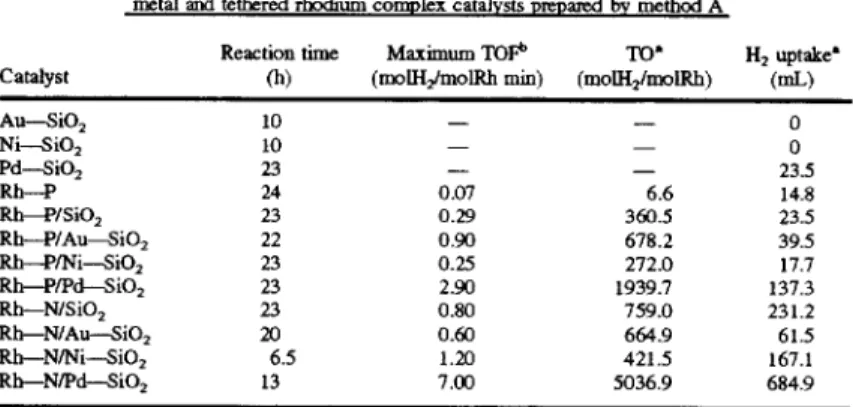
Table 2 gives the activity of the tethered rhodium catalysts
prepared by method A in the hydrogenation of toluene. As
the data illustrates in Table 2. the tethered rhodium carbonyl
amine complex catalysts are more active than the corre
sponding tethered rhodium carbonyl phosphine complex
catalysts. The activity of the catalysts consisting of a
rhodium complex tethered on a silica-supported metal cata lyst is much higher than those tethered on silica: the excep
tion to this statement is the Rh-N/Au-4i02 catalyst. which is less active than the silica tethered catalyst. Rh-N/
SiO2. The catalyst consisting of the rhodium amine complex tethered to silica-supported palladium. Rh—N/Pd—SiO2. is
a very active catalyst for the hydrogenation of toluene under
the mild conditions of 40° C. and 0.1 MPa. Its activity is up
to 7.0 molll2/molRh min.
TABLE 2
Hydrogenation of toluene catalyzed by various supported
metal and tethered rhodium complex catalysts mated by method A
Reaction time Maximum ‘1015*’ TO‘ H2 uptake‘
Catalyst (h) (rnolllzlmolRh min) (molH2/molRh) (mL)
All-S102 10 _ - 0
Ni--sro2 10 _ _ 0
Pd-SiOz 23 - _ 23.5
Rb——P 24 0.07 6.6 14.8
Rh—P/Si02 23 0.29 360.5 23.5
Rh—P/Au?9iO2 22 0.90 673.2 39.5
Rh-—P/Ni—SiO2 23 0.25 272.0 17.7
Rh—P/Pd—SiO2 23 2.90 1939.7 137.3
Rl1—N/Si02 2.3 0.80 759.0 231.2
Rh—N/Au-—Si02 20 0.60 664.9 61.5
Rh-N/Ni-SiO2 6.5 1.20 421.5 167.1
Rh-N/Pd-SiO2 13 7.00 5036.9 6849
‘Turnover and H2 uptake correspond to the reaction time. t"I‘OF de?ned as moles of H2 reacting per mole rhodium per min. Reaction conditions: catalyst, 50 mg; toluene, 5 mL; 40° C., 0.1 MPa.
are similar to those of the corresponding tethered rhodium
complex prepared by method B. However. the vCO of the rhodium carbonyl phosphine complex tethered on the silica
supported palladium catalyst prepared by method A are
di?'erent from that of the tethered rhodium co lex e
pared by method B. In the latter case. two kinds 0 rhodium complexes may be formed on the support; one is the
complex like l(EtO)3Si(CH2)3PPh |2Rh(CO)Cl; the other is
probably a complex like [(EtO)3S2i(CH2)3PPh2]Rh(CO) C.
These results suggest that in the catalysts consisting o a rhodium complex tethered to a silica-supported metal. the
interaction between the rhodium carbonyl complex and the
supported metal is not so strong as to be observed by its IR
vCO adsorption.
55
65
( 1) Effect of substrates and solvents on the rates of arene
hydrogenation
The activities (TOF and T0) of the catalysts. Rh—P/Pd— SiO2 and Rh—N/Pd—SiO2. for the hydrogenation of vari
ous substrates in different solvents are listed in Table 3. The
data in Table 3 show that the activities of both catalysts for the hydrogenation of benzene and toluene in benzene or
toluene are higher than those in ethanol. For the catalyst
Rh—P/Pd—SiO2. the activity for the hydrogenation of
benzene is higher than that for the hydrogenation of toluene.
but for the catalyst Rh—N/Pd—SiO2 it is just the opposite.
From the results shown in Table 3. it can be concluded that
5.789.333
nation of the substituted aromatic derivatives. Especially. the activity for the hydrogenation of anisole is about 2.5 times higher than that for the hydrogenation of benzene. This is contrary to the results obtained with other catalysts reported
in the literature. e.g.. see T. Okano. et al.. “Versatile 5
Polymer-Bound Rhodium Catalysts-Facile Hydrogenation
of Aromatic Compounds in the Liquid Phase”. Chemistry Letters, 603-606 (1982) and A. Corma. et al.. “Hydrogena
tion of Aromatics Under Mild Conditions on Transition
Metal Complexes in Zeolites. A Cooperative Effect of 10 Molecular Sieves.” Catal. Lett.. 32. 313 (1994).
TABLE 3
Effects of substrates and solvents on catalytic activig
16
(3) Effect of the preparation method on me activity of
catalysts
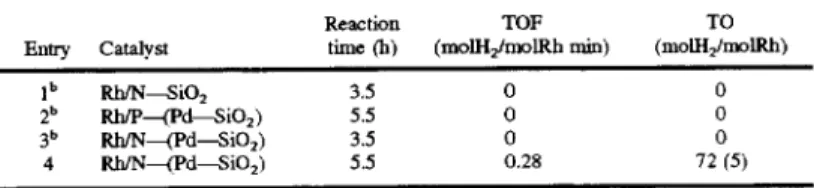
Table 5 gives results of the hydrogenation of toluene
catalyzed by tethered rhodium catalysts prepared by method
B. It was found that if after the reaction of the silica or
silica-supported palladium with the phosphine silane or amine silane. the resulting ligand-tethered silica further
reacted with chlorotrimethylsilane to convert the ——OH group on the silica surface to —OSi(CH3)3. and ?nally
reacted with lRh(CO)2Cl I2. the obtained catalysts are inac tive for the hydrogenation of toluene (see entries 1-3 in
Maximum Tor“ T0‘
Catalyst Substrate Solvent (moll-l2/molRh min] (moll-lzlmolllh)
Rh—P/Pd—SiQ2 "benzene benzene 2.9 2356 (24) l’toluene toluene 2.1 1697 (24) cbenzene ethanol 1.2 918 (24)
Rh—-N/Pd~-Si02 “benzene benzene 7.0 2010 (8)
btoluene toluene 7.0 3283 (8) "benzene ethanol 3.0 749 (6.5) ctoluene. ethanol 3.3 1214 (7) cnaphthalene ethanol 4.7 1413 (9) canisole ethanol 76 2169 t 6.5)
'l'tnmver corresponds to the reaction time in parentheses (in 11).
“Reaction conditions: catalyst, 50 mg; substrate + solvent, 5 mL; 40° C., 0.1 MPa.
cReaction conditions: catalyst. 50 mg: substrate, 4 mmol'. solvent, 5 mL ethanol; 40° C., 0.1 MPa.
‘*I‘OF de?ned as moles of 1-12 reacting per mole rhodium per min
(2) E?ect of palladium content on the catalytic activity of
Rh—P/Pd—SiO2
Table 4 gives the activity of two Rh—l='/Pd—SiO2 cata- 35 lysts with different palladium contents in the hydrogenation
of benzene. It is obvious that the catalyst with more palla dium is more active. This indicates that the palladium
content affects the activity of the catalyst.
TABLE 4
EEect of @adium content on the activity of Rh—PIPd---Si02
Maximum TOP’ TO‘
Pd content (wt %) (mollizlmolRh min) (moll-lzlmolkh) 45
0 0.1) 188 (24)
5 0.32 346 (24)
10 2.90 2356 (24)
‘Turnover corresponds to the reaction time in parentheses (in h) 50 "TOP defined as moles of 1-12 reacting per mole rlndium per min.
Reaction conditions: catalyst, 50 mg; benzene, 5 tnL; 40° C.. 0.1 MPa.
Table 5). However. if the ligand-tethered silica does not further react with chlorotrimethylsilane. and directly reacts
with |Rh(CO)2Cl]2. the resulting tethered rhodium catalyst
is active for the hydrogenation of toluene (see entry 4 in Table 5). Yet the activity of the catalyst prepared by this way is much lower than that of the catalyst prepared by method
A. At this time. the reason for this phenomenon is not known.
TABLE 5
Catalnic activig of the tethered rhodium catalysts mpared by method B‘
Reaction TOF T0
Entry Catalyst time (h) (moll-lzlmolRh min) (molllzlmolkh)
1" Rh/N—Si02 3.5 0 o
2" Rh/P—(Pd—Si01) 5.5 0 0 3" Rh/N—(Pd—SiO2) 3.5 0 O 4 RhlN—(Pd—SiO2) 5.5 0.28 72 (5)
‘Reaction conditions are the same as those in Table 2.
(4) Effect over time on catalytic activity of catalysts left exposed to air
It is very interesting that when the catalysts. Rh——N/Pd— S102 and Rh—N/SiO2. stand in air for some days. the activity of both catalysts for the hydrogenation of toluene increases (Table 6). An IR analysis of these two catalysts
shows that after the catalysts stand in air for more than one
week. Rh—N/Si02 no longer has vCO adsorptions. but for Rh—N/Pd—SiO2 the two carbonyl bands still appear at
about 2075 and 2000 cm‘‘. even standing for a longer time. In addition. as shown in FIG. 1. although after standing in
air for two weeks. the activity of the catalyst Rh—N/Si02 (B
in FIG. I) initially increases to a maximum of about 5.3 TOF at about 40 minutes. and then gradually decreases over time. but still remains higher several hours later than the level of
fresh catalyst (Rh—N/SiO2) shown as C in FIG. 1. (The
fresh catalyst maintains a nearly constant TOF level of about
0.8 over the 4.5 hours period)
As shown in FIG. 2. the stability of Rh—N/Pd—SiO2 (B
in FIG. 2). does not change remarkably even after standing
in air for three weeks as the TOF remains about 12.0 as
compared to fresh Rh—Nl'Pd?SiO2 (C in FIG. 2) which
remains around 6.5 TOF.
It is also observed that the catalytic activity of Rh-P/ Pd—SiO2 for the hydrogenation of toluene increases upon
exposure to air. It is evident that some changes are occurring
in these catalysts in air. This could involve migration of the rhodium complex from its connecting group (N or P) on the tether to the surface of the silica. Migrations of this type might be reduced or prevented by using bidentate or other polydentate connecting groups. An example of a bidentate group that should be useful for this purpose is (EtO)3Si
(CH2)3PPhCH2CH2PPh2.
TABLE 6
Hydrogenation activities‘ of Rh—N/Si02 and Rh—N/Pd—-Si02
after standg' g in air
Standing
time in Maximum TOF" T0‘
Catalyst air (days) (molH2/molRh min) (mollizlmolkh)
Rh—N/Si02 2 0.8 145 (5)
10 40 706(5)
14 5.3 771 (5) R.h——N/Pd—SiO2 2 7.0 1963 (5) 12 9.0 2641 (5) 20 13.7 3670 (5)
‘Reaction conditions are the same as those in Table 2.
l"TOF de?ned as moles of H2 reacting per mole rhodium per min.
°I1trnover corresponds to the reaction time in parentheses (in h).
In conclusion. the catalysts consisting of rhodium com
plexes tethered to silica-supported metals are very active for 20
25
45
18
the hydrogenation of arenes under the mild conditions of 40° C. and 0.1 MPa.
EXAMPLE 2
Catalyst: Rh(COD)(N~N)/Pd—SiO2
Catalytic reaction: hydrogenation of toluene to methyl‘
cyclohexane
A=Pd?$iO2 (silica supported palladium catalyst)
These components refer to those listed in the “Summary of the Invention” above.
1) Preparation of the catalysts
The silica-supported palladium catalyst (Pd—SiO2) was
prepared as described in Example 1. section 1. subsection
(2).
A mixture of [Rh(COD)Cll2 (0.090 g. 0.25 mmol) and
(CZH5O)3Si(CH2)3NHCH2CH2NH2 (0.12 mL. 0.50 mmol)
in 10 mL CHzCl2 was stirred at room temperature for 1 hr
to obtain a CI-I2C12 solution of RhCl(C()D)(N~N). The
resulting solution was added to a ?ask containing 1.0 g Pd---Si02 under vacuum The mixture was re?uxed for 4 hrs. After ?llration. the solid was washed with CII2Cl2 (2X15 mL) and dried in vacuum at room temperature. ‘The
rhodium content of the Rh(COD)(N~N)/Pd?'§iO2 catalyst
was 2.95 wt %.
The rhodium complex catalyst tethered on SiO2. RhCl
(COD)[HQNCH2CH2NH(CH2)3Si(OC2H5)3/SiO2. (Rh
(COD)(N~N)/Si02). was prepared by the same method that was used for the preparation of Rh(COD)(N~N)/Pd—SiO2 by using SiO2 instead of Pd—SiO2. The rhodium content of
this catalyst was 3.4 wt %.
(2) Hydrogenation of toluene
These reactions are performed as described in Section 2 of
Example 1.
(3) Results
The activities of the catalysts are shown in Table 7.
TABLE 7
Hydrogenation of toluene to methylcyclohexane
Maximum TOF’ T0" H2 uptakeb Run Catalyst (moll-I2lmolRh min) (molI-IJmolRh) (mL)
1 l='d—Si02 — — 23.5 (23)
(50 mg)
2 R11(COD)(N~N)C1 0.06 23 (13.5) 10 (13.5)
(20 umol)
3 Rh(COD)(N~N)/Si()2 0.06 70 (24) 26 (24)
(50 mg, 16.5 umole Rh)
4 Rh(COD)(N~N)/Pd—SiO2 1.70 921 (11) 295 (11)
(50 mg, 14.3 pmol Rh)
‘TOF de?ned as moles of H2 reacting per mole rhodium per min.
5.789.333
19
(4) Discussion
From the data in Table 7. it can be seen that the activity
of the combined catalyst Rh(COD)(N~N)/Pd—SiO2 (Run 4)
is much higher than that of the homogeneous rhodium
complex catalyst Rh(COD)(N~N)Cl (Run 2) and the het erogeneous supported palladium metal catalyst (Run 1). It is
also much higher than that of the normal rhodium complex
catalyst tethered on silica. Rh (COD)(N~N)/Si02 (Run 3). The combined catalyst. Rh(COD)(N~N)/Pd—SiO2 was
20
The data in Table 8 show that this catalyst is active for
several cycles of the hydrogenation of toluene. The activity
decrease in the 4th and 5th cycles may result from the fact
that the catalyst particles fracture over long stirring periods
with a stirring bar. This could be avoided by using another
stirring method.
EXAMPLE 4
characterized by Di?use Re?ectance Infrared Fourier Trans- 10 _ .
form Spectroscopy (DRIFI‘S) using CO as a probe. before Catalyst Rh_CNR3/Pd*sl02
and after hydrogenation. The catalyst was stirred in toluene Catalytic reaction: Hydrogenation of toluene
under a CO atmosphere at room temperature overnight both __ . _ _ .
before and after the hydrogenation. The DRIFT spectra of
11311715102’ B_C_RhcuCN(CH2)3S1(OC2H5)3I3
both of the resultant samples showed two v(CO) bands at 15 ( 3)
2093 and 2030 cm“. which are about the same as those of B__C/A; RhcllCN(CH2)3Si(OC2Hs)3|3/Pd___.SjO2 (Rh_
Rh(CO)2(N~N)Cl and of the products obtained from the CNR3/pd4iQ2)
reaction of CO with Rh(COD)(N~N)Cl and Rh(COD) _ _ “
(N~N)/SiO2. This result indicates that after hydrogenation. These compogws refer to those llstcd "1 "16 Summary
the rhodium of the combined catalyst. Rh(COD)(N~N)/ 20 of the Inv?mon above‘
Pd—SiO2. is still attached to the tether. This point is further (1) preparation of the catalyses
demonstrated by the observation that the catalyst may be _ Pd Sio — 2 was prepared in the same way as that stated 1n - -
:e;.l1;:5c.at;d1y f‘; gthgclgydmgcnauon of tolugne as
Example 1. section 1. subsection (2). To a 10 mL toluene
5 1 "1 "amp ‘ W‘ 25 solution of inmcomcu2 (0.045 g. 0.090 mmol) was added
EXAMPLE 3 dropwise 0.13 mL (0.54 mmol) of CN(CH2)3Si(OC2H5)3.
The mixture was stirred at room temperature for 30 min to
The catalyst Rh(COD)(N—N)/Pd—SiO-2 in Example 2 give a toluene solution of RhCl[CN(CI-I2)3Si(OC2H5)3l3 was used repeatedly for the hydrogenation of toluene. The (IR: v(NC) 2157(5). 2119(m) cm'l). This solution was
procedure was as follows: After ?ltration. the used catalyst 30 added to a ?ask containing 1.0 g Pd-SiO2 under vacuum.
was washed with toluene two times and dried in vacuum at The mixture was re?uxed for 4 h. After ?ltration. the solid
room temperature. The resulting catalyst was reused for the was washed with toluene (5X10 mL) and then dried in
hydrogenation of toluene in the same way and under the vacuum at room temperature. The catalyst. RhCll CN(CH2)3 same conditions as those mentioned in Example 2. The Si(OC2H5)3]$/Pd-—SiO2 (Rh—CNR3/Pd—SiO2). contains
results are shown in Table 8. 35 1.35 wt % Rh and exhibits v(NC) bands in the DRIFT
spectrum at 2176(s). 2124(w) cm“.
TABLE 8 The rhodium isocyanide complex catalyst tethered on
. . ~ . SiO2. RhCllCN(CH2)3Si(OC2H5)3/SiO2 (Rh—CNR3/
(1L3
hi1”, sidkgggneq??i?ggx??e
SiO2). was prepared in the same way as that for the
40 preparation of Rh—CNR3/Pd—SiO2. except SiO2 was used
Reaction Maximmn TOF_‘ TO" instead of Pd—SiO2. The rhodium content of the catalyst
cycle (moms/1mm mm) (MHz/"10mm was 1.0 wt %. DRIFT: v(NC) 2176(s). 2124(w) cm“.
1st 1.7 921 (11) (2) Catalytic reaction
in“?
1:
The catalytic hydrogenation reactions were carried out in
4th 3;; 1468 (11) 45 the same way and under the same conditions as those stated 5m 2.1 938 (11) in Example 1.
‘TOP de?ned as moles of H2 reacting per mole rhodium per min. (3) Rasults
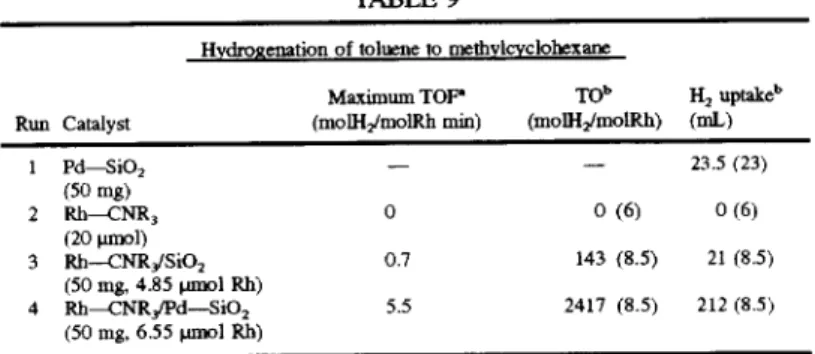
"rm-never corresponds to the reaction time in parentheses (in h). The activities of the catalysts for the hydrogenation of toluene are listed in Table 9.
TABLE 9
Hydrogenation of toluene to methylgclohexane
Maximum TOP‘ TO" H2 uptakeb
Run Catalyst (moll-lzlmolkh min) (molH2/molRh) (mL)
1 1=d_sio2 — - 23.5 (23)
(50 mg)
2 Rh-CNR; 0 0 (6) 0(6)
(20 umol)
3 Rh-—-CNR,/Si02 0.7 143 (8.5) 21 (8.5)
(50 mg, 4.85 pmol Rh)
4 Rl1—CNR3IPd—SiO2 5.5 2417 (8.5) 212 (2.5)
(50 mg. 6.55 tum] Rh)
‘TOF de?ned as moles of H2 reacting per mole rhodium per min.
21
(4) Discussion
The data in Table 9 show that the combined
homogeneous-heterogeneous catalyst Rh--CNR3lPd—
SiOZ. is not only much more active (Run 4) than either the
homogeneous catalyst Rh—CNR3 (Run 2) or the heteroge
neous catalyst Pd—SiO2 (Run 1) alone. but also much more
22
arenes other than toluene. The reaction rate is greater for
arenes with electron donor substituents than for arenes with
electron withdrawing substituents.
TABLE 11
Hydrogenation of arenes with Rh—CNR3/Pd——SiO2 catalyst
Maximum TOP‘ To‘1
Run Substrate (molHzlmolkh min) (rnoll-lzlmolkh) Product
1 Methyl benzoate 1.7 830 (12) methyl
cyclohexanecarbonxylate
2 Toluene 5.6 1122 (9) methylcyclohexane
3 Naphthalene 4.7 2171 (9) tetrahydronaphthalene (88%)
decahydronaphthalene (12%)
4 Anisole 6.6 $08 (9) methyl cyclohexyl ether
‘TOF de?ned as moles of H2 reacting per mole Rh per min. l‘Turnover corresponds to the reaction time in parentheses (in h).
Reaction conditions: catalyst 25 mg. substrate 5 mmol. solvent 5 rnL heptane. 40° C., 1 atm.
active than the rhodium complex catalyst tethered on SiO2 (Run 3). After a hydrogenation reaction. the DRIFT spec
trum of the catalyst Rh—-1CNR3/Pd—-SiO2 shows the same
two v(NC) bands at 2176(8). 2124(w) cm-1 as the original
catalyst. No infrared absorptions for —NH2 and free —NC
groups were observed in the spectra of the used catalyst or the reaction solution. This result indicates that the rhodium is still coordinated to the tether. which is attached to the
surface of the Pd—-SiO2 heterogeneous catalyst.
EXAMPLE 5
The Rh—CNR3,/Pd—SiO2 catalyst described in Example
4 was used repeatedly for the hydrogenation of toluene. After ?ltration. the used catalyst was washed with toluene
two times and dried in vacuum at room temperature. The
resulting catalyst was reused for the hydrogenation of tolu
ene in the same way and under the same conditions as those
given in Example 4. The results are shown in Table 10.
TABLE 10
Durability of Rh—CNR3/Pd—SiO2 catalyst during repeated
hydrogenation reactions of toluene
Reaction Maximum TOP“ TO"
cycle (moll-lzlmolkh min) (moll-lzlmolRh)
1st 5.5 6915 (24.5) kid 4.6 5713 (24.5). 6949 (31) 3rd 4.0 6770 (24.5), 7159 (27)
‘TOP de?ned as moles of H2 reacting per mole rhodium per min.
tTurnover corresponds to the reaction time in parentheses (in h).
The data in Table 10 show that this catalyst is active for at least three cycles in the hydrogenation of toluene. DRIFT spectral analysis of the catalyst used for three cycles shows
that neither —NH2 nor free —NC groups are present. EXAMPLE 6
The Rh——CNR3/Pd?§iO2 catalyst was also used for the
hydrogenation of arenes other than toluene. The procedure
and the reaction conditions are the same as those in Example
4. The results are given in Table 11.
From Table 11 it can be seen that the Rh—-CNR3/Pd—
SiO2 catalyst is also very active for the hydrogenation of
30
35
45
55
65
EXAMPLE 7
Catalytic reaction: Hydrogenation of toluene
These components refer to those listed in the “Summary
of the Invention" above.
(1) Preparation of the catalysts
Pd-SiO2 was prepared in the same way as described in Example 1. section 1. subsection (2). To a 10 rnL toluene
solution of lRh(CO)2Cll2 (0.035 g. 0.090 mmol) was added 0.80 mL (0.36 mmol) of