5-1-2007
Interactions between physical and virtual space
Carolyn Hsu
Follow this and additional works at:
http://scholarworks.rit.edu/theses
This Thesis is brought to you for free and open access by the Thesis/Dissertation Collections at RIT Scholar Works. It has been accepted for inclusion in Theses by an authorized administrator of RIT Scholar Works. For more information, please [email protected].
Recommended Citation
A thesis submitted to the Faculty of The College of Imaging Arts and Sciences in candidacy for the degree of
Master of Fine Arts
Rochester Institute of Technology College of Imaging Arts and Sciences School of Design
Graduate Graphic Design MFA Program
special thanks
Deborah Beardslee, Alex Bitterman, and Stephen Jacobs for their guidance and support
Synthesis
Ideation
Intermediate Evaluation
Implementation
Dissemination
Retrospective Evaluation
Conclusion
Glossary
Bibliography
Appendices
29
53
82
101
116
119
121
123
126
Introduction
Board games and video games unfold information to their players in new environments – environments with which players may have no direct relationship with such as historical and futuristic settings, or environments that are fabricated from fairy tales and imagination. The choices involved in the development of such environments are essential to the successful transfer of information between game and players, as well as from player to player. How do players travel through these constructed environments? How do these constructed environments reveal information and encourage comprehension throughout the game? Strategies related to navigation and visual coding are keys to providing an entrance, a passage, and an exit to any environment, real or abstract.
Through principles related to information design and systems design, graphic design plays a large role in the wayfinding needs prompted by various types of abstract environments, from actual three-dimensional exhibitions, to destinations in cyberspace, to written textual experiences. Relevant to environments found in board games and video games, graphic design visually translates characteristics of game play including story, structure, and atmosphere.
objective
Taking an in-depth look into how graphic design is used to successfully open doors to and encourage the journey through conceptual environments can provide an enhanced understanding of visual communication and visual perception in virtual spaces. This may lead to the creation of improved strategies for navigating through virtual environments, helping to create a system that will more closely reflect wayfinding and navigation in the physical world.
selected Key Questions
These key questions are detailed on pages 15-28.
How does graphic design help lead a player into, through, and out of an abstract environment?
How does systems design help players go through a game that transitions between more than one environment?
How are space, time, and movement generated through positioning and placement of imagery and typography?
What role does information design play in the depiction of virtual territory, zones, and regions?
How does graphic design assist in generating interaction in a game; how does it facilitate and sustain interaction?
How have board games influenced video games? How have video games influenced board games?
What types of cultural / societal symbols can be included in the design solution in order to maintain a commitment to what society already knows,
while introducing them to new environments?
associated areas of study
Motion Studies / Storyboarding Film Studies / Art Direction Theater Studies / Set Design
Urban Planning Exhibition Design Cyberspace / Cyberculture
Usability Studies Interface Design
1
2
3
4
5
6
project relevance and Importance
Just as the history of games has evolved from tangible game environments such as board games, to intangible game environments such as video games, the real world has also been constructing a crossover from real space to digital space through the Internet. Converting real businesses to online storefronts or turning archives of printed articles into online databases are two examples. Through research and analysis of how graphic design contributes to the conceptual environments in board games and video games, a further understanding of using visual means to create and navigate through new environments will be achieved. This knowledge will be useful in the transfer of environmental components from real space to digital space, as society further reinterprets the real world into new environments for digital use.
The crossover from board games to video games draws intriguing comparisons to the crossover that society is currently experiencing from the physical environment to the virtual environment. The ever-increasing awareness of the virtual environment is causing more of what once only existed in the physical environment to become re-established for use in virtual space. As society furthers this crossover, many aspects of the physical environment may become lost in the transfer from real to virtual. Because of this, it has become relevant for designers to design towards reconnecting the physical and virtual rather than designing only for one or the other. With this study of board and video games and their cross influences, graphic designers can be encouraged to seek out moments in which the physical and the virtual cross paths and create designs that serve to bridge the two rather
history of board Games
history of video Games
analysis of Graphic design
visual perception
Information design
systems design
color systems spatial systems conceptual systems navigational MapsWayfinding devices implemented on a board / video game environment that aid players through a game
Games
auxiliary elements
Information given to players through auxiliary elements in addition to the game board / environment that heavily influence the environment portrayed, for example: cards (board), overlaying interface (video)
color coding
Continuity and navigation
concept
How concepts are integrated and how they aid in making a believable environment time and space
How time is recalled by players; how spatial systems affect motion
Mapping
diagrams
contextual considerations and Influences
cultural / societal
Influences
description and definition of Theories
Examples and analysis in board game design
Examples and analysis in video game design
Examples and analysis in board game design
Examples and analysis in video game design
explanatory diagram
cross
Influences
Historical influences
Time line of different types of video games
Specific issues, elements, and techniques of video game design
Integration of Graphic design into Game environment: How elements of graphic design, paired up with systems design decisions, help or hinder immersion of players into a game environment
wayfinding
continuity
General psychology
color psychology
timing / visual rhythm
analysis of video Games General history
analysis of board Games General history
analysis of Graphic design
elements in board Game design analysis of Graphic design elements in video Game design
structure culture stereotypes real environment Characteristics abstract environment Characteristics cross Influence between real and abstract Historical influences
Time line of different types of board games
Game Design as Narrative Architecture
by Harry Jenkins“The most compelling amusement park attractions build upon stories or genre traditions already well-known to visitors, allowing them to enter physically into spaces they have visited many times before in their fantasies. These attractions may either remediate a preexisting story (Back to the Future) or draw upon a broadly shared genre tradition (Disney’s Haunted Mansion). Such works do not so much tell self-contained stories as draw upon previously existing narrative competencies. They can paint their worlds in fairly
broad outlines and count on the visitor / player to do the rest. Something
similar might be said of many games. American McGee’s Alice is an original
interpretation of Lewis Carroll’s Alice in Wonderland... McGee rewrites Alice’s story in large part by redesigning Alice’s spaces.” Harry Jenkins
Jenkins analyzes how new environments are created in video games by recreating already familiar spaces. His piece focuses on explaining the difference between interactive and narrative structure in games, how most games rely on narrative to create connections between player and game environment, and how those connections lead the player through the game.
Related to this thesis study, Jenkins’s essay deals with studying environments created out of preexisting conventions and notions that the general public is already aware of. This ties in with seeing how new conceptual environments are made by incorporating aspects of real life in order to maintain
comprehension through a common knowledge among players. This piece also speaks of how games create new experiences through “[their] creative manipulation of environmental details (Jenkins).” Although it mainly focuses on how narratives play a role in video games, it goes into detail as to how narratives are interpreted through visuals, interactive graphics, and the sequencing of visuals with respect to filmic strategies.
screenshots from American McGee’s Alice
Fictional Worlds, Virtual Experiences
Exhibition at the Cantor Center for Visual Arts“The exhibit is derived from research conducted in a Stanford Humanities Laboratory project by Lowood and other scholars, which proposes that computer games and simulations are the emerging narrative form and communication medium of the early 21st century. Housed in two small galleries and along one side of the mezzanine above the Cantor Center’s main lobby, the exhibit includes a digital time line and documentary videos of gameplay that illustrate how storytelling elements like plot, character development and game settings have evolved in computer games.”
Barbara Palmer
Fictional Worlds, Virtual Experiences was an exhibition on how video games create narratives through visual experiences. The exhibition included artifacts that displayed the history of video games, samples of video games for audience members to play, as well as a collection of work from Jon Haddock who has created games that reproduce real-life stories such as the Columbine shooting and “Tank Man,” the anonymous person who went up against tanks during the Tiananmen Square protests of 1989. This exhibit strived to portray the growing reliance on video games as a new narrative medium for the next generation.
The exhibit is relevant to this thesis because it deals with the study of how environments are created in games and how the narratives in these games are told through a successful recreation of its intended environment. The examples at the exhibit such as the games of Jon Haddock, which
reinterpret real-life incidents and environments, relate directly to studying the extent of bringing reality into a game in order to mirror a specific environment. In this case, a real-life environment is being portrayed through another medium; it shows a visual translation of an environment that society knows of and has imagined, but has never been able to experience in time and space. Furthermore, these examples show how time and space are translated into a visual world in order to place the player directly into the environment.
It is interesting to note that such real-life scenarios, which have been ingrained into society’s cultural knowledge, must be reproduced in the manner of how society originally viewed the event. Visual elements such as angles and perspectives of well-known images documenting a historical event such as the Tiananmen Square protests, are necessary to imitate in order to bring immediacy to the player and to prompt cultural memory.
Jon haddock’s interpretation of eric harris and dylan Klebold at the columbine high school cafeteria
Cantor Arts Center, 2004
Jon haddock’s interpretation of “tank Man” Cantor Arts Center, 2004
The Tourist City
Edited by Dennis Judd and Susan Fainstein
“A city that tries to build an economy based on tourism must project itself as ‘a dreamscape of visual consumption.’ People expect to experience heritage,
architecture, and culture that make up a city’s essence. A construction of any version of a city’s heritage requires large doses of ‘mythology, folk memory, and popular fantasy.’ In resort cities like Cancun or Las Vegas, which lack a marketable historic past, a tourism infrastructure is constructed out of whole cloth. In those cities, themed environments have emerged that owe more to Disneyland and Disney World than to urban history or culture.”
Dennis Judd and Susan Fainstein
This book contains case studies on the urban development and planning of tourist cities such as Las Vegas and Orlando (Disney World). It approaches in detail the reasons behind decisions made in developing tourist cities, and it explores the pros and cons of tourist city developments.
Case studies on tourist cities, in particular the themed environments of
casinos in Las Vegas, NV, and the themed environment of Disney World
residing in Orlando, FL, are relevant to this study because they depict fantasy and desire and place them into the physical environment. Places like the ones mentioned above deal with immersing imaginary environments into real life and having them interact with real surroundings and people. It is of interest to further study how the construction of the tourist city blends into its surroundings and engages its visitors. This pertains to how players are immersed into a board or video game through the design of the game’s environment.
Inside luxor hotel in las vegas, nevada: an imaginary new york-themed city The Tourist City
Science City
Designed by Chermayeff & Geismar Inc.
“Revealing the technology and systems that make cities work, Science City
is a collection of durable outdoor interactive displays. Telescopes help passersby locate distant antennae as well as experience live radio and television transmissions. Periscopes show the depths of water mains, subway tunnels and electrical conduit.”
Wayne Hunt, Urban Entertainment Graphics
This is a project that was to be installed in a higher pedestrian traffic area of New York City. It turns a portion of the city into an exhibition by making props and installations out of existing city buildings and sidewalks within its true environment.
Science City relates to this thesis study because it is a prime example of recreating a real environment, and transforming it into a new one. Wayne Hunt states that “components are bold, brightly colored forms but have an industrial or ‘real city’ look.” This project exemplifies the relationship between real-life environments and abstract environments. Although it is trying to create an imaginary “museum” out of the real-life city, it also wants its components to blend in with its surroundings to create a believable environment, one that is different yet recognizable by the typical passerby. This project is a physical example of combining two familiar environments,
the city and the museum, to create a new environment, the Science City.
drawings for the plans of Science City
Chermayeff & Geismar Inc.
example of exhibit implemented on sidewalk pay phone
Chermayeff & Geismar Inc.
research Goals
In addition to studies involving graphic design and the design of game environments, this thesis will involve a broad range of topics including, but not limited to:
Visual Perception and Psychology Urban Planning
Set Design in Film
Private and Public Space Design
Comics, Storyboarding and 2D Motion Studies
Visual perception and psychology were studied in order to gain a firmer grasp of how to use two-dimensional elements for clear communication.
Urban planning was researched to study urban issues and their impact on the physical environment.
Set design in film offers another angle from which to think about environments. For example, whereas urban planning reveals the design of real environments (physical), set design in film shows the design of fictional environments (virtual).
An examination of private and public space design provided a closer look at private and public information within designed environments such as board and video games.
Comics and storyboarding introduce two-dimensional sequencing and timing into this research. Similar to visual perception and psychology, comics and storyboarding provide a specific study of the connection between
narratives and visuals.
The additional subjects above provide the details needed to make connections between the design of real and fictional worlds. These connections will help in identifying the visual reasons behind successful fictional environments.
visual perception and psychology
“Subjects observing differently scaled environments undergo systematic shifts in the experience of time. The experience of temporal duration is compressed relative to the clock, in the same proportion as scale-model environments being observed are compressed relative to the full-sized environment.”
Alton DeLong, “Phenomenological Space-Time”
The anthology Directions in Person-Environment Research and Practice deals
with how people interact with environments. Many articles collected in this anthology deal with human cognition within an environment and the aesthetics of an individual’s surroundings. This anthology includes the article “Phenomenological Space-Time: Towards an Experiential Relativity,” written by Alton DeLong. DeLong believes that “spatial scale may be a principal mediator in the experience of time.” In his article, he researches this theory and speaks of how changes in scale lead to changes in perceived duration of time, leading some of his subjects to believe that time had passed proportionally slower or faster when passing time through a scale-model environment compared to the passing of time in true environments.
Pertaining to studies related to this thesis, psychological theories such as the aforementioned play a large role in the psychology and visual perception of the participants of a game. As DeLong was proposing, the transfer of information from real-life proportions to another scale, affect not only what viewers perceive, but also the passage of time. This theory can help bring clarity to scale shifts of the graphic design in games and can aid in movement portrayed through shifts in the passing of time. The conversion of real environments into the scale of a game environment, as suggested by this essay, may occur in a proportional and measurable way. This can affect how large or small of a scale shift should occur in any given game. If a game desires specific feelings of speed or motion, the research behind this theory may bring light to how that can be done through visual means.
urban development and the needs of society
“...it’s not about the world of design, it’s about the design of the world.”
Bruce Mau, Massive Change
A part of urban planning deals with answering to the needs of society through environmental development, whether it be the planning of transportation
means or the development of wayfinding devices. Massive Change is a
collection of interviews with a wide range of designers, from designers of urban developments to designers of technology. These interviews reveal the effects designers have on shaping the world as they continue to design for the needs of society.
These interviews are resources because they deal with the construction of the world with respect to the needs of users, or in the case of the construction of a game, the needs of the player. Seeing how urban development and planning respond to societal needs helps bring a clearer understanding of how to answer to the needs of a game’s players.
Massive Change includes an interview with Jaime Lerner, an urban planner for Curitiba, Brazil. Lerner speaks of how the needs of society aided him in the design of Curitiba’s mass transit system. Curitiba is considered one of the best examples of urban planning to date.
Another interview in Massive Change is with Dean Kamen, designer of the
Segway HT which provides transportation for distances that are too close
to drive and too far to walk. Kamen also speaks of how society’s needs have driven his designs.
Because the physical environment is what brings culture and memory to society, one must look to the construction of the existing real environment in order to build a brand new one. The development and planning that goes into designing a city should be studied in order to effectively construct any type of believable, engaging environment whether it is real or abstract.
Integrated mass transit system of curitiba, brazil
Jaime Lerner
segway ht, transportation for distances too close to drive and too far to walk
set design in Film
“...architecture sets the scene, conveying information about plot and character while contributing to the overall feel of a movie. In more discreet ways, filmmakers can use their cameras to make statements about the built – or unbuilt – environment, or use that environment to comment metaphorically on any of a variety of subjects...”
Mark Lamster, Architecture and Film
Designing a fictional environment, such as the set design or architecture within a film, can provide many insights into how constructed environments borrow from actual environments in order to bring immediacy to viewers. The book Architecture and Film is a collection of works from writers exploring set design and its connections to architecture. This book brings together articles and organizes them into three main sections: a section on the involvement of actual architects in set design, a section on the technical and cultural aspects that go into constructing these sets, and a section on the analysis of architecture in specific films.
In particular, the article by Joseph Rosa titled “Tearing Down the House: Modern Homes in the Movies,” gave an interesting look at how cultural references are built into the set of a film through architecture. Films often use architecture to create the environment they are attempting to portray. Architecture is often used as a symbol to signify a particular culture. For example, in the article mentioned above, Rosa observes that “the depiction of the traditional home became ever more entwined with notions of domestic bliss,” while on the other hand, “[t]he penthouse was typically reserved for the wealthy, older, well-educated, and unsentimental (Lamster 161).” The images to the left are two examples of architecture used in films. These two houses each characterize different lifestyles and cultures.
Set design in film is the construction of a fictional environment. Both set design and game design deal with immersing the viewer in a world that he is unable to physically enter.
house used on set design
Mr. Blandings Builds His Dream House
private and public space design
“The quality of the interface which connects man with his machines frequently determines the ability and the ultimate performance of the man-machine unit... The beginning of any man-machine interface is the objective knowledge of the full range of man’s size, shape, composition and mechanical capabilities.”
William Thorton, Human Dimension and Interior Space
The book titled Human Dimension and Interior Space, by Julius Panero and
Martin Zelnik, is divided into multiple sections that deal with the analysis and basic design standards involved in creating interior spaces specific to the measurements of the human body. Examples of specific spaces studied in this book are residential spaces, office spaces, mercantile spaces, eating and drinking spaces, leisure and recreational spaces, and public spaces. This resource provides a technical look at space construction in respect to the proportions and needs of the human body, and offers an intricate, detailed look at the personalization of a space.
Comics, Storyboarding and the 2
DMotion Studies
“Comic panels fracture both time and space, offering a jagged, staccato rhythm of unconnected moments. But closure allows us to connect these moments and mentally construct a continuous, unified reality.”
Scott McCloud, Understanding Comics
The book Understanding Comics by Scott McCloud explains why and how
elements within comics influence a story and contribute toward a believable narrative. McCloud describes visual elements used in comics that aid in the visual representation of motion and time. He explains visual techniques such as elongating frames to evoke the feeling of a longer amount of time. McCloud also speaks of how visual elements can create a rhythm to prompt motion.
By studying visual narratives, one is also able to see ways in which other mediums that function in two-dimensional formats portray time and motion. For instance, in board and video games, time and motion are most often suggested as opposed to being actually physically present. The way in which games suggest time and motion is similar to how panels of a storyboard or comic book suggest time and motion.
Key Questions
At the start of this thesis, selected key questions were posed in order to narrow down the number of varying directions the topic could take, and to provide for a focal point for exploration. Listed below, these key questions will be supported by choice examples that begin to answer each question.
As research continues, each question will be answered and organized in further detail. Here, for the purpose of introducing ideas surrounding these key questions, the examples brought up will not yet strive to take into consideration comparisons between genres and varying game platforms.
Please note that examples of games that offer customization options to the player’s game interface will only be analyzed according to their default settings – settings that all players have equal access to.
How does graphic design help lead a player into, through, and out of an abstract environment?
How does systems design help players go through a game that transitions between more than one environment?
How are space, time, and movement generated through positioning and placement of imagery and typography?
What role does information design play in the depiction of virtual territory, zones, and regions?
How does graphic design assist in generating interaction in a game; how does it facilitate and sustain interaction?
How have board games influenced video games? How have video games influenced board games?
What types of cultural / societal symbols can be included in the design solution in order to maintain a commitment to what society already knows, while introducing them to new environments?
1
2
3
4
5
6
Into, through, and out
How does graphic design help lead a player into, through, and out of an abstract environment?
This question focuses on how the integration of graphic design solutions can help ease a player into and out of the boundaries of a fictional environment.
Entering a Game
First Person Point of View
This example uses a first person point of view for the introduction of the game. Only at the beginning of a new game does the player experience a first person point of view, as shown in the top screenshot on the left. This method places the player into the back seat of a car, acting as a vehicle to transport
the player into the Animal Crossing community. Throughout the rest of the
game, the perspective stays as an aerial view of the environment, as seen in the left, bottom screenshot. The addition of the first person point of view as a device to provide the player with an entrance into the environment is a prime example of how the use of perspective can help lead a player into a game.
Establish Setting
At times, the title screen of a video game will be used to establish a setting by showing a sequence that pans across the environment the player is about to enter. The example on the left is the title screen for The Legend of Zelda Twilight Princess. The screen includes a moving background that shows the game environment to come. This example creates a preview to the game environment, similar to the introductions of certain films in which a shot that pans across an environment serves to familiarize the viewer with the surroundings before the story begins.
1
First person point of view at introduction
Third person point of view throughout course of game
panning backdrop behind title screen Animal Crossing Wild World Nintendo DS
Virtual Life, Role-Playing
Entering a Game (Continued)
Timer / Countdown
Another way a player is introduced to a new environment is by simply starting a timer or having a countdown mechanism. Once a timer is shown, the player is given a clear signal of when gameplay will begin. This helps transfer a player immediately into the arena of a game through the competitive and aggressive nature that measured time can produce in this context. The game on the left,
Tamsk, uses a series of hourglasses as game pieces. The beginning of the game is marked by turning over each game piece in order to establish the start time.
Through a Game
Maintaining First Person Perspective
Maintaining first person perspective of the player through a heads-up display
(HUD) interface keeps the player connected to his / her role as the main
character while traveling throughout a game. On the left is an example from
Gears of War, which preserves the first person perspective of the player’s character by displaying the interface in a way that places the player behind his / her equipment and gear.
Demarcating Start and End
Making the beginning and ending of a game clearly visible gives the player both start and end goals. In this example on the left, Metro color codes the start and end goals for each player; blue to blue for one player, and yellow to yellow for another. The color coded game pieces and game board help the player strategize a route through the game.
creating a beginning through time
establishing first person perspective Tamsk
Board Game Racing, Strategy
Gears of War Xbox 360 Shooter, Sci-Fi
Metro Board Game Racing, Puzzle
Conceptual System
Exiting a game has sometimes incorporated a conceptual system. Again, we take a look at Animal Crossing, seen here on the left. In order to exit out
of the Animal Crossing world and end the game, the player can go back to
his / her bed and go to sleep. At the start of a saved game the player’s character will awaken from their bedroom to once again place the character into the context of the game. This relates to the real world and how we exit our physical world through sleep, and enter it again by waking up.
Visual Boundaries
Another way of exiting a game can be seen in puzzle games such as
Lumines. Seen here on the left, there are clear boundaries to indicate where the gameplay occurs (within the grid area). As bricks stack up, they get closer and closer to the top edge of the grid or “game board.” Once these bricks hit the top line and exit the boundaries, gameplay has ended. Anytime the player is outside of the boundary they have “exited” the game.
exiting a world through sleep
creating visual boundaries for the player Animal Crossing Wild World Nintendo DS
Virtual Life, Role-Playing
Lumines I / II
transitions between environments
How does systems design help players go through a game that transitions between more than one environment?
This question looks into how a player travels in and out of environments within a single game.
Constant Variable
Maintaining certain constants through all varying environments within a game helps the player transition more easily between abstract spaces. The game on the left, Contact, involves travel between two worlds. Contact
maintains the design of the main character that the player plays (seen in bottom right corner of the top screen, and the middle of the bottom screen) as a constant variable for the player to connect to. Even when the player crosses over to the other world, shown to be different by varied line weights and style, the stylistic choices and design of the main character stay the same throughout.
Containment of Player
Containing the player in some sort of “vehicle” as he or she transports within the game environment can help transitions by never allowing the player to
visually or conceptually exit the environment. For example, in the Super
Mario Bros. series, if the player ever needs to be transported from one place to another, it is done by jumping into green pipes and “warping” to get from one place to another. The consistent use of green water pipes as a symbol of transport, helps keep the player within the game environment at all times.
2
using the main character as a constant variable throughout different environments
within one game
containing the player within the environment at all times
Contact Nintendo DS Role-Playing
space, time, and Movement
How are space, time, and movement generated through positioning and placement of imagery and typography?
The examples for this question focus on the visual generation of space, time and movement within a game. It does not focus on actual space, time or movement generated, but how visual elements are used to create the perception of these three items.
Space
Addition and Subtraction of Components
One way of transforming space can be as simple as adding or subtracting
from the actual game board. The game Zertz is played on a board that keeps
shrinking until the player has nowhere to go. The boundaries that this constantly changing game board graphically portrays with its modular game pieces, keeps the player aware of the spaces that are being generated and regenerated throughout gameplay. This game indicates space by creating a graphic textural difference between the game board and the surface that the game board rests on. The game also enhances the idea of space by constantly expanding and shrinking the game board.
Actions Prompted by Proximity
In the example to the left, World of Warcraft places text above objects, labeling them with information necessary to the player such as the object’s name and level in the game. This system of tagging objects is activated once a main character is within a specific distance from the object. It produces its own measurement of space for the environment that the player must adapt to. For instance, one might guess by looking at the scale relationship between the character and rabbit on the left, that the distance between them appears to be one inch; however because of the difference in scale and differences between virtual space versus physical space, the actual distance between the two remains unidentifiable by standard units of measurement. Instead, a conceptual measurement of space is created through graphic details such as text appearing above an object when the player reaches a specific proximity to the object.
3
adding and subtracting from a space
signaling proximity through the appearance of text above objects
Zertz Board game Strategy
World of Warcraft PC / Mac
Bully
Sony PlayStation 2
Virtual Life, Action Adventure
Animal Crossing Wild World Nintendo DS
Virtual Life, Role-Playing
Time
Creating Associations Through Distance
Monopoly is an example of how distance can affect perceptions of time. The game is set up so that the farther away a space or property is, the more value it has. This structure produces associations between time and value. In
Monopoly, items of higher cost are farthest away from the starting point. By combining an increase in value with an increase in distance, the game design creates its own measurement of time. This measurement of time adds to the overall environment of the game because it separates game time from real time.
Physical Time Devices
Here are two examples of video games that use the placement of a clock within the game in order to give the player a sense of time.
Bully, on the top, is not a game that is played in real time. In this game the clock is used as a time device in another way; it appears every time the character has a task to complete within a time limit. The clock not only lets the player know it is time to perform a task, but also provides the player with a time frame.
In Animal Crossing, the clock plays a different role. Animal Crossing is a game played in real time, and the clock icon for this game only appears when the player is at a standstill. It differs from the representation of time in Bully,
which is communicating time spent. In Bully the clock is there to represent
a countdown for when the player must complete his / her task. However, the
clock in Animal Crossing represents the forward movement of time. Passing
time is made evident by having a clock appear on the screen every time the player pauses or stops to think. The clock in Bully represents time spent while in Animal Crossing it represents time wasted.
Lumines I / II
Sony PlayStation Portable (PSP) Puzzle, Strategy
Movement
Consistent Intervals of Game Spaces
Many games produce their own measurement system by employing consistent intervals of space. This gives the player a constant to compare to – a block of space, versus two blocks of space, versus three blocks of space, and so on. An example of this is the game Sorry, pictured on the left. In order to create larger movements across the board the game groups together existing intervals of space, as opposed to bringing in a new size of space. This is represented by the colored bars that begin with a triangle and end with a circle. The sliding area gives players the ability to move over 5 spaces at once rather than going one-by-one. This produces varying speeds in the mind of the player: a “walking” speed when traveling from square to square, and a faster speed when sliding across more than one interval of space in one move.
Creating a Visual Rhythm and Tempo
The way movement is represented in Lumines is through a running timeline.
Timeline is the name that has been given to the yellow vertical line seen in the screenshot on the left. The running timeline is a vertical line that runs across the screen at varied speeds according to the pace of the music that is playing. This timeline creates a visual representation of tempo. As it moves across the entire visual field at varied speeds, it slows down and speeds up the player’s mentality. This is reflected in a player’s movements as the player slows down
and speeds up to the tempo of the timeline.
Maintaining a consistent interval of game space
Sorry Board game Territory, Racing
territory, Zones, and regions
What role does information design play in the depiction of virtual territory, zones, and regions?
This question deals with the way a game organizes its information and displays it to the player.
Color Coding
Color coding is a simple way to create boundaries between zones or regions. The examples to the left, Acquire (top) and Go (bottom), use color coding as ways for players to mark their territories. Each of these board games uses color coding to depict territorial ownership. Color coding in both examples provides each player with a map of the territories and regions belonging to them. This creates visual boundaries of the areas and zones belonging to each player. Both game boards, along with their respective game pieces, can be seen as an interactive map of a space or environment built by its players.
Use of Icons / Symbols
The use of icons or symbols can signify certain types of territories or zones. A flag can serve as a symbol for more marking or even conquering a territory. In all versions of Super Mario Bros., the flag symbol is used in order to denote the passing of a certain checkpoint or to mark the defeat of one world or territory. This approach acts as a marker for the player and separates the linear game environment into zones, separating areas that the player has already been to, apart from zones the player still has to conquer.
4
signifying checkpoints throughout the game with icons familiar to the player Acquire
Board game Territory, Strategy
Go Board game Territory, Strategy
Generating Interaction
How does graphic design assist in generating interaction in a game; how does it facilitate and sustain interaction?
This key question pertains to ways in which a game compels players to take action or lead them further into the game environment.
First Person Point of View
A game can affect interaction by creating a first person point of view for the player. First person point of view places players in the shoes of the actual characters being portrayed in the game. This builds a game where direct communication between players is necessary, thus generating interactivity.
In the board game Ca$h n’ Gun$, pieces of the game become accessories that
create characters out of the players themselves. Simplified visual props, such as the silhouette of a gun, prompt the player to undertake a specific role among other players of the game.
Player-Generated Environments
Another way to generate interaction is by creating a game environment that is built by the players themselves. On the left is the card game Order of the Stick. The environment for this game is generated entirely by the cards each player chooses to contribute to the environment and its narrative. A player-generated environment produces a game with an unlimited number of possibilities. Players must work together to keep the game going, while also competing against each other to win the game. Interaction is driven by the fact that the game’s narrative and environment are both dependent on decisions made by the players.
Interactive Instruction
Many video games include a diagram of the player’s control pad in the user interface. This shows the player which buttons perform what tasks. The tasks of each button often change as the character runs into different situations. By placing this instructional diagram on the screen, it makes it easier for the player to interact with each situation he or she may encounter. The example to the left, The Legend of Zelda Twilight Princess, displays its player controls at the upper right corner of the screen.
5
environment customized through player interaction
Ca$h n’ Gun$ Board game Role-Playing
Order of the Stick Card Game Role-Playing
directly speaking to the players through role-playing
The Legend of Zelda Twilight Princess Nintendo GameCube, Nintendo Wii Fantasy, Action Adventure, Role-Playing
Influences and cross Influences
How have board games influenced video games? How have video games influenced board games?
This question focuses on further understanding the ties between board games and video games and how one category has influenced the other in space, movement, and interactivity.
Influence of Board Games on Video Games
Contained Environment
Many of the earlier video games were contained within one image of an environment, just as board games often are. For example, early versions of
video games such as LCD games (left) feature one stagnant environment in
the background. All movements in LCD games were movements made by the
character or player, across a still image. Board games are similar: the still image served as the environment for the game while the character or player moved
across the board or “image.” LCD games are an early predecessor of the
three-dimensionality that video games are capable of today. The example to the left shows the background as a virtual perception of three-dimensionality through its use of perspective.
Linear Movement
Early forms of video games also mirrored the linear movement common
in board games. An example of this is Super Mario Bros., where the player
always moves from left to right across the screen. Board games often include prescribed linear movements across environments that are interjected by various options and obstacles. This can also be said for early 2D platformer
video games such as Super Mario Bros., which also move in a linear fashion
with obstacles along the way. One difference, however, is that winning in an earlier board game that used linear movement was most often influenced by chance, whereas the linear movement across early video game environments was often affected by skill and choices made by the player. For example, in The Game of Life (page 36), the player has little control over who will win the game as the movements across the board are determined by spinning a wheel to generate a random number that tells the player how many spaces he
may move. In comparison, the video game Super Mario Bros. (left) relies on
the skill of the player to navigate successfully across the screen.
6
linear movement across an environment LCD Game Format
Influence of Video Games on Board Games
Nonlinear Narrative
The influence of video games can be seen in the increase in nonlinear narrative
and heightened interactivity in board games of today. The narrative for Order
of the Stick, as well as its environment, are generated by players’ decisions. The advent of video games brought to board games a new form of interactivity among the players – the ability to interact with the environment itself. Instead of the previous static, contained environments of past board games, as mentioned on page 25, board games are now also discovering ways in which an environment can respond to a player. This is similar to video game environments where the environment is affected by movements made by the player.
Inclusive of Physical Environment
In recent years, popular board games such as Monopoly and Clue have created
card game representations of the original board games. These card games get away from the contained, preestablished environment, and instead, allow the physical surroundings around the game to serve as the “game board.” By taking away the actual game board, card games interact with surrounding context. The card game version takes the game out of the environment it once existed in, and allows it to be in either a physical or mental environment as determined by its players. By taking into account the surrounding context, these card games are able to break away from their contained environments and create a wider range of surroundings through players’ imaginations.
Monopoly The Card Game Card Game
Territory, Strategy Order of the Stick Card Game Role-Playing
nonlinear narrative through an interactive environment
Clue The Card Game
Card Game
Cross Influences Between Board Games and Video Games
Separation of Individual from Public Information
Auxiliary items such as individual player cards in the board game Lost Cities
(top) draw interesting comparisons to the auxiliary items included in the
interface of the video game World of Warcraft (bottom). Board games and
video games each have separate spaces in which they contain private and public information. Both games are similar in the way that they provide a private space that is visible only to each individual player and not to the public environment. Both formats of gaming involve a separate space for each individual player to hide personal information from other players.
The way in which players interact with one another in a board game compared to a video game also differs. The board game potentially includes players’ facial features and expressions that play a large role in the game whether or not they are intended to. However, in the video game environment, all expressions are masked by a virtual character and represented through textual description and computer-generated facial expressions. This difference contributes to the amount of private and public information that each type of game can offer.
Lost Cities Board Game Territory, Strategy
World of Warcraft PC / Mac
Cultural and Societal Influences
What types of cultural / societal symbols can be included in the design solution in order to maintain a commitment to what society already knows, while introducing them to new environments?
This question investigates fictional environments that were produced by integrating details from the real world.
Preexisting Environments
One way of including cultural symbols is by modeling the game environment after a preexisting environment, fictional or nonfictional, and then abstracting or embellishing it. A simple example is Chess, which serves as an abstract version of a warring battlefield. By modifying a familiar environment rather than creating a brand new one, a game can bring preestablished knowledge and emotions to the game’s narrative.
Architectural / Landscape Symbols
Another way to incorporate cultural symbols is through the addition of notable icons from architecture or the natural environment. The board game
Cityscape is an example of abstracting a city skyline and using that type of environment as the premise for a game. The rectangular high and low forms that are created by the architecture of a city skyline are abstracted in Cityscape
to the point where they are simply square blocks stacked one on top of the other. However, although they are so abstracted that they take on a simple basic geometry, the game depends on the well-known architectural symbol of rows of tall buildings in order to create the environment for this game.
Style Association
The game Okami uses the painterly style of Japanese brush paintings to
establish the environment of this game which tells tales of historical myths and legends. This brush painting style is consistent throughout the game, and creates an strong association to Japanese history, art and culture.
7
Japanese brush painting style Chess
Board Game Territory, Strategy
Cityscape Board Game Territory, Strategy
The abstraction of a warring battlefield
a portrayal of a city skyline
Okami
categorizing types of Games
It is important to categorize games in order to understand the context of each game. To that end, a comparative matrix that provides a visual overview of different game categories was generated. The varying types of games are differentiated by the players’ end goals for each game. For example, according
to this matrix, Chess is a “Strategy by Placement or Displacement” game.
This is because the purpose and goal of the player is to create disorder to his / her opponent’s strategy by blocking his / her pieces or taking over spaces. Included here is an excerpt from the comparative matrix. The set of games highlighted here were chosen for their heightened, more evident comparisons.
The complete matrix can be seen on the following page along with descriptions of its categories.
Puzzle TerritorySpace or
Chasing and
Cornering Strategy byPlacement PlayingRole Racing
Clue
Cityscape
Go
Chess
Ca$h n’ Gun$
Brain Age
Animal Crossing
Civilization Series
Contact
Final Fantasy Series
Time Space
Motion
Good Example of:
Puzzle TerritorySpace or
Chasing and
Cornering Strategy byPlacement PlayingRole Racing
Clue
Metro
Life (The Game of)
Tamsk
Cityscape
Go
Monopoly
Order of the Stick
Zertz
Chess
Ca$h n’ Gun$
Brain Age
Mario Kart
Animal Crossing
Civilization Series
Legible City
Pac-Man
Second Life
Contact
Final Fantasy Series
ARQuake
Tetris
World of Warcraft
Shadow of the Colossus
Zelda Series
Sims, The
Time Space
Motion
Good Example of:
categorizing types of Games
Board Game
categorizing types of Games
The following pages include detailed definitions of the types of games included in the horizontal axis of the comparative matrix shown on page 30.
Categories Goal of Game
Puzzle To solve problems through strategy
Racing To finish before opponent
Space or Territory To obtain as much territory as possible
Chasing and Cornering To chase or corner opponent
Strategy by Placement To place oneself strategically to advance
Role Playing To take on the role of a character
Categories Summary
Motion Portrayal of movement in 2D and virtual formats
Space Representation of space in 2D and virtual formats
categorizing types of Games
Category Definitions
puzzle
A puzzle game is a board or video game that involves solving a complex problem through various forms of experimentation. Solving puzzles is sometimes the entire goal of a game, or is included intermittently throughout a game.
A good example of a puzzle board game is Metro, in which the player must
decide or determine which pieces will lead one metro across to the other side.
An example of a puzzle video game is Tetris, a game in which the player must
consolidate blocks in order to decrease the rising number of blocks.
racing Game
A racing game involves any type of board or video game where the goal is to finish before one’s opponent.
One example of a racing board game is Clue. In Clue, players compete to gain
enough clues to guess the name of a murderer and solve a mystery before their
opponents do. An example of a video racing game is Mario Kart (Nintendo
game console) where players race cars against each other and winners are those who finish first.
space and territory
Space and territory games are those in which the end goal is to obtain as much space or territory as one can in order to “conquer” more territory than one’s opponent.
An example of a territory board game is the game Go, in which players
use black and white tiles to demarcate their territory and surround their
opponent. An example of a territory video game is Civilization. Not only
does the player “take over” pieces of land, but he also builds upon the environment in order to succeed in the game.
Metro Tetris
Clue Mario Kart
chasing and cornering
The goal of this type of game is to chase or corner one’s opponent. Chasing and cornering may seem similar to racing because oftentimes chasing games are also a race to the finish. However, they differ in the way that chasing games are not simply a race to the finish, but a race to distract and prevent opposing players or characters from advancing further than the player himself.
An example of a chasing board game is Tamsk. This game involves cornering
an opponent and trapping them in spaces to prevent opposing players from crossing to the other side of the board. A video game example is
Super Mario Bros. where the player chases and attempts to defeat his / her opposing character throughout the entire game.
strategy by placement
This type of game prompts the player to place himself in strategic areas to advance in the game while at the same time attempting to move the opponent farther away from the target or end goal.
An example of a strategy-based board game is Chess. In Chess the player advances his / her own pieces and tries to create disorder in the opponent’s strategy by blocking pieces or taking over occupied spaces. Strategy by placement is rarely the only strategic component of a video game. An example of a strategy by placement game is Tetris, also seen on page 32 in Puzzle. A video game that includes strategy by placement within its overall schema, is
Legend of Zelda: Link to the Past. In this game there are instances where the player must obtain an item and place it in the correct area in order to advance.
Tamsk Super Mario Bros.
Chess Legend of Zelda:
role playing
In this matrix, role playing should not be confused with an “RPG” or Role
Playing Game (see Glossary). This category includes games that require the
player to “physically” take on the role of another character through accessory items that fabricate an alternate character. In the case of video games, physically taking on the role of another character entails a virtual character.
An example of a board game that involves role playing is Monopoly. In
Monopoly the player must act as a real estate tycoon. Auxiliary items such as money and real estate deeds help concoct each character. An example of a role
playing video game is The Sims. Although the role playing involves virtual
means in The Sims, customization of a player through clothing, hairstyle
After comparing this collection of board and video games by type of game (see pages 32-34), each specific example was then characterized as beneficial illustrations of motion, space, or time. These three categories are some of the most important aspects of this study. This matrix enabled selection of examples according to each game characteristic such as type of game, and whether motion, space or time is interpreted successfully. With this section of the matrix, one can see visual comparisons between each game’s level of importance as it pertains to motion, space and time.
In order to clearly explain the categories of motion, space, and time, one game that serves as a good example for all three categories was chosen. The descriptions of motion, space, and time on the following page, use
the familiar board game The Game of Life as an example. The Game of Life
Motion
Motion can be represented visually in a board or video game in many different ways. One example is portraying motion through visual representation of other
objects that imply motion. For example, The Game of Life uses a metaphor that
places the timeline of an entire lifetime onto the board in the form of a road. A character’s life is passed by driving along the curved road. The player “drives” with a visual representation of a vehicle, the game piece. Although motion is not physically present, it is provoked through the player’s connection to the car on a road and the idea of motion or travel.
cars driving on the timeline of life, a metaphor representing motion in The Game of Life
space
The space of a game involves the game’s ability to confine the player within the borders of its environment. Many aspects factor in to the creation of space within a game such as the use of metaphor noted above which provides a hypothetical situation and space for a player to enter into. More specific
examples from The Game of Life can be seen in its use of color and icons.
The symbols used connote different types of occurrences that the player may stumble upon throughout the course of the game. This allows the player to visually clue in on the type of space he or she has landed on. The set of symbols specific to the game also represent a characteristic environment or space. Wayfinding devices employing color and icons aid in the creation of a space that immerses players into an environment similar to the real world, where one that uses wayfinding devices such as icons and color-coding as well. However, wayfinding devices can also bring players into a new environment with a newly defined space through newly defined icons and strategies for color-coding.
a space defined by a set of icons and color-coded spaces in The Game of Life
time
Time is portrayed visually in the two-dimensional space of The Game of Life
through the use of consistent areas of space that represent the idea of a “timed” sequence of events. Characteristics of time include consistency and continuity. The consistency of a specific amount of area per space, provides regularity and continuity representative of society’s association with time. Another part of the game that adds to this kind of time allotment is the wheel the players must spin in order to move across the board. The number that is spun on the wheel directly relates to the number of spaces to advance. These spaces represent moments in time that the player will advance.
By Location
Place where game is / can be played (from online, to indoor, to outdoor, etc.)
Location of game environment from the ground to the sky
By Time
Earliest to latest time period game portrays
Earliest to latest time period game was popularized
By Magnitude
Lowest to largest number of environments included in game
Most enclosed space to most vast area covered within game
The interaction of games with surrounding environment(s)
The degree of abstraction of a game environment compared to its level of location
Together, these two ways of organizing data show connections between the time period a game is trying to portray, compared to the time period it was produced in
This aids in further studies between complexity of games incorporating less environments versus more
How small / large conceptual spaces are interpreted given the same amount of real space
What each arrangement has to offer Examples of Arrangements
categorizing types of Games
The information and analysis provided by the comparative matrix on page 30 were used to compile a list of ways that the games can be ordered to be most helpful to this study. This is known as Richard Saul Wurman’s Organizing Hatracks, in which collections are organized by category, time, location, alphabet or magnitude. This approach toward organization was used by Wurman to demonstrate the impact organization can have on communication.
environments of cinematic set design
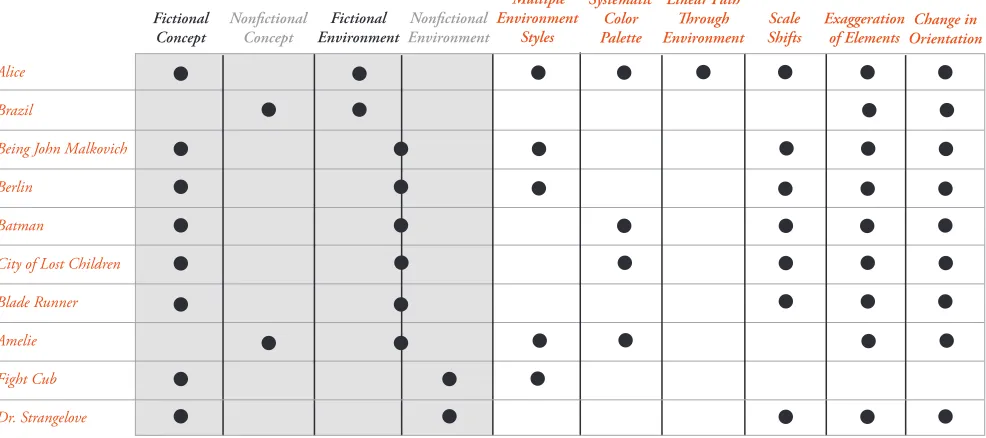
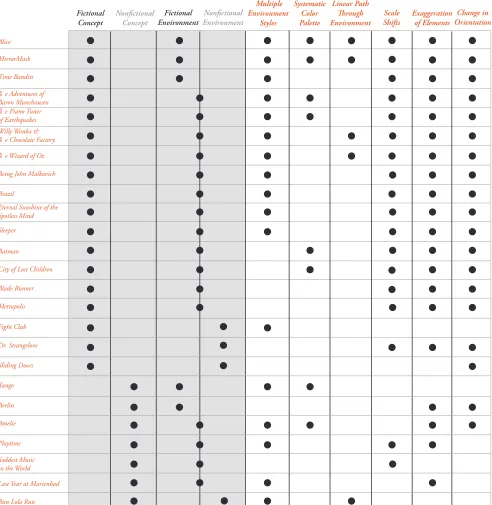
A comparative matrix was used in order to visually compare different environments as they appear in films and to provide a preliminary organizational structure for examples that are relevant to this study. Films that offered a wide range of combinations between fictional and nonfictional environments were chosen as possible examples to explore.
Below is an excerpt of this organizational structure. By studying the first four columns of this matrix, one can easily identify Fight Club and
Dr. Strangelove as examples of set design that place fictional concepts into nonfictional environments. Following the first four columns other factors are indicated. Although all of the films may contain some of the characteristics being compared to some degree, the ones marked are thought to be prime examples of each characteristic as it specifically relates to set design.
The complete matrix can be seen on the following page along with descriptions of its categories.
Nonfictional Environment
Fictional
Concept EnvironmentFictional
Alice
Brazil
Being John Malkovich
Berlin
Batman
City of Lost Children
Blade Runner
[image:46.612.92.585.454.673.2]Amelie
Fight Cub
Dr. Strangelove
Nonfictional Concept
Systematic Color Palette Multiple
Environment Styles
Linear Path Through
Nonfictional Environment
Fictional
Concept EnvironmentFictional
Alice MirrorMask Time Bandits The Adventures of Baron Munchausen The Piano Tuner of Earthquakes Willy Wonka & The Chocolate Factory The Wizard of Oz Being John Malkovich Brazil
Eternal Sunshine of the Spotless Mind Sleeper Batman
[image:47.612.85.577.199.704.2]City of Lost Children Blade Runner Metropolis Fight Club Dr. Strangelove Sliding Doors Tango Berlin Amelie Playtime Saddest Music in the World Last Year at Marienbad Run Lola Run
Nonfictional Concept
Systematic Color Palette Multiple
Environment Styles
Linear Path Through
Environment ShiftsScale Exaggerationof Elements
Change in Orientation
environments of cinematic design
The following pages include detailed definitions of the categories from the comparative matrix on page 39.
Categories Definition
Fictional Environment Fabricated setting
Nonfictional Environment Real-life setting
Fictional Concept Fabricated idea / story
Nonfictional Concept Real-life idea / story
Categories Connections to Game Design Multiple Environment Styles Transitioning between environments
Systematic Color Palette Containing the player
Linear Path Through Environment Revealing information
Scale Shifts Signaling an abstract environment
Exaggeration of Elements Manipulating old vs. creating new
environments of cinematic set design
Category Definitions
The first four categories of this matrix deal with comparing and contrasting the relationship a film creates between the environment it depicts and the concept that “lives” in that environment. For the purpose of defining these first four categories, the set designs of Wizard of Oz,Batman, and Run Lola Run will be used as examples.
environments: Fictional and nonfictional
Rarely does a film attempting to portray a fictional environment completely leave behind elements of the real world. Because fictional and nonfictional environments often overlap in film environments, a film may be positioned
between the categories of “Fictional Environments” and “Nonfictional Environments” in the organizing matrix (see page 39). The main difference between a fictional and nonfictional environment is whether or not the film uses the real environment to tell the story, or whether a fictional environment is created. A film that is marked as having both fictional and nonfictional environments is one that embellishes upon a nonfictional, real environment in order to produce a fictional one.
An example of a purely fictional environment is The Wizard of Oz. Although
this film draws its influences from real city environments as well (as in the Emerald City), it is intended by the creator that the Emerald City and all
other environments in The Wizard of Oz are figments of the imagination.
Other films such as Batman may appear to take place in an entirely fictional
environment because of its concept. However, Batman has been categorized
as a combination of a fictional and a nonfictional environment. This is
because the environment of Batman is a fictional city (Gotham City) that is
combined with a real metropolitan city (New York City) in order to create its environment – Gotham City is the equivalent of New York City in the story of Batman.
An example of a nonfictional environment appears in Run Lola Run.
This film is set in a German town, and no attempts to combine reality with abstraction are made.
Fictional environment
The Wizard of Oz
Directed by Victor Fleming