R E S E A R C H
Open Access
Spatial disaggregation of tick occurrence and
ecology at a local scale as a preliminary step for
spatial surveillance of tick-borne diseases: general
framework and health implications in Belgium
Valerie Obsomer
1,2*, Marc Wirtgen
3, Annick Linden
3, Edwin Claerebout
4, Paul Heyman
5, Dieter Heylen
6,
Maxime Madder
7,8, Jo Maris
9, Maude Lebrun
10, Wesley Tack
11, Laetitia Lempereur
12, Thierry Hance
2and Georges Van Impe
2Abstract
Background:The incidence of tick-borne diseases is increasing in Europe. Sub national information on tick
distribution, ecology and vector status is often lacking. However, precise location of infection risk can lead to better targeted prevention measures, surveillance and control.
Methods:In this context, the current paper compiled geolocated tick occurrences in Belgium, a country where tick-borne disease has received little attention, in order to highlight the potential value of spatial approaches and draw some recommendations for future research priorities.
Results:Mapping of 89,289 ticks over 654 sites revealed that ticks such asIxodes ricinusandIxodes hexagonusare largely present whileDermacentor reticulatushas a patchy distribution. Suspected hot spots of tick diversity might
favor pathogen exchanges and suspected hot spots ofI. ricinusabundance might increase human-vector contact
locally. This underlines the necessity to map pathogens and ticks in detail. WhileI. ricinusis the main vector,I. hexagonusis a vector and reservoir ofBorrelia burgdorferi s.l.,which is active the whole year and is also found in urban settings. This and other nidiculous species bite humans less frequently, but seem to harbour pathogens. Their role in maintaining a pathogenic cycle within the wildlife merits investigation as they might facilitate transmission to humans if co-occurring withI. ricinus. Many micro-organisms are found abroad in tick species present in Belgium. Most have not been recorded locally but have not been searched for. Some are transmitted directly at the time of the bite, suggesting promotion of tick avoidance additionally to tick removal.
Conclusion:This countrywide approach to tick-borne diseases has helped delineate recommendations for future research priorities necessary to design public health policies aimed at spatially integrating the major components of the ecological cycle of tick-borne diseases. A systematic survey of tick species and associated pathogens is called for in Europe, as well as better characterisation of species interaction in the ecology of tick-borne diseases, those being all tick species, pathogens, hosts and other species which might play a role in tick-borne diseases complex ecosystems.
Keywords:Tick, Vector, Spatial distribution, Ecology, Vector-borne diseases
* Correspondence:[email protected] 1
Université Catholique de Louvain, Earth and Life Institute, Georges Lemaitre climate and earth research centre, place Louis Pasteur 3, 1348, Louvain la Neuve, Belgium
2Biodiversity department ELIB, Université Catholique de Louvain, Earth and
Life Institute, 4 place Croix du sud, 1348, Louvain-la-Neuve, Belgium Full list of author information is available at the end of the article
Background
The incidence of tick-borne diseases is increasing in Europe [1] and follows an increase in the number of tick bites [2] attributed to two factors: abundance of questing ticks and human exposure to ticks [3]. Measures tar-geting human exposure by promoting timely removal of ticks failed to stop the rise in Lyme borreliosis incidence in the Netherlands. On the other hand, this rise was re-lated to an increase in Ixodes ricinus abundance [3]. Knowing the local variations in the distribution of the species interacting in tick-borne diseases systems, in-cluding ticks, pathogens and species influencing the presence and abundance of ticks and pathogens, could provide new opportunities to estimate potential infection risks locally, identify local hot spots and develop targeted prevention, surveillance and control.
Necessary information is lacking at national and sub na-tional levels in many countries. The first missing informa-tion concerns the presence and distribuinforma-tion of tick species. Efforts to characterise tick distribution on a European scale [4-6] are limited by the information available at sub na-tional level and only target major vectors such asI. ricinus. Other tick species less willingly biting humans sometimes harbour high pathogen prevalence’s and might contribute locally to the pathogens’cycles [7]. The role of all tick spe-cies present should be investigated jointly per pathogen and their distribution clarified. The second missing infor-mation concerns the spatial distribution of hosts, predators and species influencing tick populations and pathogens’ prevalence in ticks. The presence and abundance of tick species varies locally according to many factors, including host availability [3]. Pathogen prevalence in ticks also varies locally according to availability of reservoirs, dead-end hosts and vectors [8]. The third set of missing information concerns pathogens associated to ticks, their presence, reservoirs, vectors and distribution. Pathogens found using classical PCR methods are those searched for, while others might be present but undetected. Because micro-organisms are increasingly found in ticks, a more system-atic approach is needed. The list of micro-organisms found locally or abroad in local tick species could be narrowed by clarifying pathogenicity, vector capacity and presence of reservoirs to provide a list of potential pathogens to inves-tigate locally. This would clarify the spectrum of pathogens potentially transmitted locally through a tick bite.
In this paper, occurrence records and information on tick species relevant for public health have been com-piled for a country where tick-borne diseases received little attention. In Belgium, the limited quality of current information is obvious because of proximity to the Netherlands, a country that stands out for efficient in-vestigations of tick-borne diseases. In the Netherlands, tick bites are subject to spatial monitoring [9]. Lyme borreliosis is monitored by physician surveys targeting
Erythema migrans, the most common symptom [2]. In
Belgium, only Lyme borreliosis is regularly diagnosed. In 2009, official numbers of cases varied from 500 to 1500 [10] or 9000 cases [11] according to the source. In the Netherlands, 22000 cases were recorded for that same year [2]. I. ricinus is believed to occur in Southeast Belgium but records occur elsewhere. Detailed distribu-tion can approximate local exposure to ticks. This is of direct public health interest because according to Euro-pean guidelines for Lyme borreliosis, an individual pre-senting an Erythema migrans is considered a confirmed case if potentially exposed to areas favourable for vector ticks [12]. Laboratory confirmation and remembering a tick bite are not necessary to confirm this diagnosis.
This study aims to show how an integrated spatial ap-proach on tick species in a given country can provide the preliminary information needed for adapted national public health policies by providing: 1) a list of tick species present and their detailed distribution, 2) the micro-organisms they could harbour, 3) ecological traits influencing vector status, 4) implications for public health and suggestions for future research priorities.
Methods
Three sources of tick locations were considered: new tick collections, literature collections and “grey datasets”. Quality levels are proposed for each record to document for example accuracy of tick location according to type of host/vegetation (lower if captured on moving animals such as dog or deer). Information on localisation, collection, vegetation or host, pathogen load, and original data source were compiled in an excel database (Additional file 1). A systematic literature search was made based on ISI web of knowledge using the keywords “tick AND ecology” from 1989 to 2001 and“tick”from 2002 to 2011. Additional ar-ticles resulted from a specific search on presence and pathogenicity of microorganisms found in ticks. The data-base and additional literature articles form the basis for this paper and are examined for the following items: geo-graphical distribution, species behaviour, ecology, presence of micro-organisms. Consequences for public health and prevention are highlighted. For some sites additional de-tails were provided by authors, however, the methodology is already described in published articles and summarised in the Additional file 1. This includes (1) Collection BAYER, 579 sites [13], (2) Collection RLVBD, 51 sites [14], (3) Collection UGENT FOREST, 33 sites [15,16], (4) Col-lection ARSIA, 17 sites [17], (5) ColCol-lection UCLIREC, 5 sites [18], and (6) Collection UA1, 16 sites [7,19-22]. Col-lection GREY DATA includes tick field observations from the website of NATAGORA and NATUURPUNT (www. observations.be, www.waarnemingen.be) by registered users involved with nature related activities from 1980
Obsomeret al. Parasites & Vectors2013,6:190 Page 2 of 19
until February 2012. Methodologies for original tick col-lections are described in detail below:
Collection VANIMPE
In the framework of the convention 5284a funded by IRSIA (Institut pour l′encouragement de la recherche dans l′ industrie et l′agriculture), the center of acarology (UCL) led two collection campaigns in the Campine, the plateau brabançon and the Condroz. The regions were selected based on local Lyme borreliosis cases and favourable tick habitat. The first campaign in 1989 targeted 30 sites and the second campaign prospected 234 sites from May to October 1990 including 79 days of prospection. Ticks were collected from the environment by flagging. Each collection lasted 2 hours and UTM coordinates were checked on maps (100 m).
Collection WILDSCREEN
From 2007 to 2009, ticks from wild cervids (Cervus
elaphus and Capreolus capreolus) found dead, hunted
or killed for sanitary reasons were collected by the Wild Screen Network disease monitoring activities in Southern Belgium [23]. Ticks were preserved in 70% ethanol at room temperature, and morphologically identified up to stage and species level (by L. Lempereur and A. Nahayo). Sex and repletion were recorded. Der-macentor reticulatuswas also collected on wild cervids from 2010 to 2012. AsD. reticulatusandD. marginatus may show overlapping phenotypes [24], a PCR was used for confirmation, targeting theDermacentorsecond In-ternal Transcribed Spacer 2 (ITS2) with the following primers: ITS_forward (5′ -GTG-CGT-CCG-TCG-ACT-CGT-TTT-GA-3′) and ITS_reverse (5′ -ACG-GCG-GAC-TAC-GAC-GGA-ATG-C-3′) [25]. The DNA purification was carried out using the NucleoSpin tissue kit for tissue protocol (Macherey-Nagel GmbH, Germany). Samples were frozen in liquid nitrogen and homogenized on a Tissue Lyser® (Qiagen, GmbH, Germany). PCR condi-tions were as follow: each reaction was carried out in 50 μL volume containing 4 μl of the DNA prepar-ation, 5 μl of each 2 mM dNTP, 2 μl of each 10 μM oligonucleotide primer, 2 U of TaqDNA polymerase (New England Bio labs) with 5 μl of the 10x PCR supplied buffer and completed to 50 μl with sterile water. PCR was achieved with an initial denaturation cycle at 95°C for 5 min, followed by 35 cycles (94°C, 45 s), annealing (53°C, 45 s), extension (72°C, 70 s) and a final extension step at 72°C for 10 min. All ITS2 PCR products were sequenced using a modified Sanger method with the Big Dye terminator kit ver-sion 3.1 and resolved with a 3730 ABI capillary se-quencer (Applied Bio systems). Sequencing reaction
was performed with the same primers as for the PCR and sequences aligned by BLAST search.
Collection ITG
Ticks were collected by flagging for several years (site 1, 60, 172).
Collection IRSNB
Additional tick locations registered in museum collec-tions were provided by the IRSNB (Institut Royal des Sciences Naturelles de Belgique).
Collection DGZ
While investigating anaplasmosis in 11 farms in Flanders, in 2011, the Dierengezonheidzorg (DGZ–Animal Health Care Flanders, Belgium) recordedI. ricinus ticks on sev-eral animals from those 11 farms.
Collection GLAXOSMITHKLINE
Ticks were captured by flagging in 1999 in 3 sites in Belgium (sites 228, 242, 353).
Collection MARTIN
D. reticulatuswas found on a human around Namur and
a trypanosome discovered in the intestine ofI. ricinusin the context of other research [26].
Collection UGENT VETE
The clinic of poultry diseases of Ghent University per-forms diagnosis required by individuals. In this frame-work they recorded a tick infestation on a pigeon from Argasspecies, probably Argas reflexusin July 2012 near Berlaar (site 303) in the province of Antwerp.
Results and discussion
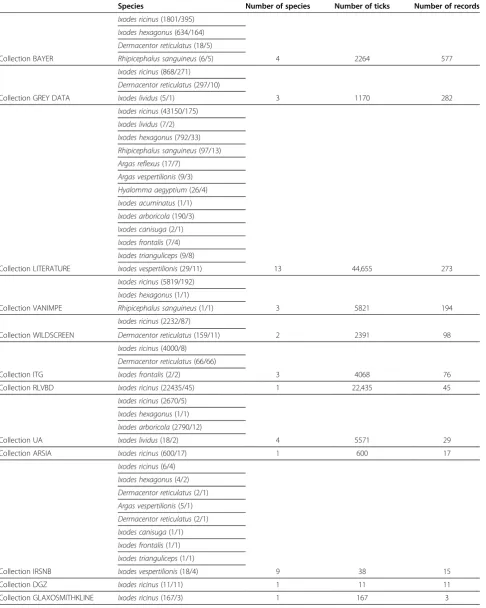
The database includes 1624 records for a total of 89,289 ticks and is summarized per collection in Table 1. Re-cords within 3 km range were grouped for the display in 654 sites. Original details are available for each record (Additional file 1) and can be visualised using Google Earth (Additional file 2). Figure 1 shows sites of occur-rence for all tick species.
Tick species in Belgium
Table 1 Tick species found in Belgium per collection
Species Number of species Number of ticks Number of records
Ixodes ricinus(1801/395)
Ixodes hexagonus(634/164)
Dermacentor reticulatus(18/5)
Collection BAYER Rhipicephalus sanguineus(6/5) 4 2264 577
Ixodes ricinus(868/271)
Dermacentor reticulatus(297/10)
Collection GREY DATA Ixodes lividus(5/1) 3 1170 282
Ixodes ricinus(43150/175)
Ixodes lividus(7/2)
Ixodes hexagonus(792/33)
Rhipicephalus sanguineus(97/13)
Argas reflexus(17/7)
Argas vespertilionis(9/3)
Hyalomma aegyptium(26/4)
Ixodes acuminatus(1/1)
Ixodes arboricola(190/3)
Ixodes canisuga(2/1)
Ixodes frontalis(7/4)
Ixodes trianguliceps(9/8)
Collection LITERATURE Ixodes vespertilionis(29/11) 13 44,655 273
Ixodes ricinus(5819/192)
Ixodes hexagonus(1/1)
Collection VANIMPE Rhipicephalus sanguineus(1/1) 3 5821 194
Ixodes ricinus(2232/87)
Collection WILDSCREEN Dermacentor reticulatus(159/11) 2 2391 98
Ixodes ricinus(4000/8)
Dermacentor reticulatus(66/66)
Collection ITG Ixodes frontalis(2/2) 3 4068 76
Collection RLVBD Ixodes ricinus(22435/45) 1 22,435 45
Ixodes ricinus(2670/5)
Ixodes hexagonus(1/1)
Ixodes arboricola(2790/12)
Collection UA Ixodes lividus(18/2) 4 5571 29
Collection ARSIA Ixodes ricinus(600/17) 1 600 17
Ixodes ricinus(6/4)
Ixodes hexagonus(4/2)
Dermacentor reticulatus(2/1)
Argas vespertilionis(5/1)
Dermacentor reticulatus(2/1)
Ixodes canisuga(1/1)
Ixodes frontalis(1/1)
Ixodes trianguliceps(1/1)
Collection IRSNB Ixodes vespertilionis(18/4) 9 38 15
Collection DGZ Ixodes ricinus(11/11) 1 11 11
Collection GLAXOSMITHKLINE Ixodes ricinus(167/3) 1 167 3
Obsomeret al. Parasites & Vectors2013,6:190 Page 4 of 19
surveys. Other species records are sporadic and difficult to interpret. Those records might reflect patchy distribution for ticks associated with bat habitats for example, or just lack of systematic surveys for the recently investigated D. reticulatus(Fabricius, 1794) [34]. The distribution of species with 20 or fewer occurrences is difficult to analyse. Areas without records are due to absence or absence of surveys, thus leading to difficulties in the interpretation of the data.
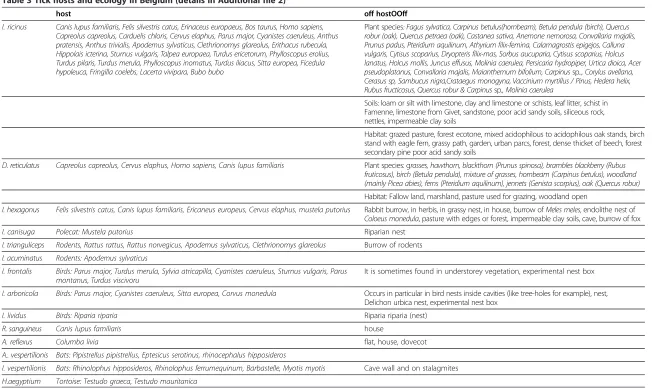
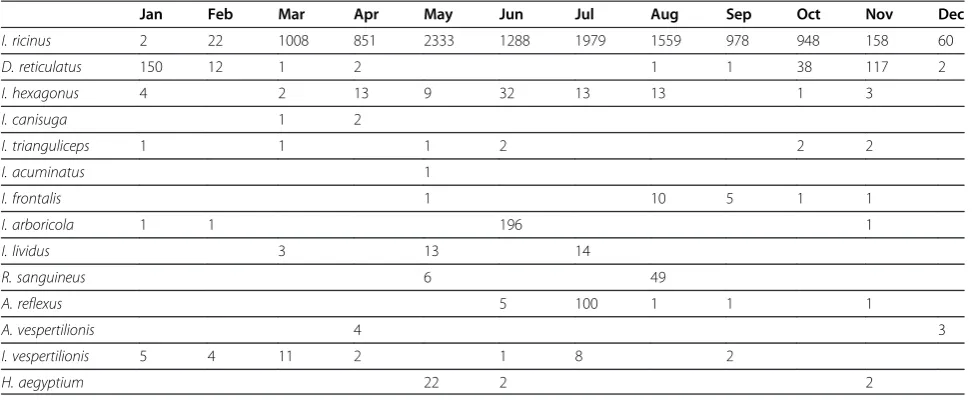
Most tick species are nidiculous and thus found mainly on hosts, nests or burrows. Off host habitats are important forI. ricinusandD. reticulatus which quest on the vegetation.I. ricinusis found in deciduous forests, pas-tures bordered by trees, hedges and bushes [35], or with tall grass and high humidity [27], vegetated sand dunes [3], pine forests [14] and city parks [36]. Contradictory defini-tions of D. reticulatushabitats exist in the literature [32] withD. reticulatusfound in drier areas thanI. ricinus[37] or in moist areas along rivers [38] or on the fringe of meadows in dry vegetation [39] and variation in abundance in similar sites [40]. Many vertebrates are parasitized byI. ricinus(Table 3). I. hexagonus is present on many mam-mals but never birds [39]. Other species seem restricted to specific hosts such as birds (I. frontalis (Panzer, 1798), I. arboricola Schulze & Schlottke, 1930, Argas reflexus (Fabricius, 1794), I. lividus Koch, 1844), rodents (I. triangulicepsBirula, 1895,I. acuminatusNeumann, 1901), mammals (I. canisuga Johnston, 1849, D. reticulatus) or bats (Argas vespertilionis (Latreille, 1796), I. vespertilionis Koch, 1844). Rhipicephalus sanguineus (Latreille, 1806) is imported on dogs and found occasionally in houses. Hyalomma aegyptium(Linnaeus, 1758) is imported on tor-toises. Names are such as revised by Barker and Murrell [41] or used by Petneyel al. [32]. While seasonality might be linked to host life cycle for bat ticks, most nidiculous ticks seem active year round (Table 4). I. ricinus is more frequently recorded in spring and autumn but the decrease in summer seems to be an artefact due to vegetation stages influencing flagging efficiency [42]. Slight activity occurs in winter.D. reticulatus seems mainly absent on the vegeta-tion in summer.
Co-occurrence of tick species in some sites raises the question of potential interactions with species recorded together on the same hosts [33], or their eggs found in the same shelter [43,44]. Sites with high diversity of tick spe-cies might be hot spots of potential micro-organism
exchanges. Indeed, although ticks specific, for example, to birds rarely bite humans, they might maintain a cycle of pathogens in their host populations. Those might be picked up by the generalist species I. ricinus, and passed onto humans [7,45]. The possibility that co-occurring exotic and local species might facilitate establishment of exotic micro-organisms should be investigated.
Microorganisms associated to tick species
In addition to potential paralysis caused by the saliva of some female ticks, which seems very rare in Europe [46], the main impact of ticks on human health is through transmission of pathogens. Ticks acquire microorganisms through an infected meal or transovarial transmission. Micro-organisms recorded in ticks might come from a re-cent blood meal and presence in a tick does not mean that this tick species is a competent vector. For Ixodidae ticks feeding once per stage, the microorganisms need to sur-vive molting and be transmitted to the next host while argasidae nymphs and adults bite repeatedly. Then, to be a pathogenic for humans, they must cause symptoms in humans. A list of 300 recorded micro-organism/tick asso-ciations is presented in Additional file 3. Some sources have a low reliability but this exhaustive list is a basis for systematic investigations and reliability of vector status and pathogenicity are compiled to propose priorities for investigations. Associations are recorded mostly outside Belgium as this was little investigated in the country. Not-ably, while mycoplasmas are increasingly related to ticks in the USA [47], and their prevalence is increasing throughout Europe [48,49], there are no investigations of Mycoplasmain Belgian tick species in the literature.
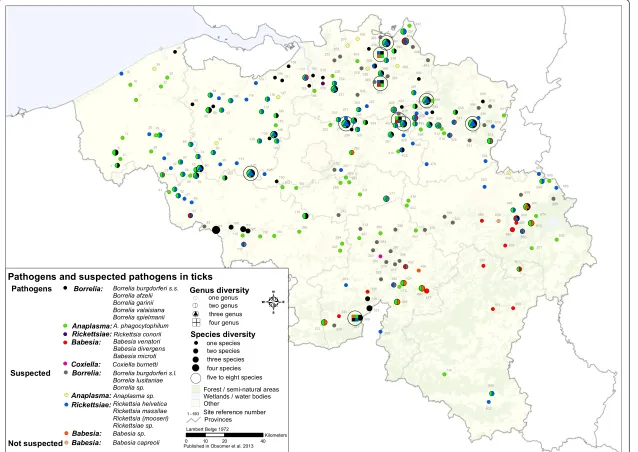
For ticks present in Belgium, more than 100 associations with tick-borne (suspected) pathogens have been docu-mented (Table 5) with some recorded in Belgium (Figure 2). PathogenicBorrelia(Borrelia burgdorferis.s., B. valaisana, B. garinii, B. afzelii, B. spielmanii),Anaplasma
phagocythophilum and suspected pathogens such as
Borrelia lusitaniae and Rickettsia (R. helvetica, Rickettsia sp.,R. massilae)seem to be present throughout the coun-try. Transovarial transmission of someBabesiaspecies in-cludingBabesia divergens[50],B venatorum[51], (but not B. microti) [52] occurs in I. ricinus. ABabesia belt goes from Couvin (site 212) to Verviers (site 667) and has been Table 1 Tick species found in Belgium per collection(Continued)
Ixodes ricinus(1/1)
Collection MARTIN Dermacentor reticulatus(1/1) 2 2 2
Collection UGENT Argas reflexus(1/1) 1 1 1
TOTAL 14 89289 1624
Figure 1Map of tick species recorded in Belgium before 2011.Map of existing tick species records in Belgium. One color corresponds to one species. When two or more species occur at the same site special symbols compile the colors of the two or more species.I. ricinusis in black color. Numbers labelling each site correspond to site number in Additional file 1.
Obsomer
et
al.
Parasites
&
Vectors
2013,
6
:190
Page
6
of
19
http://ww
w.parasitesand
vectors.co
m/content/6/1
documented for many years [53]. Other sites are based on ticks found on dogs and the place of infection is unsure, but a local focus ofBabesia canisexists near Mons [54]. Some sites show a high diversity with more than 5 (suspected) pathogens. In site 575 (Genk), 481 (Ham) and 271 (Boortmeerbeek), high diversity might be linked to the presence of many ticks from many hosts. This means that (1) those localities have a higher diversity of (suspected) pathogens or (2) diversity is high everywhere but picked up there because of abundant tick material, or (3) diversity is high when ticks are abundant. Site 575 presents five pathogens (Borreliae burgdorferi s.s., B. valaisiana, B.
afzelii, B. garinii and A. phagocytophilum) and three
suspected pathogens (B. lusitaniae,Rickettsia helvetica and Rickettsia sp.) found in ticks collected from 38 cats (quite sedentary), thus suggesting a potential local transmission.
Most interestingly, 4 pathogens (A. phagocytophilum, B. burgdorferi s.s., B. afzelii, B. garinii) and two suspected pathogens (Babesia sp., Anaplasma sp.) were recorded from unfedI. ricinusnymphs (135 ticks) during flagging at site 297 (Vierves-sur-Viroin), highlighting vector status and local presence of the pathogens. This area seems to be a hot spot ofI. ricinusabundance and the only place with up to 6 potential pathogens recorded in unfed questing ticks. Site 64 (Chercq) stands out with 5 cats harbouring 60 I. ricinusbut no pathogens.
Ecological traits influencing the potential vector role of tick species
The major vector I. ricinus–a generalist species
I. ricinusis a confirmed vector for many human
[image:7.595.59.539.310.693.2]patho-gens (Table 5). Several factors contribute to the efficiency
Table 2 Tick species of Belgium
Tick name Records in BE (Ticks) Year for last record NL NW EU N FR GE
Established in the wild
Ixodes ricinus 1223 (88758) 2011 Yes Yes Yes Yes
Ixodes hexagonus 201(1333) 1987 Yes Yes Yes Yes
Dermacentor reticulatus 102 (861) 2012 Yes Yes Yes Yes
Ixodes frontalis 16 (102) 2011 Yes Yes Yes
Ixodes arboricola 15(2980) 2011 Yes Yes Yes
Ixodes lividus 5 (30) 1989 Yes Yes Yes
Ixodes canisuga 2 (3) 1945 Yes Yes Yes
Ixodes trianguliceps 9 (10) 1987 Yes Yes Yes
Ixodes acuminatus 1 (1) 1987 Yes
Argas reflexus 8 (18) 2012 Yes Yes Yes
Argas vespertilionis 4 (14) 1942 Yes Yes Yes
Ixodes vespertilionis 15 (47) 1969 Yes Yes Yes
Established in houses and recurrently imported on host
Rhipicephalus sanguineus 19 (104) 1982 Yes Yes Yes Yes
Not established but recurrently imported on host
Hyalomma aegyptium 4 (26) (1965) Yes Yes
Potentially present but never found in Belgium
Ixodes unicavatus Potential Never Yes Yes Maybe No
Ixodes uriae Potential Never Yes Yes Yes
Ixodes ventalloi Potential Never Yes Yes
Ixodes apronophorus Potential Never Yes Yes (UK) Yes
Ixodes rugicollis Potential Never Yes
Ixodes simplex Potential Never Yes
Dermacentor marginatus Potential (1973) Yes Yes Yes
Haemaphysalis punctata Potential Never Yes Yes (UK) Yes Yes
Haemaphysalis concinna Potential Never Yes Yes Yes
Haemaphysalis inermis Potential Never Yes Yes
Table 3 Tick hosts and ecology in Belgium (details in Additional file 2)
host off hostOOff
I. ricinus Canis lupus familiaris, Felis silvestris catus, Erinaceus europaeus, Bos taurus, Homo sapiens, Capreolus capreolus, Carduelis chloris, Cervus elaphus, Parus major, Cyanistes caeruleus, Anthus pratensis, Anthus trivialis, Apodemus sylvaticus, Clethrionomys glareolus, Erithacus rubecula, Hippolais icterina, Sturnus vulgaris, Talpea europaea, Turdus ericetorum, Phylloscopus erolius, Turdus pilaris, Turdus merula, Phylloscopus inornatus, Turdus iliacus, Sitta europea, Ficedula hypoleuca, Fringilla coelebs, Lacerta vivipara, Bubo bubo
Plant species: Fagus sylvatica, Carpinus betulus(hornbeam), Betula pendula (birch), Quercus robur (oak), Quercus petraea (oak), Castanea sativa, Anemone nemorosa, Convallaria majalis, Prunus padus, Pteridium aquilinum, Athyrium filix-femina, Calamagrostis epigejos, Calluna vulgaris, Cytisus scoparius, Dryopteris filix-mas, Sorbus aucuparia, Cytisus scoparius, Holcus lanatus, Holcus mollis, Juncus effusus, Molinia caerulea, Persicaria hydropiper, Urtica dioica, Acer pseudoplatanus, Convallaria majalis, Maianthemum bifolium, Carpinussp.., Corylus avellana, Cerasus sp, Sambucus nigra,Crataegus monogyna, Vaccinium myrtillus / Pinus, Hedera helix, Rubus fructicosus, Quercus robur & Carpinussp., Molinia caerulea
Soils: loam or silt with limestone, clay and limestone or schists, leaf litter, schist in Famenne, limestone from Givet, sandstone, poor acid sandy soils, siliceous rock, nettles, impermeable clay soils
Habitat: grazed pasture, forest ecotone, mixed acidophilous to acidophilous oak stands, birch stand with eagle fern, grassy path, garden, urban parcs, forest, dense thicket of beech, forest secondary pine poor acid sandy soils
D. reticulatus Capreolus capreolus, Cervus elaphus, Homo sapiens, Canis lupus familiaris Plant species: grasses, hawthorn, blackthorn (Prunus spinosa), brambles blackberry (Rubus fruticosus), birch (Betula pendula), mixture of grasses, hornbeam (Carpinus betulus), woodland (mainly Picea abies), ferns (Pteridium aquilinum), jennets (Genista scorpius), oak (Quercus robur)
Habitat: Fallow land, marshland, pasture used for grazing, woodland open
I. hexagonus Felis silvestris catus, Canis lupus familiaris, Ericaneus europeus, Cervus elaphus, mustela putorius Rabbit burrow, in herbis, in grassy nest, in house, burrow ofMeles meles, endolithe nest of
Coloeus monedula, pasture with edges or forest, impermeable clay soils, cave, burrow of fox
I. canisuga Polecat: Mustela putorius Riparian nest
I. trianguliceps Rodents, Rattus rattus, Rattus norvegicus, Apodemus sylvaticus, Clethrionomys glareolus Burrow of rodents
I. acuminatus Rodents: Apodemus sylvaticus
I. frontalis Birds: Parus major, Turdus merula, Sylvia atricapilla, Cyanistes caeruleus, Sturnus vulgaris, Parus montanus, Turdus viscivoru
It is sometimes found in understorey vegetation, experimental nest box
I. arboricola Birds: Parus major, Cyanistes caeruleus, Sitta europea, Corvus monedula Occurs in particular in bird nests inside cavities (like tree-holes for example), nest, Delichon urbica nest, experimental nest box
I. lividus Birds: Riparia riparia Riparia riparia (nest)
R. sanguineus Canis lupus familiaris house
A. reflexus Columba livia flat, house, dovecot
A.. vespertilionis Bats: Pipistrellus pipistrellus, Eptesicus serotinus, rhinocephalus hipposideros
I. vespertilionis Bats: Rhinolophus hipposideros, Rhinolophus ferrumequinum, Barbastelle, Myotis myotis Cave wall and on stalagmites
H.aegyptium Tortoise: Testudo graeca, Testudo mauritanica
Obsomer
et
al.
Parasites
&
Vectors
2013,
6
:190
Page
8
o
f
1
9
http://ww
w.parasitesand
vectors.co
m/content/6/1
ofI. ricinus[55]: (1) it is the most abundant tick species in Europe with all stages readily biting humans [56]. (2) This species takes one meal on 3 different hosts in one life cycle and parasitizes a wide range of hosts from mammals (e.g. squirrels, badgers, wild boars, cervids, foxes, dogs, cats, cows, rodents, bats) to birds (common blackbird, European robin, pheasant, nest of the Eagle owl), reptiles, lizards and amphibians [57-59]. Larvae and nymphs are found on any hosts and frequently on rodents or birds [60,61]. Adults feed on larger mammals. A large range of hosts means that there are opportunities to encounter many pathogens and disperse in many habitats, with for example I. ricinus representing 20% of ticks found on Parus major[7]. (3) Phenologic plasticity is wide with all stages surviving 2 weeks under water, several ticks surviv-ing at−10°C, and non engorged nymphs kept alive several months in a fridge (5°C) waking up in minutes if heated by hand contact. The species is vulnerable to desiccation and will not be encountered in arid or non-vegetated envi-ronments. Temperatures over 35°C for two weeks will kill all stages [35]. Tolerance to desiccation can be higher in ticks infected by pathogens [62]. This species walks on average 40 cm around its questing post and finds shelter in litter or soil cracks [35]. While ticks interrupt questing to move down the vegetation, in order to rehydrate (quies-cence), Perretet al.discovered that after dark, quiescence was often interrupted by walking events not necessarily leading to questing, with ticks walking repeatedly 9 m. They suggested that some of these movements represent horizontal walks if the ticks were not confined to their ex-perimental vertical channels and that some of these move-ments represent activities that enable ticks to find a favourable questing site in nature [63]. Similar
experiments but in horizontal arenas did not record such movements [64].I. ricinusis widely distributed in Belgium with sites of apparently higher occurrence (around sites 219, 286, 288, 374, 499) (Figure 3). Lack of standardisation impedes calculation of tick densities and tick abundance and is presented here as the total number of specimens collected in a site. While abundance is expected to de-crease from East to West with decreasing forest cover, this is not what comes out of the general map. Few occur-rences are recorded in the Southeast despite high forest cover, but few surveys are carried out in that region, while many surveys took place in Campine to clarify tick pres-ence. The large abundance around the Meuse area is picked up as well as decreased abundance between the Meuse and Brussels, which corresponds to a highly culti-vated area (Hesbaye). Abundance is also lower along the coast, which is intensely cultivated. High abundances are recorded along the Dutch border and might reflect an in-crease in tick populations such as recorded in the Netherlands. These trends need, however, to be confirmed because of the lack of standardisation in sampling.
Secondary vectors I. hexagonus and D. reticulatus
[image:9.595.56.545.100.300.2]I. hexagonus is a confirmed vector of B. burgdorferi s.l. [65] with 28% prevalence recorded [66]. It is a nidiculous species found in burrows and occasionally in caves [44]. This reduces human vector contact but several charac-teristics must be highlighted: 1) human infestations were frequent during the war when people sheltered in under-ground sites during air raids [45] and I. hexagonus is considered a common parasite of man in Germany and the United Kingdom [43], 2) the species has a wide range of hosts such as hedgehogs, mustelids, foxes, Table 4 Seasonality of tick observations (number of ticks) in Belgium
Jan Feb Mar Apr May Jun Jul Aug Sep Oct Nov Dec
I. ricinus 2 22 1008 851 2333 1288 1979 1559 978 948 158 60
D. reticulatus 150 12 1 2 1 1 38 117 2
I. hexagonus 4 2 13 9 32 13 13 1 3
I. canisuga 1 2
I. trianguliceps 1 1 1 2 2 2
I. acuminatus 1
I. frontalis 1 10 5 1 1
I. arboricola 1 1 196 1
I. lividus 3 13 14
R. sanguineus 6 49
A. reflexus 5 100 1 1 1
A. vespertilionis 4 3
I. vespertilionis 5 4 11 2 1 8 2
Table 5 Tick/micro-organism associations for which pathogenic status and vector status for human should be investigated as a priority: pathogens and suspected pathogens/tick species associations found abroad or in Belgium referenced in the literature for tick species found in Belgium
Tick species V/U Borrelia Babesia Rickettsia Coxiella,
Franciscella Anaplasma
Virus Other
I. ricinus V burgdorferi sensu stricto*, afzelii*, garinii*,lusitaniae valaisiana*, spielmanii*,sp bavariensis*, miyamotoi*,
venatorum*, divergens*, microti*
helvetica F. tularensis*
A. phagocytophilum*
CCHF*, TBEV*, Louping Ill*
U ruskii bovis, bigemina,
rodhaini
prowazekii*,conorii*,
slovaca*, monacensis*, felis*, massiliae*, typhi*, sp.
C. burnetii* WNV*, Eyack*,
Erve* Tettnang*, Tribec*, KEMV*
Bartonella henselae*, Serratia marcescens*, Staphylococcus aureus*, Candidatus Neoehrlichia mikurensis*, Toxoplasma gondii*, Pasteurella pneumotropica*, Chromobacterium violaceum*, Pseudomonas aeruginosa*, Diplorickettsia massilinsis
I. frontalis U afzelii*, garinii*, turdi-like burgdorferi sensu lato,
C. burnetii* KEMV*, TBEV* Candidatus Neoehrlichia mikurensis*
I. acuminatus U burgdorferi sensu lato C. burnetii* F. tularensis* Bhanja
I. hexagonus V burgdorferi sensu lato TBEV*
U burgdorferi sensu stricto*,
valaisiana*,spielmanii*,garinii*,
afzelii*,lusitaniae, bavariensis*
microti*, bovis conorii*,helvetica,sp. A. phagocytophilum* Erve*
I. arboricola U garinii*, valaisiana*
afzelii*, burgdorferi sensu lato, spielmanii*
helvetica,sp. TBEV*
I. lividus U burgdorferi sensu stricto*, garinii* (heilongjiangensis),sp. C. burnetii* TBEV* Kama
I. canisuga U burgdorferi sensu lato TBEV* Yersinia pestis(Plague)*
I. trianguliceps V microti*
U burgdorferi sensu lato, afzelii*, garinii*
C. burnetii*, F. tularensis* A. phagocytophilum*
Louping-ill*, TBEV*, CCHF*
I. vespertilionis U Kul, TBEV*
D. reticulatus V microti* sibirica* C. burnetii* OHF*
U burgdorferi sensu lato divergens* bigemina
slovaka*, canada*, conorii*, sp, helvetica*, raoultii*
F. tularensis* Francisella-likeA. phagocytophilum*
TBEV* Bartonella henselae*
R. sanguineus V conorii* CCHF*
U burgdorferi sensu lato microti-like*, gibsoni
Candidatus rickettsia kulagini,massiliae*, canis, felis*, rickettsi*, rhipicephali,
C. burnetii*, A. phagocytophilum*
Thogoto* Ehrlichia canis, Ehrlichia ewingii Hepatozoon canis, Salmonella bacteria, Batonella vinsonii, Rangelia vitalii, Dipetalonema dracunculoides, Mycoplasma haemocanis, Leishmania infantum
A. reflexus U C. burnetii* WNV*, TBEV*,
NYMV, QRFV
A. vespertilionis U burgdorferi sensu lato, borrelia sp C. burnetii* rabies*, IK (KTR), SOK
Wolbachia persica, Treponoma vespertilionis
H. aegyptium U turcica, sp C. burnetii*
Vconfirmed vector,Uunknown vector status,*recognised pathogen,WNVWest Nile Virus,CCHFCrimean-Congo Hemorrhagic fever,TBEVTick borne Encephalitis virus,QRFVQuaranfi Virus,NYMVNyamanini virus,
KTRKetera virus,OHFOmsk Hemorrhagic fever,SOKSokolok,IKIssyk Kul,KEMVKemerovo. In bold pathogen recorded in Belgium. Details in Additional file3.
Obsomer
et
al.
Parasites
&
Vectors
2013,
6
:190
Page
10
of
19
http://ww
w.parasitesand
vectors.co
m/content/6/1
polecat, badger, roe deer [30], as well as dogs and cats which can increase the spread of ticks and import ticks in gardens close to humans, 3) I. hexagonusis found in urban gardens [33], 4) most hedgehogs are infested [67] and the presence of ticks in their surface nests is a po-tential threat when gardening [33], 5) This species brings pathogens to people normally not at risk for tick bites (just gardening) and can remain undetected for a longer time, 6) it is active throughout the year [68], 7) because of B. burgdorferi s.l. transovarial transmission [65], this species could maintain a silent high rate of infection creat-ing long term foci of high infection in the wildlife in areas where it acts as reservoir, 8) finally, Lyme borreliosis could be picked up by I. ricinus sharing the same host. In Belgium,I. hexagonusis widespread on cats and dogs [13] and has been observed on many mammals (Table 3), on humans [27], in nests, burrows, caves (sites 594, 617), house (site 200) and on grass (sites 492, 670). Populations might fluctuate between years [27]. The species in Belgium carries all the pathogenic species of Borrelia burgdorferi s.l., A.
phagocytophilum as well as the suspected pathogen R.
helvetica[13].
D. reticulatusmight be restricted to limited areas and not actively questing in the warm months when people are entering risky areas. D. reticulatus is reported on wild boar, cervids, dogs, horses and cats in the French Ardennes [37], wolves or rarely birds [27,32,43]. It can bite humans [69]. Adults are captured by flagging but immatures are nidiculous. This species seems to be expanding its distribution in Europe. In Belgium, the tick has probably been present for some time with one speci-men recorded on vegetation in 1950 (site 553), on a dog (site 567) and a human in the eighties (site 376). Established populations have only recently been moni-tored. Between 2007 and 2009, 16 out of 2297 ticks taken from 161 wild cervids [23] (WILDSCREEN collec-tion) were D. reticulatus.From 2010 until March 2012, 150 additional D. reticulatus were discovered on 3 cervids in 6 sites including one confirmed by flagging (site 797). Confirmation of the species at a molecular level was carried out when sequences of the 646 bp of a part of the ITS2 gene were successfully obtained for 16 D. reticulatus. These 6 sites are in the Southeast but this tick is found on vegetation in the North (60, 130, 172, 535) [34] and on hosts in other locations [13].
Ticks parasite of birds
Birds probably carry ticks to most geographical locations but this does not mean that ticks will survive in these locations. The presence of all pathogenic species of B. burgdorferi s.l. in I. frontalis and I. arboricola in Belgium suggests a potential role in the Borrelia life cycle [7]. Up to 50% ofI. frontalis[69] and alsoI. lividus [70] were infected with B. burgdorferi s.l. in other
countries. While seldom reported as biting humans, they might maintain the pathogen cycle in wildlife. I. frontalis (previously I. pari) is associated with a broad range of songbirds, including thrushes (Turdidae), the Great tit and the collared dove [7,28,43], with up to 30 speci-mens per bird [71]. I. frontalisis occasionally collected by flagging [72] and evidence suggests that it might be more often present in under-storey vegetation than in nests [7]. In Belgium it has been found on birds in 11 sites. I. arboricola is found mainly in Europe but was recorded in Egypt on birds coming back to Europe [27]. It is a nidicolous tick infesting birds and bats [73]. The Great tit might be the dominant host but heavy infesta-tions occur on the Common starling and Peregrine falcon [32]. In Belgium it was recorded in 10 places in-cluding 3 sites with 70 specimens (sites 233, 252, 337) where the species was actively surveyed. Specimens were found on birds (Table 3) and in nests of the House martin. I. lividus is found on the Sand martin and in their nests [27]. Experimental records showed that these ticks were collected on the Great tit [74] and it was found repeatedly in nests of the House martin in Japan [75].
Ticks parasite of rodents and small mammals
Figure 2Map of the micro-organisms, suspected pathogens and pathogens found in ticks of Belgium.Map of existing information on micro-organisms found in ticks in Belgium. Information is presented at the genus level but if available, details of species are provided in additional file 2. Numbers labelling each site correspond to site number in Additional file 1.
Obsomer
et
al.
Parasites
&
Vectors
2013,
6
:190
Page
12
of
19
http://ww
w.parasitesand
vectors.co
m/content/6/1
parasitizes small mammals, birds and sometimes humans and is mostly found in nests and burrows [28]. Only one specimen was found in Belgium on a wood mouse (site 630).
Other tick species sharing habitats with humans
Three tick species are not frequent but bite humans and can establish populations inside houses, making them a potential threat. Rhipicephalus sanguineus is a tropical tick imported on dogs or rarely with hares, cattles, horses, or plants [55]. The tick cannot survive outside but multiplies inside houses and dog kennels [27]. Ticks hunt for hosts by moving actively [86], can drink free water and survive for years inside. This was shown to cause house infestations in 12 cities in the Netherlands, in Switzerland [87] and 334 foci in Berlin [88]. Tick pop-ulations can build up in some years from one engorged female to thousands of ticks and eggs [87,89,90]. Eggs are hidden in cracks and crevices and ticks crawl around. Mean temperature probably limits its northward distribution [91]. This species is rarely found on humans [27], but seems to more willingly bite humans occasionally, representing at times up to 7% of ticks bit-ing men [92]. Up to 22 ticks on one man were reported in France [93]. Some studies suggest that this highlights a change of behaviour related to temperature increase [94,95] but this needs to be further investigated. R. sanguineus is a vector of highly pathogenic Rickettsiae conorii with confirmed transovarial passage [96]. Preva-lence in nymphs infesting houses can reach up to 40% [87], against usually 1% [94] outside. In Belgium, R.
sanguineus was found in houses in Antwerp [27] (site
210), Hoboken (site 199) [90] and Maldegem (site 71), but also on dogs with a travel history (e.g. sites 338, 426, 536, 684) [13] and on humans (site 210) [27].
Argas reflexusis frequent mainly on pigeons but read-ily bites humans, chickens or horses in buildings in the absence of pigeons [43,55]. With Argas vespertilionis (see below) this species belongs to the Argasidae family, which differs from Ixodidae in their feeding habits. Ticks take many short meals. Nymphs and adults engorge in less than an hour. Ticks feed on eight to twelve hosts per life cycle and spend most of their life in the hosts’ habitat [97]. Building infestations are undetected for years because of nocturnal host-seeking behaviour, high host specificity and short meals [98]. However, when pi-geons are eradicated,A. reflexusappear seeking for alter-native hosts [97]. Even if the build-up of a large number of ticks takes years, thousands of ticks were found re-peatedly when investigating 188 infested buildings in Germany [98]. Searching for ticks before renovating is now a current recommendation in Germany. Particular-ities include a long lifetime of up to 9 years without food, low water loss rate, absorption of water vapour at
75% relative humidity and high tolerance of temperature extremes. Movements are restricted to periods of host-seeking, the remaining time being spent resting aggre-gated in cracks of walls [97-99]. In Belgium ticks were recorded in 7 sites from pigeons, pigeon houses, houses and flats. The bites may cause allergy, anaphylactic shock or loss of consciousness [100]. It is an uncon-firmed vector of human pathogens.
Argas vespertilionisparasitizes bats [43]. They stay the whole year in or near caves or other shelters (roofs of houses), the hosts being present or not. Eggs were found together with eggs of I. hexagonus and I. vespertilionis [43,44]. Ticks bite alternative hosts in the absence of their usual host and readily bite man. People reported being bitten in caves or in their bed when bats are in the attics [55]. Larvae attach for 19 days. Nymphs and adults feed in less than one hour [97]. They take many small meals on many hosts potentially accumulating patho-gens. A. vespertilionis causes irritating bites on humans and viable strains ofC. burnetii were isolated from ticks which had been dead for a year [97]. While 84% of mu-seum specimens tested positive for B. burgdorferi s.l. in the UK [78], this might reflect sample contamination. Borrelia sp. organisms related toBorrelia recurrentis, B. duttoniiandB. crociduraewere present in numbers in a dying bat in the UK [101] parasitized byA. vespertilionis. In Belgium, 11 ticks were found on hosts in four locations.
Species of little interest for human health
Ixodes vespertilionis was never recorded biting man. It parasites the Lesser horseshoe and the Great bats. It ac-tively searches for hosts by walking slowly on very long legs in caves. It is restricted to the darkest part of the caves, offering 100% humidity [28,102]. Decrease of hu-midity to 61% increases tick activity until they die after a few hours. All stages are mainly found in caves, moving away with the host but coming back for molting and egg laying [102]. Specimens are not on the ground but on walls and roof crevices. In West France low densities are present in most caves. Ticks were found in caves or on bats in 10 sites in East Belgium [27].
Conclusion
Figure 3Map ofI. ricinuswith abundance and hot spots.Map of existingI. ricinusrecords in Belgium. Abundance is based on number of ticks collected and is not standardized between sites. Collection lasted days in some sites and only a few hours in other sites, however, details on collection methods are often lacking and raw numbers of collected ticks are thus presented. Numbers labelling each site correspond to site number in Additional file 1.
Obsomer
et
al.
Parasites
&
Vectors
2013,
6
:190
Page
14
of
19
http://ww
w.parasitesand
vectors.co
m/content/6/1
particularly if the lack of detailed distribution of major de-terminants (hosts, predators) impeded building of ad-equate distribution models. However, modelling tick distribution could provide information in places not sur-veyed, clarify ecology and attach local probabilities to tick presence [104]. For modelling exophilic tick distribution (I. ricinusandD. reticulatus),examples in the field of mal-aria vectors show that occurrences can prove useful to de-lineate species distribution [105]. However, models perform better when explanatory variables englobe most ecologically relevant parameters [106]. Because of their in-fluence on ticks and on the pathogens presence and abundance, distribution of relevant host species or valu-able proxies [3] should be integrated in the models with major habitat characteristics. Distribution of nidiculous species could be approached by mapping their specific hosts. (3) Because of the above, the potential roles (hosts, pathogen reservoir versus accidental host [107], influen-cing tick abundance, influeninfluen-cing pathogen prevalence, and
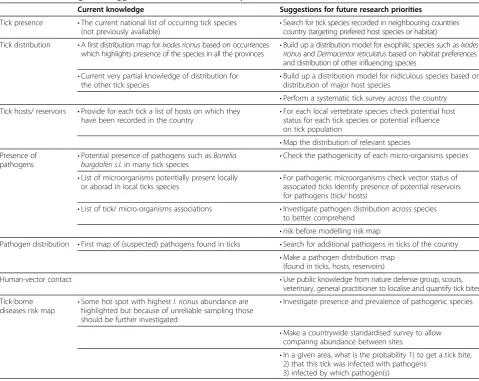
[image:15.595.57.537.354.735.2]predators) of the birds, mammals, reptiles, amphibian or other local species should be assessed and their distribu-tion investigated. (4) With regards to pathogens, their presence needs to be clarified. The list of micro-organisms /tick associations provided here needs to be narrowed by investigating pathogenicity, identifying reservoirs (ticks and other species), selecting pathogens for which reser-voirs are present, and identifying vector capacity for asso-ciated ticks. (5) With regards to pathogen distribution, pathogens should be monitored in ticks, reservoirs or any hosts to provide a spatial distribution per pathogen. (6) Human vector contact could be approached using pub-lic knowledge from groups at risk, such as nature lovers, hunters, foresters, veterinarians, health practitioners or even the general public. Such facilities for recording tick bites were developed successfully in the Netherlands [9]. (7) Finally a risk map should provide the following locally: integration of the above distribution maps to determine the probability of being bitten by a tick, to obtain an
Table 6 Main findings and suggestions for further research priorities
Current knowledge Suggestions for future research priorities
Tick presence •The current national list of occurring tick species (not previously available)
•Search for tick species recorded in neighbouring countries country (targeting prefered host species or habitat)
Tick distribution •A first distribution map forIxodes ricinusbased on occurrences which highlights presence of the species in all the provinces •
Build up a distribution model for exophilic species such asIxodes ricinusandDermacentor reticulatusbased on habitat preferences and distribution of other influencing species
•Current very partial knowledge of distribution for the other tick species
•Build up a distribution model for nidiculous species based on distribution of major host species
•Perform a systematic tick survey across the country Tick hosts/ reservoirs •Provide for each tick a list of hosts on which they
have been recorded in the country
•For each local vertebrate species check potential host status for each tick species or potential influence on tick population
•Map the distribution of relevant species Presence of
pathogens •
Potential presence of pathogens such asBorrelia
burgdoferi s.l.in many tick species •
Check the pathogenicity of each micro-organisms species
•List of microorganisms potentially present locally
or aborad in local ticks species •
For pathogenic microorganisms check vector status of associated ticks Identify presence of potential reservoirs for pathogens (tick/ hosts)
•List of tick/ micro-organisms associations •Investigate pathogen distribution across species to better comprehend
•risk before modelling risk map
Pathogen distribution •First map of (suspected) pathogens found in ticks •Search for additional pathogens in ticks of the country
•Make a pathogen distribution map (found in ticks, hosts, reservoirs)
Human-vector contact •Use public knowledge from nature defense group, scouts, veterinary, general practitioner to localise and quantify tick bites
Tick-borne
diseases risk map •
Some hot spot with highestI. ricinusabundance are highlighted but because of unreliable sampling those should be further investigated
•Investigate presence and prevalence of pathogenic species
•Make a countrywide standardised survey to allow comparing abundance between sites.
•In a given area, what is the probability 1) to get a tick bite, 2) that this tick was infected with pathogens
infected tick bite per pathogen, and a list of potential path-ogens locally. In this context, potential hotspots could be identified as well as places needing further investigation. This would provide a spatial disaggregation of risk and prepare analysis of seasonal or yearly variations.
I. ricinusis the main vector of diseases in Belgium be-cause it is present in most vegetated areas, carries many pathogens and is responsible for most tick bites in humans. Its distribution highlights the possibility of be-coming infected by the pathogenic agent of Lyme borreliosis in any province. Other species might play a role by maintaining pathogens present in wildlife, or by bring-ing pathogens closer to people in their houses and gar-dens. While the number of bites on humans caused by other species is less than by I. ricinus, occurrence of such an event in unexpected areas such as houses or gardens or during the winter season extends the risk to people not considered to be at risk and increases the probability of a tick bite being ignored. Some places seem to pose a greater risk with more abundant tick populations, higher diversity of pathogens or both, but this should be confirmed. Current prevention measures target B. burgdorferi s.l. mainly through deticking. Other pathogens are increasingly investigated and found in domestic animals, wildlife or humans and transmission of some of those can occur at the time of the tick bite without delay (e.g. TBEV). Avoidance be-haviour should be promoted such as avoiding areas with ferns [108], wearing boots and long trousers or repellent, using deticking as the second line measure. Another reason to avoid ticks is that in Belgium only 30% of Lyme patients remember a bite and 35% never develop Erythema migrans [109]. Lyme disease can be difficult to diagnose in the absence of Erythema
migrans and particularly if additional symptoms are
caused by co-occurring pathogens.
The analysis of the presence of pathogens in ticks might be easier than in human blood as organisms are more easily detected by PCR in ticks than in blood. Sys-tematic surveys using ticks as sentinels could assess the prevalence of the pathogens in wildlife. Geolocation of tick and pathogen records allows integration into a more general databases such as those developed in the frame-work of The Vbornet [5] or the TICK MAP initiative [110] and could help fulfil the empty maps for tick and tick-borne disease occurrence in Belgium [4,6]. This study based on imperfect sampling data calls for an increased surveillance of ticks and tick-borne species at a detailed spatial scale as well as clarification of local vector status for tick species and pathogens which occur in these species. A systematic survey of ticks and associ-ated pathogens is called for in Europe, as well as better characterisation of species interaction in the ecology of tick-borne diseases.
Additional files
Additional file 1:Detailed information available per sites of occurrence for ticks recorded in Belgium.Description: table per site with geographical coordinates in latitude-longitude and in Belgian Lambert, list of records included in the site, list of species included in the sites, literature/collection references for the sites and general quality level. Additionally to the main tab a Memo tab describes each field.
Additional file 2:Records of tick occurrence in Belgium.Description: a kmz file to open in Google Earth with 5 folders to navigate into the database. (1) Records per tick species: one point per record classified in folders by tick species, (2) Records per pathogens: one point per record classified in folders by pathogen genus then species, (3) Records per authors: one point per record classified in folders by authors, (4) Sites: one point per site with information on tick species and pathogens, (5) Records: One point per record with information available in the Additional file 1 included.
Additional file 3:Micro-organisms found locally or abroad in tick species present or potentially present in Belgium.Description: tick species, reference of the article and details on the records, discussion on pathogenicity to humans and potential transmission by tick species, and pathogenicity status as well as reference to specific articles and overall assessment of vector status.
Abbreviations
ARSIA:Association Régionale de Santé et d’Identification Animale; BLAST: Basic Local Alignment Search Tool; CCHFV: Crimean Congo Hemorrhagic Fever virus; DGZ: Dierengezonheidzorg Animal Health Care Flanders Belgium; DNA: deoxyribonucleic acid; dNTP: deoxy ribonucleotide triphosphate; IK: Issuk Kul virus; IRSIA: Institut pour l′encouragement de la recherche dans l′industrie et l′agriculture; IRSNB: Institut Royal des Sciences Naturelles de Belgique; ITS2: second Internal Transcribed Spacer 2; LIV: Looping Ill virus; OHFV: Omsk Hemorragic fever virus; PCR: Polymerase Chain Reaction; RLVBD: Reference Laboratory for Vector Borne Disease; SOK: Sokuluk virus; TBEV: Tick-borne Encephalitis virus; UA: University of Antwerp collection; UGENT FOREST: Ghent University, Forestry department collection; UGENT VETE: Ghent University, Faculty of Veterinary Medicine; UCLIREC: Université Catholique de Louvain Clinical and experimental research institute; WILDSCREEN: Network for disease surveillance in wildlife; WNV: West Nyle virus.
Competing interests
The authors declare that they have no competing interests.
Authors’contributions
VO: Design of the study, compilation of the record, writing up of the manuscript. MW: Organisation of data collection, tick and pathogens identification, writing up the manuscript. AL: Organisation of data collection, revising the manuscript. EC: Details on data collection, revising the manuscript. PH: Organisation of data collection, tick and pathogens identification, revising the manuscript. DH: Organisation of data collection, tick and pathogens identification, writing up the manuscript. MM: Organisation of data collection, tick and pathogens identification, revising the manuscript. JM: Organisation of data collection, revising the manuscript. ML: Details on data collection, revising the manuscript. WT: Details on data collection, revising the manuscript. LL: Details on data collection, tick and pathogens identification, revising the manuscript. TH: tick and pathogens identification, revising the manuscript. GvI: Collected many data, tick identification, advice on manuscript design, provided expert knowledge, and revised the manuscript. All authors read and approved the final version of the manuscript.
Acknowledgements
Many thanks to Adrien Nahayo and other collaborators of the WILDSCREEN network for monitoring of diseases in wildlife and for their time and effort in collecting ticks. The authors would also like to thank Philippe Martin from the Saint-Luc hospital in Bouge Belgium, Thomas Kesteman from the UCL IREC Institute, the staff of the Royal Institute for Natural Sciences of Belgium (IRSNB) including Georges Wauthy and Léon Baert, the staff of
Obsomeret al. Parasites & Vectors2013,6:190 Page 16 of 19
GlaxoSmithKline including Yves Lobet and Pierre Voet for providing fresh records or additional details on their published records. The authors are grateful to the nature organisation NATAGORA and NATUURPUNT and particularly Wouter Vanreusel, Marc Herremans, Karin Gielen, Jean-Yves Paquet and Antoine Derouaux for providing details and numerous records of tick location. Thanks to Sophie Vanwambeke, Eva De Clercq, Sen li and Nienke Harteminck for support and raw literature. Thanks to BAYER for accepting to share their records for our research. Many thanks to the Belgian Sciences Policy Office for funding this work through the STEREO II project for Earth Observation (MULTITICK project).
Author details
1Université Catholique de Louvain, Earth and Life Institute, Georges Lemaitre
climate and earth research centre, place Louis Pasteur 3, 1348, Louvain la Neuve, Belgium.2Biodiversity department ELIB, Université Catholique de
Louvain, Earth and Life Institute, 4 place Croix du sud, 1348,
Louvain-la-Neuve, Belgium.3Department of infectious and parasitic diseases,
health and pathology of the wildlife, University of Liège, boulevard de Colonster 20, 4000, Liège 1, Belgium.4Laboratory of Parasitology, Faculty of
Veterinary Medicine, Ghent University, Salisburylaan 133 9820, Merelbeke, Belgium.5Reference Laboratory for Vector-Borne Diseases, Queen Astrid
Military Hospital, Bruynstraat 1, 1120, Brussels, Belgium.6Evolutionary ecology group, Department of Biology, University of Antwerp, Groenenborgerlaan, 171-2020, Antwerpen, Belgium.7Institute for Tropical Medicine, 155 nationalestraat, B2000, Antwerpen, Belgium.8Department of Veterinary
Tropical Diseases, University of Pretoria, Pretoria, South Africa.9ARSIA, Allée des Artisans, 2 - 5590, Ciney, Belgium.10Dierenarts Gezondheidszorg
Herkauwers Veepeiler, DGZ Vlaanderen, l Hagenbroeksesteenweg 167 l, 2500, Lier, Belgium.11Laboratory of Forestry, Department of Forest and Water
Management, Ghent University, Geraardsbergsesteenweg 267, 9090, Melle-Gontrode, Ghent, Belgium.12Laboratory of Parasitology and Pathology
of Parasitic Diseases, Department of Infectious and Parasitic Diseases, Faculty of Veterinary Medicine, University of Liège, Bd de Colonster 20 B43, 4000, Liège, Belgium.
Received: 25 May 2013 Accepted: 16 June 2013 Published: 22 June 2013
References
1. Heyman P, Cochez C, Hofhuis A, Van der Giessen J, Sprong H, Porter SR, Losson B, Saegerman C, Donoso-Mantke O, Niedrig M, Papa A:A clear and present danger: tick-borne diseases in Europe.Expert Rev of Anti-Infe2010, 8:33–50.
2. Hofhuis A, Harms M, Van der Giessen G, Sprong H, Notermans D, Van Pelt W:Ziekte van Lyme in Nederland 1994–2009: Aantal huisartsconsulten blijft toenemen. Is voorlichting en curatief beleid genoeg?
Infectieziekten Bull2010,21:84–87.
3. Sprong H, Hofhuis A, Gassner F, Takken W, Jacobs F, van Vliet AJH, van Ballegooijen M, van der Giessen J, Takumi K:Circumstantial evidence for an increase in the total number and activity of Borrelia-infectedIxodes ricinusin the Netherlands.Parasit Vectors2012,5:294.
4. Estrada-Peña A, Farkas R, Jaenson TGT, Koenen F, Madder M, Pascucci I, Salman M, Tarrés-Call J, Jongejan F:Association of environmental traits with the geographic ranges of ticks (Acari: Ixodidae) of medical and veterinary importance in the western Palearctic. A digital data set. Experiment Appl Acarol2013,59(3):351–366.
5. VBORNET European network for arthropod vector surveillance for human public health.[http://www.vbornet.eu/].
6. EFSA Panel on Animal Health and Welfare (AHAW):Scientific opinion on geographic distribution of tick-borne infections and their vectors in Europe and the other regions of the Mediterranean basin.EFSA J2010,8(9):1723. 7. Heylen D, Tijsse E, Fonville M, Matthysen E, Sprong H:Transmission
dynamics ofBorrelia burgdorferi s.l.in a bird tick community. Environ Microbiol2013,15(2):663–673.
8. Wielinga PR, Gaasenbeek C, Fonville M, de Boer A, de Vries A, Dimmers W, Akkerhuis Op Jager G, Schouls LM, Borgsteede F, van der Giessen JWB: Longitudinal analysis of tick densities andborrelia,anaplasma, and ehrlichiainfections ofixodes ricinusticks in different habitat areas in the Netherlands.Appl Environ Microbiol2006,72(12):7594–7601.
9. Tekenradar.nl.The Netherlands: Publisher Wageningen University, RIVM en De Natuurkalender; 2013 [http://www.tekenradar.nl/].
10. Ducoffre G:Surveillance des maladies infectieuses par un réseau de laboratoires de microbiologie 2009. Tendances epidémiologiques 1983–2008. Belgian Institute for Public Health (ISP-WIV): Belgium; 2009 [http://www.iph. fgov.be/epidemio/epifr/plabfr/plabanfr/index09.htm.Rapport2009]. 11. Vanthomme K, Bossuyt N, Boffin N, Van Casteren V:Incidence and
management of presumption of Lyme borreliosis in Belgium: recent data from the sentinel network of general practitioners.Eur J Clin Microbiol Infect Dis2012,31:2385–2390.
12. Stanek G, Fingerle V, Hunfeld K-P, Jaulhac B, Kaiser R, Krause A, Kristoferitsch W, O'Connell S, Ornstein K, Strle F, Gray J:Lyme borreliosis: clinical case definitions for diagnosis and management in Europe.Clin Microbiol Infect 2011,17:69–79.
13. Claerebout E, Losson B, Cochez C, Casaert S, Dalemans AC, De Cat A, Madder M, Saegerman C, Heyman P, Lempereur L:Ticks and associated pathogens collected from dogs and cats in Belgium.Parasit Vectors2013,6:183. 14. Li S, Heyman P, Cochez C, Simons L, Vanwambeke SO:A multi-level
analysis of the relationship between environmental factors and questing Ixodes ricinusdynamics in Belgium.Parasit Vectors2012,5:149.
15. Tack W, Madder M, Baeten L, Vanhellemont M, Gruwez R, Verheyen K:Local habitat and landscape affectIxodes ricinustick abundances in forests on poor, sandy soils.Forest Ecol Manag2012,265:30–36.
16. Tack W, Madder M, De Frenne P, Vanhellemont M, Gruwez R, Verheyen K:The effects of sampling method and vegetation type on the estimated abundance ofIxodes ricinusticks in forests.Exp Appl Acarol2011,54:285–292. 17. Lempereur L, Lebrun M, Cuvelier P, Sépult G, Caron Y, Saegerman C, Shiels
B, Losson B:Longitudinal field study on bovineBabesia spp.and Anaplasma phagocytophiluminfections during a grazing season in Belgium.Parasitol Res2012,110:1525–1530.
18. Kesteman T, Rossi C, Bastien P, Brouillard J, Avesani V, Olive N, Martin P, Delmée M:Prevalence and genetic heterogeneity ofBorrelia burgdorferi sensu latoinIxodesticks in Belgium.Acta Clin Belg2010,65:319–322. 19. Heylen DJA, Madder M, Matthysen E:Lack of resistance against the tick
Ixodes ricinusin two related passerine bird species.Int J Parasitol2010, 40:183–191.
20. Heylen DJA, Matthysen E:Contrasting detachment strategies in two congeneric ticks (Ixodidae) parasitizing the same songbird. Parasitology2010,137:661–667.
21. Heylen DJA, Matthysen E:Differential virulence in two congeneric ticks infesting songbird nestlings.Parasitology2011,138:1011–1021. 22. Heylen DJA, Matthysen E:Experimental evidence for host preference in a
tick parasitizing songbird nestlings.Oikos2011,120:1209–1216. 23. Linden A, Wirtgen M, Volpe S, Nahayo A, Pirson J, Paternostre J, Grégoire F:
Surveillance of wildlife diseases in Belgium.Rev Épid San Anim2011, 59–60:213–215.
24. Zahler M, Gothe R, Rinder H:Genetic evidence against a morphologically suggestive conspecificity ofDermacentor reticulatusandD. Marginatus (acari: ixodidae).Int J Parasitol1995,25:1413–1419.
25. Dobec M, Golubic D, Punda-Polic V, Kaeppeli F, Sievers M:Rickettsia Helveticaindermacentor reticulatusticks.Emerg Infect Dis2009,15:98–100. 26. Bigaignon G, Martin P, Tomasi JP, Gonzalez M, Lozes E, Gillion P, Fain A:La
maladie de Lyme en belgique:présence du spirochèteborrelia burgdorferidans les tiquesixodes ricinusrécoltées dans la région mosane.Rev Med Liege1989,44(15–16):489–493.
27. Fain A:Les tiques de belgique: acari, ixodoidea.Belgium: Royal Belgian Institute of Natural Sciences Press; 1990.
28. Hillyard PD:Ticks of north-west Europe: keys and notes for identification of the species.London: Linnean Society of London and the Estuarine and Coastal Sciences Association, Field Studies Council; 1996.
29. Rageau J:Répartition géographique et rôle pathogène des tiques (acariens:ArgasidaeetIxodidae) en France.Wladomosci Parazytologiczne 1972,43(4-6):707–719.
30. Aubert M:Contribution à l′étude du parasitisme du renard (Vulpes vulpes L.) par lesIxodidae(Acarina) dans le nord-est de la France.
Acarologia1975,17(3):452–479.
31. Bronswijk JEMH, Garben AFM, Rijntjes RH:De teken ixodida van de benelux-landen.The Netherlands: Wetenschappelijke mededelingen van de Koninklijke Nederlandse Natuurhistorische Vereniging; 1979. 32. Petney T, Pfaffle M, Skuballa J:An annoted checklist of the ticks
(Acari:Ixodida) of Germany.Syst Appl Acarol2012,17:115–170. 33. Gern L, Rouvinez E, Toutoungi LN, Godfroid E:Transmission cycles of