Impact of Poor Basic Literacy and
Numeracy on Employers
The views expressed in this report are the authors’ and do not necessarily reflect those of the Department for Business, Innovation and Skills.
Department for Business, Innovation and Skills
1 Victoria Street
London SW1H 0ET
www.gov.uk/bis
Research paper number 266
Contents
About the authors ... 5
Summary ... 6
1. Introduction ... 14
1.1 Policy context ... 14
1.2 Aims of the research ... 16
1.3 Theoretical and methodological challenges ... 17
1.4 Methodology ... 19
1.5 The rest of this report ... 20
2. Prevalence of poor basic skills ... 21
2.1 Definition of basic skills gaps ... 22
2.2 Prevalence of poor basic literacy and numeracy... 23
2.3 Awareness of workforce skills needs ... 28
2.4 Characteristics of workplaces with basic skills gap ... 30
2.5 Characteristics of employees with poor basic skills ... 32
3. Economic impacts of poor basic skills on workplace performance ... 34
3.1 Impact of poor basic skills ... 36
3.2 Econometric analysis... 41
4. Characteristics of workplaces providing basic skills training ... 47
4.1 Provision of basic skills training ... 48
4.2 Reasons for not providing basic skills training ... 49
4.3 Public-funded basic skills training ... 52
4.4 Motivations for providing basic skills training ... 55
5. Costs and benefits of workplace basic skills training ... 60
5.2 Benefits to the organisation ... 64
5.3 Costs to the organisation ... 66
5.4 Econometric Analysis of costs and benefits ... 67
6. Conclusions and implications ... 72
About the authors
Trinh Tu is Head of Employment, Welfare and Skills research in the Ipsos MORI Social Research Institute. She has 20 years research experience focusing on skills shortages, unemployment and the evaluation of government training and employment programmes.
Dr Matt Colahan is a Research Manager at Ipsos MORI. He is a Fellow of the Higher Education Academy. He is currently evaluating the impacts of various employer-led training initiatives for the UK Commission for Employment and Skills.
Chris Hale is an Associate Director and economist within Ipsos MORI, with 13 years’ experience in assessing the impacts, costs and benefits of public intervention across all major policy areas.
John D’Souza is a statistician at Ipsos MORI. He has over 20 years’ experience in statistics as a lecturer and an applied statistician.
Alex McCallum is an economist in Ipsos MORI’s Policy and Evaluation Unit.
David Mallows is Director of Research at NRDC, UCL Institute of Education, London. He has over 25 years experience in adult education as a teacher, teacher trainer, manager and researcher.
JD Carpentieri is a Lecturer in Adult Education at NRDC, UCL Institute of Education, London. He has extensive experience conducting research and evaluation projects in the field of adult learning.
Jenny Litster is Senior Project and Business Development Officer at NRDC, UCL Institute of Education, London. She is a project manager and a researcher who specialises in desk-based research and the design of evaluation methodologies and instruments.
The employer case studies were carried out by Brian Creese, JD Carpentieri, Sam Duncan, Natasha Kersh, David Mallows, and Jon Swain (all UCL Institute of Education, London)
Summary
This report presents the findings of a study to estimate the economic impact of poor basic skills on workplace performance. The study, undertaken by Ipsos MORI Social Research Institute in partnership with the National Research and Development Centre for Adult Literacy and Numeracy (NRDC) at the Institute of Education, aims to address the lack of evidence on the prevalence of poor basic skills in the workplace and its impact, as well as the costs and benefits associated with public-funded basic skills training.
Successive UK governments have focused on addressing basic skills deficit in the
workforce in recognition of the economic and wider public benefits. However, much of the research evidence on the impact of basic skills interventions has focused primarily on employees’ basic skills levels1 rather than on the impact of these skills on employers.
There is little reliable evidence on the scale of costs resulting from basic skills deficits in the workplace. Where research has been undertaken in this field, it has focussed on the routes through which employers might incur costs rather than attempting to estimate them. This study aims to bridge the evidence gaps by drawing on both primary and secondary data sources including:
• A comprehensive literature review of qualitative and quantitative evidence on the prevalence and costs of poor basic literacy and numeracy in the workforce, and the range impact to employers from providing workplace basic skills training.
• A nationally representative survey of 4,234 workplaces in England to estimate the prevalence of poor basic skills in the workplace, and a survey of 4,239
workplaces that have delivered public-funded basic skills training to estimate the costs and benefit of the training2. Where permission was given, the survey
responses were augmented by observations on turnover and employment taken from the Business Structure Database held within the ONS Virtual Micro-data Laboratory.
1 For example, the OECD Programme for the International Assessment of Adult Competencies (PIAAC). 2 Though it should be noted that the large majority of these workplaces were delivering basic skills training as part of an Apprenticeship which posed challenges in terms of isolating the impact of the basic skills training – this is discussed in detail in sections 3.2 and 5.2.
• In-depth follow-up case studies which combine participant observation and employer and employee interviews at nine workplaces.
Prevalence of poor basic skills in workplaces
There is a lack of consensus on how to define (and, therefore, measure) literacy and numeracy needs and deficits within a workplace context. Employers often view
employees’ skills as a holistic group of functional and social skills of which literacy and numeracy are only two components. This research attempted to address this conceptual issue by moving away from abstract, broad-brush notions of literacy and numeracy and, instead, focused on specific real-world examples of work-based activities3. In this way, respondents would be encouraged to think about the use of literacy and numeracy within their workplace. One in eight (12%) workplaces in England report a literacy and/or
numeracy gap whereby at least one member of staff is unable to perform certain literacy or numeracy tasks to the level required in their day-to-day job. More workplaces report a literacy gap than numeracy gap (8.6% vs 6.6%). Only 3.2% of workplaces report a deficit in both.
However, evidence from the case studies suggests that the prevalence of basic skills deficits in England may be understated for a number of reasons.
Firstly, a number of the employers interviewed for the case studies have poor
understanding of the basic skills elements within the tasks that their employees carry out. For example, during the case study interviews it was common for employers to begin by asserting that their employees had the basic skills needed for their jobs.
However, as the interviews progressed, examples of basic skill gaps started to emerge. Employers also have poor awareness of the literacy and numeracy gaps within their workforce and, by implication, the impact of such gaps on their own workplace performance. There is limited evidence from the case studies of employers requiring certain qualifications to verify levels of literacy and numeracy or of the mapping of these to job roles. Instead, for roles which involve specific literacy or numeracy tasks, employers
3 A total of seven literacy and numeracy tasks were devised based on the literature review. These were: 1) Fully understand written procedures; 2) Complete day-to-day paperwork without errors; 3) Respond in writing; 4) Communicate verbally with clients, colleagues or subcontractors; 5) Spot numerical error; 6) Perform simple arithmetic/calculations; and 7) Use numerical data or information correctly in day-to-day activities.
created and used their own assessment tools as part of the recruitment process. In some cases they also assumed a certain level of literacy and numeracy had been achieved by potential recruits through vocational or professional qualifications that they hold. These findings are consistent with the survey results which show that the majority of
workplaces (56%) do not specify minimum levels in English or maths in their recruitment. In addition, a sizeable minority (43% of workplaces) do not undertake an annual performance review for all their staff which point to a lack of effective
mechanisms to measure and monitor basic skills in the workplace.
Secondly, the case studies also suggest that, in the modern workplace limitations to employees’ numeracy and literacy are masked by the use of ICT interventions, such as software packages that help with account management, and templates for written correspondence. There was also evidence of use of informal solutions such as peer support.
These practices allow employers to compensate for deficits without having to explicitly tackle any training needs that employees might have. Indeed two thirds of workplaces with a reported basic skills gap do not provide basic skills training.
What’s more, work processes designed to compensate for, or mask, literacy and
numeracy deficits among employees may contribute to skills decline and poor take up of training opportunities by reducing the demands on employees’ skills and their motivation to improve them.
Impact of basic skills deficits in the workforce
Workplaces with basic skills gap report a range of costs to their business with efficiency-related costs being most common: between a third to a half of employers with a basic skills gap reported an increase in the number of errors made by staff, a constraint on the introduction of new and/or more efficient processes, and/or a reduction in
product or output quality.
A number of analyses were conducted to explore the strength of the relationship between basic skills deficiencies amongst employees and firm-level productivity4 controlling for
influential factors such as industry sector, type of organisation, firm size including composition of full-time and part-time employees. Overall no statistically significant relationship was detected. This finding is consistent with the broad results of the survey: low proportions of employers (12%) reported a gap in basic literacy or numeracy, with fewer still (8% of all employers) reporting that those gaps caused material impacts on the performance of their workplace. As such, the aggregate effect of these skills deficits might be expected to be of insufficient magnitude to be detectable through econometric
analysis.
There are a number of possible explanations for this finding. As already highlighted, some employers have been able to mitigate against the impact of poor literacy and numeracy through use of ICT interventions and informal solutions and strategies such as peer support to reduce the extent to which these skills are required to complete many
processes. The results also need to be taken in the context of prevailing labour market conditions. The survey was undertaken in late 2012, at a time when unemployment remained high relative to pre-recession levels meaning employers may have been more able to place workers with literacy and numeracy deficits in occupations where these skills are not required or have limited impact on efficiency or profitability.
Finally, failure to observe statistically significant effects at a firm level does not
necessarily imply that there are no economic costs associated with poor basic skills in the workforce. For example, research suggests that employees with basic skills deficits may receive lower wages (e.g. Bassi, 1995; Ananiadou, 2003). Furthermore, if such deficits were to be addressed, the workers involved might be redeployed in higher value processes, leading in the longer term to an expansion in total output (i.e. GVA - Gross Value Added). However, the benefits of doing so may not accrue to the employers concerned (particularly if they have compensated for skills deficits through investment in
4 The study was constrained to a proxy measure of productivity (turnover per worker). While this measure captures any direct effects of basic skills deficits on sales (potentially mediated through inefficiency in production, low product quality or poor customer service), it does not capture any effects driven by increased production costs. Such costs might emerge if basic skill deficits cause wastage in production processes or through greater requirements to invest in training. See section 3.2 for further discussions on methodological issues.
technology) as workers may need to move elsewhere to exploit these skills. If this is the case, incentives for employers to invest in basic skills training may not always be strong.
Prevalence of basic skills training
Nationally, 15% of workplaces report that they have provided basic skills training over the past year. The majority of workplaces with a reported basic skills gap (68%) do not
provide basic skills training. Furthermore, the case studies did not identify formal basic skills training as a priority for employers or for employees.
The primary reason for not providing basic skills training (cited by 90% of employers who do not provide training) is that they do not have basic skills needs in the workforce. This reason was also cited by seven in ten employers who reported a basic skills gap in their workforce, further reinforcing the case study evidence that many modern workplaces are addressing the limitations to employees’ numeracy through the use of ICT and
informal solutions and strategies, including shadowing, peer support and scaffolding5. This system is seen as adequate to cover the deficits, but the more informal elements can also be precarious where higher skilled staff are not always present.
Impact of public-funded basic skills training
Employers that have delivered public-funded basic skills training to employees report a number of business benefits (though this may be conflated with the Apprenticeship training); the most commonly cited benefits are: a reduction in the number of errors made by the workforce (cited by 63%), an increase in the organisation’s capacity to meet
statutory and industry requirements (58%); being able to introduce more efficient or new processes (52%); and being able to produce higher quality products (51%).
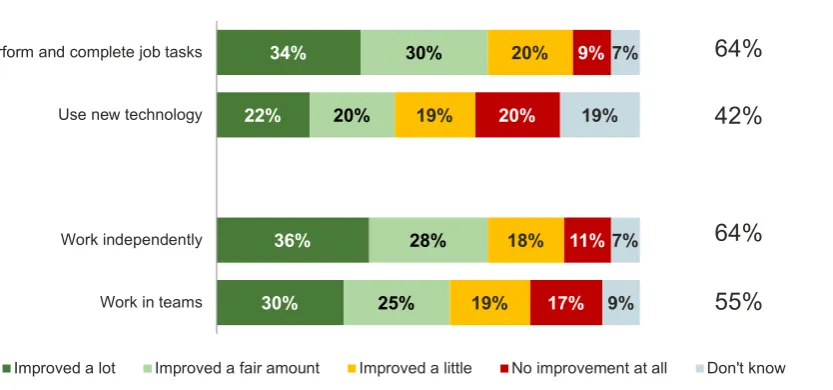
In addition, these employers also report benefits for their employees following the public-funded basic skills training: 64% say they see an improvement in employees’ ability to perform and complete job tasks; a similar percentage (64%) report an improvement in employees’ ability to work independently; 55% cited employees’ ability to work in teams; and 42% see an improvement in employees’ abilities to use technology.
5 The use of systems or processes that allow employers to reduce their requirements for higher level skills.
In terms of costs, half (52%) of employers indicated that they provided staff to cover the work of all employees receiving basic skills training, incurring financial costs through paying additional wages.
Further econometric analysis was undertaken to estimate the impact of basic skills training on: (i) the prevalence of basic skills deficits, and (ii) firm performance. This research
focused on the impact on workplaces only and does not measure any benefits to individual learners.
For both analyses, no statistically significant relationship was detected. These results are consistent with the low levels of training provided in the workplace – on average, 2.4% of employees per workplace completed basic skills training.
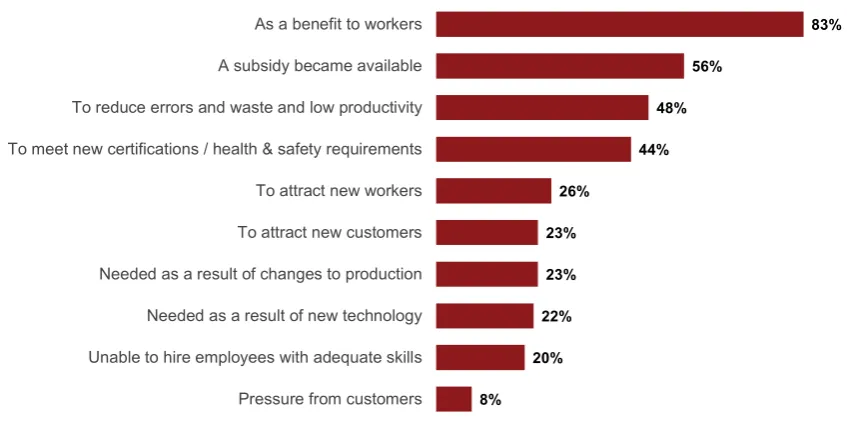
The estimations of the impact of basic skills training may also be biased by the lack of an isolated training intervention – 97% of workplaces offering public-funded basic skills training were doing it as part of an Apprenticeship and it is possible that these employers may not perceive the basic skills element as necessary meaning that the econometric analysis could be looking for an impact within a much smaller group of learners with an actual need for the training. Linked to this, the survey data suggests that employers’ motivations for providing training are more complex and the natural assumption of a direct relationship between training/education and competencies do not always hold true. For example, 83% of employers who provide public-funded basic skills training do so as a benefit to staff; less than half said the training was implemented to reduce waste and low productivity; and only 20% said the training was offered specifically as a result of skills deficiencies in the labour market.
Finally, as already discussed, employers may also be mitigating the impact of poor levels of basic skills within the workforce through use of technology and informal solutions and strategies.
be felt over an extended period. For example a study commissioned by BIS6 suggested that every £1 spent on apprenticeship funding delivered a benefit (NPV) of £35-£40 over the working life of the employee. Given the low numbers receiving basic skills training (as part of an Apprenticeship), and the long-term nature of predicted benefits, the magnitude of any impact over the course of a year7 could be very small indeed.
The ability to estimate this relationship would likely be improved with repeated
observations over time – allowing for additional econometric techniques to be used that improve the accuracy of results – allowing for a more detailed picture of changes
occurring over time in specific industries, sectors, or even specific employers.
Conclusions
Evidence from the case studies suggest that some employers may be underestimating the extent of their basic skills gaps, which could point to a lack of effective mechanisms to measure and monitor basic skills in the workplace. A recurring theme from the case studies was that some employers have a very narrow understanding of literacy and numeracy in relation to job roles and requirements and business performance. In order to better understand and support their employees in meeting the literacy and numeracy demands of the workplace, employers need support in understanding the literacy and numeracy components of workplace tasks.
Some employers make use of low cost and informal mechanisms, like scaffolding of tasks or explicit on-the-job training, in order to diminish the impact of poor skills. Informal
solutions such as shadowing, scaffolding and peer support allow some firms to compensate for deficits without having to explicitly tackle any training needs that employees might have. However, there were also examples of employers using these methods to develop employees’ skills as well as to compensate for deficits, and there is a need to study these types of collaborative workplace practices in more detail. The case studies have highlighted that this level of detail is vital for a fuller understanding of the impact of poor literacy and numeracy in the workplace.
6 BIS Research Paper No. 38 – Measuring the Economic Impact of Further Education; March 2011. 7 The time period selected in the current study.
The majority of employers (85%) do not provide any form of basic skills training, with the majority (90%) saying that they have no need for it. The low number of staff
undertaking public-funded basic skills training (an average of 2.4% of employees per workplace) and as part of an Apprenticeship means that such training may not be a vehicle for affecting a significant change in workplace performance; as stated this research does not assess the impact of basic skills training on individuals and the wider economy.
The case study evidence suggests that the supply of training needs to be more closely aligned with the demands of the workplace. There was little evidence that firms were interested in helping their employees’ to gain a formal qualification, except where that qualification was deemed to have an external currency. Many employers appear to feel that scaffolding of literacy and numeracy tasks and/or informal skills development between colleagues was a more appropriate solution. Further research could be done to
1. Introduction
This report presents the findings of a study to estimate the impact of poor basic literacy and numeracy on employers in England. The study, undertaken by Ipsos MORI Social Research Institute in partnership with the National Research and Development Centre for Adult Literacy and Numeracy (NRDC) at the Institute of Education, brings together evidence from multiple sources including: a comprehensive literature review, a nationally representative survey of 4,234 workplaces in England, a survey of 4,239 workplaces that have delivered public-funded basic skills training and detailed case studies with
employer and employees in nine workplaces.
This chapter first details the background to the study. The research aims and objectives are then discussed, prior to the chapter outlining the methodology used for the study.
1.1 Policy context
Basic skills deficits in England and the UK
Successive UK governments have focused on addressing basic skills deficit in the
workforce in recognition of the economic and wider public benefits. Since the late 1960s, advances in technology and globalisation have led to major changes in the workplace and a move towards a more skills-based economy in England, resulting in a greater demand for workers to possess at least basic level skills in English and maths (e.g. Levenson, 2004; Hoyles et al, 2002).
The Moser Report8, commissioned by the Labour government to tackle the “vast basic skills problem in this country", states that the minimum basic skill levels required by adults to function in work and society were Level 1 literacy and Entry Level 3 numeracy. The government responded by launching the Skills for Life strategy. When the strategy was launched in 2001, free literacy, language and numeracy training was made
available to all adults without a Level 2 qualification (equivalent to a GCSE at A* - C). As part of the Skills for Life strategy, a nationwide survey of basic skills (Skills for Life
Needs and Impact Survey) was published in 2003; the survey estimated that, in England 5.2 million adults aged 65 had literacy below Level 1, and 6.8 million adults aged
16-8A Fresh Start – Improving Literacy and Numeracy, DfEE, 1999
65 had numeracy below Entry Level 3. A similar picture emerged in 2011 when the survey was repeated; whilst more adults were proficient at Level 2 literacy, there was no change at Entry Level 3 and below. The 2011 survey also indicated a slight decline in numeracy above Level 1, and an increase in the proportion falling below Entry Level 2.
More recently, the OECD Programme for the International Assessment of Adult Competencies (PIAAC) 2013 found that whilst the UK’s mean literacy proficiency is around average for adults aged 16-65, it is in the bottom three countries for 16-24 year olds9. A similar picture emerges for numeracy; the UK is below average for 16-65 year
olds and in the bottom four for 16-24 year olds. Thus, overall the UK performs worse in numeracy relative to literacy, and young adults are more disadvantaged relative to the overall population in both literacy and numeracy.
However, research such as the PIAAC does not include an employer perspective. Indeed, the research evidence has focused primarily on employees’ basic skills levels rather than on the impact of these skills on employers. The Employer Skills Survey 2013 (UKCES) found that, 12% of employers said their employees’ literacy needed improving or updating in the next 12 months and a similar proportion (13%) identified numeracy. However, there is little reliable evidence on the scale of costs resulting from basic skills deficits in the workplace. Where research has been undertaken in this field, it has focussed on the routes through which employers might incur costs rather than attempting to estimate them. The most prominent attempt to estimate costs to UK employers was undertaken by Gallup10, which stated a figure of £4.8 billion a year.
However, whilst widely cited, the reliability of the estimates have been highly criticised (Robinson, 1997).
Addressing basic skills deficits through workplace training
Between 2001 and 2008, the government invested £5 billion in the Skills for Life
strategy11, to meet targets for ‘functional’ literacy and numeracy levels by 2020. One of the most prominent initiatives was Train to Gain which funded brokers to encourage employers to take up training opportunities. In practice, employer take-up of the scheme
9 The only other countries where young adults score worse than older people are Cyprus and Norway. 10 Commissioned by the (then) Adult Literacy and Basic Skills Unit (ALBSU), 1992.
11 Revised and updated on a number of occasions: see the Leitch Review (DIUS, 2007), Skills for Life: Progress in Improving Adult Literacy and Numeracy (NAO, 2008), and Skills for Life: Changing lives (DIUS, 2009).
was much lower than anticipated (NAO, 2008), and an Ofsted evaluation of the scheme reported that:
“The provision of skills for life training was a particular weakness. Those employees with language, literacy, or numeracy (skills for life) needs rarely received sufficient training or encouragement to improve their skills” (Ofsted, 2008, p.4)
Train to Gain was cancelled by the Coalition Government, and in 2010 the Skills for Sustainable Growth strategy was launched. This re-iterated the need for a skilled workforce to drive growth in jobs and GDP, and committed to public-funded basic skills training that would be demand-led by employers and learners:
“We will therefore continue to fully fund literacy and numeracy provision for those who need it […] to focus on equipping individuals with the skills and qualifications they need to get a job, progress in work and play a full part in society” (BIS, 2010, p.32)
The merits of programmes designed to improve basic skills are contested in the literature. A review of workplace literacy and numeracy training in and outside the UK suggested that such training does not lead to increased turnover, although there may be benefits in terms of staff retention (Ananidou, 2003). However, a review of a
state-funded literacy programme in the US state of Indiana, found that both employers and employees reported productivity gains (Hollenbeck and Timmeney, 2009). Regardless, it remains that the evidence on the benefits of workplace skills training to employees vastly outweighs the evidence on the benefits to employers. Furthermore, evaluations have tended to rely heavily on qualitative data. As Bassi (1994, p.67) stated: “The impact of workplace education programmes is known to be extraordinarily difficult (if not impossible) to quantify rigorously.”
1.2 Aims of the research
The aim of this study is to address the lack of robust evidence on the impact of poor basic skills to employers in England. Specifically the research seeks to:
1) Estimate the prevalence of basic skills deficits in the workforce and the
2) Estimate the costs and benefits associated with public funding for workplace basic skills training.
1.3 Theoretical and methodological challenges
Meeting the aims of the research presents a number of theoretical and methodological challenges. These are described below along with the approach taken to mitigate them.
Defining and measuring ‘poor’ basic skills
There is a lack of consensus on how to define (and, therefore, measure) literacy and numeracy needs and deficits within a workplace context. Employers often view
employees’ skills as a holistic group of functional and social skills of which literacy and numeracy are only two components. In 2009 the UK Commission for Employment and Skills developed a theoretical framework which placed literacy and numeracy in a
broader context of employability skills. Within this framework, literacy and numeracy are conceptualised as ‘functional skills’ which are supported by other personal
characteristics sought by employers (e.g. readiness to participate, taking responsibility, self-management, problem solving). Defining ‘poor’ basic skills remains inherently challenging.
This research attempted to address this conceptual issue by moving away from abstract, broad-brush notions of literacy and numeracy and, instead, focused on specific real-world examples of work-based activities. In this way, respondents would be encouraged to think about the use of literacy and numeracy within their workplace.
Measuring impact of poor basic skills
It is very difficult to isolate the contribution that literacy and numeracy may have on productivity. Research suggests that respondents find it difficult to ascribe a monetary value to costs of basic skills. Therefore, this research used objective measures (e.g. turnover, training budgets etc.) to estimate the impact of poor basic skills as opposed to subjective assessments.
Data collection
the interviews should be with “the most senior person at the workplace” since this individual would be best placed to answer both questions relating to employees’ skills needs and firm-level performance12.
Some research suggests that the impact of basic skills training on employees’ abilities is limited and transient (Wolf and Evans, 2011), whilst other international research has shown that employers believe that such programmes are unlikely to have an immediate impact (Plett, 2007). In the absence of clear evidence on the most appropriate timescale for measuring the impact of basic skills training, an elapsed period of 12 months was chosen for the sample of employers who have delivered public-funded basic skills training.
Identifying basic skills training and isolating its impact
The Individualised Learner Record (ILR) was used to identify employers who had provided public-funded basic skills training. However, it should be noted that 97% of employers were delivering basic skills training as part of an Apprenticeship13. Therefore,
similar to the difficulties in isolating the impact of skills deficits, there were inherent challenges in attempting to isolate the benefits of basic skills training. Firstly, because the vast majority of basic skills training was part of a broader package of training and, secondly, because it was delivered to small numbers of employees (Wolf & Evans, 2011). On average, the employers who provided public-funded basic skills training in this study had two employees complete the training during the reference period of September to December 2012. Finally, recent evidence from the Longitudinal Study of Adult Learning (LSAL)14 in the US has shown that the impact of skills programs take
many years to fully develop and short-term evaluation of programs may miss much of their eventual impact. These factors combined pose significant challenges to identifying the impacts of basic skills training at the level of the firm15.
12 This was often the owner for small, single-site businesses.
13 From Academic Year 2012/13 all Apprenticeship providers are required to provide opportunities to support apprentices in progressing towards achievement of Level 2 functional skills or GCSE qualifications.
14 Prof. Stephen Reder Portland State University, Oregon, USA.
15 This research does not look at the impact of basic skills training on employees (i.e. the training could lead to long-term economic benefits for both the individual and the wider economy).
Finally, there are a number of methodological challenges associated with the econometric analysis. These are discussed in detail in sections 3.2 and 5.4.
1.4 Methodology
The study comprises three distinct phases:
Phase 1: Literature review
The first stage involved a systematic literature review to produce a theoretical framework of the routes through which business performance may be affected by workforce English and maths skills. The theoretical framework was subsequently used to inform the
questionnaire design for the employer surveys and case studies.
The literature review synthesised evidence from qualitative and quantitative studies that shed light on the costs to employers of poor literacy and numeracy. It also addressed the benefits of, and the barriers to, workplace training, with a focus on employer
perceptions of the need for and efficacy of workplace training in English and maths. The review also considered and summarises key theoretical and methodological issues.
Phase 2: Employer surveys
Ipsos MORI conducted a telephone survey with a nationally representative sample of 4,234 workplaces in England, and a telephone survey with 4,239 workplaces that had delivered public-funded basic skills training one year prior to the survey. Where permission was given, the survey responses were augmented by observations on turnover and employment taken from the Business Structure Database held within the ONS Virtual Micro-data Laboratory16. The survey fieldwork took place between October
2013 and January 2014.
For the survey of workplaces in England the sample was drawn from the
Inter-departmental Business Register (IDBR), disproportionately stratified by size of worksite and sector to facilitate sub-group analyses. The final data has been weighted to be representative of all employers in England.
16 This work contains statistical data from ONS which is Crown Copyright. The use of the ONS statistical data in this work does not imply the endorsement of the ONS in relation to the interpretation or analysis of the statistical data. This work uses research datasets which may not exactly reproduce National Statistics aggregates
For the survey of workplaces that had provided public-funded basic skills training, employers were identified using the Individualised Learner Record (ILR) which contains a flag to identify the employer for learners who had undertaken basic skills training. In-scope employers were matched to the Blue Sheep database to append employers’ telephone numbers, addresses, and other ‘firmographic’ information such as industry and number of employees (which was verified and updated during the interview if
necessary). The final data has been weighted to be representative of all employers who had employees finish basic skills training during September to December 2012.
Case studies
In order to contextualise the survey findings, nine detailed case studies were conducted in June 2014 with employers who had taken part in the survey. The case studies
included interviews with a range of managers and employees, and also an observational component which focused on employee engagement with basic literacy and numeracy tasks and artefacts in the workplace. Lastly, the case studies collected and analysed documentation used by employees in their job roles.
1.5 The rest of this report
The rest of this report is divided into the following chapters:
Chapter 2 - Prevalence of poor basic skills across workplaces in England
Chapter 3 - Economic impacts of poor basic skills on firm performance
Chapter 4 - Characteristics of firms providing basic skills training
Chapter 5 - Costs and benefits of workplace basic skills training
2. Prevalence of poor basic skills
Key findings
Overall, 12% of workplaces in England report a basic skills gap whereby at least one of their employees is unable to perform a literacy or numeracy task to the level required in their day-to-day job: 5% indicates a literacy gap only, 3% indicates a numeracy gap only17 and 3% state both.
Understanding written procedures and communicating verbally are the most frequently cited skills requiredby employers, whilst spotting numerical errors and responding in writing are the least required (though overall the differences between the tasks are slight).
Employers who report basic literacy and/or numeracy deficits are more likely to be part of a larger organisation. This is because larger employers are more likely to have HR systems in place to identify skills problems among their workforce and to seek a solution to that problem. There is evidence from the case studies that the prevalence of skills deficits in England may be understated because employers have poor awareness of the literacy and numeracy gaps within their workforce, partly because they have adapted by putting in place coping strategies but also because they have a narrow understanding of literacy and numeracy in relation to job roles and requirements.
Employers reporting a basic skills gap are more likely than those that do not, to operate in Manufacturing and Wholesale, Retail and Motor Repairs. Basic literacy gaps are most prevalent among Skilled Trades, Process, Plant and Machine Operatives and Personal Service occupations. Basic numeracy gaps most prevalent in Elementary occupations and in Sales and Customer Service.
This chapter looks at the prevalence of poor basic literacy and numeracy in workplaces in England, and the characteristics of employers who identify these skills deficits in their workforce. Where relevant, comparisons are made with a separate sample of employers who have provided public-funded basic skills training in the past year.
2.1 Definition of basic skills gaps
The definition of a ‘basic skills gap’ in this study is:
A workplace reporting that at least one member of staff is unable to perform one or more specific literacy or numeracy tasks to the level required in their day-to-day job
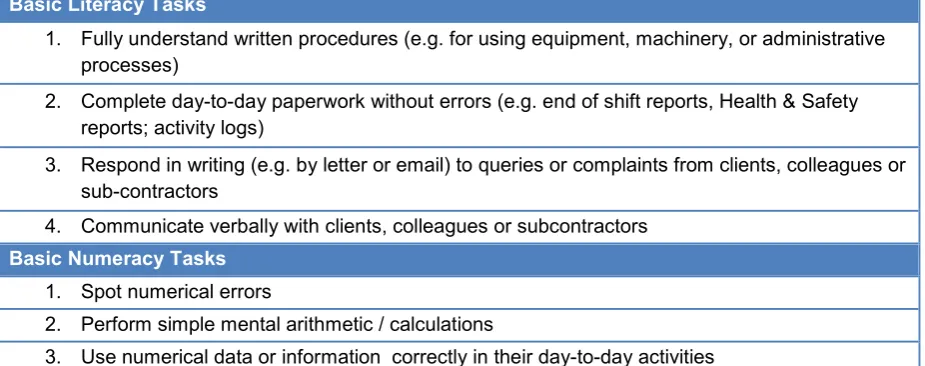
[image:22.595.68.531.431.614.2]The literacy and numeracy tasks that respondents were asked about are outlined below in Table 2.1. By specifying real world tasks the research moves away from abstract notions of ‘literacy’ and ‘numeracy’ which are difficult for respondents to conceptualise and estimate.
Table 2.1: Basic literacy and numeracy tasks
Basic Literacy Tasks
1. Fully understand written procedures (e.g. for using equipment, machinery, or administrative processes)
2. Complete day-to-day paperwork without errors (e.g. end of shift reports, Health & Safety reports; activity logs)
3. Respond in writing (e.g. by letter or email) to queries or complaints from clients, colleagues or sub-contractors
4. Communicate verbally with clients, colleagues or subcontractors
Basic Numeracy Tasks
1. Spot numerical errors
2. Perform simple mental arithmetic / calculations
2.2 Prevalence of poor basic literacy and numeracy
OverallOverall, 12% of workplaces in England report a basic skills gap, with 5% indicating a literacy gap only, 3% indicating a numeracy gap only18 and 3% stating both. In total, 8%
of workplaces report a basic literacy gap and 6% report a basic numeracy gap. However, evidence from the case studies suggests that employers may be understating the extent of basic skills deficit in the workplace (section 2.3).
Looking specifically at the group of employers who have provided some form of public-funded basic skills training19, the prevalence of reported basic skills gaps is higher which is to be expected since this group of employers have delivered the training to address identified skills needs: 22% of these employers report a basic skills gap with 11% indicating a literacy gap only, 4% indicating a numeracy gap only, and 7% stating both. In total, 18% of these employers cite a basic literacy gap and 11% cite a basic numeracy gap. The reasons for the higher incidence are explored in section 2.3. Overall fewer employers (regardless of whether or not they provide basic skills training) cite employees’ numeracy problems, mainly because they are less likely to require their employees to perform these tasks.
Evidence on the prevalence of basic skills gaps in English workplaces is inconsistent. For example, Atkinson and Spilsbury (1993) reported that 10% of workplaces identified employees’ basic skills as ‘just adequate or worse’. In the Employer Skills Survey (ESS) 2013, 12% of workplaces said their employees’ literacy needed improving or updating in the next 12 months, whilst 13% identified numeracy. In ESS 2011, 18% of workplaces reported a basic skills gap (though respondents were not asked about literacy and numeracy separately). This distinction was made in ESS 2009: 4.5% of workplaces reported a literacy gap and 4% reported a numeracy gap. Similarly, Robertson (1997) reviewed the results from three waves of the Skills Needs in Britain survey (1994-1996)
18 The precise figures are 5.4% for literacy only and 3.4% for numeracy only. This rounding accounts for the percentage point difference compared to the overall figure of 12%.
19 These employers were sampled from the Individualised Learner Record (ILR) which records all learners who have received post-16 training funded by the Skills Funding Agency.
and suggested that only 4% of employers felt that business objectives were impeded by poor basic skills.
By individual task
Looking across the individual literacy and numeracy tasks, there is some variation in employers’ requirements for the different tasks. Communicating verbally and
understanding written procedures are the most frequently cited skills required by
employers, whilst spotting numerical errors and responding in writing are the least cited. There is limited variation by task for reported skills gap (see Figure 1).
Figure 1: Proportion of employers reporting skills gaps
94% 92% 88% 87% 86% 84% 83% 4% 4% 4% 4% 4% 2% 3% 1% 4% 6% 7% 9% 12% 11%
Communicate verbally with clients or colleagues
Fully understand written procedures (e.g. for using equipment, machinery, or administrative processes)
Use numerical data or information correctly in their day-to-day activities
Perform simple mental arithmetic / calculations
Complete day-to-day paperwork without errors (e.g. end of shift reports, Health & Safety reports)
Respond in writing (e.g. by letter or email) to queries or complaints from clients or colleagues
Spot numerical errors
No Gap Gap Not required
Base: Nationally representative sample 4,234 workplaces in England; “Don’t know” responses not shown
% of employers nationally reporting skills gaps
Figure 2: Proportion of employers providing public-funded training reporting skills gaps 90% 89% 86% 82% 85% 83% 78% 8% 8% 5% 6% 9% 4% 5% 1% 2% 7% 10% 4% 11% 13%
Communicate verbally with clients or colleagues
Fully understand written procedures (e.g. for using equipment, machinery, or administrative processes)
Use numerical data or information correctly in their day-to-day activities
Perform simple mental arithmetic / calculations
Complete day-to-day paperwork without errors (e.g. end of shift reports, Health & Safety reports)
Respond in writing (e.g. by letter or email) to queries or complaints from clients or colleagues)
Spot numerical errors
No Gap Gap Not required
Base size: Nationally representative sample of 4239 workplaces with employees completing public-funded basic skills training between September and December 2012. "Don't know" responses are not shown.
% of employers providing publically-funded basic skills training reporting skills gaps
Responding in writing and completing day-to-day paperwork was frequently cited in the case study interviews, perhaps due to its high visibility and clear relation to basic skills. In case study one, a social enterprise in the North East, the manager expressed concern about the writing skills of the volunteers, who made up a large proportion of the
workforce. She reported often feeling that emails were written too abruptly, conveying an aggressive attitude. She also noted that when using case notes to resolve grievances they were often written ambiguously and needed repeated readings to be clear on what they reported. She did not feel they were consistently of sufficient quality to gain the benchmarking they were aiming to achieve. She also felt that advisors generally were not always good at writing appropriately for different audiences.
standard grammar and punctuation) and mistakes in emails would reflect badly on the brand. The kind of mistakes made include spelling, homophones, grammar (verb tenses, non-standard forms like ‘I done this…’) and punctuation (in particular whole paragraphs without full stops or commas). This case study illustrates how company policy and practice is shaped by ‘perception’ of poor literacy in the workforce.
The CEO of a social enterprise, described in case study seven, emphasised the
potential impact of poor numeracy. He said that his Administration Manager might make a calculation that was 50p out, or she might make one that was £500 out, and in the latter case, she would not necessarily notice that something was wrong, even when rechecking the figures. As she had primary responsibility for invoices and accounts, this occasionally caused problems.
However, spotting numerical errors was not often cited as a concern in the case study interviews. Indeed, in general employers expressed very little concern about the numeracy of their employees, feeling that few were required to use numeracy to fulfil their role. For example, the manager of the care home described in case study five felt that the maths the care assistants needed was ‘as basic as it gets; for example, the resident has only eaten half their lunch’. They do need to be able to tell and record the time, but they do not have to do any calculations, with or without a calculator, and nor do they administer any drugs, or even take a residents’ temperature.
Where employees were required to use numeracy, this was often supported through the use of software such as Excel. In some cases employees seemed unaware of the extent of the numeracy tasks that they carried out. For example, office workers in the cleaning company visited initially said that they were required to use very little numeracy in their roles. However, on further questioning they were able to identify a number of numeracy tasks that they carried out regularly.
Numbers of employees with skills deficits
the required level; this is equivalent to 7% of all employees. The task with the lowest reported deficit is respond in writing – 5% of employees are unable to execute this task to the level required; this is equivalent to 2% of all employees.
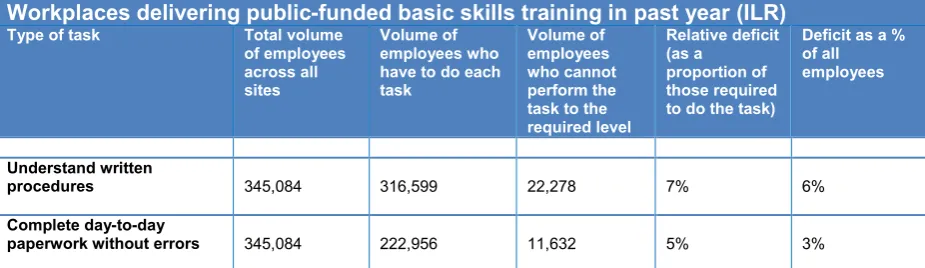
[image:27.595.57.528.275.520.2]When looking at employers who have provided public-funded basic skills training in the past year (Table 2.3), the reported volumes of employees unable to do each task to the required level is higher than average. However, this is to be expected given that these employers tend to be part of a larger organisation and have a much larger workforce.
Table 2.2: Volumes of employees with a gap in literacy and numeracy across employers nationally (weighted)
Workplaces in Englan
Type of task d Total volume of employees across all sites
Volume of employees who have to do each task
Volume of employees who cannot perform the task to the required level
Skills gap as a proportion of those required to do the task
Deficit as a proportion of all employees
Use numerical data or information correctly in
their day-to-day activities 152,311 94,040 10,724 11% 7% Spot numerical errors 152,311 59,832 4,512 8% 3% Communicate verbally 152,311 122,640 8,131 7% 5% Complete day-to-day
paperwork without errors 152,311 98,704 7,036 7% 5%
Understand written
procedures 152,311 132,425 8,313 6% 5%
Perform simple mental
arithmetic / calculations 152,311 89,042 4,977 6% 3%
Respond in writing 152,311 68,617 3,518 5% 2%
Base: Nationally representative sample of 4,234 workplaces in England
Table 2.3: Volumes of employees with gap in basic literacy and numeracy across employers who provide public-funded basic skills training (weighted)
Workplaces delivering public-funded basic skills training in past year (ILR)
Type of task Total volume Volume of Volume of Relative deficit Deficit as a % of employees employees who employees (as a of all across all have to do each who cannot proportion of employees
sites task perform the those required
task to the to do the task) required level
Perform simple mental
arithmetic / calculations 345,084 219,047 34,476 16% 10%
Spot numerical errors 345,084 122,032 15,883 13% 5% Use numerical data or
information correctly in
[image:27.595.61.522.595.781.2]Workplaces delivering public-funded basic skills training in past year (ILR)
Type of task Total volume Volume of Volume of Relative deficit Deficit as a % of employees employees who employees (as a of all across all have to do each who cannot proportion of employees
sites task perform the those required
task to the to do the task) required level
Understand written
procedures 345,084 316,599 22,278 7% 6%
Complete day-to-day
paperwork without errors 345,084 222,956 11,632 5% 3% Base: Nationally representative sample of 4,239 workplaces with employees completing public-funded basic skills training between September and December 2012
2.3 Awareness of workforce skills needs
[image:28.595.59.522.72.206.2]There is a link between employers’ reported basic skills needs and the presence of infrastructures in the workplace to identify skills deficits. For example, employers who report basic literacy and/or numeracy deficits are more likely than those that do not (Table 2.4):
• To provide all employees with a formal written job description.
• To conduct annual performance reviews with all employees.
• To have a training plan that specifies in advance the level and type of training their employees will need in the coming year.
These findings suggest that the prevalence of skills deficits in England may be
understated because employers, especially small and medium sized businesses, do not have in place systems that would enable them to identify such skills gaps for all their workforce (see also section 4.4).
Table 2.4: Proportion of employers with skills review processes in place
Nationally Employers
providing No basic skills Basic skills public-funded Presence of: deficit reported deficit reported basic skills
training
Formal written job description
All employees have a formal written job 71% 75% 89%
description
No employees have a formal written job 13% 8% 2%
description
Annual performance review
All employees have an annual 54% 68% 80%
performance review
No employees have an annual 33% 20% 9%
performance review
Nationally Employers
Have a training plan that specifies in advance the level and type of training that employees need in the coming year
47% 60% 78%
Base: Nationally representative sample of 3,739 workplaces with no skills deficits and 495 with skills deficits. Nationally
representative sample of 4,239 workplaces with employees completing public-funded basic skills training between September and December 2012
There is also evidence in the literature to support the notion that skills deficits may be under-reported. For example, the National Audit Office (2004) and the House of Commons Public Accounts Committee (2006) have both highlighted that employees rarely have their literacy and numeracy assessed. In addition, a small scale study by Boyle et al (2001) found that managers may be unaware of the level of basic skills required by their workforce, or take it for granted that their employees possess such skills. Furthermore, in line with this, the 1992 Gallup survey indicated that only 27% of employers had a formal policy for addressing basic skills difficulties in the workforce (with 71% having no policy).
This lack of awareness may be accentuated by employers’ inability to recognise the basic skills elements within the tasks that their employees carry out. During the case study interviews it was common for employers to begin by asserting that their employees had the skills needed for their jobs; that the basic skills requirements were very low and that they could cope with them. However, with further questions some examples did emerge as the interview proceeded: when first asked if he felt any of their employees lacked the English or maths needed to do their jobs effectively, the HR manager in case study eight said no, he did not think so. As the interview progresses, he maintained that overall this is the case, but also came up with four examples of potential skills gaps and their impact. One example was an area manager who makes mistakes when writing formal letters (grammar, punctuation and spelling) but this was deemed not to have a negative impact on their work because others in the team are able to write it for him. In another example, he expressed doubts about whether store managers understand the instructions given and able to impart this to junior members of staff because, as he puts it, ‘no one is going to say they don’t understand it’.
observe that she was concerned about the writing skills of the volunteers who made up the bulk of her workforce.
2.4 Characteristics of workplaces with basic skills gap
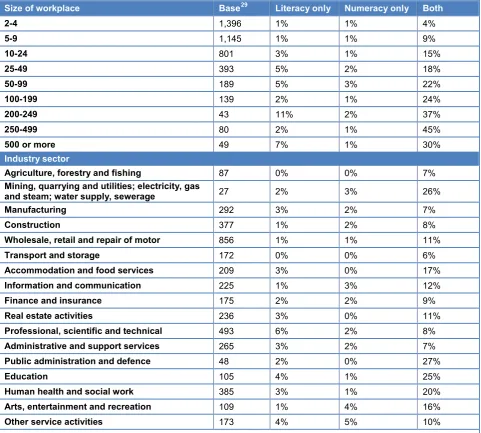
SizeEmployers who indicated that they had a literacy and/or numeracy gap in the workforce were significantly more likely to:
• Operate as part of a multi-site organisation (50% vs 39% of those with no basic skills gap).
• Have more employees (17% with more than 100 employees at the worksite vs 6% of those with no basic skills gap).
This reflects previous research (e.g. CBI 2012 Education and Skills survey) in which larger organisations were more likely to cite skills deficits in the workforce. This is
because, as the number of employees increases, so does the likelihood that at least one of them will have a basic skills gap. Larger organisations are more likely to have a
dedicated HR team and systems for reviewing employees’ skills and training needs.
Sector
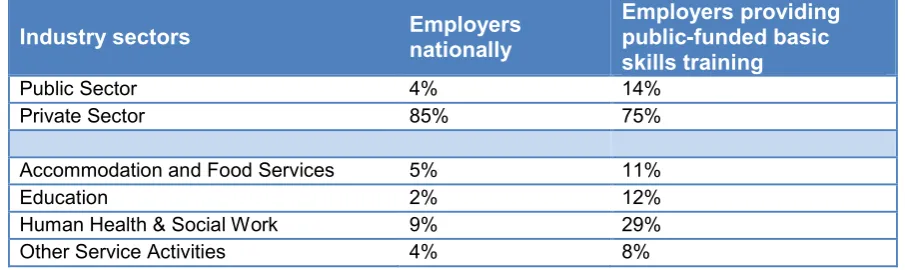
Employers reporting a basic skills gap (especially in numeracy) were more likely to operate in the public sector (8% vs 4% of those with no basic skills gap).
The prevalence of reported basic skills deficits (i.e. where employees who are unable to perform the tasks required of them in their day-to-day role) also varies by industry sector. Employers in Wholesale, Retail and Motor Repairs have the highest reported incidences by far for both literacy and numeracy though they are also the group most likely not to report an issue. Other industry sectors reporting relatively higher incidences of literacy and numeracy gaps include Manufacturing and Professional, Scientific and Technical sectors (see Table 2.5).
Industry sectors Report skills gap No basic skills gap
Literacy
Manufacturing 11% 7%
Wholesale, Retail and Motor Repairs 26% 20%
Information and Communication 2% 6%
Real Estate 2% 6%
Professional, Scientific and Technical 6% 12% Numeracy
Manufacturing 10% 7%
Wholesale, Retail and Motor Repairs 24% 20%
Real Estate 4% 6%
Professional, Scientific and Technical 9% 12%
This finding is largely consistent with employer surveys undertaken by the CBI, and Levenson (2004) has suggested a number of occupational changes which have contributed to this pattern. Firstly, some manufacturing job roles have become less narrowly defined and now require more problem-solving and intra- and inter-team communication. Secondly, good customer service has increasingly come to be seen as a source of competitive advantage. This has highlighted the need for front line staff to have good interpersonal skills, and is particularly salient in the retail sector (and increasingly this includes writing - over electronic media - as well as spoken). These changes may have resulted in employers in these sectors looking for better quality basic skills and they may also be more sensitive to deficits.
2.5 Characteristics of employees with poor basic skills
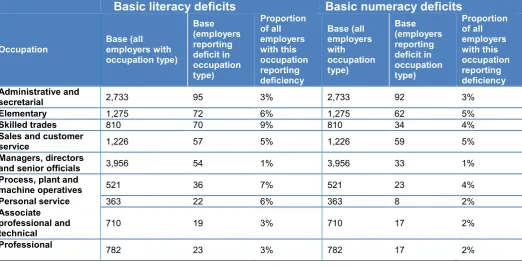
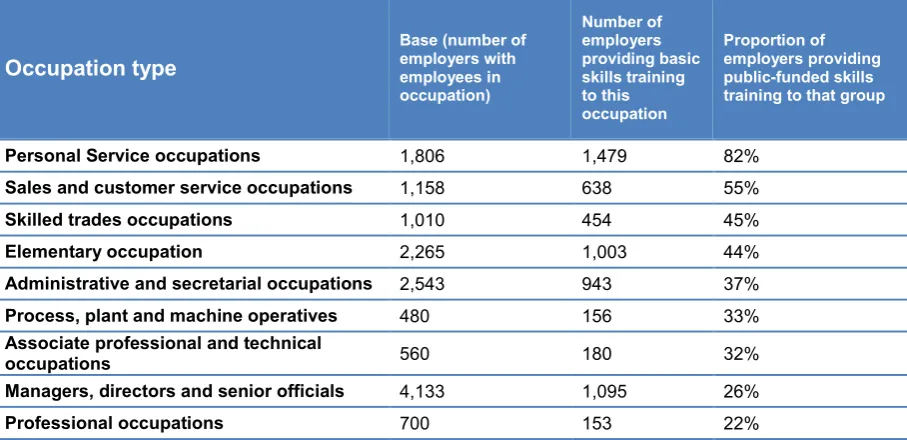
OccupationPrevious research had indicated a link between basic skills deficits and certain types of occupation20. In the current survey employers were asked which occupation types they
employed (from a nine-fold typology) and those employers who indicated a skills deficit were also asked which of their occupation types had the skills deficiency. The
responses, summarised in Table 2.6, indicate that:
• Basic literacy gaps are most prevalent among employees in Skilled Trades (9% of employees in this occupation are unable to perform literacy tasks to the level required of them), Process, Plant and Machine Operatives (7%), and Personal Service (6%).
[image:32.595.41.564.420.687.2]• Basic numeracy gaps are less commonly reported than literacy across many occupations, and are most prevalent in Elementary occupations and in Sales and Customer Service (5% each).
Table 2.6: Basic literacy or numeracy gaps by occupation
Basic literacy deficits Basic numeracy deficits
Occupation Base (all employers with occupation type) Base (employers reporting deficit in occupation type) Proportion of all employers with this occupation reporting deficiency Base (all employers with occupation type) Base (employers reporting deficit in occupation type) Proportion of all employers with this occupation reporting deficiency Administrative and
secretarial 2,733 95 3% 2,733 92 3%
Elementary 1,275 72 6% 1,275 62 5%
Skilled trades 810 70 9% 810 34 4%
Sales and customer
service 1,226 57 5% 1,226 59 5%
Managers, directors
and senior officials 3,956 54 1% 3,956 33 1%
Process, plant and
machine operatives 521 36 7% 521 23 4%
Personal service 363 22 6% 363 8 2%
Associate professional and
technical 710 19 3% 710 17 2%
Professional 782 23 3% 782 17 2%
20 However, this does not necessarily mean that these occupations lead to higher costs for firms through basic skills gaps.
This pattern is in line with the observation that skills deficits are reported relatively more frequently in the Manufacturing and Wholesale, Retail and Motor Repairs sectors, and less frequently in the Professional, Scientific and Technical sectors. Furthermore, they are consistent with the patterns observed in the Skills for Life (SfL) 2011 and PIAAC (2013). The SfL 2011 showed that workers in routine, semi-routine, and lower
supervisory and technical occupations are most in need of basic skills training. Most recently, the PIAAC showed that, on average, semi-skilled white-collar occupations score lower in literacy and numeracy scales than skilled occupations. This pattern occurred across all countries but was most pronounced in Canada and the UK.
Young employees
Employers reporting a basic skills gaps are significantly more likely than those that do not, to employ young people (27% hire at least one 16-18 year old vs 11% of employers not reporting a basic skills gap)21. Research indicates that basic skills gaps are more
prevalent amongst younger people in the UK (e.g. PIAAC, 2013), and more than two-thirds of employers in the 2012 CBI survey identified a “pressing need” to raise literacy and numeracy standards amongst 14-19 year olds.
English as a Second Language
Employers who report skill gaps are also significantly more likely to have employees with English as their second language (39% vs 22% of employers not reporting a basic skills gap), and this is particularly pronounced for those reporting a literacy gap (41% vs 22% of employers not reporting a basic skills gap). These results reflect the 2013 PIAAC study which shows that, individuals with a foreign-language background score significantly lower in literacy, numeracy and problem solving compared to those who take the tests in their native language22.
21 The same pattern is found for employers who provide public-funded basic skills training too, with 40% of those with a skills deficit hiring at least one 16-18 year old, compared to 30% of those without a skills deficit.
22 Even after taking into account other factors such as country of birth, age, gender, occupation and socio-economic status. Although it should be noted that the differences in the UK are less pronounced than the OECD average.
3. Economic impacts of poor
basic skills on workplace
performance
Key findings
A number of analyses were conducted to explore the strength of the
relationship between basic skills deficiencies amongst employees and firm-level productivity23 controlling for influential factors such as industry sector,
type of organisation, firm size including composition of full-time and part-time employees.
No statistically significant relationship was detected. This finding is consistent with the broad results of the survey: comparatively low proportions of employers (12%) reported a gap in basic literacy or
numeracy, with fewer still (8% of all employers) reporting that those gaps caused material impacts on the performance of their workplace. As such, the aggregate effect of these skills deficits might be expected to be of
insufficient magnitude to be detectable through econometric analysis.
The case studies also highlighted that some employers have been able to mitigate against the impact of poor literacy and numeracy through the use of ICT interventions and informal solutions and strategies such as peer support to reduce the extent to which these skills are required to complete many processes.
The results also need to be taken in the context of the prevailing labour market; unemployment was relatively high meaning that employers may have had greater choice in how they deploy workers to ensure minimal impact on efficiency and profitability.
Finally, failure to observe statistically significant effects at a firm-level does not necessarily imply that there are no economic costs associated with poor basic skills in the workplace. Low levels of basic skills may constrain the economy through lower levels of productive capacity and reduction in aggregate supply – this would not be captured in the econometric analyses which were focused on the microeconomic impacts.
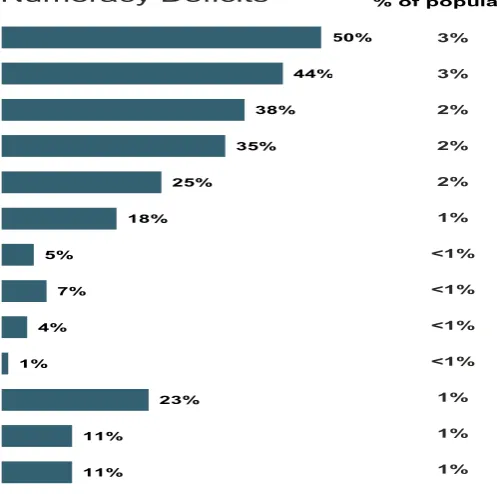
Workplaces with basic skills gap also self-report a range of costs to their business – the most commonly cited impact is an increased number of errors by employees: reported by 43% of employers with a basic literacy gap and 50% of employers with a basic numeracy gap (equivalent to 3% to 4% of employers in England).
Employers reporting a basic skills gap are also more likely to report a higher volume of customer complaints (11% have had more than 50 complaints in the past year vs 4% of employers not reporting a basic skills gap).
Employers with basic skills gaps are significantly more likely to have experienced accidents (38% vs 20%), and significantly less likely to have had none (58% vs 76%) compared to employers without basic skills gaps.
One in ten (11%) employers with a numeracy deficit reported fewer sales or lower profit margins as the result. These impacts were not shared by
This chapter focuses on the cost to businesses of poor basic skills in the workforce. As noted elsewhere, UK research in this field has tended to focus on the ways in which employers might incur costs, rather than attempting to estimate the costs. The first part of this chapter summarises the perceived routes through which employers have
experienced costs, and the second section presents the findings from the econometric analysis.
3.1 Impact of poor basic skills
24A systematic literature review was undertaken as part of this study to develop a theoretical framework of the routes through which business performance may be
affected by poor basic literacy and numeracy among employees. The literature provides evidence on the range of impacts and costs to employers which can be summarised as:
Efficiency costs, Time costs, Accidents and Meeting Requirements, Turnover, and Human Resource costs.
In the survey, each of these possible impacts was posed to employers reporting a basic literacy and/or numeracy deficit. In total, just 8% of all workplaces indicated that they had experienced some kind of impact as a result of basic skills deficits in their workforce. Their detailed responses are shown in Figure 2, but to summarise, the most frequently cited impacts – for both basic literacy and numeracy gaps – are: an increase in the number of errors by employees; an inability to introduce more efficient or new processes; additional training costs; and a reduction in product or output quality. Overall, around a third to a half of workplaces with reported basic skills gaps have experienced these impacts (equivalent to between 2% to 4% of all workplaces in England), with numeracy gaps causing the greater detrimental impact to businesses.
24 Owing to small base sizes, sub-group analysis (e.g. by employee size, industry sector, occupation) is not possible in this section.
Figure 3: Impact of basic literacy and numeracy gap (self-reported) 43% 36% 33% 33% 26% 17% 6% 6% 4% 1% 1% 0% 0%
Increased number of errors
Prevented more efficient / new processes being introduced
Additional costs for training
Reduced product / output quality Failure to comply with requirements (e.g. H&S / quality requirements) Higher volume of customer complaints
Higher staff turnover
Increased time / costs
Higher absenteeism
Increased accidents
Unable to promote staff / give additional responsibilities
Lower profit margins
Fewer sales
Base: All employers with literacy skills deficits (540); All employers with numeracy skills deficits (344)
% of population
4% 3% 3% 3% 2% 1% 1% 1% <1% <1% <1% 0% 0% Literacy Deficits 50% 44% 38% 35% 25% 18% 5% 7% 4% 1% 23% 11% 11%
% of population