This is a repository copy of ISPH wave simulation by using an internal wave maker. White Rose Research Online URL for this paper:
http://eprints.whiterose.ac.uk/86311/ Version: Accepted Version
Article:
Liu, X., Lin, P. and Shao, S. (2014) ISPH wave simulation by using an internal wave maker. Coastal Engineering, 95. 160 - 170. ISSN 0378-3839
https://doi.org/10.1016/j.coastaleng.2014.10.007
[email protected] https://eprints.whiterose.ac.uk/
Reuse
Unless indicated otherwise, fulltext items are protected by copyright with all rights reserved. The copyright exception in section 29 of the Copyright, Designs and Patents Act 1988 allows the making of a single copy solely for the purpose of non-commercial research or private study within the limits of fair dealing. The publisher or other rights-holder may allow further reproduction and re-use of this version - refer to the White Rose Research Online record for this item. Where records identify the publisher as the copyright holder, users can verify any specific terms of use on the publisher’s website.
Takedown
If you consider content in White Rose Research Online to be in breach of UK law, please notify us by
ISPH Wave Simulation by Using an Internal Wave Maker
Xin Liua, Pengzhi Lina,*, Songdong Shaob
a
State Key Laboratory of Hydraulics and Mountain River Engineering, Sichuan University,
Cheng-Du, 610065, China.
b
Department of Civil and Structural Engineering, University of Sheffield, Mappin Street, Sheffield,
S1 3JD, United Kingdom. (College of Hydraulic and Hydroelectric Engineering, Qinghai University,
Xining, 810016, China)
Abstract
In this paper, a non-reflection internal wave maker algorithm is included in the
in-compressible Smoothed Particle Hydrodynamics (ISPH) model for the wave
simula-tions. A momentum source term derived from the Boussinesq equations is employed and
added into the Lagrangian form of Navier-Stokes equations for the wave generations
that are not affected by the reflected waves. In this work, the technical details of
imple-menting the internal force into the ISPH equations are proposed and a series of
numeri-cal tests are carried out for the selection of relevant parameters and investigation of their
sensitivities in different wave conditions. In model applications, the problems of wave
propagation and reflection from a vertical wall are studied to verify the model
perfor-mance in standing wave generations and the non-reflection characteristics of the internal
wave maker. Furthermore, a more challenging wave decomposition process over a
*
Corresponding author, Tel.: +86 028-85406172; Fax: +86 028-85405148
ezoid breakwater is presented, which has not been fully investigated by other similar
particle-based methods. The simulation results of wave surface profile on six wave
gauges agree well with the experimental results and this shows that the present model
with the non-reflection internal wave maker can provide a more robust particle
model-ing tool for the long time simulation of wave and wave-structure interactions.
Key words: ISPH, internal wave maker, non reflection, momentum source term, wave
simulation, long time.
1. Introduction
In the wave generations in Smoothed Particle Hydrodynamics (SPH) method, the
pioneering work was attributed to Monaghan (1994) in which the initial wave
parame-ters based on the theoretical solutions were given to fluid particles to generate the target
wave. However, this method can only be used to generate one wave event, such as the
solitary wave, because the resetting of the initial wave parameters is not possible for a
series of wave event. Another more widely used wave generation algorithm employs the
numerical wave paddle to push the water in different frequencies and amplitudes and
can generate any kinds of the wave found in the practical field. The earliest work to use
the wave paddle for a mesh free particle modeling approach could be traced back to
Monaghan (1994). The wave paddle was also used by Gotoh and Sakai (1999), who
studied the cnoidal wave breaking on a slope using the Moving Particle Semi-implicit
(MPS) method (Koshizuka et al., 1998). Later studies have extended this popular wave
making concept to the periodic waves (Khayyer and Gotoh, 2009), solitary waves (Dao
et al., 2013) and random waves (Zheng et al., 2010). In these models, a common
maker theory was applied in the same way as that used in the laboratory experiment. In
this sense, the SPH wave paddle can generate a variety of the laboratory waves without
any theoretical barrier. Besides, numerical water waves can also be generated by other
similar approaches, such as a moving structure (Gallati et al., 2005) and landslide
fall-ing object (Du et al., 2006).
By using the above wave paddle method, however, for the long-time wave-structure
interaction problems, the reflected waves from the structure will propagate towards the
numerical wave maker and then be reflected. The secondary reflection wave could
strongly affect the subsequent wave propagations and result in the distortions of wave
height. This has put a severe limitation on the particle-based methods to achieve
long-time wave simulations, which is indispensible in order to get the required wave
dynamics. One temporary remedy would be to employ a large computational domain to
delay the arrival of the secondary reflection wave at expensive CPU cost. On the other
hand, the damping layer concept can also be used to absorb the undesirable reflection
waves. However, this can also increase the size of computational domain, and the
effi-ciency of numerical damping layers could differ quite a lot under different wave
condi-tions and layer coefficients (Molteni et al., 2013). By realizing the above issues, a
self-absorbing wave paddle concept was initially presented for the separation of incident
and reflected waves by Frigaard and Brorsen (1995), although this method involved
complex wave theories and relied on the accuracy of water surface measurements in
front of the wave paddle. Following this, Hayashi et al. (2000) developed a practical
non-reflection wave paddle to study the wave breaking and overtopping of an upright
seawall using the MPS method. Shibata et al. (2011) proposed a transparent boundary
efficient manner. Didier and Neves (2012) developed a piston-type wave maker with the
dynamic wave absorption functions which enabled the outgoing waves to be absorbed.
The most recent work was attributed to Skillen et al. (2013) who used a paddle-free
Fourier series analysis to assign the particles with relevant wave kinematics and they
computed a large-scale SPH wave propagation problem.
Although quite a few good progresses have been made in the wave generations
us-ing the above non-reflection wave paddles, alternative approaches should be explored to
find a more efficient wave generation mechanism in SPH so as to fully demonstrate its
potentials in the wave simulation. In this regard, some previous studies in the grid-based
models could provide useful information. For example, consider another category of
wave generation techniques without the existence of wave paddle, i.e. the internal wave
maker. Based on the Boussinesq-type equations, Larsen and Dancy (1983) introduced a
novel wave maker theory to generate the regular waves in shallow water condition. In
their method, the free surface undulation was not induced by the wave paddle but
cre-ated by using an artificial mass source term derived from the mass conservation
princi-ple. Lee and Suh (1998) developed a similar approach based on the mild slope equations
and investigated the mass and energy transports of the generated wave. Furthermore,
Lin and Liu (1999) proposed an internal wave generator following the mass
conserva-tion in Navier-Stokes (NS) equaconserva-tions and different types of the waves were generated by
using this mass source function. Also, Wei et al. (1999) derived a more efficient
shal-low-water based transfer function that related the source amplitude to the surface wave
characteristics. In their work, both the mass and momentum source functions have been
presented. Later improvements have been made by Choi and Yoon (2009) and Ha et al.
has been no similar work carried out in the particle modeling approach so far.
In this paper, by following Wei et al. (1999) and Choi and Yoon (2009) an internal
wave maker algorithm based on the momentum conservation is introduced into the
ISPH method. In the formulations the momentum source term derived from the regular
wave theories will be added into the NS equations as an internal particle force, which
changes with the time and position. Therefore, time-dependent water waves can be
eas-ily generated through the periodic internal forces. The efficiency and accuracy of the
coupled internal wave maker and ISPH model are verified by several benchmark wave
simulations, including the wave generation under different wave and source region
pa-rameters, and the standing waves in front of a vertical wall. Finally, a regular wave
in-teraction with submerged breakwater is simulated, in which the higher harmonics are
separated from the main wave when it passes over the breakwater into the deep water
region. This test case has been considered as being challenging for the particle-based
models as it involves long time wave simulations in which the secondary wave
reflec-tion is quite substantial.
2. ISPHModel with Internal Wave Generator
2.1 Momentum source term and wave absorbing region
2.1.1 Momentum source term
In Lin and Liu's model (1999) with the mass source term, a source region was
placed in the center of water flume and mass generations and deductions occurred
al-ternately during a wave period. For the Lagrangian methods such as SPH, this mass
variation process could cause the drastic increase or decrease of the particle numbers,
into or removed from the computational source region. To avoid this problem, in this
study the momentum source term derived by Wei et al. (1999) is added into our ISPH
model as the internal wave maker instead of the mass source term. In Wei et al.'s theory,
the Boussinesq equations were employed to derive the relationships between the surface
elevation and the target wave. Following this, Choi and Yoon (2009) presented the
gen-eral form of the momentum source function as
2
1
, , ( , , ) exp ( ' ) '
4 m
f x y t S x y i k y t dk d
, (1)
where f is the momentum source term with the acceleration dimension, m S
deter-mines the shape of the source function, x and y denote the coordinate direction, t is
the time, is the wave frequency and the y direction wave number is k'ksin
,where
is the angle between the wave direction and x axis and k is the wavenumber.
The shape function S has the following form:
2 ( , , ) exp( )
S x y D x , (2)
where D is the source function amplitude and can be determined from the desired
wave characteristics, and is a parameter associated with the width of source
func-tion. D has the following form:
2 4 3
0 1 0
2
1 0
( ) cos
1
H gk h
D
I k kh
, (3)
where I1 / exp[k2/ (4 )] . For the monochromatic wave, H is the wave 0
height, g is the gravitational acceleration, h is the still water depth, 0 1 and are
1
1 3
, (4)
2
2
0 0
2
z z
h h
,
(5)
where z denotes the representative velocity position in a depth-averaged model, and
usually takes z 0.53h0.
The value of the source function is larger in the middle and smaller on the two sides.
Then the relationship between and the source region width W2 xsidexmid is
2 2
side mid
exp[ ( ) ] exp[ ( ) ] 0 exp( 5) 2
W
x x
. (6)
2 5
W
, (7)
where xside and xmid are the positions of the lateral and middle source regions,
re-spectively.
The relationship between the source region width W and wave length L is
( / 2)
W L , i.e. 2W L/ , then can be represented as
2 2 80
L
, (8)
where
is related to the source region setup for a specific problem. As long as thesource region width and wave length are known,
is determined.For the ISPH modeling of monochromatic waves in this study, the monochromatic
wave the momentum source function vector in Eq. (1) can be simplified in the vertical
2
mx (2 ) exp( ) sin( )
D
f g x x t
. (9)
This equation has the dimension of acceleration, which can be directly added into
the N-S equations in the SPH methods.
2.1.2 Wave absorbing region
The proposed internal wave generator should be employed more efficiently together
with a wave absorbing region to prevent the undesirable secondary wave reflections.
Following Wei and Kirby (1995), the commonly adopted absorbing coefficient has the
following form:
st
ab
st st ab
exp ( ) 1
exp(1) 1 c n
b
x x
x
A c x x x x
,
(10)
where A is the absorbing coefficient, b x and st x are the starting position and ab
length of the absorbing region, respectively, c and n are the empirical damping c
coefficients to be determined via the numerical test. Following Lin and Liu (2004), the
coefficients in this model are taken as c 200 and nc 10. Ab has the unit of 1/s
and will be added into the N-S equations in the next section.
As far as we know, there are not many investigations made on the wave absorbing
region in particle-based methods. Xu (2010) presented a simple exponential absorbing
zone to dampen the linear wave reflection, in which the absorbing length was 2 times of
the wave length and the particle velocities were directly reduced at the end of each time
step. Shibata et al. (2011) presented a wave absorbing method and they assigned a large
2.83 times of the wave length. Besides, Molteni et al. (2013) developed a matched layer
approach for the shallow wave damping, in which a shorter damping distance of 1.5
wave length was used. In the present method, the absorbing length is chosen as 2.0
wave length following Wei and Kirby (1995). It is noted that equally good wave
damp-ing effects have been achieved in all of these cases.
2.2 SPH governing equations
In the ISPH method the N-S equations are written in the Lagrangian form and the
advection term is automatically calculated through the tracking of particle motion. Thus
the numerical diffusion arising from the successive interpolation of the advection
func-tion used in the Eulerian grid-based method is avoided in the SPH. Due to the
Lagran-gian nature of SPH, the internal wave generator with the mass source term is difficult to
be added into the SPH equations, while for the momentum source term the adding of the
additional source force could be much more straightforward. As a result, the final form
of the complete mass and momentum conservation equations with the momentum
source term as well as the wave absorbing term are written as
0 u
, (11)
2 0
1 1
m b
du
p g u f Au
dt , (12)
where u is the particle velocity vector, is the fluid density, p is the particle
pres-sure, 0 is the laminar kinematic viscosity,
is the sub-particle scale (SPS)turbu-lence stress, which was originally presented by Gotoh et al. (2001). fm is the
momen-tum source term that changes in the x direction and keeps constant in the z direction.
ing coefficient with the expression as shown in Eq. (10).
The eddy viscosity assumption is used to model the SPS turbulence stress
as2
(2 )
3
ij tSij k ij
, (13)
where t is the turbulence eddy viscosity, Sij (ui xjuj xi)/2is the strain rate
k is the turbulence kinetic energy, ij is the Kronecker delta function. The turbulence
eddy viscosity t is calculated by a modified Smagorinsky model as follows:
, ) (CSd0 2S
t
(14)
where CS is the Smagorinsky constant (=0.1), d0 is the particle spacing representing
the characteristic length scale of the small eddies, and S 2SijSij is the local strain
rate.
In the ISPH model the two-step projection method is used to solve the N-S Eqs. (11)
and (12) which is composed of two steps. The first step is an explicit integration of
ve-locity in the time, resulting in a temporary non-zero divergence veve-locity field that
should be corrected in the next step. Because of the spatial variations of Eq. (9) in the x
direction, the momentum source term fm will generate additional divergence in the
momentum equation that needs to be corrected in the end of computational time cycle.
Similar situation also applies to the wave absorbing term A u . Thus both of them b
should be considered in the first prediction step, represented as follows without
consid-ering the pressure and gravity terms:
2
* 0
1
( )
t m b
u u u f Au t
, (15)
* t *
r r u t, (16)
temporary particle velocity and position, and t is the time increment.
Assuming u** is the changed particle velocity contributed by the remaining
pressure and gravity terms, there is
1 * ** * 1
1
( )
t t
u u u u g p t
. (17)
By taking Eq. (17) into the mass conservation Eq. (11), the Pressure Poisson
Equa-tion (PPE) is obtained as follows (Liu et al., 2014):
* 1
1
(g pt ) u
t
. (18)
The solution of PPE produces the required pressure to correct the non-zero
diver-gence velocity fields including those contributed by the momentum source term. After
obtaining the pressure field, the particle velocity is updated by Eq. (17) and the position
of particle is centered in the time as
1
1 ( )
2 t t
t t
u u
r r t. (19)
2.3 ISPH formulas and boundary conditions
Following Liu et al. (2014), the viscous and turbulent stress terms in Eq. (12) are
given as follows:
2
0 2 2 2
4 ( )
( ) ( )
( ) ( )
j i j ij i ij
i ij
j i j ij
m r W
u u r
, (20)2 2
1
( ) ( i j )
i j i ij
j i j
m
W
, (21)where i and j are the reference particle and its neighbor, m is the particle mass, W is
j i ij u u
u , iWij is the kernel gradient, and is 0.1h to keep the denominator
nonzero, where h is the smoothing length. In present 2D ISPH model, the 5th order
Quintic kernel function is used.
The gravity, momentum source and wave absorbing terms are directly calculated in
the arithmetic form. The pressure term is expressed as follows, as Khayyer and Gotoh
(2008, 2009) have suggested:
2 2
1
( ) ( i j )
i j i ij
j i j
p p
p m W
. (22)Also by following Liu et al. (2014), the velocity divergence term on the right hand
side of PPE Eq. (18) is discretized as
* * *
( )i j( i j) i ij j j
m
u u u W
, (23)and the left hand side of PPE (Eq. 18) is expressed as
2
2 2
8 1
( )
( )
j ij ij
i i ij
j i j ij
m p r
p W
r
, (24)where pij pi pj.
As for the numerical boundary conditions, the general principle is that the mirror
particles are used to treat the solid boundaries and a symmetric free surface judgment
criterion is used to identify the free surface particles in the ISPH computation. For
fur-ther details see Liu et al. (2014) and these are not repeated here.
2.4 Implementation of internal force in source region
The detailed procedures of adding the internal force are presented in this section.
The internal wave maker is located in the middle of the numerical flume with its width
internal force is imposed on every particle in this region. Following the Boussinesq
equations, this internal force does not change in the z direction from the flume bottom to
the free surface. Inside the source region, the force function has the form as shown in Eq.
(9), which changes in the x direction and thus results in symmetric force pointing to
both sides. The internal force is calculated by Eq. (9) with an amplitude of
22g x exp( x D) /
and a periodic term of sin(t). The amplitude and
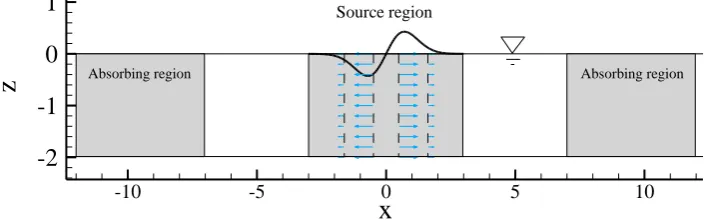
direc-tion of the force source term are illustrated in the black curve on top of the source
re-gion as shown in Fig. 1. The vectors in the source rere-gion denote the distributions of
in-ternal force acting on the fluid particles. The forces increase from the outside to inside
[image:14.595.113.469.377.489.2]areas and decrease again when approaching to the middle region (x = 0.0).
Fig. 1: The internal momentum source region.
For a still water flume without the momentum source term, a zero velocity field
appears at the prediction time step, and the pressure obtained from the PPE has a
hydro-statics distribution that keeps the velocity being divergence free. With the presence of
momentum source term in Eq. (12), there is additional force acting on each fluid particle.
During the wave generation, the internal force points to both sides to push the water out
of the source region. Due to the non-uniformity of the momentum source force as
shown in Fig. 1, the intermediate velocity divergence at the prediction time step is
nega-tive near the source region boundary and posinega-tive in the middle area. As a result, this
x
z
-10 -5 0 5 10
-2 -1 0 1
Absorbing region
Source region
Absorbing region
increases the pressure laterally and decreases the pressure centrally, and deviate it from
the hydrostatic state. In the first half period, the free surface rises on the two sides and
falls in the middle, while in the next half period, it goes the opposite way. Accordingly,
a periodic wave is generated. As this force is added into the N-S equations in form of
the momentum source term to generate waves, the proposed internal wave maker is not
affected by the reflected waves. In this sense, the ideal non-reflection wave generation
condition is achieved.
As shown in Fig. 1, the wave absorbing regions are also placed on both sides of the
flume to absorb the wave near the two lateral solid boundaries. So the incident waves
can be fully dissipated without any numerical shock. The above system should be able
to run for quite a long time without the interference between the incident and reflected
waves. It has been found that the momentum source term is very simple to implement in
the SPH model so as to make it more durable for the practical purpose.
3. Model Verifications and Applications
In this section, the efficiency and accuracy of the ISPH internal wave maker will be
investigated through some benchmark wave simulations and wave-structure
interac-tions.
3.1 Periodic wave generations
Here the proposed internal wave maker simulations will be verified by the
analyti-cal solutions of linear wave theory and the sensitivity of relevant parameters in the
mo-mentum source term will be investigated. The test problem was carried out in a
numeri-cal flume with the still water depth 0.4 m. The flume length was adjusted by following
dis-tance was 0.01 m and totally 200,000 water particles were used in the simulations. In
the first case, the wave period used was 2.0 s with the internal wave generator region
width being 1.0 m, which was about 25% of the wave length. The generator region was
located from 10.0 m to 11.0 m (as shown in Fig. 2), within which the internal forces
were added on the fluid particles. Two wave absorbing regions were placed near two
sides of the flume with the length of 8.0 m, which was about twice of the wave length.
(a) t/T = 0.25 (b) t/T = 0.5
[image:16.595.87.507.247.692.2](c) t/T = 0.75 (d) t/T = 1.0
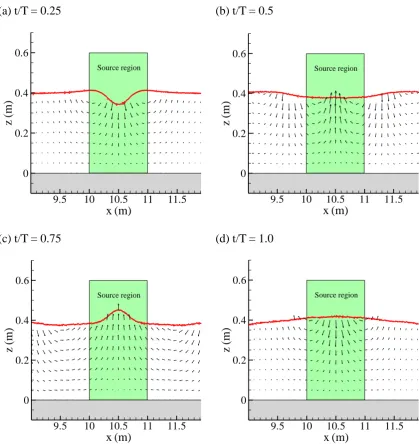
Fig. 2: Velocity field in the source region during internal wave making.
The SPH computed flow velocity fields are shown in Fig. 2 and the velocity values x (m)
z
(m
)
9.5 10 10.5 11 11.5 1
0 0.2 0.4 0.6
Source region
x (m)
z
(m
)
9.5 10 10.5 11 11.5 1
0 0.2 0.4 0.6
Source region
x (m)
z
(m
)
9.5 10 10.5 11 11.5 1
0 0.2 0.4 0.6
Source region
x (m)
z
(m
)
9.5 10 10.5 11 11.5 1
0 0.2 0.4 0.6
Source region
were obtained through the liner interpolation of individual particle velocities for clarity.
For the first half period in Fig. 2 (a), the non-zero velocity field discussed in Section 2.4
is generated from the still water and an outward velocity field is applied to the particles
near the two lateral sides of the source region. Thus the water in the source region goes
out and the free surface falls down to keep the velocity field divergence free. In
com-parison, in Fig. 2 (c), the water converges in and this results in the rising up of water
surface. This alternation of increase and decrease in the water surface levels in the
source region generated a continuous and stable periodic wave series. The velocity
dis-tributions in Fig. 2 demonstrated that the fluid incompressibility is largely ensured
ex-cept on some individual surface particles after the correction step of ISPH projection
method. It should be noted that more strict incompressibility could be achieved by using
the error compensating term proposed by Khayyer and Gotoh (2011) and used by Gotoh
et al. (2014) in the ISPH simulation of sloshing flows.
For quantitative verification, five wave gauges were placed in the flume at the
posi-tion x = 14.695 m, 18.39 m, 22.085 m, 25.78 m and 33.17 m, with the distance from the
source region being about 1.0, 2.0, 3.0, 4.0 and 6.0 times of the wavelength, respectively.
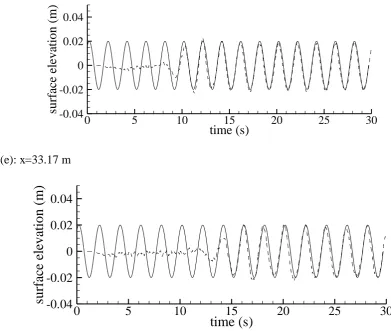
The ISPH computed time histories of the water surface are illustrated in Fig. 3,
com-pared with the analytical solutions of the linear wave theory. The numerical water
sur-face profiles were obtained by averaging the locations of nearest four sursur-face particles
from the ISPH computation. In the simulations, a tiny phase lag was observed since the
target wave was generated from a narrow region instead of a vertical line. In the
com-parisons, this phase lag was corrected by adjusting all of the theoretical wave phases so
as to match the first wave gauge recordings. Then other simulation results could match
(a): x=14.695 m
(b): x=18.39 m
(c): x=22.085 m
(d): x=25.78 m
: internal wave maker : theory time (s) su rf ac e el ev at io n (m )
0 5 10 15 20 25 30
-0.04 -0.02 0 0.02 0.04 time (s) su rf ac e el ev at io n (m )
0 5 10 15 20 25 30
-0.04 -0.02 0 0.02 0.04 time (s) su rf ac e el ev at io n (m )
0 5 10 15 20 25 30
(e): x=33.17 m
Fig. 3: Surface elevation of periodic wave generated by ISPH internal wave maker
(sol-id line: theory, dashed line: ISPH).
In Fig. 3, it can be found that there is a flat wave trough for the result in the first
gauge, which is an indication that the ISPH generated wave is still not stable. However,
for the second wave gauge, the difference between the theoretical and ISPH results is
relatively small. Similar phenomena are also observed on the rest three gauges, which
showed that a stable wave train has been formed. The discrepancy in the first wave
gauge is within expectation. As evidenced in the internal wave maker theory (Choi and
Yoon, 2009), the wave parameters are usually not very accurate in the areas close to the
source region. Similar issues have also been found in SPH simulations using a fixed
wave paddle.
For further verification purpose, similar to the test of Choi and Yoon (2009), the
time (s)
su
rf
ac
e
el
ev
at
io
n
(m
)
0 5 10 15 20 25 30
-0.04 -0.02 0 0.02 0.04
time (s)
su
rf
ac
e
el
ev
at
io
n
(m
)
0 5 10 15 20 25 30
-0.04 -0.02 0 0.02 0.04
computed u – v velocity profiles were presented in Fig. 4, compared with the theoretical
results of linear wave theory. The measurement sections were chosen by their distances
from the center of the source region at xmid = 10.5 m and contained four nearby sections
(x' = x-xmid = 0.4 m, 1.2 m, 2.0 m and 2.8 m, i.e. x'/h = 1.0, 3.0, 5.0, 7.0) and two distant
sections (two and three wavelengths from the source region, i.e. x'/h = 19.725, 28.962).
From the results in Fig. 4, it is found that the discrepancies from the theoretical values
are very obvious near the source region for x'/h = 1.0 and 3.0. However, for the other
four measurement sections further away, the present internal wave maker solutions
agree quite well with the linear wave theory at each x'/h.
x'/h=1.0 x'/h=3.0 x'/h=5.0 x'/h=7.0 x'/h=19.725 x'/h=28.962
x'/h=1.0 x'/h=3.0 x'/h=5.0 x'/h=7.0 x'/h=19.725 x'/h=28.962
: Linear wave theory : ISPH u (m/s) z fr o m b o tt o m (m )
-0.2 -0.10 0 0.1 0.2 0.1 0.2 0.3 0.4 u (m/s) z fr o m b o tt o m (m )
-0.2 -0.10 0 0.1 0.2 0.1 0.2 0.3 0.4 u (m/s) z fr o m b o tt o m (m )
-0.2 -0.10 0 0.1 0.2 0.1 0.2 0.3 0.4 u (m/s) z fr o m b o tt o m (m )
-0.2 -0.10 0 0.1 0.2 0.1 0.2 0.3 0.4 u (m/s) z fr o m b o tt o m (m )
-0.2 -0.10 0 0.1 0.2 0.1 0.2 0.3 0.4 u (m/s) z fr o m b o tt o m (m )
-0.2 -0.10 0 0.1 0.2 0.1 0.2 0.3 0.4 v (m/s) z fr o m b o tt o m (m )
-0.2 -0.10 0 0.1 0.2 0.1 0.2 0.3 0.4 v (m/s) z fr o m b o tt o m (m )
-0.2 -0.10 0 0.1 0.2 0.1 0.2 0.3 0.4 v (m/s) z fr o m b o tt o m (m )
-0.2 -0.10 0 0.1 0.2 0.1 0.2 0.3 0.4 v (m/s) z fr o m b o tt o m (m )
-0.2 -0.10 0 0.1 0.2 0.1 0.2 0.3 0.4 v (m/s) z fr o m b o tt o m (m )
-0.2 -0.10 0 0.1 0.2 0.1 0.2 0.3 0.4 v (m/s) z fr o m b o tt o m (m )
-0.2 -0.10 0 0.1 0.2 0.1
Fig. 4: Section velocity at different positions by ISPH (solid), compared with the linear
wave theory (circle).
Due to the depth-averaged characteristics of the present wave maker, the
evanes-cent wave mode could appear near the source region, but it should decay quickly away
from the wave maker. This fact can be seen in the sections far away from the source
re-gion in Fig. 4, especially at x'/h = 19.725 and 28.962, where the effect of evanescent
wave mode was completely eliminated and the accuracy of velocity field was ensured.
Similar phenomena have been found in the piston wave maker theory(Dalrymple and
Dean, 1991), and also reported by Lin and Liu (1999) and Choi and Yoon(2009) in the
internal wave maker theory using the grid-based models. Here it should be pointed out
that in Fig. 4 the evanescent wave mode influences a range of 3h ~ 5h, while it is 2h ~
3h in Choi and Yoon (2009). The discrepancy could be attributed to the different
com-putational conditions. Since the present ISPH wave maker employs the Boussinesq
model in which the fluid parameters do not depend on the flow depth, it is not
applica-ble for the deep water conditions. In the following section, the limitations of the method
will be further investigated.
3.1.1 Sensitivity test on different source region widths
In Wei et al.'s theory (1999), there was no strict requirement on the source region
width and thus the intensity distribution of input source momentum can be in any shape.
In the present ISPH model, this intensity distribution is only affected by the source
re-gion width but with the total input momentum being kept constant. To test the source
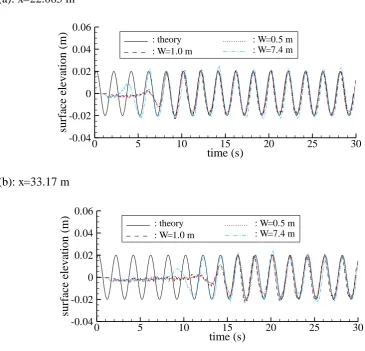
region effect, different region widths of W = 0.5 m, 1.0 m and 7.4 m (which is about
13.5%, 27% and 200% of the wavelength) are compared in the numerical simulations
in Fig. 5.
(a): x=22.085 m
[image:22.595.87.453.121.472.2](b): x=33.17 m
Fig. 5: Free surface elevations for different source region widths.
From the figure, it is seen that for the small source region width W = 0.5 m and 1.0
m, the target wave height and wave length are in good agreement with the linear wave
theoretical values. This has indicated that the total input momentum does not change
with the source region width. There is no obvious difference observed in the simulations
by using either W = 0.5 m or 1.0 m, but a smaller source region could impose a larger
momentum input on each fluid particle and result in a larger velocity and smaller time
step. For example, for the case of W = 1.0 m, the minimum time step was about t =
0.004 s, while for W = 0.5 m the time step was reduced to t= 0.002 s. On the other
hand, as for the results using W = 7.4 m in Fig. 5, the generated wave height is obvious-time (s)
su
rf
ac
e
el
ev
at
io
n
(m
)
0 5 10 15 20 25 30
-0.04 -0.02 0 0.02 0.04 0.06
: W=1.0 m : W=7.4 m : theory : W=0.5 m
time (s)
su
rf
ac
e
el
ev
at
io
n
(m
)
0 5 10 15 20 25 30
-0.04 -0.02 0 0.02 0.04 0.06
: W=1.0 m : W=7.4 m : theory : W=0.5 m
ly larger than the theoretical solution. This may be due to that for the wide source region
the required momentum is generated in a relatively larger space domain with more time
delay, thus leading to incorrect wave parameters. By carrying out a series of additional
tests, it has been found that the optimal source region width is about 20% ~ 50% of the
wave length in this study, by balancing both the target wave accuracy and the
computa-tional efficiency.
3.1.2 Sensitivity test on different wave lengths
Relatively accurate results have been obtained for the above case with T = 2.0 s that
represents the medium length wave. In this section, the sensitivity tests of numerical
result on different wave lengths will be studied. Similar setup as employed in the
previ-ous section is used, except that two different wave periods T = 0.7 s and 3.0 s are
con-sidered, which represent the short and relatively long waves. In order to eliminate the
influence of source region width on the computational results, the region width is fixed
as 0.228 m and 1.73 m for these two additional runs, respectively. Also, it has been
checked that this dimension falls within the optimal source region range (30% of
wave-length) as mentioned before, thus the interpretation of numerical results can objectively
disclose the wave length effects. Several wave gauges were placed at different locations
using the multiples of the wave length to measure the free surface elevations, and the
results are presented in Fig. 6.
(b) T = 0.7 s
Fig. 6: Free surface elevations for different wave periods (wave lengths).
From the figure, it is found that for the long wave generation (T = 3.0 s), the surface
elevation on the wave gauge at x = 2L is much higher than the theoretical value. At x =
4L and 5L, the generated wave profiles approach to the theoretical solutions and also
become stable. The reason can be explained as follows. In the wave propagation region
within x = 4L, the source region velocity field needs time to gradually adjust to the real
target wave velocity field. For the long wave generation in a constant water depth,
larg-er input momentum is genlarg-erated than that undlarg-er the short wave condition, so the
ad-justment distance becomes relatively longer as a result. In comparison, for the short
wave with T = 0.7 s, the generated waves can become stable very quickly within 2L
distance but the mean wave height is much smaller than the target wave height. The sit-time (s)
su
rf
ac
e
el
ev
at
io
n
(m
)
0 5 10 15 20 25 30
-0.02 0 0.02
0.04 : x = 2L : x = 5L : theory : x = 4L
time (s)
su
rf
ac
e
el
ev
at
io
n
(m
)
0 5 10 15 20
-0.02 0 0.02
0.04 : x = 2L: theory : x = 6L: x = 4L
uation becomes worse further away from the source region. This may be due to that the
present internal wave maker theory is based on the Boussinesq equations so all of the
flow variables are assumed to be depth-averaged. For the short wave in a real water
flume, since the velocity near the free surface is always larger than that near the flume
bottom, the accuracy of wave generation theory based on the depth-averaging concept
deteriorates. In the following case studies, we will focus on the long wave simulations,
although further work on the short waves should also be carried out in details.
3.2 Wave reflection from a vertical wall
In this part, the ISPH internal wave maker model will be applied to the problem of
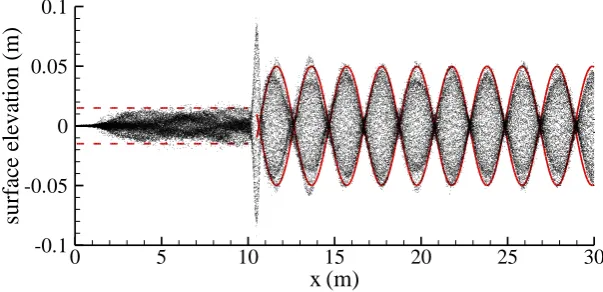
wave reflections from a vertical wall. In this simulation, the periodic waves are
gener-ated in the middle of the flume and then propagate to both lateral directions. The still
water depth is 0.5 m and initial particle distance is 0.01 m. The source region is from x
= 10.0 m to x = 11.0 m, and the wave damping zone is placed on the left side of the
flume from x = 0.0 m to x = 6.0 m. The right side of flume is a solid vertical wall to
ful-ly reflect the incident waves. If there is no interaction between the reflected wave and
the momentum source region and also the wave damping zone can absorb the wave
se-ries as efficiently as like a single wave train, we may expect the following scenarios: the
total internal reflection will only happen on the right wall and a standing wave should
be generated between the source region and the right wall. Besides, in the region
be-tween the source region and the damping zone, a wave group composed of two
mono-chromatic wave trains, should propagate in the same direction with the same wave
height and frequency but in a different phase.
As shown in Fig. 7, the black points represent the free surface particle trajectories
right (standing wave) and left (propagating wave) sides of the source region can be
ex-pressed by using the linear wave theory as
0 0
right cos( ) cos( ) 0cos( ) cos( )
2 2
i r
H H
kx t kx t H kx t
, (25)
0 0
left cos( ) cos( )
2 2
H H
kx t kx t
, (26)
where right and left are the wave surface elevations in two different regions,
respec-tively. i and r represent the incident and reflected wave profiles, and is the
phase difference between two waves in the left region. In this case, the phase difference
can be obtained by assuming that the wave is generated in the middle of source region at
x = 10.5 m. So the reflected wave arrives at the middle line after propagating a distance
of 2× (30.0-10.5) = 39.0 m, which contains 9.614 wavelengths, i.e. 9.614 period lags.
Based on this, the theoretical results of surface profile (envelope lines) in the standing
wave region (right) and propagating wave region (left) can be obtained and employed to
verify the ISPH simulation results. The envelope lines are shown in Fig. 7 in the form of
[image:26.595.146.448.530.676.2]dashed and solid lines, respectively, for the two different regions.
Fig. 7: ISPH computed wave reflections from a vertical wall, and solid and dashed lines
represent theoretical surface envelops in two wave regions. x (m)
su
rf
ac
e
el
ev
at
io
n
(m
)
0 5 10 15 20 25 30
-0.1 -0.05 0 0.05 0.1
From the figure, it is found that in the area between the source region and right wall,
very good agreement between the theoretical values and ISPH simulation results has
been achieved, with the exception of a very few number of individual particles being
outside of the envelope line. Besides, in the area on the left side of source region,
equally good agreement is found outside the damping region from x = 6.0 m to x = 10.0
m. The efficiency of wave absorbing layer is also demonstrated by the fact that the wave
height decreases to nearly zero in front of the left wall due to the wave damping effect.
The above comparisons showed that the present internal wave maker has on influence
on the reflected waves passing through the momentum source region. Here it is worth
mentioning that the present internal wave maker may not give more accurate results
than the traditional wave making methods by using a numerical wave paddle. However,
by using the momentum source term, satisfactory non-reflection wave generation
tech-nique can be achieved for the ISPH model which enables longer time wave simulations.
3.3 Wave decomposition on a trapezoid breakwater
There are many trapezoid breakwaters in the ocean engineering field, which
main-tain a steady water surface for the port or other coastal structures. The interaction
be-tween the wave and breakwater is also a popular topic among the SPH researchers
(Rogers et al., 2010; Suwa et al., 2013; Altomare et al., 2014; Ren et al., 2014).
Har-monic generation or decomposition occurs above the breakwater and this phenomenon
results in the energy being transferred from the first harmonic to the higher bound
har-monics of the incident wave (Mei and Ünlüata, 1972). On re-entering the deeper water
on the downstream side of the breakwater, these higher harmonics are released as the
free waves. This has a significant impact on the transmitted wave energy, which cannot
incident wave, this highly nonlinear phenomenon can become more significant (
Chris-tou et al., 2008).
In this section, the experimental data of Beji and Battjes (1993) is used to validate
the present ISPH model with the proposed internal wave maker. The wave
decomposi-tion case is generally used as thecritical test for a numerical wave model due to the
complicated wave-wave and wave-structure interactions.
(a)
The problem setup
(b)
[image:28.595.82.509.235.595.2]snapshots at t = 43.0 by present model
Fig. 8: Wave decomposition on a trapezoid breakwater.
The numerical setup of the problem is shown in Fig. 8 (a) by following the
experi-ment of Beji and Battjes (1993). The bottom of the 2-D numerical flume is horizontal
with a total length of 36 m. The momentum internal wave maker is located in the region
from x = 10.0 m to 11.0 m and the wave absorbing region is placed on both sides of the
absorbing region absorbing region
source region a b c d e f
f
a b c d e
flume with the length of 8.0 m. The transmitted and reflected waves are absorbed by
these damping regions so the whole simulation can run for a long time without the
in-fluence of the secondary reflection. The trapezoid breakwater is located in the region
from x = 14.0 m to 25.0 m with a front slope 1/20 and a back slope 1/10. The water
depth on the top of breakwater is 0.1 m and the still deep water depth in the flume is 0.4
m. Six wave gauges (a) - (f) were used in the experiment at x = 18.5 m, 20.5 m, 21.5 m,
22.5 m, 23.7 m and 25.3 m to measure the free surface elevations. In the ISPH
simula-tions, the initial particle distance is d = 0.005 m and totally 520,000 (half million) 0
fluid particles are employed. The incident wave period is 2.02 s and the wave height is
0.02 m.
Prior to the numerical simulation of wave-structure interaction, we removed the
breakwater and tested the wave generation and propagation on a flat bottom. The ISPH
computed wave surface elevations at the six wave gauges were observed to be very
close to the theory values from the linear wave theory, which proved the accuracy of the
model under specified wave conditions. The formal simulations were then carried out
up to 50 seconds although the stable waveforms had been developed at all wave gauges
after 10.0 s. The target wave was generated in the source region and it propagated
to-wards the breakwater. The waveform in this region is the direct superposition of the
in-cident and reflected waves as shown in Fig. 8 (b), which also shows the wave
decompo-sition snapshots on the onshore side of the breakwater.
The ISPH computed wave surface profiles at six wave gauges are compared with
the experimental data of Beji and Battjes (1993) in Fig. 9 (a) - (f). When the main wave
begin to climb the slope, the wave height increases slightly as shown in Fig. 9 (a) due to
Fig. 9 (a) - (b) for the same reason. At the wave gauge (c) on the top of the breakwater,
the high-order harmonic wave begins to develop and a secondary wave appears. During
this process, the wave energy is redistributed and part of it is taken away by the
har-monic waves with a different phase velocity, as shown in Fig. 9 (c) - (d). Behind the
breakwater, the secondary wave mode gains more energy from the main wave and the
harmonic effect becomes stronger, which can be seen at the wave gauge (e). The
predic-tion of wave transformapredic-tion in the region where wave gauges (e) and (f) are located is
the most difficult one because of the complicated flow separations and nonlinear wave
energy transfers. Generally speaking, the comparisons between the ISPH simulations
and experimental results of Beji and Battjes (1993) are quite good in the first two
gaug-es (a) - (b), while there exist some kind of differencgaug-es in the wave trough for the other
four gauges (c) - (f). The overall good agreement with the experimental data on the
sur-face elevations at all wave gauges is an indication that the proposed non-reflection wave
generation process by using the internal wave maker works quite well for the ISPH
model. To further evaluate the ISPH model performance, the numerical results of
Cha-zel et al. (2011) by using a grid model are also shown in Fig. 9 (e) and (f) for a
compar-ison. It is shown that the ISPH results agree better with the experimental wave crests
while the Chazel et al.’s (2011) results agree better with the experimental wave troughs,
and two numerical models can equally predict the wave decomposition and deformation
processes in a satisfactory manner.
: exp data : Chazel et al., 2011
(a) (b) (c) (d) time (s) su rfa ce el ev at io n (m )
33 34 35 36 37 38 39
-0.02 0 0.02 0.04 time (s) su rfa ce el ev at io n (m )
33 34 35 36 37 38 39
-0.02 0 0.02 0.04 time (s) su rfa ce el ev at io n (m )
33 34 35 36 37 38 39
-0.02 0 0.02 0.04 time (s) su rf ac e el ev at io n (m )
33 34 35 36 37 38 39
-0.02 0 0.02 0.04
(e)
[image:32.595.96.482.82.375.2](f)
Fig. 9: Free surface elevations on six wave gauges (a) - (f), computed by ISPH
inter-nal wave maker model, compared with experimental data (Beji and Battjes, 1993) and
grid based method (Chazel et al., 2011, at e and f).
To demonstrate the stability of the computational waveforms, the long time
simula-tion results are presented in Fig. 10, in which the recorded data are taken from 10 s to
45 s for the selected wave gauges (b), (d) and (e) (marked with b, d and e in Fig. 10). It
should be noted that the experimental data are only presented for 3 wave periods for a
comparison. In theory, without the use of the internal wave maker and the wave
absorb-ing region, the secondary reflection waves will reach the breakwater after about 28.0 s
and then lead to unrealistic wave deformations. In the figure, due to the use of the
in-ternal wave maker, the stable waveforms can be observed from 10.0 s to 45.0 s in that
both the wave shapes and wave amplitudes are almost the same during this time. This
has proved that the secondary reflection wave is nearly eliminated and the ISPH model
time (s)
su
rfa
ce
el
ev
at
io
n
(m
)
33 34 35 36 37 38 39
-0.02 0 0.02 0.04
time (s)
su
rfa
ce
el
ev
at
io
n
(m
)
33 34 35 36 37 38 39
-0.02 0 0.02 0.04
can run for any arbitrarily longer time depending on the simulation interest.
(b)
(d)
[image:33.595.86.482.113.589.2](e)
Fig. 10: Long time ISPH simulations of wave surface profiles using internal wave
mak-er at wave gauges (b), (d) and (e), compared with expmak-erimental data of Beji and Battjes
(1993).
4. Conclusion
In this paper, the non-reflection wave maker theory originated from the mesh-based
: exp data : ISPH time (s) su rfa ce el ev at io n (m )
10 15 20 25 30 35 40 45
-0.02 0 0.02 0.04 time (s) su rfa ce el ev at io n (m )
10 15 20 25 30 35 40 45
-0.02 0 0.02 0.04 time (s) su rfa ce el ev at io n (m )
10 15 20 25 30 35 40 45
-0.02 0 0.02 0.04
method is introduced into the mesh-free ISPH model. The proposed internal wave
mak-er algorithm employs an intmak-ernal force to genmak-erate the pmak-eriodic waves using a
momen-tum source term and thus does not cause the secondary wave reflection which is
inevi-table when a solid numerical wave paddle is used. The internal force equation is derived
from the Boussinesq equations based on the momentum conservation, which is
straightforward to implement in the ISPH algorithms.
Through a series of sensitivity tests on the propagating wave, it has been found that
the present ISPH wave maker model is more efficient under the relatively medium and
long wavelength conditions and the optimal momentum source region width is 20% ~
50% of the wavelength. Furthermore, the wave reflection from a vertical wall has been
simulated and a stable standing wave train is formed with the computed wave surface
profiles being consistent with the theoretical envelop lines. In the last case, 520,000
par-ticles are employed for the simulations of wave decomposition on a trapezoid
breakwa-ter. The ISPH computations have been carried out for a long time and quite stable wave
profiles have been obtained, which shows that the secondary wave reflection effect is
eliminated and the accuracy of internal wave maker model is satisfactory for the
non-reflection wave generation. In conclusion, the proposed internal wave maker
algo-rithm provides an alternative way to study the long-time wave propagations and
wave-structure interactions using the particle-based method.
However, it should be realized that the present model can only generate linear
waves in a vertical 2-D domain. Future work needs to be carried out to develop the
depth-resolved momentum source function so that some nonlinear waves, such as the
higher-order Stokes wave, can be generated by the ISPH internal wave maker model.
maker algorithm as long as a 3D ISPH solver is available.
5. Acknowledgement
This research work is supported, in part, by the National Key Basic Research
Pro-gram of China (2013CB036401), China Postdoctoral Science Foundation
(2014M552358), National Natural Science Foundation of China (NSFC 51279120;
51479126, 51479087).
References
Altomare, C., Crespo, A.J.C., Rogers, B.D., Dominguez, J.M., Gironella, X.,
Gómez-Gesteira, M., 2014. Numerical modelling of armour block sea breakwater
with smoothed particle hydrodynamics. Comput. Struct. 130, 34-45.
Beji, S., Battjes, J.A., 1993. Experimental investigation of wave propagation over a bar.
Coastal Eng. 19, 151-162.
Chazel, F., Lannes, D., Marche, F., 2011. Numerical simulation of strongly nonlinear
and dispersive waves using a Green-Naghdi model. J. Sci. Comput. 48(1-3),
105-116.
Choi, J., Yoon, S.B., 2009. Numerical simulations using momentum source wave-maker
applied to RANS equation model. Coastal Eng. 56, 1043-1060.
Christou, M., Swan, C., Gudmestad, O.T., 2008. The interaction of surface water waves
with submerged breakwaters. Coastal Eng. 55, 945–958.
Dalrymple, R.A., Dean, R.G., 1991. Water Wave Mechanics for Engineers and
Scien-tists. Prentice-Hell.
run-up, breaking and impact on a vertical wall by SPH method. Nat. Hazards Earth
Syst. Sci. 13, 3457-3467.
Didier, E., Neves, M.G., 2012. A semi-infinite numerical wave flume using smoothed
particle hydrodynamics. Int. J. Offshore Polar Eng. 22(3), 193-199.
Du, X., Wu, W., Gong, K., Liu, H., 2006. Two dimensional SPH simulation of water
waves generated by underwater landslide. J. Hydrodyn. Ser. A 21(5), 579-586 (in
Chinese).
Frigaard, P., Brorsen, M., 1995. A time domain method for separating incident and
re-flected irregular waves. Coastal Eng. 24, 205-215.
Gallati, M., Braschi, G., Falappi, S., 2005. SPH simulations of the waves produced by a
falling mass into a reservoir. Nuovo Cimento C Geophys. Space Phys. C 28, 129.
Gotoh, H., Sakai, T., 1999. Lagrangian simulation of breaking waves using particle
method. Coastal Eng. J. 41(3&4), 303-326.
Gotoh, H., Shibahara, T., Sakai, T., 2001. Sub-particle-scale turbulence model for the
MPS method - Lagrangian flow model for hydraulic engineering. Comput. Fluid
Dyn. J. 9, 339-347.
Gotoh, H., Khayyer, A., Ikari, H., Arikawa, T., Shimosako, K., 2014. On enhancement
of Incompressible SPH method for simulation of violent sloshing flows. Appl.
Ocean Res. 46, 104-115.
Ha, T., Lin, P.Z., Cho, Y.S., 2013. Generation of 3D regular and irregular waves using
Navier–Stokes equations model with an internal wave maker. Coastal Eng. 76,
55-67.
Hayashi, M., Gotoh, H., Memita, T., Sakai, T., 2000. Gridless numerical analysis of
Khayyer, A., Gotoh, H., 2008. Development of CMPS method for accurate
wa-ter-surface tracking in breaking waves. Coastal Eng. J. 50(2), 179-207.
Khayyer, A., Gotoh, H., 2009. Modified Moving Particle Semi-implicit methods for the
prediction of 2D wave impact pressure. Coastal Eng. 56(4), 419-440.
Khayyer, A., Gotoh, H., 2011. Enhancement of stability and accuracy of the moving
particle semi-implicit method. J. Comput. Phys. 230(8), 3093-3118.
Koshizuka, S., Nobe, A., Oka, Y., 1998. Numerical analysis of breaking waves using the
moving particle semi-implicit method. Int. J. Numer. Methods Fluids 26(7),
751-769.
Larsen, J., Dancy, H., 1983. Open boundaries in short wave simulations - a new
ap-proach. Coastal Eng. 7, 285-297.
Lee, C., Suh, K.D., 1998. Internal generation of waves for time-dependent mild slope
equations. Coastal Eng. 34, 35-57.
Lin, P., Liu, P.L.F., 1999. Internal wave-maker for Navier-Stokes equations models. J.
Waterw. Port Coastal Ocean Eng. 125(4), 207-215.
Lin, P., Liu, P.L.F., 2004. Discussion of vertical variation of the flow across the surf
zone. Coastal Eng. 50, 161-164.
Liu, X., Lin, P.Z., Shao, S.D., 2014. An ISPH simulation of coupled structure interaction
with free surface flows. J. Fluids Struct. 48, 46-61.
Mei, C.C., Ünlüata, U., 1972. Harmonic generation in shallow water waves. In: Meyer,
R.E. (Ed.), Waves on Beaches and Resulting Sediment Transport. Academic Press,
pp. 181–202.
Molteni, D., Grammauta, R., Vitanza, E., 2013. Simple absorbing layer conditions for
78-90.
Monaghan, J.J., 1994. Simulating free surface flow with SPH. J. Comput. Phys. 110,
399-406.
Ren, B., Wen, H., Dong, P., Wang, Y., 2014. Numerical simulation of wave interaction
with porous structures using an improved smoothed particle hydrodynamic method.
Coastal Eng. 88, 88-100.
Rogers, B.D., Dalrymple, R.A., Stansby, P.K., 2010. Simulation of caisson breakwater
movement using 2-D SPH. J. Hydraul. Res. 48(S1), 135-141.
Shibata, K., Koshizuka, S., Sakai, M., Tanizawa, K., 2011. Transparent boundary
condi-tion for simulating nonlinear water waves by a particle method. Ocean Eng. 38(16),
1839-1848.
Skillen, A., Lind, S., Stansby, P.K., Rogers, B.D., 2013. Incompressible smoothed
parti-cle hydrodynamics (SPH) with reduced temporal noise and generalised Fickian
smoothing applied to body-water slam and efficient wave-body interaction. Comput.
Meth. Appl. Mech. Eng. 265, 163-173.
Suwa, T., Nakagawa, T., Murakami, K., 2013. A study of the wave transformation
pass-ing over an artificial reef uspass-ing SPH method. J. Comput. Sci. Technol. 7(2),
126-133.
Wei, G., Kirby, J.T., 1995. Time-dependent numerical code for extended Boussinesq
equations. J. Waterw. Port Coastal Ocean Eng. 121, 251-261.
Wei, G., Kirby, J.T., Sinha, A., 1999. Generation of waves in Boussinesq models using a
source function method. Coastal Eng. 36(4), 271-299.
Xu, R., 2010. An Improved Incompressible Smoothed Particle Hydrodynamics Method
Manchester, UK. http://wiki.manchester.ac.uk/spheric/index.php/SPH_PhDs.
Zheng, J.H., Soe, M.M., Zhang, C., Hsu, T.W., 2010. Numerical wave flume with