Making With Others: working with textile
craft groups as a research method
Dr Amy Twigger Holroyd, Emma Shercliff
School of Design, University of Leeds, Leeds, LS2 9JT, UK
Abstract
This paper discusses the activity of making with others as a means of researching the experience of making, with a particular focus on textiles. It draws on the methods used by both authors in our doctoral research projects, relating to hand-stitching (Shercliff) and hand-knitting (Twigger Holroyd).
Making with others has a long history in textiles. Indeed, the fact that group textile making activities are so prevalent supports their potential use within research into, and for, creative textile practices. However, we both discovered a distinct lack of documented examples to refer to as we developed our own research methodologies.
We have found that running workshops and making activities specifically for a research project – as we did – differs from other established and emerging methods which involve participants in research. In documenting and discussing several group making activities which we carried out in the course of our research, we seek to draw attention to the adaptability and variability of these methods, to establish a critical dialogue around them, argue for their value, and provide examples which we hope will be of use to other researchers.
KEYWORDS: making with others, textiles, research methods, documenting examples
Introduction
hand-knitting (Twigger Holroyd). In documenting six of the group making activities which we carried out in the course of our research, and describing four of them in detail, we seek to establish a critical dialogue around these methods, argue for their value, and provide examples which we hope will be of use to future researchers.
Making with others – whether in social groups or formal workshops, working on individual or collective projects – has a long history in textiles. For example, there is evidence of people getting together to knit in groups since at least the eighteenth century (Rutt, 1987). Today, we see people making textiles together in a wide range of contexts: in organised guilds and informal groups, via one-off projects and ongoing initiatives, and creating a wide range of work, from the useful to the frivolous to the intentionally political.
Before we began our respective PhD studies, we both had experience of running
workshops and facilitating projects. These experiences directly inspired and informed our research topics and methods. The fact that group textile making activities are so prevalent supports their potential use within research into, and for, creative textile practices. The act of making within a group is familiar, both to individual practitioners who are increasingly undertaking practice-led research, and to enthusiasts, who may be interested in taking part. However, we both found a distinct lack of documented examples to refer to as we developed our own research methodologies.
Through discussing and reflecting on our research activities, and the rich material they enabled us to access, we have become convinced of the value of making with others as a research method. We have also discovered the variety contained within this umbrella heading; even within our two doctoral studies, we have identified six distinct strategies, which have much in common, yet vary from one another in multiple ways. Thus, ‘making with others’ is a versatile method that can be adapted according to the variables presented by diverse research questions and contexts. In order to develop a critical understanding of this area of activity, we feel it is important to communicate what we have done and share the strengths and benefits of these methods, along with the challenges we have met.
Related methods
which overlap with our own. These methods offered starting points for the development of our ideas, and highlighted critical issues.
While practice-based research in art and design has a relatively short history, it has a growing literature, which offers a logical starting point for any researcher undertaking work in this area. However, the majority of this literature is concerned with individual practice, where making is used as a reflective tool to examine the practice itself (e.g. Gray & Malins, 2004; de Freitas, 2007). Although we both have individual creative practices, we deliberately set out to use making with others as a central activity in our research, and so needed to look elsewhere for relevant methods.
The use of focus groups is common when seeking to explore the lived experience of a particular group (Bryman, 2004). Twigger Holroyd’s first activity, in which the participants knitted together while discussing a number of open-ended questions about their experiences of knitting, could be described as a making-led focus group. However, the remainder of our activities were quite different, in that the insights we gained emerged directly from the making processes, rather than verbal questions.
This emphasis on the processes of making corresponds to the concept of ‘creative research methods’, developed by David Gauntlett, building on previous work in artistic practice, visual sociology and visual methods. He describes them as ‘methods in which people express themselves in non-traditional (non-verbal) ways, through making ... a physical thing’ (Gauntlett, 2007, p. 25). Gauntlett’s work highlights the value of making with the hands, and thus offers an important reference for our participatory textile-based research. However, his projects have used making as a method of investigating ‘external’ questions, such as identity. In contrast, we sought to use making with others to explore themes inherent to the making process.
The anthropological approach of participant observation can be an effective method of investigating first-hand the experience of making with others. Trevor Marchand’s extensive fieldwork explores the on-site embodied learning of practical skills through his own apprenticeship to building (Marchand, 2001; 2009) and fine woodwork trades (Marchand, 2010). This usually involves the researcher joining and being accepted by an existing group; Shercliff used this method in the first of our examples. However,
as both facilitator and participant. The researcher’s specialist knowledge about making drives the workshop activity.
This dual role, of facilitator and participant, can also be identified in action research, a method developed in educational contexts and the social sciences and often used by practitioner-researchers. Key to action research is the involvement of the researcher and participants in projects that aim to improve their situation through the implementation of remedial action (Robson, 1993). Although we were very interested in the experiences of the participants in our research, our intentions were not to implement change.
Finally, we note that our activities could bear some relation to co-design methods, which extend user-centred design approaches to include participants as partners in the process of designing products, services and experiences (Sanders & Stappers, 2008). However, the emphasis in co-design is generally on producing a more successful outcome. In contrast, our interest lies in learning more about the processes of making. Although Twigger Holroyd’s project involved participants in the development of a new knitting resource – and thus can be described as co-design – the research primarily aimed to investigate how participants experienced designing and making items for themselves to wear.
There are therefore several established and emerging methods which share characteristics with our approach to making with others. However, there is no single established
approach that embraces all of our activities, and we feel it is worthwhile exploring the intersection of our methods to further develop our critical understanding of the benefits of making with others as a distinct research approach.
Our projects
Project profile: Shercliff
My research investigated the nature of embodied knowledge acquired and practised
through the rhythms and patterns of hand-stitching processes. The micro context concerns the dynamic relationship between practical skill, the body and its proximity to tools, materials and other people during actual experiences of making.
The research grew out of my involvement in community art projects and a curiosity to
investigate further the physical, emotional and social satisfactions expressed by
participants. Working with the premise that the skilled activity of hand-stitching concerns more than technical ability, it explored how these activities articulate dimensions of subjective experience. In turn, it aimed to reveal ways in which the relationship between
an individual and a group is constructed through their crafting skills.
Project profile: Twigger Holroyd
My research explored amateur fashion making as a strategy for sustainability.
Homemade clothes are often seen as sustainable, in comparison with the environmental
and social problems associated with mass-produced ʻfast fashionʼ. However, the
conversations I had with knitters while running workshops and participatory projects
suggested that their experiences of wearing homemade clothes were complex and often ambivalent. Therefore, the research aimed to investigate these experiences.
A second layer of activity involved the development of re-knitting techniques, which could be used by individual amateur knitters to rework garments in their wardrobes. Because
re-knitting techniques must be adapted to suit the particularities of each individual garment, they provide an opportunity to engage with creative design. The research aimed to investigate the impact of the experience of designing, and re-knitting, on the practices of amateur knitters.
Comparing the projects
and valued by practitioners. Twigger Holroyd took a broader view, examining the relationship between the making process and the wearing of homemade items. There were also practical differences between the two projects: Twigger Holroyd’s research was full-time, with the majority of making activities taking place within an intensive period of six months or so; Shercliff’s was part-time, stretched over a period of five years,
providing the opportunity for periods of personal reflection between a series of group making activities.
On the other hand, there are many connections. We share an ontological position: we both drew on our previous experience as practitioners, which contributed to the design of the research. There are epistemological similarities in that we both wanted to explore the nature of knowledge known in and through making. We were both also interested in the social context of making – hence the emphasis on making with groups, rather than multiple individuals.
A further similarity, which is important to acknowledge, is that of gender: the majority of participants in our activities were female, reflecting a wider gender imbalance in textile craft participation. The association of textiles with femininity and domesticity has a long and complex history (Parker, [1984] 2010), and although this was not the subject of either project, we were both aware of gender as an important contextual issue.
Our methods
We will now turn to the practical group making activities that we undertook within these research projects. Taking each of our projects in turn, we will describe the general approach that was taken, identify three activities (further illustrated in Table 1), and discuss two of these in detail.
Introduction to methods: Shercliff
As a practice-led research project, textile making figured centrally as the means by which to conduct the enquiry and was combined with ethnographic approaches such as
The research activities included participation in an embroidery group with regular monthly meetings over two years (example 1), as well as shorter making events. Some of
these were tightly planned workshops designed in response to previous experiences and to explore a specific theme or question (e.g. example 2). Others took advantage of opportunities, such as residencies or commissions, that arose in the course of the project and were incorporated into the research (e.g. example 3). Documentation (video,
photographic, written and audio) aimed to capture what the stitching experience or activity looked like, and what it felt like to be engaged in it.
Example 1: Joining in (Shercliff)
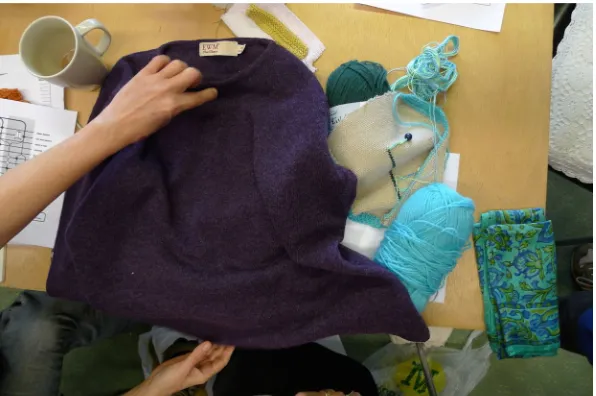
Early in my research I made contact with an embroidery group local to where my family live. This broad familiarity made it relatively straightforward for me initially to observe the group working together, and later to join in as a participant observer (figure 1).
I did not want the responsibility of designing and managing a project to influence my experience of ‘joining in’, and it felt inappropriate in this context to request tasks from participants that they might not otherwise do. As I wanted to study the personal
motivations people have to stitch in a group it was important that participants made work
independently from my interest in their activity. Additionally, as a participant in the group, I was later able to analyse how participants were supported by, and helped to maintain, the group’s collective goals both as a social entity and as embroiderers.
Example 2: Taking a Thread for a Walk (Shercliff)
At a later stage in the research, questions arising from analysis of earlier making
experiences needed addressing; I wanted to explore people’s perceptions and
assumptions of the experience of hand-stitching. Rather than interviewing people, I hoped that discussion prompted by their physical involvement in the stitching would provide a closer view of making. This required participants who were comfortable reflecting on and
evaluating their experiences of creative tasks in group discussion.
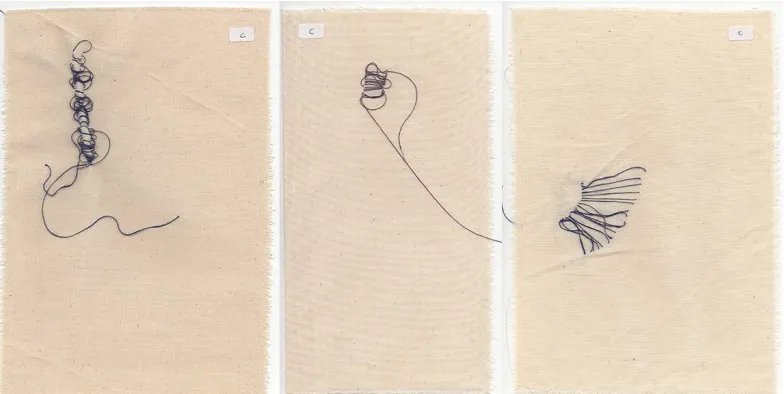
One of these structured workshops, held with five research students, explored perceptions of a hand-made aesthetic. After ranking examples I had prepared according to how attractive they found the stitching and how well they thought the stitching functioned, I
[image:8.595.104.496.342.539.2]asked each participant to stitch their own, following my instructions (figure 2). When asked again to rank my examples, several participants had changed their perceptions, and a rich conversation ensued concerning the means by which hand-stitching is valued.
Figure 2. Example 2: Shercliff’s example on the left; the other two are participants’ examples made following the same instructions, which were to stitch a line of parallel stitches without pulling the thread taut. Photo: Shercliff.
Introduction to methods: Twigger Holroyd
My methods built on the workshops and projects I had already undertaken within my practice as a knitwear designer-maker. The main activity involved a group of seven
workshop sessions at my studio, spaced over several months. The workshop activities gradually shifted from group discussion whilst making (example 4), through structured
re-knitting and design tasks, to working on individual projects (example 5), with the project culminating in the participants re-knitting items from their own wardrobes. Further material was gathered from a wider community of knitters via an informal participatory knitting activity which I run at music festivals each summer (example 6).
Example 5: Re-knitting studio (Twigger Holroyd)
This was the sixth of the seven sessions with the group. By this stage, we had finished
testing the re-knitting techniques, and the participants were working on their own individual re-knitting projects. This session was much more fluid and unstructured than the earlier workshops. At first, the participants worked in twos and threes, but as they moved around the space, they discussed their projects with the others, creating constantly
shifting discussion groups (figure 3). The participants also referred to my extensive collection of knitting books and used the yarn stored in the studio as a colour resource.
During this period, I behaved in a similar way to the participants, dropping in and out of discussions. Although I was seen as an expert on the technical aspects of the re-knitting
treatments, there was no sense that their preferences and decisions should be ʻcheckedʼ
with me, as a professional designer. The participants referred to ʻacting as consultantsʼ
[image:9.595.100.398.497.695.2]for each other, which encapsulates this point.
Example 6: The Knitting Circle (Twigger Holroyd)
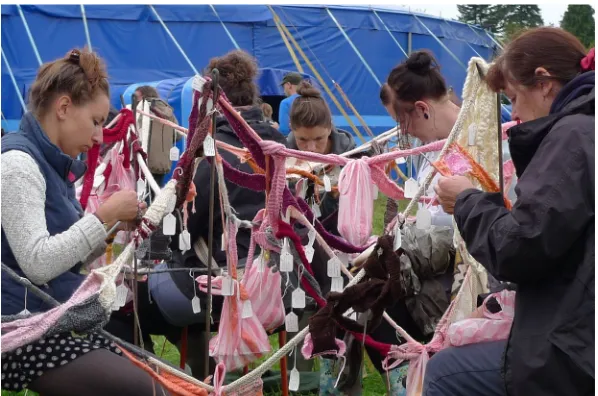
Since 2009, I have run a free, drop-in, communal knitting activity at summer music
festivals (figure 4). I aim for this to be an engaging and accessible activity that will provide an enjoyable experience of knitting, embracing knitters of all abilities. The completed pieces of knitting are left on display, growing in number as the festival
progresses. For the first few years of this activity, I asked people to ʻshare a knitting
memoryʼ on small cardboard tags, after their time spent knitting. The tags were attached
to the knitting and become part of the public display.
I started gathering these comments as a way of making the knitting activity more
engaging; however, I realised that they could be of value to my research. In 2012, I asked
[image:10.595.99.398.360.558.2]participants to share their feelings about wearing homemade clothes. This strategy was effective; it prompted conversation on the topic, and comments which recorded memories and opinions. In 2012, 245 separate comments were written; combined with the tags from the previous years, I gathered over a thousand responses.
Figure 4. Example 6: drop-in activity at summer music festival. Photo: Twigger Holroyd.
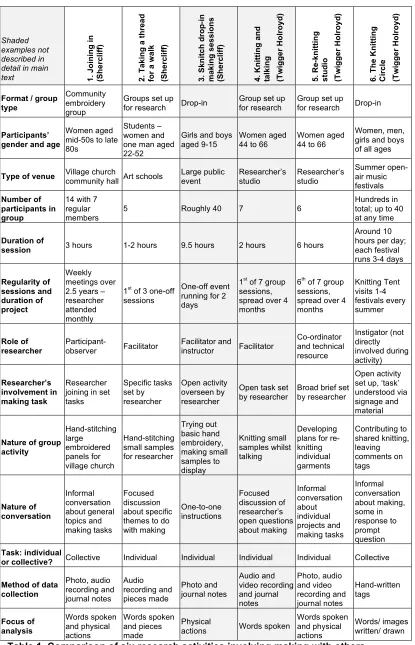
Comparing the examples
Shaded examples not described in detail in main
text 1. Joi
ni ng in (S h e rc li ff) 2. T aki ng a thr ead fo r a w a lk (S h e rc li ff) 3. S kni tch dr op -in ma k in g s e s s io n s (S h e rc li ff) 4. K ni tt ing and ta lk in g (T w ig g e r H o lr o y d ) 5. R e -kni tt ing st udi o (T w ig g e r H o lr o y d ) 6. T he K ni tt ing Ci rc le (T w ig g e r H o lr o y d )
Format / group type
Community embroidery group
Groups set up
for research Drop-in
Group set up for research
Group set up
for research Drop-in
Participants’ gender and age
Women aged mid-50s to late 80s
Students – women and one man aged 22-52
Girls and boys aged 9-15
Women aged 44 to 66
Women aged 44 to 66
Women, men, girls and boys of all ages
Type of venue Village church community hall Art schools Large public event Researcher’s studio Researcher’s studio Summer open-air music festivals Number of
participants in group
14 with 7 regular members
5 Roughly 40 7 6 Hundreds in total; up to 40 at any time Duration of
session 3 hours 1-2 hours 9.5 hours 2 hours 6 hours
Around 10 hours per day; each festival runs 3-4 days Regularity of sessions and duration of project Weekly meetings over 2.5 years – researcher attended monthly
1st of 3 one-off sessions
One-off event running for 2 days
1st of 7 group sessions, spread over 4 months
6th of 7 group sessions, spread over 4 months Knitting Tent visits 1-4 festivals every summer Role of researcher
Participant-observer Facilitator
Facilitator and
instructor Facilitator
Co-ordinator and technical resource Instigator (not directly involved during activity) Researcher’s involvement in making task Researcher joining in set tasks Specific tasks set by researcher Open activity overseen by researcher
Open task set by researcher
Broad brief set by researcher
Open activity set up, ‘task’ understood via signage and material
Nature of group activity Hand-stitching large embroidered panels for village church Hand-stitching small samples for researcher Trying out basic hand embroidery, making small samples to display Knitting small samples whilst talking Developing plans for re-knitting individual garments Contributing to shared knitting, leaving comments on tags Nature of conversation Informal conversation about general topics and making tasks Focused discussion about specific themes to do with making One-to-one instructions Focused discussion of researcher’s open questions about making Informal conversation about individual projects and making tasks Informal conversation about making, some in response to prompt question Task: individual
or collective? Collective Individual Individual Individual Individual Collective Method of data
collection Photo, audio recording and journal notes Audio recording and pieces made Photo and journal notes Audio and video recording and journal notes Photo, audio and video recording and journal notes Hand-written tags Focus of analysis Words spoken and physical actions Words spoken and pieces made Physical
actions Words spoken
Words spoken and physical actions
[image:11.595.92.507.51.696.2]Words/ images written/ drawn
There are many comparisons that can be made; we will highlight just a few, and in doing so explain a little more about the terms we have used. There is a clear link between the two drop-in activities (examples 3 and 6), in that the participants were not identified in advance, and chose how long to stay. Both involved the learning of new skills; however, in example 3 this was the main focus for the researcher, while example 6 catered for all levels of experience in a more ‘open’ project, where participants were left to experiment and produce whatever they wished as a contribution to the shared project. Furthermore, the role of the researcher differs in that example 6 was designed to run without her direct intervention.
The making activity in example 5 took on a life of its own – becoming more like the ongoing project in example 1 – as participants gained understanding of, and confidence in, their tasks. It takes time for researchers and participants to reach a level of intimacy, which potentially nurtures a unique depth and quality of conversation. In these cases the environment induced by the making activity itself facilitates ‘raw’ comments from participants that can reveal new or unexpected insights about the making.
Valuing experience
As experienced practitioners, for whom making is an integral and longstanding part of life, it is easy for us to overlook the value of our own practices to the research. However, it is vital that we do not take the knowledge and skills we brought to the projects for granted; our practices shaped the initial research questions, the workshop activities and subsequent reflection and analysis. In practical terms, our knowledge enabled us to plan effectively, for example in terms of the tools and materials we would need, and the likely duration of different making tasks.
Additionally, we both explored ideas through our individual making practices as the research developed. Having spent time interviewing and observing stitchers, Shercliff used her own making to ‘make sense’ of the information she had gathered:
The notion of ‘making sense’ can not only be taken as making (in craft
practices) through sensory exploration, but also as ‘sense making’ –
creating critical understandings about that practice both through action
and reflection on it. (Gray & Burnett, 2007, p. 22)
Her individual practice helped her to sort the data, highlight key themes, refine questioning and suggest new areas of investigation to be explored. Moreover, her own closeness to the making experience enabled her to notice details in what others were doing and saying whilst making. In cases like this, the insights that arise from using and reflecting upon one’s own experience within the research illuminate details that might otherwise be overlooked, or even missed entirely.1
Twigger Holroyd used her own making practice to test out the re-knitting techniques on a sample garment, keeping one step ahead of the participants. On a practical level, this enabled her to identify problems they might encounter, and develop advice accordingly. More importantly, it allowed her to experience the same process as the participants; this established both a personal, ‘inside’ knowledge of the process, and a vital bond with the group. She found that her practical expertise earned the trust of the participants, and thus their ongoing commitment to a relatively long project.
1 Bolt (2007) makes this point using the example of David Hockney’s research into the drawing
Strengths
We see these participatory making methods as having three key strengths. Firstly, we both found that making supports open, constructive conversation, which helps to gain a detailed understanding of the opinions and experiences of our participants. Others have made similar observations; Stitchlinks (2008, p. 3) suggests that ʻbeing occupied at a certain level appears to prevent the brain from applying its normal prejudices and limitations, which helps to lower barriers making it easier to talk more intimatelyʼ. Furthermore, making can slow the pace of conversation, allowing participants to give thought to topics before contributing, rather than – as can be the case with interviews – feeling pressured to generate an instant opinion (Gauntlett, 2007).
A second strength of the methods we have used relates to the gathering of data during the creative activity.Rather than talking to makers about their practice retrospectively, we were able to hear the participants’ feelings first-hand as they engaged in making. Moreover, we were able to draw on much more than words: the spontaneous use of practical skills allows embodied knowledge to come to the fore. Because different types of information can be observed and gathered when making together – e.g. visual, oral, experiential and emotional – connections between doing and thinking can be captured simultaneously, and drawn out in informal conversation with participants.
While these group making methods are effective in accessing the knowledge that emerges ‘in the moment’ of making, they also reveal changes in perception which occur during the process. For example, in the series of sessions Twigger Holroyd conducted, she was able to capture the participants’ thoughts during the early workshops, when they started to sample various techniques; as they considered their initial design ideas; during the actual re-knitting process; and finally, after the projects were completed. Even within a single workshop (example 2), Shercliff was able to investigate how participants’ judgements of simple stitching tasks changed, before and after trying them out themselves.
Challenges
outside of the experience looking in, and also at the centre of it. If the subject of research concerns the experience of making, it remains in part inaccessible by the very fact of being a researcher; that role requires a critical distance that in itself prevents the
experience being had fully. In his essay ‘Altogether Elsewhere’, Edmund de Waal (2002) discusses markers of authenticity in craft practice, and although his subject is the Western craftsman-ethnographer in foreign lands searching for authentic products and practices, it is possible to identify with what he describes as:
…the positioning of the Western craftsman-ethnographer as both ‘the man
apart’, the dispassionate onlooker able to observe the goings-on rationally
and impartially, and also to be the intuitive, instinctual colleague of the
peasant craftsman, to crouch next to the loom or wheel and enact the
pantomime of shared skills. This is the taxing position (…), the problem of
‘being there’. (de Waal, 2002, p. 185)
In our projects, we each instinctively felt our way through this conundrum. It is only now, on reflection, that we fully appreciate the practical and methodological challenges
concerning the generation of knowledge which are associated with the dual role of facilitator and participant. We are both interested in developing our understanding of this issue, and aim to return to some of the related methods mentioned earlier in this paper in future, in order to build on similar experiences from these other knowledge fields. On a practical note, reflexive note-making after the action helps to turn the making experience into words, although some of the spontaneity of sensation had when in contact with tools and materials is lost. We have both found video and audio recordings to be an important asset, providing documentation that can be revisited after the event and often revealing detail that had been missed during the sessions. Of course, video recordings carry their own challenges: Twigger Holroyd used multiple webcams and separate audio recorders to capture the informal conversation that occurred throughout a day-long workshop (example 5). While this created incredibly rich data, transcription was not straightforward. Furthermore, there is the issue of where to position the camera,
words. She also used her own making as a means of analysis, sensing what mattered and drawing out key themes for further exploration. Because Twigger Holroyd was primarily interested in the participants’ interpretations of their activities, she focused on their spoken words (or written comments, in the case of example 6), using the physical action only as the context for the conversations. She analysed these conversations using thematic coding and a constant comparative method (Robson, 2011), allowing topics to emerge from the workshop data.
Recommendations
Our main motivation in writing this paper was to offer insights for others considering making with others as a research method.
In part, the logistics of our projects influenced our decisions to undertake these particular activities; different timescales, locations, budgets and research interests would have led to different strategies. We would like to re-emphasise the adaptability and variability of these methods, and would therefore encourage others to develop and adapt their own strategies, appropriate to their own particular contexts.
Due to the exploratory nature of participatory practice-based research we have found it important to plan a structure which addresses the research aims, but is flexible enough to allow the researcher to learn, adapt and re-focus as the project progresses. For, as one of the participants in Twigger Holroyd’s research reflected, after her experience of the similarly open-ended process of re-knitting:
You've got to allow for … things to turn out in a surprising way. Because
you don't know.
References
Bolt, B. (2007). The Magic is in Handling, in: E. Barrett & B. Bolt (eds) Practice As
Research: Approaches to Creative Arts Enquiry. London: I. B. Tauris. pp. 27-34.
Bryman, A. (2004) Social research methods. Oxford: Oxford University Press. De Freitas, N. (2007). Activating a Research Context in Art and Design Practice, in:
International Journal for the Scholarship of Teaching and Learning. July 2007. Vol.
1, no. 2.
de Waal, E. (2002). Altogether Elsewhere: The Figuring of Ethnicity, in: P. Greenhalgh (ed) The Persistence of Craft: The Applied Arts Today. London: A&C Black. pp.185-194.
Audiences. Abingdon: Routledge.
Gray, C. & Malins, J. (2004). Visualizing Research: A Guide to the Research Process in
Art and Design. Aldershot: Ashgate.
Gray, C. & Burnett, G. (2007).Making Sense: ‘Material’ Thinking and ‘Materializing Pedagogies’, in: interactiveDiscourse: International Online Journal of Learning and
Teaching in Higher Education. November/December 2007. Vol. 1, issue. 1.
Marchand, T. (2001). Minaret Building and Apprenticeship in Yemen. Richmond, Surrey: Curzon Press.
Marchand, T. (2009). The Masons of Djenné. Indianapolis: Indiana University Press. Marchand, T. (2010). Making Knowledge: explorations of the indissoluble relation
between minds, bodies, and environment, in: Journal of the Royal Anthropological
Institute special issue: Making Knowledge. May 2010. Vol. 16, Issue Supplement s1.
pp. S1-S21.
Parker, R. ([1984] 2010). The Subversive Stitch: Embroidery and the Making of the
Feminine. London: The Women’s Press.
Robson, C. (1993). Real world research: a resource social scientists and
practitioner-researchers. Oxford: Blackwell.
Robson, C. (2011). Real world research: a resource for users of social research methods
in applied settings. 3rd ed. Chichester: Wiley.
Rutt, R. (1987). A History of Hand Knitting. London: B.T. Batsford.
Sanders, E. B-N. & Stappers, P. J. (2008). Co-creation and the New Landscapes of Design, in: CoDesign, Vol. 4, issue. 1, pp. 5-18.
Stitchlinks (2008). Guide to our theories so far. Retrieved 08 11, 2013, from Stitchlinks: <http://www.stitchlinks.com/pdfsNewSite/research/Our theories so far New_