Size Matters
Seeing the Values in Large Technology Heritage
Leonie Alison Wain
Submitted: October 2012
The research presented in this thesis, except where acknowledged in the text, is
the original work of the author. The ideas upon which this thesis was based were
developed by the author in consultation with her supervisors.
Leonie Alison Wain
Abstract
Large technology heritage objects are impressive, exciting and fascinating. They
can also be difficult, dangerous and expensive. When working with large technology
objects every project demands more resources, every triumph is more newsworthy
and every mistake is more visible. With large technology objects “getting it right” is
vital.
This thesis explores what “getting it right” means in both affective and practical
terms, and for both producers of, and visitors to, large technology heritage displays.
During 2008-9 over 80 producers and 368 visitors were interviewed at seven heritage
sites and, for comparison, one non-heritage site within Australia. These interviews
were analysed both qualitatively and quantitatively to examine people’s attitudes to
large technology heritage, and to understand the major influences that form, maintain
and change such attitudes. The thesis also examines methods of interpreting and
dis-playing large technology objects, as well as the impact of heritage industry standards
on the preservation, restoration and management of large technology heritage.
The results of the study indicate that, while the practical challenges of giving big,
old machines a new life as heritage are formidable, it is the values that different people
see in such objects that are the source of the greatest difficulties. Producers of large
technology heritage come from different backgrounds and communities of practice,
and they see different values in the objects and look to different practical ways to
enhance those values. Unfortunately they do not always understand, or value, each
other’s values, which can lead to bitter disputes over which is the right way to do
things. They also do not always understand the values that their visitors see in the
objects, or recognise that display methods that are welcoming and engaging for their
visitors may be very different from the ways in which they themselves expect to see
The major finding of this study, therefore, is that an emphasis on developing
tech-nical methods of preserving, restoring and interpreting large technology heritage is
doomed to failure unless it is combined with an equally strong emphasis on
devel-oping methods to draw out and reconcile the different values that people see in that
heritage. Different practical methods of preserving, restoring and interpreting large
technology objects are not “right” or “wrong” in themselves, but they do have the
effect of enhancing some values and reducing or destroying others. Unless everyone
involved in the project agrees on the values that practical treatments should enhance,
there will be no consensus about the success of those treatments.
The findings of this study have important implications for research and practice
in large technology heritage. In particular, research is needed into the social impacts
of large technology heritage, and into ways of incorporating values effectively into
the practice of caring for large technology heritage. Such research, and concomitant
changes in practice, will contribute significantly to the success and sustainability of
large technology projects, and to the survival of these fabulous objects for the future.
Contents
List of quoted producers xvii
Acknowledgements xxi
1 Why Large technology? 1
1.1 The special place of large technology heritage . . . 1
1.2 Where things go wrong . . . 10
1.2.1 Missing the point . . . 10
1.2.2 Missing the opportunity . . . 13
1.2.3 Missing the audience . . . 16
1.3 Understanding the problems . . . 18
1.4 Outline of the study . . . 20
2 Methodology 27 2.1 Introduction . . . 27
2.2 Boundaries . . . 28
2.2.1 The meaning of “large” . . . 28
2.2.2 The characteristics of “technology” . . . 30
2.2.3 The choice of sites . . . 32
2.2.4 The selection of participants . . . 37
2.3 Methods . . . 38
2.3.2 Ethics . . . 46
2.3.3 Demographic variables . . . 47
2.3.4 Transcription of data . . . 60
2.3.5 Sampling methodology . . . 60
2.3.6 Qualitative analysis . . . 64
2.3.7 Quantitative analysis . . . 65
2.3.8 The visitors . . . 74
2.4 Conclusion . . . 77
3 Finding Connections 79 3.1 Introduction . . . 79
3.2 Frames of reference — storing and processing information about the world . . . 81
3.3 Bringing yourself to heritage — choosing and using information about the past . . . 84
3.4 Feeling involved — sensory experience and personal relevance . . . 87
3.5 Making personal connections . . . 92
3.5.1 Growing into history . . . 98
3.5.2 The personal relevance of personal stories . . . 103
3.6 Making Physical Connections . . . 110
3.7 Operating and looking new — two different things. . . 115
3.8 Touching the past . . . 119
3.9 Conclusion . . . 125
4 Facing barriers 129 4.1 Introduction . . . 129
4.2 A fear of technical specifications . . . 130
4.3 Cultural attitudes to technical subjects . . . 134
4.4 Conclusion . . . 147
5 Reflecting the past 151
5.1 Introduction . . . 151
5.2 Participation and detachment: details and big pictures . . . 152
5.3 Enjoying the past and expressing the present: the impact of genre . . . . 161
5.3.1 Creating and re-creating . . . 164
5.3.2 Doing it for ourselves and doing it for our visitors . . . 174
5.4 Keeping faith: allegiances to communities of practice . . . 182
5.5 Conclusion . . . 198
6 Belonging in the present 201 6.1 Introduction . . . 201
6.2 Engagement . . . 203
6.3 Alignment . . . 217
6.4 Imagination . . . 223
6.5 Conclusion . . . 228
7 Reaching out 231 7.1 Introduction . . . 231
7.2 Visitors’ definitions of success . . . 232
7.3 Physical messages . . . 236
7.3.1 The poor relation . . . 236
7.3.2 Peas in a pod . . . 241
7.4 Intellectual messages . . . 244
7.4.1 The formalist perspective . . . 247
7.4.2 The analytical perspective . . . 250
7.4.3 The local perspective . . . 251
7.5 Ambient messages . . . 253
7.5.1 Variety . . . 254
7.5.3 A sense of control . . . 262
7.6 Conclusion . . . 269
8 Meeting Standards 273 8.1 Introduction . . . 273
8.2 Accepting diversity . . . 275
8.3 Developing standards . . . 279
8.4 The pros and cons of different standards . . . 289
8.4.1 Place, wholeness and issues of tangible and intangible heritage . 300 8.4.2 Function, use and present-day values . . . 304
8.5 Accepting diversity within standards . . . 310
8.6 Economic value . . . 312
8.7 Conclusion . . . 317
9 Conclusion 321 A Tables 329 A.1 Brief guide to tables . . . 329
A.2 Influence of individual demographic categories on responses to survey questions . . . 330
A.3 Interaction of gender and age . . . 349
A.4 Interaction of gender and occupation . . . 355
A.5 Interaction between gender, age and childcare status . . . 361
B Questionnaires and consent forms 365 B.1 Visitor Information Sheet . . . 366
B.2 Visitor Questionnaire . . . 367
B.3 Producer Consent Form . . . 369
B.4 Producer Information Sheet . . . 370
B.5 Producer Questionnaire . . . 371
C List of Dialogue Methods 373
List of Figures
1.1 Hiding your assets: large technology is often conspicuous by its absence 14
3.1 Influence of age and gender on interest in the history of large
technol-ogy objects . . . 98
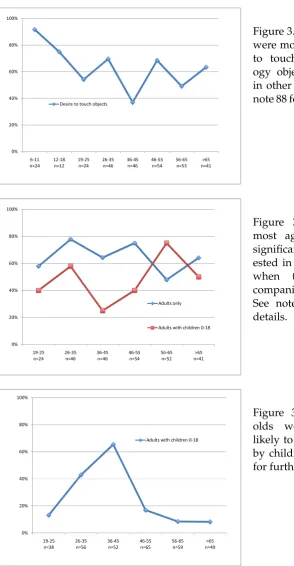
3.2 Influence of age on desire to touch large technology heritage objects . . . 123
3.3 Influence of childcare status on adults’ desire to touch objects . . . 123
3.4 Percentage of adults in different age groups who were accompanied by
children . . . 123
4.1 Influence of gender on interest in technical specifications . . . 136
4.2 Influence of gender and occupation on interest in technical specifications 137
4.3 Influence of gender and age on interest in technical specifications . . . . 138
4.4 Influence of gender and occupation on interest in how the object was
made . . . 139
4.5 Influence of gender and occupation on interest in how the object worked 139
4.6 Influence of gender and occupation on interest in technical specifications 139
5.1 Object value diagram . . . 155
5.2 Agricultural machines: displayed with interpretation from their
own-ers at the Campbelltown Museum field day . . . 176
5.3 Cars: displayed without interpretation from their owners at the Gold
Coast car show . . . 177
7.1 Interest in history of large technology objects at different sites . . . 235
7.2 Subliminal negative messages in large technology signage . . . 237
7.3 Maintenance and interpretation problems with large technology . . . 239
7.4 Pragmatic but dull display layouts and signage for large technology . . 242
7.5 Linking machines to create a visual narrative . . . 260
8.1 Cultural significance: the experience of a working steam train . . . 298
8.2 Cultural significance: bearing witness to past events . . . 299
8.3 Iron corrosion and growing plants at the Henrichsh ¨utte ironworks . . . 308
List of Tables
2.1 Sample crosstabulation . . . 70
2.2 Use of significance values derived from logistic regression tests . . . 74
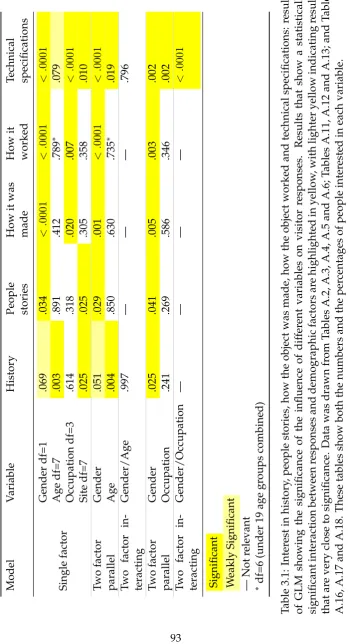
3.1 Influence of different variables on visitor responses to history, people stories, how the object was made, how the object worked and technical specifications . . . 93
3.2 Influence of different variables on visitor interest in restoration, activa-tion and touching of large technology heritage objects . . . 114
3.3 Influence of age and childcare responsibilities on adults’ desire to touch large technology objects . . . 122
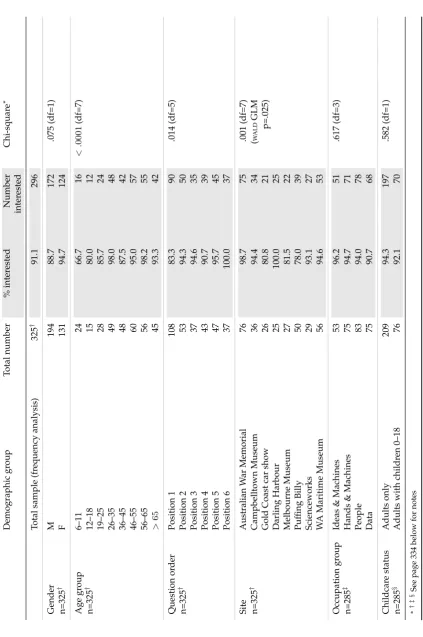
A.1 Details of sample population in total and by site . . . 331
A.2 Interest in history of large technology heritage objects . . . 333
A.3 Interest in technical specifications . . . 335
A.4 Interest in how the object was made . . . 337
A.5 Interest in how large technology heritage objects worked . . . 339
A.6 Interest in stories about people connected with the objects . . . 341
A.7 Desire to see objects restored to look new . . . 343
A.8 Desire to see objects made to work again . . . 345
A.9 Desire to touch large technology heritage objects . . . 347
A.11 Gender–Age 2 — (a) Interest in history; (b) Interest in technical
specifi-cations . . . 351
A.12 Gender–Age 3 — (a) Interest in how the object was made; (b) Interest
in how the object worked . . . 352
A.13 Gender–Age 4 — (a) Interest in stories about people connected with the
object; (b) Interest in objects being restored to look new again . . . 353
A.14 Gender–Age 5 — (a) Interest in objects being made to work again; (b)
Interest in touching large technology heritage objects . . . 354
A.15 Gender–Occupation 1 — Total sample by gender and occupation . . . . 356
A.16 Gender–Occupation 2 — (a) Interest in the history of large technology
objects; (b) Interest in technical specifications . . . 357
A.17 Gender–Occupation 3 — (a) Interest in how the object was made; (b)
Interest in how the object worked . . . 358
A.18 Gender–Occupation 4 — (a) Interest in stories about people connected
with the objects; (b) Interest in objects being restored to look new again . 359
A.19 Gender–Occupation 5 — (a) Interest in objects being made to work
again; (b) Interest in touching large technology heritage objects . . . 360
A.20 Childcare status 1 — Total sample by (a) gender and childcare status;
(b) age and childcare status . . . 362
A.21 Childcare status 2 — Interest in technical specifications . . . 363
A.22 Childcare status 3 — Desire to touch large technology objects . . . 364
List of quoted producers
The following is a list of producers of large technology heritage who have been quoted
or otherwise identified in the text.
Les Bell Private Owner, Campbelltown Museum
Michelle Berry Objects Conservator, Museum Victoria
John Boardman Private Owner, Campbelltown Museum
Tom Brereton Volunteer Guide, Pumping Station, Scienceworks
Michael Brevenholt Education Officer, Western Australian Maritime
Museum
Matthew Churchward Senior Curator of Engineering and Transport,
Museum Victoria
Garry Collins Private Owner, Gold Coast car show
Jamie Croker Large Technology Conservator, Australian War
Memorial
Graeme Daniel Volunteer Steam Engine Driver, Puffing Billy
Steve Deacon Private Owner, Campbelltown Museum
Jenine Fleming Marketing Manager, Scienceworks
Steve Gower Director, Australian War Memorial
Ray Graf Private Owner, Campbelltown Museum
Ron Gunn Leading Hand Fitter, Puffing Billy
David Hallam Senior Conservator (Industrial and Engineering
Sue Ham Volunteer Co-ordinator, Puffing Billy
Allen Hillard Private Owner, Campbelltown Museum
Deborah Hillard Private Owner, Campbelltown Museum
Robin Hirst Director (Collections, Research and Exhibitions),
Museum Victoria
Graeme Hoobins Volunteer, Pumping Station, Scienceworks
Diana Jones Acting Director, Western Australian Museum
Karl Kelenen Private Owner, Campbelltown Museum
John Kemister Large Technology Conservator, Australian War
Memorial
Nikki King-Smith Conservator of Submarine and Slipway, Western
Australian Maritime Museum (on secondment to
Tasmanian Museum and Art Gallery when
interviewed)
Rod Lovell Private Owner, Campbelltown Museum
Ian Macleod Executive Director of Collection Management and
Conservation, Western Australian Museum
Sally May Head of Maritime History, Western Australian
Maritime Museum
Andrew McVey Private Owner, Campbelltown Museum
Maggie Myers Objects Conservator, Western Australian Maritime
Museum
Col Ogilvie Engineering Conservation Consultant, National
Museum of Australia
Helen Privett Objects Conservator, Museum Victoria
Geoff Rooks Private Owner, Gold Coast car show
Lyle Ross Private Owner, Gold Coast car show
Eamonn Seddon Chief Executive Officer, Puffing Billy
Andrew Schroeder Large Technology Conservator, Australian War
Memorial
Ray Shelley Private Owner, Gold Coast car show
Mike Smith Senior Research Fellow, Centre for Historical
Research, National Museum of Australia
Carl Thomson Private Owner, Campbelltown Museum
Fred Vanags Private Owner, Campbelltown Museum and
Custodian of Maitland City Council’s steam
heritage assets
Matilda Vaughan Mechanical Engineer and Volunteer Guide,
Pumping Station, Scienceworks
Vicki Warden Museum Development Officer, Museum Resource
Centre of Southern Inland Queensland
John White Senior Curator of Military Heraldry and
Acknowledgements
Firstly I would like to thank my principal supervisor Professor Paul Pickering for
giving the green light to what seemed at the start, even to me, an odd-ball project.
Paul is widely recognised as one of the most supportive and constructive supervisors
in the Australian National University (ANU), and I have been incredibly lucky to have
his guidance throughout this project.
Secondly I would like to thank my specialist supervisors Kate Clark and Linda
Ferguson. I met Kate soon after starting the thesis, and it was she who introduced
me to the idea of values as a basis for making decisions in heritage. As well as
be-ing fundamental to the development of the thesis, this idea has also taken me on
a personal journey from a focus on the physical fabric of objects, to a more holistic
view of heritage. Linda’s extensive experience in visitor evaluation for museums was
enormously helpful in introducing me to the possibilities and options of qualitative
research, a methodology to which I was completely new.
Thirdly I would like to thank Dr Terry Neeman of the Statistics Consulting Unit at
ANU, who probably did not know quite what she was taking on when she agreed to
help me, but who has been my statistics angel. As a “stats newb” I have plagued her
with the dumbest questions, to which she has ever replied with gentle patience and
careful explanations. She took my small sample sizes in her stride, and was always
positive about what I could do with them.
As I moved into the fieldwork phase of the project, I had the pleasure of meeting
who happily took time out of their visiting experience to attend to my questions, and
provide often lengthy and personal answers. It also included staff, volunteers and
pri-vate large technology owners at the organisations I visited who were equally happy
to sit down with me, often for an hour or more, to share their passion and their
knowl-edge. I would like to thank all these people for their generosity and insight — their
ideas helped me to move beyond my limited preconceptions and discover a world of
new ways of valuing big old machines.
I would like to thank all the students and staff at the ANU Research School of
Humanities and the Arts who were such good companions on the journey and who
invariably offered help and advice when I needed it. In particular, Jacqui D’Arcy,
Sophie Jensen, Sophie McIntyre and my office mate Anna Edmundsen were always
on hand (or online) with tea, sympathy and gossip for light relief.
Finally, and most importantly, I would like to thank my family. I would like to
thank Brenda and Dennis, my mother and father for starting it all by nurturing my
interest in museums and setting me on the path to being a conservator. I would like
to thank my children, Matthew and Marina, for their patience with their mother (who
was always writing but never seemed to finish anything) and for their assistance in
taking lots of photos of big objects. And finally, I would like to thank my husband
Doug. He has kept me financially in the black, provided endless IT support,
enthusi-astically discussed all my latest big ideas, and bouyed me up with love and
cheerful-ness. I would not even have wanted to do it without him.
Chapter 1
Why Large technology?
1.1
The special place of large technology heritage
Heritage, as defined by UNESCO, is a source of life and inspiration. It is “our legacy
from the past, what we live with today, and what we pass on to future generations.”1
Heritage, though, is very personal, and means many different things to many
dif-ferent people. For some it is objects and ideas from the past or family and cultural
traditions. For others it is re-enactments of past events and ways of life. For many
heritage is found in a mix of different ideas, things and events. At this more personal
level, as Kate Clark notes, “. . . heritage is what people value and want to hand on to
the future.”2
The preservation of heritage, and the production and consumption of a variety of
forms of heritage experiences, have grown enormously around the world in recent
decades, and heritage is increasingly recognised as an important resource for the
con-struction of personal and community identity, for informal and lifelong learning, for
entertainment, and for sustainable economic and cultural development.3 One of the
1UNESCO, “About World Heritage”, URL:http://whc.unesco.org/en/about/(accessed 26/01/2011).
2Kate Clark, ed.Capturing the Public Value of Heritage: The Proceedings of the London Conference(English
Heritage, London, 2006), p. 3.
3Chapter 7 of the UNESCO report “Our Creative Diversity” discusses these issues at length, as well
aspects of heritage that has grown most in the latter half of the twentieth century (and
the early years of the twenty-first), is the conservation, restoration, use and display of
technology heritage.
This is somewhat ironic, as the modern heritage movement itself was driven, at
least in part, by antipathy to the perceived degradation of monuments and landscapes
by the technology and consequences of the industrial revolution. John Ruskin and
William Morris, both of whom were instrumental in the early development of the
heritage preservation movement, considered the increasingly complex machines of
the nineteenth century to be at best soulless, and at worst evil. According to Ruskin,
machines produced articles that had a spuriously high finish, but that were fatally
flawed by being divorced from the higher, human qualities of skill and imagination.
He felt that the impact of such machines was not just economic or practical but had
moral connotations as well: according to Ruskin the new machines corrupted society,
dehumanising workers and making them into slaves.4 Morris was milder in his
con-demnation, conceding that it was alright to use machines merely to save labour (as in
grinding corn), but still maintaining that they should not be used to replace artistry
(as in crafts such as weaving).5 He was particularly scathing about steam power, the
Falk and Dierking discuss the growth in museum numbers, size and attendance in the USA, and the perception of visitors that museums provide opportunities for both learning and fun. Andrews discusses
the importance of heritage for community identity and regeneration. UNESCO,Our Creative Diversity:
Report of the World Commission on Culture and Development, UNESCO, n. p., 1998. URL: http://unesdoc.
unesco. org / images / 0010 / 001016 / 101651e . pdf(accessed 17/03/2008). Roy Rosenzweig and David
Thelen,The Presence of the Past : Popular Uses of History in American Life, Columbia University Press, New
York, c. 1998, pp. 3, 37, 68, 90. John H. Falk and Lynn D. Dierking,Learning from Museums: Visitor
Experiences and the Making of Meaning, AltaMira Press, Walnut Creek, 2000, pp. 72 and 220. Baroness Andrews, “Sustainable communities: the economic, social and environmental benefits of heritage.” In
Capturing the Public Value of Heritage: The Proceedings of the London Conference, ed. by Kate Clark, English Heritage, London, 2006, p. 39.
4Ruskin’s impassioned arguments on this subject were expressed in his famous essay “The Nature of
Gothic”, which formed part ofThe Stones of Venice II: The Sea Storieswritten in 1851–3. This was reprinted
in E. T. Cook and Alexander Wedderburn, eds.,The Works of John Ruskin. 36 vols. Library Edition, George
Allen, London, 1903-9, Vol. 10. See Sections 12–15, especially pp. 192–4.
5See “The Aims of Art”, written by William Morris in 1886 and reprinted in May Morris, ed.The
Collected Works of William Morris with Introductions by his Daughter May Morris. 24 vols. (Longmans Green
and Company, London, 1910-15), (Signs of Change: Lectures on Socialism, v. 23, 1915, pp. 81–97, especially
pp. 86-7). Morris, author of “The Manifesto of The Society for the Protection of Ancient Buildings”, was much influenced by his friend Ruskin’s ideas about the preservation of heritage and its importance for
society. Kate Clark, “Values in cultural resource management”. InHeritage Values in Contemporary Society,
ed. by George Smith, Phyllis Mauch and Hilary Soderland, Left Coast Press, Walnut Creek, California,
new motive power for machinery that drove equally new techniques of production,
and modes of consumption:
. . . the life of modern times forces on [the workman] the production of
many things which can be nothingbut utilitarian, as for instance a steam
engine. . . (Emphasis added.)6
Steam powered machines today, of course, are seen as some of the most
roman-tic and exciting examples of heritage, a reversal of taste that would surely have
as-tounded Ruskin and Morris.7 This turnaround in public opinion, however, did not
happen quickly, despite the example of pioneering technology collectors such as Henry
Ford. More generally, as Neil Cossons has noted:
It was not until the 1950s and the arrival of industrial archaeology that
the first attempts were made. . . to emphasise that the great age of industry
itself had a distinguished heritage. . .8
Since that time, however, interest in technological heritage has soared, a phenomenon
that Lucy Taksa attributes to the desire to memorialise industrial sites as they — and
the skills, communities and ways of life they supported — are in their turn lost to
new technologies and the off–shore opportunities of globalised markets.9 Much of
2010, p. 90; George Allan Cate,John Ruskin: A Reference Guide, G.K. Hall, Boston, c1988, p. xii.
6“Making the Best of It”, written by William Morris c. 1879 and reprinted in Morris, The Collected
Works of William Morris with Introductions by his Daughter May Morris, (SeeHopes and Fears for Art: Lectures on Art and Industry, v. 22, 1914, pp. 81–118, especially p. 322).
7The particular enthusiasm that people have for steam technology is regularly noted, both in the
literature and by people who produce and consume heritage. For example, a report on the state of transport heritage in the United Kingdom (UK) noted the particular popularity “of steam propulsion, even among children”; Lucy Taksa noted that the interpretation of the Eveleigh Railway Workshop her-itage precinct in Sydney, Australia strongly emphasised the “romance of the steam era”; and Ray Graf, a private owner of small electrical locomotives at the Campbelltown Museum field day, noted that “You will find most people turn up here and the only reason is to see the steam locomotives.”The Transport
Trust. “Transport heritage: an assessment of needs and potential”. c. 2000. Heritage Lottery Fund.URL:
www.hlf.org.uk/English/PublicationsAndInfo/AccessingPublications/Transport+heritage.htm(accessed
13/07/2009), Section 1: Executive Summary: Railways.Lucy Taksa. “Globalisation and the
memoriali-sation of railway industrial heritage”.Historic Environment21, no. 2 (2008): 11–19, p. 15.
8Neil Cossons, “Culture, communities and conservation: a future for global heritage.” InOutback and
Beyond. TICCIH/ICOMOS, n. p., Broken Hill, Australia, 2010, n.p.
that technological heritage is physically large, and it is this imposing, challenging
“large technology heritage” that is the major subject of this study.10
It is difficult to directly determine the size of the technological heritage industry,
as assessments of the size of the heritage industry generally, the number of people
employed, and the resulting economic and social benefits to communities rarely
re-port on technological collections and institutions as a distinct category. It is,
how-ever, possible to gain some impression of the level of present-day participation in
activities centred around this type of heritage from other sources. In the Australian
context, Collections Australia Network (CAN) lists many heritage organisations that
describe large technology heritage as a major feature of their collections and displays,
and even more that feature at least one or two large technology items.11 The Steam
and Engine of Australia website lists 83 museums of historic technology (covering
ar-eas as diverse as transport, agriculture, energy production, water movement, mining
and telecommunications),12 the Australasian Motor Museums Association (AMMA)
lists 58 museums of motoring heritage around Australia,13,and Engineering Heritage
Australia (EHA) has formally recognised over 137 mostly in-situ items of outstanding
engineering heritage interest.14
In the sphere of private ownership, the Australian Historic Motoring Federation
represents over 900 historic motoring clubs around Australia,15and the level of
activ-ity of clubs devoted to the care of more general industrial technology (mainly
agricul-10The definition of “large technology heritage”, and what it means and encompasses, is discussed in
detail in Chapter 2.
11See the CAN website at URL:http://www.collectionsaustralia.net.au/institution list/, (accessed
26/01/2011).
12See the Steam and Engine of Australia website at URL:http://www.steamengine.com.au/index.php/
directory/museums, (accessed 30/12/2010).
13See the AMMA website at URL: http://www.australasianmotormuseums.com.au/australian motor
museums.php, (accessed 26/01/2011).
14The list cited here was produced in 2008, and EHA continues to actively research and mark
en-gineering heritage sites through its Heritage Recognition Program. Enen-gineering Heritage Australia,
Register of Engineering Heritage Markers, Engineering Heritage Australia, n. p., 2008. URL: http://www. engineersaustralia.org.au/shadomx/apps/fms/fmsdownload.cfm?file uuid=C7EEAE52- EB40-
C8C9-4858- 41066D279042&siteName=ieaust(accessed 30/12/2010). Note that while most of the
organisa-tions listed on the Steam and Engine of Australia website are also listed on CAN, very few of the sites or organisations listed by either EHA or AMMA are listed by CAN, so there is little overlap between the Steam and Engine of Australia, the EHA and the AMMA lists.
15Australian Historic Motoring Federation website:http://www.ahmf.org.au, (accessed 26/01/2011).
tural, but including other genres such as military technology and small scale power
generation), is evinced by the fact that in New South Wales (NSW) alone seven major
field day events were held between January and July 2011.16 In 2010 CAN also held
a list of 583 preserved steam engines, and the Australian National Maritime Museum
held a list of 400 historic vessels.17
The number of paid staff, volunteers and private owners involved with such
or-ganisations is considerable, and the number of people who participate as visitors even
more so. Peter Hiscock, Deputy Chairman of Puffing Billy estimated that, as well
as paid staff, his organisation drew on the services of over 700 volunteers.18 Peter
Garnham, a driving force in the organisation of the Hunter Valley Steam Festival for
many years, noted that the work of running the festival was almost entirely done by
volunteers, and that visitors at the weekend event were estimated by Tourism NSW
in 2008 to have injected $2.1M into the economy of the host town of Maitland.19
Al-lison Russell, Acting Director of the National Motor Museum at Birdwood in South
Australia, noted that the Museum’s Bay to Birdwood Run (for pre-1956 vehicles) and
Bay to Birdwood Classic (for 1956–1977 vehicles) events, which are run on alternate
years, attract about 1300 and 1700 vehicles respectively and lure about 10,000 visitors
through the museum gates for each event.20
A key element of the appeal of much technology heritage is its sheer size, which
has a strong affective power. Big things generally seem to have a deep, visceral
at-traction for people: witness the enduring appeal of big dinosaurs, tall buildings, and
large works of art. Andrew Schroeder, large technology conservator at the Australian
16The Old Machinery Magazine website: Events and Rallies for New South Wales, URL:http://www.
tomm.com.au/events/view/state/nsw(accessed 31/12/2010).
17Kate Clark. “‘Only Connect’ - The social, economic and environmental benefits of cultural
her-itage”. 2012. Australian Government: Department of Sustainability, Environment, Water, Population
and Communitites. URL: http://www.environment.gov.au/heritage/strategy/documents.html(accessed
30/05/2012), p. 3.
18With a large number of these being retirees, only about 550 of them were active volunteers. Active
or not, though, they were interested enough to belong to an organisation focussed on the preservation of large technology heritage.
19The people quoted throughout this Introduction were interviewed as part of the research for this
study. Details of the interview, data collection and analysis procedures are provided in Chapter 2.
War Memorial (the Memorial), commented simply that “people see [big things] as
im-pressive — they want them” and noted that many places built their own big things,
such as the “Big Banana” purely to attract visitors. Diana Jones, acting director of the
Western Australian Museum — Maritime (WA Maritime Museum) said of the
enor-mous turbines in the old East Perth Power Station, “. . . they are amazingly daunting
and majestic.” These words have nothing to do with the functionality of the objects,
but instead describe their affective presence, both beautiful and sometimes
uncom-fortable. They also describe an immediate and instinctive personal reaction which is
not mediated by words: as Kit Messham-Muir said of his encounter with a similarly
enormous artwork, “I didn’t think — I felt.”21
Robin Hirst, a senior exhibition manager of many years’ experience at Museum
Victoria, also noted that big things are essential in displays to provide vistas and
di-rections:
Exhibitions of small things get repetitive. Large things add relief and
rhythm. It’s a matter of juggling shape, design, and colour to keep
peo-ple’s attention focussed.
He also commented that big things are memorable in a way that small things are not:
You have to build a shrine around a small thing to give it a sense of
impor-tance: the physical footprint is important.
This view was echoed by a visitor at the Memorial who felt it was the big things
he remembered seeing as a child that brought him back to the same museum as an
adult.22
Big things are so memorable, in fact, that they can become intergenerational things,
the iconic objects and experiences that people bring their children and grandchildren
to see. An 88–year-old great grandmother riding on Puffing Billy with her family said:
21Kit Messham-Muir. “Body hits: The dynamics of kinespherics and interpretation in current musuem
displays”. 2006.Exploring Dynamics: Cities, Cultural Spaces, Communities. Museums Australia, Brisbane.
URL:http://museumsaustralia.org.au/site/conf bris06.php(accessed 12/10/2012), pp. 2, 5.
22Memorial 290: Male, 56–65, quantity surveyor.
My brother and I and my dad [used to come on this] when we were kids. . .
Now I’m here with my great grandchildren for their first time.23
A big part of the attraction of many large technology objects is the history that they
embody. Andrew Schroeder noted that, for an organisation, having a big thing was
good, but having a big thing with a well-known history was even better, commenting
that “. . . it brings an audience or a profile to their collection.” Many visitors spoke of
the respect they felt for an object which had had a long and hard working life, but
spoke quite dismissively of an object — even a “real” one24— which had never been
used. As a mechanic remarked at the Campbelltown Steam and Machinery Museum
(Campbelltown Museum):
You can see the integrity. You can see that it’s done what it was meant to
do rather than something that looks all showroom and pretty but is yet to
prove itself.25
The sheer size of the “real” thing also has a major impact on visitors, especially
when they feel that they have seen the object before and therefore should already
know how big it is. A visitor at the Memorial said:
When you go to an air-show you don’t really get up close to them, so you
don’t really get a true sensation of what the inside of the plane was like,
what the size was.26
A visitor at the WA Maritime Museum made a similar comment:
I didn’t expect [the yacht] Australia II to be that large, from below. It’s a
lot different from when you see it on the television. You have no idea or
concept of the scale or size.27
23Puffing Billy 382: Female,>65, watchcase maker and home maker.
24“Real” here is used in the sense of having had a prior existence and purpose before being
incorpo-rated into a heritage display.
25Campbelltown Museum 131: Male, 46–55, mechanic.
26Memorial 248: Female,>65, childcare centre owner.
Even memory seems to falter in the face of things of this size. An ex-RAAF veteran at
the Memorial remarked with interest:
I can’t remember these aircraft being so large.28
Size is not only surprising but encompassing — many large technology heritage
objects are built specifically for people to climb inside, and even when they are not,
the sensory impact of their size and — if they are working — their sound, smell,
movement and vibration, creates an immersive environment which invites people to
step imaginatively into a different world. Conservator Nikki King-Smith said of the
submarine she worked on at the WA Maritime Museum:
. . . what I found really interesting. . . was the closed environment, because
it was dangerous and strange. . . The fact that these people lived in it and
loved it. . . This was like a giant cubby house.
Michael Brevenholt, education officer at the WA Maritime Museum, also commented
that the physical impact of the submarine made communicating its significance much
less difficult:
It’s very easy to do an immersion style thing, going inside an object like
that and [asking the children] to partake in the lives of the submariners
for an hour. But it also works from the outside, because of its size and
im-pact. . . everyone sees it. . . and says “wow”. That makes kids more inclined
to listen to what you have to say.
Many visitors want to experience how the physical environment of a large technology
object feels in relation to their own bodies. A visitor at the Memorial said:
You see it on TV and hear about it but you don’t ever grasp what it really
is until you use your five senses — see, touch. . . to understand it.29
28Memorial 281: Male,>65, printer.
29Memorial 261: Female, 26–35, office manager.
Seeing the interior environment of the object can also stimulate people to think about
the objects not in terms of broad historical concepts or general technological
princi-ples, but in terms of the practical reality of what it must have felt like to live and work
with the objects every day. A couple at the Memorial discussed their insight into life
in the cockpit of an Avro Anson trainer aircraft with some amusement:
Man: The guide said “Look at the size of the seats.”
Woman: How did they fit in them?
Man: Can you imagine sitting in that seat for 12 hours? And you can’t
move, you’ve just got to sit there, and think about bodily functions!30
Large technology heritage objects also often have particularly long and complex
life histories, a feature that seems to engender a sense of empathy and fellow feeling in
many people, even to the point of anthropomorphism. A visitor at Darling Harbour,
for instance, when asked if big old machines should be made to work again, replied
with a laugh:
It doesn’t matter because no one can work for [too] long. The human and
the machinery don’t work for ever.31
A visitor at the WA Maritime Museum, when asked if the machines should be restored
to look new, likewise reasoned:
Sometimes, I suppose, butwecan’t be restored to look new again can we?32
Another visitor at the Campbelltown Museum was of the opinion that the most
im-portant time in a machine’s life was when it had been used for a while because:
. . . by then they’ve developed a bit of character. . . Brand new out of the box
you don’t know her.33
30Memorial 294: Male, 56–65, electrician. Female, 46–55, accountant.
31Darling Harbour 384: Male, 56–65, physics professor.
32WA Maritime Museum 172: Female,>65, telephonist.
There was a strong sense from the people interviewed in this study that large
tech-nology heritage objects were more than just collections of parts, and that their
char-acter and performance was determined by more than just their technological
specifi-cations. As with people, the idiosyncracies of their physical bodies and the
circum-stances of their lives were seen to interact throughout their “lives”, amplifying
differ-ences to create individuals with distinct characters, quirks and abilities. These features
made them interesting and — mostly — likeable, and it was evident that many people,
from a wide range of backgrounds, wanted to see such objects preserved, interpreted
and made accessible.
1.2
Where things go wrong
Unfortunately, along with the interested visitors and the many successful projects,
there are problems in the world of large technology heritage, and it is in part these
problems that have led to the present study. These issues are outlined below.
1.2.1 Missing the point
There are a number of different approaches to preserving large technology objects.
Each of these approaches can preservesomeimportant aspects of this type of heritage,
but not all, and the requirements of these different approaches often conflict with each
other.
For example, evidence of the life and use of an machine is embodied in its physical
fabric, and can only be understood in detail through close examination, sampling and
scientific analysis. Preserving this information means changing the object as little as
possible.
Alternatively, the way a particular machine works and the skills needed to
main-tain and operate it can only be understood in detail by experiencing the machine while
it is working, and this may mean changing the object considerably, both to return it to
(and maintain it in) working order, and to meet modern safety requirements.
Both these approaches preserve important aspects of information about the object,
but they are different aspects, and they require treatments that are on different sides
of a philosophical divide. Knowing which treatment is appropriate means identifying
what is most significant about that object, and devising an approach to treatment and
interpretation that will preserve and enhance that significance.
Producers of large technology heritage, though, come from many different skill
backgrounds, and frequently draw their ideas about how such objects “should” be
treated more from the traditions of their knowledge backgrounds than from the needs
of the heritage object and situation with which they are actually dealing.
Conse-quently, producers whose background traditions stress the importance of replacing
worn parts with new, and maintaining a “spick-and-span” appearance that connotes
good care and workmanship, may inadvertently remove original evidence that is
fun-damental to the historical significance and accurate understanding of the object. Jamie
Croker, large technology conservator at the Memorial, described the impact of the
re-covery of the original wartime fabric from the Memorial’s German Albatros aircraft,
which had been removed and discarded by well-meaning restorers in the 1960s:
. . . it still had all of the original paint on it. . . it helped us get all the stitching
in the right spots for all the fabric. It also clarified a lot of things. . . that
we didn’t realise, which was [that] not all the fabric on the Albatross was
lozenge-print fabric. The majority of it was actually plain linen that had
been painted. . .
This information not only helped to guide the physical restoration of the aircraft, but
also prompted new lines of investigation about its history:
. . . what the curator thinks is that the date of manufacture on that aircraft
seems to coincide roughly with the production of lozenge fabric — when
it was first brought into production. So [maybe] it was just starting to be
time, lozenge was still hard to get. . . and they decided that. . . everywhere
it was [going to be] painted — they’d use plain linen. . .
The end result was both more historically accurate, and more interesting than could
have been achieved without the opportunity to examine the original fabric.
On the other hand, producers whose backgrounds stress the importance of
retain-ing all original material, and who view change to the object essentially as damage
to the historical record, may inadvertently cause the complete loss of the intangible
heritage associated with the object; the heritage skills and embodied knowledge that
are required to run the object, and the sensory experience of its operation. It has to
be asked whether a large technology object that has lost a few original parts is less
original or authentic than one that has lost its ability to move. Eamonn Seddon, chief
executive officer of Puffing Billy, spoke of the challenges of reconciling these two
ap-proaches to ensure that visitors continued to be able to experience the thrill of a fully
operational steam train:
[On our locomotives] instead of white metal axle faces, [as] the public can’t
see them, we’ve introduced a very high density plastic axle face. Now,
somebody might say,“Well, that’s not very original” But I’m saying,“Well,
hang on though, it’s actually protecting the wheels, [otherwise] they’re
actually going to wear out” They’re going to last me 50 times longer than
[the old type] would have. . . We can’t put [the locomotives] on plinths,
that’s not what we’re about. . .
Values and traditions from the past are important to the preservation of large
tech-nology heritage, as it is these legacies from past experiences that drive producers’
passionate interest in, and commitment to, the objects for which they care. To develop
approaches to management and display that meet the needs of a large technology
object in a heritage context, though, producers need to acknowledge the differences
between the object’s service and heritage roles, as well as the differences between the
large technology object and more traditional museum objects. Planning and
imple-menting practical preservation and display strategies means bringing the expertise
from different traditions together to develop new, shared ways of doing things that
meet new and different needs.
1.2.2 Missing the opportunity
It is common to find large technology both poorly cared for and poorly interpreted
in museums, offering a stark contrast to other items stored and displayed by such
organisations. The constraints of money and space undoubtedly play a part in this —
particularly in small organisations which have very limited resources — but these are
not the underlying reasons. The real causes are the decisions made by organisations
as to where to place their resources.
For instance, the opportunity to preserve and make accessible to the public the
grand and historic Spotswood Pumping Station was a key reason in 1992 for siting
Museum Victoria’s new Scienceworks campus in an otherwise out-of-the-way
back-water of Melbourne.34 In 2009, however, when visitors to Scienceworks were
inter-viewed for this study, it was apparent that many visitors to the site did not realise that
the Pumping Station was part of the museum site at all, and visitor profile surveys
showed that only 18% of visitors to the site actually visited the Pumping Station while
they were there (the lowest visitation of any part of the site except for the popular, but
restricted seating, areas of the Lightning Room and Planetarium).35
This is hardly surprising, though, as it is quite hard to find information about
the Pumping Station unless you already know exactly what you are looking for.
Je-nine Fleming, marketing manager for Scienceworks, commented that Museum
Victo-ria had explicitly decided not to promote it with a dedicated campaign, commenting
that “It’s not a key driver for our audience.” Presumably for this reason it also has
34Interview with Jenine Fleming, marketing manager for Scienceworks, January 2011.
35Visitation data drawn from Museum Victoria’s market research and evaluation report “At a Glance
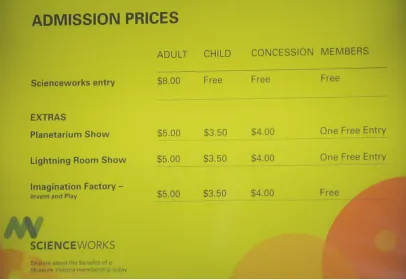
Figure 1.1: This illuminated sign is the only list of site attractions that visitors see as they enter Scienceworks. In practical terms the Pumping Station does not need to be listed here, as the sign is there to show admission costs, and the Pumping Station is free. The sign also, however, acts as a default list of “special” things that are not part of the regular exploratorium-style galleries, and this makes the omission of the Pumping Station a problem. Visitors are also handed an A4 sheet listing tours and special events which does mention the Pumping Station, but by the time they read this they are already likely to have selected all the extras they can manage from the attractions promoted on the illuminated board. Image: Alison Wain, 2009
minimal exposure on the Scienceworks website,36while at the Scienceworks site itself
there is equally little signage to indicate what the Pumping Station is, where it is, or
how to access it (Fig. 1.1).
Those that do make their way there find dusty buildings and machinery with
min-imal and poorly integrated interpretation. Potential attractions such as the extensive
36The Pumping Station is not listed on the Museum Victoria as an exhibition. It is listed alongside
administrative options such as “Venue Hire and Events” in a small, grey font link leading to very brief information that only describes it as being open for tours or self-guided tours. This is not eye-catching and does not suggest that it is regularly and readily accessible. See the Museum Victoria website at URL:
http://museumvictoria.com.au/scienceworks/(accessed 01/02/2011).
and cave-like sub-surface tunnels, wells and machinery are not even hinted at, despite
being arguably the most unusual and sensational part of the site. For comparison,
Fre-mantle Prison offers guided tours of the cramped and flooded tunnels underneath it
for a healthy $60 per adult, and bookings are essential.
During the time that Museum Victoria has had responsibility for the management
and display of the Pumping Station it has, amongst other major projects, opened two
major new sites — the Melbourne Museum and the Immigration Museum —
devel-oped the Lightning House and Planetarium at Scienceworks itself, and undertaken
major refurbishments of the exhibitions in the main galleries of all of its sites. The
lack of attention to the Pumping Station is, therefore, not due to lack of resources,
but to deliberate decisions not to use those resources to upgrade the Pumping Station
experience.
Undoubtedly those decisions were backed by sound reasoning given the
Mu-seum’s circumstances at the time, but it was reasoning that seems to have been
under-lain by the perception that the Pumping Station, its machinery, and its history were
too dull or too intractable to warrant making their interpretation a priority project. In
fact Robin Hirst, of Museum Victoria, repeatedly expressed negative perceptions of
large technology heritage as being difficult and inconvenient:
For all the space they only get across one message. . . they can distort the
story because they take up so much space.
Getting them out is so difficult and expensive. It makes it difficult to
change things around regularly to attract repeat visitors.
[Sometimes] we have constructed large things rather than used collection
objects, because you can walk through or get in fabricated objects. . . With
the real objects. . . you have to go around them which makes them take up
even more space.
mu-seum world. Hilda Hein, for instance, makes assertions about the difficulty and
un-desirability of operating old machinery without any substantiation, and without
ap-parently recognising the dismissive personal prejudices embedded in her words:
Periodic performances by museum staff trained to use antique instruments
are sometimes scheduled, but they are expensive and possibly obtrusive,
hazardous, and unsanitary. The equipment’s unpredictable performance
may be what captivates the visitor’s curiosity, but these somewhat
un-reliable demonstrations are increasingly giving way to prepackaged and
scripted lessons that inform the public in standardized, repeatable detail
regarding an object’s capabilities. Regrettably, video tapes leave little room
for exploration, but they can easily be replayed.37
Large technology objects present large challenges that are sometimes easier to just
ignore, but this process of denial can result in the loss of tremendous opportunities.
To enable an object to fulfil its role as heritage and become an asset rather than a
liability, producers need to address the challenges openly, and with the same levels of
creativity and attention to detail that are applied to the mentally safer comfort zones
of more traditional museum objects.
1.2.3 Missing the audience
Producers put large technology objects on display for visitors without necessarily
un-dertaking much investigation of what those visitors really want to see and
experi-ence. A number of producers interviewed for this study expressed opinions about
what visitors were or were not interested in, or what sort of presentation they found
most engaging, but these were personal and anecdotal views. In no case was there
any systematic study of visitor attitudes to large technology heritage.
The relationship of visitors to such objects is, though, significantly different from
37Hilda S. Hein,The Museum in Transition : a Philosophical Perspective, Smithsonian Institution Press,
Washington, c 2000, p. 9.
the relationship of producers to those same objects. Visitors generally have only a
fleeting engagement with the object, mostly on the day of their visit, though strands
of connection may twine out from that visit into both the past and the future.38 For
most visitors, engagement with the object is seen through the prism of leisure — they
have come for a good day out, and that day out should comprise pleasurable
experi-ences such as fun, learning and social interaction. For most producers, however, their
extended care of an object or collection generates in–depth knowledge and emotional
investment, and engagement with the object is seen through the prism of achievement
— they have come to do something worthwhile. They too expect fun, learning and
social interaction, but they also expect satisfaction, respect and, sometimes, payment.
They are also deeply conscious that, through their work on such objects they place
their skills, standards and ideas on display and they will be judged, both by other
producers and by their visitors.
The attitudes of visitors and producers to large technology objects are therefore
substantially different. Many producers use their large technology objects to express
strongly held personal or organisational messages and viewpoints. To visitors, who
are looking more for ways to make personal connections to the objects, this passion
and ideology can come across as boring and obsessive. Visitors on the other hand,
do not have the opportunity to develop a detailed knowledge of the object, so their
understanding of it is disproportionality influenced by information that is quickly
and easily accessible at the time of their encounter. This includes the immediate
sen-sory experience of the object, and information that they or their companions already
have. This information is, of course, not always accurate, leading producers to be
often amused at, or saddened by, the perceived ignorance of visitors.
The different motivations and perceptions of producers and visitors mean that
they can have very different views on the best way to present large technology
her-itage, and the messages that producers try to transmit to their visitors about large
technology heritage can be very different from the messages that visitors actually take
away with them. In particular, the positive messages of ingenuity, achievement and
even glory that seem unquestionable to producers who are passionate about the
tech-nology, can seem biased and unjustified to visitors with different points of view. The
WA Maritime Museum’s celebrations of the 25th anniversary of Australia II’s victory
in the 1983 America’s Cup yacht race, for instance, involved media and other events
featuring the yacht as the centre of a story of Australian ingenuity, all-out effort and
national triumph. The messages received by one interviewee from these events were,
however, very different:
I came to the lecture here about the [America’s Cup] race. I thought it was
all crazy, like a bunch of children. [In the video] the [Australia II] crew
and the US crew were exercising and the Australia II crew punched the US
crew to the ground and ran off. And the US crew were yelling obscenities
in the race. . . And they only won one race and they made such a song and
dance about it. Men just go on! They’re never going to let this story go.39
With their long periods of use and complex connections with society, large
tech-nology objects have audiences that go beyond those who once manufactured or used
them, and carry meanings and information that go beyond celebrations of their
tech-nical ingenuity and achievements. To maximise the potential of a large technology
object as heritage, it is important to understand and recognise these diverse audiences
and messages, and to include them in both management and display strategies.
1.3
Understanding the problems
None of the issues described above are strictly to do with the technology itself. It is
not the nature of the technology that determines what people do with it and how they
perceive it; it is people themselves, and the values that they bring to it. Accordingly
it is people, and their various values, that are the subject of this study: the
produc-39WA Maritime Museum 197: Female,>65, telephonist.
ers of heritage who preserve, restore, interpret and display large technology heritage
objects; and the visitors who come to see those objects.40 The study investigates the
many views of large technology heritage that people hold, explores the influences
that underlie those views, and links those views to the decisions people make as both
producers of, and as visitors to, large technology heritage.
In 1991, Nick Merriman conducted a postal survey of 1,500 people in the UK that
aimed to:
. . . understand how people themselves think about the past and museums
and how they use them, rather than how analysts think they use them.41
In 1998, Roy Rosenzweig and David Thelen conducted a telephone survey of 1,500
people in the USA which also aimed to find out how ordinary people used and
un-derstood the past.42 Both of these studies focussed on capturing the opinions and
values of ordinary people about the past, and comparing them with the views of
“ex-perts” (academics, teachers, politicians, museum professionals and others). Both
stud-ies sought to understand popular uses of the past both through interviewees’ actual
words (in Merriman’s study through written survey responses; in Rosenzweig and
Thelen’s study through telephone interviews) and through statistical analyses of their
coded responses.
Merriman noted that, due to the size of the project, his work had two key
limita-tions. These were that:
• the study was based on a large scale survey, and therefore analysis was kept at
a broad level only;
• the survey dealt with the concept of “the museum” as an undifferentiated genre,
with no questions about specific examples or types of museums or other heritage
40Note that both these groups may include people who are (or were) manufacturers of large
technol-ogy items as service objects, but that this role is different to that of producing heritage, just as the role of the object in its service life is different to its role as heritage.
41Nick Merriman,Beyond the Glass Case: the Past, the Heritage and the Public in Britain, Leicester
Univer-sity Press, Leicester, 1991, p. 3.
display sites.
These limitations, he felt, meant that the “complexity and fine-grain of people’s
im-ages of the past or their attitudes to museums have been glossed over”, and that
“ide-ally this now needs to be supplemented with in-depth analyses of specific elements of
museums, conducted in the manner of the ethnographer.”43With a similar interest in
people’s images of the past and of heritage, the present study takes up this challenge,
focussing on the specific area of large technology heritage in an Australian context.
1.4
Outline of the study
To help the reader navigate quickly through the study, this section briefly describes
the contexts and contents of the remaining chapters.
Chapter 2 discusses the methodology of the study, including the complementary
use of qualitative and quantitative research techniques, decisions regarding data
ac-quisition and analysis, the siting of the study in the Australian context, the ethical
foundations of the study and the selection of interview sites and participants. To
provide context and background information for the reader the chapter defines the
boundaries of the study (including what is meant by “large”, and by “technology”),
provides a brief explanation of relevant statistical ideas for readers who are new to
statistics, and discusses the demographic make-up of the study population (the
over-all sample of visitors who were interviewed).
While some private owners of large technology heritage care for and work on their
machinery solely as a private joy, most love to share their passion with others,
show-ing their objects off at open days, competitions and privately run display sites.
Volun-teers and professional heritage staff working with large machinery in public museums
are similarly in the business of displaying large technology heritage to visitors. For all
these producers of heritage displays, pleasing their visitors — giving them an
experi-ence that they would like to repeat, and which they would recommend to their friends
43Merriman,Beyond the Glass Case: the Past, the Heritage and the Public in Britain, p. 6.
— depends upon understanding who their audiences are (and could be), how they
re-spond to different types of displays, and why they rere-spond as they do. Chapters 3
and 4, therefore, use the qualitative and quantitative methods described in Chapter 2
to analyse visitor responses to large technology displays at eight different Australian
sites. Chapter 3 focusses on the importance for visitors of being able to relate what
they see to their existing frames of reference, and the personal and individual
cir-cumstances of their lives. Three broad theoretical themes are used to set this data
in context: the way information about the world is stored and processed by the
hu-man brain; the way people choose and use information about the past; and the ways
in which sensory experience and personal relevance underpin the power, affect and
memorability of events. Chapter 4 explores the impact of technical information on
visitors’ confidence, understanding and engagement with heritage machinery, with
particular reference to gender segregation in technological training and employment
as a source of difference in male and female responses to technical information in
heritage.
Just like their visitors, producers of large technology heritage come from many
different backgrounds. Consequently, although they mostly share a deep
commit-ment to the welfare of their objects, their approaches to preserving and displaying
their objects are varied, and sometimes even in conflict. This can lead to tensions
be-tween different producers and organisations, and to destructively negative views of
each other’s abilities, motivations and achievements. Large technology heritage is,
however, too complex to preserve, too expensive to care for, and too diverse for any
one organisation or individual to be able to tackle it alone, so strategies for sharing
a distributed network of knowledge, skills, funding, research and collections are
vi-tal. Understanding where different values and approaches come from, and how they
influence the preservation and use of different aspects of large technology heritage,
is crucial for understanding how conflicts can be resolved, and sound collaborative
the past and the present that influence the way large technology heritage producers
approach their objects.
Chapter 5 focusses on the past, looking at the influence of different routes into the
world of large technology heritage — the confidence in tacit and embodied
knowl-edge created by early, regular and often family association with large technology, and
the more cerebral approach engendered by professional tertiary training in
engineer-ing or heritage studies. It looks at the influence of different genres of large technology
heritage on attitudes to visual presentation of the objects, anticipated target audiences,
expectations of visitor experiences, and the different goals of historical accuracy and
expressive creativity. Finally, it discusses the influence of communities of practice —
particularly those from the formative period of late adolescence and early adulthood
— and discusses in detail philosophical and ethical differences between the
conserva-tion and engineering approaches to large technology heritage. Chapter 6 focusses on
the present, looking at the influence of social relationships, identity and self-esteem
on producers’ participation in large technology related organisations through three
different modes of belonging: engagement, alignment and imagination. Engagement
is about joining in; alignment is about working together; and imagination is about
seeing new potential and transcending past experience.
As well as being influenced by values from their personal lives, social groups and
vocational communities of practice, producers of large technology heritage also
op-erate within a wider world of heritage theory and practice. This wider community
has its own traditions and values, which are developed and disseminated through
research and publication, and promoted — sometimes enforced — through industry
codes and standards. Chapters 7 and 8 discuss the assumptions and dictates of such
industry values and standards in terms of their impact on the preservation and
pre-sentation of large technology heritage.
Chapter 7 discusses the importance for heritage producers of engaging a wide
range of audiences, not just people who are similar in age, background, taste and