Int. J. Electrochem. Sci., 10 (2015) 1136 - 1143
International Journal of
ELECTROCHEMICAL
SCIENCE
www.electrochemsci.org
Short Communication
Simultaneous Electrochemical Determination of Ascorbic Acid,
Dopamine and Uric Acid Based on Nitrogen Doped Carbon
Sphere Modified Glassy Carbon Electrode
Fucheng Ye1, Zubiao Wen2, Hongfu Wu1, Chunyan Wang1,* , Yong Qian1
Key Laboratory of Radioactive Geology and Exploration Technology Fundamental Science for National Defense, East China Institute of Technology, Nanchang, 330013, China
College of Chemistry and Chemical Engineering, Jiangxi Normal University, Nanchang 330022, China
*
E-mail:[email protected]
Received: 31 October 2014 / Accepted: 8 December 2014 / Published: 1 xxx 2014
Nitrogen doped carbon sphere (NDCS), with an average diameter ranging from 220 to 280, was prepared with glucose and melamine mixture as starting materials and ethylene glycol as the solvent and reducing agent by solvothermal method. The microstructures of the NDCS were characterized by X-ray photoelectron spectroscopy (XPS) , XRD pattern and Raman spectra. NDCS exhibited highly electrocatalytic activity towards the oxidation of biomolecules such as ascorbic acid (AA), dopamine (DA) and uric acid (UA) due to its unique structure and properties originating from nitrogen doping. This new finding provides a novel and promising candidate of advanced electrode material for the simultaneous determination of AA, DA and UA in human metabolism.
Keywords:Nitrogen doped carbon sphere (NDCS); glassy carbon electrode; electrocatalysis;
Electrochemical determination; Ascorbic acid; Dopamine; Uric acid
1. INTRODUCTION
functionalize CSs with special catalytic, magnetic, electrical and optical properties. For example, nitrogen doped carbon sphere (NDCS), with the N atoms doping in CSs, structural deformation was formed because of the local tension emerging in the hexagonal carbon network [24], which can enhance the electron transmission and chemical reaction activity [25] in virtue of the additional lone electron pair of N atoms providing negative charge to the delocalized π system in sp2 hybridized carbon skeleton.
Simultaneous determination of dopamine (DA), ascorbic acid (AA) and uric acid (UA) has received a considerable attention [26] and plays a vital role in the process of metabolism [27]. Once abnormality of the content of these biological molecules in the body, it will cause a series of related diseases such as infertility, cancer, AIDS, Huntington disease, leukemia and pneumonia [28-30] etc. However, there is a trouble to simultaneously detect DA, AA and UA on traditional electrodes for electrochemical detection because the voltammetric response overlaps and the electrode is polluted by the oxidation products which will cut down the stability, reproducibility and sensitivity of the electrode [31-33]. Hence, many modified electrode mateials such as the ionic liquid [34], conductive polymer [35-38], functionalized carbon nanotubes [39-41], nitrogen doped graphene [42] and platinum hybrid nanomaterial [43] were used to successfully detect AA, DA and UA .
In this paper, we directly synthesize nitrogen doped carbon sphere (NDCS) by one-step solvothemal method. The microstructure and electrochemical properties of NDCS is characterized through scanning electron microscopy (SEM), X-ray powder diffractometer (XRD), Raman Spectroscopy, X-ray Photoelectron Spectroscopy (XPS) and Electrochemical Workstation. The results indicate that NCSs modified electrode show an excellent electrocatalytic activity to oxidize small biological molecules (AA, DA and UA), and the oxidation peak do not appear to overlap. Therefore, we believe that the one-step method of preparation functional nanomaterials will have a large application in the future.
2. EXPERIMENTAL
2.1 Raw Materials
Melamine, glucose were bought from Sinopharm Chemical Reagent CO. Ltd (China), Ascorbic acid, dopamine and uric acid were obtained from Shanghai Chemical Reagents Company. All chemicals were of analytical grade and solutions were prepared with ultrapure water (>18MΩ).
2.2 Preparation of nitrogen doped carbon sphere (NDCS)
cooled to room temperature naturally. A dark precipitate was collected and washed with absolute ethanol three times. The as-obtained CS was then dried in a vacuum at 60 °C for 10 h.
2.3 Characterization
The morphology of NDCS was characterized on a field-emission scanning electron microscope (FE-SEM, S-4800, Hitachi, Japan) at an accelerating voltage of 10 kV, Spot 3. Raman spectrum was recorded using a micro-Raman system (Renishaw InVia, UK) with an excitation wavelength of 514 nm. The structures of NDCS were analyzed by X-ray diffraction (XRD) using an X-ray powder diffractometer (Shimadzu, X-6000, Cu Kα radiation). X-ray photoelectron spectroscopy (XPS, Kα) analyses were carried out using a Thermo Fisher X-ray photoelectron spectrometer equipped with Al radiation as the probe, with a chamber pressure of 5 10−9 Torr. The power was 72 W, and the pass energies were 200 eV and 50 eV for survey scans and high-resolution scans, respectively. The analysis spot size was 400 μm in diameter. All electrochemical measurements were performed on a CHI 660 electrochemical workstation (CH Instruments, USA). Cyclic voltammograms (CVs) and different pulse voltammograms (DPVs) were collected in a three-electrode system (GCE or modified GCE as the working electrode, a Pt wire as counter electrode, and an Ag/AgCl as the reference) at room temperature.
3. RESULTS AND DISCUSSION
[image:3.596.198.398.475.647.2]3.1. Characterization of nitrogen doped carbon sphere (NDCS)
Figure 1. SEM images of as-synthesized NDCS
image reveals that most of the carbon spheres are in perfect spherical morphology and some of them are inclined to form chain-like aggregates.
10 20 30 40 50 60
Int ensi ty (a. u. )
2 Theta (degree) C(002)
C(110)
A
1000 1500 2000
Int ensi ty (a. u. )
Raman shift (cm-1)
D band
G band
[image:4.596.117.475.134.273.2]B
Figure 2. (A, B) XRD pattern and Raman spectra of NDCS
Fig. 2A shows the XRD pattern for NDCS, where the two peaks at 25.4°and 42.8°, can be indexed to the typical graphitic (002) and (100) planes, respectively.
200 400 600 800
Int ensi ty (a. u. )
Binding Energy (eV)
C1s
N1s O1s
A
280 282 284 286 288 290 292
Int
ensi
ty
(a.
u)
Binding Energy (eV)
C1s B
C-C/C=C
C=N C-N
394 396 398 400 402 404 406
Int ensi ty (a. u. )
Binding Energy (eV)
N1s
"Pyridinc" N
"Pyrolic" N
"Graphitic" N
C
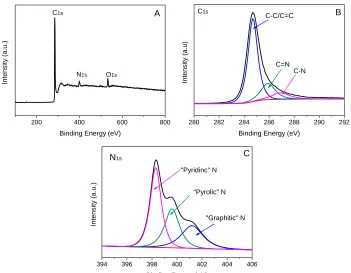
Figure 3. (A) XPS spectra of NDCS, The peaks located at 285, 398.5, and 534.0 eV indicate the carbon, nitrogen, and oxygen elements, respectively. (B) and (C) high-resolution C1s and N1s XPS spectra.
[image:4.596.125.476.391.664.2]
graphitization degree of the carbon sphere can be determined by Raman spectra. Fig. 2B shows the Raman spectrum of the as-synthesized NDCS. Two characteristic peaks lying at about 1355 and 1595 cm−1 correspond to the D-band and the G-band, respectively [45]. The D-band is explained by defects, dislocations, and lattice distortions in the carbon structures. The G-band is attributed to the ordered graphite structure. Generally, the D-band to G-band intensity ratio is used to estimate evaluate the defects of carbon materials. The peak intensity (ID/IG=0.96) indicates that the graphitic layers in NDCS are not well ordered and that there are some defects in the sample.
Fig. 3A shows the XPS wide spectra for NDCS. It is shown that the presence of principal C1s (285eV), O1s (532eV), and N1s (398.5eV) peaks. The elemental content analysis from the XPS data reveals the mass composition of NDCS: C 85.6 %, N 6.8%, O 7.6%. As for C1s, three typical peaks centered at 284.7, 285.9 and 287 eV as shown in Fig. 3B, corresponding to C-C/C=C (sp2 and sp3), C =N, C-N groups, respectively. N1s peak can be fitted into three components (From Fig. 3C).
-0.2 0.0 0.2 0.4 0.6
-20 0 20 40 60 80
C
ur
rent
(
A
)
Potential (V)
A
AA
DA
UA
-0.2 -0.1 0.0 0.1 0.2 0.3 0.4 0.5
0 10 20 30 40 50 60 70
bare GCE CS@GCE NDCS@GCE
C
ur
rent
(
)
Potential (V)
[image:5.596.159.429.282.703.2]B
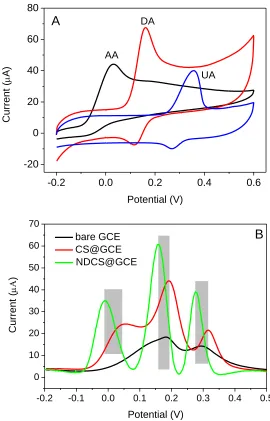
Figure 4. (A) Cyclic voltammograms (CVs) of 1.0 mM AA, 0.2 mM DA and 0.2 mM UA in 0.10 M
Table 1. Comparison of peak current and peak potential of different electrode
The intense peaks locate at 398.5 eV and 399.5 eV is assigned to nitrogen atoms with “pyridinic” and “pyrrolic” chemical structures, and the peak at 401.3 eV corresponds to N atoms linked with three carbon atoms at the same (denoted as “graphitic”N atoms. These XPS analyses reveal that nitrogen atoms have been successfully incorporated into carbon frameworks and exist as three kinds of chemical status in carbon spheres.
AA, DA and UA coexist in the extracellular fluid of the central nervous system and serum. The ability to selectively determine these species has been a major goal of electroanalysis research. The individual electrochemical behaviors of AA, DA and UA at a NDCS/GCE were first investigated by cyclic voltammetry (CV) as shown in Fig. 4A. The oxidation peak of AA, DA, UA on NDCS@GCE are around 0.03, 0.16 and 0.35V, respectively. To confirm the feasibility of the simultaneous determination of AA, DA and UA at NDCS modified GCE, differential pulse voltammograms (DPVs) was carried out in their mixture. Fig. 4B and Table1 describe the DPVs of the bare GCE, CS@GCE and NDCS@GCE in 0.1M phosphate buffer solution (pH=7.0) with 1mM AA, 0.2mM DA and 0.2mM UA. At the bare GCE (black line), it can be seen that the electrochemical response to three biomolecules was very poor and indistinguishable. Moreover, the oxidation peaks for AA and DA overlapped together. Consequently, it is difficult to determine the three small biomolecules simultaneously at bare GCE. When CS or was modified to the surface of GCE, peak current is improved obviously and the differences between their peak potentials are larger. These demonstrate that the CS or NDCS modified GCE are more beneficial to the fast and effective simultaneous electrochemical detection AA, DA and UA. Compared to CS@GCE and bare GCE, the well-defined peaks at NDCS@GCE (green line) are recorded. We noted that negative shift of the oxidation peak potential at the NDCS@GCE. This phenomenon indicates that carbon sphere doped with nitrogen atoms can accelerate the electron transfer and decrease the overpotentials of AA, DA, UA oxidation as well. It is obvious that AA, DA and UA molecules with different structure have strong interaction with NDCS. As a result, NDCS can decrease the overpotentials of AA, DA and UA oxidation at different levels according to their interaction, confirming that NDCS with much higher electrocatalytic activity can be used for simultaneous determination small biomolecules.
In addition, the separation of the oxidation peak potentials on the NDCS@GCE for AA-DA and DA-UA is about 169mV, 118mV respectively. The larger separation of the peak potentials allows selectively determining AA, DA or UA in the presence of the other two species, or simultaneously detecting them in their mixture. It is the key factor to realize simultaneous determination AA, DA and UA.
Electrode Mater.
Method Current(μA) Potential(V)
AA DA UA AA DA UA
4. CONCLUSIONS
The present paper describes that nitrogen doped carbon sphere (NDCS) with an average diameter ranging from 220 to 280 nm was successfully synthesized by solvothermal method. It is found that the NDCS shows excellent electrocatalytic activity towards the oxidation of ascorbic acid, dopamine and uric acid due to unique structural and properties of NDCS. Moreover, the electrocatalytic oxidation of these three biomolecules on the NDCS modified electrode shows three well-defined oxidation peaks with larger peak separation. This new finding demonstrates that NDCS is promising candidate of advanced electrode material in electrochemical sensing and other electrocatalytic applications.
ACKNOWLEDGEMENTS
This work was supported by the Young Scientist Foundation of Jiangxi Province (No. 20133BCB23020) , Foundation of Jiangxi Educational Committee (No. GJJ14471), the Open Project Foundation of the Key Laboratory of Radioactive Geology and Exploration Technology Fundamental Science for National Defense of China (2011RGET07, RGET1310) and the Open Project Foundation of Nuclear engineering technology research center of Ministry of Education(HJSJYB2011-17).
References
1. A. A. Deshmukh, S. D. Mhlanga, N. J. Coville, Materials Science and Engineering: R: Reports 70 (2010) 1.
2. H. D. Du, B. H. Li, F. Y. Kang, R. W. Fu, Y. Q. Zeng, Carbon 45 (2007) 429.
3. R. Alcántara, F. J. Fernández Madrigal, P. Lavela, J. L. Tirado, J. M. Jiménez Mateos, C. Gómez de Salazar, R. Stoyanova, E. Zhecheva, Carbon 38 (2000) 1031.
4. A. Bibby, L. Mercier, Chem. Mater. 14 (2002) 1597.
5. V. G. Pol, M. M. Thackeray, Energy Environ. Sci. 1904 (2011) 4.
6. J. Chen, N. Xia, T. Zhou, S. Tan, F. Jiang, D. Yuan, Int. J. Electrochem. Sci. 4 (2009) 1063. 7. C. W. Xu, L. Q. Cheng, P. K. Shen, Y. L. Liu, Electrochem. Commun. 9 (2007) 997. 8. Y. C. Liu, X. P. Qiu, Y. Q. Huang, W. T. Zhu, Carbon 40 (2002) 2375.
9. H. Mahfuz, A. Adnan, V. K. Rangari, S. Jeelani, B. Z. Jang, Composites Part A: Applied Science and Manufacturing 35 (2004) 519.
10.A. Hirata, M. Igarashi, T. Kaito, Tribology International 37 (2004) 899. 11.Z. Wang, J. Yin, Chem. Phys. Lett. 289(1998) 189.
12.Z. Mehraban, F. Farzaneh, V. Dadmehr, Mater. Lett. 63 (2009) 1653.
13.J. Y. Miao, D. W. Hwang, K. V. Narasimhulu, P. Lin, Y. T. Chen, S. H. Lin, L. P. Hwang, Carbon 42 (2004) 813.
14.S. Y. Sawanta, R. S. Somania, B. L. Newalkarb, N. V. Choudaryb, Materials Letters. 63 (2009) 2339.
15.Y. Z. Mi, Y. L. Liu, New Carbon Materials. 24 (2009) 375.
16.D. Banerjee, D. Sen, K. K. Chattopadhyay, Microporous and Mesoporous Materials. 171 (2013) 201.
20.M. Kim, S.B. Yoon, K. Sohn, J.Y. Kim, C.-H. Shin, T. Hyeon, J.-S. Yu, Microporous Mesoporous Mater. 63 (2003) 1.
21.V. G. Pol, V. G. Pol, D. Sherman, A. Gedanken, Green Chem. 11 (2009) 448. 22.V.G. Pol, Environ. Sci. Technol. 44 (2010) 4753.
23.V. G. Pol, S. V. Pol, J. M. Calderon-Moreno, A. Gedanken, Carbon 44 (2006) 3285.
24.C. L. Sun, H. W. Wang,M. Hayashi,L.C. Chen, K. H. Chen, J. Am. Chem. Soc. 128 (2006) 8368.
25.K. A. Kurak,A. B. Anderson, J. Phys. Chem. C. 113 (2009) 6730.
26.H. X. Li, Y. Wang, D. X. Ye, J. Luo, B. Q. Su, S. Zhang, J. L. Kong, Talanta 127 (2014) 255. 27.M. Noroozifar, M. Khorasani-Motlagh, R. Akban, M. B. Parizi, Biosensors & Bioelectronics 28
(2011) 56.
28.O. Arrigori, C. D. Tullio, Biochim. Biophys. Acta 1569 (2002) 1.
29.J. R. Delanghe, M. R. Langlois, M. L. DeBuyzere, N. Na, J. Ouyang, M. M. Speeckaert, M. A. Torck, GenesNutr. 6 (2011) 341.
30.Y. Z. Zhou, H. Y. Zhang, H. D. Xie, B. Chen, L. Zhang, X. H. Zheng, P. Jia, Electro-chim. Acta 75 (2012) 360.
31.P. Y. Chen, R. Vittal, P. C. Nien, K. C. Ho, Biosensors and Bioelectronics. 24 (2009) 3504. 32.F. Gonon, M. Buda, R. Cespuglio, M. Jouvet, J. F. Pujol, Nature. 286 (1980) 902.
33.R. F. Lane, C. D. Blaha, Langmuir., 6 (1990) 56.
34.A. Safavi, N. Maleki, O. Moradlou, F. Tajabadi, Analytical biochemistry. 359 (2006) 224.
35.Y. Z. Zhang, Y. Pan, S. Shao, L. P. Zhang, S. P. Li, M. W. Shao, Electroanalysis, 19 (2007) 1695. 36.P. Wang, Y. X. Li, X. Huang, L. Wang, Talanta. 73 (2007) 431.
37.X. H. Lin, Q. Zhuang, J. H. Chen, S. B. Zhang, Y. J. Zheng, Sensors & Actuators B: Chemical. 125 (2007) 240.
38.A. Balamurugan, S. M. Chen, Analytica Chimica Acta. 596 (2007) 92.
39.S. F. Jiao, M. G. Li, B. Fang, C. Wang, D. Chen, B. Fang, Electrochimica Acta. 52 (2007) 5939. 40.Y. Zhang, S. Su, Y. Pan, L. Zhang, Y. Cai, Ann. Chim. 97 (2007) 665.
41.A. H. Liu, I. Honma, H. S. Zhou, Biosensors & Bioelectronics. 23 (2007) 74.
42.Z. H. Sheng, X. Q. Zheng, J. Y. Xu, W. J. Bao, F. B. Wang, X. H. Xia, Biosensors & bioelectronics. 34 (2012) 125.
43.S. Thiagarajan, S. M. Chen, Talanta 74 (2007) 212.
44.A. Das, S. Pisana, B. Chakraborty, S. Piscanec, S.K. Saha, et al. Nat. Nanotechnol. 3(2008)210 45.Z. Xu, C. Gao, Macromolecules 43 (2010) 6716.