Int. J. Electrochem. Sci., 7 (2012) 5367 - 5373
International Journal of
ELECTROCHEMICAL
SCIENCE
www.electrochemsci.org
The Effect of Sintering Temperature and Carbon Content on
the Properties of Li
0.84Ni
0.08MnPO
4/C Synthesized by Sol-Gel
Method
Yurong Zhang*, Yanyan Zhao
College of Chemistry and Chemical Engineering, Fuzhou University, Fuzhou, Fujian 350108, China *
E-mail: [email protected]
Received: 11 April 2012 / Accepted: 17 May 2012 / Published: 1 June 2012
Li0.84Ni0.08MnPO4/C composite cathode materials for lithium ion battery are synthesized by sol-gel method followed by heat treatment in the air. Field-emission scanning electron microscopy (FE-SEM) measurements show that firing temperature affects the morphology of the end products. X-ray powder diffraction (XRD) analysis indicates that the samples are olivine-structured. The galvanostatic charge-discharge results show that the optimal firing temperature registers 400℃, and that sample Ni008-20%-400 possessed the best properties with its initial discharge capacity of 145.3 mAhg-1 at 0.02C rate and good capacity retention at a high C-rate.
Keywords: Li-ion battery; olivine; cathode material; doping; sol-gel method
1. INTRODUCTION
possessed the best performance. So in this work, focus was put on the structure and electrochemical activities of this composition.
2. EXPERIMENTAL
Li0.84Ni0.08MnPO4/C was prepared by sol-gel method with lithium acetate dihydrate, manganese acetate tetrahydrate, nickel acetate tetrahydrate, ammonium dihydrogen phosphate, ascorbic acid, and sucrose as starting materials, and citric acid as a chelating agent. The starting materials were dissolved in distilled water separately and then mixed together; the pH value of the resulting solution was adjusted to 2 by the addition of HNO3. Then, the water in the solution was driven out by rotational vaporization under 70℃ water bath to obtain a gel which was further vacuum-dried at 120℃ followed by 5 h heating at 300℃ in the air to get precursor. Then, conductive carbon was mixed with the precursor and ball-milled to get a homogeneous mixture, which was in turn calcined at 400 , 500 , and 600 ℃ for 3 h, respectively, to obtain Li0.84Ni0.08MnPO4/C. The initial conductive carbon contents were 10 and 20 wt.% of the final products, respectively. According to the initial conductive carbon amounts and the firing temperatures, the products were labeled as Ni008-10%-400, Ni008-10%-500, Ni008-10%-600, Ni008-20%-400, and so on.
The crystal structure of the products was investigated by powder X-ray diffraction (XRD) on a Philips X’pert Pro diffractometer using Cu Kα (λ=0.154178 nm) radiation at room temperature. The microstructure of the products was measured by field emission scanning electron microscopy (FE-SEM, FEI Nova NanoSEM 230, USA). The final carbon contents of the samples were measured on a carbon and sulfur analyzer (Eltar-CS800, Germany). Results showed that the final carbon amounts for samples Ni008-10%-400, Ni008-10%-500, Ni008-10%-600, Ni008-20%-400 were 10.2 , 9.4 , 8.9, and 22.8 wt.%, respectively. Charge–discharge tests were conducted with the coin cell (type: CR2025), which consisted of a working electrode and a lithium foil counter electrode separated by a Celgard 2300 microporous membrane. One mole per liter of LiPF6 / EC + DMC + EMC (1:1:1 vol. %) was used as the electrolyte. The working electrode was prepared by mixing the as-synthesized product, acetylene black, and poly (vinylidene fluoride) binder in a weight ratio of 80:10:10 and the viscous slurry in N, N-dimethylformamide solvent was cast on an aluminum foil and dried at 120 ℃ under vacuum for 12 h. The cells were assembled under a highly pure argon atmosphere in a glove-box (ZKX-2B, China). The half-cell tests were carried out on a Land CT 2001A electrochemical measurement system between 2.8 and 4.4 V at a constant rate. The capacity was calculated based on active material excluding carbon.
3. RESULTS AND DISCUSSION
b
c d
a
shape, such kind of morphology was in favor of the activity of the cathode materials. When the firing temperature increased to 500 ℃, the sample particle became block-like with irregular shape. Further elevating the firing temperature to 600℃, the particle grew further and became round. It was obvious that the microstructure of the sample depended on the firing temperature.
Figure 1. FE-SEM images of Li0.84Ni0.08MnPO4/C; a: 10%-400 b: 10%-500 c: Ni008-10%-600 d: Ni008-20%-400
X-ray powder diffraction patterns of Li0.84Ni0.08MnPO4/C were recorded and shown in Fig. 2. It was confirmed that samples Ni008-10%-500 and Ni008-10%-600 were of a single phase with olivine structure indexed to orthorhombic Pmnb (JCPDS card number: 33-0804). For samples Ni008-10%-400 and Ni008-20%-400, a detectable second phase labeled as “*” was found, which was highly likely to be Mn2P2O7. The cell parameters of each sample were refined using MDI Jade 5 software. The results showed that the volumes of samples 10%-400, 10%-500, 10%-600 and Ni008-20%-400 were 299.71, 300.56, 300.95, and 299.60 Å3 , respectively, which were smaller than the standard value of 303.14 Å3
[image:3.596.95.501.169.548.2][image:4.596.92.482.140.377.2]
would ease the internal stress caused by the lattice misfit between charged and discharged phase [10], thus might enhance the cyclic ability of the Ni-doped materials.
Figure 2. XRD patterns of Li0.84Ni0.08MnPO4/C
Galvanostatic charge-discharge measurements of samples Ni008-10%-400, Ni008-10%-500, and Ni008-10%-600 were carried out. The results tested at a charging rate of 0.05 C (1C=170mAh/g) and a discharging rate of 0.02C were shown in Fig. 3. It was found that both the initial discharge capacity and reversible capacity decreased when elevating the firing temperature. Such a trend was reasonable, as discussed previously, higher firing temperature led to larger particle size, thus lengthened the pathway for Li+ ion migration, which was detrimental to the activity of the cathode material according to the insertion/extraction reaction mechanism suggested by Padhi et. al. [1].
As expected, the electrochemical performance of sample fired at 400℃ was further improved by increasing carbon content to overcome one of its main defects, i.e. poor conductivity, which was also illustrated in Fig. 3. It was found that the initial and the 40th capacity for sample Ni008-20%-400 at 0.02C rate were 145.3 and 92.6 mAh.g-1 respectively, which were 45% and 86% higher than those of Ni008-10%-400 respectively. In a word, the increase of carbon content enhanced not only capacity but also cyclic ability.
a
b
voltage was set at 4.4V to avoid decomposition of the electrolyte, which would decrease the discharge capacity to a certain extend.
[image:5.596.82.471.134.709.2]
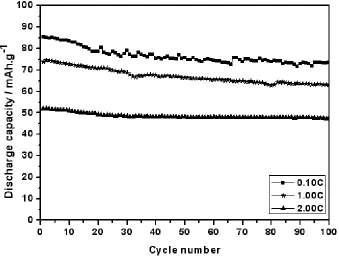
Figure 4. Cycle performances of sample Ni008-20%-400 at various C-rates
Fig. 4 showed the rate performances of sample Ni008-20%-400 tested at the same charge/discharge current for each rate measurement. It was found that the discharge capacity dropped with the elevation of C-rate. On the one hand, flake-like morphology of sample Ni008-20%-400 would shorten the length for Li+ ion migration and enhance its electrochemical properties; on the other hand, according to the report for LiMnPO4 synthesized by hydrothermal route [27], the extent of disorder arrangement of cations in the structure of sample fired at low temperature might be higher, which would block the one-dimensional diffusion pathway for Li+ ion, thus affected its rate performances. Even so, the electrochemical activity of sample Ni008-20%-400 was much better than that of undoped LiMnPO4 synthesized under the same conditions [26], confirming the positive effect of Ni doping.
4. CONCLUSIONS
Flake-like olivine-structured Li0.84Ni0.08MnPO4/C composite cathode materials for lithium ion battery had been successfully synthesized by sol-gel method followed by heat-treatment at a low temperature of 400℃ without using inert gases. Half-cell measurements indicated that sample Ni008-20%-400 possessed the best performances.
ACKNOWLEDGEMENTS
References
1. A. K. Padhi, K. S. Nanjundaswamy, J. B. Goodenough, J. Electrochem. Soc., 144(1997)1188 2. Gangulibabu, N. Kalaiselvi, D. Bhuvaneswari,C. H. Doh, Int. J. Electrochem. Sci., 5 (2010) 1597 3. Hong-Chang Wong, James R. Carey, Jenn-Shing Chen, Int. J. Electrochem. Sci., 5 (2010) 1090 4. Jian Gao, Jianjun Li, Xiangming He, Changyin Jiang, Chunrong Wan, Int. J. Electrochem. Sci., 6
(2011) 2818
5. H. Xie, Z. Zhou, Electrochim. Acta, 51(2006) 2063
6. S.-Y. Chung, J. T. Bloking, Y. -M. Chiang, Nat. Mater. 2(2002) 123 7. R. Yang, X. Song, M. Zhao, F. Wang, J. Alloys Compd., 468(2009) 365
8. A. Yamada, M. Hosoya, S.-C. Chung, Y. Kudo, K. Hinokuma, K.-Y. Liu, Y. Nishi, J. Power Sources, 119-121(2003) 232
9. A.Yamada, S.-C. Chung, J. Electrochem. Soc., 148 (2001) A960
10.Z.X. Nie, C.Y. Ouyang, J.Z. Chen, Z.Y. Zhong, Y.L. Du, D.S. Liu, S.Q. Shi, M.S. Lei, Solid State Commun., 150(2010)40
11.G. Li, H. Azuma, M. Tohda, Electrochem. Solid-State Lett., 5(2002)A135
12.T. Drezen, N.-H. Kwon, P. Bowen, I. Teerlinck, M. Isono, I. Exnar, J. Power Sources, 174(2007) 949
13.D. Wang, H. Buqa, M. Crouzet, G. Deghenghi, T. Drezen, I. Exnar, N.-H. Kwon, J. H. Miners, L. Poletto, M. Grätzel, J. Power Sources, 189(2009) 624
14.Y. Wang, Y. Yang, Y. Yang, H. Shao, Solid State Commun., 150(2010) 81 15.Z. Bakenov, I. Taniguchi, Electrochem. Commun., 12(2010) 75
16.D. Choi, D. Wang, I.-T. Bae, J. Xiao, Z. Nie,W. Wang, V. V. Viswanathan,Y. J. Lee, J.-G. Zhang,G. L. Graff, Z. Yang, J. Liu, Nano Lett., 10(2010) 2799
17.Z. Bakenov, I. Taniguchi, J. Electrochem. Soc., 157(2010) A430
18.D. Wang, C. Ouyang, T. Drézen, I. Exnar, A. Kay, N.-H. Kwon, P. Gouerec, J. H. Miners, M. Wang, M. Grätzel, J. Electrochem. Soc., 157(2010) A225
19.T. Shiratsuchi, S. Okada, T. Doi, J.-I. Yamaki, Electrochim. Acta, 54(2009) 3145
20.M. M. Doeff, J. Chen, T. E. Conry, R. Wang, J. Wilcox, A. Aumentado, J. Mater. Res., 25(2010) 1460
21.J.-W. Lee, M.-S. Park, B.Anass, J.-H. Park, M.-S.Paik, S.-G. Doo, Electrochim. Acta, 55(2010) 4162
22.C. Hu, H. Yi, H. Fang., B. Yang, Y. Yao, W. Ma, Y. Dai, Electrochem. Commun., 12(2010) 1784 23.G. Yang, H. Ni, H. Liu ,P. Gao, H. Ji, S. Roy, J. Pintob, X. Jiang, J. Power Sources, 196(2011)
4747
24.G. Chen, J. D. Wilcox, T. J. Richardson, Electrochem. Solid-State Lett.,11(2008) A190
25.Huihua Yi, Chenglin Hu, Haisheng Fang, Bin Yang, Yaochun Yao, Wenhui Ma, Yongnian Dai, Int. J. Electrochem. Sci., 7 (2012) 663
26.Y. Zhang, Y.Zhao, L.Deng, Ionics, DOI 10.1007/s11581-011-0655-y
27.Haisheng Fang, Zhiyun Pan, Liping Li, Yong Yang, Guofeng Yan, Guangshe Li, Shiqiang Wei, Electrochemistry Commun., 10 (2008) 1071