BMC Health Services Research 2002,
2 x
Research article
Application of the development stages of a cluster randomized trial
to a framework for evaluating complex health interventions
Mark B Loeb
Address: Departments of Pathology and Molecular Medicine and Clinical Epidemiology and Biostatistics, McMaster University, Hamilton, Ontario, Canada
E-mail: [email protected]
Abstract
Introduction: Trials of complex health interventions often pose difficult methodologic challenges. The objective of this paper is to assess the extent to which the various development steps of a cluster randomized trial to optimize antibiotic use in nursing homes are represented in a recently published framework for the design and evaluation of complex health interventions. In so doing, the utility of the framework for health services researchers is evaluated.
Methods: Using the five phases of the framework (theoretical, identification of components of the intervention, definition of trial and intervention design, methodological issues for main trial, promoting effective implementation), corresponding stages in the development of the cluster randomized trial using diagnostic and treatment algorithms to optimize the use of antibiotics in nursing homes are identified and described.
Results: Synthesis of evidence needed to construct the algorithms, survey and qualitative research used to define components of the algorithms, a pilot study to assess the feasibility of delivering the algorithms, methodological issues in the main trial including choice of design, allocation concealment, outcomes, sample size calculation, and analysis are adequately represented using the stages of the framework.
Conclusions: The framework is a useful resource for researchers planning a randomized clinical trial of a complex intervention.
Background
Antibiotic use in nursing home residents is an important public health issue given that 50% to 75% of residents are exposed to at least one course of antibiotics annually [1– 4]. Such overuse can potentially lead to the development of multi-drug antibiotic resistant bacteria, drug-related ad-verse effects, and harmful drug interactions [5–14]. The appropriate use of antibiotics in this setting is challenging. The diagnosis of infection in residents of nursing homes
is often difficult, since symptoms may be vague and signs difficult to elicit [14]. The evaluation of residents is often made by nursing staff who have varying levels of expertise and knowledge about infectious diseases. Frequently, treatment decisions are made by busy clinicians who rely on nursing assessment as their primary source of informa-tion. Interventions to optimize antibiotic use in this set-ting therefore need to directly involve both nurses and physicians and have the potential for strong "buy-in" Published: 11 July 2002
BMC Health Services Research 2002, 2:13
Received: 13 March 2002 Accepted: 11 July 2002
This article is available from: http://www.biomedcentral.com/1472-6963/2/13
from these healthcare professionals. Such interventions are aimed at changing behavior and by necessity will in-volve multiple components.
Recently, Campbell and colleagues published a frame-work for the design and evaluation of complex health in-terventions [15]. Derived from a document drafted by members of the MRC Health Services and Public Health Research Board, the paper is based on the premise that a different construct is required for trials that evaluate com-plex interventions. Examples include interventions to im-prove delivery of health services, to change health professionals' behavior, or to promote health through strategies aimed at individuals, schools, healthcare facili-ties, or communities. It is apparent that such trials pose very different challenges when compared to clinical trials designed, for example, to assess the efficacy of pharmaco-logic therapy [16]. Amongst these are the development, identification, documentation, and reproduction of the interventions. Although such challenges are well known [17–19], few published strategies exist for researchers about to embark on a clinical trial of these interventions. Campbell et al. propose that the development and evalu-ation of such complex interventions be considered in a se-ries of phases, analogous to the sequential phases of drug development [15].
The design and evaluation framework proposed by Camp-bell et al. appears to be well suited to interventions for op-timizing antibiotic use in long-term care facilities. The objective of this paper is to evaluate the extent to which the various steps in the development of a cluster rand-omized trial to optimize antibiotic use in nursing homes are represented in the framework for the design and eval-uation of complex health interventions [15]. Often it is not possible to evaluate complex health interventions, such as strategies to improve antibiotic use in long-term care facilities, by randomizing individuals. Cluster rand-omized trials randomize groups of individuals, healthcare professionals, or institutions. Applying the development steps of this trial to the framework proposed by Campbell and colleagues allows for a formal evaluation of the framework's utility.
Methods
The five phases of the framework of Campbell et al [15] include 1) a pre-clinical or theoretical phase, 2) Phase I, identification of the components of the intervention, 3) Phase II, definition of the trial and intervention design, 4) Phase III, methodological issues for the main trial, and 5) Phase IV, promoting effective implementation of the in-tervention. Using the framework, the corresponding stag-es of the nursing home trial development are identified and described.
Results
Preclinical or theoretical phase Overview
The purpose of this phase is to determine if the interven-tion has the potential to have the desired effect. This step can take into account previous studies demonstrating em-pirical evidence for the intervention as well as the theoret-ical basis for the intervention. Review of the theorettheoret-ical basis for an intervention may lead to an altered hypothe-sis and improved specification of "potentially active ingre-dients" [15].
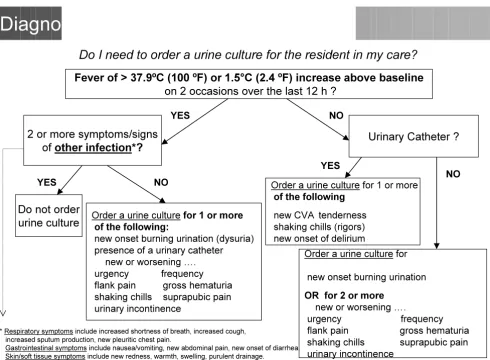
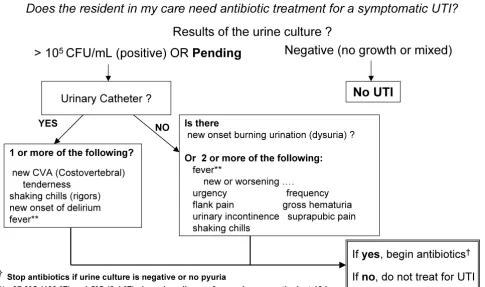
The first step in the development of the algorithms was to systematically review the literature for data that could lead to strategies for reducing antibiotic use. Lower respiratory infections, urinary infections, and skin and soft tissue in-fections account for the majority of bacterial inin-fections in residents of long-term care facilities [1,2,4,14]. No data to support reducing antibiotics for lower respiratory or skin infections was located. In contrast, data to support reduc-ing antibiotic use for urinary indications was found. Asymptomatic bacteriuria, the presence of bacteria in the urine in the absence of urinary symptoms, occurs in up to 50% of older institutionalized women and 35% of insti-tutionalized older men [20]. There are four randomized controlled trials that demonstrate no benefit in treating asymptomatic bacteriuria in residents of long-term care facilities [21–24]. Despite the evidence, one third of all prescriptions for urinary indications in residents of nurs-ing homes are for asymptomatic bacteriuria [1]. Accord-ingly, the algorithms indicate that urine should not be cultured and antibiotics should not be prescribed in the absence of clinical features of urinary infection (Figures 1 and 2). The algorithms also consider the increased risk of urinary infection with indwelling urinary catheters and with specific urinary symptoms [25–28].
Phase I: defining components of the intervention Overview
This phase, often inter-related to the previous phase, em-phasizes modeling or simulation studies to improve un-derstanding of the components of an intervention. Use of qualitative research and descriptive studies may help de-fine components of the intervention. Furthermore, in this phase potential barriers in trials that seek to change be-havior may be elicited [15].
and opinions of those involved in the process of prescrib-ing antibiotics for asymptomatic bacteriuria [29]. Twenty-two physicians and 16 nurses, each in Twenty-two focus groups, participated. Both physicians and nurses emphasized that there was a wide range of indicators, more subtle than the classic symptoms of urinary tract infection, that influence the ordering of cultures and the prescribing of antibiotics. Because residents in long-term care facilities frequently have cognitive impairment and are unable to articulate their symptoms, health care providers rely instead on signs of more subtle functional and behavioural changes. Misconceptions about the definition of symptoms of uri-nary tract infection were also discussed. Although the nurses participating in the focus groups had learned that foul-smelling urine alone was not sufficient reason to
[image:3.612.60.550.99.458.2]or-der a culture, a number of physicians still felt that this was one of the main reasons why cultures are ordered. Other key findings included the influence nurses have over phy-sician prescribing through their description of the clinical situation, often conveyed over the telephone. Physicians attributed their use of antibiotics to treat bacteriuria in res-idents with no urinary symptoms to relatively vague non-urinary symptoms (e.g. lethargy, change in functional sta-tus). To these physicians, this meant that such residents were not in fact "asymptomatic", despite the fact that ab-sence of urinary symptoms alone was used to define asymptomatic bacteriuria in the clinical trials [21–24]. This was an important barrier to evidence-based care that would not have been discovered without using a qualita-tive approach.
Figure 1
Diagnostic algorithm. This algorithm guides physicians and nurses in the ordering of urine cultures for nursing home residents with suspected infections.
Diagnostic Pathway
Fever of > 37.9ºC (100 ºF) or 1.5°C (2.4 ºF) increase above baseline
on 2 occasions over the last 12 h ?
2 or more symptoms/signs
of
other infection*?
Urinary Catheter ?
Do not order
urine culture
YES
YES
YES NO
NO NO
* Respiratory symptoms include increased shortness of breath, increased cough, increased sputum production, new pleuritic chest pain.
Gastrointestinal symptoms include nausea/vomiting, new abdominal pain, new onset of diarrhea. Skin/soft tissue symptoms include new redness, warmth, swelling, purulent drainage.
Do I need to order a urine culture for the resident in my care?
Order a urine culture for
new onset burning urination
OR for 2 or more
new or worsening ….
urgency frequency flank pain gross hematuria shaking chills suprapubic pain urinary incontinence
Order a urine culturefor 1 or more
of the following:
new onset burning urination (dysuria) presence of a urinary catheter
new or worsening …. urgency frequency
flank pain gross hematuria
shaking chills suprapubic pain urinary incontinence
Order a urine culture for 1 or more
of the following
new CVA tenderness shaking chills (rigors) new onset of delirium
To assess the factors leading to the ordering of urine cul-tures, we conducted a prospective survey in four nursing homes. Nursing staff were asked to complete a brief ques-tionnaire every time a request for a urine culture was made. They were asked to specify the signs and symptoms present at the time the culture was ordered and to specify who initiated the request for the culture. Physicians, after they received the results of the urine culture, were asked to indicate the clinical reasons for their therapeutic decision. Forty-eight percent of the 545 urine cultures obtained over six months were ordered by nursing staff and 52% by physicians. The urine culture was suggested by nursing staff 56% of the time. For 67% of urine culture orders, there were no urinary symptoms present at the time the culture was requested. One in every three urine cultures
ordered resulted in an antibiotic prescription. Of these prescriptions, one third were for asymptomatic bacteriu-ria.
Phase II: defining trial and intervention design Overview
In this phase, the information gathered in phase I is used to develop the optimum intervention and study design. The feasibility of delivering the intervention is tested and the acceptability to healthcare providers and patients is as-sessed [15].
The diagnostic and treatment algorithms were tested and further refined in a three-month pilot study conducted in four nursing homes. Administrators and directors of nurs-Figure 2
Treatment algorithm. This algorithm allows physicians and nurses to optimize antibiotic use in residents with suspected infec-tions.
Treatment Pathway
Results of the urine culture ?
Urinary Catheter ?
1 or more of the following? new CVA (Costovertebral)
tenderness shaking chills (rigors) new onset of delirium fever**
Is there
new onset burning urination (dysuria) ? Or 2 or more of the following:
fever**
new or worsening ….
urgency frequency flank pain gross hematuria urinary incontinence suprapubic pain shaking chills
YES
No UTI
NO
Does the resident in my care need antibiotic treatment for a symptomatic UTI?
> 10
5CFU/mL (positive) OR
Pending
Negative (no growth or mixed)
If
yes
, begin antibiotics
†If
no
, do not treat for UTI
† Stop antibiotics if urine culture is negative or no pyuria
Note: the recommended treatment duration for uncomplicated cystitis in women is 7 days and 7-14 in males. For an uncomplicated pyelonephritis, treatment duration is 10-14 days.For a complicated cystitis, treatment duration is 10 days. For a complicated pyelonephritis, treatment duration is from 14 to 21 days.
[image:4.612.63.548.145.432.2]ing of the homes felt that the algorithms should be intro-duced to the nursing staff by each facility's infection control practitioner. To ensure that the infection control practitioners themselves understood the algorithms, they were asked to decide whether urine cultures should be ob-tained and antibiotics ordered for six case-scenarios using the algorithms. Using this "train the trainer" approach, the practitioners then conducted brief seminars with reg-istered nursing staff to introduce the algorithms in their facilities. This approach was unsuccessful however. Semi-structured interviews with staff revealed that in two of the homes there were nurses who were completely unfamiliar with the algorithms two-thirds of the way into the pilot study. This led to the development of a standardized 30-minute presentation of six case-scenarios facilitated by one of two study investigators. Participation was active, staff were asked to decide whether to order antibiotics and urine cultures and to justify their answers using the algo-rithms. In addition, a video-tape replicating the seminar material was made and distributed to the nursing homes. The use of logs to document appropriate adherence to the algorithms was also piloted during the three-month pilot. Office visits to introduce the algorithms to nursing home physicians were conducted using the six case-scenarios presented to nursing staff. Feedback about the algorithms from both physicians and nurses was positive, both groups felt that the algorithms were user friendly and fea-sible in the long-term care setting.
Additionally, the initial poor adherence to the algorithms indicated that regularly scheduled on-site visits should be another component of the intervention, serving as an im-portant reminder or cue to the participants. Meetings with the local champion for the study (usually the director of nursing) to discuss barriers or obstacles to completing the study were therefore held during the pilot. Feedback about adherence to the protocol was given. Such follow up visits were acceptable to staff and administrators as they were not overly time consuming.
Phase III: methodological issues for the main trial Overview
Campbell and colleagues state that this step addresses is-sues normally posed by randomized trials, such as sample size, inclusion and exclusion criteria, methods of rand-omization, as well as the challenges of complex interven-tions [15].
The main antibiotic trial uses a randomized matched pair design where one of 11 pairs of nursing homes (matched by size and case-mix), has been randomized to the clinical algorithms and the other to usual management of pre-sumptive urinary tract infections. Only free-standing, community-based nursing homes are eligible i.e. those representative of the majority of nursing homes in Canada
and the United States. To be eligible, nursing homes must also: 1) have 100 or more residents (since the required sample size of antibiotics courses will be achieved soon-er); 2) have no stated policy for diagnosis or treatment of urinary tract infections; 3) agree to refrain from introduc-ing new management strategies for antibiotic utilization or urinary tract infection during the study. The primary outcome of this trial is the total number of antibiotic courses prescribed. Other outcomes include 1) the pro-portion of antibiotic courses prescribed for urinary indica-tions, 2) rates of urine cultures ordered, 3) hospitalization rates for urinary tract infections, and 4) mortality rates. The last two outcomes are being measured to ensure that the algorithms can safely be applied. Within a nursing home, randomization of individual healthcare providers to the algorithm likely would introduce bias due to con-tamination. Therefore, for the quantitative component of this study, the nursing home will serve as the unit of allo-cation and analysis.
To conceal allocation, one nursing home in each pair was arbitrarily assigned an even number (and the other odd) by a hospital administrative assistant not associated with the study or any of the investigators and who was blinded to the nursing homes' identity. A statistician who is not as-sociated with the study and who was unaware of the nurs-ing home pairs, generated a list of 11 random numbers using a random numbers table, one for each pair of nurs-ing homes. The correspondnurs-ing odd or even numbered nursing home in each pair was assigned the intervention.
An absolute reduction in 20% of all antibiotic use, which corresponds to a reduction in the proportion of antibiotic prescriptions for urinary indications from 30% to 10%, was considered the minimal clinically important effect worth detecting. To detect this difference, for an alpha of 0.05 and 80% power, adjusting for the effect of within cluster dependency, 4513 prescriptions need to be collect-ed in total. This means that 20 or 10 pairs of nursing homes will need to be followed for 10 months. Given the potential for withdrawals of nursing homes, 22 homes will be recruited.
days), and overall mortality rates will be compared using paired t-tests and Wilcoxon signed rank test. Logistic re-gression analysis that adjusts for the effect of clustering will be performed to adjust for potentially important co-variates such as nursing home size, proportion of resi-dents bed/wheelchair bound, and pharmacy automatic stop dates.
Phase IV: promoting effective stability of the intervention, assessing for the existence of adverse effects
Qualitative studies to assess the attitudes and perceptions of both nurses and physicians will help us understand the key elements to maintaining sustainability should the in-tervention prove to be successful in reducing antibiotic use. We plan to conduct focus group studies for nursing staff and semi-structured interviews amongst physicians and directors of nursing care. If the intervention is not suc-cessful, this qualitative approach may help explain the barriers leading to failure of the intervention.
Although the trial itself is meant to examine the effective-ness of the intervention, including adherence and adverse effects, if the results demonstrate that the intervention can reduce overall antibiotic use and is safe, one possibility is to conduct a cohort study of the algorithms in nursing homes over a large geographic area will be made.
Discussion
The application of the trial to improve antibiotic use in nursing home residents to the framework demonstrates that the framework is a useful resource for health services researchers. Not surprisingly, the stages of the framework have been used in previous studies of complex interven-tions, even before the framework was published. One re-cent example is the Rapid Early Action for Coronary Treatment (REACT), a multi-component, community-based educational intervention of community develop-ment, public education, provider education, and patient education (31). The description of the trial described in this paper however allows for a focused assessment of the components of this framework.
The pre-clinical phase of the antibiotic trial involved a summary of the evidence needed to construct the algo-rithms. This phase should include a systematic review of the literature with respect to the intervention [32], a point omitted in the pre-clinical phase description of the design paper but discussed in the Medical Research Council pa-per [www.mrc.ac.uk/index/publications/publications-electronic_publications.htm] described in the text [15]. It was also evident that the preclinical and first phase cannot be clearly demarcated, given that it was the modeling study in phase I which actually determined if the interven-tion had the potential to have the desired effect, the stated aim of the preclinical phase [15].
The use of qualitative research to help define the interven-tion was extremely valuable. Focus group studies helped to accurately identify and anticipate barriers to the inter-vention, even prior to the pilot study. Determining physi-cians and nurses attitudes, beliefs, and behaviors toward antibiotic use for urinary infections highlighted the im-portance of nonspecific, non-urinary symptoms and the key role of nurses in the process of antibiotic treatment of asymptomatic bacteriuria in institutionalized older adults. As specified in the framework, these findings illus-trate the utility of using qualitative methods early in the development of complex interventions. Focus groups and semi-structured interviews will also be conducted at the end of the main trial. We anticipate that such qualitative data will help us identify strategies to sustain the algo-rithms should the algoalgo-rithms prove to be effective in re-ducing antibiotic use [33,34].
Results of the questionnaires administered to nurses and physicians used in developing the algorithms provided convincing evidence about the need to target both order-ing of urine cultures and antibiotic prescriborder-ing in order to reduce overall antibiotic use. The particular importance of introducing the algorithms to nurses in order to culturing of urine was emphasized. This confirmed the qualitative findings. It is notable that although the phases of the framework are described as being sequential [15], compo-nents of the frameworks might vary temporally, as exem-plified by the qualitative and questionnaire data described in phase I being collected prior to the actual development of the algorithms.
The pilot study was instrumental in refining and introduc-ing the algorithms. One of the most valuable aspects of the pilot study was finding the optimal way to introduce the algorithms to nurses and physicians. Perhaps more emphasis could have been placed on strategies to intro-duce the complex health interventions in the design framework [15].
Sample size calculation is an important challenge in clus-ter-randomized trials. Cluster randomization reduces power and the sample size generally needs to be substan-tially increased. Further elaboration on this topic in the Phase III of the framework would be of benefit to re-searchers.
Conclusion
The application of a randomized trial to optimize antibi-otic use in nursing homes to the framework reported by Campbell and colleagues demonstrated that the frame-work is a useful resource for researchers embarking on a clinical trial of a complex health intervention.
Competing interests
None declared.Acknowledgements
The trial described in this paper is funded by the Agency for Healthcare Re-search and Quality (AHRQ). Dr. Loeb holds a New Investigator Award from the Canadian Institutes of Health Research.
References
1. Loeb M, Simor AE, Walter S, McArthur M, Duffy J, Kwan D, McGeer A: Antibiotic use in Ontario facilities that provide chronic care.J Gen Intern Med 2001, 16:376-383
2. Jacobson C, Strausbaugh L: Incidence and impact of infection in a nursing home care unit.Am J Infect Control 1990, 18:151-159 3. Lee YL, Trupp LD, Lee R, Nothvogel S, Farsad N, Cesario T:
Infec-tion surveillance and antibiotic utilizaInfec-tion in a community-based skilled nursing facility.Aging Clin Exp Res 1996, 8:113-122 4. Montgomery P, Semenchuk M, Nicolle LE: Antimicrobial use in
nursing homes in Manitoba.J Ger Drug Ther 1995, 9:55-74 5. Terpenning MS, Bradley SF, Wan JY, Chenoweth CE, Jorgensen KA,
Kauffman CA: Colonization and infection with antibiotic-re-sistant bacteria in a long-term care facility.J Am Geriatr Soc
1994, 42:1062-1069
6. Wingard E, Shlaes JH, Mortimer EA, Shlaes DM: Colonization and cross-colonization of nursing home patients with trimetho-prim-resistant gram-negative bacilli.Clin Infect Dis 1993, 16: 75-81
7. Chenoweth CE, Bradley SF, Terpenning MS, Zarins LT, Ramsey MA, Schaberg DR, Kauffman CA: Colonization and transmission of high-level gentamicin-resistant enterococci in a long-term care facility.Infect Control Hosp Epidemiol 1994, 15:703-709 8. Shlaes DM, Lehman MH, Currie-McCumber CA, Kim CH, Floyd R:
Prevalence of colonization with antibiotic resistant gram-negative bacilli in a nursing home care unit: the importance of cross-colonization as documented by plasmid analysis. In-fect Control 1986, 7:536-545
9. Gaynes RP, Weinstein RA, Chamberlin W, Kabins SA: Antibiotic-resistant flora in nursing home patients admitted to the hos-pital.Arch Intern Med 1985, 145:1804-1807
10. Bjork DT, Pelletier LL, Tight RR: Urinary tract infections with an-tibiotic resistant organisms in catheterized nursing home patients.Infect Contr 1984, 5:172-177
11. Rice LB, Willey SH, Papnicolaou GA, Meideros AA, Eliopoulos GM, Moellering RC, Jacoby GA: Outbreak of ceftazidime resistance caused by extended-spectrum B-lactamases at a Massachu-setts chronic care facility. Antimicrob Agents Chemother 1990,
34:2193-2199
12. Muder RR, Brennen C, Goetz AM, Wagener MM, Rihs JD: Associa-tion with prior fluoroquinolone therapy of widespread cipro-floxacin resistance among gram-negative isolates in a Veterans Affairs medical centre. Antimicrob Agents Chemother
1991, 35:256-258
13. Wiener J, Quinn JP, Bradford PA, Goering RV, Nathan C, Bush K, Weinstein RA: Multiple antibiotic-resistant Klebsiella and Es-cherichia coli in nursing homes.JAMA 1999, 281:517-523 14. Nicolle LE, Bentley D, Garibaldi R, Neuhaus E, Smith P, SHEA
Long-Term Care Committee: Antimicrobial use in long-term-care fa-cilities. SHEA Long-Term-Care Committee.Infect Control Hosp Epidemiol 2000, 21:537-545
15. Campbell M, Fitzpatrick R, Haines A, Kinmonth AL, Sandercock P, Spiegelhalter D, Tyrer P: Framework of design and evaluation of complex interventions to improve health.BMJ 2000, 321: 694-696
16. Stephenson J, Imrie J: Why do we need randomized controlled trials to assess behaviorial interventions?BMJ 1998, 316: 611-613
17. Haynes RB, Haines AB: Barriers and bridges to evidence-based practise.BMJ 1998, 317:273-276
18. Bradley F, Wiles R, Kinmonth A, Mant D, Gantley M: Development and evaluation of complex interventions in health services research: case study of the Southhamptom heart integrated care project (SHIP).BMJ 1999, 318:711-715
19. Ukoumunne OC, Gulliford MC, Chinn S, Sterne JAC, Burney PGJ:
Methods for evaluating area-wide and organization-based in-terventions in health and health care: a systematic review.
Health Technology Assessment 1999, 3:1-110
20. Nicolle LE: Asymptomatic bacteriuria in the elderly.Infect Dis Clin NA 1997, 11:647-662
21. Nicolle LE, Bjornson J, Harding GKM, MacDonell JA: Bacteriuria in elderly institutionalized men.N Engl J Med 1983, 309:1420-1425 22. Nicolle LE, Mayhew JW, Bryan L: Prospective randomized com-parison of therapy and no therapy for asymptomatic bacte-riuria in institutionalized women.Am J Med 1987, 83:27-33 23. Ouslander JG, Schapira M, Schnelle JF, Uman G, Fingold S, Tuico E,
Ni-gam JG: Does eradicating bacteriuria affect the severity of chronic urinary incontinence in nursing home residents ?Ann Intern Med 1995, 122:749-754
24. Abrutyn E, Mossey J, Berlin JA, Boscia J, Levison M, Pitsakis P, Kaye D:
Does asymptomatic bacteriuria predict mortality and does antimicrobial treatment reduce mortality in elderly ambula-tory women.Ann Intern Med 1994, 120:827-833
25. Orr PH, Nicolle LE, Duckworth H, Brunka J, Kennedy J, Murray D, Harding GK: Febrile urinary infection in the institutionalized elderly.Am J Med 1996, 100:71-77
26. Nicolle LE, Orr P, Duckworth H, Brunka J, Kennedy J, Murray D, Harding GK: Gross hematuria in residents of long-term-care facilities.Am J Med 1993, 94:611-618
27. Nicolle LE: Urinary infections in the elderly: symptomatic or asymptomatic.Inter J Antimicrobiol Agents 1999, 11:265-268 28. Boscia JA, Kobasa WD, E Abrutyn, ME Levison, AM Kaplan, Kaye D:
Lack of association between bacteriuria and symptoms in the elderly.Am J Med 1986, 81:979-982
29. Walker S, McGeer A, Simor AE, Armstrong-Evans M, Loeb M: Why are antibiotics prescribed for asymptomatic bacteriuria in institutionalized elderly people? A qualitative study of physi-cian's and nurse's perceptions.CMAJ 2000, 163:273-277 30. Donner A: A regression approach to the analysis of data
aris-ing from cluster randomization.Int J Epidemiol 1985, 14:322-326 31. Luepker RV, Raczynski JM, Osganian S, Goldberg RJ, Finnegan JR, Hedges JR, Goff DC, Eisenberg MS, Zapka JG, Feldman HA, et al: Ef-fect of a community intervention on patient delay and emer-gency medical service use in acute coronary heart disease: The Rapid Early Action for Coronary Treatment (REACT) Trial.JAMA 2000, 284:60-67
32. Cook DJ, Mulrow CD, Haynes RB: Systematic reviews: synthesis of best evidence for clinical decisions. Ann Intern Med 1997,
126:376-380
33. Ornstein SM, Musham C, Reid A: Barriers to adherence to pre-ventive services reminder letters: The patient's perspective.
Journal of Family Practice 1993, 36:195-200
34. Stange KC, Miller WL, Crabtree BF, O'Connor PJ, Zyzanski SJ: Mul-timethod research: Approaches to integrating qualitative and quantitative methods.Archives of General Internal Medicine
1994, 9:278-282
35. Schulz KF, Chalmers I, Hayes RJ, Altman DG: Empirical evidence of bias. Dimensions of methodological quality associated with estimates of treatment effects in controlled trials.JAMA
Publish with BioMed Central and every scientist can read your work free of charge
"BioMedcentral will be the most significant development for disseminating the results of biomedical research in our lifetime."
Paul Nurse, Director-General, Imperial Cancer Research Fund
Publish with BMCand your research papers will be:
available free of charge to the entire biomedical community
peer reviewed and published immediately upon acceptance
cited in PubMed and archived on PubMed Central
yours - you keep the copyright
[email protected] Submit your manuscript here:
http://www.biomedcentral.com/manuscript/
BioMedcentral.com
36. Green SB, Corle DK, Gail MH, Mark SD, Pee D, Freedman LS, Grau-bard BI, Lynn WR: Interplay between design and analysis for behavioral intervention trials with community as the unit of randomization.Am J Epidemiol 1995, 142:587-93
Pre-publication history
The pre-publication history for this paper can be accessed here: