International Journal of Innovative Technology and Exploring Engineering (IJITEE) ISSN: 2278-3075, Volume-8 Issue-9, July, 2019
Process Optimization and TAKT Time Reduction
Through Structured Component Quality Planning
(CQP) for Flawless Implementation
R.Punniyamoorthy , R.Arulmoli
Abstract: In today’s business scenario strategic structuring of an organization with narrowly mapped Roles & Responsibilities helps to drive company’s performance. Every single human endeavor takes a shot at the guideline of complementarily. Nothing is conceivable aside from through activity and co-appointment. This is on the grounds that man is fundamentally a social creature. All creatures are supplied with necessities and the satisfaction of these requirements requires joint venture. In any case, in the undertaking to satisfy human needs, once in a while the parts of the undertaking happen to be on inverse sides and in this way there are difficulties in such co-employable ventures. Mankind has an impulse for assets and the sense for sharing isn't similarly solid. Subsequently it happens that public activity is enmeshed in unfriendly interests. Down the ages, the contradicted premiums have been extensively run based on physical quality which enables to command and the absence of it that prompts accommodation: the ownership of land and its absence, the entrance to capital-money sources, and the scholarly and functional capability to sort out and abuse capital from one viewpoint, and its absence, coming full circle in the enterprising premiums set against the premiums of the work force or labor. CQP results in flawless launch with desired parameters.
Index Terms: Component quality planning, Process optimization , Value engineering, Waste elimination, Supplier development, TAKT time, Flawless implementation.
I. INTRODUCTION
Economic conditions, regulatory context, consumer trends, globalization, localization, and technological innovation mean that we operate in an incredibly fast-paced, exciting - and challenging – industry. Furthermore, Original Equipment Manufacturers are increasingly adopting a zero-tolerance policy for deviations in quality from their supply partners, cost remains the ultimate differentiator. As a Project Team we need strive to differentiate by providing our customers with exceptional quality and delivery at a competitive cost by leading the right supply base. To do this work with a panel of suppliers with a proven track record of consistency and high performance, In addition, each and every supplier will have demonstrated a commitment to our strategy pillars of Innovation and Technology, Global Capability and Excellence in Execution. Working better together will deliver business growth for the companies. It is highly important to nominate a supplier who will strive to achieve excellence and should have the maturity, organization to undergo a structured process of development.
Revised Manuscript Received on July 10, 2019
Dr.R.Punniyamoorthy, Assistant Professor, SRM Institute of Science & Technology, Ramapuram, Chennai, Tmailnadu, India
Dr.R.Arulmoli, Assistant Professor, School of Management, SRM Institute of Science & Technology, Ramapuram, Chennai, India
Objective:
1. To Fulfill customer and automotive standard requirements and to select the best supplier for new business so as to guarantee smooth project accomplishment and Excellent QCD performance in serial production.
2. To have constant improvement on the contribution level through Value Engineering, Process Optimization, Efficiency increase, waste elimination etc. This enables the organization to improve its GOM (Gross Operating Margin).
Scope:
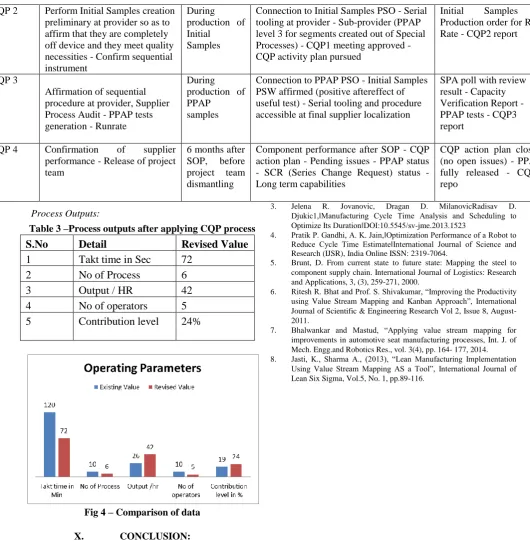
1. Project is taken to regularize an existing part where Value engineering & Process optimization is done on the process to reduce the TAKT time from 2 min to 1 min to reduce cost, there by retaining the desired contribution levels without compromising on Quality and delivery.
2. The Component Quality Planning (CQP) is followed for Determination and assignment procedure to every business decision. This included new projects as well as reallocation of existing business, Process optimization etc.
Supplier Development & Integration
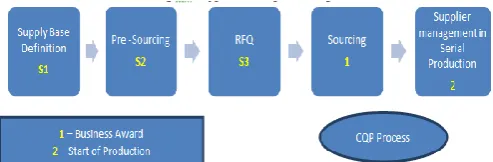
It is a Part of Strategic sourcing & Supplier development department, they follow this technique for flawless implementation of supplier parts. The same is explained below in detail
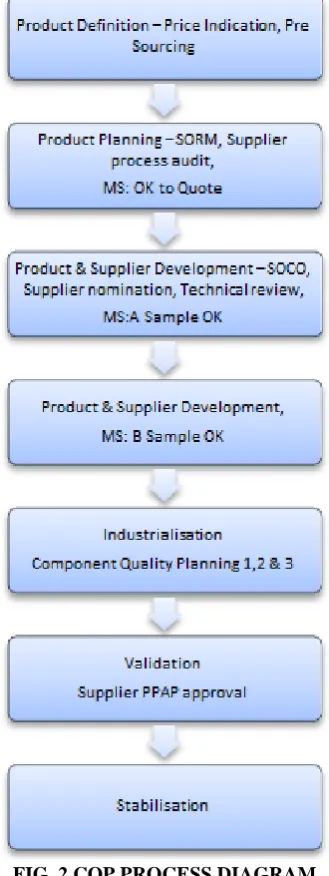
[image:1.595.319.566.568.649.2]To achieve excellence in part development process, tools like Component Quality Planning (CQP) helps to carry out the process flawlessly. It’s in depth process analysis helps to cover all the functional areas in the development so that the results are unchallenged.
(CQP) for Flawless Implementation
FIG .2 CQP PROCESS DIAGRAM
Existing Parameters & Results
[image:2.595.91.256.57.496.2]The actual realization of the project is achieved by understanding the existing operational parameters, so that the project path is clear and visible. Also it is important for the project team to understand that project undertaken will add value to the customer as well as to the organization. The actual data gives the team on the real focal parameters.
Table 1 - Table Showing the Existing parameters
S.No
Detail
Existing Value
1
Takt time in Sec
120
2
No of Process
10
3
Output / HR
26
4
No of operators
10
5
Contribution level
19%
Supplier Base Pre-Requisite
Before getting in to real awarding of any business, the certain basic Pre-Requisite is necessary in order to have a right Business partner.
Code of Conduct:
It helps all of us live up to the highest ethical standards, to meet our obligations to the law, our commitments to our customers and our responsibilities to each other and our shareholders. It protects company’s reputation and creates a culture in which we can all thrive. The suppliers and service providers must provide assurance of their compliance with applicable laws. To manufacture long haul associations with suppliers and grant business to them based on the esteem they give. In return we expect them to share our ethical standards, uphold the Code or a code with equivalent provisions and report on compliance in key areas, including anti-bribery legislation, the use of conflict minerals and the exploitation of child, compulsory, forced or slave labor.
II. SUPPLIER-STRATEGYSET-UP:
A prerequisite of being part of a Target Panel is the fulfillment of automotive standard requirements. Any interested potential suppliers will be asked to complete Supplier Profile Questionnaire where, in addition to standard company information, suppliers are asked to prove certification in terms of IATF16949 and their automotive experience. Should a new potential supplier meets strategic requirements, it will be assessed by VDA 6.3 based Supplier Process Audit. To be confirmed as a supplier, the standard contract package must be signed by the authorized representatives. Once a member of a Target Panel, a supplier will need to perform in line with various strategic statistics based on spend maturity and QCDI performance. In case of any deviation from expectations and targets, the supplier can be put on, at any time, a ‘New Business on Hold’ (NBoH) status, which will immediately block any business increase.
III. SUPPLIERRISKMANAGEMENT
International Journal of Innovative Technology and Exploring Engineering (IJITEE) ISSN: 2278-3075, Volume-8 Issue-9, July, 2019
IV. STANDARDSUPPLIERAGREEMENTS
This Includes
1. Non-Disclosure Agreement 2. Master Supply Agreement 3. Project Agreement 4. Tooling Agreement
5. Quality Assurance agreement 6. Part Pricing Agreement
7. Warranty Reimbursement agreement
V. SUPPLIERTARGETS
Supplier targets are intended to set clear QCD focuses for providers and to evaluate supplier execution by overseeing key performance indicators (KPIs). Supplier targets are connected to all immediate material providers. Business drives perfection by defining quality, cost and delivery targets for each provider. These objectives are checked on and affirmed recorded as a hard copy to every supplier yearly.
Quality
QUALITY KPIs for supplier quality are as follows: • Customer incidents due to suppliers’ defect • Defective Parts counted Per Million (PPM) • Number of total incidents
• Response time for claim handling
• Supplier caused Cost of Poor Quality (CoPQ)
As we believe that rapid and proactive problem solving is key to eradicate non quality, we measure supplier response time in QR6σ(Quick Response Six Sigma). We continuously aim to reduce PPM defects across its business and execute a zero defect strategy. As a result, we will implement prevention-oriented supplier management activities in the introduction process of goods and services. On time provision of qualification parts and documents and release without deviations will be also closely tracked by KPIs for Supplier Quality. Cost targets measure, on a full year’s basis, a supplier’s ability to continuously reduce the cost of the function supplied. Those teams led by our Segments Leaders are the supplier’s preliminary contacts in order to engage in business discussions on Value Creation, long term business agreements and partnership matters.
VI. DELIVERY
Delivery targets are defined to ensure that the ‘right part at the right time in the right quantity’ is delivered. Targets will be measured on a monthly basis. As foundations for excellent delivery performance, we expect suppliers to focus on preventive actions and delivering the right capacity, as well as being reactive - delivering ‘Quick Response’ actions on time and in an efficient manner.
Supplier Nomination
The nomination procedure consists of 3 core steps and is accompanied by CQP process (Component Quality Planning/APQP)
• Pre-Sourcing Committee • Request for Quotation (RFQ) • Sourcing Committee
VII. PRE-SOURCINGCOMMITTEE:
To underpin a robust selection of suppliers that will receive a RFQ. The Pre-Sourcing Committee is applicable for any item that must follow the nomination process. The Pre-Sourcing Committee ensures that, in addition to our internal strategy considerations, the selection of suppliers to receive a RFQ takes into account the following:
• Ability of the supplier to meet customer requirements • Validation of panel versus latest QCD performance • Validation of panel versus current projects running with potential RFQ candidates
The Pre-Sourcing Committee is responsible for first alignment on possible business nomination across the functions. Organized by the buyer responsible for the project, and with the participation of Global Commodity and Business Unit representatives, the Pre-Sourcing Committee ensures the appropriate selection of candidates for our business. The Committee is supported by local purchasing teams from preferred countries and experts from Quality Management, Product & Manufacturing Engineering. Based on the decisions made by the committee, buyers are allowed to send RFQs for particular business requirements to identified suppliers (Target Panel suppliers in the first instance).
VIII. REQUESTFORQUOTATION(RFQ)
The purpose of the RFQ is to accumulate suppliers’ quotations in line with necessities for specified projects. eRFQ is open for current and potential suppliers and provides guidance on any change or creation of a supply chain (Quality, Cost, Delivery). Any quotation delivered via the platform is binding. The eRFQ contains component drawings and/or specifications, as well all relevant attachments that are mandatory to participation in the eRFQ, such as Standard Agreements and Cost Breakdowns, Initial and Final Feasibility Declarations, plus any project related obligatory documents. If marked mandatory, these documents are to be considered & confirmed as feasible in order to submit a valid quote. When submitting quotations, suppliers must use the Supplier Portal. Quotations sent by email or in a different format than expected will not be considered. Providing a quotation in the predefined format will help to analyze and feedback as quickly as possible and in a structured and fair way, allowing suppliers and candidates to understand the reasons behind the decision.
IX. SAFELAUNCHCONCEPT
Safe Launch Concept (SLC) is a strategy to guarantee that dispatch dangers are moderated and dispatch issues are rectified as fast as conceivable amid increase. The of SLC will:
(CQP) for Flawless Implementation
• Ensure that any quality issues that may emerge are immediately distinguished, contained, and redressed at the provider's area
• Increase association and perceivability of supplier's best administration
SLC applies from start of project until the completion of launch and all aspects of the containment area. Safe Launch is a containment initiative designed to ensure a supply of defect free parts for SOP and the acceleration phase. The supplier is required to recognize all extra assessment, testing, and dimensional checks required in the regulation territory dependent on Key Product Characteristics, Customer Interface, high RPN and additionally issues distinguished amid item and procedure improvement. Control must stay set up for a timeframe or amount of parts as indicated by SQE. The exit criterion is shipment of 0 defects for the duration of this containment. If a problem is identified in CSL1, this activity will stay essentially for at least 2 weeks after the provider has executed the changeless
[image:4.595.319.546.115.209.2]restorative activities. In the event that time or amount isn't determined, SLC will stay basically all through quickening or for at least 3 months, whichever is longer. The graph beneath demonstrates the key components of SLC.
Fig 3: KEY ELEMENTS OF SAFE LAUNCH
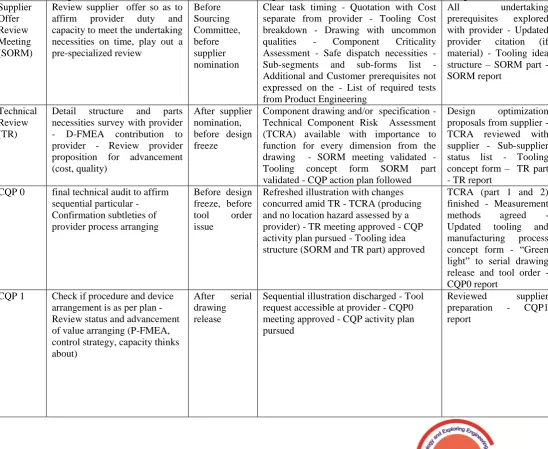
Table 2: Component Quality Planning Process:
Review Purpose When? Input Output
Supplier Offer Review Meeting (SORM)
Review supplier offer so as to affirm provider duty and capacity to meet the undertaking necessities on time, play out a pre-specialized review
Before Sourcing Committee, before supplier nomination
Clear task timing - Quotation with Cost separate from provider - Tooling Cost breakdown - Drawing with uncommon qualities - Component Criticality Assessment - Safe dispatch necessities - Sub-segments and sub-forms list - Additional and Customer prerequisites not expressed on the - List of required tests from Product Engineering
All undertaking
prerequisites explored with provider - Updated provider citation (if material) - Tooling idea structure – SORM part - SORM report
Technical Review (TR)
Detail structure and parts necessities survey with provider - D-FMEA contribution to provider - Review provider proposition for advancement (cost, quality)
After supplier nomination, before design freeze
Component drawing and/or specification - Technical Component Risk Assessment (TCRA) available with importance to function for every dimension from the drawing - SORM meeting validated -
Tooling concept form SORM part
validated - CQP action plan followed
Design optimization proposals from supplier - TCRA reviewed with supplier - Sub-supplier status list - Tooling concept form – TR part - TR report
CQP 0 final technical audit to affirm sequential particular - Confirmation subtleties of provider process arranging
Before design freeze, before tool order issue
Refreshed illustration with changes concurred amid TR - TCRA (producing and no location hazard assessed by a provider) - TR meeting approved - CQP activity plan pursued - Tooling idea structure (SORM and TR part) approved
TCRA (part 1 and 2) finished - Measurement
methods agreed -
Updated tooling and manufacturing process concept form - “Green light” to serial drawing release and tool order - CQP0 report
CQP 1 Check if procedure and device arrangement is as per plan - Review status and advancement of value arranging (P-FMEA, control strategy, capacity thinks about)
After serial drawing release
Sequential illustration discharged - Tool request accessible at provider - CQP0 meeting approved - CQP activity plan pursued
Reviewed supplier
[image:4.595.24.573.328.777.2]International Journal of Innovative Technology and Exploring Engineering (IJITEE) ISSN: 2278-3075, Volume-8 Issue-9, July, 2019
CQP 2 Perform Initial Samples creation preliminary at provider so as to affirm that they are completely off device and they meet quality necessities - Confirm sequential instrument
During production of Initial
Samples
Connection to Initial Samples PSO - Serial tooling at provider - Sub-provider (PPAP level 3 for segments created out of Special Processes) - CQP1 meeting approved - CQP activity plan pursued
Initial Samples -
Production order for Run Rate - CQP2 report
CQP 3
Affirmation of sequential procedure at provider, Supplier Process Audit - PPAP tests generation - Runrate
During production of PPAP
samples
Connection to PPAP PSO - Initial Samples PSW affirmed (positive aftereffect of useful test) - Serial tooling and procedure accessible at final supplier localization
SPA poll with review result - Capacity Verification Report - PPAP tests - CQP3 report
CQP 4 Confirmation of supplier
performance - Release of project team
6 months after SOP, before project team dismantling
Component performance after SOP - CQP action plan - Pending issues - PPAP status - SCR (Series Change Request) status - Long term capabilities
CQP action plan closed (no open issues) - PPAP fully released - CQP4 repo
[image:5.595.31.562.46.596.2]Process Outputs:
Table 3 –Process outputs after applying CQP process
S.No
Detail
Revised Value
1
Takt time in Sec
72
2
No of Process
6
3
Output / HR
42
4
No of operators
5
5
Contribution level
24%
Fig 4 – Comparison of data
X. CONCLUSION:
The CQP process has resulted in Flawless launch of the part with the desired operating parameters set for the project. A constant customer feedback is obtained so as to ensure smooth running of the part. Of course further improvements can be done time to time so as to add value to the customer and the organization.
REFERENCES
1. Nils Boysen, Malte Fliedner, Armin Scholl [2008], “Assembly line balancing”, International Journals of Production Economics pp 509– 528.
2. Mr. Rahul.R.Joshi, Prof.G.R.Naik, ―Reduction in Setup Time By SMED A Literature Review‖ International Journal of Modern Engineering Research (IJME) Vol.2, Issue.1, Jan-Feb 2012 pp-442-444
3. Jelena R. Jovanovic, Dragan D. MilanovicRadisav D. Djukic1,‖Manufacturing Cycle Time Analysis and Scheduling to Optimize Its Duration‖DOI:10.5545/sv-jme.2013.1523
4. Pratik P. Gandhi, A. K. Jain,‖Optimization Performance of a Robot to Reduce Cycle Time Estimate‖International Journal of Science and Research (IJSR), India Online ISSN: 2319-7064.
5. Brunt, D. From current state to future state: Mapping the steel to component supply chain. International Journal of Logistics: Research and Applications, 3, (3), 259-271, 2000.
6. Ritesh R. Bhat and Prof. S. Shivakumar, “Improving the Productivity using Value Stream Mapping and Kanban Approach”, International Journal of Scientific & Engineering Research Vol 2, Issue 8, August-2011.
7. Bhalwankar and Mastud, “Applying value stream mapping for improvements in automotive seat manufacturing processes, Int. J. of Mech. Engg.and Robotics Res., vol. 3(4), pp. 164- 177, 2014. 8. Jasti, K., Sharma A., (2013), “Lean Manufacturing Implementation