The Application of Pericyclic, Photolytic, Chemoenzymatic
and Cross-coupling Techniques to the Synthesis of
Biologically Active Natural Products and Related Structures
A thesis submitted for the Degree of Doctor of Philosophy of
The Australian National University
by
Qiao Yan
Research School of Chemistry
Canberra, Australia
April, 2017
© Copyright by Qiao Yan 2017
Declaration
I declare that, to the best of my knowledge, the material presented in this thesis
represents the result of original work carried out by the author during the period
2012-2017 and has not been presented for examination for any other degree. This thesis by
publication is comprised of four journal articles. Established methodologies have been
acknowledged, wherever possible, by citation of the original publications from which
they derive.
Qiao Yan
Acknowledgements
During my four and a half years of PhD life, I have been changed a lot by the
experience. In this long journey, I am lucky to have received plenty of help from a range
of people. Without them I would not have got to this point in a long but nevertheless
rewarding experience.
First, I would like to thank Professor Martin Banwell for his supervision,
encouragement and guidance. He gave me the opportunity to study in Banwell Group
and made me grow up in the past few years. His encouragement gave me the energy to
overcome the difficulties encountered in many of my experiments. In addition, when I
saw how diligent he is, working late almost every day, I told myself that I too must
work hard to become a successful scientist. All in all, both the Banwell chemistry and
habits have contributed so much to the entirety of my PhD studies. There is so much I
could say but put simply….many thanks Martin!
I am indebted to Dr Xinghua Ma. Although invariably busy working on his own
projects, Xinghua has always been so enthusiastic in discussions and provided many
effective solutions to the problems I encountered in my experiments. His careful
analysis and down-to-earth advice gave me the confidence to complete complex tasks.
Many thanks Xinghua and I wish you all the very best for your future.
I would also like to thank all the members of the Banwell Group, especially Nadia, Ping,
Shuxin and Benoit. In addition, I want to express my sincere thanks to my lab mates in
3.27, namely Xiang, Jeremy and Josh. I have spent almost every working day of the last
four and a half years with the three of you and am so grateful for your companionship
and advice.
Publications and Presentations
The following list details the publications and presentations that have resulted from the
author’s research work performed during her candidature for the Degree of Doctor of
Philosophy.
Publications:
1.
Establishing the True Structure of the Sorbicillinoid-derived Isolate
Rezishanone C by Total Synthesis
Qiao Yan, Martin G. Banwell, Michelle L. Coote, Richmond Lee and Anthony C.
Willis
Chem. Asian J.
,
2017
,
12
, 1480.
2.
Studies on the Photochemical Rearrangements of Enantiomerically Pure,
Polysubstituted and Variously Annulated Bicyclo[2.2.2]octenones
Qiao Yan, Benoit Bolte, Yuhua Bai, Martin G. Banwell, Anthony C. Willis and Paul
D. Carr
J. Org. Chem.
,
2017
,
82
, 8008.
3.
A Palladium-Catalyzed Ullmann Cross-Coupling/Reductive Cyclization Route
to the Carbazole Natural Products 3-Methyl-9
H
-carbazole, Glycoborine,
Glycozoline, Clausazoline K, Mukonine and Karapinchamine A
Qiao Yan, Emma Gin, Malgorzata Wasinska-Kalwa, Martin G. Banwell and Paul D.
Carr
J. Org. Chem.
,
2017
,
82
, 4148.
4.
A Unified Approach to the Isomeric
α
-,
β
-,
γ
- and
δ
-Carbolines via their
6,7,8,9-Tetrahydro Counterparts
Presentations:
1.
Establishing the True Structure of a Sorbicillinoid-derived Isolate by
Chemoenzymatic Synthesis
Qiao Yan, Martin G. Banwell and Anthony C. Willis
Commentary on the Contributions of Ms Qiao Yan to
the Four Papers Included in this PhD Thesis by
Publications
Publication 1
This is a communication detailing the author’s extensive experimental efforts directed
towards the total synthesis of
ent
-rezishanone C. The author carried out,
single-handedly, the entirety of the synthetic chemistry-based laboratory work reported in this
communication. Except for the reported computational chemistry studies, she wrote the
whole of the experimental section and conducted relevant literature surveys. In addition,
the author collated and formatted all of the reported spectral data presented in the
associated supporting information document. Dr Anthony C. Wills conducted the X-ray
crystallographic studies reported in this paper. Professor Martin Banwell wrote the body
of the paper.
Publication 2
This is a full paper detailing extensive experimental work concerned with the
photochemical rearrangements of bicyclo[2.2.2]octenones. The author carried out 90%
of the synthetic chemistry-based laboratory work reported in this article. She also wrote
95% of the experimental section and conducted relevant literature surveys. In addition,
the author collated and formatted all of the reported spectral data presented in the
supporting information document. Drs Anthony C. Wills and Paul D. Carr conducted
the X-ray crystallographic studies reported in this paper while Professor Martin Banwell
wrote the body of the paper.
Publication 3
addition, the author collated and formatted all the reported spectral data presented in the
supporting information document. Dr Paul D. Carr conducted the X-ray crystallographic
studies reported in this paper while Professor Martin Banwell wrote the body of the
paper.
Publication 4
Table of Contents
Declaration……….i
Acknowledgements………...………...iii
Publications and Presentations……..………..v
Relative Contributions to Publications……..………vii
Table of Contents………...………...ix
Abstract………...………...1
Thesis Overview………..………..……….3
Publication 1 ……….………..……….10
Publication 2 ….……….………168
Publication 3 ………..……..……..301
Abstract
The body of this thesis is comprised of four scientific articles and is preceded by an
overview that contextualises all of this submitted/published work.
The first major part of this thesis is comprised of
Publication 1
. This details work
concerned with establishing the true structure of the sorbicillinoid-derived isolate
rezishanone C by total synthesis. Specifically, the enantiomer,
B
, of what proved to be
the true structure,
C
, of the sorbicillinoid rezishanone C (sorbivinetone) was synthesized
from the homochiral
cis
-1,2-dihydrocatechol
A
that is itself generated through the
whole-cell biotransformation of toluene. These studies and dispersion-corrected DFT
calculations support the proposal that rezishanone C is an artefact of the isolation
process and arises through a Diels-Alder cycloaddition reaction between ethyl vinyl
ether and sorbicillinol (
D
).
The second major part of the thesis is comprised of
Publication 2
. This is concerned
with the synthesis and photochemical rearrangements of enantiomerically pure,
polysubstituted and, in some cases, variously annulated bicyclo[2.2.2]octenones.
Specifically, then, a series of bicyclo[2.2.2]octenones has been prepared by engaging
the enzymatically-derived and enantiomerically pure
cis
-1,2-dihydrocatechol
A
in either
inter- or intra-molecular Diels-Alder cycloaddition reactions with various dienophiles.
These polycyclic adducts or simple derivatives thereof were shown to readily participate
in both photochemically promoted 1,3-acyl migration and oxa-di-
π
-methane
rearrangement processes to give products such as
E
and
F
, respectively.
OHOH
A
O O
O
O OH H
HO O
O OH O
O
OH
O O H
B C D
O H
O O H
The third major part of the thesis is comprised of
Publication 3
. This details the
establishment of a palladium-catalyzed Ullmann cross-coupling/reductive cyclization
route to the carbazole natural products 3-methyl-9
H
-carbazole, glycoborine,
glycozoline, clausazoline K, mukonine and karapinchamine A. These were prepared by
reductive cyclisation of the relevant 2-arylcyclohex-2-en-1-one (e.g.
G
) to the
corresponding tetrahydrocarbazole (e.g.
H
) and dehydrogenation of this to give the
target carbazole (e.g.
I
). Compounds such as
G
were themselves prepared using a
palladium-catalyzed Ullmann cross-coupling reaction that served to link the appropriate
2-iodocyclohex-2-en-1-one and
o
-halonitrobenzene.
The fourth and final part of the thesis is comprised of
Publication 4
. This details a
unified approach to the isomeric
α
-,
β
-,
γ
- and
δ
-carbolines via their 6,7,8,9-tetrahydro
counterparts. Specifically, then, a cross-coupling/reductive cyclisation protocol has been
employed in preparing all four carbolines. So, for example, the 2-nitropyridine (
L
),
which is readily generated through an efficient palladium-catalyzed Ullmann
cross-coupling reaction, is reductively cyclized under conventional conditions to give
6,7,8,9-tetrahydro-
α
-carboline (
M
) that is itself readily aromatized to give
α
-carboline (
N
).
O O2N
N
H NH
OMe OMe OMe
G H I
O N O2N
N N
H NH N
Thesis Overview
Publication 1: Establishing the True Structure of the Sorbicillinoid-derived Isolate
Rezishanone C by Total Synthesis
[image:15.595.143.510.425.518.2]The sorbicillins are an ever-expanding class of polyketide-derived fungal metabolite
1that display significant structural diversity and (sometimes) unusual biological
activities.
2Rezishanone C
3is a representative member of the sub-type
2cof sorbicillins
that arise through a Diels-Alder reaction between sorbicillinol and various
non-sorbicillinoid-derived compounds containing a dienophilic residue. In particular,
rezishanone C is thought to arise through reaction between ethyl vinyl ether (a common
contaminant in ethyl acetate, the solvent used to isolate this material) but precisely
which one of eight possible adducts represents the true structure of this artefact remains
unclear. Given the uncertainty regarding the structure of rezishanone C and informed by
theoretical calculations, the author developed a total synthesis of what proved to be
ent
-rezishanone C.
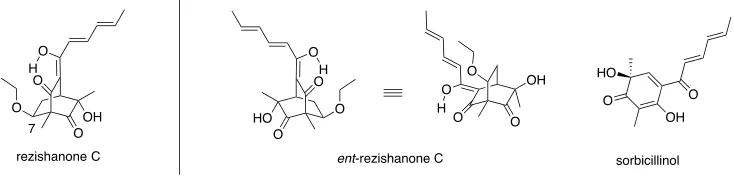
Figure 1
. Structures of rezishanone C,
ent
-rezishanone C and sorbicillinol
Thus, this publication details a twenty-three step total synthesis of
ent
-rezishanone C
(Scheme 1). Starting from
cis
-1,2-dihydrocatechol
1
, and through the application of
intermolecular Diels-Alder and retro-aldol/aldol sequences,
trans
-diol
2
was formed.
Over nine steps this last compound was converted into ethyl ether
3
that was itself
subjected to
cis
-dihydroxylation under conditions defined by Bäckvall
4and so affording
diol
4
. A Barton-McCombie deoxygenation reaction
5then a DMP (Dess-Martin
periodinane)-mediated oxidation followed and compound
4
was thereby transformed
sorbicillinol 7
O O
O
O HO
H
ent-rezishanone C
O O
OH
O O H H
OH O O
O
O
rezishanone C
HO
O O
diol then gave
ent
-rezishanone C. All the spectral data derived from this material
matched those reported for the isolate. Furthermore, the specific rotation of the
synthetic material was of the same magnitude but opposite sign to that reported for the
isolate and so definitively establishing the structure of rezishanone C as that shown in
Figure 1.
Scheme 1.
Key steps involved in the synthesis of
ent
-rezishanone C
Publication 2: Studies on the Photochemical Rearrangements of Enantiomerically
Pure, Polysubstituted and Variously Annulated Bicyclo[2.2.2]octenones
Bicyclo[2.2.2]octenones including the parent system
7
(Scheme 2) are excellent
substrates for certain photochemically promoted rearrangement reactions.
8Specifically,
on irradiation in the presence of photosensitizers such as acetophenone they participate
in oxa-di-
π
-methane rearrangements and so affording, via a triplet pathway,
cyclopropannulated diquinanes such as
8
. In contrast, on direct irradiation they engage,
now via a singlet pathway, in a 1,3-acyl migration reaction (Givens rearrangement) to
give bicyclo[4.2.0]oct-4-en-7-ones such as
9
. Upon sustained irradiation photoproduct
9
and many of its derivatives can undergo decarbonylation to give the corresponding
Δ
2-norcarene, e.g.
10
.
OH
OH
1
OH O
OH
O O
O
2 3
O O O
4
HOOH
6
O O
O O
H O O
O O
5
O
4 steps 9 steps
KHMDS then
E,E-CH3(CH=CH)2COCN
THF –78 °C, 3 h 55% or 81% brsm
5% K2OsO4•H2O
citric acid, NMO
CH3CN/H2O
22 °C, 14 h 68%
6 steps
2 steps
O O
OH
O O H
Scheme 2.
Photochemical rearrangement reactions of bicyclo[2.2.2]octenone (
7
)
[image:17.595.241.409.56.207.2]By way of example, then,
Publication 2
describes methods for the synthesis of
enantiomerically pure bicyclo[2.2.2]octenones such as
11-14
(Figure 2)
9and the
engagement of these systems in the above-mentioned photochemical processes. As a
result a suite of novel diquinanes, bicyclo[4.2.0]octenones and/or bicyclo[4.1.0]octenes
was produced. A number of these photoproducts are potential precursors to a range of
terpenoid-type natural products.
Figure 2.
Examples of
enantiomerically pure bicyclo[2.2.2]octenones
Publication 3: A Palladium-Catalyzed Ullmann Cross-Coupling/Reductive
Cyclization Route to the Carbazole Natural Products 3-Methyl-9
H
-carbazole,
Glycoborine, Glycozoline, Clausazoline K, Mukonine and Karapinchamine A
9
H
-
Carbazole and its various derivatives
continue to fascinate
organic chemists because
of their value in both medicine and materials science.
10Many biologically active natural
products embodying this framework have also been isolated, particularly from higher
plants.
10d,10e,11Accordingly,
this publication details the development of
a two-
step
process
leading to
1,2,3,4
-
tetrahydro
-9
H
-
carbazoles
(formally
2,3,4,9
-
tetrahydro
-1
H
-carbazole
s)
12that can
then
be oxidized
(
directly
)
to
the corresponding
carbazoles.
13A
O H
H
O
7 8
9 10
oxa-di-π-methane rearrangement
1,3-acyl migration
decarbonylation
hν
sens
hν
(direct)
hν
(direct) H
H
H
H O
O O
OH O
O O OTBS
O
OH AcO O
OAc
Scheme 3.
The synthesis of glycozoline
[image:18.595.107.434.58.137.2]By such means the author has been able to realize syntheses of the parent carbazole as
well as the natural products 3-methyl-9
H
-carbazole,
14glycoborine (a.k.a.
glycrophylamine),
11a,15glycozoline,
11a,16clauszoline
K,
17mukonine
18and
karapinchamine A
19together with their mono-methoxylated congener 2-methoxy-9
H
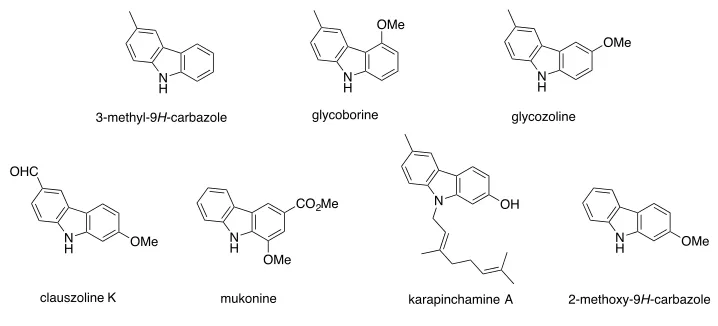
-carbazole (Figure 3).
Figure 3.
Structures of certain carbazole-based natural products
and a
mono-methoxylated congener
Publication 4: A Unified Approach to the Isomeric
α
-,
β
-,
γ
- and
δ
-Carbolines via
their 6,7,8,9-Tetrahydro Counterparts
The isomeric
α
-,
β
-,
γ
- and
δ
-carbolines (Figure 4) are important heterocyclic ring
systems
20encountered, albeit to varying extents, as key structural motifs in various
biologically active natural products.
O
O2N NH NH
15 16 glycozoline
OMe OMe OMe
H2
Raney-Nickel 10 wt. % Pd/C
Ph2O, 210 °C 0.33 h, 89% MeOH, 22 °C
16 h, 72% Pd[0]-catalyzed Ullmann cross-coupling
3-methyl-9H-carbazole glycoborine glycozoline
clauszoline K karapinchamine A
N
H NH NH
OMe
N H OHC
OMe
N OH
OMe
N H
OMe
CO2Me
mukonine
N
H OMe
2-methoxy-9H-carbazole
[image:18.595.89.448.322.485.2]This publication reports on the development of a unified approach (perhaps the first to
have been developed) to the carbolines involving palladium-catalyzed Ullmann
cross-coupling,
21reductive cyclization and dehydrogenation reactions as key steps, the last
being employed to convert tetrahydro-carbolines into their fully aromatic counterparts
(
viz
. the carbolines). The synthesis of
α
-carboline, as shown in Scheme 4, is illustrative
of the reaction sequence used.
Scheme 4.
The synthesis of
α
-carboline
O N
H2
10 wt. % Pd/C 10 wt. % Pd/C
O2N
N N
H N N
H
Ph2O, 210 °C
0.66 h, 97% MeOH, 22 °C
16 h, 75% palladium-catalyzed Ullmann cross-coupling
References
1.
For examples of recently reported sorbicillins see: (a) El-Elimat, T.; Raja, H. A.;
Figueroa, M.; Swanson, S. M.; Falkinham III, J. O.; Lucas, D. M.; Grever, M. R.;
Wani, M. C.; Pearce, C. J.; Oberlies, N. H.
J. Antibiot.
,
2015
,
68
, 191; (b) Zhai,
M.-M.; Qi, F.-M.-M.; Li, J.; Jiang, C.-X.; Hou, Y.; Shi, Y.-P.; Di, D.-L.; Zhang, J.-W.; Wu,
Q.-X.
J. Agric. Food Chem.
,
2016
,
64
, 2298.
2.
For useful points-of entry into the literature on sorbicillinoids see: (a) Harned, A.
M.; Volp, K. A.
Nat. Prod. Rep.
,
2011
,
28
, 1790; (b) Meng, J.; Wang, X.; Xu, D.;
Fu, X.; Zhang, X.; Lai, D.; Zhou, L.; Zhang, G.
Molecules
,
2016
,
21
, 715.
3.
(a) Bringmann, G.; Lang, G.; Gulder, T. A. M.; Tsuruta, H.; Mühlbacher, J.;
Maksimenja, K.; Steffens, S.; Schaumann, K.; Stöhr, R.; Wiese, J.; Imhoff, J. F.;
Perovíc-Ottstadt,
S.; Boreiko, O.; Müller, W. E. G.
Tetrahedron
,
2005
,
61
, 7252; (b)
Lee, D.; Lee, J. H.; Cai, X. F.; Shin, J. C.; Lee, K.; Hong, Y.-S.; Lee, J. J.
J.
Antibiot.
,
2005
,
58
, 615; (c) Maskey, R. P.; Grün
-Wollny, I.; Laatsch, H.
J. Nat.
Prod.
,
2005
,
68
, 865; (d) Neumann, K.; Abdel-Lateff, A.; Wright, A. D.; Kehraus,
S.; Krick, A.; König, G. M.
Eur. J. Org. Chem.
,
2007
, 2268.
4.
Ell, A.; Closson, A.; Adolfsson, H.; Bäckvall, J.-E.
Adv. Synth. Catal.
,
2003
,
345
,
1012.
5.
Barton, D. H. R.; McCombie, S. W.
J. Chem. Soc., Perkin Trans. 1
,
1975
,
16
, 1574.
6.
Volp, K. A.; Johnson, D. M.; Harned, A. M.
Org. Lett.
,
2011
,
13
, 4486.
7.
For a related conversion see Franck, G.; Brödner, K.; Helmchen, G.
Org. Lett.
,
2010
,
12
, 3886.
8.
For a relevant and recent review see Banwell, M. G.; Bon, D. J.-Y. D. Applications
of the Di-
π
-Methane and Related Rearrangement Reactions in Chemical Synthesis.
In
Molecular Rearrangements in Organic Synthesis
: Rojas, C. M., Ed.; Wiley,
Hobokjen, NJ, 2015; Chapter 9, pp 261-288.
9.
Juo, S.-Y.; Jang, Y.-J.; Liu, J.-Y.; Chu, C.-S.; Liao, C.-C.; Hung, S.-C.
Angew.
Chem. Int. Ed
.
2008
,
47
, 8082 and references cited therein.
10.
Ley, S. V.; Norman, J.; Griffith, W. P.; Marsden, S. P.
Synthesis
,
1994
, 639.
Wright, A. E
. J. Nat. Prod
.
2013
,
76
, 1989; (e) Kim, S.-H.; Ha, T.-K.-Q.; Oh, W.
K.; Shin, J.; Oh, D.-C.
J. Nat. Prod
.
2016
,
79
, 51; (f) Patel, O. P. S.; Mishra, A.;
Maurya, R.; Saini, D.; Pandey, J.; Taneja, I.; Raju, K. S. R.; Kanojiya, S.; Shukla,
S. K.; Srivastava, M. N.; Wahajuddin, M.; Tamrakar, A. K.; Srivastava, A. K.;
Yadav, P. P.
J. Nat. Prod
.
2016
,
79
, 1276.
12.
Banwell, M. G.; Kelly, B. D.; Kokas, O. J.; Lupton, D. W.
Org. Lett
.
2003
,
5
, 2497.
13.
Campaigne, E.; Lake, R. D.
J. Org. Chem
.
1959
,
24
, 478.
14.
(a) Chakrabarty, M.; Nath, A. c.; Khasnobis, S.; Chakrabarty, M.; Konda, Y.;
Harigaya, Y.; Komiyama, K.
Phytochem
.
1997
,
46
, 751; (b) Cui, C.-B.; Yan, S.-Y.;
Cai, B.; Yao, X.-S
. J. Asian. Nat. Prod. Res.
2002
,
4
, 233.
15.
Chakravarty, A. K.; Sarkar, T.; Masuda, K.; Takey, T.; Doi, H.; Kotani, E.;
Shiojima, K
. Indian J. Chem. Sec. B
2001
,
40
, 484.
16.
(a) Chakraborty, D. P.
Phytochem
.
1969
,
8
, 769; (b) Li, W. S.; McChesney, J. D.;
El-Feraly, F. S.
Phytochem
.
1991
,
30
, 343.
17.
(a) Birari, R.; Roy, S. K.; Singh, A.; Bhutani, K.
Nat. Prod. Commun
.
2009
,
4
,
1089; (b) Lin, W.; Wang, Y.; Lin, S.; Li, C.; Zhou, C.; Wang, S.; Huang, H.; Liu,
P.; Ye, G.; Shen, X.
Eur. J. Med. Chem
.
2012
,
47
, 214.
18.
(a) Brenna, E.; Fuganti, C.; Serra, S.
Tetrahedron
,
1998
,
54
, 1585; (b)
Laphookhieo, S.; Sripisut, T.; Prawat, U.; Karalai, C.
Heterocycles
,
2009
,
78
, 2115.
19.
Nakamura, S.; Nakashima, S.; Oda, Y.; Yokota, N.; Fujimoto, K.; Matsumoto, T.;
Ohta, T.; Ogawa, K.; Maeda, S.; Nishida, S.; Matsuda, H.; Yoshikawa, M.
Bioorg.
Med. Chem
.
2013
,
21
, 1043.
20.
For useful points-of-entry into the substantial body of literature on these
compounds see (a) Smirnova, O. B.; Golovko, T. V.; Granik, V. G.
Pharm. Chem.
J
.,
2011
,
44
, 654; (b) Hung, T. Q.; Dang, T. T.; Janke, J.; Villinger, A. Langer, P.
Org. Biomol. Chem
.,
2015
,
13
, 1375 and references cited therein.
Publication One
Establishing the True Structure of the
Sorbicillinoid-derived Isolate Rezishanone C by Total Synthesis
Qiao Yan, Martin G. Banwell, Michelle L. Coote,
Richmond Lee and Anthony C. Willis
Natural Product Synthesis
Establishing the True Structure of the Sorbicillinoid-Derived
Isolate Rezishanone C by Total Synthesis
Qiao Yan,
[a]Martin G. Banwell,*
[a]Michelle L. Coote,
[a, b]Richmond Lee,
[a, b]and
Anthony C. Willis
[a]Abstract:The enantiomer,ent-4, of the true structure, 4,
of the sorbicillinoid rezishanone C (sorbivinetone) has
been synthesized from a homochiral cis
-1,2-dihydrocate-chol that is itself generated through the whole-cell bio-transformation of toluene. These studies together with dispersion-corrected DFT calculations support the propos-al that rezishanone C is an artefact of the isolation process and arises through a Diels–Alder reaction between ethyl vinyl ether and sorbicillinol (3).
The sorbicillins are an ever-expanding class of
polyketide-de-rived fungal metabolite[1]that display significant structural
di-versity and (sometimes) unusual biological activities.[2]
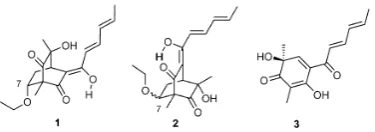
Rezisha-none C (sorbivinetone, Figure 1),[3] for which both structures
1and2have been suggested, can be classified as a member
of the so-called hybrid sub-type[2a] of sorbicillins that arise
through a Diels–Alder reaction between sorbicillinol (3) and various non-sorbicillinoid-derived compounds containing a di-enophilic residue. In the case of rezishanone C, it has been
suggested[3a]that ethyl vinyl ether is the dienophile involved.
Since this ether is a contaminant often found in ethyl acetate, the solvent used in extracting rezishanone C from various fungal sources, it is quite possible that this compound is an ar-tefact of the isolation process rather than a true natural
prod-uct. Some support for this argument follows from the report[3a]
that the acetate of the racemic modification of compound3
(i.e. (:)-sorbicillinol acetate) reacts with ethyl vinyl ether under
ambient conditions to give a Diels–Alder adduct designatedO
-acetylrezishanone C. On this basis, Bringmann proposed[3a]
structure 1 for rezishanone C (a compound that would arise
througha-face addition of ethyl vinyl ether to diene3).
Others who have isolated what we now confirm to be the same material have suggested that it may be one or other of
the C7 epimeric forms of compound2(that would arise if the
same dienophile added, depending on the C7 stereochemistry,
in either anexoorendomode to thebface of diene3).[3b–d]It
should be noted that each of the four research groups who have reported isolating rezishanone C used a different solvent
to acquire their 1H and13C NMR spectral data sets and thus
preventing direct comparisons between them.3
Rezishanone C, in any of its structurally proposed or
plausi-ble alternate forms,[4] embodies a polyfunctionalized and
ho-mochiral bicyclo[2.2.2]octane core bearing a bridgehead methyl group, a structural motif that we have been able to as-semble by chemoenzymatic means during the course of our
studies on the total synthesis of various terpenoids.[5]
Accord-ingly, and given the absence of any prior studies[6]as well as
the ambiguities associated with its structure, we were attract-ed to rezishanone C as a synthetic target. As a prelude to un-dertaking synthetic studies, we carried out dispersion-correct-ed DFT calculations to determine the transition state energies associated with the various possible modes of Diels–Alder cy-cloaddition that could take place between sorbicillinol (2) and ethyl vinyl ether. These suggested that the reaction pathway
leading to compound4(rather than congener1or the 7R
epi-meric form of2) is the most energetically favorable one (see
the Supporting Information). As such, and given the nature of the homochiral starting material available to us, we pursued
the total synthesis ofent-rezishanone C (ent-4, Figure 2), and
thereby established that the illustrated structure4is the
cor-Figure 1.The two possible structures,1and2, originally proposed for
re-zishanone C (sorbivinetone) and its likely biogenetic precursor sorbicillinol
(3).
[a]Q. Yan, Prof. M. G. Banwell, Prof. M. L. Coote, Dr. R. Lee, Dr. A. C. Willis
Research School of Chemistry Institute of Advanced Studies The Australian National University Canberra, ACT 2601 (Australia) E-mail: [email protected]
[b]Prof. M. L. Coote, Dr. R. Lee
ARC Centre of Excellence for Electromaterials Science
Supporting information and the ORCID identification number(s) for the au-thor(s) of this article can be found under https://doi.org/10.1002/
Communication
[image:25.595.338.526.256.322.2]ly available, enzymatically derived and homochiralcis
-1,2-dihy-drocatechol5[7]into the corresponding and previously
report-ed acetonide6.[5,8]Compound6was itself engaged in a
ther-mally induced Diels–Alder cycloaddition reaction with
a-chlor-oacrylonitrile,[9]and the epimeric mixture oforthoadducts thus
obtained were hydrolyzed using potassium hydroxide in tert
-butanol to give the known[5,10]bicyclo[2.2.2]octenone7(53%
from5). Cleavage of the acetonide moiety within the last
com-pound was achieved using acidified AG-50W-X8 resin in hot aqueous methanol, but this process was accompanied by a retro-aldol/aldol sequence that led to the production of the
trans-diol 8 (86%). The structure of compound 8 was con-firmed via single-crystal X-ray analysis (see the Supporting In-formation). The propensity for retro-aldol reactions to take place within this framework was further emphasized on
at-tempting to convert the ketone moiety within compound8
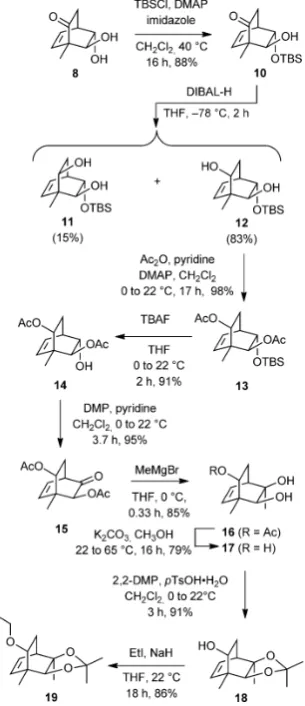
Progress towards the bicyclo[2.2.2]octane core of targetent
-4could be made (Scheme 2) by selectively converting the
hy-droxyl residue remote from the bridgehead methyl group
within compound8 into the corresponding TBS ether 10
(88%). Reduction of the ketone moiety associated with
com-pound 10 was achieved stereoselectively using DIBAL-H, and
so affording a chromatographically separable mixture of
epi-mers11[10](15%) and12(83 %). Two-fold acetylation of diol12
under standard conditions gave the diester 13 (98 %), and
treatment of the latter with tetra-n-butylammonium fluoride
(TBAF) then gave alcohol14[10](91%) that could be oxidized to
the corresponding ketone15(95%) using Dess–Martin
periodi-nane (DMP).[11]Reaction of compound15with methyl
magne-sium bromide at 08C for a brief period gave thecisdiol 16[10]
(85%) through selectivesi-face addition of the nucleophile to
the ketone carbonyl and as a result of the a-acetoxy group
hindering the correspondingreface. After saponification of the
remaining acetate residue within compound16, the triol17[10]
[image:26.595.322.475.368.722.2](79%) was converted, by standard methods, into the acetonide
Figure 2.The theoretically favored Diels–Alder adduct,4, arising from the
re-action of sorbicillinol (3) with ethyl vinyl ether and the structure of its enan-tiomer (ent-4) targeted for synthesis in the present study.
Scheme 1.Assembling the bicyclo[2.2.2]octane core ofent-rezishanone C
(ent-4).
18(91%). Finally, compound18 was treated with sodium
hy-dride and ethyl iodide and so generating the ethyl ether19
(86%) that embodies a number of the key structural features
of the core ofent-rezishanone C.
Our proposed conversion of compound19into target1
re-quired that the double bond within the former compound be manipulated such that a ketone carbonyl group is introduced adjacent to (rather than remote from) the bridgehead methyl group. In one of a number of attempts to achieve such an
out-come alkene19 (Scheme 3) was treated withmeta
-chloroper-benzoic acid (mCPBA) and a single epoxide20(86 %) was
ob-tained. The high degree of selectivity associated with this elec-trophilic addition reaction may be the result of hydrogen bonding between the epoxidizing agent and the oxygen of the pendant ethoxy group. Disappointingly, all efforts to effect the reductive cleavage of this compound with the desired re-gioselectivity failed. So, for example, on reaction of
com-pound20with lithium triethylborohydride the undesired
alco-hol21(84 %) was obtained, perhaps as a result of electronic
ef-fects exerted by the pendant ethoxy group and/or steric ones arising from the methyl group at the junction between dioxo-lane and bicyclo[2.2.2]octane frameworks. The structure of
compound21 (and, therefore, the precursor epoxide 20)
fol-lowed from a single-crystal X-ray analysis of the crystalline triol
22[10](59% or 84%, based on recovered starting material)
pro-duced through hydrolysis of the acetonide group using acidi-fied AG-50W-X8 resin.
The above-mentioned difficulties were overcome by the
means outlined in Scheme 4. Thus, alkene19was subjected to
dihydroxylation under conditions defined by B-ckvall,[12]
afford-ing a chromatographically separable mixture of products23
(22%) and24 (68%). Presumably, the facial selectivity of this
oxidation process, which is essentially opposite to that
ob-served in the conversion 19!20, is now dictated, to some
ically pure acetal25 (89%) that was reductively cleaved with
diisobutylaluminum hydride (DIBAL-H) in CH2Cl2and so giving
the diol mono-ether26[10]in 95% yield.[13]As a prelude to
con-ducting a Barton–McCombie deoxygenation reaction,[14]
com-pound26was converted into the corresponding xanthate 27
(96%) under standard conditions and on treatment of this
with tris(trimethylsilyl)silane (TTMSS)[15]and
azobisisobutyroni-trile (AIBN) reduction took place to give the anticipated ether
28(79%). 2,3-Dichloro-5,6-dicyanobenzoquinone (DDQ)[16]was
used to effect the oxidative cleavage of compound28,
afford-ing alcohol 29 (89 %) that was converted into the target
Scheme 3.An unwanted regiochemical outcome associated with
manipulat-ing the olefinic residue in compound19.
Scheme 4.Regiocontrolled manipulation of the olefinic residue within
com-pound19and an O-acylation reaction.
rather than C-acylation took place, leading to the unstable
enol ester31(84 %) as the exclusive product of reaction.
The difficulties detailed immediately above were overcome
in the same manner as used by Harned and co-workers[6a]
during the course of their synthesis of sorbicillactone A. Thus, the potassium enolate derived from deprotonation of ketone
30(Scheme 5) was treated with (3E,5E
)-2-oxo-3,5-heptadieneni-trile[6a,18] in THF at @788C, and now the desired C-acylated
product32(55%) was obtained as a crystalline solid, the
struc-ture of which was confirmed by single-crystal X-ray analysis.
The completion of the target compoundent-4from this point
involved hydrolysis[19] of the acetonide residue within
com-pound32 using acidified AG-50W-X8 resin then pyridinium
para-toluenesulfonate (PPTS).[20]Oxidation of the resulting diol
33 (63 % or 82 %, based on recovered starting material) with
the Ley–Griffith reagent[21]then gave compoundent-4(52 %).
All the spectral data acquired on compound ent-4were in
complete accord with the assigned structure. In addition, the specific rotation of this material was of similar magnitude but
opposite sign to that reported for rezishanone C[22]while the
1H and 13C NMR data recorded on the synthetic material
matched those reported by Bringmann,[3a] Lee,[3b] Laatsch,[3c]
and Kçnig[3d]for the title isolate (see the Supporting
Informa-tion for tabulated comparisons). The studies detailed above clearly indicate that rezishanone C has the illustrated structure
and not that originally depicted by Bringmann (structure1).[3a]
Furthermore, the materials subsequently isolated by others are
one and the same compound (and not, for example, the 7R
-epimeric form of 2). This outcome, when considered in
con-junction with the theoretical calculations described above, adds weight to the hypothesis that rezishanone C is an artefact
of the isolation process and arises as detailed above.[3a] The
Experimental Section
All computational methods, the derived data and the ensuing anal-yses are provided in the Supporting Information, as are the proce-dures for the preparation of all new compounds and the associat-ed spectroscopic and analytical data. Copies of the NMR spectra of
new compounds, and X-ray plots and data for compounds7,8,9,
11,14,16,17,22,26,30and32are also included in the SI.
Acknowledgements
We thank the Australian Research Council for financial support through grants DP150101947 and CE140100012. QY is the grateful recipient of PhD Scholarship provided by the CSC of the People’s Republic of China. We are grateful to Professor Bringmann (University of Werzburg) for kindly providing copies of the various spectra recorded on sorbivinetone (re-zishanone C).
Conflict of interest
The authors declare no conflict of interest.
Keywords: density functional calculations · Diels–Alder ·
natural products·sorbicillins·total synthesis
[1] For examples of recently reported sorbicillins see: a) T. El-Elimat, H. A. Raja, M. Figueroa, S. M. Swanson, J. O. Falkinham, III, D. M. Lucas, M. R. Grever, M. C. Wani, C. J. Pearce, N. H. Oberlies,J. Antibiot.2015,68, 191, b) M.-M. Zhai, F.-M. Qi, J. Li, C.-X. Jiang, Y. Hou, Y.-P. Shi, D.-L. Di, J.-W. Zhang, Q.-X. Wu,J. Agric. Food Chem.2016,64, 2298.
[2] For useful points-of entry into the literature on sorbicillinoids see: a) A. M. Harned, K. A. Volp,Nat. Prod. Rep.2011,28, 1790, b) J. Meng, X. Wang, D. Xu, X. Fu, X. Zhang, D. Lai, L. Zhou, G. Zhang,Molecules2016,
21, 715.
[3] a) G. Bringmann, G. Lang, T. A. M. Gulder, H. Tsuruta, J. Mehlbacher, K. Maksimenja, S. Steffens, K. Schaumann, R. Stçhr, J. Wiese, J. F. Imhoff, S. Perov&c-Ottstadt, O. Boreiko, W. E. G. Meller,Tetrahedron2005,61, 7252, b) D. Lee, J. H. Lee, X. F. Cai, J. C. Shin, K. Lee, Y.-S. Hong, J. J. Lee,J. Anti-biot.2005, 58, 615, c) R. P. Maskey, I. Gren-Wollny, H. Laatsch,J. Nat. Prod.2005,68, 865, d) K. Neumann, A. Abdel-Lateff, A. D. Wright, S. Keh-raus, A. Krick, G. M. Kçnig,Eur. J. Org. Chem.2007, 2268.
[4] In principle the dienophile ethyl vinyl ether could add to either thea -orb-face of the diene3, in either anexo- orendo-mode and in either anortho- orpara-like manner.
[5] See D. J.-Y. D. Bon, M. G. Banwell, J. S. Ward, A. C. Willis,Tetrahedron
2013,69, 1363and references therein.
[6] For representative recent examples of studies on the synthesis of sorbi-cillinoids see: a) K. A. Volp, D. M. Johnson, A. M. Harned,Org. Lett.2011,
13, 4486, b) C. Qi, T. Qin, D. Suzuki, J. A. Porco, Jr.,J. Am. Chem. Soc.
2014,136, 3374.
[7] For reviews oncis-1,2-dihydrocatechols see: a) R. A. Johnson,Org. React.
2004,63, 117, b) T. Hudlicky, J. W. Reed,Synlett2009, 685, c) S. E. Lewis,
Chem. Commun.2014,50, 2821.
[8] T. Hudlicky, H. Luna, G. Barbieri, L. D. Kwart,J. Am. Chem. Soc.1988,110, 4735.
[9] E. G. Mackay, C. G. Newton,Aust. J. Chem.2016,69, 1365. [10] X-ray analysis data for this compound are provided in the SI.
Scheme 5.A successful C-acylation reaction and completion of the synthesis
ofent-rezishanone C(ent-4). [a] Based on recovered starting material.
[14] D. H. R. Barton, S. W. McCombie,J. Chem. Soc. Perkin Trans. 1 1975, 1574.
[15] C. Chatgilialoglu, D. Griller, M. Lesage,J. Org. Chem.1988,53, 3641. [16] K. Horita, T. Yoshioka, T. Tanaka, Y. Oikawa, O. Yonemitsu,Tetrahedron
1986,42, 3021.
[17] Compound23can be converted into ketone30using a three-step re-action sequence. See the Supporting Information for details.
[18] For a related conversion see G. Franck, K. Brçdner, G. Helmchen,Org. Lett.2010,12, 3886.
[19] Only this two-stage hydrolysis process produced good yields of diol33. [20] M. Miyashita, A. Yoshokoshi, P. A. Grieco,J. Org. Chem.1977,42, 3772. [21] S. V. Ley, J. Norman, W. P. Griffith, S. P. Marsden,Synthesis1994, 639.
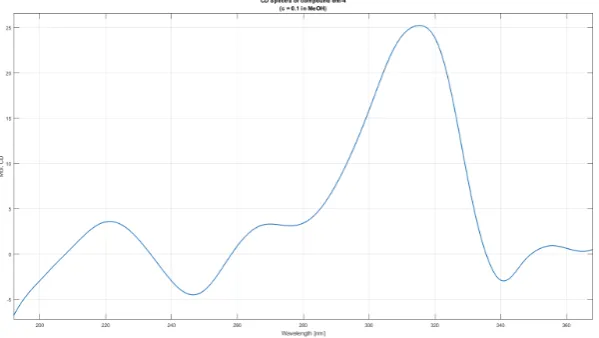
[22] The CD spectrum of compoundent-4is provided in the Supporting In-formation and is essentially a “mirror image” to that of rezishanone C, kindly provided to us by Professor Bringmann.
[23] a) K. C. Nicolaou, S. A. Snyder,Angew. Chem. Int. Ed.2005, 44, 1012;
Angew. Chem.2005,117, 1036, b) M. E. Maier,Nat. Prod. Rep.2009,26, 1105.
Manuscript received: March 26, 2017 Revised manuscript received: April 28, 2017 Accepted manuscript online: April 28, 2017 Version of record online: June 5, 2017
Supporting Information
Establishing the True Structure of the Sorbicillinoid-Derived
Isolate Rezishanone C by Total Synthesis
Qiao Yan,
[a]Martin G. Banwell,*
[a]Michelle L. Coote,
[a, b]Richmond Lee,
[a, b]and
Anthony C. Willis
[a]SUPPORTING INFORMATION FOR:
Establishing the True Structure of the Sorbicillinoid-derived
Isolate Rezishanone C by Total Synthesis
Qiao Yan,
aMartin G. Banwell,*
, aMichelle L. Coote,
a,bRichmond Lee
a,band
Anthony C. Willis
aa
Research School of Chemistry, Institute of Advanced Studies
The Australian National University, Canberra, ACT 2601, Australia
b
ARC Centre of Excellence for Electromaterials Science
Part A: Computational Studies
S2
1.
General Approach and Outcomes
2.
Total Energies of Species
3.
Gaussian Archive Entries for All Species
!
Part B: Experimental Studies
S8
4.
General Experimental Procedures
5.
Specific Chemical Transformations
6.
Comparison of the
13C NMR Data Derived From Rezishanone C with
those Recorded on
ent
-Rezishanone C
7.
CD Spectrum of Compound
ent
-4
8.
Data Associated with Single-crystal X-ray Analyses of Compounds
7, 8, 9, 11, 14, 16, 17, 22, 26, 30 and 32
9.
References
10.
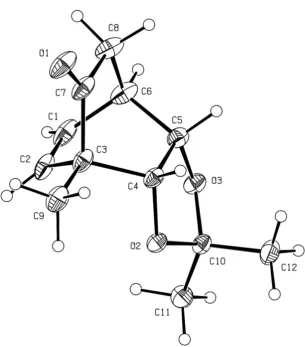
ORTEPs Derived from Single-crystal X-ray Analyses of Compounds
7, 8, 9, 11, 14, 16, 17, 22, 26, 30 and 32
Part A: Computational Studies
1.
General Approach and Outcomes
All quantum chemical calculations were carried out with Gaussian 09.
1The activation
free energy barriers in solution (ΔG
‡) are reported relative to the individual free
starting materials: the diene and dienophile.
The [4+2]-cycloaddition transition state
(TS) electronic structures were optimized with the meta-hybrid functional M06-2X
2in conjunction with Grimme’s empirical dispersion correction D3 (zero damping),
3herein termed M06-2X(D3), using Pople’s
46-31G(d,p) basis set and the SMD
5polarizable continuum solvent model under ethyl acetate (EA) parameters. The
ultrafine integral grid was selected during the optimization calculations to ensure
accuracy in the computed vibrational frequencies. Frequency calculations at 298K
based on harmonic oscillator approximation were performed at the same level of
theory to verify that all TSs had one imaginary frequency and to compute the
vibrational contributions to the entropies.
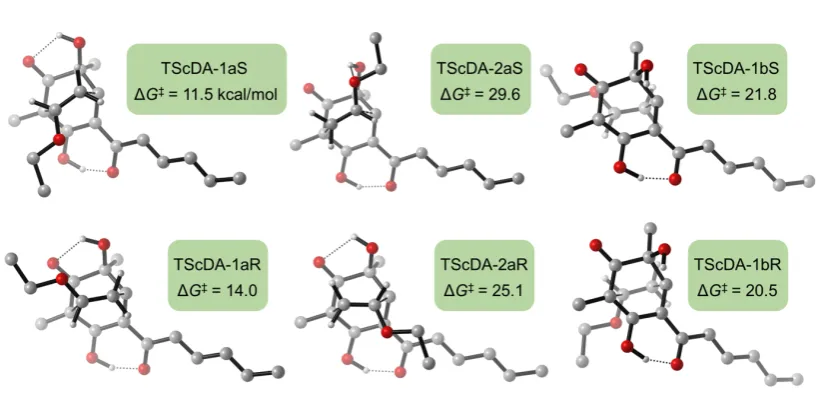
Figure S1 shows the various possible transition structures for the [4+2]-cycloaddition
reaction between sorbicillinol (3) and ethyl vinyl ether. We also endeavored to search
for a step-wise [4+2] pathway but only the concerted one was found. From Figure S1
it is seen that the lowest energy transition structure (designated here as
TScDA-1aS)
is that leading to
ent-rezishanone C (ent-4). The next lowest transition structure is
some 2.5 kcal mol
–1higher in energy and would thus not contribute significantly to
2.
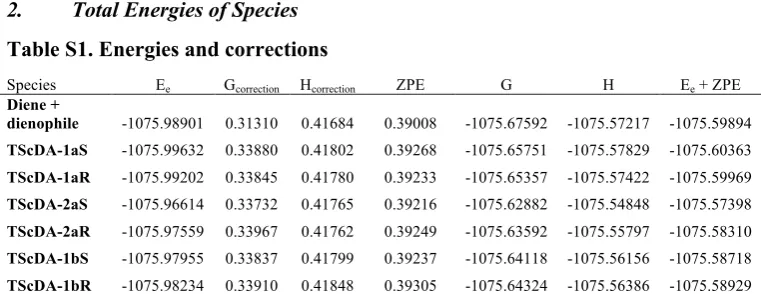
Total Energies of Species
Table S1. Energies and corrections
Species Ee Gcorrection Hcorrection ZPE G H Ee + ZPE
Diene +
dienophile -1075.98901 0.31310 0.41684 0.39008 -1075.67592 -1075.57217 -1075.59894
TScDA-1aS -1075.99632 0.33880 0.41802 0.39268 -1075.65751 -1075.57829 -1075.60363
TScDA-1aR -1075.99202 0.33845 0.41780 0.39233 -1075.65357 -1075.57422 -1075.59969
TScDA-2aS -1075.96614 0.33732 0.41765 0.39216 -1075.62882 -1075.54848 -1075.57398
TScDA-2aR -1075.97559 0.33967 0.41762 0.39249 -1075.63592 -1075.55797 -1075.58310
TScDA-1bS -1075.97955 0.33837 0.41799 0.39237 -1075.64118 -1075.56156 -1075.58718
TScDA-1bR -1075.98234 0.33910 0.41848 0.39305 -1075.64324 -1075.56386 -1075.58929
All energy values are in hatrees. Ee is the electronic energy of the species. The energy corrections Gcorrection and
Hcorrection and Zero Point Energy (ZPE) are added to Ee to constitute Gibb’s free energy (G), enthalpy (H) and the
Ee + ZPE respectively.
3.
Gaussian Archive Entries for All Species
diene
Part B: Experimental Studies
4.
General Experimental Procedures
Unless otherwise specified, proton (
1H) and carbon (
13C) NMR spectra were recorded
at 18 °C in base-filtered CDCl
3on a spectrometer operating at 400 MHz for proton
and 100 MHz for carbon nuclei.
1H NMR data are recorded as follows: chemical shift
(δ) [multiplicity, coupling constant(s) J (Hz), relative integral] where multiplicity is
defined as s = singlet; d = doublet; t = triplet; q = quartet; m = multiplet or
combinations of the above. In relevant cases, the signal due to residual CHCl
3appearing at δ
H7.26 and the central resonance of the CDCl
3“triplet” appearing at δ
C77.0 were used to reference
1H and
13C NMR spectra, respectively. Samples were
analyzed by infrared spectroscopy (ν
max) as thin films on KBr plates. Optical rotations
were recorded using the sodium D-line (589 nm) in a cell with a path length of 1 dm,
at the concentrations indicated and in the specified solvent at 22 °C. Specific rotations
were then calculated in the usual manner. Low- and high-resolution electron impact
(EI) mass spectra were recorded on a double focusing, triple sector machine. Low-
and high-resolution ESI mass spectra were recorded on a triple-quadrupole mass
spectrometer operating in positive ion mode. Melting points are uncorrected.
Analytical thin layer chromatography (TLC) was performed on aluminum-backed 0.2
mm thick silica gel 60 F
254plates. Eluted plates were visualized using a 254 nm UV
lamp and/or by treatment with a suitable dip followed by heating. These dips included
phosphomolybdic acid/ceric sulfate/sulfuric acid (conc.)/water (37.5 g : 7.5 g : 37.5 g
: 720 mL), potassium permanganate/potassium carbonate/5% sodium hydroxide
aqueous solution/water (3 g : 20 g : 5 mL : 300 mL), and
p-anisaldehyde or
vanillin/sulfuric acid (conc.)/ethanol (15 g : 2.5 mL : 250 mL). Flash chromatographic
separations were carried out following protocols defined by Still et al.
6with silica gel
60 (40-63 µm) as the stationary phase and using the AR- or HPLC-grade solvents
indicated. The melting points of solids purified by such means were recorded directly
(ie after they had crystallized from the concentrated chromatographic fractions).
Starting materials, reagents, drying agents, and other inorganic salts were generally
commercially available and were used as supplied. Tetrahydrofuran (THF), methanol
and dichloromethane were dried using a solvent purification system that is based upon
a technology originally described by Grubbs
et al.
7Where necessary, reactions were
5.
Specific Chemical Transformations
(3aR,7aS)-2,2,4-Trimethyl-3a,7a-dihydrobenzo[d][1,3]dioxole (6)
A magnetically stirred solution of commercially available diol 5 (10.00 g, 79.3 mmol)
in 2,2-dimethoxypropane (320 mL) was cooled to
−10 °C then treated with
p-toluenesulfonic acid monohydrate (1.60 g, 8.0 mmol). The ensuing mixture was
stirred at
−10 °C for 0.40 h then treated with triethylamine (4.0 mL, 28.6 mmol)
before being concentrated under reduced pressure (no heating) to provide a brown oil.
This oil was dissolved in diethyl ether (400 mL) and the resulting solution washed
with NaOH (1 × 200 mL of a 1 M aqueous solution). The separated aqueous phase
was extracted with diethyl ether (1
× 200 mL) and the combined organic extracts
washed with water (2
× 200 mL) before being dried (MgSO
4), filtered then
concentrated under reduced pressure to afford diene 6 (10.60 g, 80%) as a pale-yellow
oil. This material, the spectral data for which matched these reported previously,
8was
used immediately in the next step of the reaction sequence.
(3aS,4R,7S)-2,2,7-Trimethyl-3a,4,7,7a-tetrahydro-4,7-ethanobenzo[d][1,3]dioxol-8-one (7)
Step i: A magnetically stirred solution of diene
6 (5.29 g, 31.8 mmol) and
α-chloroacrylonitrile (7.62 mL, 95.4 mmol) in benzene (62 mL) maintained under a
nitrogen atmosphere was heated under reflux for 18 h then cooled and concentrated
under reduced pressure. The residue thus obtained was subjected to flash column
chromatography (silica, 0:1 → 1:24 v/v ethyl acetate/40-60 petroleum ether gradient
O
O
6
OO
O
elution) to give a 4:1 mixture of epimeric and previously reported Diels-Alder
adducts.
9Step ii: A magnetically stirred solution of the mixture of adducts (3.98 g, 15.7 mmol)
obtained from Step i in t-BuOH (120 mL) was treated with potassium hydroxide (3.52
g of pellets, 62.7 mmol) and the resulting mixture heated under reflux for 15 h before
being cooled then concentrated under reduced pressure. The residue thus obtained
was diluted with ethyl acetate (200 mL) and the ensuing mixture washed with water
(1
× 200 mL). The separated aqueous phase was treated with potassium carbonate
(1.47 g, 10.6 mmol) and extracted with ethyl acetate (2 × 100 mL) then the combined
organic phases were dried (MgSO
4), filtered, and concentrated under reduced
pressure. The orange oil thus obtained was subjected to flash chromatography (silica,
0:1
→ 1:9 v/v ethyl acetate/40-60 petroleum ether gradient elution) to afford, after
concentration of the appropriate fractions (R
f= 0.5 in 1:4 v/v ethyl acetate/40-60
petroleum ether), ketone 7
9(2.91 g, 89%) as a colorless, crystalline solid, mp = 79-80
°C (lit.
9mp = 81-82 °C).
1
H NMR (400 MHz, CDCl
3
) δ 6.34 (t, J = 7.1 Hz, 1H), 5.72 (d, J = 8.0 Hz, 1H), 4.49
(m, 1H), 4.05 (d, J = 7.1 Hz, 1H), 3.17 (m, 1H), 2.12 (dd, J = 18.7 and 3.9 Hz, 1H),
1.88 (d, J = 18.7 Hz, 1H), 1.37 (s, 3H), 1.30 (s, 6H).
13
C NMR (100 MHz, CDCl
3
)
δ 210.5, 133.7, 131.6, 110.9, 79.9, 79.3, 54.8, 35.6,
35.3, 25.5, 25.1, 14.5.
IR (KBr) ν
max2977, 2935, 2887, 1731, 1374, 1208, 1093, 1070 cm
–1.
MS (EI, 70 eV)
m/z 208 (M
+•, 30%), 193 [(M−CH
3•)
+, 40], 150 (60), 121 (70), 108
(100), 105 (72), 100 (70).
HRMS M
+•calcd for C
12H
16O
3208.1099, found 208.1095.
Specific rotation [α]
D= +313.5 (c = 0.8, CHCl
3).
(1S,4R,7S,8S)-7,8-Dihydroxy-1-methylbicyclo[2.2.2]oct-5-en-2-one (8)
A magnetically stirred solution of compound 7 (2.40 g, 11.5 mmol) in methanol/water
(126 mL of a 105:21 v/v mixture) was treated with AG-50W-X8 resin (2.86 g of H
+OH O
OH
form). The ensuing mixture was heated at 65
°C for 16 h then cooled and filtered. The
retained solids were washed with methanol (40 mL) and the combined filtrates
concentrated under reduced pressure. The residue thus obtained was diluted with ethyl
acetate (40 mL) and the separated aqueous phase extracted with ethyl acetate (2 × 40
mL). The combined organic extracts were dried (MgSO
4), filtered and concentrated
under reduced pressure and the residue thus obtained subjected to flash column
chromatography (silica, 1:1
→ 1:0 v/v ethyl acetate/40-60 petroleum ether gradient
elution) to give, after concentration of the appropriate fractions (R
f= 0.2 in ethyl
acetate), diol 8 (1.67 g, 86%) as a colorless, crystalline solid, mp = 122-125 °C.
1
H NMR (400 MHz, CD
3
OD) δ 6.45 (m, 1H), 5.82 (dd, J = 7.8 and 1.1 Hz, 1H), 3.91
(s, 1H), 3.45 (s, 1H), 2.93 (broad s, 1H), 2.07 (m, 2H), 1.23 (s, 3H) (signals due to
hydroxyl group protons not observed).
13
C NMR (100 MHz, CD
3
OD)
δ 213.1, 136.9, 132.6, 82.8, 80.0, 57.2, 40.5, 36.9,
14.8.
IR (KBr) ν
max3388, 1714, 1366, 1097, 1033, 744 cm
–1.
MS (ESI, +ve) m/z 191 [(M+Na)
+, 100%].
HRMS (M+Na)
+calcd for C
9H
12NaO
3191.0684, found 191.0687.
Specific rotation [α]
D= +487.8 (c = 0.6, CH
3OH).
(5S)-5-((1,3-Dioxolan-2-yl)(hydroxy)methyl)-2-methylcyclohex-2-en-1-one (9)
A magnetically stirred solution of diol 8 (60 mg, 0.36 mmol) in benzene (5 mL) was
treated with ethylene glycol (240
µL, 4.30 mmol) and p-toluenesulfonic acid
monohydrate (12 mg, 0.06 mmol). The ensuing mixture was heated under reflux for
1.5 h then cooled and concentrated under reduced pressure to give a pale-yellow oil.
This oil was dissolved in ethyl acetate (50 mL) and the solution thus obtained washed
with NaHCO
3(1
× 50 mL of a saturated aqueous solution). The separated aqueous
phase was extracted with ethyl acetate (1 × 50 mL) and the combined organic phases
were then dried (MgSO
4), filtered, and concentrated under reduced pressure. The
O HO
O O
H
residue thus obtained was subjected to flash column chromatography (silica, 2:3
→
1:1 v/v ethyl acetate/40-60 petroleum ether elution) to give, after concentration of the
appropriate fractions (R
f= 0.5 in ethyl acetate), compound
9 (37 mg, 48%) as a
colorless, crystalline solid, mp = 112-114 °C.
1
H NMR (400 MHz, CDCl
3
)
δ 6.72 (m, 1H), 4.86 (d,
J = 4.0 Hz, 1H), 4.10-3.85
(complex m, 4H), 3.53 (broad s, 1H), 2.70 (m, 1H), 2.45-2.32 (complex m, 4H), 1.93
(broad s, 1H), 1.77 (s, 3H).
13
C NMR (100 MHz, CDCl
3
)
δ 199.8, 144.4, 135.7, 103.6, 73.9, 65.6, 65.4, 39.2,
37.7, 29.1, 15.9.
IR (KBr) ν
max3452, 2966, 2923, 2891, 1668, 1152, 1090, 1074, 963 cm
–1.
MS (ESI, +ve) m/z 235 [(M+Na)
+, 100%].
HRMS (M+Na)
+calcd for C
11
H
16NaO
4235.0946, found 235.0939.
Specific rotation [α]
D= +34.0 (c = 0.5, CHCl
3).
(1S,4R,7S,8S)-8-((tert-Butyldimethylsilyl)oxy)-7-hydroxy-1-methylbicyclo[2.2.2]-oct-5-en-2-one (10)
A magnetically stirred solution of diol 8 (700 mg, 4.16 mmol) in dry dichloromethane
(45 mL) maintained under an atmosphere of nitrogen was treated with imidazole (1.13
g, 16.6 mmol), DMAP (51 mg, 0.42 mmol) and then TBSCl (1.88 g, 12.5 mmol). The
ensuing mixture was heated under reflux for 16 h then cooled to room temperature
before bring poured into NH
4Cl (100 mL, a saturated aqueous solution) and extracted
with dichloromethane (3
× 100 mL). The combined organic phases were then dried
(MgSO
4) filtered, and concentrated under reduced pressure. The residue thus obtained
was subjected to flash column chromatography (silica, 0:1 → 1:4 v/v ethyl
acetate/40-60 petroleum ether elution) to give, after concentration of the appropriate fractions (R
f= 0.7 in ethyl acetate), compound
10 (1.04 g, 88%) as a colorless, crystalline solid,
mp = 71-73 °C.
OTBS O
OH
1
H NMR (400 MHz, CDCl
3
) δ 6.42 (dd, J = 7.7 and 6.3 Hz, 1H), 5.77 (dd, J = 7.7 and
1.7 Hz, 1H), 3.96 (d, J = 3.2 Hz, 1H), 3.52 (d, J = 3.8 Hz, 1H), 2.86 (broad s, 1H)
2.14-2.03 (complex m, 2H), 1.96 (m, 1H), 1.27 (s, 3H), 0.89 (s, 9H), 0.11 (s, 6H).
13
C NMR (100 MHz, CDCl
3
) δ 210.3, 136.0, 130.6, 83.3, 79.8, 55.7, 39.8, 35.9, 25.9,
18.2, 14.4, −4.5(7), −4.6(1).
IR (KBr) ν
max3458, 2955, 2930, 2858, 1720, 1256, 1116, 1087, 838, 777 cm
–1.
MS (ESI, +ve) m/z 305 [(M+Na)
+, 100%].
HRMS (M+Na)
+calcd for C
15H
26NaO
3Si 305.1549, found 305.1549.
Specific rotation [α]
D= +331.2 (c = 0.8, CHCl
3).
(1R,2S,3S,4R,6S)-3-((tert-Butyldimethylsilyl)oxy)-1-methylbicyclo[2.2.2]oct-7-en-e-2,6-diol
(11)
and
(1R,2S,3S,4R,6R)-3-((tert-Butyldimethylsilyl)oxy)-1-methylbicyclo[2.2.2]oct-7-ene-2,6-diol (12)
A magnetically stirred solution of ketone
10 (2.82 g, 10.0 mmol) in dry THF (140
mL) maintained under an atmosphere of nitrogen was cooled to −78 °C then treated,
dropwise over 1 h, with DIBAL-H (60 mL of a 1 M solution in THF, 60.0 mmol). The
ensuing mixture was stirred at
−78 °C for 1 h before being warmed to 0 °C and
quenched by the slow addition of ice (CAUTION! EXOTHERMIC REACTION).
The ensuing mixture was poured into HCl (40 mL of a 1 M aqueous solution) and
extracted with ethyl acetate (3 × 200 mL). The combined organic phases were then
dried (MgSO
4), filtered and concentrated under reduced pressure. The residue thus
obtained was subjected to flash column chromatography (silica, 1:19 → 3:7 v/v ethyl
acetate/40-60 petroleum ether gradient elution) to give two fractions, A and B.
Concentration of fraction A (R
f= 0.5 in 1:4 v/v ethyl acetate/40-60 petroleum
ether) afforded compound 11 (470 mg, 15%) as a colorless, crystalline solid, mp =
83-85 °C.
1
H NMR (400 MHz, CDCl
3
) δ 6.14 (dd, J = 8.0 and 6.2 Hz, 1H), 5.75 (dd, J = 8.0 and
1.2 Hz, 1H), 3.85 (m, 1H), 3.63 (m, 1H), 3.32 (m, 1H), 3.06 (m, 1H), 2.62 (t, J = 6.8
OTBS OH OH
OTBS OH HO
11 12
Hz, 1H), 2.48 (broads s, 1H), 2.10 (m, 1H), 1.55 (s, 1H), 1.39 (s, 3H), 0.88 (s, 9H),
0.10 (s, 3H), 0.09 (s, 3H).
13
C NMR (100 MHz, CDCl
3
) δ 134.3, 134.2, 85.8, 80.6, 74.2, 43.3, 38.3, 35.2, 26.0,
18.5, 18.3, −4.4(9), −4.5(4).
IR (KBr) ν
max3325, 2953, 2929, 2857, 1463, 1257, 1112, 1083, 1060, 836, 776 cm
–1.
MS (ESI, +ve) m/z 307 [(M+Na)
+, 100%].
HRMS (M+Na)
+calcd for C
15
H
28NaO
3Si 307.1705, found 307.1705.
Specific rotation [α]
D= +89.2 (c = 1.3, CHCl
3).
Concentration of fraction B (R
f= 0.1 in 1:4 v/v ethyl acetate/40-60 petroleum
ether) afforded compound 12 (2.31 g, 83%) as a clear, colorless oil.
1
H NMR (400 MHz, CDCl
3
) δ 6.33 (m, 1H), 5.76 (d, J = 8.1 Hz, 1H), 3.93 (d, J = 7.2
Hz, 1H), 3.54 (s, 1H), 3.25 (s, 1H), 2.49 (broad s, 1H), 2.15-2.03 (complex m, 1H),
1.30 (s, 3H), 1.22 (m, 1H), 0.86 (s, 9H), 0.05 (s, 6H) (signals due to hydroxyl group
protons not observed).
13
C NMR (100 MHz, CDCl
3
) δ 134.8, 132.4, 83.2, 79.8, 68.4, 45.5, 39.2, 36.8, 26.0,
18.2, 18.0, −4.5, −4.6.
IR (KBr)
ν
max3413, 2955, 2929, 2857, 1252, 1111, 1092, 1055, 934, 859, 836, 775,
718 cm
–1.
MS (EI, 70 eV) m/z 284 (M
+•, 3%), 227 (35), 165 (56), 135 (55), 117 (82), 75 (100).
HRMS M
+•calcd for C
15H
28O
3Si 284.1808, found 284.1807.
Specific rotation [α]
D= +80.3 (c = 0.6, CHCl
3).
(1R,2S,3S,4R,6R)-3-((tert-Butyldimethylsilyl)oxy)-1-methylbicyclo[2.2.2]oct-7-ene-2,6-diyl Diacetate (13)
A magnetically stirred solution of compound
12 (1.70 g, 6.0 mmol) in dry
dichloromethane (212 mL) maintained at 0 °C under an atmosphere of nitrogen was
treated with DMAP (58 mg, 0.5 mmol), pyridine (10 mL, 123.6 mmol) and acetic
anhydride (5.5 mL, 58.6 mmol). After a further 1 h at 0 °C the reaction mixture was
warmed to 22 °C and then allowed to stir at this temperature for 16 h before being
OTBS OAc AcO

![Figure 2. Examples of enantiomerically pure bicyclo[2.2.2]octenones](https://thumb-us.123doks.com/thumbv2/123dok_us/8207647.262457/17.595.241.409.56.207/figure-examples-of-enantiomerically-pure-bicyclo-octenones.webp)