APPLYING ISHIKAWA APPROACH FOR MODELING ERP
RISKS-EFFECTS
1ZAITAR YOUSSEF, 2OUZARF MOHAMED
1University Sidi Mohamed Ben Abdellah, Faculty of Science and Technology-Fez – Morocco 2 University Sidi Mohamed Ben Abdellah, Faculty of Science and Technology- Fez – Morocco
E-mail: [email protected] , [email protected]
ABSTRACT
Implementation of Enterprise Resource Planning systems (ERP) presents many risks and often severe effects, which must be identified and analyzed. This work shows how Ishikawa approach can be used to model risk factors and their effects on ERP projects, on the one hand and on the organization, on the other. A real case study regarding three large companies and involving a panel of experts and practitioners is presented to illustrate application of the method .We can present this research according to the following general question: What are the probable risks of ERP projects and their effects on the project and on the organization?
Keywords: ERP, Risks Management, Risks Assessment, Effects, Ishikawa
1. INTRODUCTION
An Enterprise Resource Planning system is a suite of integrated software applications used to manage transactions through company-wide business processes, by using a common database, standard procedures and data sharing between and within functional areas [1]. However, several surveys have shown that a high percentage of ERP implementations are classified as failures [2][3][4]. It is a complex and risky adventure. The failure factors are not well known, but they can possibly lead to real effects: many companies have failed in ERP projects. Among these enterprises, there are Mobile Europe, Dell computer, Dow Chemical, which retread from the project [5].it is also possible for the project to lead to the bankruptcy of the company as the case of FoxMeyer Drug [5][6]. According to the investigation conducted from September 2012 to January 2013, ERP often result in failure, 53% of projects exceeded the budget set, 61% exceeded the deadline and 60% realized less than 50% of expected benefits[7], another study called chaos manifesto conducted by Standish Group[8], shows that : 21% of software projects are failed and abolished before they are completed or delivered but never used; 42% of projects cost more than the expected estimate, exceed the schedules and / or shortage of features; 37% of projects are completed on time and estimated costs. These failures are primarily caused by the absence of certain prerequisites that are necessary for the success of ERP implementation [5][9][10].The
study of Glomark-Governan,[11] which covers 250 companies worldwide found that before the implementation of ERP systems ; 85 percent of organizations have not prepared an objective analysis of costs, benefits , and the risk factors that result in the failure of the projet :exceedind budget and time,and not meeting desired features [12][13][14] [15][16].
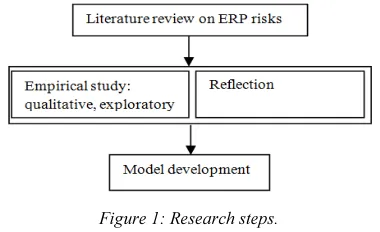
[image:1.595.312.502.537.653.2]This article aims to identify all risk factors of ERP project, and their undesirable effects on the project and on the organization.To address this problem we can summarize the methodology of our research in the following way:
Figure 1: Research steps.
2. THE ISHIKAWA METHOD
ISSN: 1992-8645 www.jatit.org E-ISSN: 1817-3195
of importance or detail. Thus, all causes that can produce failures are identified and eliminated. It is used to represent the relationship between effect and causes of a problem
2.1 Risk factors
The risk assessment has to be considered early in the project by developing a list of probable risks that can lead to failure. However, some minor and serious risks may occur during the project that requiring treatment. This step consists in identifying potential risks and any events that generate risks, which could lead to non compliance with objectives.
The literature on risk factors (RF) in ERP projects is closely linked to the success factors (SF). Indeed, if knowledge of the (RF) is essential for managing risks during an ERP project, another perspective is to focus on the (SF); elements that ensure the success of ERP projects. The review of the contributions shows that the authors treat the (SF) more than (RF). This justifies our focus on a comprehensive study of risk factors. According [17] risk is the possibility that a project is not executed in planned deadlines, cost and specifications. These deviations from the forecasts are considered highly unacceptable.
We present in the following table a broad review of the literature on risk factors of ERP projects:
Table 1: Literature ReviewOn Risk Factors
Risk Factors References
Lack of commitment / expertise of the top management
[14][18][19][20][2 1][22][23][24][25] [26][27][28][29][3 0][31][32][33][34] [35][36][37][38] Poor project management [14][39][40][41] Inappropriate staffing: Inadequate
distribution of roles and
responsibilities, insufficient members
[18] [21] [22] [24] [27] [29] [42] [43] [44] [45] [46] [47] Poor consultants [14][20] [29] [39]
[41] [48] Inadequate project manager [14][20] [40] [41]
[43] [45][48] [49] unrealistic Planning of the project
deadlines
[21] [43] [49]
Poor estimation and management of financial and material resources
[14][18] [22] [50] [51] Conflicts between organization and
consultants
[39] [41]
Lack of expertise / involvement of key users
[14][29] [39] [41] [48] [49] [52] Lack of expertise of the project team
with the system and the processes
[22] [25] [29] [53]
Users’ resistance to change [21]
Lack of expertise of the integrator [29] [48][52] Poor risk management [14] [20][39] [41]
[42] [48] Inadequate BPR (Business Process
Reengineering)
[14] [39] [40] [45] [54] Ineffective strategy thinking and
planning
[14] [41] [48] [49]
Gap in the requirement definition [10] [45] [55] [56] Inadequate selection [14] [16] [39]
[40] [41] [57] [58] Misfits between the IT and business
strategies
[59] [14] [22] [29]
Inadequate management of the adaptation of ERP
[41] [59] [60] [61] High rate of system customization [10] [22] [39] High degree of complexity of the ERP [62] Insufficient and inadequate training of end-users)
[10][14][19] [29] [39][45][61] Technical issues: Issues related to the
installation and operationalization ...
[21][22][29][33] [45][50][53][64] [65][66] Inadequate management of
organizational change
[14][22][39]
Poor data conversion, under-estimation of data-migration risk
[10][61]
Ineffective communications [14][41]
Lack of expertise of the integrator with processes
[22]
Poor quality of testing [21] Issues related to maintenance of ERP [22] Organizational complexity and level of geographic dispersion (multi-site issues)
[22][66]
Lack of experience and expertise of the organization in the management of contracts
[38][67]
Dependence on 'key' users [68]
Insufficient resources [24][25][26][27][2 8][30][32][33][36] [37][53][63][64] [65][69][70][71] [72][73][74][75] Intensity of Conflict [25][32][35][37] [38][53][63][64] [76][77] Level of functional specialization [78]
Magnitude of changes by the system [24][27][28][33] [35][53][65][77] [78]
Process complexity [32][38][53][64] [67][72] Lack of system flexibility (ability to
absorb future changes)
[27][63][64]
Number of modules installed [5]
Financial stability of the editor [27][67][73][77] Lack of experience and expertise of
the editor with ERP contracts
[67]
Lack of experience and expertise of the editor with processes
[28][38][67][68] [77]
Cultural mismatch with the editor [67][79] Financial stability of the integrator [67][73] Lack of experience and expertise of
the integrator with ERP contracts
[67]
Lack of experience and expertise of the editor with processes
[28][38][67][68]
2.2 Risk effects
ERP can deliver the expected results (in terms of the implanted system) .but at a much higher than planned cost. Conversely, an ERP may have met the deadlines and budgets prescribed but have not achieved their objectives.
According to [80], there are three main impacts associated with the implementation of ERP :poor quality of the system (reliability, efficiency, portability, profitability, usability, understability, verifiability, and the facility of maintenance), overruns of budgets and schedule .in addition to these effects, [53][80][81] mention that the consequences of poor implementation can up to: Customer Relations ,reputation of information technology service, profitability, competitive position, organizational effectiveness, market share, ability to perform current operations , financial health of the organization, Survival of the organization.
2.3 Classification of ERP Risks
The treatment of all risk factors is a daunting and expensive task for an organization. For this reason, we must classify these factors in order to facilitate their treatment.
From a broad review of the literature on failures the first type of classification can be made depending on the nature of the factor. Another distinction is made between factors [82], this classification can be interpreted in two ways: internal organization and external to the organization, but that influence its success, among these, there are factors related to poor political and economic situation in the country, or factors related to poor organization of the company. The second interpretation leads to distinguish what is related to the business of what is not. According to this view, the factor related to the business organization is internal. By cons, those related to consultants or integrators are external. The authors offer listings that do not include economic or political factors, because it is not possible to act directly on these. [5], class factors in technical factors such as factors related to testing, technical problems, etc. Organizational factors that related to the definition of requirements, etc. [18] categorize the risks in: organization Risks, personal skills risk, risks related to technology, risks associated with users .Finally [39] rank the factors according to seven categories: risks related to the organization, risks related to project management, human resources risks, risks management, risks associated with vendor and
consultants, process risks, and risks related to technology.
3. METHODOLOGY (CASE STUDY)
Case study research is an approach which examines a phenomenon in its natural setting, employing multiple methods of data collection together information from one or a few entities (people, groups, or organizations)’’ [83]. It is also one of the most popular qualitative approaches in the studies of information systems [84]. In this paper, we follow the relevant literature and employ a case study methodology, supplemented by the literature review, to derive insights and propose future research.
To perform our study, we conducted a series of interviews and meeting with the directors of information systems and the staff of ERP implementation. This study was performed in three large structures located in the north region of the Africa, experienced in ERP projects .During this study, we have asked the members about the practices followed in the implementation of ERP, they present the success factors the one hand and the risks and challenges on the other hand.
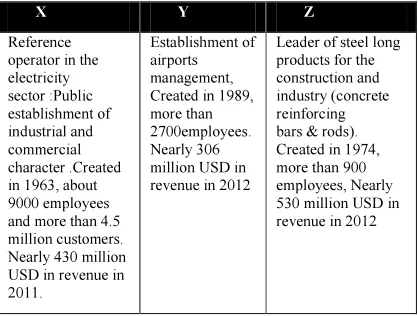
[image:3.595.303.512.505.663.2]We briefly present below the organizations studied: (for confidentiality reasons, we define them as X, Y,Z).
Table 2: The Organizations Studied
X Y Z
Reference operator in the electricity sector :Public establishment of industrial and commercial character .Created in 1963, about 9000 employees and more than 4.5 million customers. Nearly 430 million USD in revenue in 2011.
Establishment of airports management, Created in 1989, more than 2700employees. Nearly 306 million USD in revenue in 2012
Leader of steel long products for the construction and industry (concrete reinforcing bars & rods). Created in 1974, more than 900 employees, Nearly 530 million USD in revenue in 2012
4. RESULTS AND DISCUSSION
ISSN: 1992-8645 www.jatit.org E-ISSN: 1817-3195
Description of ERP implementation experience in X Company
In 1998, the X Company recognizes that its system does not allow meeting the increased flows of information and does not allow effective coordination. So it decided to implement SAP R / 3 system after painstaking care taken in selecting the package that would meet 80% of the needs of the organization through the modules: Financial Management(FI), HR Management(HR), Procurement & stocks(MM) ,business management, Customer Relationship management, technical Management, Controlling (CO), the decision making(BI).
Among the key success factors of this project, the IS (information system) director emphasizes the importance of: The involvement of top management, involvement of internal expertise more than external, X has allocated its best resources for full-time to create a homogenous team work consisting of (young and experienced employees) .A detailed project management has been established including communication and training activities. In terms of communication, the implementation team has scheduled meetings with all staff throughout the project with stakeholder involvement, X trained over 2000 people to introduce gradual change, good management of (deadlines, budget, quality),clear identification of roles and responsibilities, after project ( X has followed the updates perfectly).
The Director of IS showed that this project is very structured because it helps to improve the process and to give visibility on indicators such as turnover in real time, but it must be adapted to the company, it recommended ERP for large organizations. The ERP project was considered highly successful by the organization.
Description of ERP implementation experience in Y Company
It was in 1998 that the Y organization decided to move towards the implementation of ORACLE APPLICATIONS , the choice of ERP and the integrator is followed assistance to the project owner for the integration of the modules: Financial Management(FI), Controlling (CO), Inventory & purchase Management(MM), suppliers management, Fixed Asset Management(AM),
When the decision to implement a new system was taken, top management has given its full trust the committee responsible for the project (Competence
Centre): A technical and functional manager and Leadership modules (accounting, immobilization ...) Who decided to have complete ownership of the solution in-house following the specific area of Y, the competence center has developed modules internally as: customer management, local air control (CLA) also the development of a specific process for OP (payment order adopted by public administrations that does not exist in the standard ORACLE) .For data migration to the new system, Y has organized workshops recovery and proceed with the preparation of CSV files. Among the major issues encountered in the implementation is the lack of experience in the 11.5.9 version of the ERP implemented (the first release it was in 2004 in the region) and the passage of 11.5. 2 to 11.5.9 resulted in a complete overhaul of the setting and increased BD (need for storage space): purchase of a new server.
The Director of Information Systems has focused on the importance of ERP projects in large organizations to help them better decision making.
Description of ERP implementation experience in Z Company
Following the merger between two large groups ,the Z Company changed its JD Edwards software by SAP R / 3 ERP in 2007, The implementation of the package lasted eight months by an experienced integrator for the modules: Financial Management (FI) , Inventory & purchase (MM), sales Management (SD), the decision Support(BI), Customer Relationship management, Maintenance management (PM), Controlling (CO).
programmable logic controllers which resulted the development of interfaces between them and the ERP for information in real time without operator intervention.
Finally management considered implantation as fully successful and the system is continually updated.
5. PROPOSITION OF CAUSES-EFFECTS MODEL OF ERP RISKS
[image:5.595.91.511.297.758.2]According to our previous studies [85][86] and the results of the current theoretical and empirical research, we can illustrate the risk factors for implementing an ERP project into four categories: Organizational /managerial Factors, Financial factors, Human Factors, Technological factors.
Table 3: Categorization of risk factors
Catego ries of risks
N° Risk Factors
O rg an iz a ti on al an d m a n age ri al Fac to rs
R1 Poor top management support R2 Organization Culture
R3 Misestimation and poor planning of current and future needs of the organization
R4 Unrealistic expectations R5 Lack of vision oriented process R6 Instability of leadership positions
(unstable organizational environment) R7 Incompatibility between structure of the
organization and ERP system R8 Misalignment between ERP / Needs
(Incompatibility between IT strategies and business strategies)
R9 Poor business process reengineering R10 Organizational complexity and level of
geographic dispersion (multi-site issues) R11 Neglecting the managerial aspect and
consider the ERP project :purely technical
R12 Poor management of ERP project (poor estimates of resources and project size) R13 Ineffective communication with users
(incomprehension requirements) R14 Misestimation of workload
R15 Lack of experience and expertise of the organization in the management of contracts
R16 Lack of experience and expertise of the integrator in ERP contracts elaboration R17 Incorrect Choice of ERP modules R18 Rapid turnover of the team of ERP
Maintenance
R19 Frequent changes in qualified end users R20 Insufficient employee involvement R21 Lack of clarity in defining roles R22 Lack of rigor in project monitoring R23 Heaviness of legal and administrative
procedures
R24 Lack of control and verification of data entered into the system
R25 Poor choice of the integrator and consultants fi n an ci al fa ct o rs
R26 The high costs of integration R27 The high cost of necessary training R28 The high cost of ERP maintaining R29 The high costs of updating and license
buy H u m an Fac to rs
R30 Change resistance (rejection of the ERP by users)
R31 Social Risk: feeling of control of activities, downsizing. R32 Insufficient careful to employee
concerns and lack of motivation R33 Lack of qualified staff in the processes
of the organization
R34 Lack of qualified staff in computer and databases ...
R35 Lack of experience and expertise of the integrator with the processes of the organization
R36 Lack of experience and expertise of the editor with the processes of the organization
R37 Inadequate project manager R38 Inadequate responsible for ERP
maintaining
R39 Inadequate training of ERP users R40 Intensity of conflicts, internal conflicts
between departments R41 Dependence to 'key users' R42 Absence of consultants
R43 Lack of commitment of the project team R44 Conflicts between the organization and
consultants
R45 Conflicts between the organization and the integrator
R46 Poor cultural fit with the editor R47 Poor cultural fit with the integrator
T e ch n ol ogi cal f a ct o rs
R48 Poor choice of ERP
R49 Complex architecture and high number of modules implemented
R50 Issues related to the necessary change of hardware (requirement of new hardware )
R51 Incorrect profiles management and misallocation of access rights (open access to functionalities and sensitive transactions)
R52 Issues related to the integration and interfaces: number of interfaces with existing systems
R53 Invalid setting: Errors when setting or configuration can cause coriaceous malfunctions
R54 The rigidity of ERP (lack of system flexibility and not ability to respond to future changes) the company grows, ERP sometimes can’t follow this trend.
R55 The high rate of system customization (ERP modifications & custom developments)
R56 Issues related to system installation R57 Issues related to data migration R58 Issues related to maintenance of ERP R59 Lack of appropriate tests
ISSN: 1992-8645 www.jatit.org E-ISSN: 1817-3195
[image:6.595.91.507.135.359.2]
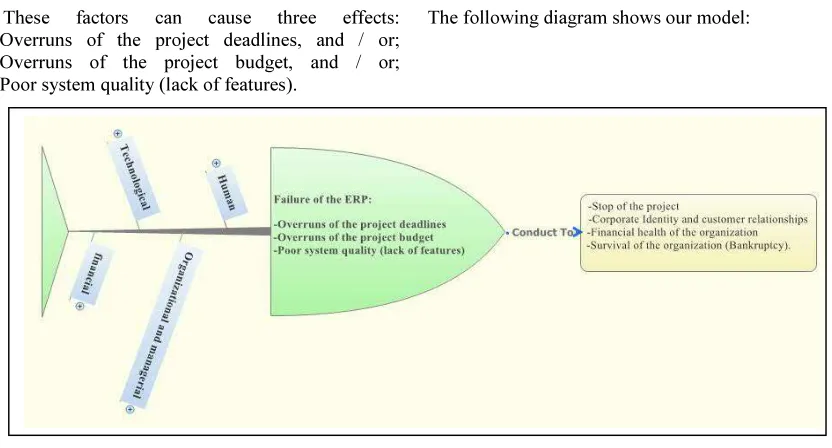
These factors can cause three effects: -Overruns of the project deadlines, and / or; -Overruns of the project budget, and / or; -Poor system quality (lack of features).
Figure 2: Risks-effects of ERP projects
4. CONCLUSIONS AND FUTURE WORK:
In this article, we introduced a new approach to risk assessment in an ERP project. This study allowed us to model and structures the relationships between risk factors and effects. This is a first attempt to apply the ISHIKAWA model for risks assessment in this class of projects. The ERP is not a magic solution; its benefits are the good preparation and effective implementation with an appropriate use. It is difficult to distinguish the importance of one factor over another. Actually, there is no one single factor of failure; all these of them have their intrinsic importance. The research gives additional benefits such as the categorization of risks. Our research will continue in: classification of risks according to their importance and the proposal of a set of best practices for implementation and use of ERP in organizations.
Despite these merits, the research has its limitations. The main limitation concerns with its exploratory nature. This condition does not allow to attempt any generalization of the results but provides evidence of the applicability of ISHIKAWA technique and its potential in this field.
And these effects can in turn lead to four major effects:
-Stop the project and / or;
-Impact on branding of organization and customer
relationships and / or;
-Financial health of the organization and / or; -Survival of the organization (Bankruptcy).
The following diagram shows our model:
Another critical factor is Data availability and quality of the value of expert judgments in respect to the project risks. Future research should investigate new ways and means of obtaining data.
REFRENCES:
[1] Davide Aloini ,Riccardo Dulmin,Valeria Mininno,’’ Risk assessmentin ERP projects’’, Information Systems , 2012, 183–199
[2] Kanaracus, C. ‘‘10 Biggest ERP Software Failures of 2011’’. Network World ,2011. [online]http://www.networkworld.com.http://w ww.networkworld.com (Accessed 20 Décember 2013)
[3] Hickey, K.’’California County Dumps SAP’’ Washington Technology, 2010.[online] http://washingtontechnology.com. (Accessed 25August 2012)
[4] Wong, B., & Tein, D, ’’Critical Success Factors for ERP Projects’’. In Proceedings of the National Conference of the Australian Institute of Project Management 2003, Alice Springs, Australia.[online]
http://cms.3rdgen.info/3rdgen_sites/107/resour ce/ORWongandTein.pdf. (Accessed 15 september 2013)
[6] Panorama Consulting Group ‘’Lessons Learned From a Government ERP Failure’’,(2012) [7] Panorama Consulting Solutions, (2013)
.[online]http://panorama- consulting.com/resource-center/2013-erp-report/(Accessed 15 jully 2013)
[8] Standish group’Chaos manifesto’The year of the executive sponsor’ ,2012
[9] Capron, B, D. Kuiper, L. Levy, et D. Dureno’ Methodology for avoiding failure, Manufacturing Systems’, Wheaton, 1995. [10]Botta-Genoulaz, V, P-A Millet’ An
investigation into the use of ERP systems in the service sector’, International Journal Production Economics, 2005.1-20.
[11] Glomark-Governan. New Findings: Reducing the Risk and Increasing the ROI of ERP Implementations. The Economic Value Creation Report, Issue 3, 2008.[online] http://www.glomark-governan.com (Accessed 20 jully 2013)
[12] Bradford,M.,and F.Florin.’Examining the role of innovation diffusion factors on the implimentation success of the entreprise resource planning systems’, International journal of accounting information systems ,2003, 4(3) :205-225
[13] Tiwana,A.,and M.keil. ‘Functionality risk in software development’. in IEEE transactions on engineering management,2006,412-425. [14] Aloini,D.,R.Dulmin,and V .Mininno.’Risk
management in ERP project introduction : Review of the literature’.Information& Management ,2007,44(6) :547-567.
[15] Bradley,j.’Management based critical success factors in the implementation of entreprise Resource Planning systems’.International Journal of Accounting Information Systems , 2008.175-200.
[16] Tsai,W.-H.,S.-J.Lin,W.-R.Lin,and J.-Y.Liu.’The relationship between planning& control risk and ERP project success’in IIEEM 2009 : IEEE International conference on Industrial Engineering Management, Jhogli,Taiwan,2009.
[17] AFITEP,Dictionnaire de management de projet,4e edition,AFNOR,2000.
[18] Hakim, A., and H. Hakim.’’A practical model on controlling the ERP implementation risks ‘’ Information Systems, 2010, 35 (3):204 -214 [19] Singh, L. P., S. Singh, and N. M. Pereira..
‘’Human Risk Factors in Post -Implementation Phase of ERP in SMEs in
India ‘'. Edited by D. F. Kocaoglu, T. R. Anderson and T. U. Daim. 2010.
[20] Grabski, S. V., and S. A. Leech. ‘‘Complementary controls and ERP implementation success’’. International Journal of Accounting Information Systems, 8. 2007.
[21] Wong, A., and H. Scarbrough. ‘’Critical Failure Factors in ERP Implementation’’. Paper read at PACIS 2005 -Pacific Asia Conference on Information Systems.2005 [22] Bernard, J.- G., S. Rivard, and B. Aubert.
‘’Evaluation du risque d'implantation de progiciel’’, CIRANO: centre interuniversitaire de recherche en analyse des organisations. 2002.
[23] Scott, J.E., Vessey, I.‘’Managing risks in enterprise systems implementations’’. Communications of the ACM, 45, 4, 74-81.2002.
[24] Chang, S., Gable, G.G.’’A comparative analysis of major ERP lifecycle implementation, management and support issues in Queensland government’’, Pacific Asia Conference on Information Systems,2001, 5, 1152-1166.
[25] Schmidt, R., Lyytinen, K., Keil, M., Cule, P. ‘’Identifying Software Project Risks: An International Delphi Study’’. Journal of Management Information Systems, 2001. 17, 4, 5-36.
[26] Kerzner, H.’’Project management: a systems approach to planning, scheduling, and controlling’’. New York, NY: John Wiley & Sons. 2001.
[27] Kliem, R.L. ‘’Risk management for business process reengineering projects’’. Information Systems Management, 2000. 17,4, 71-74. [28] O’Leary, D.E.’’ Enterprise Resource Planning
Systems : Systems, Life Cycle, Electronic Commerce, and Risk’’. New York, NY : Cambridge University Press. (2000).
[29] Sumner, M.’’Risk Factors in enterprise-wide/ERP projects’’. Journal of Information Technology, 2000.15, 4, 317-327.
[30] Davenport, T.H. ‘’Mission critical: realizing the promise of enterprise systems’’. Boston, MA: Harvard Business School Press. 2000. [31] Bingi, P., Sharma, M.K., Godla, J.K. ‘’Critical
ISSN: 1992-8645 www.jatit.org E-ISSN: 1817-3195
[32] Van Slooten, K., Yap, L. ‘’Implementing ERP information systems using SAP’’. Proceedings of the Americas Conference on Information Systems, 1999. 5.
[33] Cooke, D.P., Peterson, W.J.’’ SAP Implementation: Strategies and results’’. The Conference Board. 1998
[34] Glass, R.L. ‘’Software Runaways’’. Upper Saddle River, NJ : Prentice Hall PTR. 1998. [35] Guimaraes, T., Bond, W. ‘’Empirically
assessing the impact of BPR on manufacturing firms’’. International Journal of Operations & Production Management, 1996. 16, 8, 5-28. [36] Grover, V., Jeong, S.R., Kettinger, W.J., Teng,
J.T.C. ‘’The implementation of Business Process Reengineering’’. Journal of Management Information Systems, 1995. 12, 1, 109-144.
[37] Bashein, B.J., Markus, M.L., Riley, P. ‘’Preconditions for BPR success’’.Information Systems Management, 1994. 11, 2, 7-13. [38] Willcocks, L., Griffiths, C. ‘’Predicting risk or
failure in large scale IT projects’’. Technology forecasting and social change,1994. 47, 2. [39] Amid, A., M. Moalagh, and A. Z. Ravasan.
‘’Identification and classification of ERP critical failure factors in Iranian industries’’. Information Systems, 2012. 37 (3):227-237. [40] Motwani, J., R. Subramanian , and P.
Gopalakrishna. ‘’Critical factors for successful ERP implementation:Exploratory findings from four case studies’’. Computers in Industry ,2005.56.
[41] Somers, T. M., and K. Nelson. ‘The impact of critical success factors across the stages of
enterprise resource planning
implementations’’. In 34th Hawaii International Conference on System Sciences. Hawai. 2001.
[42] Malhotra, R., and C. Temponi. ‘’Critical decisions for ERP integration: Small business issues.’’ International Journal of Information Management. 2010.30 (1).
[43] Law, C. C. H., and E. W. T. Ngai. ‘’ERP systems adoption: An exploratory study of the organizational factors and impacts of ERP success’’. Information & Management .2007.44:418 – 432.
[44] Sun,A.Y.T.,A.Yazdani,and J.D.Overend. ‘’Achievement assessment for enterprise resource planning (ERP) system implementation based on critical success factors(CSFs)’’. International Journal Of Production Economics ,2005. 98(2):189-203.
[45] Huang, S.M., I.C. Chang, S.H. Li, and M. -T. Lin. ‘’Assessing risk in ERP projects: identify and prioritize the factors’’. Industrial Management and Data Systems. 2004. 104 (8):681- 688.
[46] Kumar, V., B. Maheshwari, and U. Kumar. ‘’An investigation of critical management issues in ERP implementation: emperical evidence from Canadian organizations ‘’,Technovation, 2003. 23 (10):793 -807 [47] Gilbert, J.T. ‘’Reducing the risks from
innovation’’. Journal of Systems Management, 1996. 47, 1, 12-16.
[48] Ewusi-Mensah, K. ‘’Critical issues in abandoned information systems development projects’’. Communications of the ACM, 1997. 40 (9):74 -80.
[49] Umble, E. J., R. R. Haft, and M. M. Umble. ‘’Enterprise resource planning: Implementation procedures and critical success factor’’. European Journal of Operational Research ,2003. 146:241-257 [50] Peng, G. C., and M. B. Nunes. ‘’Surfacing
ERP exploitation risks through a risk ontology’’. Industrial Management & Data Systems ,2009. 109 (7):926 - 942.
[51] Ehie, I. C., and M. Madsen. ‘’Identifying critical issues in enterprise resource planning (ERP) implementation’’. Computers in Industry. 2005. 56.
[52] Law, C.C.H.,C.C.Chen,and B.J.P.Wu. ‘’Managing the full ERP life-cycle:Considerations of maintenance and support requirements ans IT governance practices as integral elements of the formula for successful ERP adoption’’.computers in Industry ,2010 .61 (3):297-308
[53] Barki, H., Rivard, S., Talbot, J. ‘’Toward an Assessment of Software Development Risk’’. Journal of Management Information Systems, 1993. 10, 2, 203-225.
[54] Botta-Genoulaz, V., P.-A. Millet, and G. Neubert. ‘’The role of Enterprise Modeling in ERP Implementation’’. International Conference on Industrial Engineering and Production Management. Paper read at IEPM’01 : International Conference on Industrial Engineering and Production Management, at Quebec, Canada.2001. [55] Baccarini, D., G. Salm, and L. P.E.D.
[56] Tomas, J.- L. ‘’ERP et progiciels intégrés, la mutation des systèmes d'information ‘’. Dunod ed. Paris.1999.
[57] Kumar anabhav and Gupta PC, ‘’Identification and Analysis of Failure Attributes for an ERP System’’, International Congress on Interdisciplinary Business and Social Science 2012 ,(ICIBSoS 2012), Procedia - Social and Behavioral Sciences, 2012 ,65 ,986 – 991 [58] Tsai, W. H., M. J. Shaw, Y. W. Fan, J. Y. Liu,
K. C. Lee, and H. C. Ch en. ‘’An empirical investigation of the impacts of internal/ external facilitators on the project success of ERP: A structural equation model’’, Decision Support Systems .2011. 50 (2):480 - 490. [59] Morton, N. A., and Q. Hu. ‘’Implications of
the fit between organizational structure and ERP: A structural contingency theory perspective’’. International Journal of Information Management .2008. 28:391–402. [60] Hong, K. K., and Y.-G. Kim.’’The critical
success factors for ERP implementation: an organizational perspective’’. Information & Management ,2002.40.
[61] Wright, S., and A. M. Wright. ‘’Information system assurance for enterprise resource planning systems: unique risk considerations’’. Journal of Information Systems. 2001. 16 (1):99-113.
[62] Santamaria-Sanchez, L., M. Nunez-Nickel, and S. Gago-Rodrıguez. ‘’The role played by interdependences in ERP implementations: An empirical analysis of critical factors that minimize elapsed time’’. Information & Management .2010. 47:87 – 95.
[63] Kale, V. ‘’Implementing SAP R/3: The guide for business and technology managers. Indianapolis’’, IN : Sams Publishing. (2000). [64] Lyytinen, K., Mathiassen, L., Ropponen, J.
‘Attention shaping and software risk - A categorical analysis of four classical risk management approaches’’. Information Systems Research, 1998. 9, 3, 233-256. [65] Sherer, S.A. ‘’Purchasing software systems:
managing the risk’’. Information & Management, 1993. 24, 5, 257-267
[66] Brehm, L., Heinzl, A., Markus, L.M. ‘’Tailoring ERP Systems: A spectrum of Choices and their Implications’’. Proceedings of the Hawaii International Conference on System Sciences, 2001. 34.
[67] Aubert, B.A., Rivard, S., Patry, M. ‘’Managing IT outsourcing risk: lessons learned’’. Série Scientifique – CIRANO, 2001.39.
[68] Markus, L.M., Tanis, C. ‘’The Enterprise System Experience – From Adoption to Success’’. In Zmud, Robert W. (Ed.): Framing the Domains of IT Management. Pinnflex Educational Resources. Cicinnati, OH. (2000).
[69] Gattiker, T.F., Goodhue, D.L. ‘’Understanding the Plant Level Costs and Benefits of ERP: Will the Ugly Duckling Always Turn Into a Swan’’, Proceedings of the Hawaii International Conference on System Sciences, 2000. 33.
[70] Ropponen, J., Lyytinen, K. ‘‘Components of software development risk: How to address them? A project manager survey’’. IEEE Transactions on Software Engineering, 1999. 26, 2, 98- 112.
[71] Welti, N. ‘’Successful SAP R/3 implementation : practical management of ERP projects’’. Harlow, Eng: Addison-Wesley. 1999.
[72] Department of Air Force. ‘’Software Risk Abatement (AFSC/AFLC Pamphlet 800-45)’’. Department of the Air Force Command. Andrew’s Air Force Base, CA. (1988). [73] Wideman, M.R. ‘’Risk Management’’.Project Management Journal, 1986. 17, 4, 20-27. [74] Lynch, R.K. ‘’Nine pitfalls in implementing
packaged applications software’’. Journal of Information Systems Management, 1985. 2, 2, 88-92.
[75] Keider, S.P. ‘’Why Systems Development Project Fails’’. Journal of Information Systems Management, 1984. 1, 3, 33-38. [76] Themistocleous, M., Irani, Z., O’Keefe, R.M.,
Paul, R.,’’ ERP problems and application integration issues: An empirical survey’’. Business Process Management Journal, 2001. 7, 3, 195-204.
[77] Gross, P.H.B., Ginzberg, M.J. ‘’Barriers to the Adoption of Application Software Packages’’. Systems, Objectives, Solutions, 1984. 4, 211-226.
[78] Barki, H., Pinsonneault, A.’’ Explaining ERP implementation effort and benefits with organizational integration’’. Cahier du Gresi,2002. 02-01.
[79] McKeen, J.D., Smith, H.A. ‘’Managing External Relationships in IS’’. Proceedings of the Hawaii International Conference on Information Systems, 2001. 34
ISSN: 1992-8645 www.jatit.org E-ISSN: 1817-3195
‘.European Journal of Operational Research 220 484–495
[81] Akkermans .H, K. van Helden, ‘‘Vicious and virtuous cycles in ERP implementation: a case study of interrelations between critical success factors’’, European Journal of Information Systems ,2002. 11 ,35–46. [82]Wang,E.T.G.,S.P.Shih,J.J.Jiang,and
G.Klein.’’The consistency among facilitating factors and ERP implementation success:Aholistic view of fit’’.Journal of Systems and Software.2008. 81(9):1609-1621. [83] Benbasat, I., Goldstein, D.K., Mead, M.,’’ The
case research strategy in studies of information systems’’. MIS Quarterly, 1987. 11 (3), 369–386.
[84] Avison, D., Malaurent, J.,’’ Impact of cultural differences: a case study of ERP introduction in China’’. International Journal of Information Management. 2007.27, 368–374. [85] Zaitar .Y et Ouzarf M,.’’ERP Projects: Key
Success Factors and Risk of Failure A Proposed Model of Governance of Enterprise Resource Planning’’ , International Journal of Computer Applications ,Volume 46 - Number 8. 2012.
[86] Zaitar .Y et Ouzarf M,’’Les projets ERP : facteurs clés de succès et risques d’échecs. Proposition d’un modèle de gouvernance des progiciels de gestion intégrés’’, Congrès International en Génie Industriel et management des Systèmes ,CIGIMS ,du 18 au 19 Avril 2012,Fès Maroc.
[87] Zaitar .Y .’’Les systèmes d’information au cœur de l’Entreprenariat au Maroc, Guide pratique et simulation de création d’entreprise’’, les Editions Europeennes Universitaires, 2013,132 pages