Toward Securing Sensor Clouds
Apu Kapadia, Steven Myers, XiaoFeng Wang and Geoffrey Fox
School of Informatics and Computing
Indiana University, Bloomington
{
kapadia, samyers, xw7, gcf
}
@indiana.edu
ABSTRACT
We aim to secure smart sensor networks, where computa-tionally powerful sensing devices such as smartphones or cognitive radios interact with the cloud. In previous work, we have proposed a large-scale brokering framework, and we are researching several facets of securing sensors in the context of this framework. In this paper we discuss initial results for three portions of this effort, challenges that re-main for secure sensor networks, and specific directions we are currently pursuing. In particular, we discuss our work on (i) Sensor risk assessment, relating to the possession and environment of the smartphone sensors, (ii) New mal-ware threats and defenses installed on the sensor network proper, and (iii) Defense against the side-channel analysis on the Software-as-a-Service infrastructure.
KEYWORDS:Sensor Network, Brokered Network, Se-curity, Wireless.
1
INTRODUCTION
With the increased pervasiveness of sensory devices for military and civilian uses comes the demand for effective processing of the large amounts of data they collect. This demand can only be met with the low-cost computing re-sources offered by today’s cloud computing systems. To-day’s cloud can already support data-intensive computing at a low cost: for example, a large-scale computing task can be accomplished on Amazon’s Elastic Compute Cloud (EC2) at an expense as low as 10 cents per CPU hour. So far little effort has been made in applying the ultra cost-effective cloud platform towards analyzing and managing sensor data. Recently, we have made the first step towards building a practical sensor cloud system [21]. Different from prior work on sensor networks [21], we assume that sensors communicate directly with a proxy or broker on a cloud. In our research, we consider a group of sen-sors organized as a hierarchical structure or some types of partitions, which communicate with their cloud proxies through wireless channels. The sensor platforms studied in
our research are ones with multiple sensors that can each measure different properties of the environment. For ex-ample, we might have GPS for positioning, microphones for sound, laser-range finders for scanning surroundings, temperature indicators, wireless radios etc. We can imag-ine a host of different autonomous and manned devices that contain these sensors including vehicles, robots, smart-grid nodes, mobile computers, and smartphones. For each de-vice, we have a number of different sensors that can pro-vide different environmental readings on a near continuous basis, further these hosts all contain reasonable computa-tional power and power supplies for continuous function. Finally, they all have reliable cellular network conductivi-ties. We imagine that these hosts are continually collecting data from their environment, performing some level of data processing and publishing the outcomes to a cloud for fur-ther analysis or data storage. For the purposes of our stud-ies, we examine modern Android smartphones as exemplar hosts in our work.
Figure 1, which has also been used in our prior paper [21], illustrates the structure of the system built in our research. A critical issue for this sensor-cloud computing environ-ment is security and privacy. In [21], we summarize the security and privacy challenges we face when building a trustworthy sensor-cloud system, which come from the fol-lowing perspectives:
∙The environment in which sensors work can be compro-mised by the adversary. For example, the adversary can ar-tificially reduce or raise temperatures to cause the sensors to collect improper data.
∙Individual sensors can be vulnerable to attacks. This can happen when the adversary has physical access to the sen-sors, or remote access through propagating malware.
∙Information flows within the cloud can be intercepted and stolen or modified by compromised cloud nodes.
∙ The cloud client can be infected by malicious code im-planted by an adversary, which can lead to further security breaches within a sensor-cloud system.
Router
Router
Router
Router Mini Computer Mini Computer Mini Computer Mini Computer
External Storage
External Storage Router Router
Router
Router Cloud Computing
Cloud
Computing Cloud Computing
Tower-mount Antenna
Tower-mount Antenna Wireless Bridge
Figure 1. A depiction of the different components of the sensor and cloud-computing network. Android smart-phones denote the sensors in the system, and are in the possession of individuals. The smartphones have some computational capacity, and transmit through WiFi or cellular services to a brokering network, running over traditional TCP/IP services. The brokering service can itself have computers performing filtering, processing and/or creating other mashups of sensor data.
to different types of attacks. Even when the data transferred over the channels is fully encrypted: side-channel informa-tion leaks constitute creditable threats.
Our prior research pinpoints a subset of issues within thE problem space that need immediately attention. Specifi-cally, we investigated I) techniques for detecting anoma-lous use of sensors, particularly, when the adversary gains unauthorized physical access to smartphones; ii) we demonstrated that intelligent smartphone-based malware can be built to “understand” the context of a phone con-versation and extract a small amount of high-value infor-mation from the context [33] (Given the small quantity of such sensitive information, the malware can deliver it to its master through covert channels, even without direct net-work access [33].); and iii) prior research shows that even in the presence of Wi-Fi encryption and HTTPS protection, the traffic features of the communication between sensors and the cloud, and between the cloud and its clients can easily be analyzed to infer highly-sensitive user data [6]. In this paper, we sketch recent progress and follow-up on previously discussed research plans on these fronts, includ-ing detection of anomalous use of sensors, and defenses against smartphone malware and side-channel leaks. We summarize below.
Sensor risk assessment. With the possibility of a vast number of sensors deployed throughout an environment on different hosts, with all the sensors feeding information in
to a cloud computing infrastructure, there is the possibil-ity for an adversary to attack a sensor, and thereby make its readings untrustworthy. There are several types of at-tacks on differing types of sensors one can imagine. These range from changing the environment of the sensor so its readings are faulty, to actively changing the logic in the sensor system itself. We are concerned with the former, as opposed to the latter in which traditional patching and anti-viral and anti-malware technologies are likely to be used. Therefore, what is needed is the ability of a sensor to measure changes to its normal operating environment, and report changes that seem to indicate a high risk that the sensor is not in an appropriate operating environment. Our research on contextual authentication and deauthen-tication of smartphones, has developed an layered sens-ing approach, whereby each sensor measures risks locally based on its own information and appropriate risk model. Individual sensor risks are then conglomerated together through a trained support vector machine, to a larger global risk view. In our application, the global risk is used to ei-ther deauthenticate or authenticate a user’s smartphone, but the data could as easily be used to measure data-reliability and provenance from sensors on the phone.
Defense against sensory malware Our research on sen-sory malware, i.e., malware augmented by on-board and paired sensors, demonstrates how Trojan malware can spy on a user’s phone conversations and steal their credit card information (for example) and send this information to a “malware master” [33]. Furthermore, our Trojan malware evades existing defenses.
We demonstrated that sensory malware is a potent threat with challenges remaining to defend against such attacks. Even though we presented a targeted solution to prevent sensory malware attacks, the general problem of knowing when sensors are taking legitimate readings of the environ-ment and when they are actually causing a privacy breach is hard to solve.
to detect its side-channel information problems and quan-tify such leaks. The outcomes of such an application in-forms the web developer of the presence of the problem and its seriousness. Based on such understanding, the de-veloper can decide on the course of action that contributes to the improvement of the security quality of her applica-tions.
The rest of the paper is organized as follows. Section 2 describes our recent work on sensor risk assessment. Sec-tion 3 presents a new detecSec-tion mechanism we developed for mitigating the threat of sensory malware. Section 4 sur-veys our new technique for mitigating side-channel leaks. Section 5 describes the related research and Section 6 con-cludes the paper.
2
Sensor risk assessment
Our research on contextual sensor data shows that it is fea-sible for smartphones to continuously evaluate their sen-sors and based on appropriate risk-models calculate risk in real-time. While risk is measured in real-time, the risk models which must be learned through the use of appropri-ate machine learning algorithms, can be computationally intensive. This is not troubling, as training can either be offloaded to the cloud, or if security and/or privacy rea-sons interfere, then these computationally intensive tasks can be scheduled for a phone’s low-use periods. For ex-ample, smartphones can train while the phone is charging during the evening. With relation to specific risks based on individual sensors, we have considered two alternate sen-sors: geo-locational data as is derived through a mashup of GPS, WiFi and Cellular Tower positioning, and determina-tion of friends and strangers in the near proximity via short range Bluetooth radio.
We have shown that by labeling a small number of geo-graphic sites that users frequent and developing a history of geo-locational positioning information, the phone can infer when it is supposed to be in certain locations. This model-ing is done through the use of a third-order Hidden-Markov Model (HMM). Sequences of observations correspond to a discretization of location into a string on labeled known and unknown locations. Initially we performed experiments where time was discretized in to 30 minute segments. Us-ing positional data from the MIT Reality MinUs-ing Project of Eagle and Pentland[14] , which contains positional data collected via phones for 100 users over a 9 month period, we trained the HMMs using traditional Baum-Welch and Viterbi HMM training algorithms. In fact, we train a sepa-rate HMM for each 4-hour segment of time during the day. This allows us to predict location based on a reasonably re-cent location history, but not so short as to be meaningless. Next, to calculate the risk of the phone’s present location, we use an HMM trained over a 4-hour period immediately preceding the current time segment, and use it to predict— with the forward algorithm— the likelihood of the HMM having made the observed sequence of positions. We nor-malize the result, but essentially if the forward algorithm
suggests that the HMM would produce a given sequence with low probability, then we predict high-risk, and vice-versa. Certain thresholds of risk are then set to determine if the phone should force authentication.
With such a risk calculation and forced authentication in place, we are now able to simulate loss and theft of the phones, and determine how effective our positional model is. Essentially, we simulate theft of phones by having their locations switch to a series of previously unknown loca-tions that the phone does not frequent. To simulate loss of the phone, the phone is assumed to remain in its cur-rent location independent of the movements of its owner. While such simulations are first approximations to actual theft and loss, we believe that they appropriately simulate a large number of such cases. Actual data on the positioning of stolen phones is unavailable. Given such a model, we then determined thresholds for measured risk which should force authentication, allowing us to determine our type I and II errors. Some example users’ Receiver Operating Characteristic (ROC) curves for theft are shown in Fig. 2. The right-most graph is atypical in performance, the other two more accurately report mean performance. Different lines depict Time of Theft plus an offset of 30 minute inter-vals (i.e. TOT+i depicts theft detection𝑖⋅30minutes after theft.
Typical
A-Typical
Figure 2. A depiction of three users’ ROC curves.
as a test-bed platform for a large number of sensors, where power supplied to the radios need not be an issue.
In order to measure risk, we consider a two level white/grey-listing system. First, phones can whitelist cer-tain Bluetooth devices, such that their presence will result in a low-risk measurement, no matter the presence of other devices. However, in the absence of such white-listed vices, a risk measurement must be made based on the de-vices that can be detected. In order to make such a measure-ment the phone constantly searches for Bluetooth identi-fiers and records their relative presences over time, defining a distribution𝐷over Bluetooth identifiers: devices that are observed frequently have high probability mass, and vice-versa. Using this distribution, we can now think of those in-dividuals that are frequently in proximity as more trusted, than those that are not. The entropy of this distribution,
𝐻(𝐷), tells us the average amount of risk we are exposed to on a daily basis. Thus to measure the risk of a given situation, we can measure the information presented by the identifiers (IDs)𝑖,−log(Pr(𝑖)), currently visible, and de-termine its distance from𝐻(𝐷). To measure the probabil-ity of seeing a given id, we keep track of the amount of time all Bluetooth IDs have been seen in recent history (a month). We then consider the fraction of time a given id has been observed, presenting its probability. We use a heuris-tic to account for identifiers that have never previously been observed, according them a very small probability in the distribution that is not 0.
In order to punish and reward high and low risk scenar-ios, we consider this difference transformed under a logis-tic sigmoid. This gives us the following risk function:
Risk = 1
1−𝑒−
∑
𝑖∈Observed ids(−log(Pr(𝑖))−𝐻(𝐷))
.
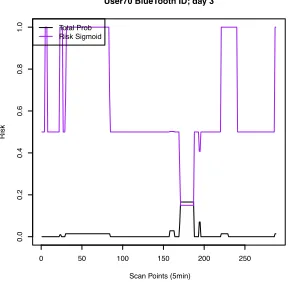
In Figure 3 we show a sample of our risk prediction func-tion, when used to predict risk for a given day in the Reality Mining Dataset. The upper (magenta) line depicts the rel-ative risk predicted at any given point in time of the day based on the the grey-listing Bluetooth risk predictor (i.e., predicted by logistic sigmoid). The low risk time periods is consistent with the device being in the presence of devices that are frequently present. The high-risk periods indicate the presence of a number of individuals which the phone has rarely or never seen. The lower line indicates the rela-tive probability mass of the observed identifiers at a given time.
0 50 100 150 200 250
0.0
0.2
0.4
0.6
0.8
1.0
Scan Points (5min)
Risk
User70 BlueTooth ID; day 3
Total Prob Risk Sigmoid
Figure 3. Depiction of a user’s relative risk.
[image:4.612.365.510.449.590.2]risk measurements from the individual sensors, and pro-vide a better global risk measurement, then the individual sensors can provide. The expectation is that this will be done through the use of a trained Support Vector Machine (SVM).
3
Defense against Sensory Malware
Our research on sensory malware shows that is is feasible for Trojan malware to spy on user’s speech-based commu-nications through access to the microphone [33]. In par-ticular we demonstrated how our Trojan can target a small amount valuable information such as a spoken credit card number or social security number and transmit this infor-mation to the “malware master”. We showed how our sensory malware can evade existing defenses through the use of stealthy local processing of information and the use of covert channels so as to avoid suspicious permissions needed by the Trojan application. We thus demonstrated that sensory malware is a potent threat with challenges re-maining to defend against such attacks.
Even though we presented a targeted solution to prevent sensory malware attacks, the general problem of knowing when sensors are taking legitimate readings of the environ-ment and when they are actually causing a privacy breach is hard to solve. Our current defense against speech-based malware is to recognize that a phone call to a sensitive num-ber (such as a bank or credit card company) is being made. If so, the reference monitor that controls when audio can be recorded and delivered to applications can preempt any ongoing recordings and replace it with blank audio. We showed that such a defense incurs minimal penalty and does not significantly delay outgoing phone calls [33]. To defend against sensory malware attacks in general, thus we propose techniques that take into account thecontext
under which sensing is being performed. In our defense explained above, we can see that a phone call to a sensi-tive number is contextual information that is interpreted as an unsafe situation to be recording from the microphone. Similarly, the sensors can be used to detect various unsafe contexts for various sensors. We are currently exploring how to automatically infer such sensitive contexts for vari-ous sensors. For example, in our work (reported in this pa-per) for sensor risk assessment, we utilize various on-board sensors to assess the risk of theft. We propose various mod-els to infer an unsafe or anomalous situation for the phone. In the same way, we hope to characterize normal situations when different sensors are used, and thus flag anonymous uses of sensors to the user. Our system can then take input from the user as to whether the access to a sensitive sensor is authorized and if so the system can continually refine its models for risk assessment.
We thus hope that we can build a generalized framework to learn and refine context based risk assessments of when it is relatively safe or unsafe to use different sensors. Again, “when” is not only a matter of time, but also various situa-tions such as who is around, what motion is being sensed,
what the camera can see, and so on. We believe this ap-proach is an exciting avenue for research since sensor-based context are used to secure the use of sensors.
4
Mitigating Side-channel Leaks from Web
Applications
Our research, as elaborated in our prior paper [6], indi-cates that mitigation of the side channel problem in web applications is nontrivial. Particularly, it is unlikely to have an application-agnostic solution to the problem. We eval-uated the effects of two padding strategies on web appli-cations, includingroundingthat rounds up packet sizes to the nearest multiple of certain bytes, andrandom padding
contain client/server communications, Sidebuster evaluates whether the attributes of such communications reveal the sensitive condition. We also developed new techniques for analyzing GUI widgets, such as auto-suggestion lists, which are triggered by input events (e.g., letters being en-tered) to synthesize different user inputs into an integral variable (e.g., a query word) that the developer labels as a “taint target”.
[image:6.612.64.279.343.508.2]Every web application gives away some information through its side-channels. However, not all such infor-mation leaks are serious enough to warrant mitigation ef-forts. For example, people could live with disclosure of the lengths of their query words and some operations they performed, such as sending/receiving emails. A question, therefore, becomes how to quantify the private information that can be inferred from a side-channel vulnerability. This question can be answered through dynamic analysis, be-cause the encrypted traffic of a web application is actually generated by its underlying web servers/browsers, whose source code is often beyond the access of the developer. To conduct such an analysis, we also come up with a design of a quantification technique that systematically re-runs se-lected portions of a web application to understand how the domain of a taint source or target can be partitioned by its side-channel leaks [47].
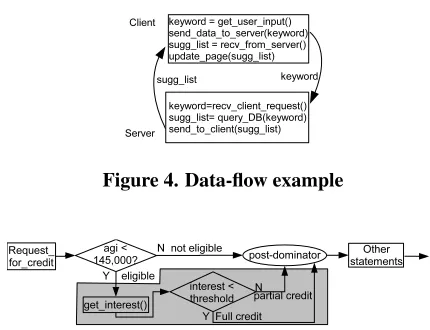
Figure 4. Data-flow example
Figure 5. Control-flow example. The code within the dark boxes runs on the client side.
Figures 4 and 5 describe two examples. The first one is the code of a suggestion list. For simplicity, we describe the program using Java pseudocode. The program is split into the part that runs on a web server and the part that works in the client’s browser.1Given a tainted variablekeyword, a
static analysis can identify the taint data to be propagated to the network throughsend data to server. This func-tion is then instrumented for further evaluafunc-tion. Analysis of the server-side code also taints the suggestion list to be sent back to the client, which makes our analyzer instrument
1A Java program can be easily complied into AJAX code by the
Google Web Toolkit (GWT)
sent to client on the server side. Then, we can in-strument related program statements for dynamic analysis, because in the absence of data, static analysis alone can-not determine whether the content of the tainted variable is inferable from attributes of the tainted web traffic. During the runtime of the application, the instrumented code works with the web server and browser to identify the sizes of the packets containingkeywordletter(s) and those carrying their corresponding suggestion lists. The former leaks little information except the length ofkeyword, while the lat-ter changes with the content ofkeyword: different con-tents lead to suggestion lists with different sizes. Such a side-channel leak is therefore identified. The example in Figure 5 is the simplified program logic for tax credit and deduction claims in a tax preparation application. Suppose that the variable,agi, is marked as a taint source. An in-formation flow analysis tracks the taint data to the branch condition “agi<145000”, and further identifies itsscope, from the condition to apost-dominatorwhere all branches converge. Checking the code within the scope, we find that the “not eligible” branch involves one round of client/server interactions, while the “eligible” branch has two, one for the deduction request/response and the other for entering the user’s interest. This asymmetric structure then is de-tected to disclose the tainted condition.
White-box testing of web applications needs their source code and depends on the programming languages with which they are implemented. In follow-up research, we will study black-box testing that does not suffer from these constraints. Given that most high-profile web applications are actually closed source, black-box testing has become a popular choice for evaluating their security problems such as cross-site scripting (XSS) and SQL injection flaws. Al-though there are a large number of open-source and com-mercial black-box fuzzers, none of them check for side-channel leaks. A prominent property of a web application is that part of its program logic resides on the client side, and can therefore be used for guiding a fuzz test. As an example, let us consider a suggestion list with its input text box labeled as a taint source. Analyzing its JavaScript code reveals that the content of the text box will be sent to the server in response to every keystroke, which allows an au-tomatic fuzzer to generate test keystrokes and evaluate the web flow vectors triggered by these inputs. Such an analy-sis can also uncover the changes of keystroke inputs result-ing in different suggestion lists, which therefore also need to be tainted. The contents of the lists further inform the fuzzer of the options the user has, i.e., the legitimate val-ues the input text box can take. This enables the fuzzer to generate test cases to evaluate whether these options can be distinguished from each other by their traffic attributes.
transitions or move some of its states to its client-side com-ponent. Given the complexity of today’s web applications and the presence of a large amount of legacy code, it is de-sirable for this code transformation to be supported by a suite of automatic tools, which we plan to develop. Based upon the side-channel vulnerabilities detected by white-box testing, padding policies can be specified for state tran-sitions whose traffic attributes disclose the content of sen-sitive data flows. For the example in Figure 4, the pol-icy can be to pad all responses that carry suggestion lists. Mitigation of control flow leaks can be more complicated. Consider Figure 5. We have two options: either adding a round of fake communications and delay on the “not el-igible” branch or move the code related to a state transi-tion, e.g., the program logic bounded by dash lines, to the browser. Such code splitting can be done automatically [9].
5
RELATED WORK
5.1
Mobile phone security and privacy
There has been some work in using sensors to establish context for different purposes on smartphones. The work of Peddemors et al. [30] uses past networking and sensor events to predict future network events. They give exam-ples of predicting network availability. The ability to dict events is distinct from deviating from normal or pre-scribed behavior. Nonetheless they use the prediction of being at home or work, and for durations. Therefore, the system should be considered. Of particular problem is the complexity of computing predicted events, which would be too slow in our scenario.
The work of Tanviruzzaman et al. [37] is most similar to that discussed here. In their work, they suggest the use of a hierarchy of sensor information to establish authentica-tion, and show some work on using accelerometer data on an iPhone to produce a biometric that can be used to au-thenticate to the phone. Jakobsson et al. [19] discuss the notion of implicit authentication of phones based on con-textual data, and use call pattern data.
5.2
Sensory malware threats and defenses
Researchers have been investigating attacks and defenses related to sensory malware [5]. Work on proof-of-concept video malware shows how malware can capture video and transmit this video after suitable compression to lessen the burden on the network [45]. However such approaches are not stealthy because the amount of data sent over the work is still very large. We would like to assume that net-work access is limited completely using techniques such as Kirin [12], a security certification mechanism for applica-tions on Android. Even in cases where a system such as Saints [28] is used to control the interaction between appli-cations, we would like to study the use of covert channels to circumvent such mechanisms. While techniques such as behavioral detection of malware by monitoring system calls [3], and power consumption [25] attempt to detect malware on mobile platforms, we aim to study the limits
of such detection techniques. Resources are limited on mo-bile devices, and malware could circumvent detection be-cause of the inherent limitations placed on the detection techniques.
5.3
Side-channel information leaks
Side-channel leaks have been studied for a long time in dif-ferent contexts. In addition to the information leaks that happen through electromagnetic signals (e.g., keystroke emanation [42]), shared memory/registers/files between processes (e.g., the recent discovery of the side-channel weakness in Linux process file systems [46]), CPU usage metrics, etc, the side-channel attacks are recently found to threaten cloud computing platforms like Amazon EC2 [31]. Examples of side-channel leaks through encrypted chan-nels include the attack on the RSA secret keys used in OpenSSL [4], keystroke inference from SSH [34], anal-yses on phrases and sentences from the variable-bit-rate encoding in VoIP [44], and detection of movie titles in an encrypted video-streaming system [32]. For encrypted web communication, prior research shows that a network eavesdropper can fingerprint web pages using their side-channel characteristics [43, 7]. Such information leaks pose a threat to anonymity channels like Tor, MixMaster and WebMixes [36, 11, 2].
6
SUMMARY
We have outlined our research on secure sensor networks in the context of a high-level cloud based brokering archi-tecture and highlighted various research challenges going forward. We outline research challenges associated with assessing the trustworthiness of the sensors based on en-vironmental sensor data, detecting and defending against “sensory malware” on such sensors, and mitigating side-channel leaks when sensor devices communicate with the cloud. We believe these components of the overall cloud based sensor network architecture are the least trustworthy since they are out of the control of the cloud “back end.” Thus, addressing these challenges will help protect the in-tegrity of the sensing platforms, the privacy of users who carry mobile sensors, as well as the delivery of sensor data to the cloud. These protections will greatly contribute to trustworthy collection of sensor data from smart and mo-bile sensing devices.
REFERENCES
[1] Jani M¨antyj¨arvi, Mikko Lindholm, Elena Vildjiounaite, Satu-Marja M¨akel¨a, and Heikki Ailisto.Identifying users of portable devices from gait pattern with ac-celerometers, IEEE International Conference on Acoustics, Speech, and Signal Processing, Volume 2, 2005.
[2] G.D. Bissias, M. Liberatore, D. Jensen, and B.N. Levine. “Privacy vulnerabili-ties in encrypted http streams,” In proceedings of Privacy Enhancing Technolo-gies Workshop (PET 2005), pages 1–11, 2005.
[3] A. Bose, X. Hu, K.G. Shin, and T. Park. “Behavioral detection of malware on mobile handsets,” In MobiSys ’08: Proceeding of the 6th international confer-ence on Mobile systems, applications, and services, pages 225–238, New York, NY, USA, 2008. ACM.
[5] L. Cai, S. Machiraju, and H. Chen. “Defending against sensor-sniffing attacks on mobile phones,” In MobiHeld ’09: proceedings of the 1st ACM workshop on Networking, systems, and applications for mobile handhelds, pages 31–36, New York, NY, USA, 2009. ACM.
[6] S. Chen, R. Wang, X. Wang, and K. Zhang. Side-channel Leaks in Web Ap-plications: a Reality Today, a Challenge Tomorrow. InOakland ’10: The 31st IEEE Symposium on Security and Privacy, May 2010.
[7] H. Cheng and R. Avnur. “Traffic analysis of SSL encrypted web brows-ing,” http://citeseerx.ist.psu.edu/viewdoc/download? doi=10.1.1.3.1201\&rep=rep1\&type=url\&i=0, 1998. [8] J. Cheng, S.H.Y. Wong, H. Yang, and S. Lu. “Smartsiren: virus detection and
alert for smartphones,” In MobiSys ’07: proceedings of the 5th international conference on Mobile systems, applications and services, pages 258–271, New York, NY, USA, 2007. ACM.
[9] Stephen Chong, Jed Liu, Andrew C. Myers, Xin Qi, K. Vikram, Lantian Zheng, and Xin Zheng. Secure web application via automatic partitioning. InIn SOSP’07, pages 31–44. ACM Press, 2007.
[10] D. Dagon, T. Martin, and T. Starner. “Mobile phones as computing devices: The viruses are coming!”IEEE Pervasive Computing, 3(4):11–15, 2004. [11] G. Danezis. “Traffic analysis of the http protocol over TLS,” http://
homes.esat.kuleuven.be/˜gdanezis/TLSanon.pdf, as of Dec 2009.
[12] W. Enck, M. Ongtang, and P. McDaniel. “On lightweight mobile phone appli-cation certifiappli-cation,” In CCS ’09: proceedings of the 16th ACM conference on Computer and communications security, pages 235–245, New York, NY, USA, 2009. ACM.
[13] W. Enck, M. Ongtang, and P. McDaniel. “On lightweight mobile phone appli-cation certifiappli-cation,” In CCS ’09: proceedings of the 16th ACM conference on Computer and communications security, pages 235–245, New York, NY, USA, 2009. ACM.
[14] N. Eagle and A. Pentland, “Readlity mining: sensing complex social systems,” Personal and Ubiquitous Computing, 10(4):1-268, Springer-Verlag, 2006 [15] W. Enck, M. Ongtang, and P.D. McDaniel. “Understanding android security,”
IEEE Security & Privacy, 7(1):50–57, 2009.
[16] W. Enck, P. Traynor, P. McDaniel, and T. La Porta. “Exploiting open function-ality in sms-capable cellular networks,” In CCS ’05: proceedings of the 12th ACM conference on Computer and communications security, pages 393–404, New York, NY, USA, 2005. ACM.
[17] K. Farrahi and D.G. Perez. “Learning and predicting multimodal daily life patterns from cell phones,” In J.L. Crowley, Y. Ivanov, C.R. Wren, D. Gatica-Perez, M. Johnston, and R. Stiefelhagen, editors, ICMI, pages 277–280. ACM, 2009.
[18] T. Iso and K. Yamazaki. “Gait analyzer based on a cell phone with a single three-axis accelerometer,” In MobileHCI ’06: proceedings of the 8th conference on Human-computer interaction with mobile devices and services, pages 141– 144, New York, NY, USA, 2006. ACM.
[19] M. Jakobsson, E. Shi, P. Golle and R. Chow “Implicit Authentication for Mobile Devices” In the proceedings of HotSec’09: The 4th USENIX Workshop on Hot Topics in Security, Montreal, Canada, August 10–14, 2009.
[20] A. Kapadia, D. Kotz, and N. Triandopoulos. “Opportunistic Sensing: Security Challenges for the New Paradigm,” In The First International Conference on Communication Systems and Networks (COMSNETS), January 2009. [21] A. Kapadia, S. Myvers, X. Wang and G. Fox. “Secure Cloud Computing with
Brokered Trusted Sensor Networks,” In The 2010 International Symposium on Collaborative Technologies and Systems (CTS ’10), May 2010
[22] C. Karlof, N. Sastry, and D. Wagner. “Tinysec: a link layer security archi-tecture for wireless sensor networks,” In SenSys ’04: proceedings of the 2nd international conference on Embedded networked sensor systems, pages 162– 175, New York, NY, USA, 2004. ACM.
[23] J.K. Lee and J.C. Hou. “Modeling steady-state and transient behaviors of user mobility: formulation, analysis, and application,” In MobiHoc ’06: proceedings of the 7th ACM international symposium on Mobile ad hoc networking and computing, pages 85–96, New York, NY, USA, 2006. ACM.
[24] P. Levis, S. Madden, J. Polastre, R. Szewczyk, A. Woo, D. Gay, J. Hill, M. Welsh, E. Brewer, and D. Culler. “TinyOS: An operating system for sensor networks,” In Ambient Intelligence. Springer Verlag, 2004.
[25] L. Liu, G. Yan, X. Zhang, and S. Chen. “Virusmeter: Preventing your cell-phone from spies,” In E. Kirda, S. Jha, and D. Balzarotti, editors,RAID, volume 5758 of Lecture Notes in Computer Science, pages 244–264. Springer, 2009. [26] M. Luk, G. Mezzour, A. Perrig, and V. Gligor. “Minisec: a secure sensor
network communication architecture,” In IPSN ’07: proceedings of the 6th international conference on Information processing in sensor networks, pages 479–488, New York, NY, USA, 2007. ACM.
[27] Wired News. “Declassified NSA document reveals the secret history of tempest,” http://www.wired.com/threatlevel/2008/04/ nsa-releases-se.
[28] M. Ongtang, S.E. McLaughlin, W. Enck, and P.D. McDaniel. “Semantically rich application-centric security in Android,” In ACSAC, pages 340–349. IEEE Computer Society, 2009.
[29] M. Ongtang, S. E. McLaughlin, W. Enck, and P. D. McDaniel. “Semantically rich application-centric security in Android,” In ACSAC, pages 340–349. IEEE Computer Society, 2009.
[30] A. Peddemors, H. Eertink, and I. Niemegeers. “Predicting mobility events on personal devices”,Pervasive and Mobile Computing, Special issue on Human Behaviour in Ubiquitous Environments,To Appear.
[31] T. Ristenpart, E. Tromer, H. Shacham, and S. Savage. “Hey, you, get off of my cloud: exploring information leakage in third-party compute clouds,” In CCS ’09: proceedings of the 16th ACM conference on Computer and communica-tions security, pages 199–212, New York, NY, USA, 2009. ACM.
[32] T.S. Saponas, J. Lester, C. Hartung, S. Agarwal, and T. Kohno. “Devices that tell on you: privacy trends in consumer ubiquitous computing,” In SS’07: proceedings of 16th USENIX Security Symposium on USENIX Security Sym-posium, pages 1–16, Berkeley, CA, USA, 2007. USENIX Association. [33] Roman Schlegel, Kehuan Zhang, Xiaoyong Zhou, Mehool Intwala, Apu
Ka-padia, and XiaoFeng Wang. “A Stealthy and Context-Aware Sound Trojan for Smartphones,” In the 18th Annual Network & Distributed System Security Symposium (NDSS ’11), San Diego, CA, February 6–9, 2011.
[34] D.X. Song, D. Wagner, and X. Tian. “Timing analysis of keystrokes and timing attacks on SSH,” In SSYM’01: proceedings of the 10th conference on USENIX Security Symposium, pages 25–25, Berkeley, CA, USA, 2001. USENIX Asso-ciation.
[35] G.E. Suh, J.W. Lee, D. Zhang, and S. Devadas. “Secure program execution via dynamic information flow tracking,” In ASPLOS-XI: proceedings of the 11th international conference on Architectural support for programming languages and operating systems, pages 85–96, 2004.
[36] Q. Sun, D.R. Simon, Y.M. Wang, W. Russell, V.N. Padmanabhan, and L. Qiu. “Statistical identification of encrypted web browsing traffic,” In SP ’02: pro-ceedings of the 2002 IEEE Symposium on Security and Privacy, page 19, Wash-ington, DC, USA, 2002. IEEE Computer Society.
[37] M. Tamviruzzaman, S.I. Ahamed, C.S. Hasan, and C. O’brien. “ePet: when cellular phone learns to recognize its owner,” In SafeConfig ’09: proceedings of the 2nd ACM workshop on Assurable and usable security configuration, pages 13–18, New York, NY, USA, 2009. ACM.
[38] The Tor Project. Tor: anonymity online. http://www.torproject. org/, 2009.
[39] P. Traynor. “Securing cellular infrastructure: Challenges and opportunities,”
IEEE Security & Privacy, 7(4):77–79, 2009.
[40] P. Traynor, W. Enck, P. McDaniel, and T.L. Porta. “Mitigating attacks on open functionality in sms-capable cellular networks,” InMobiCom ’06: proceedings of the 12th annual international conference on Mobile computing and network-ing, pages 182–193, New York, NY, USA, 2006. ACM.
[41] P. Traynor, M. Lin, M. Ongtang, V. Rao, T. Jaeger, P.D. McDaniel, and T.F. La Porta. “On cellular botnets: measuring the impact of malicious devices on a cellular network core,” In E. Al-Shaer, S. Jha, and A.D. Keromytis, editors,
ACM Conference on Computer and Communications Security, pages 223–234. ACM, 2009.
[42] M. Vuagnoux and S. Pasini. “Compromising electromagnetic emanations of wired and wireless keyboards,” Inproceedings of the 18th USENIX Security Symposium, pages 1–16, Montreal, Canada, 2009. USENIX Association. [43] D. Wagner and B. Schneier. “Analysis of the SSL 3.0 protocol,” InWOEC’96:
proceedings of the Second USENIX Workshop on Electronic Commerce, pages 4–4, Berkeley, CA, USA, 1996. USENIX Association.
[44] C.V. Wright, L. Ballard, S.E. Coull, F. Monrose, and G.M. Masson. “Spot me if you can: Uncovering spoken phrases in encrypted voip conversations,” InSP ’08: proceedings of the 2008 IEEE Symposium on Security and Privacy, pages 35–49, Washington, DC, USA, 2008. IEEE Computer Society.
[45] N. Xu, F. Zhang, Y. Luo, W. Jia, D. Xuan, and J. Teng. “Stealthy video cap-turer: a new video-based spyware in 3g smartphones,” InWiSec ’09: proceed-ings of the second ACM conference on Wireless network security, pages 69–78, New York, NY, USA, 2009. ACM.
[46] K. Zhang and X. Wang. “Peeping Tom in the Neighborhood: Keystroke Eaves-dropping on Multi-user Systems,” InUSENIX Security ’09: proceedings of the 18th USENIX Security Symposium, Montreal, Canada, 2008. USENIX Associ-ation.