Abstract: This article was written with the aim of improving the development methodology for students of independent creative activity based on the use of problematic mathematical problems based on the elements of problematic varied mathematical problems, the structure of prognostic and qualimetric parameters based on mathematical thinking is determined, and the assessment of the level of students' creative activity is concretized and systematize the content and organizational structure of the development of creative activities of students according to did to the actual features of problematic mathematical problems and improved priority in interdisciplinary relationships, taking into account their dynamic characteristics, including improving methodological opportunities to increase the level of motivational, sensual - emotional, communicative development of students' creative activities based on the integration of teaching methods aimed at creativity, critical assessment, forecasting , independent thinking, as well as electronic software tools for simple differential equations and geometric problems. And accordingly, to develop scientific and methodological recommendations for improving the development process of students' creative activity based on the integration of interactive and traditional methods aimed at solving problematic mathematical problems.
Keywords: problematic mathematical problems, corrective solution, Maple, MatLab, MathCAD, computer systems, problematic education.
I. INTRODUCTION
In the context of globalization in the world, serious attention is required to the quality of training specialists in the education system, which is the reason for the increasing demand of society for the development of independent creative thinking. In modern conditions, the need for (Software Optimization) virtualization (Virtualization) of problem-based learning in the world's leading universities and the accelerated spread of mass online open courses, megaportals on the Internet, innovative education (3D learning; e-learning platforms: Moodle, Ilia, etc.) requires students of higher educational institutions of creative activity, the constant search for new ideas, the development of skills for their practical application.Effective research is underway in the world to ensure the quality of higher education, to increase the competitive ability of graduates based on a competent approach to education, to create modern methodological support for planning the creative educational process, thanks to the development of creative competence of teaching staff. And here an important place is taken by the internationalization and modernization of the content of modern professional education, based on
Revised Manuscript Received on December 05, 2019
D.M.Makhmudova, Faculty of Social Science, Department of Education, The National University of Uzbekistan after named Mirzo Ulugbek, Tashkent, Uzbekistan.
international best practices, and the formation of an environment of problem-based education based on competence. It is considered very important to intensify the process of student cognition of the resulting cognitive dissonance as a result of student-computer cooperation, improving pedagogical abilities to solve mathematical problems using computer technologies and putting them into practice when students develop independent creative activity.
Improving the quality of training in our country, training highly qualified specialists on the basis of international standards, in the process of introducing advanced pedagogical technologies into the educational process on the basis of international educational standards, as a result of large-scale reforms, the quality and effectiveness of training in universities has increased, which has led to the development of teachers and students of creative, new mathematical thinking. At the same time, there is a need to intensify students' independent creative cognitive activity. The Strategy for the Further Development of the Republic of Uzbekistan outlines such tasks as “widely introducing curricula and teaching materials into the system of higher education, developing modern professional knowledge, level of free-thinking and independent creative activity among students and scientific and pedagogical staff”, this The issue of improving the methodology for the development of independent creative activity of students, taking into account the features of the problem knowledge and problematic mathematical problems in higher education.
II. SIGNIFICANCEOFTHESYSTEM The purpose of the study is to improve the development methodology of students' independent creative activity based on the use of problematic mathematical problems.
Research Objectives:
Conduct a comparative-typological analysis of best practices in the use of problematic mathematical problems in the development of students' creative activity, study of didactic features of the compilation and use of problematic mathematical problems;
development of a system of examples and tasks and their implementation in practice based on ensuring the variability of problematic mathematical problems aimed at developing students' creative activities in the context of problem-based learning;
development of an integration model of training using software tools for a system of simple differential equations and geometric problems, to develop students' creative activities based on a problematic approach;
development of proposals and guidelines for the effective use of the methodology for applying mathematical problems in the development of
students' creative activities, their application, and determination of
Use of Problem Tasks in Development of
Independent Creative Activity of Students
their effectiveness through experimental work.
The object of research is the development process of university students of independent creative activity.
The subject of the study consists of the content, forms, methods, and means of developing independent creative activity of university students based on problematic mathematical problems.
Research Methods. In the course of the study, the following methods were used: comparative analysis, pedagogical observations, retrospective analysis, modeling, conversations, interviews, tests, mathematical experiments, mathematical and statistical analysis.
III. LITERATURE SURVEY
Several scientific studies have been carried out in the republic of foreign countries aimed at improving the education system related to the place and importance of problem tasks in the development of students' independent creative activity based on problem pedagogical technologies.
In particular, the theoretical, methodological and methodological foundations for improving the content of education with the help of problem tasks are reflected in scientific research: Zh. Ikromov [5], T. Tulaganov [11], N.R.Gaybullaev [3], D.I. Yunusova [13], B.S. Abdullaeva [1], M. Sh. Mamatov [7], S. Alikhonov [2] G.Zlotskiy [15] etc.
In the CIS countries, the teaching of geometric problems and simple differential equations based on computer technologies was disclosed in the works of Yu.M. Kolyagin [6], V.A. Oganisyan [6], O.V. Zimina [14], also, the methods of teaching topics on differential equations using MathCAD, MatLab, Maple, and Mathematica were disclosed.
In foreign countries, scientific studies of such scientists as J. Gilford [4], J. Renzulli [10], A. Renier [9] were carried out, devoted to the importance of using problematic problems in the process of teaching mathematics.
The conducted studies were mainly devoted to improving the use of problem pedagogical technologies in secondary schools, the development of innovative abilities among students, but little attention was paid to the use of problem mathematical problems in universities. Therefore, comprehensive research is needed on the process of using problematic tasks in the development process of students of higher educational institutions of independent creative activity.
IV. METHODOLOGY
The study reveals the essence and important features of problem-based learning, pedagogical, psychological and methodological foundations of problem-based learning, types of problem situations and methods used in teaching mathematics, as well as the use of information and communication technologies in teaching problem-solving mathematical problems. The importance of problem-based learning as a technology of advanced learning, necessary for the development of independent creative activity of a student, is revealed.
In the process of problem-based learning, the student’s creative activity increases significantly concerning its reproductive form. Disclosure of the essence of problem-based learning by creating a problematic situation in the
learning process by the teacher, the formation of creative abilities among students, based on the acmeological approach, the assimilation of new knowledge by solving educational problems and problems, the teacher will guide the students' cognition process. This will help students develop independent creative activity. In the context of problem education, the development of students' skills in mastering mathematical knowledge, motivation and independent creative activity, the place of problem mathematical problems is invaluable.
In the context of problem education, the need for knowledge, as the main source, is considered a condition of a person’s mental development, a student’s cognitive motive, the process that promotes the development of independent creative activity is problem situations. When teaching problematic mathematical problems, in most cases, mistakes made by students lead to a problematic situation, therefore, there are pedagogical techniques that specifically lead the student group to errors, which leads to the creation of a problematic situation. In mathematics, this method is called “great mistakes”; their analysis plays an important role in developing students' ability for logical thinking.
The analyzes made during the study show that improving the process of using problematic mathematical problems for problematic teaching of mathematics in universities and developing students' creative activities leads to the idea that there are moments that need to be considered:
- underutilized methods and problematic educational technologies for students developing the ability of independent and creative work with the help of problematic mathematical problems;
- little attention is paid to the development of teaching materials and conducting classes based on problem educational technologies aimed at developing students' ability to work independently and creatively;
- little attention is paid to the effective use of information and communication technologies and mathematical packages in the educational process and, on this basis, the problematic disclosure of differential equations and topics in geometry.
The above questions create difficulties for students to develop independent creative activity. This, in turn, requires students to effectively master the knowledge system and ways of mental and practical activity, to form their ability to creatively use the knowledge gained in the new environment, using their knowledge to solve educational and educational problems, and to do this, to deepen the content of problematic mathematical problems, to improve the use of information and communication technologies and mathematical packages in the educational process.
From this point of view, based on the results of the study, in the course “Higher Mathematics”, while passing through the topic “Properties of continuous functions in a segment”, it was shown how to achieve the goal of problem education, where the principle of “smart accuracy” was taken as the basis.
Algorithms for solving problem mathematical problems were developed and the learning sequence was determined. Methodological guidelines for
in lectures and methods for solving problems in practical classes were developed. The organization of problem-based learning in mathematics, the question of students using computers, in our opinion, plays an important role in educational practice, for the development of creative activity, as an effective source that generates a problematic situation. The above thoughts justify the importance of problematic educational technologies in the formation of students of higher educational institutions as individuals, in the development of their independent creative activity, as well as in the formation of their preparation for innovative activities. As a result of the systematization of problematic mathematical problems, the definition of didactic features and the formation of an integrated educational environment, the following development components of students' creative activities were improved: motivational, sensually-emotional, communicative, intellectually-active and creative. Based on the study, with the help of problematic mathematical problems, the development of independent creative activity among students was logically-structurally modeled
The second part reveals the features of problematic mathematical problems, the sequence of problematic training of simple differential equations and geometric problems, the methodology of using problematic problems in the study of special solutions of simple differential equations and bounded problems, the methodology of teaching simple differential equations and geometric problems using mathematical packages.
The problematic mathematical problem, in its content, is aimed at creating an educational situation of a research nature. If the process of solving the problem and examples includes new mathematical concepts, proofs and rules and they cannot be solved by reproductive thinking, then such a problem is considered a problematic mathematical problem. If the statement of the problem is not connected with objective and subjective factors, then it is associated with the level of intellectual difficulty that causes the problem situation, based on the study of educational material and its essence. The problem situation, in the first place, is characterized by the need to take into account the psychological, pedagogical laws of the student’s creative, heuristic thinking, in particular, it is a pedagogical condition for mastering new ways of completing assignments, mastering new knowledge arising in the process of completing assignments.
In our opinion, to create a problem situation in the course “Higher Mathematics”, the most convenient way is to introduce problematic mathematical problems into educational practice, formulate practical or interesting problems that require new connections, relationships, and the use of new solutions. In this case, problematic geometric problems and the introduction of solutions based on mathematical packages will be of great importance in increasing students 'interest in knowledge, in developing creative activities, this will be inextricably linked with the students' spatial thinking, their worldview, manifestation of their independent activity, memory, attention, will. It is known that at present, theoretical knowledge alone is not enough for future specialists, therefore, special attention in the education of young people should be given to the formation of their independent analytical and creative
thinking.
In the teaching of mathematics, mechanics, physics, and other specific sciences, the solution of problem problems plays an important role, the solution of problem problems allows students not only to test their knowledge but also allows the teacher to check how much the student has mastered the topic.
In the educational process, mathematical tasks of a deterministic nature do not give students the possibility of developing logical, creative thinking. Therefore, it is necessary to especially dwell on the nature of mathematical problems. The analysis shows that in collections of problems on simple differential equations and analytical geometry, the solution of problems ends with filling out formulas based on simple algorithms and obtaining results. Here, the student’s freedom is limited by choosing the right formula and putting the data into it. Problem problems have some positive properties necessary for the development of students' creative activity. For example, take the following problem geometric problem.
1-task. Take the triangle ABC. Initially, the points will correspond to points B, C, A, the sides will move clockwise at the same speed. You need to find a collection of intersection points.
In this problem, as a result of the fact that students are not given mathematical concepts, formulas and theorems to solve the problem, the intellectual difficulties that have arisen create a problem situation. Here, as a result of creative, non-standard thinking, by solving a problem situation, the student forms the ability to analyze data, summarize them, use theoretical knowledge. The fact is that, by the condition of the problem, the points do not coincide with the points of another triangle. Therefore, a computed collection may consist of several pieces. Points moving at a constant speed to reach the angles of another triangle must be equal to points ABC. Since the triangle is equilateral, it is enough to find the intersection points of the segments. The intersection points of the points, and, are also defined exactly. 1) ABC is equilateral, therefore CB = AB; 2) the points move at the same speed, therefore, this implies the equality of the triangles. The angles are equal, therefore the angles are also equal. On the other hand, the angles and in the sum are 600. Therefore, the angle of the BEC is equal to 1200. Thus, we find the part of the circle that passes through points B, E, C. These arguments, the student, based on creative thinking, using to search for other segments, will find a complete solution to the problem.
A consistent solution to the problem situation allows students to prove that the points passing through the points are part of a circle. If we consider that this triangle is equilateral, it turns out that the parts of the circle intersect at one point. These parts of the circle are equal to each other and, therefore, their connection will be equal to a circle with a radius. Also, using creative, logical thinking, students will solve a problem situation and be able to prove a hypothesis in a task, that is, three parts of connecting points, each of which represents a part of an ellipse.
When studying topics in higher mathematics, five types of problem situations are classified
and methodological
solutions are developed.
With the help of problematic tasks in the study of problematic situations of the first type, new knowledge of students contradicts existing knowledge and skills. In this case, the teacher’s task, with the help of non-standard thinking, is to help students connect previously acquired knowledge and ideas, overcome the contradictions that have arisen and fundamentally change their ideas. Problem situations of the second type, for solving problem problems, arise when existing knowledge and skills are in the process of modification necessary for mastering new directions.
For example, in the educational process, problem situations of the second type arise when students are given to independently solve problems in analytical geometry, the so-called show the equation of the plane passing through three points, the canonical equation of the correct line in space, show the equation of the plane of the perpendicular to the vector passing through the point, etc. This has a positive impact on the development of creative activity. A problem situation of the third type arises when generalizing the properties of a new object and introducing new concepts.
For example, the question of the distribution of the Fourier series using an arbitrary orthogonal system and the question of the distribution using the orthogonal bases of a vector in a bounded Euclidean space lead to the emergence of a problem situation of the third type. The fourth type of problem situation includes all the stages of problem training used in standard solutions to educational problems: setting a general problem, developing a solution algorithm, implementing an algorithm, studying and researching the results. In solving educational problems, the effectiveness of training seriously affects the classification of problems and the choice of methods for solving them. The ability to distinguish tasks solved in practical exercises using the same algorithms, the ability to discuss theoretical foundations, the choice of relationships both within science and between sciences, their practical orientation - all these are important components of problem-based learning. In the process of independent study of new sections of higher mathematics, the use of new knowledge and skills creates problem situations of the fifth type. In all such cases, students are given educational tasks that are solved in approximately the same way, but the future requiring new theories. Thus, a phased development of students' creative activity is achieved.
This chapter provides a developed collection of examples and tasks for creating problem situations of varying degrees of complexity, aimed at developing students' creative activities, as well as methods for solving typical problems. At the same time, the capabilities of Maple, MatLab, and MathCAD systems for problematic training of geometric problems and simple differential equations are shown.
The introduction of computer systems in problem education, while studying topics using differential equations, ensured a sharp increase in the quality of mathematical training of specialists. This was achieved by reducing the time spent on studying fairly simple, similar tasks. Along with this, it was possible to add important and necessary topics to the curriculum. Of great importance is the extensive study in the course of differential equations for the analysis of special solutions in terms of the presence of
solutions and their unity, as well as the study of equations of singular perturbations. One can also add the theory of stagnation of closed control systems, currently widely used by specialists, the theory of time oscillations of nonlinear systems, and the theory of differential games. In the same way, it is possible to make changes in seminars and the system of independent education. The main thing here is not the solution of the same simple tasks, but the systematic application of problem analysis methods.
In the study, we settled on the methodology for using MatLab and MathCAD, Maple systems for the numerical solution of differential equations. It is known that it is not always possible to solve differential equations openly, therefore it is necessary to develop methods for the approximate solution of these equations, and for this, it is necessary to use the capabilities of mathematical packages. In the approximate solution of differential equations, i.e. finding a solution that satisfies an initial or other condition, say, creating a graph of the calculated
V. EXPERIMENTALRESULTSANDDISCUSSION The MathCAD system resembles the process of solving a system of simple differential equations, the Given – Odesolve format is a modern approximation, the MatLab system has a simpler, similar bvp4c function. It does not even require the provision of an initial function to search for the desired solution.
In the curriculum of the course of differential equations, another major topic is devoted to differential equations of a large degree. The Maple system offers a wide range of software tools for solving the problems of this section. Using the Maple system seriously reduces the process of solving high-level differential equations for students. At the same time, the Maple system, using the existing procedures, makes it possible to solve a class of typical problems. These procedures are reflected in the Maple Help. Employing the Maple system, the results of differential equations can always be reflected in the form of graphs and figures. This gives especially effective results when applied problems are solved at lectures or seminars. This shows that the use of the Maple system does not require the use of methods for approximate and analytical solutions of differential equations. Solutions in the Maple system i.e. visualization of the calculation results sufficiently leads to its multiplicity and students are freed from unnecessary calculations, as a result, they have the opportunity to develop creative activity, analysis of differential equations and the properties of their solutions.
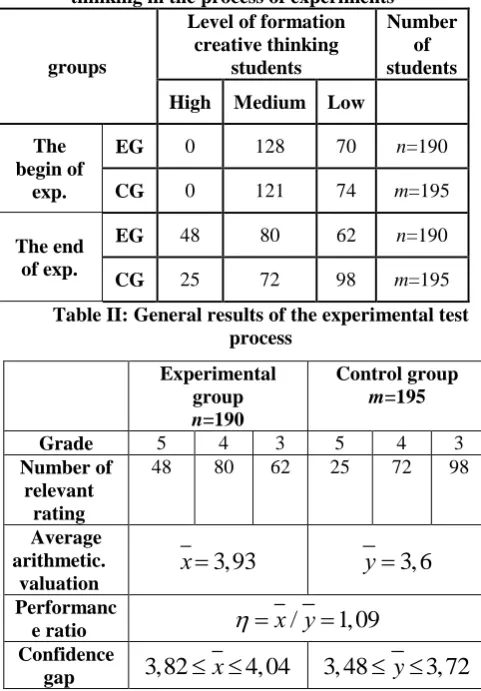
To organize experimental work on the development of students' creative activity by using problematic mathematical problems, questionnaires were conducted among teachers and students of higher educational institutions and their results were analyzed. For the experiments, the National University of Uzbekistan, Samarkand State University and Karshi State University, where certain organizational work was carried out. The experimental work was carried out in two parallel groups, among students of the physical and mathematical faculties of these universities. If in the
form, then in the experimental group they were conducted according to the method proposed by us. To ensure the accuracy of the experimental results, we used one of the mathematical-statistical methods, the Pearson chi-square test.
To determine the level of formation of creative thinking among students, methods of self-assessment and assessment by experts were used.
[image:5.595.52.293.287.633.2]The analyses showed that the average level of creative activity of students in the experimental and control groups as a result of the experiment is very different. Consequently, as a result of studying problematic mathematical problems, the level of creative thinking and assimilation of students has grown significantly. Thus, there are positive changes in the students' assimilation of the teaching material in the course "Higher Mathematics", the quality of teaching is improved as a result of the use of problematic mathematical problems.
Table I: Indicators of students' formation of creative thinking in the process of experiments
groups
Level of formation creative thinking
students
Number of students High Medium Low
The begin of
exp.
EG 0 128 70 n=190
CG 0 121 74 m=195
The end of exp.
EG 48 80 62 n=190
CG 25 72 98 m=195
Table II: General results of the experimental test process
Experimental group n=190
Control group m=195
Grade 5 4 3 5 4 3
Number of relevant
rating
48 80 62 25 72 98
Average arithmetic.
valuation
3,93
х
у
3, 6
Performanc
e ratio
х y
/
1, 09
Confidence
gap
3,82
x
4, 04
3, 48
y
3, 72
Figure 1: Diagram of a general statistical analysis of the experiment
Analysis of the results of experiments conducted in
universities using problematic mathematical problems in the course “Higher Mathematics” showed an increase in creative thinking and the level of assimilation of educational material by students of the experimental group, relative to students in the control group, by 9%. This proved that the use of problematic mathematical problems in the course "Higher Mathematics" in universities can achieve high results.
VI. RECOMMENDATIONANDCONCLUSION
Scientific research on the use of problematic tasks in the development of independent creative activity among university students makes it possible to draw the following conclusions:
1. It was found that the use of problematic mathematical problems in the course “Higher Mathematics” has a positive impact on the creative and cognitive activities of students, as well as on the development of their logical thinking ability. This made it possible to develop suggestions and recommendations for improving the development methodology for university students’ independent creative activity.
2. Problem situations that arose as a result of the use of problem mathematical problems were divided into classes, criteria for division into classes were determined (based on the characteristics of the educational material and the difficulty level of problem mathematical problems). A collection of problematic variable mathematical problems was developed, aimed at developing the creative activities of students.
3. Methodological recommendations for teaching using problematic mathematical problems in the course "Higher Mathematics" was developed. In particular, the place and importance of computer technology in teaching problematic mathematical problems was shown, the methodology for using such mathematical packages as MathCAD, MatLab, Maple, and Mathemathematica was improved in solving simple differential equations and geometric problems for the course "Higher Mathematics" for development students of creative activities, based on a problematic approach.
4. Based on the processing of the results of the pedagogical experiment by the mathematical-statistical method, it was proved that the effectiveness of the use of problematic mathematical problems when studying learning topics in the course “Higher Mathematics” is 9% higher than the traditional teaching method and problematic mathematical problems have a positive effect on the creative and cognitive activity of students.
5. Based on the theoretical studies and experiments, methodological recommendations were developed on the use of problem tasks in the development process of students' independent creative:
- it would be advisable in all sections of the course “Higher Mathematics” to widely use problematic problems and introduce them into the educational process to form students' scientific research activities;
- to develop students' independent creative activity in the process of teaching differential equations and topics in geometry in the course "Higher
and MathCAD.
REFERENCES
1. Abdullayeva B.C. Fanlararo aloqadorlikning metodologik-didaktik
asoslari (Ijtimoiy-gumanitar yo‘nalishlardagi akademik litseylarda matematika o‘qitish misolida): ped. fan. dokt. diss.avtoref., Tashkent, 2006, pp44-49.
2. Alixonov S. «Matematika o‘qitish metodikasi», Tashkent, 1992,
pp.146-200.
3. Gaybullayev, N.R. Dirchenko I.I. Razvitiye matematicheskix
sposobnostey uchashixsya: Metodicheskoye posobiye dlya uchiteley / N.R. Gaybullayev, I.I.DirchenkoT.: Oqituvchi, 1988, pp. 114-248.
4. Gilford Dj. Tri storoni intellekta//Psixologiya mishleniya: sb.
perevodov/pod red. A.M.Matyushkina.-Mocow, Progress, 1965, pp. 433-456.
5. Ikromov J. “Maktab matematika tili”. – Tashkent: Oqituvchi, 1977,
pp.163-195.
6. Kolyagin Yu.M., Oganesyan V.A. Uchis reshat zadachi. // Posobiye
dlya uchashixsya 7-8 klassov. –Moscow, Prosvesheniye, 1980, pp. 96-105.
7. Mamatov M.Sh. Maktab matematika kursida mantiq va intuitsiya
uyg‘unligi// Xalq talimi.–Tashkent.2003, Volume № 5, pp. 120-124.
8. Uzbekiston Respublikasi Prezidentining 2017 yil 7 fevraldagi
PF-4947 son “Uzbekiston Respublikasini yanada rivojlantirish bo‘yicha Harakatlar strategiyasi tugrisida”gi Farmoni. Aviable: www.lex.uz.
9. Reni A. Dialogi o matematike. –Moscow, Mir, 1980, pp 300-376,
chapter “V mire nauki i texniki”.
10. Renzulli Dj.S., Ris M. Model obogashayushego shkolnogo
obucheniya: prakticheskaya programma stimulirovaniya odarennosti detey // Osnovnie sovremennie konsepsii tvorchestva i odarennosti. – Moscow, Molodaya gvardiya, 1997, pp 312-37.
11. Tulaganov T. Matematika oqitish metodikasi (ma’ruzalar toplami),
TDPU, 2011.
12. Tojiyev M., Barakayev M., Xurramov A., Matematika o‘qitish
metodikasi. //O‘quv qo‘llanma.Fan va texnologiyalar, Tashkent, 2017, pp. 276-328.
13. Yunusova D.I. Matematikani o‘qitishning zamonaviy
texnologiyalari, Tashkent, Fan va texnologiyalar, 2011, pp. 122-200.
14. Zimina O.V. Problemnoye obucheniye visshey matematiki v
texnicheskix vuzax//Matematika v visshem obrazovanii.Moskva, 2006. Volume №4, pp.55-77.
15. Zlotskiy G.V. O psixologo-pedagogicheskoy i
metodiko-matematicheskoy podgotovke studentov matematikov universitetov
k professionalno-pedagogicheskoy deyatelnosti. //Ta’lim
muammolari. – Tashkent, 2000, Volume №2, pp.28-30.
AUTHORSPROFILE