
International Journal of Innovative Technology and Exploring Engineering (IJITEE) ISSN: 2278-3075, Volume-9 Issue-2, December 2019
Abstract: Driverless car technology is being extensively researched in both academia and industry. But it will take a while until they are sustainable in the present conditions and commercially viable. Until then driving will be done by humans and has room for error like all other humane activities. The driver analysis system tries to gauge the ability of a driver and soundness of their skill. The proposed Advanced Driver Assistance System (ADAS) authenticates a driver by recognizing their face, leaving no room for misuse by unauthorized personnel as well as prevents theft. It keeps track of the driver's activity by continuously monitoring the driver and detects drowsiness of the driver. When the trip ends, the system produces a summary of the trip with the details.
Keywords: Haar Classifier, HOG, SVM, Computer Vision
I. INTRODUCTION
Computer Vision is a area of Computer Science where extensive research is being carried out. It processes the digital image by analyzing it to produce some useful symbolic information from it which may be in the form of decisions [1].
Advanced driver assistance systems are systems that helps the driver in driving process and provides more ease to them. They are mainly intended to increase car safety and road safety. Many driver assistance systems such as collision avoidance system blind spot detector have been in existence for a long time.
They are fast evolving in the automobile industry with large adoption by many takers. An important real life application of Computer Vision is face detection. Face detection is the method of identifying faces in digital images. Face detection can be defined as object-class detection. Object-class detection is a methodology related to identifying objects of certain classes in digital images.
There are various algorithms that have been devised for face detection. Among those the most widely used algorithms are based on genetic algorithm and eigen-face [2]. Face detection is a preliminary feature used in this work.
A facial recognition system is a technology which is used to identify or verify a person from a digital image. But iris and finger print recognition dominates face recognition. They are widely used due to its contactless and non-invasive process [3].
Revised Manuscript Received on December 05, 2019.
* Correspondence Author
S.V.Jansi Rani*, Associate Professor, Department of CSE, SSN College of Engineering Chennai, India.
R.Kavya, Software Engineer, Paypal Chennai, India.
Various different techniques are used for face recognition. Amongst those methods, the ones with high accuracy are generally preferred for real life applications. Driver drowsiness detection is a car safety technology. It prevents accidents caused by the driver getting drowsy. When the system detects drowsiness of the driver, it employs some mechanism to alert the driver. Studies have that around 20% of all road accidents are fatigue-related, up to 50% on certain roads [4]. So, by alerting the driver when they are drowsy, many such accidents could be prevented.
II. RELATEDWORK
A. Advanced driver-assistance systems (ADAS)
Advanced driver-assistance systems (ADAS) objective is to help the driver and their safety by automating, adapting and enhancing vehicle systems. The automated system which is provided by ADAS to the vehicle is proven to reduce road fatalities, by minimizing the human error [4]. A collision avoidance system, also known as a pre crash system, forward collision warning system, or collision mitigating system, is an automobile safety system designed to prevent or reduce the severity of a collision. It uses Radio Direction and Ranging (RADAR) all-weather and sometimes laser (LIDAR) and camera (employing image recognition) to detect an imminent crash.
Under advanced driver-assistance systems, there are multiple categories of systems that are already implemented and that are being implemented. A lot of research is being carried out pertaining to assisting drivers in their driving, from as early as 1950s. The very first systems had radar technology to detect any vehicles in the path and their distance, but this idea wasn’t used much or commercialized [5].
The principles of threshold braking and cadence braking which were once practiced by skillful drivers with earlier non-ABS braking systems is used in the automated system called Anti-lock braking system (ABS) [5] which operates at a very high speed and more effectively than most drivers could manage. ABS lowers the stopping distances in dry, snow-covered surface, gravel and slippery surfaces.
Automatic parking is implemented to automatic parking of the car from traffic space to parking slot and it also performs parallel, angle and perpendicular parking styles. It uses coordinated control of steering angle and speed and ensures collision-free motion
within the possible space by
considering the actual
Advanced Driver Assistance System using Image
Processing Techniques
environment [6].
Driverless cars are talk of the town right now, with large investments from many enterprises, but they are far from reaching a state where they can be used in day to day life. Until then driving has to be done manually. Robot car, a self driving car can move automatically with little or no human input by sensing the environment.
An autonomous car also known as driverless or self-driving or robot car is able to drive with little or no human interaction and sense the environment automatically. They use lidar, radar, GPS, sonar, computer vision, inertial measurement units and odometry to identify navigation paths, as well as obstacles and relevant signage [7].
B. Face Detection
Paul Viola and Michael Jones in 2001[8], first developed an object detection framework which provides competitive object detection rates in real time. It is used for face detection, but it can also be trained for multiple object classes. It processes the images extremely fast while achieving high detection rates.
This framework employs the usage of simple Haar like features and this can be evaluated quickly through the use of a new image representation. Based on the model of an “Integral Image” it generates a large set of features and utilize the boosting algorithm AdaBoost to cut the over-complete set and the introduction of a degenerative tree of the boosted classifiers provides for robust and fast interferences. The detector is applied in a scanning fashion and used on gray-scale images, the scanned window that is applied can also be scaled, as well as the features evaluated. The image texture features can be described using the local binary pattern (LBP) technique. The advantages of LBP are rotation invariance and high speed computation which facilitates the broad usage in the fields of face recognition, texture examination, image segmentation and image retrieval.
For moving object detection, LBP [9] is recently used and produced better output by background subtraction. Each pixel has a texture value. This can be combined with target for tracking the thermo graphic and monochromatic video. The key points in the target region are identified by the LBP patterns and a mask is formed for joint color-texture selection.
Boosting technique provides high accurate prediction rule by combining many relatively incorrect and weak rules. AdaBoost [10] algorithm was the first algorithm which was studied on various applications and widely used.
The boosting algorithm is used to train the classifier with high detection rates [11]. AdaBoost, a machine learning algorithm produces a strong classifier by choosing visual features in a family of simple classifiers and combining them linearly. As a result, a classifier with high accuracy is obtained.
C. Face Recognition
The features of all the faces are found and stored in the database for processing during the training phase. The standard Eigen or HOG features are considered. A sample
image is tested in testing phase and the features are calculated and compared with the features of the stored database using the classifier. SVM classifier is taken as example in the figure. SVM classifier appears for optimal hyper plane as a decision function. The HOG features of the probe and the Gallery are taken by the SVM [11].
Currently, CNN classifier is considered by researchers as one of the state-of-the-art machine learning approaches. CNN is a special kind of multi-layer perception, which has many specialized hidden layers used for classification. The conventional face recognition channel has four stages: face detection, face alignment (or preprocessing), feature extraction (or face representation) and classification.
A brief comparison is presented in Table 2.1.
Table- I: Techniques
Techni
ques Advantage Disadvantage
SVM +HOG
Good frontal face detector It is beter at memory and speed
Sufficiently good at low cost
Not precise at odd angles.
Less accurate compared to deep learning.
CNN
Given sufficient data and processing power, CNN gives the best results. Provides high precision Off-the shelf models available
Not preferred for real-time videos, requires GPUs as it requires high computational power.
D. Drowsiness Detection Template Based Matching
The template for closed and open eyes is provided by this algorithm. Then the state of driver’s eyes is compared with this template, matches, then alarm are set or buzzer will on and we can prevent drowsy mode. Depend on the required results this method is used and it is efficient.
Using eye aspect ratio
In this technique, eye blinking frequency and eye closer duration is calculated for detecting driver drowsiness. A threshold value is fixed by the programmer. The threshold value and the blinking rate is compared. It produces very effective result.
Technique based on EEG
The different physiological signals such as EEG, ECG, and Heart Rate (HR) are used to detect drowsiness. In EEG technique involves various wiring patterns. The heart rate can be measured by ECG. As electrode helmet is difficult to wear all the time while driving so this system is not very efficient.
Artificial Neural Network
In this technique neurons are used. Calculations based on single neuron are not sufficient.
Many neurons have to be used for proper calculation.
III. PROPOSEDMETHODOLOGY
International Journal of Innovative Technology and Exploring Engineering (IJITEE) ISSN: 2278-3075, Volume-9 Issue-2, December 2019
Fig. 1. System Architecture
One challenge faced by commercial vehicle services is, unauthorized personnel driving them, our first check, recognizes the face of a given driver to check if they are really authorized to drive this vehicle. This is further verified through a two way authentication through a username and password as well as face recognition as shown in Fig1. The system also detects the drowsiness of a driver whilst they are in the process of driving. This will prevent many potential accidents due to the carelessness of a driver. ADAS focuses on the most important aspect of driving, which is the driver. By focusing on the driver, the system tries to prevent potential accidents from happening by alerting the driver with a beep sound. Finally, ADAS also generates a summary report.
A. Haar Cascade
Haar Cascade is a machine learning object detection algorithm used to identify objects in an image or video and based on the concept of features proposed by Paul Viola and Michael Jones. It is a machine learning based approach where a cascade function is trained from a lot of positive and negative images. It is then used to detect objects in other images.
The algorithm has four stages: 1. Haar Feature Selection 2. Creating Integral Images 3. Adaboost Training 4. Cascading Classifiers
Rectangle feature use in Haar Cascade
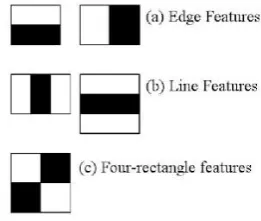
The Haar features are shown in Fig.2. The sum of pixels in the white rectangles is subtracted from the sum of pixels from the dark rectangles [7]. The rectangles are visualized in Fig 3.
[image:3.595.58.280.51.201.2]
Fig. 2. Haar Features
Fig. 3.Haar Features shown in face
Learning Classification Functions
Classification learning process requires a set of positive and negative images for training and a set of features are selected using AdaBoost for training the classifier. To increase the learning performance of the algorithm (which is sometime called as weak learner), the AdaBoost algorithm is used. Ad-boost provides guarantees in several procedures.
The process of ‘Boosting’ works with the learning of single simple classifier and rewriting the weight of the data where errors were made with higher weights. Afterwards a second simple classifier is learned on the weighted classifier, and the data is reweighted on the combination of 1st and 2nd classifier and so on until the final classifier is learned. Therefore, the final classifier is the combination of all previous n-classifiers. The Adaboost cascade of classifiers is one of the fastest and robust methods of detection and characterization; however, it presents some limitations on complex scenes especially those that changes shape.
Face detection using Haar-cascade is based upon the training of a classifier using number of positive images that represent the object to be recognized and even large number of negative images that represent objects or feature not to be detected. However, OpenCV is already provided with the program for training a classifier to recognize any object, which is known as Haar Training function. The features are consolidated and stored in the form of xml file.
We use that xml file to perform face detection.
B. Face Detection
To perform face detection on the driver, we propose to use the Haar Cascade classifier. This is implemented using the image processing library OpenCV. First, multiple images of people whose face has to recognized is collected. Next the model is trained with the Haar cascade classifier. The extracted features are stored along with the class labels in an xml file. The resulting model is to recognize user faces. If the face is found, it will return the person’s name, otherwise it will return unauthorized.
ALGORITHM-FACE DETECTION
1. OpenCV comes with a trainer as well as detector. OpenCV already contains many pre-trained classifiers for face, eyes, smile etc
[image:3.595.112.243.639.749.2]in opencv / data / haarcascades / folder. The XML files are first loaded.
3. The image is converted to grayscale.
4. The faces are detected using detect MultiScale.
5. If faces are found, the positions of detected faces are returned as Rect(x,y,w,h).
6. The ROI is created and eye detection is applied for the ROI.
C. Face Recognition
[image:4.595.343.501.259.358.2]First step is to gather dataset. The image samples of each person is manually collected and placed in separate directories labeled with the person's name. Second step is computing the face recognition embeddings as shown in Fig.4. A pre trained deep neural network ResNet-34 containing 3 million images is used to compute a 128-d vector (i.e., a list of 128 floating point values) that will quantify each face in the dataset is constructed. A dictionary [facial embedding, driver name] is created for each image.
Fig. 4.Steps for Face Recognition
Steps for face recognition,
1.Load the embedding file that contains the trained images.
2.Obtain the face to be recognized from the live video stream and compute the facial embeddings.
3.Match the obtained embedding with the pre trained facial embeddings.
4.Based on the maximal matching, the corresponding driver is recognized.
D. Drowsiness Detection
[image:4.595.76.288.295.433.2]Our system also detects the drowsiness of the driver and provides a buzzer alert when drowsiness is detected. The 68 facial landmark points as shown in Fig.5 are considered. We compute the Euclidean distance between facial landmarks points in the eye aspect ratio calculation.
Fig. 5. Visualizaiton of the 68 facial landmark points
When the distance between points falls below a certain threshold value, we can detect drowsiness of the driver. In our drowsiness detector case, the system will be monitoring the eye aspect ratio to see if the value falls but does not increase again, thus implying that the person has closed their eyes. This is because; there can be a momentary change in the Euclidean distance due to blinking of the eyes. If we detect that as drowsiness then that would be a false positive.We also use dlib’s shape predictor to predict the two eye patterns.
First, we use dlib to identify 64 points on the face. From those 64 points, we identify the six points pertaining to each of the two eyes, a total of twelve points which are of significance. We use this to calculate the eye aspect ratio as described in the next section.
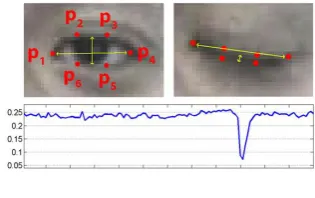
Fig. 6.Eye Aspect Ratio Calculation
CALCULATION OF EYE ASPECT RATIO:
The eye aspect ratio(EAR) is calculated based on the Euclidean distance of A(p2, p6), B(p3, p5) and C(p1, p4) as shown in Fig.6.
C B A
EAR( )/2*
If the aspect ratio of the eye drops to a low value drastically and remains the same for 48 frames consequently, drowsiness is detected and the driver is alerted.
E. GPS Tracking
We use a GPS module to track the driver's path. The GPS module is interfaced with the Raspberry Pi. It returns the current latitude and longitude values. The values are continually tracked and they are plotted on the map.
IV. IMPLEMENTATION&RESULTS
Raspberry pi was connected to the laptop directly. This method is called “headless mode” connection. By default, the SSH connection in raspberry pi is disabled. The initial enabling of SSH requires a monitor connection through HDMI cable, This can be avoided using headless mode connection.
The following steps were followed for connecting Raspberry Pi to Laptop:
1.Format the 16GB SD Card to remove any old data present in it. Install the Raspbian Stretch software with Desktop version from raspberrypi.org in order to operate the Rapsberry Pi module.
[image:4.595.69.269.661.760.2]International Journal of Innovative Technology and Exploring Engineering (IJITEE) ISSN: 2278-3075, Volume-9 Issue-2, December 2019
“ssh” without any extension by using an USB cord reader. This file enables “ssh” if not enabled before and deletes the same. SSH is required to be communicating with raspberry pi.
3. IP scanner software was installed to find the ip address of raspberry pi. This will help us to exactly identify the IP address of raspberry pi when it is connected to the local network and we can connect using IP Address through ssh.
4. Installation of Putty and Xming. Xming is an X11 display server for windows that acts as a GUI for raspberry pi.
A. User Authentication
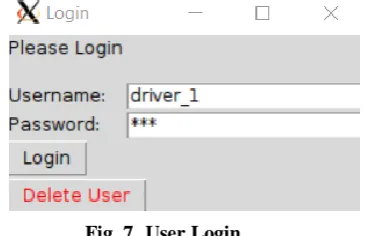
To register in the existing set of users, a first time user has to choose a new username and password and sign up for the application. As shown in Fig.7, each user has a specific username and password which they have to enter in the first prompt window in order to login.
[image:5.595.335.540.50.195.2]
Fig. 7. User Login
B. Face Recognition
[image:5.595.87.270.273.391.2]As the next step of the two-way authentication, the driver's face is recognized from the existing dataset of users as shown in Fig 8. This is implemented using the openCV library. Once the face is recognized to be that of an authenticated driver, the Start Trip prompt appears. If drowsiness is detected based on the eye aspect ratio (EAR), then driver is alerted by displaying the message on the screen as shown in Fig. 9. And the instance is recorded in the summary of the current trip.
Fig. 8.User Face Recognition
[image:5.595.47.273.546.744.2]
Fig. 9.Driver Drowsiness Detection
On the conclusion of the trip, a summary of the trip is displayed as shown in Fig.10 which contains,
Date Start Time
End Time
Driver Name
Number of times drowsiness detected
Fig. 10. Summary of the Trip
The GPS module is connected to Raspberry Pi using Universal Asynchronous Receiver/Transmitter. The connections are made using jumper cables on ground, VCC and pin 10 and pin 17.
To set up the GPS module, we set it as; sudo nano /boot/config.txt
dtparam=spi=on\\ dtoverlay=pi3-disable-bt\\ corefreq = 250 \\
enableuart = 1 \\ forceturbo = 1 \\
Obtaining data from the GPS Module
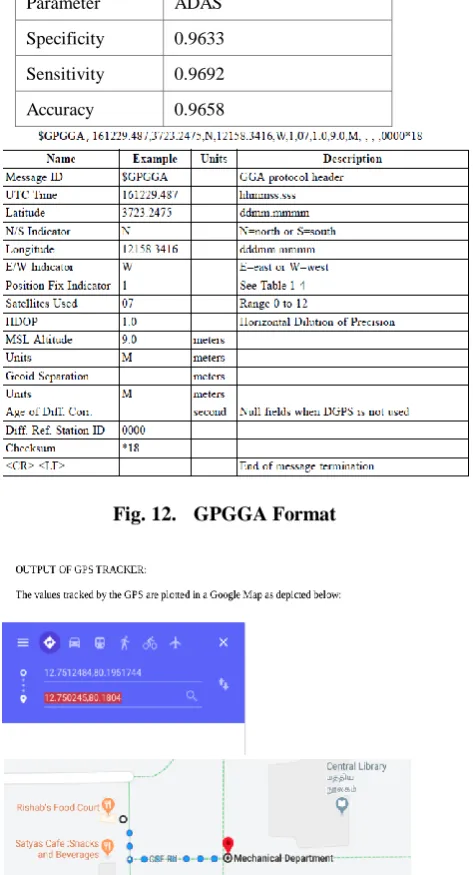
[image:5.595.311.538.621.731.2]The current latitude and longitude is returned in the file /home/ttyAMA0 as shown in Fig.11. GPGGA format is shown in Fig. 12.We take values from it every 1 sec, and plot it in a map as shown in Fig 13.
Fig. 11. GPGGA output of GPS
The performance measure is done for different sets of samples and the results obtained
are tabulated in Table.
Measure Parameter ADAS
Specificity 0.9633
Sensitivity 0.9692
[image:6.595.56.293.71.509.2]Accuracy 0.9658
Fig. 12. GPGGA Format
Fig. 13. Conversion of GPGGA to latitude and longitude
V. CONCLUSION
To conclude, we have discussed, in this paper, the detailed design and related algorithms to implement facial recognition and drowsiness detection for a driver analysis system. As another added on feature to this driver analysis system, we intend to add a feature to detect if the driver is wearing the seat belt. Also, a speed monitor can be added to
this system and over speeding will be captured and recorded by the system. This will be shown in the final summary of the trip. Since a Raspberry Pi is used to execute the work for the sake of better portability, we are constrained by limited processing capacity. In order to make the best use of it, we intend to use cloud to execute the processing, to speed up the process.
REFERENCES
1. Jun Zhang, Yong Yan and M. Lades (1997). "Face recognition: eigenface, elastic matching, and neural nets," in Proceedings of the IEEE, vol. 85, no. 9, pp. 1423-1435, Sept.
2. Reinhard Klette (2014). "Concise Computer Vision". Springer,
978-1-4471-6320-6.
3. Zhang, Jian, Yan, Ke, He, Zhen-Yu, and Xu, Yong. (2014) "A Collaborative Linear Discriminative Representation Classification Method for Face Recognition." In 2014 International Conference on Artificial Intelligence and Software Engineering.
4. Abdul Hamid, Umar Zakir \& Ahmad Zakuan, Fakhrul Razi & Akmal Zulkepli, Khairul & Azmi, Muhammad Zulfaqar & Zamzuri, Hairi & Abdul Rahman, Mohd Azizi & Aizzat Zakaria, Muhammad. (2017). "Autonomous emergency braking system with potential field risk assessment for frontal collision mitigation." 71-76. 10.1109/SPC.2017.8313024.
5. B.M. Kusuma Kumari, P. Ramakanth Kumar. (2017) "A survey on drowsy driver detection system", Big Data Analytics and Computational Intelligence (ICBDAC)”, International Conference on Big Data Analytics, pp. 272-279, 2017.
6. Paromtchik, Igor; Laugier, Christian. (1996) "Motion Generation and Control for Parking an Autonomous Vehicle" (PDF). Proceedings of the
IEEE International Conference on Robotics and Automation. Minneapolis, MN, USA. pp. 3117–3122. doi:10.1109/ROBOT.1996.5091
7. Gehrig, Stefan K.; Stein, Fridtjof J. (1999). "Dead reckoning and cartography using stereo vision for an automated car." IEEE/RSJ International Conference on Intelligent Robots and Systems. 3. Kyongju. pp. 1507–1512. doi:10.1109/IROS.1999.811692
8. Viola, P., Jones, M. J., & Snow, D. (2005). "Detecting pedestrians using patterns of motion and appearance. International Journal of Computer Vision," 63(2), 153-161.
9. Ahonen T, Hadid A, Pietika¨inen M, (2004) "Face recognition with local binary patterns." In Proceeding of European conference on computer vision (ECCV2004), LNCS 3021, pp 469–481.
10. R. Meir and G. R¨atsch. (2003) "An introduction to boosting and leveraging." S. Mendelson and A. J. Smola Ed., Advanced Lectures on Machine Learning, Springer-Verlag Berlin Heidelberg, pages
118–183.
11. Harihara Santosh Dadi, Gopala Krishna Mohan Pillutla. (2016) " Improved Face Recognition Rate Using HOG Features and SVM Classifier" IOSR Journal of Electronics and Communication Engineering (IOSR-JECE)
e-ISSN: 2278-2834,p- ISSN: 2278-8735.Volume 11, Issue 4, Ver., PP 34-44
AUTHORSPROFILE
Dr.S.V.Jansi Rani is working as Associate Professor in the department of computer science and engineering at SSN College of Engineering, Chennai. Her research is on Social network analysis, Computer Vision, Internet of Things and Networking Protocols.
Dr.R.Priyadharsini is working as Associate Professor in the department of computer science and engineering at SSN College of Engineering, Chennai. Her research area includes computer vision and machine learning techniques.
Kavya.R is working as a Software Engineer for PayPal. Her research area includes
![La politique d'association et de regimes preferentiels de la Communaute = The association policy and preferential regimes of the Community [external relations] SEC (70) 1351 final, 15 April 1970](data:image/gif;base64,R0lGODlhAQABAIAAAP///wAAACH5BAEAAAAALAAAAAABAAEAAAICRAEAOw==)