International Journal of Innovative Technology and Exploring Engineering (IJITEE) ISSN: 2278-3075,Volume-8 Issue-10, August 2019
Abstract: In this research the efficient and low computation complex signal acclimatizing techniques are projected for the improvement of Electroencephalogram (EEG) signal in remote health care applications. In clinical practices the EEG signal is extracted along with the artifacts and with some small constraints. Mainly in remote health care situations, we used low computational complexity filters which are striking. So, for the improvement of the EEG signal we introduced efficient and computation less Adaptive Noise Eliminators (ANE’s). These techniques simply utilize addition and shift operations, and also reach the required convergence speed among the other predictable techniques. The projected techniques are executed on real EEG signals which are stored and are compared with the effecting EEG arrangement. Our realizations visualize that the projected techniques offer the best concert over the previous techniques in terms of signal to noise ratio, mathematical complexity, convergence rate, Excess Mean Square error and Mis adjustment. This approach is accessible for the brain computer interface applications.
I. INTRODUCTION
EEG resembles the visual illustration of the brain activities. If any disturbance occurs in the brain causes the mental illness. From the World Health Organization and other reports from [1]-[4] says that the brain signal disturbances cause the imbalance in the health both to the physical and mental health. So, in most of the cases the outcome of the clinical methods related to brain becomes an important tool. Such that we mostly focused on the high-resolution EEG signals in accordance with the clinical reports. But, at the time of analyzing the brain wave there are several number of artifacts like Power Line Interference (PLN), Eye Blink Artifact (EBA), Electromyogram (EMG), Cardiac Signal Artifact (CSA), Respiratory Artifact (RA) and Electrode Motion Artifact (EMA).These artifacts will disturbs the signal strength and hides some characteristics of the brain in accordance with the clinical reports. So that the artifact cancellation is the key part and this is the first step in health care observation. Such that they introduced several methods for the elimination of artifacts caused due to the head movement and finding the artifacts automatically by the Influential Independent components and for detection of Epileptic Seizure from the EEG. Usually the recognition and
Revised Manuscript Received on August 12, 2019.
N.Soniya, B.Tech degree from KKR & KSR Institute of Technology and Sciences, Vinjanampadu, Guntur(D.t) and M.tech from KKR&KSR Institute of Technology and Sciences, Vinjanampadu, Guntur(Dt).
Venkata Yashwanth Goduguluri, B.Tech degree from vignans Engineering college, Vadlamudi and M.tech from Satyabhama University, Chennai.
elimination of artifact in Multichannel scalp EEG through Wavelet ICA. By giving a reference signal to find the EEG artifacts caused due to restrained progressions. The elimination of EKG artifact from the EEG by using independent component analysis and Continuous Wavelet transformation. And also uses the principal component analysis for the declination of stimulated artifacts in EEG. In support of the removal of muscle artifact from a small number of sources with the new adaptive method as EMD and CCA whether it may be single or multi-channel to be used and also with the help of Independent Vector Analysis. Intended for the portable application in adaptive filtering and independent component analysis in additional it detects the driver tiredness from EEG spectrum and also for the elimination of electrooculography artifact and for single channel EEG using
wavelet technique, to take out the EOG artifacts from the single channel using singular spectrum analysis and Adaptive Noise Cancellers furthermore they are utilizing feature learning technique in EEG in the course of DWT and ANC mainly for portable appliances for the recognition and elimination of ocular artifacts. Furthermore, the unrecognized Eye Blink Artifact (EBA) in EEG can be recognized with modified High-Speed Eye Tracker. And also uses the Cyclo-stationary Source Extraction technique for the removal of Ballisto-cardiogram artifact in EEG and uses the independent vector analysis while for the moving related technique for the exclusion of gradient artifact from EEG is illustrated in [5]-[26]. Because of the technological improvements in brain signal movement i.e. EEG that can be measured with Noninvasive Neural Prostheses utilizing mobile and wireless EEG. And the wearable EEG sensor is used to evaluate the signal quality during mental stress. The Wearable and wireless EEG approaches used in daily life purposes. A hybrid BCI’s and near-infrared spectroscopy (NIRS) is used for signal analysis in EEG. The stored EEG artifact for cochlear implant in synthetic brain for difficult audio stimuli and the ability of cochlear implant noise innovative technique is used and it can be eliminated using Auditory Evoked Potentials [28]. For more efficiency, they used the Brain-Computer interfacing for the removal of the artifacts. The EEG artifacts can be removed mainly in the portable relevance’s. The innovative technology is used to find the brain activity is the EEG spectrum, which is used to eliminate the EOG artifact and to know the driver tiredness.
Artifact Elimination in EEG Signal using Block
and Sign Based Normalized Least Mean Square
Techniques
VenkataYashwanthGoduguluri, SoniyaNuthalapati, Addanki Naveen Murthy, Duggi
Artifact Elimination in EEG Signal using Block and Sign Based Normalized Least Mean Square Techniques
4341 Retrieval NumberJ98570881019/2019©BEIESP
DOI: 10.35940/ijitee.J9857.0881019
Published By:
Blue Eyes Intelligence Engineering & Sciences Publication
Some important signal stipulating methods are used to detect the EEG and also the Thoracic Electrical Bio-Impedance (TEB) activity in Remote Health monitoring Network. In extent the proficient block practicing of lengthy period bio-telemetric brain statistics for health care monitoring is explained in [27]- [38]. The authors mainly focused on the Computational difficulty, to overcome this disadvantage they use the linear predictor and Cyclo-stationary Source Extraction technique for the removal of Ballisto-cardiogram artifact in EEG. The unrecognized Eye Blink Artifact (EBA) in EEG can be recognized with modified Multi-scale Sample Entropy, Kurtosis and Wavelet ICA. And in favor the Efficient Neural Network in adaptive filtering approach. Anda innovative methodology for decreasing the artifacts removal techniques in physiological signals is found in [39]-[43]. The ICA and multi-variate Emphirical Mode Decomposition are also used for the computational complexity diminishing in EEG artifacts they also used wavelet techniques have been designed and proved practically for the mathematical difficulty drawback. The performance [42] and the computational difficulty is achieved and the artifact removal in physiological signal is being described.
II. NORMALIZEDSIGNRELATEDADAPTIVE
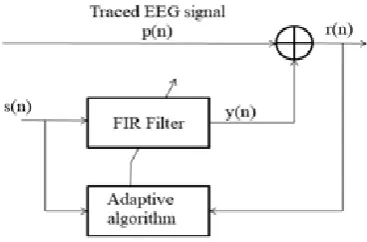
[image:2.595.77.261.484.605.2]NOISEELIMINATORSFOREEGTELEMETRY Consider a FIR filter with M coefficients. We had taken the FIR filter because of the concept filter coefficient weight adaptation. Utilizing the FIR filter, we designed an ANE linked with a sensitive EEG recording structure and it is again connected to the computer which is shown in the Fig.1. In this structure s(n) is defined as input sequence applied to the adaptive filter which regulates the filter coefficients and the desired signal is p(n) which is traced from patient, and the weight modernize recursion equation can be written as x(n+1) = x(n) + V s(n) r(n) (1)
Fig. 1. Configuration of Adaptive Noise Eliminator Where, x(n) = [x0(n), x1(n),…xM-1(n)] t is the filter weight
vector at the nth key, s(n) = [s(n), s(n-1),….s(n-M+1)]t, error signal r(n) = p(n) – xt(n) s(n) and V is the step-size constraint. In order to extract the noise from the EEG signal, the EEG signal z1(n) is imputed with a noise signal g1(n) which is
functional with the desired succession p(n) to the adaptive filter visualized in the Fig.1. The allusion signal s(n) is added with another noise component g2(n) and it is again correlated
with g1(n). The filter error equation can be written as r(n) =
[z1(n) + g1(n)] – y(n), where y(n) is the adaptive filter output
and its equation can be written as y(n) = xt(n) s(n) (2)
The Mean squared error (MSE) is computed as,
E[r2(n)] = E{[z1(n) -y(n)] – y (n ]2} + E[g12(n)] (3)
Since z1(n) and g1(n) are uncorrelated, likewise g1(n) and y(n)
are uncorrelated and the last two expectations are zero. MSE reduces the filter outcomes which is the best least square estimate of the signal z1(n).
The projected ANEs will utilize the signum function to the error or to the key information vector, or for the two of them are being gained from the LMS algorithm, for minimizing the number of multiplications and additions. The weight modernize recursion of SRLMS, SLMS and SSLMS techniques are taken as follows,
x(n+1) = x(n) + V sgn{s(n)} {r(n)} (4) x(n+1) = x(n) + V {s(n)} sgn{r(n)} (5) and
x(n+1) = x(n) + V sgn{s(n)} sgn{r(n)} (6) where sgn{.} is the well-known signum function, i.e.,
sgn{(r(n)} =
(7)
Amongst the above adaptive techniques, the SRLMS, SLMS and SSLMS will have a poorer convergence rate and a steady state error when compared to the LMS algorithm. And this is elucidated as ensues, and the SLMS equation can be written as
x(n+1) = x(n) + V {s(n)} {r(n)/|r(n)|}, (8) Here sgn{r(n)} = r(n)/|r(n)|. This is reorganized as, x(n+1) = x(n) +
s(n) r(n) (9)
The variable step size technique can be represented by applying the sign to the LMS technique, the
V’ (n) = {V/r (n)}. The V’ (n) raises, the sign technique converges due to error r (n) downs in magnitude. So that the filter converges and r(n) changes to smaller in magnitude then V’ (n) happens to larger and automatically raises the convergence rate.
By creating the V to a value of power of two then the hardware circuit becomes simple the arithmetic operations gets reduced, while in the Normalized LMs technique there is an achievement of quick convergence by normalizing the step size relating it to primary input. And that updated equation can be written as follows,
x(n+1) = x(n) +
s(n) r(n) (10)
The step size parameter V(n) can be written as, V(n) =
(11)
International Journal of Innovative Technology and Exploring Engineering (IJITEE) ISSN: 2278-3075,Volume-8 Issue-10, August 2019
The main aim of this is to achieve the less computations when we added up the NLMS with sign techniques. So that they should be visualized as NSRLMS, NSLMS and NSSLMS techniques. The weight modernized equation can be written as
x(n+1) = x(n) + V(n) sgn{s(n)} {r(n)} (12) x(n+1) = x(n) + V(n) {s(n)} sgn{r(n)} (13) x(n+1) = x(n) + V(n) sgn{s(n)} sgn{r(n)} (14)
The further requirements are to calculate the V(n) from the equations (12) – (14) can be minimized by utilizing block-based algorithms, in this the primary key is decomposed into blocks and each block consists of high extent is utilized to calculate V(n). With this the weight modernized equation can be written by considering the equations (12) – (14) and then SLi = 0 and f=0 exhibits the
following form, x(n+1) = x(n) +
sgn{s(n)} {r(n)} (15)
x(n+1) = x(n) +
{s(n)} sgn{r(n)} (16)
and
x(n+1) = x(n) +
sgn{s(n)} sgn{r(n)} (17)
And at which SLi = max {|sj|, j ϵ Csʹ}, Csʹ = {SL, SL+1,
………SL+L-1}, S ϵ C. while for SLi = 0 and k=0 the equations
[image:3.595.61.262.404.497.2](9)-(11) can be seen as x(n+1) = x(n).These techniques can be written as BBNSRLMS, BBNSLMS and BBNSSLMS correspondingly. The convergence distinctive of several techniques is described at above as shown in Fig.2. So, from these distinctive it is claimed that NSRLMS works better when compared to NLMS.
Fig.2. Distinctiveness of Convergence for several adaption’s of LMS Algorithm.
III. SIMULATIONRESULTS
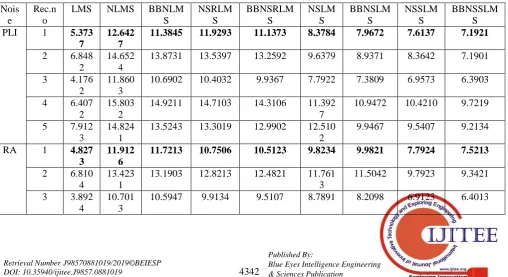
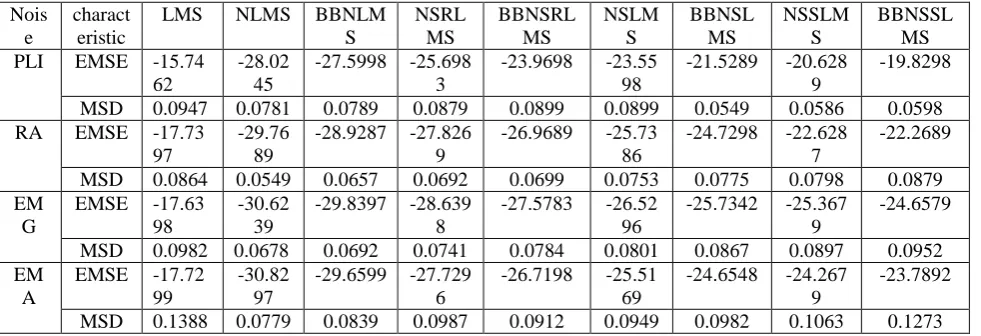
[image:3.595.48.557.554.831.2]Our outcome shows that the visualized ANE’s gives the better results at clinical practices, for this we have taken the number of EEG recordings and compared them with the past experiences which have the noisy components in the EEG. We had taken the 14 information collective electrodes and two reference electrodes and these are kept for the 10-20 systems. That information will be encrypted by the transmitter which is placed at the headset without wires based on the windows-based appliance and that wireless equipment works at the 802.11 (2.4 GHz). And we took artifacts with 6 subjects. And the sampling capacity is 125samples/second with a 4-byte floating number of equals to one electrode amplitude. The transmission speed from laptop to mobile is 4kbps. The experiments are done for 25,000 samples from male, of age 41. For the concert analysis we measured Signal to Noise ratio Improvement (SNRI). Excess Mean Square Error (EMSE) and Mis-adjustment (MSD) constraints and those are evaluated with the predictable LMS. The SNRI distinction with different artifact cancellation is shown in Table 1. Whereas, Table 2gives the distinctive measures of all techniques in remarks of EMSE, MSD for the EEG record number 1. In the outcome we have achieved the datasets with 6 EEG records as Record 1, Record 2, Record 3, Record 4, Record 5 and Record6 to make certain the ability of the outcomes. Several ANE’s are realized utilizing LMS, NLMS, BBNLMS, NSRLMS, BBNSRLMS, NSSLMS and BBNSSLMS techniques. This experiment has a noise source, which generates the noise reference signal. This reference signal contains PLI, EMG, RA and EMA noises. All the ANE’s the input is the reference signal. Several experiments are being evaluated to eliminate the noise from the original signal. These outcomes are visualized in Fig.3 to Fig.6.
Table 1. Concert of several ANE’s in terms of SNRI throughout the EEG Improvement (all values are in dB’s)
Nois e
Rec.n o
LMS NLMS BBNLM
S
NSRLM S
BBNSRLM S
NSLM S
BBNSLM S
NSSLM S
BBNSSLM S
PLI 1 5.373
7
12.642 7
11.3845 11.9293 11.1373 8.3784 7.9672 7.6137 7.1921 2 6.848
2
14.652 4
13.8731 13.5397 13.2592 9.6379 8.9371 8.3642 7.1901
3 4.176 2
11.860 3
10.6902 10.4032 9.9367 7.7922 7.3809 6.9573 6.3903
4 6.407 2
15.803 2
14.9211 14.7103 14.3106 11.392 7
10.9472 10.4210 9.7219
5 7.912 3
14.824 1
13.5243 13.3019 12.9902 12.510 2
9.9467 9.5407 9.2134
RA 1 4.827
3
11.912 6
11.7213 10.7506 10.5123 9.8234 9.9821 7.7924 7.5213 2 6.810
4
13.423 1
13.1903 12.8213 12.4821 11.761 3
11.5042 9.7923 9.3421
3 3.892 4
10.701 3
Artifact Elimination in EEG Signal using Block and Sign Based Normalized Least Mean Square Techniques
4343 Retrieval NumberJ98570881019/2019©BEIESP
DOI: 10.35940/ijitee.J9857.0881019
Published By:
Blue Eyes Intelligence Engineering & Sciences Publication
4 5.892 7
12.742 3
12.5936 11.9824 11.4967 10.934 5
10.7126 8.8148 8.3145
5 4.215 9
10.319 0
10.1124 9.3569 8.7213 7.9124 6.9219 4.9167 4.5189
EM G
1 4.912 0
9.9472 9.5678 8.9148 8.5067 7.7568 7.5013 6.7216 6.2378 2 6.901
3
14.879 2
14.4621 13.5642 13.2179 12.745 2
12.3567 11.4952 11.3987
3 5.795 6
11.201 7
11.1257 10.4128 9.5892 8.6287 8.3156 7.5287 6.5728
4 7.748 9
16.912 8
16.3128 15.4985 15.2765 14.563 1
14.1279 13.8469 13.3892
5 5.674 2
11.958 7
11.6934 10.1563 9.9146 8.4203 8.2106 7.6439 7.3693
EM A
1 5.429 5
9.5697 9.5423 8.8127 8.3218 7.9807 7.5123 7.1267 6.9109 2 4.892
7
8.8467 8.1093 7.8926 7.3497 6.9023 6.7203 6.5609 6.1107
3 7.678 2
11.653 7
11.2109 10.8193 10.1249 9.8921 9.6129 9.3149 9.1293
4 6.398 6
10.998 4
10.3193 9.6219 9.3156 8.7147 8.5179 8.2178 7.9784
5 5.912 6
[image:4.595.56.547.378.546.2]9.8926 9.4689 8.8936 8.5632 7.9834 7.7219 7.4532 6.9129
Table 2. Concert of several ANE’s in terms of EMSE and MSD throughout the EEG Improvement For record number1 (all values are in dB’s)
Nois e
charact eristic
LMS NLMS BBNLM
S
NSRL MS
BBNSRL MS
NSLM S
BBNSL MS
NSSLM S
BBNSSL MS PLI EMSE -15.74
62
-28.02 45
-27.5998 -25.698 3
-23.9698 -23.55 98
-21.5289 -20.628 9
-19.8298
MSD 0.0947 0.0781 0.0789 0.0879 0.0899 0.0899 0.0549 0.0586 0.0598 RA EMSE -17.73
97
-29.76 89
-28.9287 -27.826 9
-26.9689 -25.73 86
-24.7298 -22.628 7
-22.2689
MSD 0.0864 0.0549 0.0657 0.0692 0.0699 0.0753 0.0775 0.0798 0.0879 EM
G
EMSE -17.63 98
-30.62 39
-29.8397 -28.639 8
-27.5783 -26.52 96
-25.7342 -25.367 9
-24.6579
MSD 0.0982 0.0678 0.0692 0.0741 0.0784 0.0801 0.0867 0.0897 0.0952 EM
A
EMSE -17.72 99
-30.82 97
-29.6599 -27.729 6
-26.7198 -25.51 69
-24.6548 -24.267 9
-23.7892
Artifact Elimination in EEG Signal Using Block and Sign Based Normalized Least Mean Square
Techniques
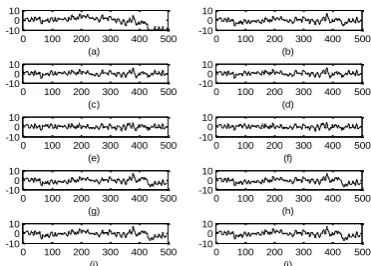
A. Adaptive Elimination of Power line Interference (PLI) This evaluation describes the Power Line Interference (PLI) elimination. The key to the filter is the EEG signal mixed with the noisy PLI of frequency 50Hz and sampled at the 160Hz record taken from male of age 41. Here the reference signal is noise and the pure signal can be extracted at the output. The EMSE result related on sign LMs technique are visualized in Fig.3. We evaluate this result by using six EEG records for ten times and then averaged. Several concerts like SNRI, EMSE and MSD are tabulated in Tables 1 and 2. In SNRI evaluation it is clear that NLMS gives 12.6427 dB, NSLMS gives 8.3784 dB, BBNSLMS gets 7.9672 dB, NSSLMS gives 7.6137 dB and BBNSSLMS gives 7.1921 dB, whereas the predictable LMS raises to 5.3737dB.
Fig.3. Distinctive outcome of PLN artifact for improved brain signal (a). EEG signal with PLN(b)Purified signal with LMS related ANE(c)Purified signal with NLMS related ANE (d) Purified signal with BBNLMS relatedANE, (e) Purified signal with NSRLMS related ANE, (f). Purified signal with BBNSRLMS related ANE(g)Purified signal with NSLMS related ANE. (h). Purified signal withBBNSLMS related ANE, (I). Purified signal with NSSLMS related ANE, (j). Purified signal with BBNSSLMS relatedANE.
[image:5.595.54.248.226.363.2]B. Adaptive Elimination of Electromyogram (EMG) The impure EEG signal is pertained as the key to the adaptive filter of Fig.1, the noise is reference signal taken from noise generator. The outcomes are visualized in Fig. 4. So that from the concert evaluation the Tables 1 and 2 shows the NLMS related noise elimination techniques results better over the other techniques. In SNRI it is shown that NLMS technique gives 9.9472 dB, NSLMS gives 7.7568 dB, BBNSLMS gets 7.5013 dB, NSSLMS gives 6.7218 dB and BBNSSLMS gives 6.2378 dB, whereas the predictable LMS raises to 4.9120 dB.
Fig.4. Distinctive outcome of EMG artifact for improved brain signal. (a). EEG signal with EMG, (b). Purified signal with LMS related ANE(c)Purified signal with NLMS related ANE(d)Purified signal with BBNLMS related ANE(e)Purified signal with NSRLMS related ANE, (f). Purified signal with BBNSRLMS related ANE(g)Purified signal with NSLMS related ANE(h)Purified signal with BBNSLMS related ANE(i)Purified signal with NSSLMS related ANE, (j). Purified signal with BBNSSLMS related ANE.
C. Adaptive Cancellation of Respiration Artifact (RA) Because of patient inspiration and expiration activity the EEG signal base line gets wanders which causes physiological noise. Our aim is to remove this artifact from the EEG signal. The resultant signals from several ANE’s are visualized in Fig. 5. Several concerts are being calculated and tabulated in Table 1 and Table 2. In SNRI the results of NLMS technique gives 11.9126 dB, NSLMS gives 9.8234 dB, BBNSLMS gets 9.9821 dB, NSSLMS gives 7.7924 dB and BBNSSLMS gives 7.5213 dB, whereas the predictable LMS raises to 4.8273 dB.
Fig.5. Distinctive outcome of RA artifact for improved brain signal (a). EEG signal with RA, (b). Purified signal with LMS related ANE, (c). Purified signal with NLMS related ANE, (d). Purified signal with BBNLMS related ANE, (e). Purified signal with NSRLMS related ANE, (f). Purified signal with BBNSRLMS related ANE, (g). Purified signal with NSLMS related ANE. (h). Purified signal with BBNSLMS related ANE(i)Purified signal with NSSLMS related ANE(j). Purified signal with BBNSSLMS related ANE.
D. Adaptive Elimination of Electrode Motion Artifact (EMA)
In this paper the EEG signal gets impure with the noise such that this impure signal is given to the Adaptive filter that is ANE. The purified EEG signal can be visualized in Fig. 6. Several concerts are measured and tabulated in Table 1 and Table 2. In SNRI evaluation it is clear that the NLMS Technique gives 9.5697 dB, NSLMS gives 7.9807 dB, BBNSLMS gets 7.5123 dB, NSSLMS gives 7.1267 dB and BBNSSLMS gives 6.9109 dB, whereas the predictable LMS raises to 5.4295 dB.
0 100 200 300 400 500
-10 0 10
(a)
0 100 200 300 400 500
-10 0 10
(b)
0 100 200 300 400 500
-10 0 10
(c)
0 100 200 300 400 500
-10 0 10
(d)
0 100 200 300 400 500
-10 0 10
(e)
0 100 200 300 400 500
-10 0 10
(f)
0 100 200 300 400 500
-10 0 10
(g)
0 100 200 300 400 500
-10 0 10
(h)
0 100 200 300 400 500
-10 0 10
(i)
0 100 200 300 400 500
-10 0 10
(j)
0 100 200 300 400 500
-10 0 10
(a)
0 100 200 300 400 500
-10 0 10
(b)
0 100 200 300 400 500
-10 0 10
(c)
0 100 200 300 400 500
-10 0 10
(d)
0 100 200 300 400 500
-10 0 10
(e)
0 100 200 300 400 500
-10 0 10
(f)
0 100 200 300 400 500
-10 0 10
(g)
0 100 200 300 400 500
-10 0 10
(h)
0 100 200 300 400 500
-10 0 10
(i)
0 100 200 300 400 500
-10 0 10
(j)
0 100 200 300 400 500
-10 0 10
(a)
0 100 200 300 400 500
-10 0 10
(b)
0 100 200 300 400 500
-10 0 10
(c)
0 100 200 300 400 500
-10 0 10
(d)
0 100 200 300 400 500
-10 0 10
(e)
0 100 200 300 400 500
-10 0 10
(f)
0 100 200 300 400 500
-10 0 10
(g)
0 100 200 300 400 500
-10 0 10
(h)
0 100 200 300 400 500
-10 0 10
(i)
0 100 200 300 400 500
-10 0 10
[image:5.595.323.509.311.444.2] [image:5.595.48.278.644.792.2]International Journal of Innovative Technology and Exploring Engineering (IJITEE) ISSN: 2278-3075,Volume-8 Issue-10, August 2019
4345
Published By:
Blue Eyes Intelligence Engineering & Sciences Publication
Retrieval NumberJ98570881019/2019©BEIESP DOI: 10.35940/ijitee.J9857.0881019
Fig.6. Distinctive outcome of EMA artifact for improved brain signal. (a). EEG signal with EMG, (b). Purified signal with LMS related ANE, (c). Purified signal with NLMS related ANE, (d). Purified signal with BBNLMS related ANE, (e). Purified signal with NSRLMS related ANE, (f). Purified signal with BBNSRLMS related ANE, (g). Purified signal with NSLMS related ANE. (h). Purified signal with BBNSLMS related ANE, (i). Purified signal with NSSLMS related ANE, (j). Purified signal with BBNSSLMS related ANE.
IV. CONCLUSION
In this research paper we projected a few resourceful ANE’s for wireless surrounded BCI structures. To facilitate and to improve the capability of ANE’s several modifications are personalized in the weight modernized equation of filtering structure. The future ANE system is a fourteen channel of EEG acquisition unit. To make certain the ability, convergence, filtering and with less computations, and we mixed up the constraints of mean square error, normalization and signum in single ANE. Various EEG signals with different artifacts are recorded and calculated with the projected ANE’s. From all these functions the projected ANE’s performs better among the LMS related ANE’s. From all these projected ANE’s NLMS related ANE’s achieves better result over the all other ANE’s but it has high computational complexity. This can be overcome by relating the signum to the NLMS then it becomes NSRLMS related ANE, its characteristics are nearly same to NLMS with minimization of computational complexity. The purified signals are figured out in Fig.3 to Fig. 6. And we utilized the block size as 5 in these experiments. If the filtering speed rises as the block size maximizes, but the output signal consists of residual noise. From the concert analysis (Table 1 and 2) it is clear that projected adaptive filters are higher than the predictable LMS. Hence these ANE’s are most suitable for remote EEG health care system.
REFERENCES
1. Gavin Giovannoni , “Brain health Time matters in multiple sclerosis”, ISBN 978-1-903539-13-2, Oxford PharmaGenesis Ltd, 2017. 2. David N. Louis, “The 2016 World Health Organization Classification
of Tumors of the Central Nervous System: a summary”, Springer-Verlag Berlin Heidelberg, Acta Neuropathol, DOI 10.1007/s00401-016-1545-1, may, 2016.
3. Rita Levi-Montalcini, “The World Health Report: Neurological Disorders public health challenges”, ISBN 92 4 156336 2, World Health Organization, 2015.
4. The World Health Report: Mental Health: New Understanding, New Hope, ISBN 92 4 156201 3, World Health Organization, 2001.
5. Ian Daly, “On the Automated Removal of Artifacts Relatedto Head Movement From the EEG,” IEEE Transactions On Neural Systems And Rehabilitation Engineering, vol. 21, no. 3, May 2013,pp.427-434. 6. Sim Kuan Goh,” Automatic EEG Artifact Removal Techniques byDetecting Influential Independent Components”, IEEE Transactions On Emerging Topics In Computational Intelligence,vol.1, no.4,August 2017,pp.270-279.
7. Md Kafiul Islam,” A Wavelet-Based Artifact Reduction from Scalp EEG for Epileptic Seizure Detection”, IEEE Journal of Biomedical And Health Informatics, 2015.
8. Nadia Mammone,” Automatic Artifact Rejection From MultichannelScalp EEG by Wavelet ICA”, IEEE Sensors Journal, vol. 12, no. 3, March 2012,pp.533 – 542.
9. Yuan Zou,”Automatic Identification of Artifact-related Independent Components for Artifact Removal in EEG Recordings”, Journal of Biomedical and Health Informatics,2013.
10.Kees Hermans,” Effectiveness of reference signal basedmethods for removal of EEG artifacts dueto subtle movements during fMRI scanning”, IEEETransactions on Biomedical Engineering, 2016. 11.Mehdi Bagheri Hamaneh,” Automated Removal of EKG Artifact From
EEG Data Using Independent Component Analysis and Continuous Wavelet Transformation”, IEEE Transactions on Biomedical Engineering, 2013.
12.Esther M. ter Braack, “Reduction of TMS Induced Artifacts in EEG Using Principal Component Analysis”, IEEE Transactions On Neural Systems And Rehabilitation Engineering, vol. 21, no. 3, May 2013, pp.376-382.
13.Xun Chen,”The Use of Multivariate EMD and CCA forDenoising Muscle Artifacts FromFew-Channel EEG
Recordings”,vol.67,no.2,February 2018, pp.359-370
14.Xun Chen,“Removing Muscle Artifacts From EEG Data: Multichannel or Single-Channel Techniques”,1986
15.Xun Chen,”Independent Vector Analysis Applied to RemoveMuscle Artifacts in EEG Data”,2017
16.Qinglin Zhao,”Automatic Identification and Removal of OcularArtifacts in EEG—Improved Adaptive PredictorFiltering for Portable Applications”,vol.13,no.2,JUNE 2014, pp.109-117
D.Guerrero-Mosquera,”Automatic removal of ocular artefacts using adaptivefiltering and independent component analysis forelectroencephalogram data”,vol.6,lss.2, pp.99-106
17.Shuyan Hu,”Driver fatigue detection from
electroencephalogramspectrum after electrooculography artefact removal”,vol.7,lss.1,pp.105-113
18.Saleha Khatun,”Comparative Study of Wavelet Based UnsupervisedOcular Artifact Removal Techniques for SingleChannel EEG data”,2015
19.Ajay Kumar Maddirala,”Removal of EOG Artifacts from Single ChannelEEG Signals using Combined Singular SpectrumAnalysis and Adaptive Noise Canceler”,2016
20.Xinyang Li,”Discriminative Ocular Artifact Correction forFeature Learning in EEG Analysis”,2015
21.Hong Peng,”Removal of Ocular Artifacts in EEG—An ImprovedApproach Combining DWT and ANCfor Portable Applications”,vol.17,no.3,May 2013,pp.600-607
22.Borna Noureddin,”Online Removal of Eye Movement and Blink EEGArtifacts Using a High-Speed Eye Tracker”,vol.59,no.8,August 2012,pp.2103-2110
23.Foad Ghaderi,”Removal of Ballistocardiogram Artifacts Using
theCyclostationary Source Extraction
Method”,vol.57,no.11,November 2010,pp.2667-2676
24.Partha Pratim Acharjee,”Independent Vector Analysisfor Gradient Artifact Removal in Concurrent EEG-fMRI Data”,2015
25.Pierre LeVan,”EEG-fMRI Gradient Artifact Correction byMultiple Motion-Related Templates”,2016
26.Chin-Teng Lin,”Noninvasive Neural ProsthesesUsing Mobile and Wireless EEG”,vol.96,no.7,July 2008,pp.1167-1183
27.Bin Hu,”Signal Quality Assessment Model for WearableEEG Sensor on Prediction of Mental Stress”,2015
28.Vojkan Mihajlovic,”Wearable, Wireless EEG Solutions in Daily LifeApplications: What are we missing ” ,2013
29.Jaeyoung Shin,”Open Access Dataset for EEG+NIRSSingle-Trial Classification”,2016
30.Luise Wagner,”The cochlear implant EEG artifact recorded from anartificial brain for complex acoustic stimuli”,2017
0 100 200 300 400 500
-10 0 10
(a)
0 100 200 300 400 500
-10 0 10
(b)
0 100 200 300 400 500
-100 10
(c)
0 100 200 300 400 500
-100 10
(d)
0 100 200 300 400 500
-100 10
(e)
0 100 200 300 400 500
-100 10
(f)
0 100 200 300 400 500
-100 10
(g)
0 100 200 300 400 500
-100 10
(h)
0 100 200 300 400 500
-10 0 10
(i)
0 100 200 300 400 500
-10 0 10
Artifact Elimination in EEG Signal Using Block and Sign Based Normalized Least Mean Square
Techniques
31.Virginie Attina,”A new method to test the efficiency of CochlearImplant artifacts removal from Auditory EvokedPotentials”,2017
32.Ian Daly,”FORCE: Fully Online and automated artifactRemoval for brain-Computer interfacing”,2013
33.Hong Peng,”Removal of Ocular Artifacts in EEG—An ImprovedApproach Combining DWT and ANCfor Portable Applications”,vol.17,no.3,May 2013,pp.600-607
34.Shuyan Hu,”Driver fatigue detection from
electroencephalogramspectrum after electrooculography artefact removal”,vol.7,lss.1,pp.105-113
35.Gundlapalli Venkata Sai Karthik,”Efficient Signal Conditioning Techniques for BrainActivity in Remote Health Monitoring Network”,vol.13,no.9,September 2013,pp.3276-3283
36.Shafi Shahsavar Mirza,”Efficient Adaptive Filtering Techniques for Thoracic Electrical Bio-Impedance Analysis inHealth Care Systems”, Soumya,”Efficient Block Processing of Long Duration Biotelemetric Brain Data for Health Care Monitoring”,2015
37.Saideh Ferdowsi,”Removing Ballistocardiogram Artifact From EEGUsing Short- and Long-Term Linear Predictor”,vol.60,no.7,July 2013,pp.1900-1911
38.S. Selvan,”Removal of Ocular Artifacts from EEGUsing an Efficient
Neural Network Based Adaptive Filtering
Technique”,vol.6,no.12,December 1999,pp.330-332
39.Kevin T. Sweeney,”A Methodology for Validating Artifact RemovalTechniques for Physiological Signals”,vol.16,no.5,September 2012,pp.918-926
40.Gang Wang,”The Removal of EOG Artifacts from EEG SignalsUsing Independent Component Analysis andMultivariate Empirical Mode Decomposition”,2015
AUTHORSPROFILE
Venkata Yashwanth Goduguluri, received her B.Tech degree from vignans Engineering college, Vadlamudi and M.tech from Satyabhama University, Chennai. And have 7 years of teaching experience as an Assistant professor in Various engineering colleges, currently working in KKR&KSR Institute of Technology and Sciences, Vinjanampadu, Guntur(D.t). Totally 3 publications are there in various journals Areas of interests are VLSI, Signal Processing, and wireless communication.
N.Soniya, received her B.Tech degree from KKR & KSR Institute of Technology and Sciences, Vinjanampadu, Guntur(D.t) and M.tech from KKR&KSR Institute of Technology and Sciences, Vinjanampadu, Guntur(Dt). And have 2 years of teaching experience as an Assistant professor in Various engineering colleges, currently working in KKR&KSR Institute of Technology and Sciences, Vinjanampadu, Guntur(Dt). Totally 11 publications are there in various journals. Areas of interests are VLSI, Signal Processing, and wireless communication.