International Journal of Innovative Technology and Exploring Engineering (IJITEE) ISSN: 2278-3075,Volume-8 Issue-10, August 2019
Abstract: The impact of search pattern is a crucial part in the block-based motion estimation for finding the motion vector. An issue of distortion performance and search speed heavily depends upon the size and shape of search strategy applied. Performing the deep analysis for motion vector distribution on standard test videos, it is desirable to have such type of algorithm that meets the requirement of searching motion vector in less time. Hence, a new kind of Pentagon algorithm is proposed in this paper for fast block-matching motion estimation (BMME). It is an easy and efficient technique for finding motion vector. Experimental results expose the proposed Pentagon algorithm sparsely surpass the noted Diamond search (DS) algorithm. The new Pentagon search algorithm is examined with the previously proposed Diamond search algorithm in terms of performance measure; the proposed algorithm attains better performance with the less complexity. The experimental examination also depicts that the pentagon algorithm is better than the previously proposed Diamond search (DS) in terms of mean-square error performance and required the number of search points. The overall speed improvement rate (SIR) is about 31% with respect to the DS. Keywords : Diamond Search, motion estimation, PSNR, search points .
I. INTRODUCTION
Digital video is essentially a sequence of pictures displayed at the desired frame rate that makes an illusion of motion pictures for viewers. In those sequences of pictures, there are strong redundancies of different types e.g. spatial, temporal, perceptual and statistical. The compactness among the neighboring pixels is termed as spatial redundancy. There is a vast correlation among the neighboring pixel that needed to be removed for achieving the better compression ratio. On the other hand, there are also strong temporal redundancies between the frames in a video sequence [1][2]. Temporal redundancy is resolved by block matching motion estimation techniques in successive video frames. In similar way perceptual redundancy can be handled as it cites the detail of a scene that the human eye unable to perceive accurately [3][4]. It can be abandoned with no loss in quality of a picture. Block matching motion estimation techniques play a vital role in motion compensated video coding technique that is used in MPEG and H.26x series [9]. The idea behind this technique is to convert a frame in a video sequence into no of non-overlapping blocks and there is a motive to find the particular block in the successive reference block. Mean of absolute error/difference is mostly used as a Matching
Revised Manuscript Received on August 14, 2019. * Correspondence Author
Neetish Kumar*, Department of Computer Science, BBA University (A
Central University), Lucknow, India. Email: [email protected]
Deepa Raj, Department of Computer Science, BBA University (A
Central University), Lucknow, India. Email: [email protected]
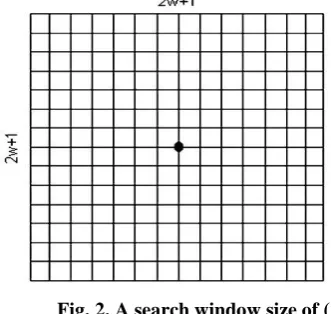
measure [13][15]. The mechanism behind finding the motion vector is to identify a candidate block in the current frame as it is in the reference frame. At first, the block is searched in a specified window size of (2W+1)*(2W+1) as shown in Figure 2.
Where W is the pixel value both in horizontal as well as vertical direction. Moving the candidate block in that window the best match block position is the motion vector as shown in Figure 1.
The reason behind the literature goes from heuristic search to fast search is the principle of local minima. The major drawback of heuristic search is that it is a time-consuming process. The candidate block is searched over the entire window [6]. Hence the search operation takes too much time for finding the motion vector. Although it is a time-consuming process but it guarantees the true motion vector that gives the optimal solution whereas through the fast search method we have to satisfy with only the suboptimal solution. As most real-world application many computationally efficient variants were developed, among which are typically the three-step search (TSS), New three-step search (NTSS) etc. NTSS is another variant of TSS that not only find the coarse motion vector but also the finer one. Centre biased property of motion vector leads to the introduction of NTSS.
Fig. 1.Motion vector between the two successive frames The various algorithms like Diamond search (DS)[12], Block-based gradient descent search (BBGDS) as well as Four-step search and [14] are developed to reduce the computational complexity less than Ο(n2
) [16]. Searching pattern and the associated shape and size of various motion estimation algorithms varies.
A New Pentagon Search Algorithm for Fast
Block-Matching Motion Estimation
[image:1.595.315.535.488.672.2]Some algorithms follow like square-shaped search patterns of different size (e.g. TSS, 4SS) while DS algorithm maintains diamond-shaped search structure and hexagonal search probes the six neighboring points variation.
Fig. 2. A search window size of (2W+1)
This paper is organised as follows Section 2 deals with the various types of searching method for finding the motion vector. Section 3 elaborated on the algorithm proposed, followed by result and discussion in section 4. Section 5, which has the conclusion section that has its concluding remark and future work.
II. DIFFERENT SEARCH TECHNIQUE FOR FINDING THE
MOTION VECTOR
The development of search pattern for estimation the motion vectors takes about tens of years. In the medical field, Tsai et al proposed a scheme for angiogram video sequence in 1994 that was fully relied upon a full frame DWT. To achieve high compression ratio this method is applied for using the frame difference method. Gibson et al. suggested about the possibilities for eliminating the artefacts from final image by adaptively examining prediction error and adjusting it appropriately for shrinking of digital angiogram videos that leads to the introduction of wavelet-based approach of lossy character. Later fast algorithms for searching are developed to evaluate motion estimation on real-time video [17]. Block searching techniques for the different type of I, P and B frames are developed. Some of the popular and efficient techniques are as follows.
A. Hexagon algorithm
Author This approach was introduced in 2002. The number of search points gets reduced after applying this algorithm compared to previously introduced algorithms, and hence results in declining the computational cost. HEXBS approach, summarized steps are follows:-
1) In The big hexagon with seven checking points is centred at (0,0) and all the seven points are tested for the block having minimum distortion. Two possibilities may arise in such case:
If Minimum Block Difference (MBD) point is found to be at the centre of the hexagon, proceed to (3) (Ending);
Otherwise, proceed to (2) (Searching).
2) the new MBD point chosen as centre and a new hexagon is formed. Again with this newly formed hexagon MBD point is identified by checking at all seven places. If it remain
the point of newly hexagon at centre, terminates (3); otherwise, repeat this step continuously.
(3) the large hexagon is switched into a small hexagon. The four new points associated with it is compare to the present MBD point. Newly initialized MBD point leads to end stage of motion vector.
[image:2.595.62.228.104.261.2]Algorithm can be explained as following on above discussed methodology. Firstly all the seven-point of the hexagon is searched if minimum distortion occurs at all six points except the centre then considering that point as centre the process is repeated [8]. If the MAD is found at the centre then the shape of the hexagon is reduced and then four extra points needed to be searched.
Fig. 3. Hexagon-based search (HEXBS): large (1) and small (2) hexagonal patterns
B. Diamond search algorithm
The Diamond Search algorithm illustrated as:
Step 1) let centre of LDSP assumed as origin, where we've 9 points to be checked on origin of search window. if the MBD points found at centre, then moved to (3) else proceed for (2). Step 2) the new LDSP is created with the previous MBD point found, assuming the MBD as centre. According to previously described step s newly MBD point should be on found on centre, if it's not then moved to (3), else recursively repeat this step.
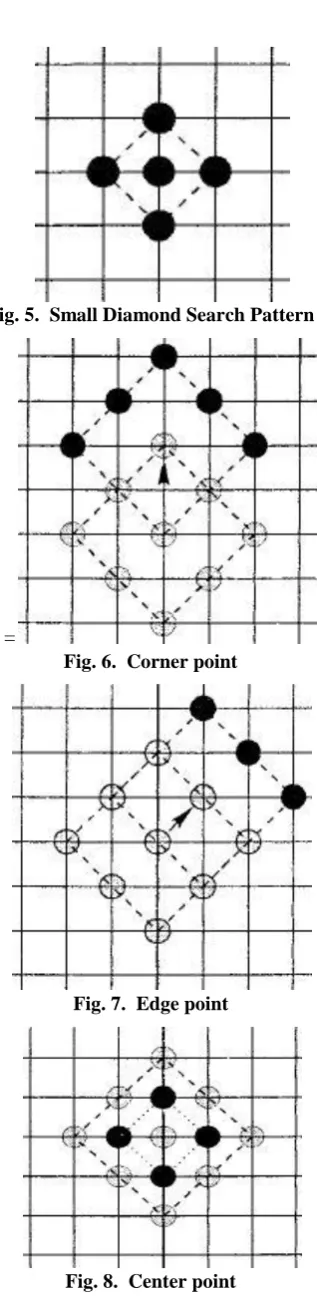
Step 3) LDSP is converted into SDSP (Small Diamond Search Pattern). The four-point of SDSP is tested. The new MBD point is the final solution of the motion vector i.e. best matching block.
[image:2.595.325.530.210.354.2]International Journal of Innovative Technology and Exploring Engineering (IJITEE) ISSN: 2278-3075,Volume-8 Issue-10, August 2019
Fig. 5. Small Diamond Search Pattern
[image:3.595.93.252.27.679.2]=
Fig. 6. Corner point
Fig. 7. Edge point
Fig. 8. Center point
In the above algorithm if the minimum found at the corner position of the LDSP then 5 extra points need to be checked and if the minimum found at the edges then 3 extra points needed to be checked [5] .
When the minimum found at the centre position than 4 extra points need to be checked and LDSP becomes SDSP [11][7].
C. Three step search
Koga et. al. described above mentioned algorithm in 1981. The performance evaluation is near optimal of this algorithm due to searching strategy of the best motion vectors detection in a coarse to the fine search pattern [12]. The algorithm steps are as follows:
Step 1) An initial step size is chosen. Eight blocks at a distance of step size from the centre (around the centre block) are picked for comparison.
[image:3.595.309.539.233.411.2]Step 2) The step size is then reduced to halved. The centre is assumed to be at point with the minimum distortion. Both of the above steps are repeated till the step size becomes smaller than 1. A particular path for the convergence of this algorithm is shown below:
Fig. 9. TSS Algorithm steps
III. PROPOSEDALGORITHM
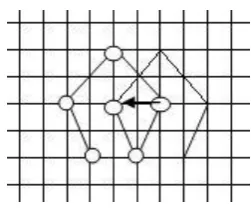
Based on the above observation a new fast pentagon algorithm is developed. The Figure for the Pentagon algorithm is shown in Figure 1. From the center point of the Pentagon all the distance is equal of 2 units except the lower corner ends that are √5. The Pentagon algorithm steps are as follows:
Step 1: The large pentagon with six checking points centered at (0,0), is tested for minimum block distortion with all six points. The MBD is tested and if, identified at the center of the Pentagon, proceed 3. (Ending); otherwise, go to step 2) (searching)
Step 2: Now a new large pentagon is created by assuming the MBD point of the previous search as the center. All new candidate points are checked and the MBD point is again identified. If the MBD point is still at the center point of a newly formed pentagon, then proceed to step 3) (ending); otherwise perform this continuous step repeatedly.
Step 3: Reduce the size of a search pattern from the large pentagon to four nearest neighbour points. The new four-point in the small pentagon tested for comparison with the present MBD point. The present MBD point termed as final solution for the motion vector.
Npent (mx, my) = 6+3*n + 4
[image:4.595.86.294.113.487.2]Where n = no of iteration the newer point exist mx, my = motion vector position coordinates Npent = total no of search point through proposed pentagon method
[image:4.595.364.489.115.237.2]Fig. 10. Pentagon Search
Fig. 11. The shape of the proposed Pentagon
The angles of this pentagon are 90, 110,110, 115,115 degree. A. CASE 1
If the minimum MAD found at left most or right most corner then the new pentagon formed has only 3 new search points. The minimum should be checked at all three external points.
Fig. 12. minimum MAD found at left or right corner
B. CASE 2
[image:4.595.353.500.271.389.2]If minimum MAD found at lower left or right corner then again 3 new points are searched. One point inside the previous Pentagon need not be checked because there is a correlation between neighbouring blocks [10].
Fig. 13. Minimum MAD found at left position
Fig. 14. Minimum MAD found at right position
C. CASE 3
Another case may arise if the minimum found at the top most corner of pentagon then two points of the newly formed pentagon
Fig. 15. Minimum found at the top position of the Pentagon
D. CASE 4
[image:4.595.326.520.475.634.2] [image:4.595.105.231.597.701.2]International Journal of Innovative Technology and Exploring Engineering (IJITEE) ISSN: 2278-3075,Volume-8 Issue-10, August 2019
Fig. 16. Minimum found at centre position
IV. RESULT AND DISCUSSIONS
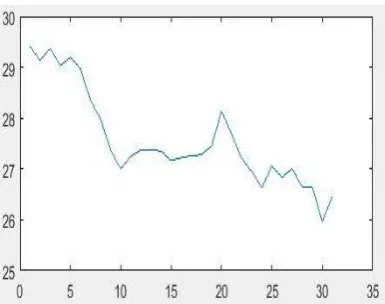
[image:5.595.61.271.290.455.2]Two video sequences are taken for analysis purpose “missa” and “caltrain”. In caltrain video sequence there are 32 frames of size 512*400. In missa video sequence there are 148 frames of 360*288 size.
Fig. 17.PSNR value of 32 frames of “missa” sequence having total 149 frames
Fig. 18.PSNR value of “caltrain” sequence having 32 frames
Case 1...( a) 6+3*1+4= 13(PENT) (b) 9+3*1+4= 16(DS) SIR= ((16-13)/3)*100 = 23%
Case 2...(a) 6+3*2+4 = 16(PENT) (b) 9+3*2+4= 19(DS) SIR= ((19-16)/16)*100 = 18.75%
Case 3.... SIR = ((9-6)/6)*100 = 50%(in both DS and PENT) Avg SIR = (23+18+50)/ 3 = 31%
By analyzing the minimum possible search points of DS and Pentagon method, 3 points are saved on an average. Hence we see 31% increment in SIR performance over diamond search. Performance comparison for caltrain video sequence is given below
Table 1:Motion vector and total time elapsed for caltrain video sequence
Motion vector Frame size Total time
DS 143 512*400 17.684
Hexagon 165 512*400 16.73
Pentagon 179 512*400 15.98
Table 2: Motion vector and total time elapsed for missa video sequence
Motion vector Frame size Total time
DS 82 360*288 13.9419
Hexagon 91 360*288 13.8512
[image:5.595.302.559.318.552.2]Pentagon 97 360*288 12.6734
Fig. 19. Motion vector for caltrain video sequence
Table 3:Avg MAD per pixel for missa and caltrain video sequence at different frame rate
Mad per pixel
Frame diff1 Frame diff3
missa 4.809 4.984
caltrain 2.561 3.882
Table 4:Avg search per frame for missa and caltrain video sequence at different frame rate
Average search per frame Frame diff1 Frame diff3
missa 0.604 0.843
[image:5.595.59.252.505.657.2]Fig. 20.Graph showing MAD for missa and caltrain sequence
V. CONCLUSION
In this paper, search pattern and search strategies of different block matching algorithm are analyzed. A new Pentagon block matching algorithm is proposed in this paper and simulation results shows that it has better performance over the existing hexagon and DS algorithm in terms of lesser no of search points. All the simulations are performed in MATLAB environment. The speed improvement rate is about 31% with respect to the DS algorithm. Like the DS and other algorithms it may be applied for the latest video compression codec.
REFERENCES
1. Vayalil, Niras Cheeckottu, and Yinan Kong.: ‘VLSI Architecture of Full-Search Variable-Block-Size Motion Estimation for HEVC Video Encoding.’ IET Circuits, Devices & Systems 11.6 2017: 543-548. 2. Paramkusam, A. V.: ‘Efficient motion estimation algorithm on the
layers.’ Electronics Letters 53.7 2017: 467-469.
3. Jia, Hongjun, and Li Zhang.: ‘Directional Cross Diamond Search Algorithm for Fast Block Motion Estimation.’ arXiv preprint arXiv:0806.0689, 2008.
4. Chau, Lap-Pui, and Ce Zhu.: ‘A fast octagon-based search algorithm for motion estimation.’ Signal Processing 83.3 , 2003, 671-675.
5. Chauhan, Shahida. : ‘Comparative study on diamond search algorithm for motion estimation.’ , 2015.
6. Nie, Yao, and Kai-Kuang Ma.: ‘Adaptive rood pattern search for fast block-matching motion estimation.’ IEEE Transactions on image processing 11.12, 2002, 1442-1449.
7. Zhu, Shan, and Kai-Kuang Ma.: ‘ A new diamond search algorithm for fast block-matching motion estimation.’ IEEE transactions on Image Processing 9.2, 2000, 287-290.
8. Zhu, Ce, Xiao Lin, and Lap-Pui Chau.: ‘Hexagon-based search pattern for fast block motion estimation.’ IEEE Trans. Circuits Syst. Video Techn. 12.5, 2002, 349-355.
9. P. T. Kovács, Z. Nagy, A. Barsi, et. al : ‘Overview of the applicability of H.264/MVC for real-time light-field applications’ 2014 3DTV-Conference: The True Vision - Capture, Transmission and Display of 3D Video (3DTV-CON), Budapest, 2014, pp. 1-4,. 10. Neetish Kumar, Dr Deepa Raj, ‘Video Processing and its Applications:
A survey’ International Journal of Emerging Trends & Technology in Computer Science (IJETTCS), 2017, ISSN 2278-6856,.
11. Neetish Kumar, Dr Deepa Raj, ‘A Study and Analysis of Images in Different Color Models’, International Journal Of Advanced Studies In Computer Science And Engineering IJASCSE 2018, Volume 7, Issue 1,. 12. Kulkarni, S. M., D. S. Bormane, and S. L. Nalbalwar. : ‘Coding of video sequences using three step search algorithm.’ Procedia Computer Science 49, 2015, 42-49.
13. Nguyen, Tung, Philipp Helle, Martin Winken, et al.: ‘Transform coding techniques in HEVC.’ IEEE Journal of Selected Topics in Signal Processing 7, no. 6, 2013, 978-989.
14. Ugur, K., Liu, H., Lainema, J., Gabbouj, et a : ‘ Parallel encoding-decoding operation for multiview video coding with high coding efficiency. 3DTV Conference, 2007 (pp. 1-4). IEEE.
15. Stankowski, J., Grajek, T., Wegner, K., et al.: ‘ Video quality in multiple HEVC encoding-decoding cycles.’ 20th International Conference on Systems, Signals and Image Processing (IWSSIP),2013, (pp. 75-78). IEEE.
16. Xiong, Zixiang, Beong-Jo Kim, and William A. Pearlman.: ‘Multiresolutional encoding and decoding in embedded image and video coders.’ Acoustics, Speech and Signal Processing, 1998. Proceedings of the 1998 IEEE International Conference on. Vol. 6. IEEE, 1998 17. Yi, Kang, You-Han Lee, and Jeong-Hyun Joo. "A Fast Video Decoding
Technique by Means of Converting Input Video Stream into Forward-Oriented Format Stream in Little-Endian Systems." 2015 7th International Conference on Multimedia, Computer Graphics and Broadcasting (MulGraB). 2015, IEEE
AUTHORSPROFILE
Neetish kumar, Research Scholar of department
of computer science of Babasaheb Bhimrao Ambedkar University (A Central University), Lucknow. Currently working on video processing, image processing and pattern recognition. He completed his M.tech computer science degree from Central University of South
Bihar, Patna
Dr. Deepa Raj, working as an Assistant Professor in the Department of
Computer Science Babasaheb Bhim Rao Ambedkar University. She did her Post Graduation from J.K Institute of applied physics and technology, Allahabad University and Ph.D. from Babasaheb Bhim Rao Ambedkar University Lucknow in the field of software engineering. Her field of interest is Software Engineering, Computer phics, and Image processing. She has attended lots of National and International conference and numbers of research papers published in her field of interest.
[image:6.595.57.281.47.217.2]![Fig. 1. The various algorithms like Diamond search (DS)[12], Block-based gradient descent search (BBGDS) as well as Four-step search and [14] are developed to reduce the computational complexity less than Ο(npattern and the associated shape and size of va](https://thumb-us.123doks.com/thumbv2/123dok_us/8187679.256819/1.595.315.535.488.672/algorithms-diamond-gradient-developed-computational-complexity-npattern-associated.webp)