Abstract: In wireless sensor network application, the localization of nodes are carried out for extended life time of the node. Many applications in wireless sensor network perform localization of nodes over an extended period of time with energy variance. However, optimal selection algorithm poses new challenges to the overall transmission power levels for target detection, and thus localized energy optimized sensor management strategies are necessary for improving the accuracy of target tracking. In this work, it is proposed to develop a Bayesian Localized Energy Optimized Sensor Distribution (BLEOSD) scheme for efficient target tracking in Wireless Sensor Network. The sensor node localized with Bayesian average scheme thatestimates the sensor node’s energy are optimized as per data transfer capacity verification. The Bayesian average energy level of the sensor network is compared with the energy of each sensor node. The sensor nodes are localized and energy distribution based on the Bayesian energy estimate for efficient target tracking. The sensor node distribution strategy improves the accuracyto identify the targets effectively. Experiments are conducted using simulation of WSN by varying number of nodes, energy levels of the node and target object density using the Network Simulator Tool (NS2) The proposed BLEOSD technique is compared with various recent methods by evaluating accuracy of target tracking, energy consumption rate, localized node density and time for target tracking. The experimental results shows that the performance of BLESOD is more encouraging compared to contemporary methods.
Keywords: Wireless sensor network, Localization, Bayesian, Energy optimization
I. INTRODUCTION
O
ne of the important characteristics of the mobile device is its efficiency to analyze its current location. In various real-time applications, the information about the current location alone is not sufficient and however the energy efficient analysis of location is also essential. Although there are different energy efficient target tracking methods are available in the literature for wireless sensor networks, we are interested to propose a method that improves the accuracy of the target being tracked at an early stage.Apart from traditional WSN model, a new tracking framework named Recognition and Tracking Algorithm for Continuous Objects (BRTCO) [17],Robust Kalman
Revised Manuscript Received on October 05, 2019.
Dr. P. Sumathy *, Assistant Professor, Department of Computer Science
& Engineering, Bharathidasan University, Tiruchirappalli, India, Email:
S.Alonshia, Research Scholar, Department of Computer Science &
Engineering, Bharathidasan University, Tiruchirappalli, India Email: [email protected]
filter-based decentralized target search(RKF-based De-TarSK) [24] and Sequential Markov Chain Monte Carlo referenced for Multi-target Tracking (SMCMC) have predicted the target location employing a spatial region.RKF-based De-TarSK [24] has used edge detection algorithm to detect the target in short time. Continuous target tracking for varied polygon size has rapidly increase the energy rate. To handle the above mentioned issues, Target Tracking and Mobile Sensor Navigation (SMCMC) [25] has been proposed to improve the energy consumption by applying min-max approximation approach. This approach has improved the tracking performance at the cost of energy.As, result, optimizing energy consumption alone is not sufficient for improving the tracking performance, but also localization of sensor nodes is also considered to be an important model. Localization through sensor node distribution by adopting distribution-free approach has been investigated in [3],where network lifetime has been improved. However, providing guarantees for tracking accuracy and consequently also for network lifetime, is difficult as the tracking accuracy depends, among others, on the sensing-based model [4], range-based approach [5]. Instead of endeavoring to present a comprehensive assurance on tracking accuracy, the target tracking system should ensure an individual application‟s needs, not only in terms of accuracy, but also in terms of location-based routing [6], spatiotemporal properties [7]. Location-based routing optimized the distance travelled by the location update to minimize the overall energy cost. On the other hand, node localization in WSN based on spatiotemporal properties reduced the localization error by applying Event Distribution Function. Most schemes presented above localize the sensor nodes by exploiting routing information based on the distance. These schemes eliminate the need for sensor node localization at the cost of energy optimality. However, the sensor nodes energy usage varies over time, the time for target tracking increases with the increase in localized node density.
This paper has proposed BLEOSD, a localization and target tracking scheme that tracks the target in short time. Using a Bayesian Sensor Node Localization architecture, BLEOSD offers a localized and energy optimized sensor distribution for real-time applications. Any number of sensors may be localized within a covered area, making BLEOSD scheme suitable for large-scale deployments. The rest of the paper is organized as follows. In Section 2, we introduce the existing works on localization of sensor node and target tracking problem. In Section 3, we introduce the Bayesian Localized Energy Optimized
Sensor Distribution (BLEOSD) scheme for efficient target
Bayesian Localized Energy Optimized Sensor
Distribution for Efficient Target Tracking
tracking in wireless sensor network. Section 4 gives a comprehensive experimental evaluation of BLEOSD scheme. Our numerical results are shown in Section 5. Concluding remarks are included in Section 6.
II. RELATEDWORKS
Existing approaches for sensor node localization such as location anonymization algorithm [8], typically focus on aggregating k-anonymous locations with the aim of providing high quality location monitoring system. Say for example, Trajectory-based data forwarding [9] using link delay model has developed a data forwarding scheme to light traffic vehicular ad hoc networks. A passive vehicular traffic measurement to increase sensor time synchronization error has been designed [10] using autonomous passive localization algorithm.
The WSNs are progressively being imagined for productive information gathering, from a geological area of intrigue. In a few observation utilizations of WSNs, target following is one of the principle destinations once the sensor nodes are confined. In the meantime vitality effective target following has been broadly examined in the proceedings. In [11], Channel Adaptive Multiple Input Multiple Output instrument has intended to diminish the intricacy while identifying objects are planned. A trial exertion dependent on Redundant Radix-based Approach [12] has been intended for broadening the system lifetime. In [13], astute portable focus in a versatile sensor arrange has been investigated by showing ideal development strategy. The DOC [Depth of Coverage] approach is used to optimize the detection capability of this class of sensor networks for hundreds of cooperative agents, while minimizing their energy consumption and avoiding collisions with the obstacles. The results show that the DOC [Depth of Coverage] approach significantly has improved the probability of detection compared to other scalable strategies known as uniform, [22], [23] grid, random and stochastic gradient methods.
First, tracking has been studied for minimization of sensor installation cost [14]. Second target tracking has been considered as an anomaly detection problem [15] by applying sequential testing. Third in certain cases, target tracking has been considered as an optimal decision rule problem [16] using Bayesian formulation. Fourth, few efforts has been conducted based on distributed target tracking [18] under ideal binary sensor model. Finally, a few target tracking approaches have used adaptive node selection [19] for reducing the energy cost and computational complexity as well as ensuring the tracking accuracy. A voronoi-based distributed sensor handover protocol [20] has been designed using localized algorithm with the objective of target tracked ratio, i.e., the quality of target tracking service. A quantized measurement fusion framework has been investigated in [21] using probabilistic quantization scheme to reduce the average communication energy saving.
In contrast all the above mentioned approaches, this paper emphasize accuracy of target tracking, energy consumption rate with localized node density. The proposed BLEOSD scheme is robust and efficient target tracking approach. It
provides competitive tradeoffs between energy-efficiency, tracking accuracy, and time for target tracking.
III. METHODOLOGY
Target tracking is one the most significant applications in remote sensor networks. A target forecast plot depends on kinematics standards and principle of likelihood that upgrades the vitality proficiency. Considering only vitality proficiency alone may not adequate for as tracking applications. In this setting we initially present the issues and the BLEOSD has handled the issues. Segment 3.2 discusses about the vitality proficient sensor hub limitation model in BLEOSD. Section 3.3 highlights on hub dispersion dependent on Bayesian vitality gauge for effective target tracking.
A. Problem definition
Given a rectangle sensing area „ ‟, a grid deployment scheme partitions the sensing area into „ ‟grid points. Each grid point „ ‟ is associated with a coordinate
„ ‟, where „ ‟ represents the
„ ‟ coordinates of „ ‟
respectively, and also
„ ‟. One of the
challenging issues while accessing with sensor nodes in wireless sensor network isthat the localization of the sensor nodes. With the decrease in the energy of sensornetwork, the performance of sensor network also gets deteriorated. It is well known that the fundamental issue in WSN is energy consumption. This issue is considered in this work to minimize the consumption of energy with the objective of efficient target tracking in WSN using localized energy optimized model. The proposed approach is compared with Boundary Recognition and Tracking Algorithm for Continuous Objects (BRTCO) [17]Robust Kalman filter-based decentralized target search(RKF-based De-TarSK) [24] and Sequential Markov Chain Monte Carlo for Multi-target Tracking (SMCMC)[25].
B.Bayesian Localized Energy Optimized Sensor Distribution [Bleosd Technique]
Initially we define the Bayesian energy is localized in Bayesian Localized Energy Optimized Sensor Distribution (BLEOSD) scheme for efficient target tracking in wireless sensor network.
Fig 1: Block Diagram of Bayesian Localized Energy Optimized Sensor Distribution
C.Bayesian-Based Sensor Node Localization
In the proposed sensor node localization model it is assumed that each sensor energy acts independently and the energy is updated based on the number of hop counts from sender sensor node to receiver node at a particular time. Based on the Bayesian network model, let us consider three sensor nodes „ ‟ with three subordinate nodes „ ‟ to communicate with each other. The sensor node localization is carried out with Bayesian average that estimates the sensor node‟s energy optimality. Let us consider energy „ ‟for a sensor node „ ‟, then the average
energy of the sensor network is as shown below.
---(1)
Where „ ‟ is the network size. The Bayesian average energy level of the sensor network is compared with the energy of each sensor node and is formalized as given below.
---(2)
Node localization is performed based on the sensor nodes in the network that satisfies the above constraints, aiming at reducing the energy consumption rate. Node localization is carried out using the Bayesian network model. The Bayesian network model with three sensor nodes
„ ‟ is shown in fig 2.
Figure 2 Bayesian Network Model
As shown in the figure, the sensor node „ ‟ is connected with „ ‟ (i.e. sub ordinate nodes), the sensor node „ ‟ is connected with „ ‟ and the sensor node „ ‟ is connected with „ ‟ respectively. The conditional probabilities of above Bayesian network is factorized and is as shown below.
--- (3)
--- (4)
The information from (3) and (4) constrains the possible locations of a sensor node. The energy for each sensor node is measured. Corresponding to the energy measurement and Bayesian formulation, each sensor node constructs a constraint on its location estimate and is given below.
---(5)
Where „ ‟ is the conditional
probability of Bayesian network of the average energy level of sensor network, corresponding to sensor nodes „ ‟, and „ ‟ is the average energy of the sensor network. Figure 3 shows the algorithmic description of Bayesian Sensor Node Localization.
Input: Sensor Nodes „ ‟,
Subordinate nodes „ ‟, sensing area „ ‟, energy „ ‟
Output: Optimized energy consumption Step 1: Begin
Step 2: For each sensor node and sensing area
„ ‟
Step 3: Measure average energy of the sensor network using (1)
Step 4: If
Step 5: Perform localization
Step 6: Measure conditional probabilities using (3) and (4) Step 7: Measure location estimate using (5)
Step 8: End if
Step 9: If
Step 10 : Do not perform localization Step 11: End if
[image:3.595.306.551.433.719.2]Step 12: End for Step 13: End
Figure 3 Bayesian Sensor Node Localization algorithm As shown in the above algorithm, sensor node localization is performed with the help of Bayesian average. By this, the sensor node energy optimizing
[image:3.595.50.283.531.769.2]Bayesian average energy of the sensing area is compared with the energy of each sensor node. Finally, the sensor nodes are localized.
D.Single Hop Sensor Node Distributional Strategy The sensor nodes are localized as mentioned in the previous section. The sensor node distribution is performed for efficient target tracking. The objective of applying sensor node distributional strategy is to improve the accuracy of identifying the targets to be tracked and also at a quicker rate. Once the location estimate constraint is computed, each sensor node applies the Bayesian inference to evaluate its New Bayesian Energy Estimate (NBEE) from its Old Bayesian Energy Estimate ( ) and the location estimate constraint ( ).
---(6)
In Single Hop Sensor Node Distributional Strategy a concentrated sink node is at the focal point of system. Here all other sensor nodes are at one-hop separate far from the sink to the target location. At whatever point the detected estimation of physical characteristic surpasses a limit ' in any node, the sensor node transmits this incentive to the sink node. The parcels incorporate the node personality ' alongside its area ' and furthermore the timestamps ' of location of the objective and is formalized as given as follows
---(7)
Let „ ‟ be the number of sensor nodes sensing the target„s above the threshold„ ‟ and that all the that all the „ ‟sensors report the sensed value within a time period „ ‟. In single hop distributional strategy, the positional values of
„ ‟ and
„ ‟ of the target is measured
as given below.
---(8)
---(9)
Where „ ‟ and „ ‟ denotes the
„ ‟ and „ ‟ of the „ith‟
sensor. The velocity for target tracking is obtained as given below.
---(10)
---(11)
Where „ ‟ and „ ‟ symbolizes the velocities
for „ ‟ and „ ‟ along
„ ‟ and „ ‟ directions respectively. From the position and velocity information, sensor node distributional strategy improves the accuracy of identifying the targets to be tracked. Therefore target tracking at different instances is denoted as.
.
---(12)
[image:4.595.308.547.102.330.2]From (12), the target being tracked for sensor node „‟ at time instant „‟ is obtained. This in turn improves the accuracy of targets being tracked. Figure 4 shows the algorithmic description of Single Hop Sensor Node Distribution.
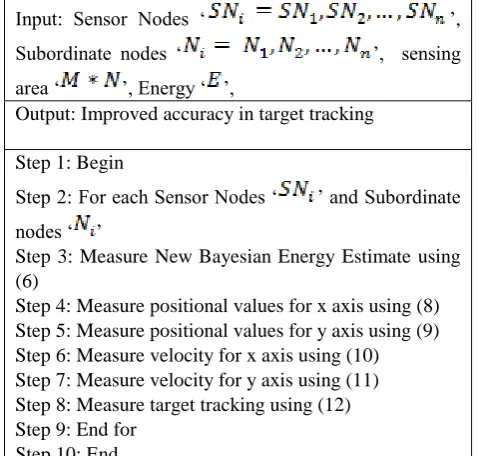
Figure 4 Single Hop Sensor Node Distribution algorithm From the Single Hop Sensor Node Distribution algorithm given above, the target tracking accuracy of the sensor node Si improved by applying the positional and velocity updates to the updated Bayesian energy estimate values.
IV. EXPERIMENTALRESULTS
Bayesian Localized Energy Optimized Sensor Distribution (BLEOSD) scheme is stimulated using NS-2 simulator with the network range of 1400*1400 m size. The number of sensor nodes selected for experimental purpose is 70 nodes and uses Random Way Point (RWM) model for BLEOSD scheme. The BLEOSD scheme uses Destination Sequence Based Distance Vector (DSDV) as routing protocol.
The experimental process ofBayesian Localized Energy Optimized Sensor Distribution (BLEOSD) states that each node is to track its neighbor node by sending calm request. The request-response process is handled and the receiver node send the response by accepting the request from the sender node using copy-verification-forward process. This function takes place till the sender node completes its data transmission process with the tracking nodes.
Figure5. Stimulation Environment
Input: Sensor Nodes „ ‟,
Subordinate nodes „ ‟, sensing area „ ‟, Energy „ ‟,
Output: Improved accuracy in target tracking
Step 1: Begin
Step 2: For each Sensor Nodes „ ‟ and Subordinate nodes „ ‟
Step 3: Measure New Bayesian Energy Estimate using (6)
Step 4: Measure positional values for x axis using (8) Step 5: Measure positional values for y axis using (9) Step 6: Measure velocity for x axis using (10) Step 7: Measure velocity for y axis using (11) Step 8: Measure target tracking using (12) Step 9: End for
The BLEOSD scheme‟s moving speed in the network is about 10 m/s for each source node with a simulation rate of 50 milliseconds to perform target tracking. The values of each parameter for performing experiments are shown in table 1. Experiment is conducted on the factors such as energy consumption, target tracking accuracy, localized node density and time for target tracking. The results of the metrics of BLEOSD scheme is compared against the existing methods Boundary Recognition and Tracking Algorithm for Continuous Objects (BRTCO) [17]Robust Kalman filter-based decentralized target search(RKF-based De-TarSK) [24] and Sequential Markov Chain Monte Carlo for Multi-target Tracking (SMCMC) in WSN.
Table I. Parameters and values forSimulation
PARAMETER VALUE
Protocols DSDV
Network range 1400 m * 1400 m
Simulation time 50 ms
Mobility model Random Way Point
Localized node density 10, 20, 30, 40, 50, 60, 70
Network simulator NS 2.34
Mobility speed 10 m/s
Pause time 10 s
V.RESULTANDDISCUSSION
The performance ofBayesian Localized Energy Optimized Sensor Distribution (BLEOSD) scheme is compared with the previous (BRTCO) [17] (RKF-based De-TarSK) [24] and (SMCMC)in WSN. The performance is evaluated according to the following metrics.
A. Scenario 1: Impact of energy consumption rate In wireless sensor networks, all sensor nodes are energy constrained. In such scenarios, it becomes highly essential to reduce the energy consumption rate. We incorporate Bayesian Sensor Node Localization algorithm to further reduce the energy consumption. The energy consumption for target tracking „ ‟ from any source sensor node is written as given below.
____(13)
From (13), the energy consumption „ ‟ for target tracking is obtained by the product of the energy for single node „ ‟ and total sensor nodes „ ‟ in the network. It is measured in terms of Joules (J). Experiments are conducted in NS2 to validate the Bayesian Localized Energy Optimized Sensor Distribution (BLEOSD) scheme, (BRTCO) [17](RKF-based De-TarSK) [24] and Sequential Markov Chain Monte Carlo for Multi-target Tracking (SMCMC) [25] in WSN.
Table II Energy Consumption Rate
Localized node density
ENERGY CONSUMPTION RATE (J)
BLEOSD BRTCO RKF-based
DeTarSK
SMCMC
10 58 59 68 63
20 75 80 86 78
30 89 97 99 93
40 70 85 96 78
50 85 89 101 95
60 92 96 108 99
70 88 100 99 93
The Table 2 presents the energy consumption rate obtained using NS2 simulator and comparison is made with three other methods, namely BRTCO [17], RKF-based DE-TARSK [24] and SMCMC [25]. To conduct experiments, localized node density in the range of 10 to 70 sensor nodes are considered.
Figure.6. Energy Consumption Rate
Figure 6 illustrates the average energy consumption for target tracking versus number of localized node density in the network. As shown in the figure, the energy consumption rate is comparative to the localized node density. With the increase in the simulation time, as the localized node density increases the result in an increase in the energy being consumed.
[image:5.595.50.291.232.366.2]Figure .7. Efficiency Throughput
Figure 7 illustrates the average energy consumption for target tracking with several nodes. It is observed from the result states that multiple nodes are available in the data transmission.The sender nodes takes the responsibility of data by identifying its neighbor node.This is addition to the process of sending the data with high security. This process is continued till it reaches the receiver node by tracking the neighbor node one by one with increase in the simulation time. As the localized node density increases, the result increases in the energy being consumed.
B.Scenario 1: Impact of target tracking accuracy In order to study the impact of target tracking accuracy, the localized node density and the objects (i.e. sensor nodes) being tracked are considered.
The target tracking accuracy is then formulated using these two factors and is as given below
[image:6.595.312.543.50.195.2]---(14) Table.III Accuracy of target tracking
Localized node density
TARGET TRACKING ACCURACY (%)
BLEOSD BRTCO RKF-based De-TarSK
SMCMC
10 68.35 56.5 52.14 61.45
20 73.87 70.15 60.72 62.82
30 75.83 72.19 62.68 67.78
40 79.21 78.61 66.05 70.15
50 81.36 80.09 70.21 72.31
60 84.19 79.12 72.04 74.14
70 89.32 85.12 70.17 82.27
From (14), the target tracking accuracy „ ‟ is measured with respect to the localized node density „ ‟. In order to increase the target tracking accuracy with respect to different number of sensor nodes, the target tracking accuracy rate using the BLEOSD scheme and two methods, DM-FT and TT-MSV are presented Table 3. The results for 70 different sensor nodes are shown in Figure 6. The target tracking accuracy rate of BLEOSD scheme is encouraging compared to state-of-the-art methods.
Figure 8 Measure of target tracking accuracy Figure 8 depicts the accuracy for target tracking with several nodes. This result states that multiple nodes are available in the data transmission in which the sender nodes takes the responsibility of data by identifying its neighbor node in the process of sending the data with high security. It shows that the sender node receives the response from the neighbor node and tracking the nearest neighbor node helps to identify boundary nodes. These nodes are located around the border line of the continuous objects in order to transfer the data. The results of BLEOSD scheme that using Single Hop Sensor Node Distribution algorithm has resulted in better tracking accuracy rate compared to [1] and [2]. whereas by applying Hop Sensor Node Distribution algorithm not only the target tracking accuracy rate is improved but also done at minimum energy consumption. On the other hand, Single Hop Sensor Node Distributional Strategy applied in BLEOSD scheme measures the position and velocity before tracking the targets with the aid of New Bayesian Energy Estimate. In Figure 6, the BLEOSD scheme achieves 7.69% and 12.96% target tracking accuracy ratio.
C.Scenario 3: Impact of time for target tracking To study the impact of time for target tracking, the localized node density and the time for target tracking for each sensor node is measured and is as given below.
(15)
[image:6.595.49.290.368.636.2]From equ(15), the time for target tracking „ ‟ is measured with respect to the node density „ ‟ and is measured in terms of milliseconds (ms).
Table IV Time for target tracking
Localized Node Density
Time for target tracking (ms)
BLEOSD BRTCO RKFbased
De-TarSK
SMCMC
10 0.09 0.173 0.18 0.14
20 0.14 0.28 0.21 0.22
30 0.19 0.33 0.28 0.27
40 0.25 0.39 0.33 0.33
50 0.36 0.5 0.47 0.44
60 0.49 0.63 0.59 0.57
70 0.55 0.69 0.71 0.63
[image:6.595.308.541.579.706.2]Figure 10 Target Tracking Time
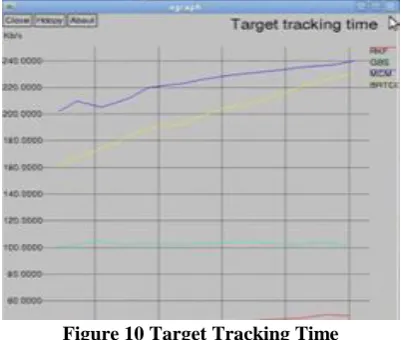
Figure 10 shows the quantitative results to compare the target tracking time performance of the three methods. To investigate the impact of target tracking time, we conducted a simulation by varying the number of sensor nodes in the network. Specifically, we fix the maximum speed of mobile node to 50 m/s and vary the number of sensor nodes from 10 to 70. Figure shows that the target tracking time with varying sensor nodes increases as the number of sensor nodes increase by applying all the methods. However, by applying BLEOSD the target tracking time is comparatively less.
This is because of the Single Hop Sensor Node Distributional Strategy that tracks the target based on the node‟s position and velocity, leading to minimum utilization of time for target tracking. Moreover, by applying sensor node distribution Bayesian distribution strategy, the time for tracking is reduced in BLEOSD scheme by 34.27% compared to BRTCO by 6.65% [17]RKFbased De-TarSK by 9.24% [24] and SMCSMC by5.25%.
[image:7.595.57.282.448.625.2]Figure 11.Average Efficiency Throughput Figure 11 shows the quantitative results to compare the target tracking with high efficiency of data transformation. The impact of target tracking time is investigated by simulation varying the number of sensor nodes in the network by calculating its efficiency when it reaches the receiver node by applying BLEOSD scheme. It is shown that the target tracking time is comparatively less.
VI. CONCLUSION
In this paper, a Bayesian Sensor Node Localization algorithm is proposed based on the concept of Bayesian average energy level to satisfy the two different requirements, high accuracy
of target tracking and low energy consumption rate, with same WSN simultaneously. The Bayesian Sensor Node Localization algorithm is proved to be stable using the sensor node energy optimality. Moreover, the experiment results on a small test and the simulation results on BLEOSD scheme demonstrate that Bayesian Sensor Node Localization algorithm can significantly improve the target tracking accuracy and decrease the energy consumption rate. BLEOSD scheme also improves tracking accuracy at less time interval because only single hop sensor node distribution strategy is applied, which simplifies the implementation. In further process, dripping of data is done on the sink by applying shortest Path from the sensor nodes simultaneously reduces the data loss and by energy consumption and with high efficiency with tracking accuracy.
REFERENCES
1. Guojun Wang, MdZakirulAlamBhuiyan, Jiannong Cao, and Jie Wu, “Detecting Movements of a Target Using Face Tracking in Wireless Sensor Networks”, IEEE Transactions on Parallel and Distributed Systems, Volume 25, Issue 4, April 2014, Pages 939-949.
2. EnyangXu, Zhi Ding, and SouraDasgupta, “Target Tracking and Mobile Sensor Navigation in Wireless Sensor Networks”, IEEE Transactions on Mobile Computing, Volume 12, Issue 1, January 2013, Pages 177-186.
3. Miao Penga, HuiChenb, Yang Xiao, SuatOzdemir, Athanasios V. Vasilakos, JieWue, “Impacts of sensor node distributions on coverage in sensor networks”, Elsevier, Journal of Parallel and Distributed Computing, Volume 71, Issue 12, December 2011, Pages 1578-1591. 4. Liang Liu, Xi Zhang, and Huadong Ma, “Localization-Oriented Coverage in Wireless Camera Sensor Networks”, IEEE Transactions on Wireless Communications, Volume 10, Issue 2, February 2011, Pages 484-494.
5. Jizhong Zhao, WeiXi, Yuan He, Yunhao Liu, Xiang-Yang Li, Lufeng Mo, and Zheng Yang, “Localization of Wireless Sensor Networks in the Wild: Pursuit of Ranging Quality”, IEEE/ACM Transactions on Networking, Volume 2, Issue 1, February 2013, Pages 311-323. 6. Zijian Wang, EyuphanBulut , Boleslaw K. Szymanski,
“Energy-efficient location services for mobile ad hoc networks”, Elsevier, Ad Hoc Networks, Volume 11, Issue 1, January 2013, Pages 273–287.
7. RaduStoleru, Tian He, Siddhartha S. Mathiharan, Stephen M. George, and John A. Stankovic, “Asymmetric Event-Driven Node Localization in Wireless Sensor Networks”, IEEE Transactions on Parallel and Distributed Systems, Volume 23, Issue 4, April 2012, Pages 634-642. 8. Chi-Yin Chow, Mohamed F. Mokbel, and Tian He, “A Privacy-Preserving Location Monitoring System for Wireless Sensor Networks”, IEEE Transactions on Mobile Computing, Volume 10, Issue 1, January 2011, Pages 94-107.
9. Jaehoon (Paul) Jeong, ShuoGuo, Yu (Jason) Gu, Tian He, and David H.C. Du, “Trajectory-Based Data Forwarding for Light-Traffic Vehicular Ad Hoc Networks”, IEEE Transactions on Parallel and Distributed Systems, Volume 22, Issue 5, May 2011, Pages 743-757. 10. Jaehoon (Paul) Jeong, ShuoGuo, Tian He, and David H.C. Du,
“Autonomous Passive Localization Algorithm for Road Sensor Networks”, IEEE Transactions on Computers, Volume 60, Issue 11, November 2011, Pages 1622-1637.
11. I-Wei Lai, GerdAscheid, Heinrich Meyr, and Tzi-Dar Chiueh, “Efficient Channel-Adaptive MIMO Detection Using Just-Acceptable Error Rate”, IEEE Transactions on Wireless Communications, Volume 10, Issue 1, January 2011, Pages 73-83.
13. Jren-Chit Chin, Yu Dong, Wing-Kai Hon, Chris Yu-Tak Ma, and David K. Y. Yau, “Detection of Intelligent Mobile Target in a Mobile Sensor Network”, IEEE/ACM Transactions on Networking, Volume 18, Issue 1, February 2010, Pages 41-52.
14. EdoardoAmaldi, Antonio Capone, MatteoCesana ,IlarioFilippini, “On the design of wireless sensor networks for mobile target detection”, IEEE/ACM Transactions on Networking, Volume 20, Issue 3, June 2012, Pages 784-797.
15. Kobi Cohen and Qing Zhao, “Asymptotically Optimal Anomaly Detection via Sequential Testing”, IEEE Transactions on Signal Processing, Volume 63, Issue 11, June 2015, Pages 2929-2941. 16. Qing Zhao, and Jia Ye, “Quickest Detection in Multiple ON–OFF
Processes”, IEEE Transactions on Signal Processing, Volume 58, Issue 12, December 2010, Pages 5994-6006.
17. Guangjie Han, Member, IEEE, JiaweiShen, Li Liu, and Lei Shu, Senior Member, IEEE “BRTCO: A Novel Boundary Recognition and Tracking Algorithm for Continuous Objects in Wireless Sensor Networks” 1937-9234 © 2016 IEEE.
18. Zijian Wang, EyuphanBulut, and Boleslaw K. Szymanski, “Distributed Energy-Efficient Target Tracking with Binary Sensor Networks”, ACM Transactions on Sensor Networks (TOSN), Volume 6 Issue 4, July 2010, Pages 1-32.
19. Juan Feng, Hongwei Zhao, and BaowangLian, “Efficient and Adaptive Node Selection for Target Tracking in Wireless Sensor Network”, Hindawi Publishing Corporation, Journal of Sensors, Volume 2016, May 2015, Pages 1-10.
20. Tien-Wen Sung and Chu-Sing Yang, “A Voronoi-Based Sensor Handover Protocol for Target Tracking in Distributed Visual Sensor Networks”, Hindawi Publishing Corporation, International Journal of Distributed Sensor Networks, Volume 2014, March 2014, Pages 1-15. 21. Yan Zhou, Dongli Wang, Tingrui Pei, and YonghongLan, “Energy-Efficient Target Tracking in Wireless Sensor Networks: A Quantized Measurement Fusion Framework”, Hindawi Publishing Corporation, International Journal of Distributed Sensor Networks, Volume 2014, February 2014, Pages 1-11.
22. G. McLachlan, Finite Mixture Models. New York, NY: Wiley Interscience, 2000.
23. J. L. Ny and G. J. Pappas, “Sensor-based robot deployment algorithms,” IEEE Conference on Decision and Control, pp. 5486–5492, 2010.
24. AshanieGuanathillake ,Andrey V. Savkin1 , Anura P. Jayasumana “ Robust Kalman filter-based decentralised target search and prediction with topology maps”IET Wireless Sensor SystemsVol. 8 Iss. 2, pp. 60-67 January 2018.