International Journal of Innovative Technology and Exploring Engineering (IJITEE) ISSN: 2278-3075, Volume-8 Issue-6, April 2019
1865
Published By:
Blue Eyes Intelligence Engineering & Sciences Publication
Retrieval Number: F3903048619/19©BEIESP
Abstract: Nowadays due to the increase in the number of school bus services, authentication is becoming an unmanageable task which results in a possibility of an unauthorized use of bus services and raises the risk of insecurity to school students and causes both physical and mental harm to the students. The conventional passenger management practices require an employee for each bus to authenticate the subscription passes which is a time-consuming task. Another school bus management system has been proposed in 2015 using RFID which can be misemployed. To enhance the efficiency of passenger’s management system this paper proposes a novel method for school bus subscription management system using face recognition technology in which a highly efficient cascade classifier algorithm is used for face detection and linear binary pattern histogram algorithm (LBPH) is used for feature extraction and selection. The entire system is programmed using python according to the demand of face recognition technology, python is provided open source computer vision (OpenCV) library support for enhanced face recognition applications. The equipment used in the school bus can distinguish teachers, parents and students and prevents the unauthorized use of bus services and responds by texting the bus administrator about unauthorized access and suggests taking the immediate action and checks the validity of existing users and suggests for renewal after expiry by a short message service(SMS).
Index Terms:-Face Recognition, Authentication System, Python, Cascade classifier, LBP, Texting for Unauthorized usage.
I. INTRODUCTION
Student security is becoming a critical issue nowadays, it is mainly because of the unauthorized access to the bus services therefore an authentication system is important. A face recognition system automatically verifies the identity of a person from a digital image or video frame from its source, a short message service (SMS) can be used to send text messages if unauthorized access prevails and keep track of validity of subscribers.
Face recognition involves extracting features from human faces and distinguishes them with others, it is the matching process between template face and the target face. In this paper Open CV library is used to search for the equivalent image in the database of faces. Basic Flow of our proposed method involves capturing the image by a camera,
Revised Manuscript Received on April 07, 2019.
Dr. S. Rooban, Assoc Professor, E.C.E Department, KLEF, Vaddeswaram, Andhra Pradesh, India.
Neelima Chowdary Battula, Student B.tech, E.C.E Department KLEF, Vaddeswaram, Andhra Pradesh, India
Vinay Bezawada, Student B.tech, E.C.E Department, KLEF, Vaddeswaram, Andhra Pradesh, India
M.V.S. Sai Sandeep, Student B.tech, E.C.E Department, KLEF, Vaddeswaram, Andhra Pradesh, India
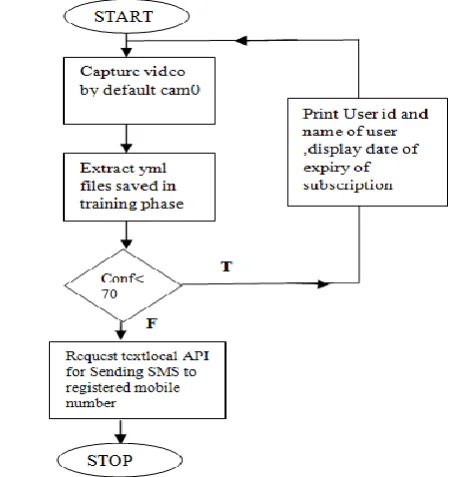
The captured image is processed in classifier and features were extracted which are then compared with template images in the databases. If the image match bus subscription validity is checked remaining days were printed. If the image doesn’t match the decision box becomes false which results in sending a text message to the mobile phone via SMS gateway application program interface (API).
II. LITERATURE SURVEY
Face Recognition System involves face detection, feature extraction, feature selection and classifier.
Fig 1 Face Recognition System.
A. FACE DETECTION
Face detection is the first and essential step of Face Recognition, it is used to detect faces from digital images or video frames. It involves tracking the face of the person in real-time image processing. Face detection can be treated as the specific case of an object class detection in which the algorithms focus on detection of frontal human faces. Face detection methods are classified into four types which are feature-based, appearance-based, knowledge-based, and template-matching.
In feature-based method aspect ratio is the first shape-based feature which is checked, it has to fit in the range *seg.Height >seg.Width >1.42*.seg.Height . All segments are validated and a rectangle with fixed proportion is generated with relation seg.Height = 1.4.seg.Width.Each rectangle is measured by verifying its diameter against the given threshold
This is the final phase in which the generated rectangles is used to separate face from the larger image which is as shown in Fig 2.
Design of School Bus Subscription
Authentication and Management System using
Face Recognition Technology
1866
Retrieval Number: F3903048619/19©BEIESP
Published By:
[image:2.595.71.263.52.123.2]Blue Eyes Intelligence Engineering & Sciences Publication
Fig 2 Feature Based Face Detection Algorithm for Digital still images.
In appearance based object detection the features are chosen to be pixel intensity values of an object in the image. The pixel intensities correspond directly to the radiance emitted by an object when the light falls on it. In this algorithm Eigen light fields of the faces from a set of images are detected. The Eigen light field is used to estimate the collection of images. Estimation of light field from images involves capturing a complete light field of an object using a large set of images. In, most of the image detection scenario only small part of the light field is visible. l(m,n) be an image which for each pixel (m,n) corresponding light field angles mn and mn which represents the orientation of an object from the camera. The least square solutions to the set of equations is i i mn, mn . Where m,n are allowed ranges, Eigen light fields needs to be interpolated in order to estimate i( mn mn).The above algorithm is used to estimate the light field from a set of images, after the estimation of light field new images of the same object with the different poses.
In knowledge-based method genetic algorithm is used in which firstly eye regions are detected by testing with all the grey scale images in the database then the algorithm generates all possibilities of face regions including nostrils, mouth corners and eyebrows and the fitness value of each Eigen face is measured, After a number of iterations high fitness value face is verified.
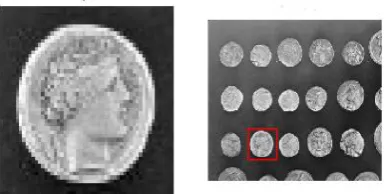
[image:2.595.316.545.60.192.2]In template matching algorithm the first step involves preprocessing, the rough classifier is given with a couple of eyes and face shape as the inputs, the average of a set of pixel values of eye templates and face templates are taken and compared with the target image shown in Fig 3.
Fig 3 Template Image and Target Image in Template Matching Algorithm.
In this paper, cascade classifier algorithm is used which is a multiple learning algorithm in which the output statistical data of each classifier can be obtained and compared with multiple alternative classifiers for better predictive performance as shown in Fig 4.
Fig 4 Face Detection using Cascade classifier.
In python OpenCV frontal face haar cascade is a default xml file designed to detect the frontal face, it works by training the cascade by superimposing negative images on positive images. The algorithm needs a lot of positive images (images with faces) and compares it with the lot of negative images (images without faces) to train the classifier.
B. FEATURE EXTRACTION , FEATURE SELECTION AND CLASSIFIER.
Image feature is an image pattern based on which the image
is described, computer vision can transform the visual information to a vector space and can perform the mathematical operation on them. The two methods, Image descriptors and neural nets are used for extracting features from images. Feature extraction algorithms are classified into two categories, geometrical feature extraction and statistical feature extraction, in geometrical feature extraction distinct facial features are represented as the structural measurements, unknown face is recognized by matching measurements with the nearest neighbor, Principal component analysis (PCA) and Independent component analysis (ICA) are the two algebraic methods which are used for statistical feature extraction.
In python OpenCV feature extraction can be performed in the training of the classifier, the classifier is trained with the existing database using LBP algorithm. LBP algorithm was proposed by Timo Ojala, in LBP histogram method each pixel of an image is labeled with an LBP code. Then the image is divided into several blocks for each block LBP histogram is calculated then the combination of all histograms results into one vectors which is responsible for feature extraction.
[image:2.595.75.270.534.631.2]International Journal of Innovative Technology and Exploring Engineering (IJITEE) ISSN: 2278-3075, Volume-8 Issue-6, April 2019
1867
Published By:
Blue Eyes Intelligence Engineering & Sciences Publication
[image:3.595.318.536.58.267.2]Retrieval Number: F3903048619/19©BEIESP
[image:3.595.86.258.59.104.2]Fig 5 Illustration of Thresholding in LBP(linear binary pattern algorithm)
Fig 6 Binary pattern generation using LBP.
The binary pattern of above illustration is 00111011, the binary value is converted to decimal and set it the center pixel, the radius (r) is used to build the circular local binary pattern and represents the radius around central pixel which is taken as 1. The number of points (p) represents the number of neighbors around the pixel. from Fig 6 the expression for LBP is given by (1)
Where
(1)
[image:3.595.95.247.148.212.2]LBP is considered as uniform if it contains over two transitions bit wise transitions from 1 to 0 and vice versa, accuracy percentage in LBP is greater compared to PCA as shown in table 1.
Table 1 Comparison of accuracy of PCA and LBP
C. COMMUNICATION VIA SMS GATEWAY API
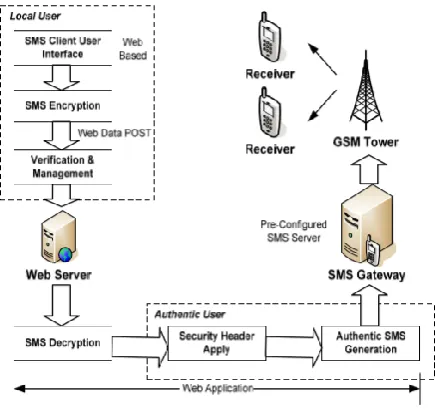
The interaction between python OpenCV and the SMS service includes specifying the API key and choosing SMS gateway API which is mostly used by SMS developers, Text local API is chosen as a sender in this proposed method which requests an URL to send the data specified in the message.
Text local API is a set of communication protocols responsible for sending the SMS message to the web server as shown in Fig 7.
Fig 7 Execution Flow of SMS
D. SMS ARCHITECTURE
A common channel signaling system SS7 is used to transmit SMS messages. The procedures and protocols for information exchange of wired or wireless network elements are defined in SS7. It is a global standard that exchange control information for mobility management, call setup and routing.
The network architecture in an SMS illustrated in Fig 8 consists of two segments these are Mobile Originating part (MO), Mobile Termination part(MT),MO comprises of mobile handset of the sender and a base station (BS) to provide the radio infrastructure for wireless communication and mobile switching center for routing (MSC) that routes the traffic into and out of BS .
[image:3.595.66.272.447.587.2]The other part is MT comprises of BS and terminating MSC for receiver and centralized store forward server SMSC which is responsible for retrieving the account status storing and accepting messages and forwarding them to intended recipients as shown in Fig 8.
Fig 8 Network Architecture in SMS.
Network architecture is assisted by two databases Visitor Location Registrar (VLR) and Home Location Registrar (HLR), These two databases store temporary and permanent mobile subscribers data
[image:3.595.314.535.527.682.2]1868
Retrieval Number: F3903048619/19©BEIESP
Published By:
Blue Eyes Intelligence Engineering & Sciences Publication
E. COMMUNICATION VIA GSM
Global system for mobile communication (GSM) is an European standard 2G mobile network. It is the most widely used digital wireless telephony technologies. It is a circuit-switched network optimized for full duplex voice telephony.GSM is a circuit-switched technology which is integrated with other technologies to form a packet-switched technology GPRS.
Network structure involves base subsystem, Network and switching subsystem, GPRS core network and Operations support system. Key feature in GSM: Subscription identity module (SIM card) is the Key feature which is detachable which allows the user to maintain his information though after changing handsets. GSM Services are Cell Broadcast, GSM localization, Multimedia Messaging Service (MMS), NITZ Network Identity and Time Zone, Wireless Application Protocol (WAP)
III. METHODOLOGY
The entire proposed method is divided into three modules database module, training module, face recognition module. First module involves database creation in which takes captured face, name, user id, subscription date, date of expiry into the database which is shown in Fig 9.
[image:4.595.395.484.102.280.2]a) FACE DETECTION AND DATABASE CREATION
Fig 9 Flow chart for database creation and face detection.
The captured images were converted to grey scale and applied with cascade classifier algorithm for face detection. In this paper for every subscriber minimum of 20 sample images were captured.
b) TRAINING THE CLASSIFIER
[image:4.595.46.266.355.657.2]In this step the images from the existing databases are converted to vectors using LBPH algorithm and features were extracted which is shown in Fig 10.
Fig 10 Flow chart for training the classifier
c) FACE RECOGNITION AND MOBILE
COMMUNICATION
This is the final step in subscription management system where the faces were detected, confidence value differentiates stranger faces with trained faces, remaining subscription days were recorded for authorised users, sends SMS to the user for renewal if subscription expires, and sends SMS to the bus administrator about unauthorised usage as shown in Fig 11.
[image:4.595.308.535.458.697.2]International Journal of Innovative Technology and Exploring Engineering (IJITEE) ISSN: 2278-3075, Volume-8 Issue-6, April 2019
1869
Published By:
Blue Eyes Intelligence Engineering & Sciences Publication
Retrieval Number: F3903048619/19©BEIESP
IV. EXPERIMENTAL RESULTS
[image:5.595.343.512.50.207.2]The cascade classifier algorithm is applied for the database creation using database module in the proposed method which takes a set of samples of an image of a person along with names and user id which are given while the program is in running state during the database creation and LBP algorithm is chosen for training the classifier as shown in Fig 12 using training module.
Fig 12 Training Database.
[image:5.595.107.232.168.307.2]Face Recognition module compares the training module database faces to the real time target image and generates the confidence value which indicates the percentage of match with the database images which is helpful in distinguishing trained faces from strangers which is shown in Fig 13.
Fig 13 Face Recognition and Authentication.
Fig 14 Indicating date of expiry for identified user
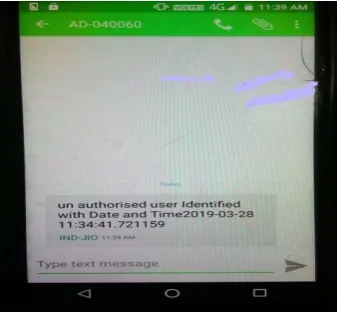
The face recognition module is inserted with text local API ,API key and URL which is used to send SMS to the registered mobile number while the unauthorized user is detected which is shown in Fig 15. Similarly date of expiry of the existing user is displayed.
Fig 15 Text Message Indicating Unauthorized access.
V. CONCLUSION
This paper proposes a novel method for school bus subscription authentication and management system using face recognition technology. This proposed method can be further extended for other transport systems like railways and airlines and for government bus services where unauthorized users can be provided with tickets immediately after authentication and bill payment and can keep track of passengers of all age groups.
REFERENCES
1. Yifeng Guo, Zeshuang Zhao, “Design of School Bus Passengers’ Identity Authentication System Based on RFID” 2015, IEEE,Vol. 11 Iss. 3, pp. 196-200.
2. Mrs. S. P. Balwir, Ms. Kajal Chaudhari, Ms. Kanchan Akre , Mr. Abhijeet Golliwar , Mr. Anurag Lokhande “Face Recognition for Biometric Door Unlocking System”. IJSTER Volume-3, Issue-9, March 2017.
3. W. Zhao, et al (2000).,“Face recognition: a literature survey”. Technical Report CAR-TR-948, University of Maryland, October 2000.
4. Michel F. Valstar, Timur Almaev, Jeffrey M. Girard, Gary mckeown, Marc Mehu, Lijun Yin, Maja Pantic and Jeffrey F. Cohn: “FERA 2015 - Second Facial Expression Recognition and Analysis Challenge” 978-1-4799-6026-2/15/$31.00
©2015 IEEE.
5. Tomasz Orczyk and Piotr Porwik:” Feature Based Face Detection Algorithm for Digital Still Images” University of Silesia, Institute of Computer Science, 41-200 Sosnowiec, Bedzinska 39, Poland.
6. Ralph Gross, Member, IEEE, Iain Matthews, Member, IEEE, and Simon Baker:” Appearance-Based Face Recognition and Light-Fields” VOL. 26, NO. 4, APRIL 2004.
7. Jizeng Wang, Hongmei Yang:” Face Detection Based on Template Matching and 2DPCA Algorithm “:2008 Congress on Image and Signal Processing.
8. Thomas Serre, Bernd Heisele, Sayan Mukherjee, Tomaso Poggio:” Feature Selection for Face Detection” A.I. Memo No. 1697 September, 2000.
9. Shiwani, Dr. Kamal Sharma,Er. Kaushal Kisore:” Comparitive Study of Face Recognition using ANN and BFO Technique” Vol. 5, Issue 3, March 2017.
[image:5.595.66.276.394.672.2]1870
Retrieval Number: F3903048619/19©BEIESP
Published By:
Blue Eyes Intelligence Engineering & Sciences Publication
AUTHORS PROFILE
Dr.S.Rooban, currently working as an associate professor in the department of electronicsand communication at K.L.E.F, Guntur, Andhra Pradesh, India.
Neelima Chowdary Battula, currently pursuing B. Tech in the stream of electronics and communication at K.L.E.F, Guntur, Andhra Pradesh, India.
Vinay Bezawada, currently pursuing B. Tech in the stream of electronics
and communication at K.L.E.F,
Guntur, Andhra Pradesh, India.
M.V.S Sai Sandeep, currently
pursuing B. Tech in the stream of electronics and communication at K.L.E.F, Guntur, Andhra Pradesh,