International Journal of Innovative Technology and Exploring Engineering (IJITEE) ISSN: 2278-3075, Volume-8 Issue-6C, April 2019
Abstract: Today’s world mainly comprises of service computing, where everything is available as a service which in turn have led to exponential increase the user service demands. In order to meet the increasing service demands of the users, there has been rapid development in cloud computing. Due to these huge demands of cloud services many Data Centers (DC) have been deployed. This have led to rapid increase in the number of Data Centers and number of servers within the DC, while increasing the consumption of energy by these DCs. The main issue which is to be considered is the energy consumption by these Data Centers. A sincere consideration to the solution of the problem mentioned above is required for optimization of energy consumption without violating the QoS degradation. This paper proposes a management strategy for an efficient energy network that will lead to the fulfillment of demands in network traffic in SD-DCNs. The proposed model addresses three main issues, the subset of switch which is to be activated by using selective-switch-activation approach, an efficient routing for a multipath and for all the flow to be scheduled, and Installation of forwarding rule in SDN switches. The above-mentioned issues combined together are taken into consideration and formulated in the form of ILP problem. Finally, a GA based heuristic approach is formulated for solving the problem so as to tackle the computational complexity of the same. The presented simulation result lays the efficacy of the proposed algorithm.
Index Terms: Data center networking, Energy Optimization, Multipath Routing, SDN, ILP, And Heuristic Approach.
I. INTRODUCTION
The current data centers, particularly the energy consumption is imposed with a heavy burden due to the unpredictable demands on cloud services. The soaring capital expenditure (CAPEX), for instance, the cost of the hardware of the data centre suppliers has been highlighted in a recent study. Also, the price of electricity has become the major operational expenditure (OPEX) owing to the colossal energy consumption [1]. Hence Energy consumption optimization by the modern data centers have become an emergent issue among the industry and academia researchers. The solutions to the optimization of energy consumed by these Data Centers have become important. The servers and network devices e.g. switches are mainly two parts through which the energy is
Revised Manuscript Received on December 22, 2018.
Jyotirmaya Mishra, Jitendra Sheetlani, Department of Computer Science and Engineering, Sri Satya Sai University of Technology & Medical Sciences, , Madhya Pradesh, India,
Kumari Renuka, Computer Science and Engineering, NIIT University, Alwar, Neemrana, Rajasthan, India
K Hemant Kumar Reddy, Department of Computer Science and Engineering, National Institute of Science & Technology, Berhampur, India,
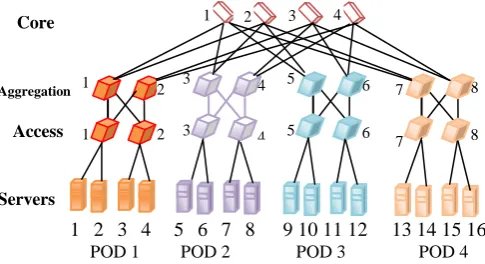
consumed in a usual Data Center. The server energy optimization has been proposed with many strategies and sufficient amount of efforts have already been devoted to it. Furthermore, the networking devices consume 20% of the total energy which cannot be ignored. Hence, this paper focuses on minimization of energy consumption by these network devices. There have been several multi- rooted network topologies such as Fat-Tree approach, DCell, Port Land and Bcube structure which have been deployed by the modern data centers. Figure 1 represents the 4 – POD Fat tree which consist of 3 hierarchical layers comprising 8 edge switches, four core switches, eight aggregate switches and sixteen servers. The data is transferred between the servers which are maintained by many prerequisite network devices. For saving the greater amount of energy consumption, selective devices shall be deactivated without hampering the quality of services (QoS) which is the focal point of the model. Another scope that the hierarchical multi-rooted network topology provides is the multiple paths between any two data centers. The multi-path routing is gainful and highly recommended. Recently, the DCN energy optimization is led by a prospective and emerging new networking model i.e. the Software Defined Networking (SDN)[2, 3].
One of the inherent characteristics of Software Defined Networking is storing the forwarding rules placements in ternary content addressable memory (TCAM) which is considerably expensive and limited by its size. In the given 4 - pod FAT tree topology, each switch consists of its own TCAM memory which enables the data flow through multi-path routing in SD-DCN. For individually selected path one forwarding rule is allocated in each of the switch. The limited TCAM size in SD-DCN is the only constrain in multi-path routing as compared to that of traditional DCN.
The paper focuses on to provide a heuristic approach for an energy-efficient software-defined data center networks. The main aim is to develop a network management strategy which will reduce the consumption of energy in software-defined DCNs. This has to be backed by a guarantee of satisfaction of the network traffic demand without violating the QoS. Networking devices such as switches and servers are the major part of a usual DC which consumes high level of energy.
An Evolutionary Based Heuristic Approach
towards Energy Efficient Software Defined Data
Centers
Since, the consumption of energy by the network devices comprise of 20% of the total energy hence it cannot be ignored and must be kept into consideration. In this paper we investigated and focused on the consumption of energy by the network switches in cloud DCs. It has been observed that energy consumption of these switches can be minimized by considering the followings- scheduling of flow routing, activation of switches and forwarding rule placements. The above problem is formulated as joint optimization approach which ensures the performance improvement without any infringement in the QoS. The remaining paper has been organized in the following manner: section 2 presents detailed literature study of cloud computing, DCN and SDNS. Architectural details of the proposed model have been presented in section 3. Simulated environment along with experimental details has been presented in section 4. Section 5 presents the simulation results and a comparative analysis. Section 6 puts forth the conclusion of the model.
II. LITERATURE SURVEY
[image:2.595.45.288.446.578.2]Large Enterprises use the DCs for their day to day data transaction in a client-server architecture mode by using IT infrastructures like residential computer, server, network organization and other system related components for storing, retrieving and report generation with a big amount of data. In order to facilitate data processing for ready use requires a bigger physical setup consisting of large no of computers, servers which are interconnected with each other. In order to run the enterprise’s core applications, it needs efficient power backup system, surplus networking connections, cooling system and authenticate security system.
Figure 1. FAT Tree Topology with 4 pods
The establishment and interconnection of the entire physical and network-based devices and equipment within a DC facility is termed as DC networking [4]. The digital connection between the equipment and data center infrastructure make a guaranteed communication and data transfer between each other through internet or external network channel. A newly emerging technology called as Software-defined networking provides more control over the network devices which basically involves the decoupling of control plane and data plane.
SDN includes virtualization network which means amalgamation of hardware, network functionality and software recourses based virtual network. SDN holds responsible for moving the packets from place to place
through the network using available data plane and keeping the control plane of the network independent.
Software-Defined Data Centre (SDDC) is formed by introduction of software to the traditional networking that is DCN. Software services can be carried out by incorporating resources such as storage system, authenticate security features and networking infrastructures which in turn can be treated as the SDDC on the whole. A secured user portal provided by the SDDC utilizes the web-based servers to distribute the information effectively. This also enables the information to be accessed by the end-user with the help of virtualization and cloud technology. Moreover, SDDC provides a superior data management system which can monitor and provides data backup for further use. It is the reference to DC where all infrastructures are virtualized and delivered as a service. The hardware configuration and devices are absolutely controlled and maintained by the intelligent software system which is one of the limitations in traditional DC. The elements of infrastructure such as networking, storage, CPU and security are visualized and delivered as a service in SDDCNs. In contrast to this, the infrastructure of traditional data centre is typically defined by hardware and devices.
The major concern of the traditional DC is to offer consistent and computationally equipped infrastructure for the immense services over internet. For achieving these properties energy consumption by the DCs are huge which variably increases the operational cost over the capital cost. The main reason behind the massive energy consumption in Data Centers is the deployment of cooling system and servers. These are the thrust area where improved software products and better environment should be set up in DCs to check the rapid consumption of the energy. The significant IT infrastructure is the network devices which are shared resources and consume more amount of energy because it always remains on. According to the need of the traffic and the ideal set up of the network, saving of the energy can be done by optimum utilization of recourses [5].
The demonstration of load currently offered, still needs the active component along with the load in the immediate future for the changes to be carried out by a management system that administers the dynamic energy. This management system strives to reach the proportionality of energy by boosting a subset of the components in ideal state. The power saving ought to be valuable, effects of performance should be least and fault tolerance should not be compromised with are crucial objective [1]. Dynamic adjustment of elements of a pack of active network like Links and switches is needed in order to fulfill the load of changing data center traffic. This can be done by an elastic tree- a network wide power manager which is presented by B.Heller, et al [6].
Core
Aggregation
Access
Servers
1
2 1 1 1
1 2 3 4
1
1
2 2
3
3
4 4
5
5
6 6
7
7
8 8
International Journal of Innovative Technology and Exploring Engineering (IJITEE) ISSN: 2278-3075, Volume-8 Issue-6C, April 2019
Recent data centers executing operations like data-oriented applications to be searched from cloud services, webmail for computing GFS, MAP reduce and cloud store by constituted with 10000 of switches and servers [7]. DCNs currently lay emphasis on inter connecting more no of data servers delivering resourceful and channelizing service that is fault-tolerant to applications of upper layer. Increased cost low scalability and failure at single point are the major problem areas if tree architecture of DCs is considered. Proposals like Fat-tree, BCube are made for a better solution as they are recently developed network architecture [8]. Network devices in great number work alone in data center networks that are strongly connected. This happens as a result of vivid emergence of diurnal pattern. Traffic soars in the day time and comes down at night.
In [4], Y. Shang, et al. presented how power-hungry devices consume energy and how they have proven to be painful for quite a many owners of data centre. They have rather prioritized on energy consumption saving data centre network of high density on a regular basis. Idea has been focused to utilize limited network devices so as to provide continuous service. This is because of negligible sacrifice of the performance of the network. At that time, the individual network devices may be switched off or switched to sleep mode so as to save energy. At first the highest priority metric of performance for data-oriented computations are routed to switches of all data centers in an algorithm as proposed. The corresponding routing is known as primary routing. Secondly the switches are detached from the primary routing to the time till the throughput of network comes down at the level of expected performance, thirdly the switches that are not additional in the ultimate routing are switched to power off or sleep mode.
A model of energy conscious routing problem has been projected by the authors that imply NP-Hard to be proposed for heuristic routing algorithm to get the motive of the design. Genetic algorithm as searching approach has been used in most of search space in various area [10, 11, 12]. Presently the application of GA has been shown the efficacy in the field of scheduling problems and most of NP complete problems [13, 14]. This work is an extension of our earlier work on data center networking, where a heuristic switch activation approached proposed in order to minimize the energy consumption at switch level [16]. This paper focuses on to minimize the consumption of energy by the networking devices. According to the need of the traffic and the ideal set up of the network, saving of the energy can be done by selectively deactivating the devices which are not in use leading to optimum utilization of recourses.
III. SYSTEM MODEL
There is a rise of big concern as high energy consumption due to imposition of heavy encumber on modern DCs by the explosive demands on cloud services. The energy consumption of DCN has been taking a major proportion in order to meet the rapidly growing data traffic requirements. The consumption of energy of the mentioned data centers are the main issue to be considered and the solution need to be considered so as to optimize the consumption of energy and
the satisfaction of large traffic demand. In the current paper, a proposal of energy conscious network management approach has been made, which guarantee to provide the demand network traffic in SD-DCNs. In order to find an efficient solution to DCN energy optimization, we jointly considered the switch activation, flow routing schedule and forwarding rule placement which ensures to satisfy the ever-increasing dynamic demand. In order to meet huge traffic demands for cloud services, several DCs are deployed that leads to large amount of power consumption. It has been observed from latest literature study that the cost of electricity has turned out to be the dominating expense of operation that super cedes capital expenses such as hardware cost because of huge energy use. The DC energy expenditure optimization has become an evolving issue. According to the National Resources Defense Council, 91 billion kilowatts was consumed by data centers in 2013 which is equivalent to an hour’s power that can be supply to all the families twice in the New York city.
A more practicable and capable solution for DCN energy optimization is given by the SDN that permits more control over the network devices and hence control plan and decoupling of data takes place. In cloud enterprise desires the SDDCs that are really innovative and packed with the capabilities. Other than deployment and management, storage, computation and networking numerous business applications in cloud environment, are of great importance. When the physical infrastructure layer detached from the application layer, while a wide range of uses are allowed. Various production verticals such as telecom &IT, retail, health care, government and BFSI, manufacturing and others have adopted the SDDCs.
The contribution made to the paper primarily focuses to observe minimum activation for routing in the SD-DCN over the restrictions of SDN. At first optimization of energy was formulated to transact with the convolution of higher computation in order to solve ILP. To solve intricate problems of ILP a heuristic algorithm has been proposed.
The efficiency of the proposed algorithm is proved through extensive simulations which is close to optimal within the stipulated timeline.
The followings are considered while designing energy efficient cloud DC network that comes along with assured satisfaction of demands of the network traffic in SD-DCNs.
There is a joint contemplation of the switch activation, scheduling of the multipath flow routing, rule placement forwarding. This energy optimization problem is put together to be the ILP.
A heuristic algorithm is proposed in order to transact with its convolution of great computation.
A. An Illustrative Example
There are numerous applications like data analysis applications using Map Race, operating in a data center are the examples of applications. Data transferring between servers may recurrently be necessary by these applications. With the imposition of a big trouble on the basic DCN; the said data are usually termed as intra-data-center traffic. These data centers consume a huge quantity of data. The major intention is the Formulation of management strategies for an energy efficient network that comes with proper fulfillment of demands or network traffic in data center networks that are software defined.
The three main concerns that are deal with top design an energy-efficient software-based data centers are: -
The Switch Activation i.e. the subset of switch that is to be activated: Particularly during night when the traffic demands area exceptionally low, it is not always vital to trigger all the switches for saving the energy. This begins the deactivation of the reluctant switches without defying the Quality of Services (QOS) for cutback energy consumption.
Multipath routing scheduling for all flows: The multiple paths are present among any two servers as for the known problem; topology for hierarchical network like multi rooted such as fat tree is measured. As a result, a particular path for the known pairs of servers that have need of minimum number of switches to be trigger for saving energy is essential to be chosen. So, the flow routing should be vigilantly done.
Forwarding rule placement in SDN switches: The TCAM constriction must be kept into contemplation while choosing a path from all accessible paths for obliging a flow. It is due to the TCAM i.e. ternary content addressable memory which is associated with each switch. Forwarding rules that are stored have minimum size and are considerably expensive. [9] These three issues are considered together and are originated as linear integer programming problem. The above difficulty can be solved by a properly defined algorithm. The validation of the outcomes of the proposed algorithm is done by the conveyance of several simulation -based experiments. Here are the measures that are required for designing an energy-efficient software defined data centers.
a) Proper activation of the subset of the switch. b) Multi-path routing scheduled for each flow.
[image:4.595.307.549.49.215.2]c) SDN switches implementing Advancing Rule Placement.
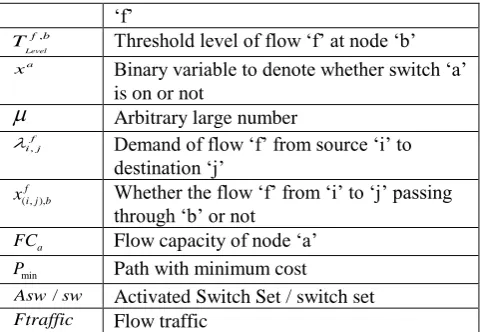
Table 1. List of Notations Symbol Description
,
a b
Lc Link capacity between nodes ‘a’ and ‘b’
k
S size
Tcam TCAM size of switch of kth switch of switch set.
f
Demand of flow
( , ), ,
u v f i j
Flow k from source ‘i’ to destination ‘j’ passing through link (u,v)
P Path set
nsw
Newly activated Switch Setk
f
SEC Energy consumption of switch ‘k’ with flow
‘f’
,
Level
f b
T Threshold level of flow ‘f’ at node ‘b’
a
x Binary variable to denote whether switch ‘a’
is on or not
Arbitrary large number,
f ij
Demand of flow ‘f’ from source ‘i’ to destination ‘j’
( , ),
f i j b
x Whether the flow ‘f’ from ‘i’ to ‘j’ passing through ‘b’ or not
a
FC Flow capacity of node ‘a’
min
P Path with minimum cost
/
Asw sw Activated Switch Set / switch set Ftraffic Flow traffic
These concerns are together addressed for formulating the integer linear programming problem. G is an undirected graph that represents a hierarchical data center network topology. G (graph) = (N, E), in which N comprises SDN enabled switch set V= {a, b, c,….} and the set of host H, i.e., N=V ∪ H and the links that are in between the nodes of N is represented by the edge set E.
B. Problem Formulation
Hence the following constraint are considered
Traffic Demand Satisfaction Constraints:
A Multi-path Routing approach is adopted to measure the capability of a DCN, which divides the flow into multiple sub flows that goes through different paths. i.e. flow path from
source to the concave destination. Let ( , ),
,
a b f s d
be the flow over the link ‘a’ and ‘b’ and (a, b) ∈ E carrying data of flow k
∈
F
s d, destined to host d ∈ H from s ∈ H. The following constrains are used for conservation of flow.( , ), ( . ),
, , ,
,
,
, (1)
a b f a b f f
S b b S S D
b N b N
S D
for all S D H and f F
The subtraction of the flow is equal to the demand of flow ‘f’ from source ‘S’ to destination ‘D’ as in constraint (1) the first flow is over the link (‘S’, ‘b’) and second flow is over the link (b, s) which indicates the same link. Where ‘a’ and ‘b’ are two intermediate points.
( , ), ( , ),
, ,
, ,
, (2)
s d f s d f
b c a b
c N a N
S D
null
for all S D H and f F v N
The subtraction of the flows will be equal to 0 or null as when considering the constraint (2) the first flow is over the link (b, c) and the second flow is over the link (a, b), and the destination for both the flows are same.
( , ), ( , ), ( , ),
, , ,
,
,
, (3)
S D f S D f a b f
a D D a S D
a N a N
S D
for all S D H and f F
International Journal of Innovative Technology and Exploring Engineering (IJITEE) ISSN: 2278-3075, Volume-8 Issue-6C, April 2019
The demand of flow ‘f’ from source ‘S’ to destination ‘D’ is symbolized by the subtraction as for both the flows the destination is same and ‘a’ belongs to the either switch or server.
Capacity Constraints in links
The biggest constraint in multi-path routing is the total amount of data which are able to flow beside an individual link gets restricted by the capacity of the link irrespective of how the flow is divided or combined. The flows as a whole from node ‘a’ - ‘b’ or ‘b’ - ‘a’ should not surpass the capacity on link a & b as the undirected link capacity model is considered.
( , ), ( , ),
, , ,
, (4)
SD
S D f S D f
a b a b a b
S H D H f F
a b
Lc
for all Lc E
Forwarding Rule Placement Constraints
Describing the flow handling solution for any known flow leaving through a switch, as stated by SDN rule policies forwarding rule need be there in the TCAM. One rule is applicable for the description of the multi-path routing does not depend on how the flow is dividing or combined at a switch. Binary variable defined as x pow (S, D, f) to the base v in order to indicate if flow k from s - d passes through v. When there exists a flow k beginning from source (s) to object (d) which passes by the link (a, b), the below variable x is 1.
( , ), , ( , ), ( , ), , ,,
0,
5
,
,
0
a b f S D f
S D b a b f
a b S D
True
if
x
False
if
Lc
E
Above described relationship in linear form is described here.
, , ( , ), , ( , ), ( , ), , ,, , , 6
a b
a b
a b f
S D
Lc E f a b f
S D b S D
Lc E
S D
x A
A
for all S D H f F b V
Compulsorily if the switch is activated, all the storable rules
of switch b ∈ V is restricted by size
a size
M
of its TCAM or the
switch would not store any rule. Hence, a binary variable
b
x
, at first is defined to denote whether switch v is on or not as given in constraint (7).
, ,
7 ,
is active b True if b V
x False otherwise
The constraint (8) explains the details of TCAM constraint. On one hand, the TCAM size constraint is described when
switch v is powered on, i.e.,
b
x
=1. On the other hand, the TCAM size available can be regarded as 0 equally.
When
b
x
=0.
( , ), .
, , (8)
SD
f b b
S D b size
S H D H f F
x M x
for all S D H b N
An ILP Formulation
To decrease the number of switches that is activated to save energy saving represented by the equation (9) is the main objective. Hence, to summarize ILP as a problem is
formulated as a result of the constraints as discussed. The problem is as given under:
: min b (9)
b V ILP x
It is computationally extravagant to find a solution to the Integer Liner Programming problem and finding out a solution that is optimal for large scale cases. Hence, a heuristic algorithm that is computationally efficient is proposed in the current section. Selection of each path will entirely depend on flow demand flow, capacity of the link and the TCAM buffer which aims at the minimization in the activated switches currently available is the main idea of our algorithm.
C. Genetic Algorithm Design
lg 1: : : , , : : , : : , size
A orithm Switch Control Approach
Input G DCN Graph Tcam Flow demand
Output F flow path set Asw Activated Switch set
Begin
Path set T P
Set Asw Flow p
, , , ( , ), 0 : , ' ' ' ' 0, : ,
( & )
( ( ) ) ax Level f i j f i j i size
f b f
a i j b
i
ath
For in do
Find all path sets from node i to node j
While do
For path p in P do
if pathTcam required path flow required then
if FC T with Max x true then
Select path p with M , , , ,
( ) in(S )
( ) ( ) 0 , , constraint f b i f i j f i j f f
i j i j
i
size
Asw and M EC
if path p found then
if path capasity then
else
path capasity
endif
F F path p
updateTcam update
Update switch status if not activated or not included
else relax U ,
s variabels & S
... ... . Level f b f b size Asw EC continue endif else increaseT endif else
reduce required Tcam
continue
endif
endfor
endwhile
End
In this work, we have used the generic genetic algorithm template and modeled according to our problem statement. Algorithm 1 depicts the sequence of that heuristic approach and algorithm 2 depicts the GA based heuristic approach in order to optimize the flow path while considering above specified multiple parameters which results an efficient route for serving a users’ requests
lg 2: : : , , : : , : : , size
A orithm GA Based Approach
Input G DCN Graph Tcam Flow demand
Output F flow path set Asw Activated Switch set
Begin
Path set T P
Set Asw Fl
, , ( , ), 0 : , ' ' ' ' : ,
( & )
( ( ) ) : Level f i j i size
f b f
a i j b
ow path
For in do
Find all path sets from node i to node j
do
For path p in P do
if pathTcam required path flow required then
if FC T with Max x true then
iterative Approach
Select path p ,
, ( , S , )
& , & ... ( ( )! Level f
i b size
i i size f b size i
Evaluate Asw EC Tcam
Apply selection mutation on p
Add subpath p to flowpath F
updateTcam update switch status
else
increaseT
endif
else
reduce required Tcam
continue
endif
endfor
while f x 1( )), 1,2,3,...,
. i wherei f x endfor End
The factor that is most significant in our algorithm is the fitness function, which is defined as the value of multiple parameters. It is based on the fractional weights provides in the fitness function. The fitness function is calculated using following formula depicted in equation (10).
( ) 1* 2 * size 3* (10)
f x w sww TCAM w Ftraffic
IV.
E
XPERIMENTALS
ETUPInternational Journal of Innovative Technology and Exploring Engineering (IJITEE) ISSN: 2278-3075, Volume-8 Issue-6C, April 2019
V. HELPFULHINTS
By taking into consideration various simulations based experimental outcome, the study of the efficiency of the proposed algorithm is done. Study is done on the following parameters.
A. On the Scheduling Time
First of all, the study is carried on both the scheduling time of the algorithm proposed and optimal solution by means of commercial Gurobi optimizer. Scales from two varied data centers that is 10 pods having 250 hosts and 4 pods having 54 hosts are respectively taken into consideration. Flows produced from each host is set to be 1, 10, 20, 50 and 100 is the average in varied instances of simulation.
The following are the observations-
Proposed algorithm is merely congruent to optimal outcome specifically in the event of 6 pods in small scale, the number of activated switches is attained.
The time of computation of the algorithm proposed is very slight as compared to the one that uses Gurobi and is with network size which is much larger or a greater number of flows, its benefit is additional significant.
B. On the Energy Saving
The study is done on how the proposed algorithm set aside the consumption of energy by the deactivation of the switches that are not needed, and by routing the flow with the specified activated switches. The judgment of the algorithm proposed herein is founded on the approach of shortest path which always switches are activated in the path of shortest route of each flow is carried out.
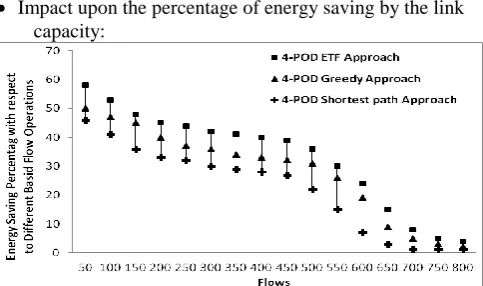
The no. of flows varying from 15 to 800 totals 20 instances is run for acquiring the average percentage of the energy savings.
Increase in flow number declines the average energy saving percentage. This is because switches in more number have to be triggered to put up magnanimous demand of traffic acquired by flows in large number. The reasonable advantage over shortest path algorithm and Greedy approach is publicized by the proposed algorithm. Figure 2 and Figure 3 depicts the performance of energy saving with respect to flows.
[image:7.595.305.551.49.179.2] Impact upon the percentage of energy saving by the link capacity:
[image:7.595.304.551.214.335.2]Figure 2. Energy Saving Percentage in 4-Pods w.r.t Flows
[image:7.595.304.548.365.493.2]Figure 3. Energy Saving Percentage in 6-Pods w.r.t Flows
Figure 4. Energy Saving Percentage in 4-Pods w.r.t Links
Figure 5. Energy Saving Percentage in 6-Pods w.r.t Links
The link capacity is widely ranged from 300 to 2500 all along with the TCAM size to be set to 550 and the link capacity. It is proved that the algorithm proposed herein has better performance than that of shortest path algorithm and Greedy approach. This is because without violating the link capacity restriction, more flow can go through a switch and hence fewer switches need to be triggered. Figure 4 and Figure 5 depicts the performance of energy saving with respect to links.
Effect of TCAM size on energy saving
percentage:
[image:7.595.48.290.549.692.2]Figure 6. Energy Saving Percentage in 4-Pods w.r.t Tcam
Figure 7. Energy Saving Percentage in 6-Pods w.r.t Tcam
VI. CONCLUSION
The main objective of this work is to minimization of energy utilization in software defined data center network at switch level. In this work, we investigate how to optimize the energy consumption by using selective-switch-activation approach. In order to implement the selective-switch-activation method, an evolutionary optimization based heuristic approach is adopted to optimize the energy consumption by considering multiple parameters. In SD-DCN, routing paths are selected based the above defined parameters and by using multipath routing approach in accordance with the traffic demand of the data center. Therefore, for congregation the necessities, the three main issues jointly considered are: -
a) Switch activation of the subset of the switch that has to be trigged. b) Scheduling of multipath routing of all the flows. c) Forward rule placement in SDN switches. The stated problem of the energy optimization has evolved as a problem of ILP. Further, a proposal for minimum switch activation algorithm for multipath routing by a heuristic has been made to transit the complexity of computation. The effectiveness of the algorithm is proved through extensive simulation and the outcome of the simulation-based experiment depicts that the proposed algorithm performance is close to optimal solution with lesser scheduling time.
REFERENCES
1. S F. Bonomi, R. Milito, J. Zhu, S. Addepalli, "Fog computing and its role in the Internet of Things", Proc. 1st Edition MCC Workshop Mobile Cloud Comput., pp. 13-16, 2012.
2. N. Yamada, H. Takeshita, S. Okamoto, and T. Sato, “Using optical approaches to raise energy efficiency of future central and/or linked distributed data center network services,” International Journal of Networking and Computing, vol. 4, no. 2, pp. 209–222, 2014. 3. D. Li, Y. Shang, and C. Chen, “Software defined green data center
network with exclusive routing,” in INFOCOM, 2014 Proceedings IEEE, pp. 1743–1751, IEEE, 2014.
4. S Yi, C Li, Q Li “A survey of fog computing: concepts, applications and issues” - Proceedings of the 2015 Workshop on Mobile Big Data, 2015.
5. D. Abts, M. R. Marty, P. M. Wells, P. Klausler, and H. Liu, “Energy proportional datacenter networks,” in ACM SIGARCH Computer Architecture News, no. 3, pp. 338–347, ACM, 2010
6. B. Heller, S. Seetharaman, P. Mahadevan, Y. Yiakoumis, P. Sharma, S. Banerjee, and N. McKeown, “Elastictree: Saving energy in data center networks.,” in NSDI, vol. 10, pp. 249–264, 2010.
7. N. McKeown, T. Anderson, H. Balakrishnan, G. Parulkar, L. Peterson, J. Rexford, S. Shenker, and J. Turner, “Openflow: enabling innovation in campus networks,” ACM SIGCOMM Computer Communication Review, vol. 38, no. 2, pp. 69–74,2008.
8. Lebiednik, Brian, Aman Mangal, and Niharika Tiwari. "A survey and evaluation of data center network topologies." arXiv preprint arXiv:1605.01701 (2016).
9. F. Giroire, J. Moulierac, and T. K. Phan, “Optimizing rule placement in software-defined networks for energy-aware routing,”2014.
10. Abraham, R. Buyya, and B. Nath., “Nature’s Heuristics for Scheduling Jobs on Computational Grids”, Proceedings of 8th IEEE International Conference on Advanced Computing and Communications, 2000 . 11. M. Srinivas and L.M. Patnaik, “Genetic Algorithms: A Survey,” IEEE
Computer 27, 617-26, June 1994.
12. S. A.Y. Zomaya, F. Ercal, and S. Olariu., “Solutions to Parallel and Distributed Computing Problems”, A Wiely-Interscience Publication, 2001.
13. Jacobs M.R. Garey and D.S. Johnson, “Computers and Intractability, a Guide to the Theory of NP-Completeness”, W.H. Freeman and Company, New York, 1979.
14. A.Y. Zomaya and Y.H. Teh. Observations on Using Genetic Algorithms for Dynamic Load-Balancing. IEEE Transactions on Parallel and Distributed Systems, 12(9):899–911, 2001.
15. K. Hemant K. Reddy, Manas Patra, Diptendu Sinha Roy, B. Pradhan, “An Adaptive Scheduling Mechanism for Computational Desktop Grid Using GridGain”, Procedia Technology, Elsevier, Volume 4, pp. 395 – 400, 2012.