Virtual Iterative Precoding Based LTE POMA
Channel Estimation Technique in Dynamic Fading
Environments
V.Madhu Kumar, T.V.Ramana
Abstract: A method of channel estimation based on antenna characteristics in angular domain is proposed in this paper. The transmitter and receiver antenna characteristics are sampled with finite sampling frequency and finite bandwidth. The physical channel perceived by the system is a filtered channel, causing the physical channel to lose its strength into multiple taps with dominant channel power, which estimate few unknown subcarri-ers. These taps in physical channel are analogous to virtual in the discrete-time domain perceived by the system, which draws less gains from the antenna sections. By the proposed work, these virtual channels improves the gain and attenuation of signal transmitted through iterative precoders of Long Term Evolution (LTE) transmitters and receivers set of antennas. An analogy of the above proposed precoding technique is drawn with the time-domain Position-orthogonal multiple access (POMA) path chan-nel model through a filtered chanchan-nel estimation with infinite temporal resolution of the sampled signal. Proposed model im-proves the performance of LTE communication system with POMA antennas by providing a perfect channel state information (CSI) including spatial precoding and beamforming. The imple-mentation of the proposed model is simulated in a new dynamic mxn tabs fading scenario path. The comparative results shows a better performance than the existing surveyed methods.
Index Terms: LTE, angular domain, virtual, multiple access, fading
I. INTRODUCTION
The presently work relates generally to LTE communica-tion systems, especially to model the channel to improve the capacity gain of a massive-input and multiple-output (massive-MIMO) channel through POMA system. With the existing MIMO channel, the use of correlated POMA system reduces the scattering of antennas by spread-ing the space between them and improves the representation of channels to provide accurate description of channel be-haviour. In conventional channel estimation the modeling of channel is done in array domain ie., antenna-to-antenna channel gains, the channel behaviour is carried between transmit-receive antenna pair and the array-domain model through channel matrix. However these are inaccurate in representing the LTE communication channel, in reality the result analysis is not valid. The modeling of these: channel estimation, channel behaviour and array-domain model, need a larger degree of channel model governed by the number of virtual clusters, each results from scatters and reflectors, in the channel, here each virtual cluster iterates the gain through dynamic bandwidth of the signal transmit-ted and received to a particular angle of elevation, regardless of the number of antennas employed and hence an accurate improvement in capacity gain with fewer channel matrix elements.
The proposed work provides a method to model the vir-tual iterative clusters instead of physical, to improve the channel estimation in angular domain with multiple anten-nas, reflecting the desired antenna pattern in time-domain
multi-path channelling, by blind estimating the radiation patterns of POMA antennas with zero-forcing modulation to introduce noise amplification and Omni-directional antenna system is simulated to analyse the statistics of the fading environments.
In this paper, a Virtual Iterative Precoding (v.i.p) is pro-posed to improve the precoder performance and a Channel Estimation Technique (c.e.t) is introduced to establish a new channel model in LTE system through simulation. This pa-per is organized as follows: Section 2 briefly reviews the related LTE and Section 3 introduces the proposed model. In Section 4 present experimental results and discussions and Section 5 concludes the paper.
II. RELATED WORKS
In this section, surveyed research work on LTE is pre-sented. Research in MIMO has widen [1] the LTE works in to vast implementation to deal with the challenges in com-munication systems [2]. For high gain and high spatial mul-tiplexing gains, to reach optimal performance [1], zero-forcing (ZF) and minimum mean square error (MMSE) methods are used. To achieve this, in these methods, a large number of antennas are used at the base station, results in excessive hardware cost. The large number of antennas ex-ploit multiple antenna systems, using radio frequency (RF) chains at the precoder stage through digital-to-analog (D/A) converters, mixers, and power amplifiers to improve the gain and beam width of array signals. These multiple arrays form massive-MIMO structures causing the variables RF phase shifters and RF chains to improve the gain and reduce the cost of the precoders design. RF phase shifters are ex-ploited as phase-only [3], to control the phases of traditional precoders, the introduction of hybrid precoding scheme have changed the RF precoding to implement the spectral effi-ciency of single-antenna for massive-MIMO systems. Sim-plified transmit precoding/receive combining design is per-formed, with these hybrid methods are further implemented [4] and [5] in millimetre wave (mmWave) MIMO systems through orthogonal matching pursuit to optimize the SVD (singular value decomposition). To reduce the searching complexity in [5], a [6] greedy precoding method is pro-posed to searching complexity is reduced. To reduce the number of RF chains [7] has introduced a limited feedback hybrid precoding and number of phase shifters are reduced in [8] to limit the interference cancellation. For multiple users situation orthogonal channel is correlated to result a finite dimensional channel model, but obtained a poor scat-tering channel environment compared to [9], obtaining low path loss at high frequency,
con-sider the hybrid precoders under fully structured to improve the capacity performance in the large antenna systems.
Spatially correlated and multiplexed MIMO systems with deterministic line-of-sight (LoS) path and a stochastic non-line-of-sight (NLoS) component. massive-MIMO reforms in time-division duplex (TDD) mode and attains CSI by up-link (UL) pilot signaling and estimators of channel parame-ters [10], correlates with down-link (DL) transmit precoding. Through channel estimates, spectral efficiency (SE) can be improved through either spatially uncorrelated [11] or spa-tially correlated [10], [12] Rayleigh fading channels. These fading characteristics are analysed in [13], were derived in UL and DL SE for single-cell analysis. However the fading characteristics SE is uncorrelated and having scattering clus-ters.
Despite the above limitations, massive-MIMO systems have new challenges in high-resolution analog-to-digital convertors (ADCs) in precoders. At millimeter wave (mmWave) [14], [15] frequency band these challenges be-comes more severe under large bandwidths [16], causing high absorption of the antennas signal. Steering antenna designs [17] are introduced to limit these challenges. How-ever the quantization of ADCs degrades the channel estima-tion performance among the quantizaestima-tion schemes.
This paper provides a way to POMA c.e.t, to model the MIMO systems to large in angular domain, by incorporating radiation patterns of the transmitter and receiver antenna in a iterative channel. Proposed technique refers to gain and bandwidth, estimating the antenna patterns through virtual clusters, result in low attenuation of the antenna signals, making channel estimation to improve.
v.i.p is introduced in this paper and compared with quan-tized feedback technique [16], Weighted-Graph-Coloring [17] for analysis, by proposing a angular-domain channel estimation, by adopting POMA as the main design. The v.i.p can be applied to inaccurate channel models in any dynamic fading environments.
III. PROPOSED LTE POMA CHANNEL ESTI-MATION TECHNIQUE
In this section, the addressed problem solutions through proposed model is illustrated. v.i.p based on virtual clusters allows high gain and high bandwidth of the MIMO system for multi-antenna system through POMA structure. This paper access the SE and gain on the problems stated for dif-ferent precoders techniques.
A. Contributions
In this paper, improvements in LTE channel estimation through v.i.p design in MIMO based POMA structure is performed. The proposed LTE c.e.t enhance the RF precod-ers by adopting virtual clustprecod-ers, which helps hybrid precoder limitations to eliminate. So far the RF phase shifters and RF chains are in implementation with hybrid precoders, pro-posed technique through v.i.p design overcome and replace the MIMO RF chain antenna structure with POMA offering good improvement in SE, gain and bandwidth of LTE an-tenna arrays. Proposed work contributions towards the LTE system are summarized below:
a) For virtual clusters design, the beam of each antenna is scattered and reflected with an angle of departure, having a dependence among the pair-wise gains of each
trans-mitter and receiver. The number of virtual clusters is lim-ited to virtual channel created and antennas are designed independent to improve the channel estimation. This de-sign alternatively reduces the number of antennas em-ployed in-turn reduces channel matrix elements.
b) v.i.p is introduced through space frequency coding sys-tem, by transmitting the training sequence through a window tap, each window tap is performed with Least Squares (LS) method, known sequence is iterated at a time while the unknown sequence is iterated during the non-idle state of channel diagonal matrix elements. This design reduces the idle time of the beam and causing a narrow high gain beam formation.
c) c.e.t is proposed through iterative channel matrix for angular domain in a linear antenna array to develop vir-tual iterative RF structures. This technique is used as ini-tial channel estimator and being iterative reduces the channel power by extracting the channel data instantane-ously.
d) For LTE POMA, a fully-structured hybrid precoder is designed, to overcome the number of RF section limita-tions in hybrid precoder in every iterative positioned channel. This POMA structure enhances the MIMO an-tenna structures through narrow beam formation by im-proving the antenna gains.
e) With the proposed work, precoder design through LTE POMA technique is simulated by taking advantage of MATLAB simulation environment in dynamic Rayleigh fading environments with 8x8 tabs.
Thus, proposed precoder technique simulation results establish the effective usage of MIMO based POMA technique applicable in antenna based interference chan-nels to reduce the overlapping of beam angle-of-departure and angle-of-arrivals.
B. Problem Formulation
Angular domain model includes radiation pattern, antenna characteristics and angular directions, formulated as:
𝑒𝑥𝑦 = 𝑒𝑥 0,2𝜋 (𝑦−1)𝑆 (1)
where exy is the channel y -th
signal of exy(θ), exy(θ) is the
antenna radiation pattern of the x-th element and S is the sig-nal samples acquired at the antenna elements. To improve the radiation pattern of the antenna elements, Eq.(1) has to model using power-angle-matrix channel, whose (x,y)-th element represent the antenna channel power from the y-th transmit beam to the x-th receive beam, which draws a con-stant channel estimation profile.
The fully-structured precoder is formulated as: 𝑚𝑖𝑛𝑖𝑚𝑖𝑧𝑒
𝑃𝑅𝐹,𝑃𝐵𝐵= 𝐾 −1𝑘=0 | 𝑃𝑘𝑜𝑝𝑡− 𝑃𝑅𝐹𝑃𝐵𝐵𝐻 𝑘 |2𝑃 (2)
𝑠𝑢𝑏𝑗𝑒𝑐𝑡 𝑡𝑜
𝐹𝑅𝐹∈ 𝐴
𝑃𝑅𝐹𝑃𝐵𝐵𝐻 𝑘
2 𝑃= 𝑁𝑠
where PRF and PBB are the POMA precoder RF and
base-band chains, k is the antenna elements, Popt is the position
optimisation parameter, p represents the number of positions FRF is the RF sections of partial structures and Ns is the
non-zero singular values. To improve the position of MIMO pre-coder variation, Eq.(2) has to model the prepre-coder to modify both the amplitudes and
draw large antenna array gains by the massive-MIMO an-tenna systems.
For channel estimation, the received signal at x-th receive antenna is formulated as:
𝑟𝑥,𝑐=
𝑓𝑥,𝑦 ,𝑐𝑝𝑦 ,𝑐 𝑡𝑦 ,𝑐 + 𝑚
𝑧=1 𝐺𝑥,𝑐 (3)
where fx,y,c is the frequency response, channel subcarrier
is c, x and y are the transmit and receive antenna and Gx,c
represents Gaussian mixture noise with mean=0 and vari-ance= σn2/2 per antenna element length. Eq.(3) has to model
the received stream as a liner combination of transmitted stream by iterating the pilot symbols by masking the non-iterative stream too zero and use of preamble structure to track the speed of received symbols at channel order se-quence.
C. Virtual Iterative Precoding
To improve Eq.(2), perform positioned RF precoding ac-cording to:
𝑃𝑅𝐹 = 𝑃𝑅𝐹(𝑥,𝑦)= 𝑁1
𝑟 𝑦 ∗ 𝑁
𝑡
𝑥 𝑒𝑗𝜑𝑥,𝑦 (4)
where 𝑗𝜑𝑥,𝑦 is the RF chain phase of the (x,y) antenna elements, N is the number of antennas and r and t are the receive and transmit antenna. Here the perfect channel esti-mation through hybrid structure and by the selection of fre-quency are made with low-dimensional virtual iterations as:
𝑉 = 𝑃𝑜𝑝𝑡𝐻 (𝑃𝑅𝐹𝑃𝐵𝐵𝐻 )−1∆ (5)
where Δ is channel matrix representing diagonal antenna position values. With the virtual iteration scheme, to support continuous symbol streams, to reduce the RF chains hard-ware complexity, where positioned RF shifters and chains are needed to adjust the amplitudes and phases of complex symbols, as compared to Nt required hybrid precoders is to
be replaced by the full-dimensional v.i.p.
In practical implementations, the RF phase shifters are quantized with variable phase shifters according to
𝑃𝑅𝐹 𝜑𝑝2 𝑥,𝑦 = 𝑎𝑟𝑔 𝑚𝑖𝑛𝜑𝜖 {0,..,2𝑏−1} 𝐹𝑅𝐹𝜑𝑝ΔΔ𝑃𝑃𝑅𝐹
𝐵𝐵 −
(0,2𝜋𝑛 ] 2𝑏
𝑝 2
(6)
where p is the antenna position, b is the symbol stream n is the number of phase entries for each position iteration and
𝐹𝑅𝐹𝜑𝑝is the unquantized position phase obtained from vir-tual iterations to control the RF channel phases and improve the antenna array gains. Thus the v.i.p is computed by Eq.(6) with the quantized PRF.
Eq.(6) with Eq.(1) domain is modelled as:
𝑃𝑅𝐹 𝑒𝑝2 𝑥,𝑦 = 𝐺𝑥,𝑐𝛿𝑝ΔΔ𝐴𝐴𝑡
𝑟− 𝑒𝑥(𝜑)𝑓𝑥,𝑦,𝑐
𝑀 𝑏=1
𝑝 2
(7)
where 𝐺𝑥,𝑐𝛿𝑝Δ𝐴𝑡
Δ𝐴𝑟 is the power-angle-matrix channel model, here At is transmitter antenna pattern matrix, Ar is receiver antenna pattern matrix, δ is power-angle-iteration matrix, where (x,y)-th represents the channel powers. Thus the power-angle-matrix channel approach draws a constant channel estimation profile through Eq.(7).
The drawn channel matrix Eq.(7) is estimated through Eq.(3) is modelled as:
𝑇𝑑𝑎𝑡𝑎 =
𝑆𝑃 𝑃𝑅𝐹 𝑝[𝑧] 2
𝑆𝑃 𝑃𝑅𝐹 𝑝[𝑧] 2+Δ𝑃𝑅𝐹
Δ𝑃𝐵𝐵
(8)
where Tdata is the transmitted pilot symbol data and SP is
signal power. From Eq.(8) the received data is represented as:
𝑃𝑅𝐹 𝑟𝑝2 𝑥,𝑦,𝑐= 𝑆𝑃 𝑃𝑅𝐹𝑝[𝑧]
2 2
𝑝 + 𝑟𝑥,𝑐𝑝ΔΔ𝐴𝐴𝑡
𝑟−
𝑏=1𝑀𝑒𝑥(𝜑)𝑓𝑥,𝑦,𝑐𝑝2+𝑇𝑑𝑎𝑡𝑎 (9)
where R.H.S of Eq.(9) represented as l+m+n, denoting l as the linear combination of transmitted stream power, m as channel preamble estimators and n as pilot symbols in an iterative order scheme, representing the POMA c.e.t.
With the virtual iteration of channel estimation, solution to Eq.(1), Eq.(2) and Eq.(3) is presented in this section. Simulation results are provided in this paper to support the above, by demonstrating the efficiency of POMA, compared with surveyed estimators, Eq.(9) is characterised in dynamic fading environments through simulation, shown in Section 4.
IV. SIMULATION RESULTS AND
COMPARI-SON
In this section, simulation results are presented to verify the precoder design. Data streams are sent from a transmitter with Nt=200 to a receiver with Nr=50 antennas, with the channel parameters Ncl=8 clusters, number of rays Nray=15
rays, the average power of each cluster is 1, the azimuth and elevation angles of departure and arrival is 10 degrees, the antenna spacing is 0.25 wavelength, and the distribution is [0, 2π).
The simulation was developed using the MatLab in order to implement proposed technique, applying calculations of gain, the services to users in the area under study. The proc-ess of developing the simulation based on the objectives:
i. Analysis of Relay Antennas ii. Analysis of Resolution iii. Analysis of Rate gap
iv. Analysis of Cumulative Distribution Function (CDF)
A. Numerical Comparisons
This work investigates the following evaluations com-paratively, with the number of RF chains is equal to the data streams i.e., NtRF=NrRF=Ns.
B. Relay Antennas
Figure 1: Sum Achievable Rate vs Number of Relay An-tennas to illustrate the performance of analytical analysis in Rayleigh fading with 8x8 tabs.
Figure 2: Sum Achievable Rate vs Number of Relay An-tennas to illustrate the performance of approximate results in Rayleigh fading with 8x8 tabs.
C. Resolution
With the quantization bits set to 11, the energy efficiency is around 1.6 Mbits per J, the Mo varies 0 to 128. The
analy-sis has taken for low resolution and precoder energy con-sumption is calculated as in [16] and [17]. Figure 3 shows the simulation of quantization bits with energy efficiency, Figure 4 shows the simulation of AoD quantization bits with Per-user rate.
Figure 3: The simulation of precoder energy efficiency with number of quantization bits through proposed precoder technique.
Figure 4: The simulation of AoD quantization bits with different Per-user rate through proposed precoder technique.
D. Rate gap
To evaluate the rate gap of proposed POMA technique, considered three types of constraints for the system design, they are analog and, digital channel feedback and BS an-tennas as in [16] and [17]. Figure 5 and figure 6 shows the rate gap simulation among proposed and [17], between ana-log and digital channels for a single cell system. It is ob-served from the figures that, the rate gap is more in simula-tion and theoretical analysis.
Figure:5: The rate gap with analog and digital channel analysis for channel feedback in Rayleigh fading with 8x8 tabs.
Figure:6: The rate gap with analog and digital channel analysis for BS antennas
E. CDF
[image:4.595.316.548.213.334.2]As comparison, POMA under achievable rates, WIG-PD scheme is analysed as in [16] and [17]. It is shown in figure 7, proposed POMA technique is even CDF achieving under maximum achievable rate and have achieved performance in user UL transmission rate.
[image:4.595.59.289.349.472.2] [image:4.595.314.549.455.577.2] [image:4.595.54.291.509.638.2] [image:4.595.319.547.612.834.2]Figure 8: Proposed technique SE variation with the num-ber of BS antennas in Rayleigh fading with 8x8 tabs.
[image:5.595.52.290.57.364.2]Figure 9: Proposed work SNR performance for varying BER values in Rayleigh fading with 8x8 tabs.
Figure 10: Proposed SNR values with its SE among other hybrid precoding methods in Rayleigh fading with 8x8 tabs.
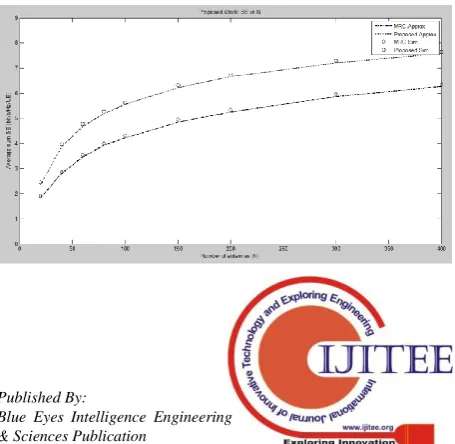
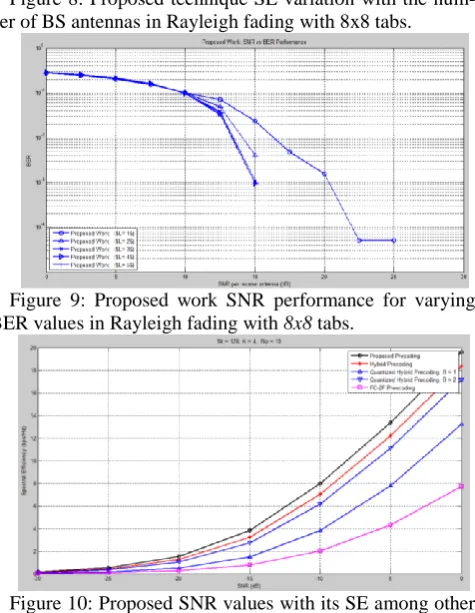
Figure 8 and figure 9 compares SE variations under pro-posed POMA technique with the same channel parameters. Compared proposed technique with studies Hybrid precod-ing [4], Quantized Hybrid Precodprecod-ing [16] and FC-ZF Pre-coding [1], through the same SE values applicable to both uplink and downlink is illustrated in figure 10. From the results, the proposed POMA c.e.t performs better compare to survey techniques by improving the performance in at-tenuation and gain for resource allocation.
V. CONCLUSIONS
In this paper, proposed precoder is simulated under practical RF shifters. This paper proposed an approach to MIMO technique, with low-complex POMA system. On the LTE system, the POMA RF precoder is designed, in this paper v.i.p is designed for hybrid precoder in massive-MIMO sys-tems through POMA. The following important conclusions have been drawn with regard to the proposed work.
1. An angular-domain modelling method for LTE communi-cation system is proposed.
2. For precoding, this paper has proposed v.i.p technique to improve the resolution of ADCs.
3.The analysis of signal along antenna arrays under in Rayleigh fading are made through clusters.
4.Demonstrated channel estimation mathematical analysis reduces the cost of hardware requirements and increases the gain of the LTE system.
Finally, v.i.p performance has been analysed in a closed form and simulated in dynamic fading environment and mmWave channels. Comparative results show the v.i.p is a variable quantized scheme and the SNR, BER and SE re-sults are still better than the surveyed precoding schemes.
REFERENCES
1. F. Rusek, D. Persson, B. K. Lau, E. G. Larsson, T. L. Marzetta, O. Edfors, and F. Tufvesson, “Scaling up MIMO: Opportunities and challenges with very large arrays,” IEEE Signal Process. Mag., vol. 30, no. 1, pp. 40–60, Jan 2013.
2. E. G. Larsson, O. Edfors, F. Tufvesson, and T. L. Marzetta, “Mas-sive MIMO for next generation wireless systems,” IEEE Commun. Mag., vol. 52, no. 2, pp. 186–195, February 2014.
3. J. Nsenga, A. Bourdoux, and F. Horlin, “Mixed analog/digital beamforming for 60 GHz MIMO frequency selective channels,” in
Proc. IEEE ICC, May 2010, pp. 1–6.
4. O. E. Ayach, R. W. Heath, S. Abu-Surra, S. Rajagopal, and Z. Pi, “Low complexity precoding for large millimeter wave MIMO sys-tems,” in Proc. 2012 IEEE International Conf. Commun., June 2012, pp. 3724– 3729.
5. O. E. Ayach, S. Rajagopal, S. Abu-Surra, Z. Pi, and R. W. Heath, “Spatially sparse precoding in millimeter wave MIMO systems,”
IEEE Trans. Wireless Commun., vol. 13, no. 3, pp. 1499–1513, March 2014.
6. R. Mndez-Rial, C. Rusu, N. Gonzlez-Prelcic, and R. W. Heath, “Dictionary-free hybrid precoders and combiners for mmWave MIMO systems,” in Proc. IEEE Int. Workshop Signal Process. Adv. WirelessCommun. (SPAWC), June 2015, pp. 151–155. 7. A. Alkhateeb, G. Leus, and R. W. Heath, “Limited feedback
hy-brid precoding for multi-user millimeter wave systems,” IEEE Trans. Wireless Commun., vol. 14, no. 11, pp. 6481–6494, Nov 2015.
8. X. Gao, L. Dai, S. Han, C. L. I, and R. W. Heath, “Energy-efficient hybrid analog and digital precoding for mmWave MIMO systems with large antenna arrays,” IEEE J. Sel. Areas Commun., vol. 34, no. 4, pp. 998–1009, April 2016.
9. V. V. Mai, J. Kim, S. W. Jeon, S. W. Choi, B. Seo, and W. Y. Shin, “Degrees of freedom of millimeter wave full-duplex systems with partial CSIT,” IEEE Commun. Lett., vol. 20, no. 5, pp. 1042–1045, May 2016.
10. E. Björnson, J. Hoydis, and L. Sanguinetti, “Massive MIMO net-works: Spectral, energy, and hardware efficiency,”Foundations and Trends in Signal Processing, vol. 11, no. 3-4, pp. 154–655, 2017.
11. T. L. Marzetta, E. G. Larsson, H. Yang, and H. Q. Ngo, Funda-mentals of Massive MIMO. Cambridge University Press, 2016. 12. J. Hoydis, S. Ten Brink, and M. Debbah, “Massive MIMO in the
UL/DL of cellular networks: How many antennas do we need?”
IEEE J. Sel. Areas Commun., vol. 31, no. 2, pp. 160–171, Feb. 2013.
13. L. Zhao, T. Yang, G. Geraci, and J. Yuan, “Downlink multiuser massive MIMO in Rician channels under pilot contamination,” in
IEEE International Conference on Communications (ICC), May 2016.
14. A. L. Swindlehurst, E. Ayanoglu, P. Heydari, and F. Capolino, “Millimeter-wave massive MIMO: the next wireless revolution,” IEEE Commun. Mag., vol. 52, no. 9, pp. 56–62, September 2014. 15. B. Ai, K. Guan, R. He, J. Li, G. Li, D. He, Z. Zhong, and K. M. S.
Huq, “On indoor millimeter wave massive MIMO channels: Measurement and simulation,” IEEE Journal on Selected Areas in Communications, vol. 35, no. 7, pp. 1678– 1690, July 2017. 16. W. Shen, L. Dai, B. Shim, Z. Wang, and R. W. Heath, “Channel
feedback based on AoD-adaptive subspace codebook in FDD mas-sive MIMO systems, ” IEEE Trans. Commun. vol. 66, no. 11, pp. 5235-5248, Nov. 2018.
AUTHORS PROFILE
T. Venkata Ramana, as a diligent scholar has excelled in studies from his child hood. His dare to dream, to work smart and strive for nothing less than excellence and to enjoy the journey every step of the way made him to scale greater heights. He has obtained his Bachelor's Degree in Electronics & Communications Engineering from Nagarjuna University. He has completed his Masters in Systems and Control Engi-neering from Osmania University. He has completed his Doctoral program Ph.D. in the area Satellite Communications from the Andhra University. He took up academic pursuit and served in an array of designations like Asso-ciate professor & Coordinator for M. Tech (Evening programs) of GITAM University. He also involved himself in teaching and research tasks. Above all he took up a mission to ignite the young minds so as to nurture the stu-dents with the potential to reach greater horizons.
V.Madhu Kumar, is a Research Scholar at GITAM University , Visakhapatnam and currently working as Assistant Professor in JITS (Autonomous), Narsampet, Warangal. He has completed his Masters in DSCE from JNTU Hyderabad. He is the Member of IEEE and Life Member of ISTE. His research area are Wireless Communication and Sig-nal Process-ing. His research topics are published in several NatioSig-nal & International Journals.