ISSN 0378-3693
Bulletin
OF
THE EUROPEAN
COMMUNITIES
Commission
The Bulletin of the European Communities reports on the activities of the Commission and the other Community institutions. lt is edited by the Secretariat-General of the Commission (rue de la Loi 200, B-1 049 Brussels) and published eleven times a year (one issue covers July and August) in the official Community languages and Spanish.
Reproduction is authorized provided the source is acknowledged.
The following reference system is used: the first digit indicates the part number, the second digit the chapter number and the subsequent digit or digits the point number. Citations should therefore read as follows: Bull. EC 1-1979, point 1.1.3 or 2 2.36.
Supplements to the Bulletin are published in a separate series at irregular inter:vals They contain official Commission material (e.g. communications to the Council, programmes, reports and proposals). The Supplements do not appear in Spanish.
Bulletin
OF THE EUROPEAN
COMMUNITIES
ECSC - EEC - EAEC
Commission of the European Communities Secretariat-General
Brussels
contents
PART ONE
SPECIALFEATURES
1 . Community development policy: a comprehensive approach 7
2. Community action in the cultural sector 9
PART T
ACTIVITIESIN SEPTEMBER 1982
0
1 . Building the Community- Economic and monetary policy - Internal market and industrial affairs
- Industrial innovation and the information market -Customs union
- Competition
- Employment, education and social policy - Regional policy
- Environment and consumers - Agriculture
-Fisheries -Transport -Energy - Nuclear safety
- Research and development - Cultural sector
14 14 14
17
18 18
21
24
27
28
33 33 35
37
37
2. Enlargement and external relations 41 - Enlargement and bilateral relations with applicant countries 41
- Commercial policy 42
- Development 43
- International organizations and conferences 45
- Industrialized countries 48
- Mediterranean countries 49
- Developing countries 49
- State-trading countries 52
- Diplomatic relations 52
- European political cooperation 53
3. Financing Community activities 54
4. Institutional and political matters 55
- European policy and relations between the institutions 55 - Institutions and organs of the Communities 56
• Parliament 56
• Council 60
• Commission 62
• Court of Justice 63
• Court of Auditors 66
• Economic and Social Committee 66
• ECSC Consultative Committee 67
• European Investment Bank 67
p
RT THREE
DOCUMENTATION1. ECU 70
70
71
72
79
2. Additional references in the Official Journal 3. Infringement procedures
4. The Community at the United Nations
Supplements 1982
1/82 A new Community action programme on the promotion of equal opportunities for .women, 1982-85
2/82 Draft of a convention on bankruptcy, winding-up, arrangements, compositions and similar proceedings
3/82 The institutional system of the Community-Restoring the balance 4/82 A Community policy on tourism
*5/82 Memorandum on the Communities' development policy
j
PART ONE
Standardized abbreviations for the designation of certain monetary units in the different languages of the Community:
ECU European currency unit
BFR Belgische frank I Franc beige OKR Oansk krone
OM Oeutsche Mark OR Greek drachma FF Franc frant;:ais
HFL Nederlandse gulden (Hollandse florijn) IRL Irish pound I punt
LFR Franc luxembourgeois LIT L1ra italiana
1 .
Community development policy:
a comprehensive approach
1.1.1. On 4 ·October the. Commission transmitted a memorandum on Community
development policy to the Council.1 This
paper, coming 10 years after the Paris Sum-mit, contains a review of achievements to date and an outline of the principles and guidelines on which the Community's de-velopment policy should be based over the next decade. This is the framework in which the negotiations for the renewal of the Lome Convention will take place, starting in Sep-tember 1983.
The past 10 years
1.1.2. Though initially focused on Africa the scope of Community action has been progressively extended: in 1975 the first ACP-EEC Convention was signed, marking the beginning of the 'Lome policy', which went beyond the heritage of the Y aounde Conventions; in 1976 comprehensive coop-eration agreements of unlimited duration were concluded with the southern Mediter-ranean countries; in 1976 also, the first programmes of financial aid for the 'non-as-sociated' developing countries in Asia and Latin America were launched, and then, fol-lowing an initiative by Parliament, cofinanc-ing was started with non-governmental or-ganizations.
At the same time, the Community was
par-ticipating in multilateral operations:
generalized preferences, commodity agree-ments, food aid. With regard to trade, the Community is the developing countries' leading supplier and customer, and again it is the Community which allocates the largest volume of generalized preferences world-wide. With regard to the financial aspect, Community aid, which increased by 7% per annum in real terms during the 1970s, at present represents 0.5%o of the Member States' GNP.
Proposals for the coming decade
1.1.3. This memorandum is intended to be an act of faith by the Community in itself. A
Community which had any doubts about it-self and its place in the world would have neither the will nor the strength to propose such a development policy. It contains a number of innovations. First of all, the Community is setting itself certain objec-tives. Its aim is that the developing countries should be fully involved, from the social, political and human points of view, in its de-velopment aid operations.
The second original feature of the text is the new political approach represented by the strategies: here again, it is not a matter of helping to create instruments, but rather of supporting policies which will enable the de-veloping countries to use the instruments we give them.
The third innovation in the memorandum is indisputably the Commission's request that a single budget framework be created for all the resources earmarked for development aid, hitherto entered in different chapters. This would mean that objectives and priorities could be identified at the same time, and discussed publicly.
Yet another innovation introduced by this document is the elaboration of a permanent framework for Community development aid. This means that the Convention with the ACP countries would have no fixed expiry date, but would have protocols valid for varying periods. The proportion of GNP target, 1 %o, will contribute to making the aid permanent.
Development activities
1.1.4. Food aid and financial assistance of-ten prove to be ill-suited to the predicament of the recipient countries: they often become an end in themselves and do not fit into a cohesive development aid strategy. They should therefore be supplemented by Com-munity back-up for national development
1 Supplement 5/82 - Bull. EC (to be published
Development policy memorandum
policies decided on freely by the govern-ments of the countries concerned.
The Commission is in effect proposing that steps be taken to get away from present practice, where the dialogue between donor and recipient is limited to devising a project and financing it, and attempt to establish a dialogue on a policy-worked out by the re-cipient State-to which the rere-cipient is com-mitted, in the same way as the Community is committed to promoting its success. The Community has already adopted this ap-proach in the context of the pilot support scheme for food strategies in several African countries.1
1.1.5. Besides those fields where external aid is aimed at enabling fragile economies to develop, there are others where development schemes can be considered more in the way of an exchange of benefits. In certain spheres such as mineral resources, energy and fisheries, the Community would help to step up the developing countries' production capacities in exchange for increased supplies.
International economic cooperation
1.1.6. Cooperation between the Commu-nity and the ACP States, which has hitherto been governed by conventions subject to re-negotiation every five years, would take the form of a framework convention of unlim-ited duration, with protocols valid for vary-ing periods.
1.1.7. The agreements concluded with Mediterranean developing countries have no fixed expiry date, but are concluded on a bilateral basis. The Commission would like this cooperation to realize its true potential in the future by taking on the form of a comprehensive, region-to-region convention.
1.1.8. The Commission intends to add to the content of the existing agreements with the other developing countries (ASEAN, In-dia, Brazil, Mexico), put the cooperative ties
with them on a stable footing, and encour-age regional cooperation.
Ways and means
1.1.9. Improving development assistance and strengthening cooperative links will in-volve a review of the scope and management of the resources deployed by the Commu-nity, ranging from finance to commercial policy instruments.
Financial assistance: long-term commitments
1.1.10. The Commission is proposing a target for Community development aid; it wants it to reach one thousandth of the Member States' combined GNP over the next 1 0 years.
Further points are that the EIB's field of op-erations should be enlarged beyond the ACP and Mediterranean countries, the Commu-nity's own borrowing capacity made avail-able for use on behalf of the developing countries, and private investment promoted within a suitable contractual framework.
Predictable trade arrangements
1.1.11. The Community must endeavour to make trade arrangements predictable and see that commodity prices are kept as stable as possible (commodity agreements, regional producer and consumer agreements). It is on this basis that the Commission will be pre-senting proposals designed to guarantee the effectiveness of the existing instruments of
EEC-ACP cooperation (Stabex, Sysmin,
sugar protocol, etc.) and proposing that a Stabex-type system for all least developed countries be examined during Unctad VI.
1
I
j
2
Community action in the cultural sector
1.2.1. The mobilization of the resources of the Treaties to improve the position of cul-tural workers and culcul-tural activities is the aim of a communication on stronger Com-munity action in the cultural sector1 which the Commission adopted on 29 September. This will be sent to Parliament and the Council.
Five years have passed since the November 1977 communication on Community action in the cultural sector.2 Basing itself largely on the work of Parliament in this field, the Commission has updated its record of work. In the Commission's view:
'The Community must bear the same economic and social responsibilities towards the cultural sector that it bears towards other sectors under the Treaties. Community action in the cultural sector is a form of economic and social action and consists of applying the EEC Treaty and Community policies to the situations, themselves economic and social, in which culture develops; far from being neutral towards its preservation and development, these situations have a pro-found impact on it.'
Having established the need for Community action, the Commission sets out four goals to be pursued:
(i) freedom of trade in cultural goods; (ii) improving the living and working con-ditions of cultural workers;
(iii) enlarging the audience;
(iv) conservation of the architectural
heritage.
Freedom of trade in cultural goods
1.2.2. Administrative barriers to freedom of trade in works of art within the Com-munity still exist. Such barriers are contrary both to Articles 30 to 34 of the EEC Treaty and to the new concept of 'Community heritage'-a concept' which subsumes the
traditional, narrower one of 'national
heritage'.
In an attempt to break down these obstacles, the Commission has presented two proposals for Council regulations.3 The first, in 1981,
was designed to simplify arrangements for
goods moved within the Community for temporary use. The other, in 1982, was con-cerned with easing the customs and tax for-malities to which trade in works of art is still subjected. The Council is currently con-sidering these proposals.
1.2.3. In the Commission's view, stronger Community action in the cultural sector could include the compilation of a list of na-tional regulations and practices which con-stitute barriers to the free movement of works of art. These could then be considered in the light of Article 36 of the Treaty, which allows specified prohibitions or re-strictions.
If the simplification of formalities encour-ages the growth of free trade in works of art, accompanying measures will have to be taken against traffic in stolen goods. Mean-while, the recovery of stolen items could be assisted by the use of a record card which the Commission intends to make available to all those who own or are responsible for works of art.
Improving the living and working conditions of cultural workers
1.2.4. The Commission is concerned to em-phasize that Articles 117 and 118 of the EEC Treaty, which refer to 'the need to promote improved working conditions and an improved standard of living' and 'close cooperation between Member States in the social field', apply to cultural workers.
That is why the Commission now gives
Community scholarships for vocational
training in a number of cultural professions (those engaged in conservation of the ar-chitectural heritage-including craftsmmusic, dancing, violin making, etc.) and
en-1 Supplement 6/82 - Bull. EC (to be published
shortly).
2 Supplement 6/77 - Bull. EC.
3 OJ C 227, 8.9.1981; Bull. EC 7/8-1981, point
Cultural sector
courages further development of skills by promoting personal contacts between cul-tural workers and multinational cooperation in cultural events of European interest (the Community Youth Orchestra).
The Commission has also carried out or in-tends to carry out a number of studies on authors' and performers' rights (where tech-nical developments are eroding employment and fees). In addition, it has presented to the Council a proposal for a seventh VAT Direc-tive which would harmonize taxation of cer-tain goods, including works of art. 1
1.2.5. Future Community action to im-prove the living and working conditions of cultural workers should involve the enlarge-ment and deepening of what has been achieved so far, especially in the fields of employment, income, social security, free-dom of movement and establishment and the protection of cultural workers in the regions.
1.2.6. As regards employment, priority should be given to the fight against unem-ployfuent in the cultural sector, especially by promoting craft trades, socio-cultural ac-tivities and live performances. Some projects to help cultural workers are eligible for aid from the European Social Fund or the Euro-pean Regional Development Fund, to which projects concerned with vocational training and job-creation for such workers can be submitted.
1.2.7. The income of cultural workers may be protected by the harmonization of copy-right periods, the introduction of collective authors' rights, the adaptation of authors' and performers' rights to technical develop-ments, the revision of playwrights' and com-posers' rights to take account of changes in the way theatres and concerts are financed, and introducing a general droit de suite for plastic artists.
1.2.8. Self-employed cultural workers must also be given greater protection against so-cial risks. The best way of achieving this is by extending a special social security scheme in which the employer's contribution is paid by publishing houses and the art business as a collective employer.
The Commission considers that the concept of the protection of cultural workers should include those active in the regions: their so-cial security position is often extremely pre-carious. Such workers should also receive aid from the European Regional Develop-ment Fund.
Enlarging the audience
1.2.9. Community action to enlarge the audience already includes support for cul-tural events (e.g. festivals).
This kind of action will be boosted by Com-munity participation in European Music Year (1985), which is being organized in collaboration with the Council of Europe, a travelling exhibition entitled '150 young painters in the Community', support for European poetry, support for the establish-ment of a European film distribution net-work, etc.
Cultural advisers and cultural institutes in the Member States will have a special part to play in this work, and greater collabora-tion between them would be advantageous.
Conservation of the architectural heritage
1.2.10. So far Community support for the conservation of the architectural heritage has consisted of granting Community scholar-ships to training centres for various trades (including the craft trades), the training of young people in heritage management, the encouragement of voluntary holiday work camps and the promotion of nuclear conser-vation techniques as practised at the Centre d'etudes nucleaires in Grenoble.
Increased Community support for the con-servation of the architectural heritage will take the form of fresh opportunities for fi-nance. The European Investment Bank has indicated its willingness to make loans for conservation which would enjoy an interest rate subsidy thanks to a budget item added by Parliament.
1 OJ C 26, 1.2.1978; Bull. EC 12-1977, point 2.1.65;
The Commission also intends to present a proposal for a Council recommendation to the Member States on the reduction of taxa-tion on privately owned architectural monu-ments.
Cultural sector
PA
WO
ACTIVITIES
1. Building the Community
Economic and monetary policy
IMF and World Bank Annual Meeting
2.1.1. The deliberations at the Annual Meeting of the International Monetary Fund and the World Bank, held in Toronto on 6 and 7 September, were overshadowed by the growing inability of a number of developing countries (including Poland, Romania and Mexico) to meet their loan repayment schedules. In these circumstances, the sugges-tion by the United States for a special emergency fund to deal with exceptional dif-ficulties was greeted with interest.
As to the other agenda items, headway was made on two fronts in particular. A majority of members was in favour of a twofold in-crease or thereabouts in quotas under the eighth quota review, from SDR 61 000 mil-lion to between SDR 100 000 milmil-lion and SDR 125 000 million. In addition, the Inter-national Development Association, which is running short of funds, will be given a new lease of life in the fiscal years 1983 and 1984 as most donor countries have agreed to make up some of the cutback in the Uni-ted States' contribution.
The Community's position was set out by the President of the Council, Mr lvar Nergaard, the Danish Minister of Economic Affairs.1
Economic Policy Committee
2.1.2. The Economic Policy Committee held three meetings:
(i) on 7 September, in its 'medium-term' composition, to discuss national investment incentives;
(ii) on 28 September, in its 'budgets' com-position, to examine the restructuring of public spending;
(iii) on 30 September, in plenary session, with Mr Byatt in the chair, to consider the Committee's draft report on the problem of investment.
Internal market
and industrial affairs
Free movement of goods
Removal of technical barriers to trade
Industrial products
2.1.3. On 10 September the Commission, taking Parliament's views into considera-tion, 2 amended3 its proposal for a Directive
amending for the fifth time the Directive of 27 July 19764 relating to restrictions on the
marketing and use of certain dangerous sub-stances and preparations (asbestos).5
Small business - Business Cooperation Centre- Distributive trades
Distributive trades
2.1.4. The fifth plenary meeting of the Committee on Commerce and Distribution was held on 17 September under the chair-manship of Mr Narjes, Member of the Com-mission, and Mr Braun, Director-General. Discussions covered the European Coopera-tion Grouping, price-marking of non-food products, indication of the country of origin of certain textile products imported from outside the Community and the distributive trades' participation in the Year of Small and Medium-sized Enterprises (1983).
Free movement of persons and freedom to provide services
Mutual recognition of diplomas and access to occupations
Veterinary surgeons
2.1.5. The Advisory Committee on Veteri-nary Training, meeting on 14 and 15
Sep-1 Point 3.5 .1.
2 OJ C 125, 17.5.1982.
3 OJ C 273, 16.10.1982.
4 OJ L 262, 27.9.1976.
tember, set up a working party to examine a body of information concerning the basic training of veterinary surgeons. The working party will draft a report to enable the Com-mittee to compare the training given in the several Member States and make such rec-ommendations as may be needed to ensure that a consistently high standard of training is provided throughout the Community. The Committee also heard papers on the organi-zation and regulation of veterinary training . in France, the United Kingdom, Luxem-bourg, Ireland and Italy.
Industry
Steel
2.1.6. At its 20 and 21 September meeting the Council noted with regret that the condi-tions required for giving effect to the ar-rangement between the Community and the United States agreed on 6 August1 had not
yet been satisfied on the American side. For its own part, the Council confirmed that it wanted the agreement to come into effect by 15 October at the latest, and that it would proceed with internal Community prepara-tions to that end. The Council noted that the Commission was continuing its talks on tubes.
2.1.7. On 22 September the Commission adopted production guidelines for highly al-loyed steel products for the second half of 1982,2 comparing the market situation with that in the corresponding period of 1981. In view of persistently discouraging market trends, the Commission is asking the pro-ducers of high-alloyed steels to see to it that output does not exceed the level reached in the second half of 1981. Supplies on the United Kingdom market will have to take account of the particularly depressed state of that market.
Forward programme for steel for the fourth quarter of 1982
2.1.8. The Commission approved the for-ward programme for steel for the fourth quarter of 1982,3 having submitted it to the
Internal market and industrial affairs
ECSC Consultative Committee on 24
Sep-tember.4
The Commission notes that the present mar-ket situation and future prospects are far from bright and that the cautiously optimis-tic forecasts for the third quarter of 1982 have not been realized. In the light of the current general economic situation and of trends in the sectors upon which steel de-mand depends, Community production of crude steel in the fourth quarter of 1982 is estimated at only 25.6 million tonnes. Mr Davignon himself stressed that with fore-casts for steel production during the last quarter of 1982 scarcely topping the 25 mil-lion tonne mark, the steel crisis was reaching an 'all-time low'. He nevertheless rejected accusations of 'cheap pessimism', since the industry had to face the facts behind the figures: the crisis could not be wholly attri-buted to the recession. Over and above short-term economic trends, a structural change in the consumption of steel was tak-ing place: for many years now, productivity had been increased on two counts. Steel was not only being produced differently, it was also being used differently.
After reviewing the situation, Mr Davignon drew the attention of European steel produc-ers to the erosion of prices. Prices had to re-main within fixed limits, otherwise the steel programme as a whole and the aim of re-structuring in particular would be thrown into jeopardy. It was also already apparent that internal trends in steel prices in the Community would not keep pace with rising costs and that an even more resolute deter-mination to increase productivity would be necessary. More that ever before, the future of the European steel industry depended on concentration on the best items of produc-tion and cooperaproduc-tion between producers. Compared with the previous quarters, the level of supply against demand for steel for the fourth quarter is as follows:
Bull. EC 7/8-1982, points 1.1.1 to 1.1.4. OJ C 253, 28.9.1982.
3 OJ C 256, 30.9.1982.
Internal market and industrial affairs
11111981
Real consumption 25.07
Stock change (%) - 1.50
Imports 1.77
Exports 8.30
Production 30.10
Estimated.
The fourth-quarter rates of abatement for products subject to Article 58 of the ECSC Treaty and for those covered by voluntary delivery restrictions were determined in the light of the main factors affecting market trends for the various categories of product, i.e., real consumption of steel, stock levels, the penetration of imports and the prospects for exports. The rates for the first group of products were published separately on 25 September1 and are as follows:
(%)
Part which may be Produc· delivered
taon m the
common
marker
la Hot wide strip 44 39
Ib Uncoated sheet 42 35
le Galvanized sheet 16 18
Id Other coated sheet + 30 + 28
IV Wire rod 40 40
V Reinforcing bars 47 50
VI Merchant bars 40 45
The rates for the products m the second group are:
11 Reversing mill plate Ill Heavy sections
Produc·
tlon
41 44
(%)
Part wh1ch may be delivered
m the
common
market
38 49
A slackening in the number of job losses, which first became evident at the beginning
(million tonnes)
JV/1981 111982 11/19821 IV/1982
27.51 27.89 28.18 24.10 -0.82 + 2.09 - - 1.00 2.39 3.15 3.05 2.50 7.31 5.18 5.90 5.00 31.61 32.01 31.03 25.60
of the second half of 1981, now appears to be confirmed. The monthly average rate of reduction in the workforce over the first eight months of 1982 was 1 675, compared with 5 050 in the first and 3 150 in the sec-ond half of 1981.
Shipbuilding
2.1.9. The fourth report on the state of the shipbuilding industry {situation at 1 January 1982), which the Commission sent to the Council on 16 September pursuant to the Council Resolution of 19 September 1978,2 points to the continuing state of crisis which has dogged the industry for six years. Furth-ermore, there is no prospect of improvement in the coming years.
This situation has come about as a result of the marked deterioration in shipping activity during 1982, the two hardest hit categories being oil tankers and bulk carriers. While the general economic depression persists both shipbuilding and the shipping market on which it depends will continue to be af-flicted by the familiar stagnation charac-terized by an excess of supply over demand. In the short term there may even be a fall-off in new orders for ships despite the al-ready low level of orders in 1981.
Community shipyards have maintained their 1981 share of the market. In volume terms, production has increased slightly to reach 2.7 million cgrt,3 which is slightly higher
1 OJ L 275, 25.9.1982.
2
OJ C 229, 27.9.1978.
3 Compensated gross registered tons: this unit takes
Industrial innovation and the information market
Table 1 -
Rates of abatement for ECSC steel products (1981-82)
(%)
IV/1981 1/1982 11/1982 111/1982 IV/1982
Part which Produc- may be
Produc-tion delivered tion
m the EEC
Products sub;ect to Article 58
la Hot wide strip 18 20 20
lb Uncoated sheet 30 25 23 le Galvanized sheet 10 17 5
Id Other coated sheet + 22 + 18 + 23
IV Wire rod
V Reinforcing bars 24 27 26
VI Merchant bars 20 24 24
'Voluntary' products
11 Reversing mill plate 19 19 23 Ill Heavy sections 23 27 30
IV Wire rod 23 25 25
than the level of new orders (2.5 million
cgrt). The employment posttton has
stabilized with a workforce of about 125 000. These figures show a 48% decline in output and a 40% reduction in the labour force since the beginning of the crisis. The report also draws attention to Japan's contribution to this present state of affairs. Although Japan is now witnessing a fall in new orders and in the level of activity of its shipyards, it is at least partly responsible for the collapse of the market: it provided a fresh impetus for orders in 1980-81 by re-laxing restrictions on its shipyards at a time when there was no sign of demand recover-ing. The report also refers to the growing importance on the international market of the South Korean shipbuilding industry and the resultant complications in the present tight market situation.
The report is therefore quite categorical in stating that the restructuring measures in the industry must be pursued with determina-tion. Notwithstanding the additional
cut-Part Part Part Part
which which which which
may be Produc- may be Produc- may be Produc- may be delivered tion delivered tion delivered tion delivered
in the in the in the m the
EEC EEC EEC EEC
20 22 22 37 33 44 39
23 27 14 38 33 42 35
5 +9 +13 13 15 16 18
+ 26 + 40 + 45 + 31 + 35 + 30 + 28
40 40 40 40
29 38 41 47 50 47 50
25 28 30 38 40 40 45
20 21 18 38 36 41 38
31 33 34 39 48 44 49
26 30 30
backs in production capacity, there is an in-creasingly urgent need to take measures which concentrate on improving competi-tiveness. With this in mind, the Commission wishes to stress that, among the various measures which the industry itself should take to bring this about, there is a particular need to expand industrial cooperation at European level, particularly in the fields of standardization, research and development.
Industrial innovation and the
information market
Industrial innovation
[image:19.491.43.456.92.359.2]Competition
The idea was to lay the foundations for a European association of these managers, which would provide the opportunity for a permanent exchange of experience on the practice of their profession and for
improv-ing the dissemination of know-how,
especial-ly technological know-how, across the Com-munity.
Customs union
Common Customs Tariff
Nomenclature
2.1.11. On 13 September the Commission adopted two Regulations for the purpose of ensuring uniform application of the Com-mon Customs Tariff nomenclature; they concerned the classification of jeans in sub-heading 61.01 B V e) and of cylinder mechanisms securing 'cargo' doors in head-ing No 84.07 or subheadhead-ing 84.08 C.1
Economic tariff matters
Tariff quotas
2.1.12. The Council adopted Regulations in September opening, allocating and provid-ing for the administration of Community tariff quotas for the following products: (i) certain wines having a registered desig-nation of origin, falling with CCT subhead-ing ex 22.05 C, originatsubhead-ing in Tunisia (1982/83);2
(ii) aubergines falling within CCT subhead-ing ex 07.01 T, originatsubhead-ing in Cyprus (1982).2
2.1.13. On 29 September the Commission adopted a Regulation opening, allocating and providing for the administration of a Community tariff quota for tomatoes falling within CCT subheading ex 07.01 M I, originating in the ACP States (1982/83).3
Reductions and suspensions
2.1.14. On 21 September the Council adopted two Regulations on the reduction of
customs duties on imports into the Com-munity of certain a§ricultural products
originating in Turkey. One involves an
amendment made necessary by the new nomenclature of Chapter 3 of the CCT and the other an amendment to certain customs duties applicable to Turkey following sus-pensions of CCT duties.
Community surveillance of imports
2.1.15. On 29 September the Commission established ceilings and Community surveill-ance for imports of carrots and onions (CCT heading No ex 07.01) originating in the ACP States (1983).3
General legislation
Repayment or remission of duties
2.1.16. Following the amendment by the Council of the provisions regarding the re-payment or remission of import or export
duties,5 on 30 September the Commission
adopted a Regulation designed to ensure that persons using the new facilities for ap-plying for repayment or remission are not granted longer time limits than those who observe the rules of procedure. 6
Competition
Restrictive practices, mergers and dominant positions: specific cases
Mergers
2.1.17. On 22 September the Commission authorized the acquisition by Finsider SpA of a controlling interest in the steel business of Teksid Acciai SpA, a steel holding com-pany in the Fiat group.
1 OJ L 267, 16.9.1982. OJ L 275, 25.9.1982. OJ L 278, 30.9.1982. OJ L 274, 24.9.1982.
OJ L 186, 30.6.1982; Bull. EC 6-1982, point 2.1.40.
Because of the crisis affecting both the Com-munity and the national steel industries, Teksid Acciai has decided to abandon pro-duction of ordinary and special steels. It has therefore closed down some plants perma-nently and set up other companies to take over the remaining assets and liabilities, which it will transfer, totally or partially, to the Finsider group.
The content of the merger agreement is as follows:
(a) Nuova ltalsider SpA (Finsider group) will acquire, in two stages, 80% of the shares of Societa Laminazione a Freddo -LAF SpA (Teksid-Fiat group), which is en-gaged in the production of cold-rolled sheet and hot-rolled strip and sheet. The remain-ing 20% of LAF's shares will continue to be held by Teksid.
(b) Terni SpA, or another Finsider group company, will acquire all the shares of In-dustria Acciai Inox SpA (Teksid-Fiat group), which is engaged in the production and cold-rolling of stainless steel sheet.
(c) Nuova Sias SpA (Finsider group) will acquire 51% of the shares of Industria Ac-ciai Speciali (Teksid-Fiat group), which is en-gaged in the production and hot-rolling of special steel long products. The remaining 49% of the capital of Acciai Speciali will continue to be held by T eksid.
These mergers will not significantly alter either Finsider's overall position or the exist-ing balance between the various groups on the common market. In one sector (special stainless steels), Teksid's contribution will
help to restore the balance on this
oligopolistic market by making Finsider one of the largest groups.
The acquisition by Finsider of a controlling interest in the Teksid steel companies ac-cordingly satisfies the tests for authorization laid down in Article 66(2) of the ECSC Treaty.
*
2.1.18. The Economic and Social Commit-tee adopted an opinion approving the amended proposal for a Council Regulation on merger control. 1
State aids
Regional aids
Belgium
Competition
2.1.19. On 2 September the Commission decided to raise no objection to the exten-sion until 31 December 1982 of the sup-plementary regional aid provided for in Sec-tion 2(b) of the Belgian Economic Expansion Act of 30 December 1970, which allows for an extra interest-rate subsidy of two points to be granted in addition to the basic sub-sidy when the economic position justifies it. In December 1981 the Commission initiated the procedure of Article 93(2) of the EEC Treaty in respect of the grant of such aid to certain regions, reaffirming the fundamental principle that the objective of regional aids is to reduce structural regional imbalances and not to resolve cyclical difficulties.2 In the mean time the Belgian Government has an-nounced that it will shortly bring in changes to the Economic Expansion Act removing the provision making allowance for cyclical problems; the Commission has accordingly decided to terminate the procedure and to accept as a transitional measure one last ex-tension of the aid in question until 31 De-cember 1982 for all development areas, pro-vided that the geographical definition of these areas and the ceilings of aid intensity authorized therein are in line with the Com-mission's Decision of 22 July 1982.3
United Kingdom
2.1.20. On 7 September the Commission authorized the United Kingdom Government to make alterations to its substantial reor-ganization of the main regional aid scheme operated in the United Kingdom, set up under the Industry Act 1972, which it had notified in 1979 and which had been ac-cepted by the Commission.4
1 OJ C 252, 27.9.1982; Bull. EC 7/8-1982, point
2.4.44.
2 Bull. EC 12-1981, point 2.1.40.
3 Bull. EC 7/8-1982, point 2.1.38.
Competition
These alterations involve upgrading to Spe-cial Development Area status a few major employment centres in the North (Teesside), in the North-West (Rochdale and Rossen-dale) and in Wales (Llanelli and Pontypool), and retaining as Intermediate Areas certain areas in the North-West (Leigh, Bolton and Northwich), in Scotland (Forres and Nairn) and in the Orkney and Shetland Islands (Kirkwall and Lerwick), which were to lose the status of Assisted Area on 1 August 1982. These alterations will also allow, for the first time, the Development Board for Rural Wales to grant aid selectively and at a level lower than applied previously for cer-tain industrial projects in the part of the reg-ion under its responsibility which lost the status of Assisted Area on 1 August.
With regard to Kirkwall and Lerwick, as the maintenance of the current status of these areas depends on certain future socio-economic developments, the Commission has reserved the right to review its position after 1 January 1984 after re-examining their economic situation.
Industry aids
Paper
The Netherlands
2.1.21. On 29 September the Commission decided to terminate the Article 93(2) proce-dure initiated in May 19821 in respect of a
plan by the Dutch Government to grant aid to a manufacturer of printing and writing paper.
The Dutch Government, in its reply to the Commission in the course of the procedure, explained that the aid, in the form of a loan of HFL 4 million at 0.25% above market rates, was part of a plan for restructuring the whole printing and writing paper indus-try in The Netherlands.
Once restructuring was complete, productive capacity would be reduced by 56% of capacity in 1981. A cutback of this mag-nitude would allow other European produc-ers to develop their markets, leading overall to a strengthening of the competitiveness
of this Community industry. These factors were crucial to the Commission's decision to terminate the Article 93(2) procedure.
Soft drinks
Belgium
2.1.22. On 22 July the Commission adopted three adverse decisions under Arti-cle 93(2) of the EEC Treaty prohibiting the Belgian Government from granting aid under the Act of 17 July 1959 for investment pro-jects by three soft drinks manufacturers. The investments planned by two of these firms (in the province of Liege) concern the expan-sion of productive capacity and of storage and dispatching facilities for their products; the investment by the third firm (in Brabant) concerns the setting up of new manufactur-ing, bottling and distribution facilities for its products.
The Commission considers that the three firms concerned, which are healthy and ex-panding, are operating in a profitable indus-try with a definite potential market and that it is therefore in their own interests to make the investments in question.
In addition, the Commission found that these aids would serve to relieve the firms of costs which they would otherwise have to bear and that accordingly the aids were like-ly to distort competition and affect trade within the meaning of Article 92(1).
Finally, the Commission decided that there were no grounds which would allow the aids in question to qualify for exemption under Article 92(2) and (3).
Mechanical engineering/Shipbuilding
The Netherlands
2.1.23. The Commission initiated the Arti-cle 93(2) procedure in respect of the Dutch Government's plans to grant aid to a ship-repair firm and to a mechanical engineering firm. Both firms had already, with the Com-mission's agreement, received substantial as-sistance from the Dutch Government to help
them to restructure. These restructuring op-erations have apparently not achieved the re-sults expected and, since the Dutch auth-orities in notifying these new cases had not in the Commission's view provided convinc-ing evidence regardconvinc-ing the restructurconvinc-ing of these firms and their chances of regaining viability and competitiveness, the Commis-sion was obliged to initiate the procedure in respect of aids which seem merely intended to wipe out debts. It should be noted that in one of these cases the aid has already been paid, in breach of Article 92(3 ), which stipu-lates that plans to grant aid must be notified before they are put into effect.
Ceramic sanitary ware
Belgium
2.1.24. On 14 September the Commission decided to initiate the Article 93(2) proce-dure in respect of a decision by a Belgian re-gional investment corporation to acquire a capital interest in a firm manufacturing ceramic sanitary ware.
This firm, which had run into serious finan-cial difficulties, has received an injection of capital from public funds.
The Commission, by initiating this proce-dure, is seeking to obtain fuller information on the economic conditions of the Belgian Government's assistance, in order to estab-lish whether it may be considered compat-ible with the common market.
The aid is such as is likely to lead to distor-tions of competition within the Community in view of the difficult situation on the relev-ant market.
Textile and clothing industry
Belgium
2.1.25. On 26 February the Commission initiated the procedure set out in the first subparagraph of Article 93(2) in respect of a proposal to grant aid to a firm in Mouscron engaged in combed wool spinning. 1
In the course of the procedure the Belgian Government submitted its comments, on the basis of which a new plan was drawn up:
Employment, education and social policy
production costs and capacity were to be further reduced. Nevertheless, the conditions for viability and the nature of the aid re-quirements as seen against the ajd scheme for the industry currently in force in Belgium are unacceptable.
In the course of the procedure four other Member States, seven federations of firms and fourteen individual firms submitted comments supporting the Commission's pos-ition.
On 14 September the Commission decided that the proposed aid did not qualify for any of the exemptions provided for in Article 92(3) because the firm concerned is not vi-able, most of the aid would be used to plug financial losses of previous years, the amount and form of the aid are not in con-formity with the industry aid scheme in force, and the combed wool spinning indus-try is suffering from serious problems of ex-cess capacity.
Employment, education
and social policy
Employment
Reorganization of working time
2.1.26. On 16 September Parliament deli-vered opinions on two Commission propos-als, one on voluntary part-time work and one on retirement age. 2
In its opinion on the proposal for a Directive
on voluntary part-time work, 3 Parliamen,t
welcomed the proposal and approved the type of legal instrument selected and the basic guidelines; however, at the same time it proposed a number of amendments, main-ly with respect to the field of application, implementation by the Member States and the time limit for drawing up the first report on the application of the Directive.
1 Bull. EC 2-1982, point 2.1.25. 2 OJ C 267, 11.10.1982.
3
Employment, education and social policy
2.1.27. In its opinion on the draft recom-mendation on the principles of a Community
policy with regard to retirement age1-a
measure which had been favourably received by the Council at its 27 May meetingl-Par-liament sought to introduce a number of amendments. For instance, it deleted the paragraph providing that financial incentives to promote the early departure of elderly workers should only apply for a limited period. And it considered that retirement pensions should only be combined with earnings up to a certain ceiling on incomes to be set by the Member States.
Financial instruments
European Social Fund
2.1.28. On 24 September the Commission approved the fourth batch of applications for assistance from the European Social F!lnd for 1982. These applications had been examined previously by the Fund Committee and involved the following sums:
(i) 438.666 million ECU in respect of oper-ations for workers leaving agriculture, textile workers, migrant workers, women and for young workers encountering employment difficulties, as follows:
Agriculture Textiles
Operauon
Young people: training aids employment aids Migrant workers
Women
(million ECU) Amount
7.135 22.361 250.263 108.056 36.053 14.798
Total 438.666
(ii) 209.434 million ECU in respect of re-training operations for unemployed or underemployed workers in less developed re-gions of the Community, training operations to meet the needs created by technical and industrial progress and rehabilitation opera-tions for the handicapped, as follows:
22
Operation
Regions Groups of firms Technical progress Handicapped people
(million ECU)
Amount
91.318 7.938 34.196 75.982
Total 209.434
(iii) 1.162 million ECU for pilot schemes.
Redeployment aid for workers in the ECSC industries
Social aspects - steel
2.1.29. On 21 September the Council adopted a Decision whereby an additional 100 million ECU (estimated) is transferred from the general budget of the Community to the operating budget of the ECSC in re-spect of 1982 and 1983.3 This sum will be
used to finance special temporary allowances for workers in the steel industry in the Com-munity whose jobs are threatened or have been eliminated following a restructuring plan adopted under the general objectives for steel. The Council had agreed in prin-ciple to this measure in June 1981.4 The
programme has already received a direct contribution of 50 million ECU from the
Member States,5 and a further 62 million
ECU was transferred from the general budget to the ECSC budget. 6
Education and vocational training
Education Committee
2.1.30. At a meeting on 17 StfPtember the Education Committee held a preliminary dis-cussion on a resolution adopted by
Parlia-1 OJ C 16, 21.1.1982; Bull. EC 12-1981, points 1.1.6
and 1.1.7.
2 Bull. EC 5-1982, point 2.1.31.
3 0 J L 277, 29.9.1982.
4 Bull. EC 6-1981, point 1.4.3.
5
Bull. EC 11-1981, point 2.3.46; Bull. EC 12-1981, point 2.3.39.
6
OJ L 74, 18.3.1982; Bull. EC 2-1982, point 2.3.2.
ment on 11 March concerning a Community programme in the field of education.
The Committee noted the Commission's progress report on joint programmes of study in higher education and expressed its approval. Since these programmes were set up in 1976-77 under the action programme in the field of education, 473 grants have been awarded in respect of 263 programmes affecting some 450 higher education institu-tions in the Community. The Committee re-quested the Commission to do what it could to expand the joint programmes of study and disseminate their results as widely as possible, with particular respect to the academic recognition of diplomas and periods of study.
The Committee also endorsed the measures proposed by the Commission to expand joint programmes of study and short study visits in the next three years.
Transition from school to working life
2.1.31. Following on from the resolution adopted by the Council and the Ministers of Education meeting in the Council on 12 July,1 a group of national coordinators was
set up on 23 September. Working with Commission staff, the group began prepar-ing a new programme of 25 to 30 pilot schemes for young people in the Member States.
Higher education
Academic recognition of diplomas and periods of study
2.1.32. The working party set up by the Education Committee to report on the posi-tion with regard to the academic recogniposi-tion of diplomas and periods of study in the sev-eral Member States and on the social and material situation, registration procedures and reception facilities provided for nation-als from other Member States in host coun-tries2 held its first meeting on 16 September.
It examined the information provided by
delegations on current agreements in the Member States between the authorities
re-Employment, education and social policy
sponsible for final decisions as regards rec-ognition, the flow of students between Member States and measures designed to en-courage students to study in another Member State.
Short study visits
2.1.33. The selection panel for short study visits met on 23 and 24 September. Out of 800 applications, 120 projects were selected for financial support by the Community in the 1982/83 academic year. The purpose of these visits is to enable higher education staff to expand their knowledge and experi-ence of higher education in the other Member States while developing cooperation between higher education institutions in the Community.
Social security- Living and working conditions
Equal treatment for men and women
2.1.34. A seminar on the new Community action programme on the promotion of equal opportunities for women organized by the Commission in conjunction with wo-mens' organizations was held in Athens on 20 and 21 September; participants included representatives of the Greek Government and Parliament. This was the first occasion on which all the organizations concerned had been brought together. On 22 and 23 September the same participants attended a public hearing in Athens organized by the European Parliament's committee of inquiry into the situation of women in Europe.
Health and safety
Public health
2.1.35. From .14 to 17 September a work-shop on policy issues in the health and social welfare of the elderly was held in Luxem-bourg.
1 OJ C 193, 28.7.1982; Bull. EC 5-1982, point
2.1.35.
Regional policy
The two main recommendations concerned the need to share information from research and studies in order to make better use of current work, and collaboration between
na-tional authorities in developing health
policies to meet the needs of the increasing proportion of elderly in the population.
Health and safety at work
2.1.36. On 13 September the Commission adopted its second report to the Council on the action programme of the European Communities on safety and health at work (financial years 1980-81).1
The report reviews progress made in giving effect to the various measures set out in the programme and dwells particularly on the application of the Council Directive of 27 November 1980 on the protection of work-ers from the risks related to exposure to chemical, physical and biological agents at work. 2 It discusses two Directives adopted
by the Council in 1982, one on the protec-tion of workers from harmful exposure to metallic lead and its ionic compounds at work3 and the other on the major accident
hazards of certain industrial activities4 (from
the viewpoint of their impact on protection and safety at work). The report also lists vadous studies on this subject currently under way.
Health and safety (ECSC)
2.1.37. In September the Commission de-cided to grant aid to a number of research projects:
(i) 1 289 928 ECU was allocated to 12 re-search projects under the Ergonomics IV programme;
(ii) 2 372 640 ECU was allocated to 10 re-search projects under the programme con-cerned with the effects on the health of workers of physical and other occupational factors at the workplace;
(iii) 1 625 700 ECU was allocated to 9 re-search projects under the programme on technical measures to combat nuisances at the workplace and in the vicinity of steel plants; these projects concern measures
deal-ing with ore briquettdeal-ing, blast furnace waste gases, steelworks, measurement of pollutant emissions, water purification and treatment of liquid wastes;
(iv) 1416 980 ECU was allocated to 7 re-search projects under the second programme of research on safety in mines; particular im-portance is attached to a Community re-search project on the human factor as a con-tributory cause of accidents; other projects concern explosions, fires, fires in mines and electricity.
Safety and health (Euratom)
2.1.38. The Commission has published the 20th annual report on the results of environ-mental radioactivity measurements in the Member States of the European Community
for air - deposition - water - milk
(1980).5
The report is based on the results of en-vironmental radioactivity measurements in the Member States and concerns the pre-sence of radiation in the air, deposition, sur-face water and milk in 1980. It constitutes one of the means available to the Commis-sion for implementing Articles 35 and 36 of 4he Euratom Treaty (concerning the con-tinuous monitoring of the level of radioactiv-ity in the environment in the Member States) and ensuring observance of the Directive es-tablishing basic standards.
Regional policy
Financial Instruments
European Regional Development fund
2.1.39. On 9 September the Commission
proposed to the Council an amendment6 to
1
OJ C 165, 11.7.1978; Bull. EC 6-1978, point 2.1.53.
2 OJ L 327, 3.12.1980. 3
OJ L 247, 23.8.1982.
4 OJ L 230, 5.8.1982.
5 Radiological protection 22 (EUR 7639), available
from DG V, Commission of the European Com-munities, Luxembourg.
its original proposaP for a revision of the European Regional Development Fund Reg-ulation, in order to take account of the sug-gestions made by Parliament.2
Seventh Annual Report
2.1.40. On 30 September the Commission sent to the Council the Seventh Annual Re-port on the activities of the European Reg-ional Development Fund in 1981. This starts by describing developments in the Commun-ity's regional policy during the year and moves on to analyse expenditure by the Reg-ional Fund, an essential tool in applying that policy. Assistance from the Fund in 1981
to-talled 1 709 million ECU3 - 52% up on
1980.
This was a year of significant innovations in the Regional Fund: the Commission prop-osed a revision of the Fund Regulation,4 and approved the first programmes to implement the measures under the non-quota section adopted by the Council in 1980;5 and the Fund was joined by a new beneficiary in the shape of Greece.
The year under review also saw the begin-ning of the second generation of multiannual regional development programmes (1981-85), which Member States submit to the
Commission and which provide the
framework for assistance from the Fund. During the year six Member States transmit-ted their programmes, describing their coun-tries' regional problems and the national measures they planned for solving them.
Quota section
2.1.41. Under the quota section, which ac-counts for 95% of the Fund's resources, the Commission granted 1 666 million ECU for 2 759 investment projects and 2 million ECU for four studies closely linked to investment projects. Of these funds, 12% were allocated for investment in industry and the services sector, which should create or maintain around 60 000 jobs. The remaining 88% went to infrastructure investment. Most of the projects funded in this category con-cerned transport or water supply infrastruc-ture.
Regional policy
Non-quota section
2.1.42. Under the Fund's non-quota sec-tion, the Commission approved six special programmes to implement the five non-quota measures adopted by the Council in 1980. (Two further programmes were ap-proved in the first half of 1982; yet another programme remains to be submitted to the Commission.)
The maximum contribution from the non-quota section of the Fund for the six prog-rammes adopted in 1981 is 166 million ECU spread over five years (1981-85), and broken down as follows:
(i) enlargement measures: 65 million ECU for the Mezzogiorno and 55 million ECU for the regions in south-west France, for the de-velopment of non-agricultural economic ac-tivities to offset the deleterious effects of the Community's enlargement on the competi-tive position of those regions;
(ii) frontier regions: 16 million ECU for the border regions of Ireland and 8 million ECU for those of Northern Ireland, to promote tourism, craft trades and small business and to develop communications;
(iii) energy: 16 million ECU for mountain areas in the Mezzogiorno, to improve energy supplies by more efficient use of new tech-niques in hydroelectric power and alternative sources of energy;
(iv) steel: 6 million ECU for certain areas in Belgium adversely affected by the restruc-turing of the steel industry, to develoP' other economic activities.
The Fund's contribution to these six prog-rammes was 40 590 000 ECU in 1981.
1 OJ C 336, 23.12.1981; Bull. EC 10-1981, points
1.2.1 to 1.2.9; Supplement 4/81 -Bull. EC.
2
OJ C 125, 17.5.1982; Bull. EC 4-1982, point 2.1.37.
3 For the quota section, funds are granted in national
currencies. The sums expressed here in ECU do not re-flect fluctuations in exchange rates during the year, since they were converted at the rates obtaining in January 1981.
4 Bull. EC 10-1981, points 1.2.1 to 1.2.9; Supplement
4/81 - Bull. EC.
Regional policy
Utilization of appropriations
2.1.43. The commitment appropnattons
and payment appropriations available for the quota section in 1981 were almost en-tirely utilized (99% and 98% respectively). The appropriations for the non-quota sec-tion, however, were used only in part (40% of commitment appropriations and 24% of payment appropriations), the remainder be-ing carried forward to 1982. This was due to the special programmes being submitted late or incomplete in 1981.
ERDF aid: third allocation for 1982
2.1.44. On 20 September the Commission
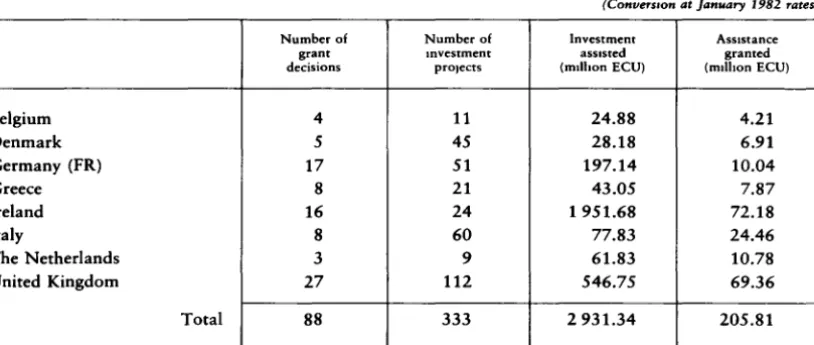
approved the third allocation of grants for 1982 from the European Regional Develop-ment Fund, totalling 205.8 million ECU for 333 investment projects costing a total of 2 931.3 million ECU.
The recipient Member States are Belgium, Denmark, the Federal Republic of Germany, Greece, Ireland, Italy, The Netherlands and the United Kingdom.
Under the Regulation of 18 March 1975
es-tablishing the ERDF, 1 as amended by the
Regulations of 6 February 19792 and 16
De-cember 1980,3 the Fund Committee had
en-dorsed these projects on 15 July.4 The
Reg-ional Policy Committee had been consulted beforehand, on 2 and 3 July, on infrastruc-ture projects costing more than 10 million ECU.
The aid granted under this allocation was distributed among the Member States as shown in Table 2.
The total of 205.8 million ECU breaks down as follows:
(i) 163.51 million ECU to help finance 238 infrastructure projects, comprising 110.66 million ECU to finance 23 projects costing more than 10 million ECU each, 52.37 mil-lion ECU to finance 209 projects costing less than 10 million ECU each, and 480 000 ECU to finance 6 projects costing less than 10 million ECU each in regions covered by
OJ L 73, 21.3.1975. OJ L 35, 9.2.1979. 3 OJ L 349, 23.12.1980.
4 Bull. EC 7/8-1982, point 2.1.78.
Table 2 - Grants from the ERDF (third 1982 allocation)
(ConversiOn at January 1982 rates)
Number of Number of Investment Asststance grant Investment assisted granted decisions proJects (m1lhon ECU) (m1lhon ECU)
Belgium 4 11 24.88 4.21
Denmark 5 45 28.18 6.91
Germany (FR) 17 51 197.14 10.04
Greece 8 21 43.05 7.87
Ireland 16 24 1 951.68 72.18
Italy 8 60 77.83 24.46
The Netherlands 3 9 61.83 10.78
United Kingdom 27 112 546.75 69.36
[image:28.479.29.436.483.655.2]