Elmahroug, M H, Tutesigensi, A and Brookes, N J (2014) Integrating external stakeholder
identification and project initiation in civil engineering infrastructure projects In:Raiden, A B and
IDENTIFICATION AND PROJECT INITIATION IN
CIVIL ENGINEERING INFRASTRUCTURE PROJECTS
Mohamed H. Elmahroug 1,2, Apollo Tutesigensi1and Naomi J. Brookes1
1Institute for Resilient Infrastructure, School of Civil Engineering, University of Leeds, Woodhouse Lane, Leeds, LS2 9JT, UK
2Department of Civil Engineering, Faculty of Engineering, University of Eljabel Elgharbi, Gherian, Libya
Current evidence suggests that there is a delay between the start of project initiation and the beginning of external stakeholder identification during the initiation phase of civil engineering infrastructure projects. A major consequence of this delay is limited project success. The aim of the research reported in this paper is, therefore, to explore the timing between project initiation and external stakeholder identification in order to understand its impact upon project success. A desk study involving three railway projects in three European countries was undertaken. It was found that external stakeholders are often asked to support proposals that may constitute opportunities to the project initiator but neither solve the external stakeholders' problems nor meet their expectations. It has also been identified that the time lag between project initiation and external stakeholder identification leads to external stakeholders having limited (if any) input into key aspects of the project defined before they get on the scene. This often results in misalignment of the project purpose and stakeholder expectations, thereby leading to lack of buy-in from external stakeholders which in turn can limit project success. Chances of project success can be improved by minimising the time lag, and the time lag can be minimised by integrating the project initiation and stakeholder identification processes. Such integration (which is the subject of on-going work) will lead to stakeholders agreeing the problem to be addressed by the project, defining options, and assessing the options for a consensus or near-consensus project that can be implemented with minimal disruption and/or challenge - and this will, in turn, boost chances of project success.
Keywords: civil engineering infrastructure, project initiation, project success, stakeholder identification.
INTRODUCTION
Civil engineering infrastructure projects, such as highways, bridges, airports, pipelines and railways, form the backbone of any modern, successful and competitive economy (HM Treasury 2012), improve quality of life and enhance the well-being of a modern society (Nget al. 2012). However, these projects often have a significant impact upon the lifestyle of a community, and their economic, environmental, sociological and political implications could last for varying periods of time (Koehn 1993). Therefore, the number of external stakeholders affected by a typical civil engineering
infrastructure project can be large, and consequently present numerous interfaces that
have to be effectively managed (Chinyio and Akintoye 2008). External stakeholders are those individuals and organisations that have no formal contractual relationship to the project but can have a strong interest in what is going on regarding the project (Cleland and Ireland 2007). According to Bourne and Walker (2005), in order to maximise external stakeholder positive inputs and minimise any potential detrimental impacts, it is vital to successfully identify and effectively collaborate with them to thoroughly understand both their expectations and potential impact upon project success.
The importance of managing external stakeholders to construction project success has been increasingly recognised (Jepsen and Eskerod 2009; Aaltonenet al. 2008;
Moodley 2008; Young 2006; Fewings 2005; Olander and Landin 2005), and this is particularly the case for civil engineering infrastructure projects. Stakeholder management has been defined as
stakeholders for the pur (McElroy
and Mills 2007: 760). This definition underlines the importance of developing relationships with stakeholders to project success. Moreover, Project Management Institute (PMI) has recently added project stakeholder management as a"10th Knowledge Area"due to the importance attached to appropriate engagement of stakeholders in key project decisions and activities (PMI 2013). Therefore, civil engineering infrastructure projects need to adopt an effective external stakeholder management approach to increase chances of project success.
Actually, the discourse on stakeholder management has been evolving since
4 (Littauet al. 2010). Since then, a number of stakeholder management approaches have been developed. In this research, eight approaches have been identified (PMI 2013; Luyet et al. 2012; BS 6079-1 2010; Yanget al. 2009; McElroy and Mills 2007; Preble 2005; Karlsen 2002; Cleland 1986), and it was found that although each approach adopts individual tools, techniques and stakeholder classification criteria to facilitate the execution of the process, all of them are similar in terms of the steps followed. Therefore, a generic stakeholder management approach has been derived from comparing and contrasting the eight approaches to identify which aspects they share and which sequence of steps they agree on. It was found that the eight approaches agree on four generic processes namely identification; analysis; engagement and evaluation.
The research reported in this paper is concerned with the first step (identification) during the initiation phase of civil engineering infrastructure projects. Stakeholder identification is defined as ifying all people or organisations impacted by the project, and documenting relevant information regarding their
projects. The process introduced comprehensive public participation by examining the -based public participatory process which is undertaken within the context of environmental impact assessment (EIA), as, in China, a participatory mechanism for infrastructure projects exists only as part of the EIA process (ibid). However, the proposed process flow indicates that the project is already initiated when participation takes place.
External stakeholder inputs are ignored until the need for a project is captured and a number of options are identified to propose a preferred solution. There is no evidence for effective external stakeholder involvement in the project initiation process despite agreement on the importance of involving them early. A civil engineering
infrastructure project is either derived from opportunity, arising from a perceived need or related to a recognised problem (Corrie 1991). According to APM (2006), this pre-project activity is performed within organisational functions or departments, while the decision to proceed with a project is made by senior management. In the United Kingdom, for example, the developer of any nationally significant infrastructure project is required to extensively consult with the affected external stakeholders of their proposals before submitting an application for development consent (The Planning Inspectorate 2012). However, the consultation does not start until the developer has prepared their proposal and notified the Planning Inspectorate that they intend to submit an application in the future. This suggests that external stakeholders are having limited (if any) input into key aspects of the project before they get on the scene, whereas some evidence (National Audit Office 2011) has recently been presented suggests that successful initiation of a major infrastructure project requires external stakeholder involvement. External stakeholders need to understand what outcomes potential civil engineering infrastructure project is meant to deliver, and participate in articulating its objectives (ibid).
The starting point of the project initiation phase should be the definition of the problem or opportunity the project is meant to address. Infrastructure projects should be aimed at addressing problems - and these problems will be faced by all society including external stakeholders. When the process of defining and agreeing the problem involves external stakeholders, the project that is initiated to address the problem is likely to be supported by external stakeholders. In practice, stakeholder identification and project initiation do not appear to be harmonised - and this tends to limit project success in infrastructure projects. It is the authors' contention that harmonisation of stakeholder identification and project initiation can be addressed by minimising the time lag between the start of the initiation phase and stakeholder identification process. Therefore, the aim of the work reported in this paper was to explore the timing between external stakeholder identification and project initiation processes during the initiation phase of civil engineering infrastructure projects with a view of proposing future work in this important area.
RESEARCH METHODOLOGY
government publications (Department for Transport 2012a; 2012b; 2010; Great Britain), text books (European Commission 2005; Hertoghet al. 2008) and official websites (51m 2012; High Speed 2 [no date]; Railway Technology 2014; The APPG for High Speed Rail 2012).
The aim of the desk study was to identify what work had been done before the first formal public consultation. The focus of the desk study was on two themes (events in the project and events relating to external stakeholders). Events in the projects were project decisions and activities relating to initiating the project, whereas events relating to external stakeholders were associated with external stakeholder related activities, such as public consultations, disputes, communications between
stakeholders and project teams. The desk study also focused on key dates in the
projects' lifecycles in order to produce a project timeline that can clearly visualise both project and external stakeholder activities during their initiation phases. In addition, the impacts of lack of external stakeholder involvement on the projects were also identified.
FINDINGS AND DISCUSSION
For each of the three projects, a timeline has been produced to show the timing between key activities in the project and any associated external stakeholder events, such as consultations. The timelines clearly visualise the time lags between the beginning of the projects' initiation phases and the first formal public consultations. They also illustrate the project activities that had been done before the public consultations, and the impacts external stakeholders had on the projects during their lifecycles.
Project 1: expansion of the west coast line through the city of Lund, Sweden
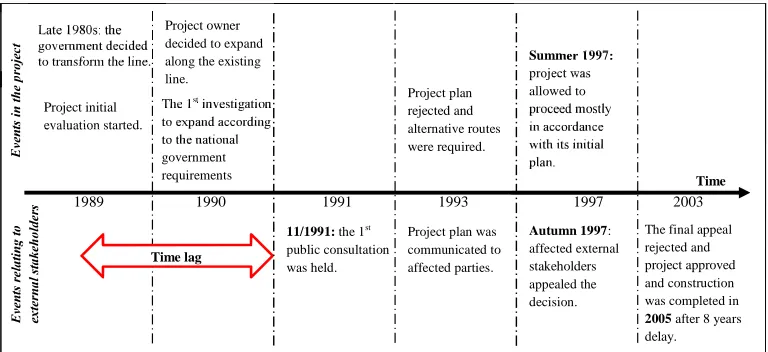
In the late 1980s, the Swedish government decided to transform the west coast railway from a single to a double track railway through the city of Lund. The initial evaluation of the project started in 1989, and in 1990 the National Railroad Administration (the project owner) decided to expand the line alongside the existing route. At this stage, the only stakeholders considered were the railway companies that would manage the traffic on this line, and for them expanding along the existing single-track railway was the most rational option (Olander and Landin 2005). The first public consultation about the project was held in November 1991 after a preferred route had been chosen, and a project proposal was already developed (Olander and Landin 2008). It was the first opportunity external stakeholders had to raise their concerns about the project, which means that there was a time lag between the start of project initiation and the first public involvement in the project.
As can be seen in Figure 1, from the initial project evaluation, three years passed before the first public consultation took place. Key aspects of the project including objectives and route selection were defined during these three years without any input
from those local residents who argued that there had been a better alternative for the proposed route that would impact on a smaller population.
Figure 1: The time lag in project 1
As a result of lack of public involvement in the initiation process of the project, the concerned residents formed an interest group and in 1993 acted through the
municipality of Lund, which was involved because a community plan was required, to raise the question for the need of alternative solutions. The municipality of Lund, in turn, through the normal planning process expressed the view that there was
insufficient alternative analysis for the design and implementation of the project, and demanded investigating additional alternative solutions (Olander and Landin 2005). As a result, additional alternative solutions were investigated, but were found to be economically and technically insufficient. In 1997 the municipality therefore allowed the project to proceed mostly in accordance with the owner's original plan. However, the affected external stakeholders appealed the decision twice but lost in both
instances. The ultimate result of the appeal required changes to address noise and safety concerns. Although they lost the case, external stakeholders delayed the project
(Olander and Landin 2008).
This project was initiated entirely in accordance with the developer's requirements (The Swedish Government). There was lack of external stakeholder involvement during the initiation phase, and external stakeholders had no input into the initiation process. In fact, attention to external stakeholders was given only when planning permissions were needed. Even then, stakeholder management was a matter of informing rather than involving external stakeholders in project decisions and
activities. Therefore, the project plans neither met the expectations nor addressed the concerns of external stakeholders, and were criticised as an expression of the
developer's interest. The delay between the beginning of project initiation and the first public consultation prevented external stakeholders from positively contributing to the project that would impact upon them. External stakeholders had the opportunity to raise their concerns only after a preferred route was selected and project plan had already been developed.
Project 2: Betuweroute rail project, the Netherlands
In the Netherlands, at the end of 1980s, the initiative of constructing a railway line between Rotterdam harbour and the German border was put on the political agenda. The project is known as Betuweroute rail project. In 1991, the initiative was
Late 1980s: the government decided to transform the line.
The 1stinvestigation
to expand according to the national government requirements
Project owner decided to expand along the existing line.
Project initial evaluation started.
11/1991:the 1st
public consultation was held.
Summer 1997:
project was allowed to proceed mostly in accordance with its initial plan.
Autumn 1997: affected external stakeholders appealed the decision.
The final appeal rejected and project approved and construction was completed in
2005after 8 years delay. Project plan
rejected and alternative routes were required.
Time lag
Time
Project plan was communicated to affected parties.
formulated in a Dutch policy document. The Dutch parliament then authorised the investment in 1994 in spite of the controversy due to the poorly defined
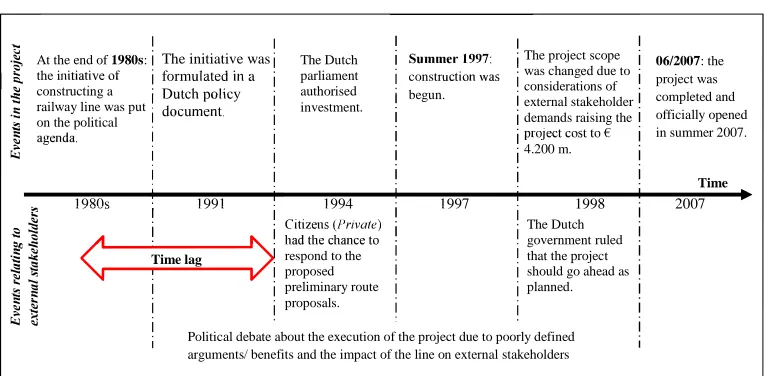
[image:6.595.73.456.208.396.2]argument/benefits and the project impact on local stakeholders. Only after when the investment had been authorised and route proposals developed, did the external stakeholders have the possibility to raise concerns about the project. In the same year, 1994, citizens had their first chance to respond to the proposed preliminary route proposals (Hertoghet al. 2008). Figure 2 illustrates key events relating to the project initiation and its external stakeholders at an early stage of its lifecycle. It shows that external stakeholders had the chance to be heard about the project only after the investment had been authorised.
Figure 2: The time lag in project 2
As can be seen in Figure 2 above, from when the project was put on the political agenda four years passed before external stakeholders had the chance to be heard about the project. The necessity for the project and its route were decided before consulting the affected external stakeholders. Only after the Dutch parliament had already authorised investment in 1994 were affected citizens consulted about the project proposals. Regardless of its ambitious objectives of provision of a sustainable transport alternative for freight and improving the competitive position of Rotterdam
the poorly defined argument/benefits and impacts of the project on the external stakeholders (Hertoghet al. 2008).
According to Hertoghet al. (2008), the project became subject to controversy in the arena of political decision-making as a result of the lack of public involvement in its initiation process. The affected external stakeholders questioned the necessity for the project and demanded mitigating measures to be taken once the first public
consultation took place. As a consequence of this demand, the project scope changed
The project was one of the TEN-T priority axes and projects (European Commission 2005). It was initiated to meet environmental and economic benefits, but lacked considerations of impact on local external stakeholders. The late involvement of external stakeholders resulted in the necessity for the construction of the project being questioned, and mitigating measures being demanded. The time lag led to external stakeholder concerns about the project being left behind allowing the project to be initiated mostly in accordance with the requirements of its developer. As a result, the
At the end of1980s: the initiative of constructing a railway line was put on the political agenda.
The initiative was formulated in a Dutch policy document.
Citizens (Private) had the chance to respond to the proposed preliminary route proposals.
06/2007: the project was completed and officially opened in summer 2007.
The Dutch government ruled that the project should go ahead as planned.
Summer 1997: construction was begun.
Time lag
Time
1980s 1991 1994 1997 1998 2007
The project scope was changed due to considerations of external stakeholder demands raising the
4.200 m. The Dutch
parliament authorised investment.
project scope changed as demanded by its external stakeholders. This dramatically e been mitigated if external stakeholders were involved in initiating the project, but unfortunately attention to affected
stakeholders was given late.
Project 3: High Speed 2 (HS2) Railway, United Kingdom
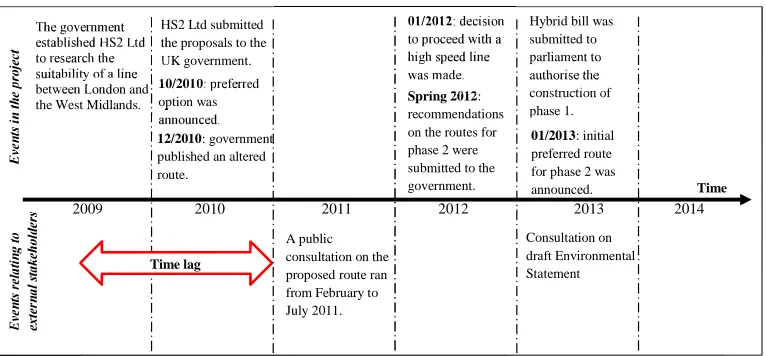
The case for high speed railway in the United Kingdom has been examined since 2009, when the UK government established HS2 Ltd to research the suitability of a high speed railway line between London and the West Midlands (Department for Transport 2010). Following its establishment, the HS2 Ltd submitted proposals for high speed railway line to the UK government in 2010. The preferred option was announced in October 2010, and published by the government at the end of the same year (Railway Technology 2014). The first public consultation did not start until the government had announced its preferred route. The consultation on the proposed route then ran from February to July 2011. In January 2012, the Secretary of State for Transport decided to proceed with HS2 Ltd's recommended route between London to Birmingham (Phase 1) following analysis of the responses to the consultation. A year later, the Secretary of State announced the initial preferred routes for Phase 2, a western branch connecting Birmingham and Manchester and an eastern branch connecting Birmingham with Leeds, after HS2 Ltd had submitted their
[image:7.595.111.494.403.581.2]recommendations on these routes (High Speed 2 [no date]). Figure 3 illustrates the earliest stage of the project lifecycle. It highlights the main events relating to initiating the project and its external stakeholders. In this project, there is no evidence for external stakeholder input before the first public consultation.
Figure 3: The time lag in project 3
As can be seen in Figure 3, HS2 Ltd had researched the suitability of a high speed railway line and submitted project proposals to the government before the start of the first public consultation. External stakeholders had the opportunity to be consulted about the project proposal after the government had already chosen and announced what it believed to be the most rational option. Moreover, key aspects of the project such as confirming the necessity for a high speed railway line and the selection of a preferred route had been defined before the first public consultation started. There is no evidence for effective external stakeholder involvement in the process of
developing the project proposal. The consultation on the project asked seven questions
route for phase 1, its environmental appraisal, and options for supporting affected property owners (Department for Transport 2012a). However, the whole consultation
The government established HS2 Ltd to research the suitability of a line between London and the West Midlands.
10/2010: preferred option was announced.
HS2 Ltd submitted the proposals to the UK government.
A public consultation on the proposed route ran from February to July 2011.
Hybrid bill was submitted to parliament to authorise the construction of phase 1.
Consultation on draft Environmental Statement
01/2012: decision to proceed with a high speed line was made.
Time lag
Time Spring 2012:
recommendations on the routes for phase 2 were submitted to the government.
2009 2010 2011 2012 2013 2014
12/2010: government published an altered route.
alternative options were made available at the time. Participants in the consultation did not have the chance to be consulted about options but rather they were asked
a result, the project proposal has been criticised by some significant sections of the rest.
Although the first public consultation was one of the largest national consultations ever undertaken by the Department for Transport (Department for Transport 2012b), external stakeholders against the project such as 51m, HS2 Action Alliance and Stop HS2 have been actively criticising the government's proposal to construct a high speed railway line since its announcement in 2010. Their argument is that there is a better alternative that can equally meet demands. They also claim that the construction of HS2 is an inappropriate way of increasing capacity as it takes far too long to deliver major capacity benefits which will not be delivered before 2033. Most of those who oppose the project believe that the project's business case is poor, and suggested other alternatives that can increase capacity much more quickly than HS2 (51m 2012). Despite active opposition, the project has been given the 'go ahead' as it also has supporters who believe that the alternatives suggested by the project opposition are unable to meet peak demand, and argue that
(The APPG for High Speed Rail 2012: 5). A potential driver of this opposition could be the lack of effective external stakeholder involvement at a sufficiently early stage when options were still being considered.
It is unknown that whether or not the time lag will have an impact upon the project's overall performance due to its current level of development. However, the time lag led to external stakeholders being asked to support proposal that constitute opportunities to the government, but seems to be an inappropriate option to them. In this project, the lag seems to be facilitated by the planning process for dealing with proposals for Nationally Significant Infrastructure Projects (NSIPs) which was established by the planning Act 2008 (Great Britain). Here, the project developer is required to
extensively consult with the affected external stakeholders of their proposals before submitting an application for development consent. However, the consultation does start until the developer has prepared their proposal and notified the Planning Inspectorate that they intend to submit an application in the future.
CONCLUSIONS
There is a time lag between the start of project initiation and the beginning of external stakeholder identification when initiating civil engineering infrastructure projects. The lag unfortunately impacts upon project success, and limits external stakeholder input into key aspects of the project defined during the project initiation phase. It also leads to misalignment of project purpose and external stakeholder expectations at an early stage of the project lifecycle. This misalignment often results in lack of buy-in from external stakeholders which in turn can limit project success.
Minimising the time lag forms a golden opportunity to solve these problems, i.e. -in, facilitating alignment and eventually boosting chances of project success. This can be achieved by integrating the process of project initiation and stakeholder identification. This integration will bring together all
stakeholders in the project at a sufficiently early stage of the project lifecycle to firstly agree the problem to be addressed by the project, define options, and assess the
minimal disruption and/or challenge. This integration is the subject of the author's on-going research.
REFERENCES
51m (2012)"Submission to the All-Party Parliamentary Group for High Speed Rail Capacity Inquiry".[Online]. [Accessed 27 Feburary 2014]. Available from:
http://www.appghsr.co.uk/upload/51m%20submission.pdf.
Aaltonen, K, Jaakko, K and Tuomas, O (2008) Stakeholder salience in global projects. "International Journal of Project Management",26(5), 509-516.
APM (2006)"APM Body of Knowledge". 5 ed. UK: Association for Project Management. Bourne, L and Walker, D H T (2005) Visualising and mapping stakeholder influence.
"Management Decision",43(5), 649-660.
BS 6079-1 (2010)"Project management - Part 1: Principles and guidelines for the management of projects". London: British Standards Institution.
Chinyio, E A and Akintoye, A (2008) Practical approaches for engaging stakeholders: findings from the UK."Construction Management and Economics",26(6), 591-599. Cleland, D I (1986) Project stakeholder management."Project Management Journal",17(4),
36-44.
Cleland, D I and Ireland, L R (2007)"Project management : strategic design and implementation". 5th ed. New York: McGraw-Hill.
Corrie, R K (1991)"Project evaluation". London: Telford.
Department for Transport (2010)"High Speed Rail".[Online]. London: The Stationery Office Limited. [Accessed 02 May 2014]. Available from:
http://www.railwaysarchive.co.uk/docsummary.php?docID=3136.
Department for Transport (2012a)"High speed rail: Investing in Britain's future - decisions and next steps".[Online]. London: Crown. Available from:
https://
www.gov.uk/government/publications/high-speed-rail-investing-in-britains-future-decisions-and-next-steps.
Department for Transport (2012b)"High speed rail: Investing in Britain's future - the government's decisions".[Online]. London: Crown. Available from:
https://
www.gov.uk/government/consultations/high-speed-rail-investing-in-britains-future-consultation.
European Commission (2005)"Trans-European Transport Network: TEN-T Priority Axis and Projects 2005". Brussels: European Commission, Energy and Transport DG.
Fewings, P (2005)"Construction project management : an integrated approach". London: Taylor and Francis.
Great Britain.Planning Act 2008. (c.29)London: The Stationery Office.
Hertogh, Met al. (2008)"Managing Large Infrastructure Projects: Research on Best Practices and Lessons Learnt in Large Infrastructure Projects in Europe".[Online]. the Netherlands: AT Osborne BV. Available from:
http://netlipse.eu/media/18750/netlipse%20book.pdf.
High Speed 2 ([no date])"What is HS2. High speed rail and HS2: The HS2 story".[Online]. [Accessed 26 February 2014]. Available from:
http://www.hs2.org.uk/about-hs2/high-speed-rail-hs2/hs2-story.
HM Treasury (2012)"National Infrastructure Plan:update 2012".[Online]. UK: Crown. [Accessed 14 October 2013]. Available from:
https://
www.gov.uk/government/publications/national-infrastructure-plan-update-december-2012.
Jepsen, A L and Eskerod, P (2009) Stakeholder analysis in projects: Challenges in using current guidelines in the real world."International Journal of Project Management",
27(4), 335-343.
Koehn, E (1993) Infrastructure Construction: Effect of Social and Environmental Regulations. "Journal of Professional Issues in Engineering Education and Practice",119(3), 284-296.
Li, T H Y, Thomas Ng, S and Skitmore, M (2012) Public participation in infrastructure and construction projects in China: From an EIA-based to a whole-cycle process."Habitat International",36(1), 47-56.
Littau, P, Jujagiri, N J and Adlbrecht, G (2010) 25 years of stakeholder theory in project management literature (1984 2009)."Project Management Journal",41(4), 17-29. Luyet, V. Schlaepfer, R., Parlange, M., and Buttler, A. (2012) A framework to implement
Stakeholder participation in environmental projects."Journal of Environmental Management",111(0), 213-219.
McElroy, B and Mills, C (2007) Managing stakeholders. In: J.R. Turner (ed)."Gower Handbook of Project Management".4th ed. England: Gower Publishing Ltd. Moodley, K (2008) Project Stakeholders. In: N.J. Smith (ed)."Engineering project
management".3rd ed. Oxford: Blackwell.
National Audit Office (2011)"Initiating successful projects: Guide".[Online]. UK: Precision Printing. [Accessed 14 October 2013]. Available from:
http://www.nao.org.uk/report/nao-guide-initiating-successful-projects-3/.
Ng, S T, Li, T H Y and Wong, J M W. 2012. Rethinking public participation in infrastructure projects.Proceedings of the ICE - Municipal Engineer.[Online].165,101-113. Available from:
http://www.icevirtuallibrary.com/content/article/10.1680/muen.11.00027.
Olander, S and Landin, A (2005) Evaluation of stakeholder influence in the implementation of construction projects."International Journal of Project Management",23(4), 321-328.
Olander, S and Landin, A (2008) A comparative study of factors affecting the external
stakeholder management process."Construction Management and Economics",26(6), 553-561.
PMI (2008)"A guide to the project management body of knowledge (PMBOK* Guide)". 4th ed. Newtown Square, Pa.: Project Management Institute, Inc.
PMI (2013)"A guide to the project management body of knowledge (PMBOK guide)". Fifth edition. ed. Newtown Square, USA: Project Management Institute, Inc.
Preble, J F (2005) Toward a Comprehensive Model of Stakeholder Management."Business and Society Review (00453609)",110(4), 407-431.
Railway Technology (2014)"Projects: High Speed 2 (HS2) Railway".[Online]. [Accessed 03 April 2014]. Available from:
http://www.railway-technology.com/projects/high-speed-2-hs2/.
The APPG for High Speed Rail (2012)"All-Party Parliamentary Group for High-Speed Rail: .[Online]. [Accessed 27 Feburary 2014]. Available from:
http://www.appghsr.co.uk/upload/APPG%20for%20High-Speed%20Rail%20Inquiry%20Report.pdf.
The Planning Inspectorate (2012)"National Infrastructure Planning. Application Process: The process".[Online]. [Accessed 24 February 2014]. Available from:
http://infrastructure.planningportal.gov.uk/application-process/the-process/.
Yang, Jet al. (2009) EXPLORING CRITICAL SUCCESS FACTORS FOR
STAKEHOLDER MANAGEMENT IN CONSTRUCTION PROJECTS."Journal of
Civil Engineering and Management",15(4), 337-348.