reach upto the customers as far as possible and fast as possible. Internet should reach to each any every corner of the world. Google launched a project named as Project Loop to give access of internet to every corner of the world in low cost and with less infrastructure cost. We are trying to review on the project loop.
1.
INTRODUCTIONMany of us think of the Internet as a global community. But two-thirds of the world’s population does not yet have Internet access. Project Project Loon is a research and development project being developed by X (formerly Google X) with the mission of providing Internet access to rural and remote areas. The project uses high-altitude balloons placed in the stratosphere at an altitude of about 18 km (11 mi) to create an aerial wireless network with up to 4G-LTE speeds (Download – 5-12 Mbps, Upload – 2-5 Mbps). It was named Project Loon, since even Google itself found the idea of providing Internet access to the remaining 5 billion populations unprecedented and "crazy."
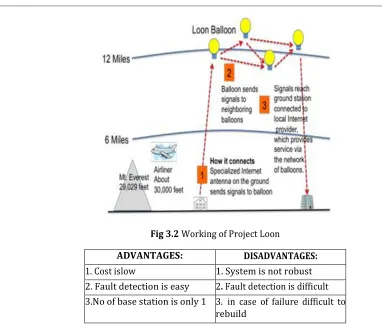
The balloons are maneuvered by adjusting their altitude in the stratosphere to float to a wind layer after identifying the wind layer with the desired speed and direction using wind data from the National Oceanic and Atmospheric Administration (NOAA). Users of the service connect to the balloon network using a special Internet antenna attached to their building. The signal travels through the balloon network from balloon to balloon, then to a ground-based station connected to an Internet service provider (ISP), then onto the global Internet. The system aims to bring Internet access to remote and rural areas poorly served by existing provisions, and to improve communication during natural disasters to affected regions.
Key people involved in the project include Rich DeVaul, chief technical architect, who is also an expert on wearable technology; Mike Cassidy, a project leader; and Cyrus Behroozi, a networking and telecommunication lead. During a crisis, connectivity is really significant because information in itself is really lifesaving. Here the key concept is a set of high-altitude balloons ascends to the stratosphere and creates an aerial wireless network .The technology designed in the project could allow countries to avoid using expensive infrastructure and avoids cost required to set a big network infrastructure.
2.
LITERATURE SURVEY2.1 HISTORY
Over the past few years, Google X has released a number of incredible projects, including Google Glass, Self Driving Cars, as well as other projects related to neural networks. Google X is Google”s secret research and development lab that is headed by Sergey Brim himself. The division is rumored to house hundreds of projects related to futuristic technologies, which until now, we have only witnessed in movies and our wildest imaginations. About ten years ago, no one would have predicted that smart phones would become such an integral part of how we lead our lives or that the internet would facilitate such a strong influence in educational transparency and cultural integration across multiple continents. An entire genre of jobs has erupted on the web over the last decade, many of which are based solely around spreading knowledge. YouTube, for example, has thousands of “how to” videos. With internet becoming available to millions of web secluded people, there will be a drastic surge of these
In 2008, Google had considered contracting with or acquiring Space Data Corp., a company that sends balloons carrying small base stations about 20 miles (32 km) up in the air for providing connectivity to truckers and oil companies in the southern United States, but didn't do so. Unofficial development on the project began in 2011 under incubation in Google X with a series of trial runs in California's Central Valley. The project was officially announced as a Google project on 14 June 2013.
Fig.2.2 New Zealand
On 28 July 2015, Google signed an agreement with officials of Information and Communication Technology Agency (ICTA)
- Sri Lanka, to launch the technology on a mass scale. As a result, by March 2016, Sri Lanka will be the second country in the world to get full coverage of internet using LTE, after Vatican City.
On 29 October 2015, Google agreed to partner with Indonesia's XL Axiata, Indosat and Telkomsel to bring the technology to the country in the hopes of connecting its 17,000 islands.
Project Loon is Google's pursuit to deploy a high-altitude balloon network operating in the stratosphere, at altitudes between 18 km and 25 km. Google asserts that this particular layer of the stratosphere is advantageous because of its relatively low wind speeds (e.g., wind speeds between 5 and 20 mph / 10 to 30 kmph) and minimal turbulence. Moreover, Google claims that it can model, with reasonable accuracy, the seasonal, longitudinal, and latitudinal variations in wind speeds within the 18–25 km stratospheric layer.
2.2. LOON POWERED INTERNET
No internet to the high speed internet for everyone.
Many of the Indian as well as the small villages and the towns are unable to enjoy the benefits of the internet due to some or the other
reasons.
For this reason Google has launched the PROJECT LOON.
The Balloon can go up to the 18-20 km height. Google claims that it can control the latitudinal and longitudinal position of high-altitude balloons by adjusting only the balloon's altitude.
Google has additionally indicated that balloons may be constructed from various materials (e.g., metalized Mylar) or a highly-flexible latex or rubber material.
This materials used by google for this project are very strong and it’s safe to use them.
The cost of the fiber optics cable is very high and it’s setup is very expensive compare to Balloon’s setup.
He had used a satellite Internet service in 2009 but found that he sometimes had to pay over $1000 per month for the service. The high-altitude balloons fly twice as high as airplanes, but below the range of satellites.
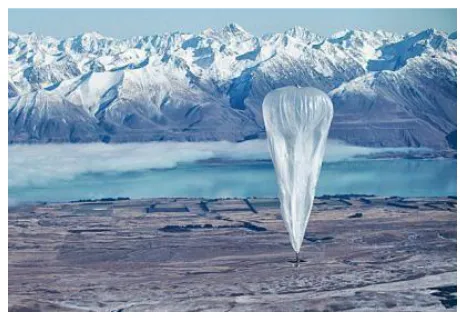
The balloons envelop are made up of plastic (polyethylene plastic) about 3 mil thick, and stand 15 m (49 ft.) across and 12 m (39 ft.) tall when fully inflated. A small box weighing 10 kg (22 lb.) containing the balloon’s electronic equipment hangs underneath the inflated envelope.
Fig.2.3. Hardware
The circuit box contains circuit which gives internet connection and radio antennas to communicate with other balloons and with Internet antennae on the ground, and batteries to store solar power so the balloons can operate during the night. Each balloon’s electronics are powered by an array of solar panels that sit between the envelope and the hardware. In full sun, these panels produce 100 watts of power, sufficient to keep the unit running while also charging a battery for use at night. A parachute attached to the top of the envelope allows for a controlled descent and landing when a balloon is ready to be taken out of service. The ground stations are able to connect to the balloons beaming down the Internet when the balloons are in a 20 km (12 mi) radius. Some reports have called Google’s project the Google Balloon Internet.
3.1SYSTEM ARCHITECTURE
Dealing with the extreme conditions in the stratosphere:
Fig 3.1.Balloon in Stratosphere
Electronics are on the balloon:
In addition to the specialized radios that provide Internet service to users on the ground, our balloons carry instruments to monitor the weather and the conditions around them, as well as a GPS to keep track of their flight patterns. The electronics are powered by solar panels, and excess power is stored in a rechargeable battery so service can continue during the night.
Communication equipment on a balloon:
There are two main radio transceivers; one for balloon-to- balloon communications and another for balloon-to-ground communications. There is also a third backup radio that we use to communicate with the balloons if the others fail or go out of range.
Will the Balloons Crash?
Each balloon is made of rugged polyethylene plastic. They use solar power to help remain aloft. The balloons float in the stratosphere, above rain and commercial aircraft, for example, and far below satellites. Of course Balloon will crash if any object or anything comes between them they will crash to that.
The Internet speed:
During our New Zealand pilot test, we expect Internet speed to be comparable to 3G.
3.2 INCIDENTS
1. In May 2014, a Loon balloon crashed into power lines in Washington, United States.
2. On 20 June 2014, New Zealand officials briefly scrambled emergency services personnel when a Loon balloon
came down.
3. In November 2014, a South African farmer found a crashed Loon balloon in the Karoo desert between
Strydenburg and Britstown.
4. On 23 April 2015, a Loon balloon crashed in a field near Bragg City, Missouri.
5. On September 12, 2015, a Loon balloon crash landed in the front lawn of a residence on Rancho Hills, Chino Hills,
CA.
6. On 17 February 2016, a Loon balloon crashed in the tea- growing region of Gampola, Sri Lanka while carrying out
tests.
7. On April 7, 2016, a Loon balloon landed on a farm in Dundee, KwaZulu-Natal, South Africa.
8. On April 22, 2016, a Loon balloon crashed in a field in the Ñeembucu department, Paraguay.
Fig 3.2 Working of Project Loon
ADVANTAGES: DISADVANTAGES:
1. Cost is low 1. System is not robust
2. Fault detection is easy 2. Fault detection is difficult
3.No of base station is only 1 3. in case of failure difficult to rebuild
CONCLUSION
This revolutionary project can bring internet to everyone on this planet irrespective of there location. Complete world can be linked together. There is near about 75% comment is in the favor of project loons. So far as I think it would be great Success of this. Project in Future. And we hope balloons could become an option for connecting rural, remote, and underserved areas, and for helping with communications after natural disasters. Information would never have been available at this ease in the history of this planet, everything just a couple of clicks away, from any corner of the world you are in. Education: There are millions of poor children all over the world who haven’t even heard the word „school.‟ Loon has the potential to become a school on the air for the under privileged. Medicine: Health and hygiene information can be made easily available to the people who haven’t even heard of the word doctor Collaboration: Connecting with the remote countries and inaccessible terrains will no longer be impossible. It will eliminate the need to lay down cables in those areas, and live weather forecast reports in such areas would be of a great help to the locals there. Internet connectivity and communication become one of the basic needs in modern human daily life. An innovative and scalable idea like the Google Project Loon would aid and benefit remote areas of the world as well as population to reap the benefits of Internet connections.
REFERENCES
[1.] Lardinois, Frederic (14 June 2013). "Google X Announces Project Loon: Balloon-Powered Internet For Rural, Remote And Underserved Areas". TechCrunch.Retrieved 15 June 2013.
[2.]. Mack, Eric (14 June 2013). "Meet Google's 'Project Loon:' Balloon- powered 'net access". CNET.Retrieved 15 June 2013.
[3]. Brodkin, Jon (14 June 2013). "Google flies Internet balloons in stratosphere for a “network in the sky”". ArsTechnica.Retrieved 15 June 2013.
[4]. Sharma, Amol (20 February 2008). "Floating a New Idea For Going Wireless, Parachute Included". The Wall Street Journal.Retrieved 16 June 2013.