
This is a repository copy of
Validation of Surrogate Endpoints in Advanced Solid Tumors:
Systematic Review of Statistical Methods, Results, and Implications for Policy Makers
.
White Rose Research Online URL for this paper:
http://eprints.whiterose.ac.uk/98519/
Version: Supplemental Material
Article:
Ciani, O., Cantrell, A. orcid.org/0000-0003-0040-9853, Davis, S.
orcid.org/0000-0002-6609-4287 et al. (6 more authors) (2014) Validation of Surrogate
Endpoints in Advanced Solid Tumors: Systematic Review of Statistical Methods, Results,
and Implications for Policy Makers. International Journal of Technology Assessment in
Health Care, 30 (3). pp. 312-324. ISSN 0266-4623
https://doi.org/10.1017/S0266462314000300
[email protected] https://eprints.whiterose.ac.uk/ Reuse
Unless indicated otherwise, fulltext items are protected by copyright with all rights reserved. The copyright exception in section 29 of the Copyright, Designs and Patents Act 1988 allows the making of a single copy solely for the purpose of non-commercial research or private study within the limits of fair dealing. The publisher or other rights-holder may allow further reproduction and re-use of this version - refer to the White Rose Research Online record for this item. Where records identify the publisher as the copyright holder, users can verify any specific terms of use on the publisher’s website.
Takedown
If you consider content in White Rose Research Online to be in breach of UK law, please notify us by
1
Table 1. Summary of the characteristics of included meta-analyses, N=31
Frequency (%)
Type of meta-analysis
Aggregate data
18 (58)
IPD
13 (42)
Number of trials, Median (IQR)
28 (9 - 51)
Aggregate data
39 (31 - 67)
IPD
4 (4 - 10)
Number of patients, Median (IQR)
4138 (1167 - 15262)
Aggregate data
15850 (10714 - 23492)
IPD
1158 (642 - 1280)
Advanced tumour types
Colorectal cancer
12 (39)
Ovarian cancer
7 (23)
Breast cancer
8 (26)
Lung cancer
9 (29)
Renal cell carcinoma
3 (10)
Prostate cancer
2 (6)
Glioblastoma multiforme
2 (6)
Gastric cancer
1 (3)
Head and neck cancer
1 (3)
Pancreatic cancer
1 (3)
Number of tumour types examined
1
24 (77)
2
4 (13)
> 2
3 (10)
Surrogate endpoint considered
PFS
15 (48)
TTP
6 (19)
PFS and TTP
*3 (10)
PFS/TTP
§5 (16)
PFS and TTP and PFS/TTP
2 (6)
IPD = Individual patient data; NSCLC = non-small-cell lung cancer; PFS = Progression-free
survival; TTP = Time to progression
Table 2. Assessment of the validity of PFS as surrogate for OS: comparison of meta-analyses by tumour type across evaluation
frameworks. Shaded cells indicate meta-analyses using individual patient data.
Tumour
type Meta-analysis
Elston and
Taylor
frameworka
IQWiG frameworkb BSES3c
Authors’ conclusions
Reliability Correlation Conclusion Overall Score /12
Level of
Evidence
Colorectal
cancer Louvet 2001
43
Level 2 Low - No proof 7 D “In conclusion, PFS certainly deserves further evaluation as an endpoint measure.”
Tang 200744 Level 1 Moderate Medium Hint 10 C
“In first-line chemotherapy trials for metastatic CRC,
improvements in PFS are strongly associated with
improvements in OS. In this patient population, PFS may
be an appropriate surrogate for OS.”
Wilkerson 200940 Level 1 Moderate Low No Proof 8 D+ “We conclude that PFS is not a surrogate for OS; rather it is a straightforward measure of on-therapy benefit.”
Chirila 201225 Level 1 Limited Medium Indication 9 C-
“We have shown that the correlation of OS with PFS,
either alone or aggregated with TTP, in clinical trials of
patients with metastatic CRC is robust across lines of
therapy and provides a useful means of predicting
improvements in OS.”
Burzykowski
200138 Level 1 Limited Low No Proof 7 D
“These results suggest that PFS is neither trial level nor
individual level valid”
Burzykowski
200624 Level 1 Limited Medium Indication 8 D+
“This clearly illustrates that PFS would not be an
acceptable, even ‘potentially’, surrogate for survival in
the set of trials analysed here. [However] the association
3
have been dominated by random noise.”
Buyse 200745 Level 1 Limited High Indication 10 C
“The analyses presented here show that, in historical
trials comparing FU leucovorin with single-agent FU or
with raltitrexed, PFS was an acceptable surrogate for
OS”
Green 200826 Level 1 Limited Medium Indication 10 C- “We conclude that there is modest evidence for surrogacy between one-year PFS and two-year OS.”
Lung
cancer Hotta 201150 Level 2 Low - No Proof 8 D+
“A PFS advantage is unlikely to be associated with an
OS advantage any longer due to this increasing impact
of PPS on OS.”
Li 201247 Level 2 Low - No Proof 7 D
“Our data suggest that PFS is appropriate survival
marker in the clinical trials of EGFR-TKIs for advanced
NSCLC.”
Mandrekar 201048 Level 2 Low - No Proof 6 D-
“Our present findings (based on data from phase II trials)
demonstrate that PFS is a significant predictor of patient
survival in advanced NSCLC.”
Foster 201157 Level 1 Limited Medium Indication 8 D+
“PFS showed the most promise as a surrogate endpoint
for OS (in SCLC) at the patient and the trial-level across
all the statistical methods assessed.”
Breast
cancer
Miksad 200853 Level 1 Limited Low No Proof 8* 9**
D+
C-
“This meta-analysis suggests that the trial-level TE on
PFS is significantly associated with the trial-level TE on
OS. However, prediction of OS based on PFS is
surrounded with uncertainty.”
Wilkerson 200940 Level 1 Moderate Low No Proof 8 D+ “We conclude that PFS is not a surrogate for OS; rather
4
Burzykowski
200851 Level 1 High Low No Proof 7 D
“No end point could be demonstrated as a good
surrogate for OS in these trials.”
Ovarian
cancer
Wilkerson 200940
Level 1 Moderate Low No Proof 8 D+ “We conclude that PFS is not a surrogate for OS; rather it is a straightforward measure of on-therapy benefit.”
Rose 201054 Level 2 Low - No Proof 5 E+
“We studied the correlation between PFS at six months
and survival and found measures of PFS at six months
correlated better than response rate to OS.”
Burzykowski
200138 Level 1 Limited High Indication 8 D+
“It seems plausible to conclude that PFS is a valid
surrogate for survival in advanced ovarian cancer for
treatments of the type used in the trials analysed.”
Burzykowski
200624 Level 1 Limited High Indication 8 D+
“Consequently, we suggest a better validity of the
surrogate (PFS) [than in CRC].”
Renal cell
carcinoma Heng 201159 Level 2 Low - No Proof 5 E+
“PFS may be a meaningful intermediate endpoint for OS
in patients with metastatic RCC who receive treatment
with novel agents.”
Prostate
cancer
Halabi 200958 Level 2 Low - No Proof 6 D-
“PFS seems to be associated with OS. These data need
to be validated prospectively before it can be used
routinely as an intermediate end point in phase II trials in
CRPC.”
GBM
Ballman 200742 Level 2 Low - No Proof 6 D-
“In light of our assessment of the relationship between
PFS and OS, it appears that PFS provides only a
moderately reliable estimate of survival.”
Polley 201041 Level 2 Low - No Proof 5 E+
“Our analysis suggested that PFS at 6 months may be
an appropriate primary endpoint in the context of phase
5
GBM patients. Future research is needed to validate our
findings in a larger population.”
CRC = colorectal cancer; CRPC = castrate-resistant prostate cancer; EGFR-TKIs = epidermal growth factor receptor tyrosine-kinase inhibitors;
FU = fluorouracil; GBM = Glioblastoma multiforme; NSCLC = non-small-cell lung cancer; OS = overall survival; PFS = progression-free survival;
PPS = post-progression survival; RCC = renal cell carcinoma; RCT = randomised controlled trial; SCLC = small-cell lung cancer; TE =
Treatment effect, TTP = time to progression.
*Taxanes; ** Anthracyclines.
a
Level 1 corresponds to treatment-level association, i.e. evidence showing treatment effects on the surrogate correspond to treatment effects
on the final patient-relevant endpoint. Level 2 corresponds to evidence showing association between the two endpoints.
b
Reliability is assessed according to (i) use of appropriate statistical approach, (ii) robustness and generalisability of results, (iii) systematic
compilation of data, (iv) sufficient restriction of indications, degrees of disease severity, interventions and (v) clear definitions of endpoints. Low,
moderate, limited and high indicate growing level of reliability. High correlation corresponds to R ≥ 0.85 whilst low correlation to R ≤ 0.70.
Correlation is not even assessed if the study is of low reliability. The conclusion about the effect on the final endpoint drawn from the effect
observed on the surrogate can be a no proof, hint, indication or proof according to increasing level of validity of the surrogate endpoint.
c
Overall score sums up scores from 0 to 3 obtained in each of the four domain (i.e., study design, target endpoint, statistical evaluation and
6
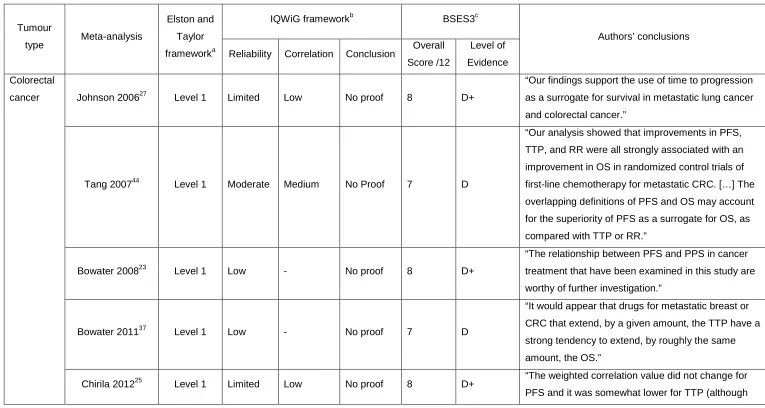
Table 3 Assessment of the validity of TTP as surrogate for OS: comparison of meta-analyses by tumour type across evaluation
frameworks
Tumour
type Meta-analysis
Elston and
Taylor
frameworka
IQWiG frameworkb BSES3c
Authors’ conclusions
Reliability Correlation Conclusion Overall Score /12
Level of
Evidence
Colorectal
cancer Johnson 200627 Level 1 Limited Low No proof 8 D+
“Our findings support the use of time to progression
as a surrogate for survival in metastatic lung cancer
and colorectal cancer.”
Tang 200744 Level 1 Moderate Medium No Proof 7 D
“Our analysis showed that improvements in PFS,
TTP, and RR were all strongly associated with an
improvement in OS in randomized control trials of
first-line chemotherapy for metastatic CRC. […] The
overlapping definitions of PFS and OS may account
for the superiority of PFS as a surrogate for OS, as
compared with TTP or RR.”
Bowater 200823 Level 1 Low - No proof 8 D+
“The relationship between PFS and PPS in cancer
treatment that have been examined in this study are
worthy of further investigation.”
Bowater 201137 Level 1 Low - No proof 7 D
“It would appear that drugs for metastatic breast or
CRC that extend, by a given amount, the TTP have a
strong tendency to extend, by roughly the same
amount, the OS.”
7
with confidence limits that overlap those of PFS/TTP)
[…] the correlation of OS with PFS, either alone or
aggregated with TTP, in clinical trials of patients with
metastatic CRC is [...] a useful means of predicting
improvements in OS.”
NSCLC
Johnson 200627 Level 1 Limited Low No proof 8 D+
“Our findings support the use of time to progression
as a surrogate for survival in metastatic lung cancer
and colorectal cancer.”
Bowater 200823 Level 1 Low - No proof 8 D+
“The relationship between PFS and PPS in cancer
treatment that have been examined in this study are
worthy of further investigation.”
Hotta 200946 Level 1 Limited Low No Proof 8 D+
“TTP potentially acts as a surrogate marker, but may
not be still a definitive alternative in the first-line
setting.”
Li 201247 Level 2 Low - No Proof 7 D
“Our data suggest that PFS is appropriate survival
marker in the clinical trials of EGFR-TKIs for
advanced NSCLC.”
Breast
cancer
Hackshaw 200552 Level 1 Moderate Medium Hint 9 C-
“TTP may be a useful surrogate marker for predicting
survival in women receiving first-line anthracycline
chemotherapy and could be used to estimate the
survival benefit in future trials of first-line
chemotherapy.”
Bowater 200823 Level 1 Low - No proof 8 D+
“The relationship between PFS and PPS in cancer
treatment that have been examined in this study are
8
Bowater 201137 Level 1 Low - No proof 7 D
“It would appear that drugs for metastatic breast or
CRC that extend, by a given amount, the TTP have a
strong tendency to extend, by roughly the same
amount, the OS.”
Burzykowski
200851 Level 1 Limited Low No Proof 7 D
“No end point could be demonstrated as a good
surrogate for OS in these trials.”
Ovarian
cancer Buyse 2000
9
Level 1 Limited High Indication 8 D+ “We conclude that TTP can be used as a surrogate for survival in advanced ovarian cancer.”
Prostate
cancer Bowater 200823 Level 1 Low - No Proof 8 D+
“The relationship between PFS and PPS in cancer
treatment that have been examined in this study are
worthy of further investigation.”
CRC = colorectal cancer; EGFR-TKIs = epidermal growth factor receptor tyrosine-kinase inhibitors; NSCLC = non-small-cell lung cancer;
OS = overall survival; PFS = progression-free survival; PPS = post-progression survival; RR = response rate; TTP = time to progression.
Shaded cells indicate meta-analyses using individual patient data.
a
see Table 2.
b
see Table 2.
c


![5 (4 Methoxybenzoyl) 4 (4 methoxyphenyl) 1 [1 (4 methoxyphenyl)ethylideneamino]pyrimidin 2(1H) one](data:image/gif;base64,R0lGODlhAQABAIAAAP///wAAACH5BAEAAAAALAAAAAABAAEAAAICRAEAOw==)