Pupils' historical thinking
within a museum environment
Irene Kriekouki - N akou
Thesis Submitted to the University of London
For the Degree of Doctor of Philosophy
1996
University of London
Institute of Education
Abstract
Pupils' historical thinking within a museum environment
Focusing on the exploration of pupils' historical thinking within a museum environment, this study was based on a longitudinal field study, which was conducted in the natural environment of several museums over a period of three years.
Four groups of thirty-five pupils each (from 12 to 15 years of age) responded in writing to tasks which were related to different museum objects and collections. Two of these groups, which served as main groups, responded to the tasks while the pupils were in the first, second and third secondary school grades. The two additional groups responded to the relevant tasks when pupils were in the first and the third secondary school grades respectively.
The collected data were analysed in terms of historical thinking on the basis of the theoretical investigation and definition of historical thinking, in the context of changing approaches to history and history education. The results of the qualitative analysis of both the longitudinal and cross-sectional aspects were discussed in relation to the following variables: pupils' background characteristics and age, historical information or knowledge acquired previously (mainly at school) or in the museum, the educational atmosphere of museums, museum objects and collections (accord~11g to their type and level of difficulty they posed for pupils' work), and the tasks devised for the research.
Acknowledgements
I would like to give my deepest thanks to Peter Lee, my supervisor, for his professional guidance, insightful and detailed comments, meaningful silences and his friendly encouragement throughout the course of this research.
Many deep thanks go to Dr. John Versey for his general interest in this work, his very helpful comments and supportive encouragement. Many thanks go to Alaric Dickinson for his tactful comments during my first steps into the research.
I would also like to express my gratitude to several people who facilitated my work: to Michael Pinnock, whose seminars at the Institute of Education introduced me to changing approaches to history education in Britain; to David Close, John Reeve and Elaine Sanson for their help in my initial introduction to museum studies and museum educational programmes in Britain, at the Institute of Education, at the British Museum and at the University College London Institute of Archaeology respectively; to Patricia Thomas and Sharon Lawson for their administrative support at the Department of History and Philosophy; to Rachel Howard for her corrections.
I am also indebted to the Moraitis School in Athens: to Chrisanthy Cartali, who enabled me to work with many secondary school groups at several museums over a period of three years; to Alexis Demaras for his friendly encouragement, especially at the beginning of the research. Many thanks from heart go to the 141 pupils who thoughtfully responded to several tasks, concentrating for about an hour on each pre-selected museum object. Their cooperation, enthusiasm and personal comitment in this work made this research more of a possibility.
I would also like to thank all my good friends and family for their support and understanding. Many thanks go to Alecos Zannas for his love and invaluable time-consuming help in. computing. I would also like to express my gratitude to Dimitris Nakos for his understanding, encouragement and support.
Dedicated to
Table of Contents
Abstract ... 2
Chapter One: Introduction... 17
1.1. Brief description of research ... 18
1.2. General research problem and rationale ... 18
1.3. Analysis of the major problem in terms of subordinate problems ... 19
1.3.1. The problem of defining historical thinking and its elements ... 19
1.3.2. The problem of determining the method ... 25
1.4. The general schema of this longitudinal field study.... ... ... ... ... 27
1.5. Orientation of the problem ... 27
1.6. Description ofthe general nature of the research problem ... ... ... ... 29
1.7. Assumptions and implications ... 30
1.8. The scope and the limits of the study ... 33
1.9. Importance, value and significance of the study to education ... 34
Chapter Two: The theoretical background - Historical thinking ... 36
2.1. The analytical problem of defining historical thinking... ... ... 37
2.1.1. Defining historical thinking... ... ... ... .... 38
2.1.2. The elements of historical thinking... 54
2.2. Historical thinking and intellectual development... 91
2.2.1. The '!Uethodology' category system and reasoning ... 92
2.2.2. Historical reasoning and Piaget's and Peel's theories of intellectual development ... 95
2.2.3. The relation of historical thinking to distinctive levels of intellectual development... 98
2.3. Historical thinking, History and History Education ... 100
2.3.1. Historical thinking and 'traditional' history and history education ... . 101
2.3.2. Historical thinking and 'modern' history and history education ... . 103
2.3.3. Historical thinking and 'postmodern' history and history education... 104
Chapter Three: The theoretical background - Historical thinking
and the museum environment _________________________________________ _ 109 3.1. The general museological aspect of the research _____________________________________________ 110 3.2. The educational character of museums ___________________________________________________________ 111
3.2.1. The general educational character of museums ________________________________ 111 3.2.2. The changing character of museums ________________________________________________ 113 3.2.3. Historical thinking and the educational character of museums _________ 119 3.3. The historical significance of museum objects ________________________________________________ 123 3.3.1. The general significance of museum objects as 'opera aperta' _________ 123 3.3.2. The historical significance of museum objects as sources _______________ 129 3.3.3. Historical thinking and the use of museum objects as sources ________ 141 3.4. Historical thinking within a museum environment _________________________________________ 143
Chapter Four: Method ______________________________________________________________________________________ 146 4.1. Statement of the technique employed ______________________________________________________________ 147 4.1.1. The first detailed plan of proposed research and the pilot study _ _ _ _ _ _ 147
4.1.2. Basic decisions 148
4.1.3. The methodological design _____________________________________________________________ _ 4.2. Data collectiorl _______________________________________________________________________________________________ _ 4.2.1. The sample - individuals and groups ______________________________________________ _ 4.2.2. The tasks ________________________________________________________________________________________ _
150 156 157 160 4.2.3. The museums __________________________________________________________________________________ 170 4.2.4. Museum objects _______________________________________________________________________________ 180
4.2.5. The balance of data collection 214
4.2.6. How data collection was finally made _____________________________________________ 216 4.3. Data translation _______________________________________________________________________________________________ 216 4.4. Data coding _ _ _ _ _ _ _ _ _ _ _ _ _ _ _ _ _ _ _ _ _ _ _ __ __ _ _ _ _ _ _ _ _ _ _ _ _ _ _ _ __ __ _ _ _ _ _ __ _ _ _ _ _ _ _ _ _ _ _ _ _ _ __ _ _ _ _ _ _ _ _ _ _ _ _ __ _ _ _ _ _ _ _ _ _ _ _ _ _ _ _ _ _ _ 219
Chapter Five: The category systems and the analysis of responses ___ 221
5.1. Basic decisions 222
5.6. The analysis of the use of 'dependent' and 'independent' historical
information or knowledge... ... ... ... ... ... ... 251
5.7. A typical specimen of analysis ... 253
Chapter Six: Discussion of results... ... ... ... ... 256
6.1. Introductory notes .... .... ... ... ... ... ... ... ... ... 257
6.2. Historical thinking and the museum environment... 258
6.2.1. Pupils' historical thinking and the educational environment of museums ... . 259
6.2.2. Historical thinking and the use of 'dependent' historical information ... . 265
6.3. Historical thinking and museum objects of different type ... 274
6.3.1. Historical thinking in relation to single 'isolated' museum objects and collections ... 274
6.3.2. Historical thinking in relation to 'everyday' museum objects and objects of art ... 281
6.4. Historical thinking and age ... 289
6.4.1. Qualitative observations ... 291
6.4.2. Historical thinking and intellectual development ... 296
6.4.3. Historical thinking and age in relation to museum objects of increasing difficulty... 302
6.5. Historical thinking and the questions set ... 310
6.5.1. Historical thinking in relation to different questions ... ... ... 311
6.5.2. Evaluation of the questions set... 318
6.6. Observations on pupils' historical thinking in relation to their work with museum objects... ... ... ... ... ... ... 322
6.6.1. Obst;;vations on pupils' historical thinking in terms of issues relating to its content ... ... .... ... ... ... 322
6.6.2. Observations on pupils' historical thinking in terms of issues relating to its specific charactetistics ... 326
Chapter Seven: Conclusions ... 328
7.1. A picture: a scale applied to reality ... 329
7.2. Conclusions: the picture ... 331
7.2.1. Historical thinking and educational variables ... 331
7.2.1. Historical thinking and museological variables ... 332
7.3. Significance for future research and history education ... 334
7.3.1. Studying historical thinking ... 336
7.3.3. Significance for history education ___________________________________________________ 337 Epilogue _ _ _ _ _ _ _ _ _ _ _ _ _ _ _ _ _ _ _ _ _ _ _ _ _ _ _ _ _ _ _ _ _ _ _ _ _ _ _ _ _ _ _ _ _ _ _ _ _ _ _ _ _ _ _ _ _ _ _ _ _ _ _ _ _ _ _ _ _ _ _ _ _ _ _ _ _ _ _ _ _ _ _ _ _ _ _ _ _ _ _ _ _ _ _ _ _ _ _ _ _ _ _ _ _ _ _ _ _ _ _ _ _ 341
References 344
List of schematic plans
1. Defining historical thinking - point 1 2. Defining historkal thinking - point 2 3. Defining historical thinking - point 3 4. Defining historical thinking - point 4 5. Defining historical thinking - point 5 6. Defining historical thinking - point 6 7. Defining historical thinking - point 7 8. Defining historical thinking - point 8 9. Defining historical thinking - point 9
10. The methodology of historical thinking
11. The ongoing spiral line of the methodology of historical thinking 12. The content of historical thinking in terms of its focus
13. The object's manifestations to which the content of historical thinking relates 14. The content of historical thinking in terms of the distinguished manifestations of the human and social context
15. The content of historical thinking in terms of 'context'
16. The content of historical thinking in terms of its relation to the 'physical object' or to its 'representum'
17. The 'particular content' of historical thinking
18. The content of historical thinking in terms of the concepts of time and space 19. The content of historical thinking in terms of historicity
20. Historical thinking and intellectual development
21. Historical thinking within 'traditional' history and history education 22. Historical thinking within 'modem' history and history education 23. Historical thinking within 'postmodem' history and history education 24. The three distinctive types of current historical thinking
25. The three current distinctive types of museums and their relevant educational character
26. The relation of the three distinctive types of museums to relevant distinctive types of historical thinking
27. Museums' enchanting cycle of concepts
28. The archaeological significance of the object according to distinctive types of current archaeology
29. The groups
32. Methodological point 4 33. Methodological point 5 34. Methodological point 6 35. Methodological point 7 36. Methodological point 8 37. Methodological point 9
38. The time schedule for data collection
39. Data collection by groups, secondary school grades and tasks
40. The balance of the methodological design in terms of the data planned to be collected in secondary school grades A, Band C, by number of groups, number of pupils, number of tasks (and their questions) and number of responses
41. Archaeological periods covered
42. Data collection plan by groups, tasks, museum objects, collections and museums
43. The coding system
44. A typical example of coding
List of figures
1. Results of the analysis of pupils' responses to question a in terms of whether pupils' general approach was historical on the basis of 'methodology'
2. Results of the analysis of pupils' responses to question a in terms of whether pupils' general approach was historical on the basis of 'focus'
3. Results of the analysis of pupils' responses to question a in terms of whether pupils' general approach was historical on the basis of 'context'
4. Results of the analysis of pupils' responses to question a in terms of whether pupils' general approach was historical on the basis of 'historicity'
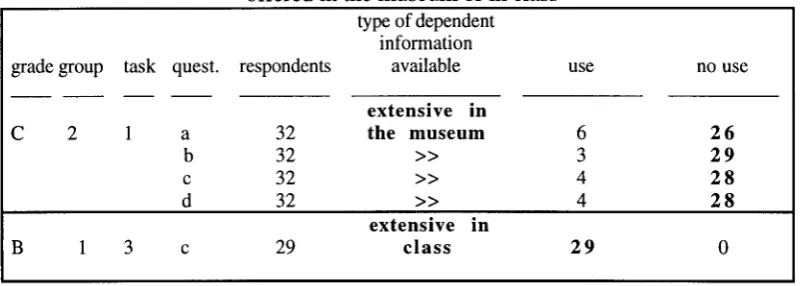
5. Number of respondents using dependent historical information, in relation to its limited or extensive type
6. Number of respondents using extensive dependent historical information offered in the museum or in class
7. Number of pupils of group Cl using dependent information about a 'difficult' museum object that was not related to independent historical knowledge
8. Number of pupils of groups Al and A2 using dependent information about an object that was directly related to independent historical knowledge
9. Number of pupils of group B2 using dependent historical information in relation to a single object and a collection of objects
10. Percentages of pupils using dependent historical information in terms of accuracy
11. Percentages of pupils of group C 1 using 'problematic' dependent historical information, in relation to a 'difficult' object, in terms of accuracy
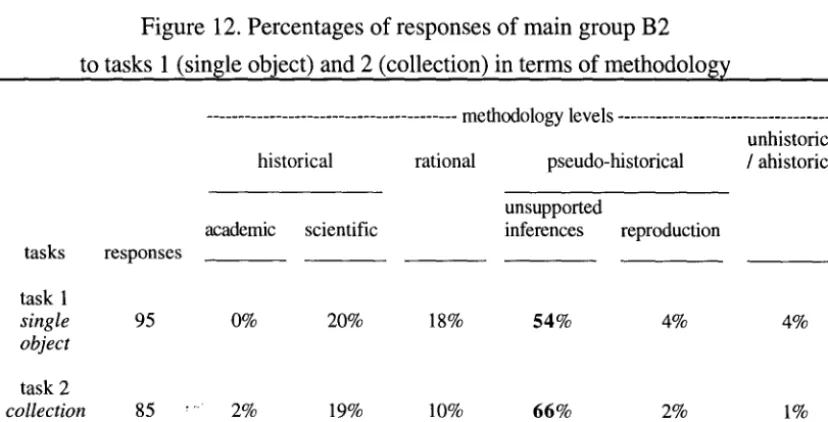
12. Percentages of responses of main group B2 to tasks 1 (single object) and 2 (collection) in terms of methodology
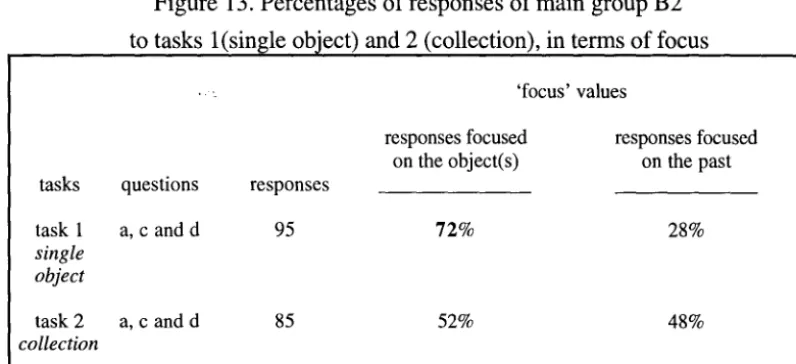
13. Percentages of responses of main group B2 to tasks 1 (single object) and 2 (collection) in terms of focus
14. Comparative results between responses to task 1 (single object) and task 2 (collection), in terms of historical context and historicity
15. Comparative ;:-.;sults between responses to task 1 (single object) and task 2 (collection), in terms of historical context and historicity, in relation to different questions set
16. Percentages of responses of main group B2 to question c of task 1 (presentation of an object) and task 2 (collection) in terms of 'context'
17. Number of pupils choosing everyday objects and objects of art
19. Percentages of pupils whose historical thinking was in the 'historical' methodology categnry, on the basis of all groups who responded to question a of task 1, in relation to objects of different type
20. Number of pupils who did not give any responses corresponding to 'formal operations' / 'explainer thinking' at the age of 12/13, and by the ages of 13/14 and
14/15
21. Number of responses of 'historical' methodology of the two main groups to common task 1 (questions b, c and d)
22. Global observations on the historical behaviour of the 71 individuals of both main groups in expressing historical thinking of 'historical' methodology over a period of three years
23. Longitudinal results in terms of the percentage of responses of 'valid historical thinking' to questions b, c and d
24. Cross-section~"l results in terms of the percentage of responses of 'valid historical thinking' of groups A3, Bl, B2 and C4 to questions b, c and d, in relation to the same museum object
25. Comparison of the longitudinal and cross-sectional results, in terms of the percentage of responses of 'valid historical thinking' to questions b, c and d
26. Cross-sectional results in terms of the percentage of pupils who expressed 'valid historical thinking' in relation to question b
27. Longitudinal results in terms of the percentage of pupils of main group 1 who, being presented with museum objects of increasing difficulty, especially at the age of 14/15, expressed 'valid historical thinking' to question b
28. Comparison of the cross-sectional results with the longitudinal results of group 1, in relation to question b, in terms of the percentage of pupils who expressed 'valid historical thinking'
29. Common task
"1':
Methodology of responses by question (% of responses) 30. Common task 1: Focus of responses by question (% of responses) 31. Common task 1: Historicity of responses by question (% of responses)32. Common task 1: 'Valid historical thinking' of responses by question (% of responses)
33. Comparison of the results shown in figure 32 (all groups - different museum objects) with the relevant results of groups A3, B 1, B2 and C4 (same museum object) in terms of 'valid historical thinking'
34. Percentages of respondents of group B 1 in each category of 'methodology' for task 1 and task 3
36. The content of pupils' historical thinking in terms of 'particular content 2' on the basis of the full response set (N = 1079)
37. The content of pupils' historical thinking in terms of the concept of time on the basis of the full response set (N
=
1079)38. The content of pupils' historical thinking in terms of the concept of space on the basis of the full response set (N
=
1079)List of illustrations
1. The Roman copy of an Ancient Greek relief, known as the 'Gradiva' (No. 1284 of the Chiaramonti Museum); A. Masson's 'Gradiva', 1939
2. Main groups 1 and 2 3. Additional groups 3 and 4
4. The National Archaeological Museum in the late 19th century and now 5. The Acropolis Museum on the top of the hill behind the Parthenon
6. The view from the Acropolis of Athens: many famous archaeological sites, the mountains, the sea and some islands
7. The temples of the Acropolis of Athens during the conservation and protection works
8. The Agora Museum, the re-erected Hellenistic Stoa of Attalos, in the archaeological area of the Ancient Agora of Athens, just underneath the Acropolis 9. The Acropolis Studies Centre near the Acropolis of Athens
10. Museum object a. 'The Moschoforos'
11. Museum objec: a. 'The Moschoforos' in about the 1880 among other statues, which were found in 1864 in the area where The Acropolis Museum was built
12. A typical kouros
13. The base of 'The Moschoforos' with the Archaic epigraph reading from right to left: 'Romvos, the son of Palos, donated [it]'
14. Museum object b. The Hellenistic grave stele 15. The famous grave stele of 'Egesso'
16. Museum object c. The Archaic clay mould for a bronze statue
17. Museum object( s) d. Replicas of the West pediment of the Parthenon
18. Museum object(s) d. Replicas of the metopes of the North side of the Parthenon
19. Information offered in the Acropolis Studies Centre: The small label next to the entrance 'Replicas .of the West pediment and the metopes of the North side of the Parthenon'; extensive type of information placed in a window-case table in the middle of the hall
20. Museum object(s) e. Some of the pre-selected Cycladic and Mycenian objects of the Prehistoric collection of The National Archaeological Museum
21. Collection a. The Prehistoric collection of The National Archaeological Museum
23. Collection d. T}1e small collection of Archaic and Classical vases and lamps of The Acropolis Museum
24. Characteristic differences in the appearance of pupils' responses
25. Protogeometric cist grave of a young girl and pithos burial of an infant; most pupils of main group C 1, who visited the Agora Museum, chose one of these two objects as the most interesting object displayed
'This, then, I believe to be the museums' greatest value to the child, irrespectively of what a museum's content may be: to stimulate his imagination, to arouse his curiosity so that he wishes to penetrate ever more deeply the meaning of what he is exposed to in the museum, to give him a chance to admire in his own good time things which are beyond his ken, and, most important of all, to give him a feeling of awe for the wonders of the world. Because a world that is not full of wonders is one hardly worth the effort of growing up in.'
1.1. Brief description of research
Chapter One Introduction
1.2. General research problem and rationale
1.3. Analysis of the major problem in terms of subordinate problems 1.3.1. The problem of defining historical thinking and its elements 1.3.2. The problem of determining the method
1.4. The general schema of this longitudinal field study
1.5. Orientation of the problem
1.6. Description of the general nature of the research problem 1.7. Assumptions and implications
1.8. The scope and the limits of the study
1.1. Brief description of research
This research is on the theme 'Historical Thinking and the Museum Environment'. Its aim was to explore pupils' historical thinking as it occurred within a museum environment over a period of three years; pupils from 12 to 15 years of age responded to a series of specially devised tasks in the form of open questions about museum objects and their historical significance as sources of information or evidence about the past. This longitudinal field study answers questions about what pupils make of museum objects, and it gives a longitudinal picture of change in pupils' historical thinking on the basis of pupils' handling of relics.
1.2. General research problem and rationale
This longitudinal field study aimed to explore pupils' historical thinking in the first three years of secondary school, which correspond to the last years of compulsory education in many countries. It was conducted among pupils who were educated by a traditional approach to history education, in order to observe historical thinking as it evolved by pupils who did not have any education and/or experience in matters regarding scientific historical thinking and method. Indeed, the Greek traditional system by which these pupils were educated is based on the reproduction of historical knowledge provided by compulsory history text-books, and, thus, does not offer pupils any opportunity to work with any sort of sources, or to activate their historical thinking.
Our understanding of pupils' underlying historical thinking was considered of great significance to history education, because their 'own ideas and thoughts could provide an invaluable basis for further work and discussion to develop' their historical thinking, as D. Thompson (1984, p. 180) suggests. This consideration was mainly based on Vygotsky's (1934, pp. 184-189) argument that education and assistance can lead children to do more than they could do by themselves 'though only within the limits set by their state of development' and according to the 'zone of proximal development'. So the study was expected to be significant to history education and to museum educational programmes, which aim to advance pupils' historical thinking and knowledge.
traditional educational system, would show some of the underlying thinking within this system: pupils' potential and undeveloped abilities in historical thinking that went beyond this educational system's limits. It was also expected to enable us to discuss the benefits of museum practice for history learning, in relation to history teaching and learning at school: a) whether a museum environment in general, and museum objects as relics in particular, stimulate pupils' imagination, curiosity, and incentive to disce!:'1 relics' historical polysemy, b) whether museum objects do activate relevant background historical knowledge, and c) whether they do provoke questioning useful for historical enquiry.
In addition, observations on some basic factors which might influence pupils' historical thinking within a museum environment were expected to lead us to a discussion of educational programmes and practices by which the educational role of museums could be enriched and better related to school history education.
Moreover, this research explored pupils' historical thinking by studying how pupils treated museum objects in a museum environment, the thoughts they expressed, the questions they asked, and the way they reacted to these objects. But in order to explore pupils' historical thinking, many critical decisions had to be made, because historical thinking is a complex intellectual activity about which there is neither much research nor any large body of theoretical work.
1.3. Analysis of the major problem in terms of subordinate problems
The study of historical thinking as a complex intellectual activity presupposed a substantial amount of theoretical work, on which decisions about the method of data collection and data analysis could be based. In the first place, there was the problem of defining historical thinking and its elements, in order to form the category systems by which pupils' historical thinking could be analysed. There was also the problem of defining the specific variables which were expected to influence pupils' historical thinking within a museum environment, in order to decide upon the method of the research.
1.3.1. The problem of defining historical thinking and its elements
historical thinking related to working with museum objects as sources of historical information or evidence was conceived as involving, among other things, careful observation, directed imagination, background historical knowledge, rational and at the same time imaginative and empathetic thinking, and historical skills. Moreover, the analysis of pupils' historical thinking was based on a theoretical investigation and definition of historical thinking in the context of changing approaches to history and history education.
Indeed, this investigation took into consideration a substantial amount of relevant theoretical work by many historians and theorists of different origin and orientation: from the Ancient Greeks Herodotus and Thucydides, to Postmodern theorists, like K. Jenkins (1991, 1995). But it was mainly based on changing approaches to history and history education in Britain, as analytically discussed in Chapter 2. Among other theoretical arguments, it was related to the controversial issue stated by Ccllingwood (1939, p. 110), that 'there is nothing else except thought that can be the content of historical knowledge'. It was also related to what Dickinson, Gard and Lee (1978, p. 13) have indicated about historical knowledge: 'historical knowledge and the process of historical inquiry cannot be divorced' , and 'the dichotomy between "content" and "method" cannot be sustained' (referredto by Thompson D., 1984, p. 172). This theoretical investigation in relation to much parallel analytical work finally led to the definition of historical thinking and its elements: its 'methodology', 'content' and 'specific characteristics'.
Moreover, after much consideration, pupils' historical thinking was studied in terms of the interrelation of its 'methodology' and certain issues related to its 'content' and 'specific characteristics'. This critical decision was based on extensive theoretiql and practical analytical work. The outcome of this time-consuming procedure was very illuminating, because the specific issues selected for testing in this longitudinal field study were of basic theoretical significance, and they also constituted distinctive and differentiating elements of pupils' historical thinking shown in the collected data.
1.3.1.1. The methodology of historical thinking
In order to study pupils' historical thinking in terms of its methodology two main questions were asked:
Can we relate the different levels of historical thinking 'methodology' to distinctive levels of reasoning?
The analysis of pupils' historical thinking in terms of its methodology was of great significance to the study, because substantial differences characterised pupils' historical thinking in relation to 'methodology', as shown by the following responses, given by three pupils aged 13, to the same task, concerning the same museum object:
*
'It is a big statue.'*
'It is an Archaic statue.'*
'It must be an Archaic statue, because it is characterised by a smile, which is known to be typical of Archaic statues.'The first thought was based on description, the second offered an unsupported historical inference about the object, while in the third thought a historical inference was demonstrated and supported in explanatory historical terms.
The 'methodology' category system consisted of distinctive levels of historical methodology, and was largely dependent on D. Shemilt's (1987) work on 'Adolescent ideas about evidence and methodology in history'. It was also related to distinctive level::; of reasoning on the basis of Peel's (1965, 1967, 1971) and Piaget's (Inhelder, B. and Piaget, 1. 1958) theories on intellectual development and reasoning. As will be suggested in the discussion of the theoretical background of the research in Chapter 2., Piaget's and Peel's distinctive stages of intellectual development did not serve as limiting stages for the purposes of this study. Peel's stages of 'describer thinking' and 'explainer thinking' and Piaget's stages of 'concrete operations' and 'formal operations', and especially their ideas and the criteria on which the discrimination of these stages was based, offered the broad basis on which the methodology of pupils' historical thinking was related to different types of reasoning. Each of these types or levels of reasoning was related to a number of distinctive levels of pupils' historical thinking, while a number of historical thinking levels were scaled between the two distinctive levels, at a level which might be def!~ed as intermediate.
D. Shemilt's (1980) and D. Thompson's (1984) 'optimistic' ideas.l Moreover, there was no use of stages corresponding to precise points of growth, because this study was theoretically related to M. Booth's (1987) 'Critique of the Piagetian approach to histor~qeaching' and to Bruner's (1960, 1973) and Vygotsky's (1934) ideas about the effect of education and instruction on the process of children's intellectual development. Thus, the relation of the seven 'methodology' levels to distinctive levels of reasoning was as follows:
'Concrete Operations' / 'Describer Thinking'
1. Description of the object as an object of the present 2. Description of the object as an object of an imprecise past Intermediate level
3. Reproducing historical information or knowledge 4. Unsupported inferences made directly from the object
'Formal Operations' / 'Explainer Thinking'
5. Inferences by ra!ional processes
6. 'Scientific' historical inferences by historical processes 7. 'Academic' historical inferences by historical processes
The 'methodology' category system, like all other category systems, is analytically discussed in Chapter 5, while its theoretical basis is presented in Chapter 2.
1.3.1.2. The content of historical thinking
The content of historical thinking was conceived as a very broad theme. Therefore, it was defined in relation to some basic theoretical issues and the analytical aim of the research only. Moreover, it was defined on the basis of relevant theoretical work, such as Collingwood's (1939, 1946) and Carr's (1961) theories about the l:ontent of historical thinking, and in relation to issues which emerged as indigenous to the data. In both cases, familiarity with the data, gained
by careful study of the content of pupils' responses, led to the final construction of the 'content' category systems.
The 'content' category systems were based mainly on the following ideas: On Collingwood's (1946, pp. 213-214) concepts of 'looking at' or 'looking through' the 'outside' or the 'inside' of relics, and that 'all history is the history of thought' and that 'you are thinking historically when you say about anything, "I see what the person who made this (wrote this, used this, designed this, etc.) was thinking". Until you can say that, you may be trying to think historically but you are not succeeding. And there is nothing else except thought that can be the content of historical knowledge.'2 (Collingwood, 1939, ed. 1989, p. 110.) It was also based on Carr' s jd~a that this dialogue with the past is 'not between abstract and isolated individuals, but between the society of today and the society of yesterday' (1961, p. 55), and on Walsh's idea that 'history is not just an account of past events, but explains these events, seen as human actions, by tracing their intrinsic relations with other events and locating them in their historic context.' (1958)
After much practical analytical work and consideration (see Chapters 2 and 5), based on broad relevant theoretical investigation, it was decided to study the content of pupils' historical thinking in relation to the following issues only.
1) The content of pupils' historical thinking was first studied in terms of its 'focus', to see whether pupils' thinking focused on the museum objects studied
[1], or whether it focused on the 'past' [2].
e.g. 'It is a Roman statue.' [1]
'Romans must have had developed sculpture.' [2]
2) It was then studied in terms of its 'context', to see whether pupils 'looked at' museum objects, i.e. whether they treated museum objects as objects qua objects [A]3 or as objects related to their illustrated human/social context [AHS], or whether they 'looked through' them, i.e. whether they treated museum objects in a real (historical) human and/or social context [CBA].
e.g. 'It is a vase.' [A]
'The girl illustrated is offering a gift to an older woman.' [AHS] 'This vase was used in Ancient Greek religious ceremonies.' [CBA]
2 This controversial issue is discussed further i:1 Chapter 2.
3) Finally, it was studied in terms of 'historicity', to see whether pupils' thinking related to the historical past, present or future [H], or whether it related to an ahistorical present, or to an unhistorical past or future [Pl.
e.g. 'It is a Mycenian vase.' [H] 'It is a beautiful vase.' [P]
At first, the content of pupils' historical thinking was studied also on the basis of a series of indigenous typologies, which mainly emerged from the data. Thus, the content of pupils' responses was also studied in terms of whether it related to the object or to its 'representum', i.e. to its representation, in terms of its 'particular content', i.e. in terms of its relation to the museum object's perceived identity, and in terms of pupils' conceptions of time and space. (See Chapter 2.) Finally, it was decided to limit the study of these issues to some general observations because a detailed analysis of all relevant issues could not be covered in depth by a single research. (See Chapter 5.)
1.3.1.3. The 'specific characteristics' of historical thinking
Pupils' historicalt~inking as a whole was also studied in terms of some other issues, which were called 'specific characteristics' of historical thinking, e.g. historical questioning and the notion of historical relativity, because they were conceived as characterising it in relation to some specific and significant historical elements and skills.
The significance for historical thinking of some of these elements and skills is illustrated in terms of broad theoretical argument, while some of the relevant concepts such as empathy, are analytically discussed both in relation to new approaches to history education (R. Ashby and P. J. Lee, 1987; M. Booth et aI., 1986; P. J. Lee, 1984b; D. Shemilt, 1984) and in relation to other fields of social sciences like psychology, (K. B. Clark, 1980) and the psychology of art (R.
Arnheim, 1986).
However, because of the great number of issues involved, pupils' historical thinking was mainly analysed in terms of 'general evaluation', according to which the outcome of pupils' historical thinking was evaluated as 'valid' [+], 'acceptable'
e.g. General evaluation of pupils' responses about an Archaic relief: 'It must be an Archaic relief.' [+]
'It is an Archaic statue.' [+*]
'It is an Archaic vase.' [*]
'It is Palaeolithic.' [-]
All other 'specific characteristics', which are analytically discussed in Chapter 2, could not be fully examined within the limits of a single study because they relate to complex concepts of great historical significance. Therefore, this longitudinal field study was confined to a first level analysis of them. (See Chapters 5 and 6.)
1.3.2. The problem of determining the method
The method for data collection (i.e. the division of tasks, the selection of pupils, and the selection of the museum objects and collections with which pupils were presented), was designed with respect to the variables which were expected to influence pupils' historical thinking within a museum environment. Namely, pupils' historical thinking was expected to be influenced by: (1) individual differences and age; (2) the different tasks set; (3) the different museum objects with which pupils were presented, and the difficulty they posed for pupils' work; (4) historical information that was 'dependently' acquired in the museum in relation to the historical context of the objects studied; and (5) general background historical information or knowledge that was 'independently' acquired (mainly at school).4
These variables w~;-e discussed in the context of some general assumptions which are broadly accepted by educationists and teachers, because they rest on a substantial amount of theoretical work, and they comply with the everyday school experience. (See also Part 1.7, and Chapter 2.) Pupils' thinking within the age range from twelve to fifteen years relates to different levels of reasoning, because this age range is a transitional period of growth between childhood and maturity, during which great intellectual changes occur. It is also influenced by a series of individual, social and cultural differences, by the aim, the method and the practices employed in school education, and the general educational atmosphere of the social environment within which it is realised.
Therefore, a series of relevant questions guided the method employed:
1. How far was pupils' historical thinking related to age?
2. How far was it related to the different tasks pupils had to respond to?
3. How far was it related to the different types of museum objects they were presented with, and the level of 'difficulty' they posed for pupils' work?
On this basis, it ~~~ decided to proceed to a longitudinal field study which was conducted in the natural environment of several museums, over a period of three years. Four groups of pupils (of thirty-five pupils each), of mixed abilities and varied school performance, were selected. Two of these groups, called 'main groups', served the longitudinal aspect of the study; pupils responded to tasks when they were in the first, second and third secondary school grades. The other two 'additional' groups belonged to the first and third secondary school grades respectively. Several tasks were devised in relation to different pre-selected museum objects and collections which posed different levels of difficulty for pupils work. In addition, some selected museum objects were related to 'dependent' historical information provided by the museum and/or to 'independent' historical knowledge previously acquired at school.
1.4. The general schema of this longitudinal field study
The educational Data collection Data analysis
environment
- Pupils from a Greek Pupils' written 1. Analysis of pupils' urban environment, of a responses to several historical thinking, in terms high social background, of tasks, collected as of its methodology, content different ages (12-15 years qualitative data over ('focus', 'context',
old), belonging to different three years 'historicity') and its
school groups in one specific characteristics
private school, educated by ('general evaluation')
the traditional approach to 2. First level analysis of
history education other issues concerning the
- Different tasks in the content and the specific
form of open questions on characteristics of historical
different museum objects thinking
in several museum
environments Conclusions
- Historical knowledge Conclusions about the
'dependently' acquired evolution and development
(in the museum) and of pupils' historical
'independently' acquired thinking in a museum
(previously at school by a environment within the age
traditional system) range from 12 to 15
1.5. Orientation of the problem
The broad ground from which the major problem of this research emerged was the controversial nature of history. There is an ongoing dialogue on history as a discipline, and on history education in the late 20th century, which is maintained not only by academic history societies and the relevant academic theories (as in 'traditional', 'modern' and 'postmodern' approaches to history). It is also maintained by social movements and theories (as exemplified by women's liberation movements, and black power movements), by ethnic movements (for example the ethnic movements in the Balkans and in the area of the previous Soviet Union), by movements based on broad issues, which have been related to religion (for example, Arab:: and Muslims in Asia and Africa), and as a consequence of the fact that millions of people on our planet starve. In addition, the general crisis in the 19th and the early 20th centuries' philosophical, social and economic theories (such as the theory of Marx), and the great changes which characterise our postmodern societies as far as aesthetic, ideological, social, economical, and cultural aspects are concerned, have opened up a new area for investigations in relation to several historical questions, including 'What is history?' and 'Why teach history, and how?' .
The problem of pupils' historical thinking, as an issue related to the aims and the method of history education, has particular links with the following historical topics, which are further discussed in the theoretical background of this research presented in Cha~ters 2 and 3.
(1) Changing approaches to history education in Great Britain are mainly concerned with the development of pupils' historical knowledge and thinking in close relation to the development of pupils' historical concepts and skills, and so they are based to a considerable extent on working with different types of sources. But relatively little research has been so far carried out on the use of museum objects as historical evidence, although there has been plenty of practical work, and although its importance has l>een generally discussed by educationists, historians, psychologists and teachers. (See Chapter 2.)
Greece, and the current movement to reform their appeal and social role, demand, among other things, the exploration of new methods of history education in general, and of history education within a museum environment in particular.
(3) There is an interest in many countries in changing the character, atmosphere and social role of l:lluseums, to make them more alive and appealing for people to visit. There is also a great interest in organising educational programmes, especially those which interrelate museums and schools. This close interrelation of museums and schools for the better teaching and learning of several subjects, including history, has raised many interesting relevant topics, which demand to be explored.
(4) The use of electronic media, such as computers, videos, CD ROMs, interactive multimedia, and the Internet, in the field of humanities in general, and in history education and museum educational programmes in particular, requires careful consideration. Far from reducing the educational value of electronic media, the study of the advantages of pupils' intellectual activation within a physical 'authentic' enviror:.rnent and within the electronic environment of media is of great educational significance. The advantages of pupils' intellectual, historical and aesthetic development by their exposure to authentic objects as well, even if they are sometimes as humble as a broken clay tool, have to be carefully studied as a counterbalance to their exposure to the bright, but electronic world of media, which offers pre-packaged ways of looking at 'electronic copies' of things. In addition, the fact that a museum environment offers the challenge of a personal dialogue with the displayed relics at a moment of time, in which the past and the present meet, in contradiction to the speed electronic media have introduced to life, and its implications for thinking, are matters which deserve careful study.
1.6. Description of the general nature of the research problem
On the other hand, the development of social sciences in the 20th century, " .
especially the development of psychology and sociology and the reformation of geography, demand an exploration of historical and educational topics in the light of the interconnection of many social sciences. In other words, a historical topic like historical thinking cannot be isolated within the limits of history and history education, but has to be treated in relation to the broader area of social sciences.
Indeed, the problem of historical thinking was conceived to be related to psychology, as far as intellectual development and cognitive growth were concerned, and to semiotics with respect to the interpretation of texts or artefacts as historical sources. It also had sociological aspects, mainly related to the sociology of education, and was in some ways related to the sociology and the psychology of art, since pupils' historical thinking was studied in a museum environment, where pupils were presented with museum objects, most of which were works of art. This fact was closely related to the 'museological' nature of the problem, i.e. to theories on museums, especially museums' social and educational role.
The study of pupils' historical thinking was mainly confined to its educational, historical and museological aspects, but its broader nature was seriously taken into consideration, as discussed further in the analytical presentation of the theoretical background in Chapters 2 and 3.
1.7. Assumptions and implications
The assumptions and implications which underlie this study, and which are discussed in detail in relation to the theoretical background of the research, are mainly educational.
Before that age, we find certain intellectual formations that perform functions similar to those of genuine concepts to come. With regard to their composition, structure, and operation, these functional equivalents of concepts stand in the same relation to true concepts as the embryo to the fully formed organism. To equate the two is to ignore the lengthy developmental process between the earliest and the final stages. It would not be an exaggeration to say that to equate the intellectual operations of three-year-olds with those of adolescents - as some psychologists do - means to use a sort of logic that would deny the existence of sexual maturation in puberty only because certain elements of sexuality are already present in infants.'
Far from accepting that intellectual development depends only on age, and that different stages of intellectual development appear at specific points of growth, it was assumed that the exploration of adolescents' thinking in general, and historical thinking in particular, is especially interesting. 'Adolescence' is an intermediate, transitional stage between childhood and maturity, therefore relevant studies enable us to explore the process of thinking from a 'simple' level of reasoning, dependent on the immediate environment, to a 'mature' level of hypothesising and conceptualising.
The exploration of adolescents' thinking, especially during the ages from 12 to 15, was assumed to be very significant for educational purposes, because at about the age of 15, pupils' compulsory education ends in many countries. Our understanding of adolescents' capabilities and how they think at the age many of them leave school, has important !mplications for educational decisions concerning teaching in the final grades of secondary school, because adults' general knowledge and attitudes towards many fields of human knowledge are dependent on this crucial stage of education.
that these cannot simply be acquired in the process of ordinary life. That history is,
pre-eminently, a prime ingredient of such "enabling knowledge" should be clear.'
History education is very important for individuals and societies, and as such it is a
useful and a necessary school subject, provided that it is taught in an active and
productive way. Otherwise it is a dull and difficult school subject, which serves the
reproduction of a particular ideology, and by which time is spent only to let pupils
develop verbalism, misunderstanding, and memorising, instead of enabling therrito
ask questions not only about the past, but, most important, about the present and
the future. It must be mentioned here that questioning is assumed to be a basic element of human intellectual development and knowledge, and perhaps even the
supreme element of human civilisation. History education is, therefore, a very
important school subject, conceived not only as a record of the past, but at the
same time as a means of human enquiry.
(3) Museums are very important institutions for many reasons, including the broad
educational role they can play in contemporary societies. Educational programmes
which relate museum practice to teaching and learning at school are vital for
education in general, because they not only develop pupils' intellectual abilities and
thinking in many fields of human knowledge, but also advance pupils' aesthetic
and social development, since they give pupils the opportunity to work and interact
beyond their school's walls, in places of specific aesthetic standards.
Participation in carefully devised museum practice may encourage young people to
enjoy visiting museums later in their life, a habit which may guarantee an
intellectual and aesthetic attitude. In addition, visiting museums can give people 'a
feeling of awe for the wonders of the world' as Bruno Bettelheim (1980)
mentions. This 'awe for the wonders' of a world, which is created by different
societies and cultures at different times, may allow people to sympathise with and
consequently to understand people of other cultures. This fact is of great social and
political importance, since ignorance and the inability to accept and appreciate the
'different' seem to be two of the main causes of the development of fanaticism and
racism, especially in young people, in many parts of the world. Therefore,
museum practice in relation to teaching and learning several school subjects is not
only important for its own sake, but also has indirect aesthetic, intellectual, social
1.8. The scope and the limits of the study
The main scope of the study was to explore pupils' historical thinking as expressed and developed within a museum environment, and to discuss the benefits that museum practice could offer for history education in general, and for the development of pupils' historical thinking in particular. Its scope was also to discuss ways in which museum practice could be interrelated with history teaching and learning in school to achieve effective learning in history.
The limits of the study were set by the fact that the sample of this longitudinal field study was confined to a specific age range, from a specific cultural and social milieu, and within a specific, traditional educational environment.
Only pupils from 12 to 15 years of age were observed, so the conclusions of the research refer to this age range in particular. In addition, the research was carried out in Greece, with Greek pupils from a particular Greek school, in Greek museums. The Greek environment in which this field study was conducted was chosen for both theoretical and practical reasons. The decision was mainly based on the theoretical interest in studying pupils' historical thinking as expressed within a traditional educational system, for reasons which have already been mentioned and which are discussed further in Chapter 2. This particular environment was also selected because of the researcher's own experience and knowledge of the Greek educational system (in particular its aims and methodology in relation to teaching and learning procedures, and its educational standards), since she lives in Greece and has been working in a Greek secondary school for more than ten years. This fact made data collection for this longitudinal field study realisable, and proper data analysis possible.
One basic assumption of the research was that thinking in general, and historical thinking in particular, are influenced by social, economical and cultural factors. This field study was limited to the exploration of historical thinking expressed and developed by Greek pupils from an urban environment, and (according to Greek standards) of a generally high social and economic background. Despite the fact that intellectual differences remain, the advantage in thinking and learning abilities of pupils belonging to high social class compared to pupils from a lower social class (as a consequence of many factors) has been suggested by many thinkers. Thus, the results and conclusions of the research may have limited direct implications for education. But they may have more general implications for history education, if we accept that the study of what privileged pupils are capable of, may give us the horizon or the scope within which historical thinking of less privileged pupils is developed. In addition, the analytical method of the research, its results and conclusions may offer a basis for further research on historical thinking, especially of pupils in broader educational, cultural and social milieus.
It will be clear that, although the content of the data offered a basis for a number of potential analyses, it was analysed in terms of pupils' historical thinking only. Other aspects, such as pupils' aesthetic attitudes, were only indirectly analysed, in cases in which these aspects were interrelated with historical thinking. This fact suggested material for further research, which is discussed in the concluding chapter.
1.9. Importance, value and significance of the study to education
The theme of the research was mainly chosen because of its significance to education. The exploration of pupils' historical thinking within a museum environment, wher~pupils could treat museum objects as historical evidence, was assumed to be of importance for history education, as a means for improving our understanding of pupils' historical thinking, and of how working with relics as sources within a museum environment may forward history education.
importance for the dialogue on history education both within each specific educational approach, and among the different approaches.
The use of evidence in history education and its importance for the development of historical knowledge and historical thinking are underlined by changing approaches in Great Britain. On the other hand, studies which support the use of sources as a means of history teaching and learning produce pressure for the reform of traditional educational approaches. Therefore, this study was expected to be significant to changing approaches to history education in Britain, and to the possible reform of the traditional approach to history education in Greece.
Although there is much discussion and literature on the 'difficulties' of history as a school subject and on pupils' work with sources, relatively little research has been done so far on the development of pupils' historical thinking in the context of physical objects. Therefore, the findings of the research (about pupils' historical thinking in relation to the use of museum objects as sources), could contribute to a deeper understanding of pupils' thinking in this 'problematic' area, and could raise a number of questions for further investigation.
Chapter Two
Theoretical Background - Historical thinking
2.1. The analytical problem of defining historical thinking 2.1.1. Defining historical thinking
2.1.2. The elements of historical thinking 2.2. Historical thinking and intellectual development
2.2.1. The 'methodology' category system and reasoning 2.2.2. Historical reasoning and Piaget's and Peel's theories of intellectual development
2.2.3. The relation of historical thinking to distinctive levels of intellectual development
2.3. Historical thinking, History and History Education
2.3 .1. Historical thinking and 'traditional' history and history education
2.3.2. Historical thinking and 'modern' history and history education
2.3.3. Historical thinking and 'postmodern' history and history education
2.1. The analytical problem of defining historical thinking
The aim of exploring pupils' historical thinking demanded an initial definition of historical thinking and its elements, which was considered fundamental especially for refining the category systems for data analysis.
The relevant definition was based on broad theoretical knowledge and experience and especially on the relevant theoretical investigation which was conducted in the first year of the rC0~arch (1990-1991). It must be emphasised here, though, that this theoretical investigation is still open, mainly because historical thinking is a complex intellectual activity. In addition there are several different conceptualisations of historical thinking, because each historical theory perceives it in relation to its particular theoretical approach, which is largely dependent on the specific social, economic, political, ideological context in which it is realised. Therefore, any attempt to define historical thinking has to take into consideration different perceptions of history and historical thinking, that are tested, interpreted, understood and appreciated in the light of our ideological context.
On this basis it was decided to proceed to a definition of historical thinking which would be limited enough to be realisable, but at the same time efficient for the analysis of pupils' historical thinking in the context of changing approaches to history and history education. Therefore, it was directly based on a considerably small number of theorists, whose work was closely related to the analytical purpose of the study, while the work of a great number of historians of different orientation formed the general context within which history and historical thinking were conceived. (See Part 2.3.)
It will be clear that theories of other social sciences had to be considered as well, such as theories of the psychology and sociology of thinking and of art, and of semiotics, because historical thinking, besides anything else, is interrelated with the interpretation of various sources, as is discussed in detail in this chapter.
the assumption that it is through this dialogue which is realised in terms of the relativity of human thinking and knowledge that theoretical investigations are developed, and each theory is justified.
2.1.1. Defining historical thinking
(1) Historical thinking, seen on a first and quite simple level, is an intellectual activity by which a person, the 'historian', looks back to the past wishing to study it.
Schematic Ian 1. Definin historical thinking - Point 1
Past Present
c(--- ~
A.
'historian'
(2) In order to study the past the historian has to use sources and interpret them as evidence, because as Collingwood (1946, p.l0), among others, mentions, 'historical procedure, or method, consists essentially of interpreting evidence'.
The selection and use of a (primary) source is based in the first place on its identity as a relic, as an 'object' of the past. Consequently the relic itself, as an 'object' from the past, persuades the historian also about the reality of the past. But the relic itself cannot speak on its own about the past. The historian questions it, and only in terms of this relation to the historian does the relic become a source. The weight that the source bears depends on what questions the historian asks of it. The source also, being 'potential evidence',l becomes evidence for the past, in terms of its interpretation by the historian.
But the real past is lost in time, it cannot 'really' directly be known. The only thing that the historian can do is to try to reconstruct it on the basis of the evidence available.
Schematic Ian 2. Defining historical thinking - Point 2
Past Present
'Real Past'
---:>
r:::r
relic'reconstructed past'
<---
o
<---D
<- .. Ievidence interpretation - source historian
(3) But since 'history is the science of res gestae, the attempt to answer questions about human actions done in the past' (Collingwood, Ibid., p. 9), sources 'became evidence precisely to the extent to which the historian conceived them in terms of purpose, that is understood what they were for.' (Collingwood, 1939, p. 109.) The past to be reconstructed is not an empty 'area' of time, but is full with human purposeful actions and thoughts, and so sources serve as evidence when interpreted in relation to their human context, when the historian can understand the underlying thoughts of the past in the present.
So according to Collingwood (Ibid., p.ll 0), ' "all history is the history of thought". You are thinking historically, when you say about anything, "I see what the person who made this (wrote this, used this, designed this, etc.) was thinking". Until you can say that, you may be trying to think historically but you are not succeeding. And there is nothing else except thought that can be the object of historical know ledge.' 2
The importance of historical thinking for the whole process of history is underlined by most historians, since historical thinking is interrelated with both historical knowledge and historical method. In order to think historically the historian handles sources as 'relics they [human beings of the past] had left behind (books or potsherds, the principle was the same)', which become evidence when conceived in their human context, and not just as 'relics of various kinds, differing among themselves in such ways that they have to be interpreted as relics of different pasts which can be arranged on a time scale.' (Ibid., p. 109.)
Schematic Ian 3. Defining historical thinking - Point 3
Past Present
'Real Past'
---»
r:::r
~
relic'reconstructed past' '
<---
:c:I
<- ...J¥
( 8
<---liE)
'res gestae' evidence interpretation - source in human context
historian
(4) The route of historical thinking is more complex, though, than is shown in the above schematic plan 3., because human beings of the past, whose actions and thoughts the historian wishes to penetrate, belonged to a particular society, culture and period. In Walsh's (1958) words: 'History is not just an account of past events, but explains these events, seen as human actions, by tracing their intrinsic relations with other events and locating them in their historic context.' So the historian has to interpret the evidence available in its social context as well, in order to reconstruct the particular past in relation to its particular social, and cultural context.
Schematic Ian 4. Definin historical thinkin - Point 4 Past
'Real Past'
~
'reconstructed past'®
<----~
<0-£
'res gestae' in social context---»
r:::I--- r:::J
evidence interpretation - source in human and social context
relic I
,
<_ -I
Present
historian
So relics are used as sources and are interpreted as evidence within the social and cultural environment of the historian.
Schematic Ian 5. Definin historical thinking - Point 5
Past Present
'Real Past'
~
---:>~
'reconstructed past'
'res gestae' evidence interpretation - source historian
in social context in human and social context within a particular
(6) The distinction of these two societies is related to the idea of the historicity of the source, i.e. that the source itself belongs to the reality of the past and to the reality of the present at the same time. This fact underlines some problems related to the appreciation of the limitations of sources as evidence, and more generally to the limits of historical interpretation.
their wishes, exhortations and intentions. This polysemy of a text, or generally of sources, is related to the uncertainty attached to any interpretation.3 It will be clear that historical interpretation is characterised by uncertainty even more than any other interpretation of a text or object, mainly because it is carried out in terms of historicity, and uncertainty is inherent in the nature of historical enterprise.
Consequently there can be many different types of interpretation; an 'interpretation dependent on the intention of the author' , an interpretation which denies fidelity to
...
the intention of the author and which depends more on the right of the intention of the work, an interpretation based on the intention of the reader related to the intention of the work, or a deconstructing interpretation, according to which the text becomes a stimulus for the wanderings of interpretation. (See Umberto Eco, 1990, pp. 37-38.)
But even if we accept that written texts or artistic works are potentially 'opera aperta' , open and endless, 'this does not mean that every act of interpretation can have a happy end. Even the most absolute deconstructor accepts the idea that there are interpretations which are obviously unacceptable. This means that the interpreted text imposes limits to its interpreters. The limits of the interpretation fall in with the rights of the text.' (Ibid., p. 24.)
Historians have to interpret their sources mainly on the basis of the intention of its author and in relation to its general human and social context in the past. As Carr (1961, p. 22) says 'the facts of history never come to us "pure", since they do not and cannot exist in a pure form: they are always refracted through the mind of the recorder. It follows that when we take up a work of history, our first concern should be not with the facts which it contains but with the historian who wrote it.'
Historians may include in their interpretation the investigation of the 'intentio operis', the meaning of the source as an 'opus' independently of the intention of