Contents lists available atScienceDirect
Advances
in
Mathematics
www.elsevier.com/locate/aim
Computable
torsion
abelian
groups
✩Alexander G. Melnikova,∗, KengMeng Ngb
a Massey University, Auckland, New Zealand b Nanyang Technological University, Singapore
a r t i c l e i n f o a bs t r a c t
Article history:
Received16May2017 Accepted12December2017 Availableonlinexxxx
CommunicatedbyH.JeromeKeisler
Keywords:
Abeliangroups Computablestructures Computablecategoricity
We provethat c.c. torsion abelian groups canbe described by aΠ0
4-predicatethat describesthefailureofa brute-force diagonalisationattemptonsuchgroups.Weshowthatthere isnosimplerdescriptionsincetheirindexsetisΠ0
4-complete. The results can be viewed as a solution to a 60 year-old problem of Mal’cev in the case of torsion abelian groups. We provethat a computable torsion abelian grouphas one or infinitely many computable copies, up to computable isomorphism.TheresultconfirmsaconjectureofGoncharov fromtheearly1980sforthecaseoftorsionabeliangroups.
©2017ElsevierInc.Allrightsreserved.
1. Introduction
This paper lieswithinthegeneralareacalled computable algebra which seeksto un-derstand theextent towhich classicalalgebracanbe made effective.The fundamental objects of computable algebra are groups, rings, Booleanalgebras and other algebraic
✩ Manythankstoourgoodfriendandformeradvisor/mentorRodDowneyforlotsofvaluablesuggestions
regarding theintroduction. Thefirstauthorwaspartially supportedbyMarsden Fund ofNew Zealand (TheRoyalSocietyofNewZealand)andMasseyUniversityResearchFund.Thesecondauthorispartially supportedbyMOE-RG26/13andMOE2015-T2-2-055(NanyangTechnologicalUniversity).
* Correspondingauthor.
E-mail addresses:[email protected](A.G. Melnikov), [email protected] (K.M. Ng).
https://doi.org/10.1016/j.aim.2017.12.011
structuresthatadmitanalgorithmicpresentation(tobeclarifiedshortly).Asaseparate areaofmathematicalendeavour,computablealgebragoesbacktovanderWaerden[33], Dehn [4], Hermann [20] and others. Such studies predate the formal definition of an algorithm.In the1960s, Rabin [28] and Mal’cev [24] used the languageof computable function theory ([32,30]) to clarify and extend these early ideas. In particular, Rabin andMal’cevsuggestedthefollowingformaldefinitionofanalgorithmicallypresented al-gebraicstructure.Acomputable presentation (acomputablecopy, aconstructivisation) ofacountably infinitealgebraic structure Ais anisomorphiccopy ofA whosedomain is a Turing computable set and whose functions, relations, and constants are all Tur-ingcomputable.Anynaturalcountablealgebraic structureencounteredbytheworking mathematicianwill haveacomputablecopy.
Much of classical algebra is devoted to the classification of structures up to iso-morphism. In computable algebra, it is natural to view structures up to computable isomorphism which is of course more fine-grained. For instance, Mal’cev constructed two computably presented torsion-free abelian groups of infinite rank which were not computablyisomorphic[24].Mal’cevalso realisedthatthere werestructureswhere the classicaland thecomputableisomorphismtypes coincided.Forexample, any two com-putable copies of the order type of the rationals are computably isomorphic. Mal’cev called such structures autostable, but nowadays we call them computably categorical. Mal’cevaskedageneralquestion: Whichstructures are computablycategorical? Infact Mal’cevwasmainlyinterestedinabelian groupsandspecificallyasked:
Problem 1.1 (Mal’cev). Describecomputablycategoricalabeliangroups.1
Overthepast60years,computablecategoricityhasbecomeoneofthecentraltopics incomputablestructuretheory,seee.g.[29,23,18]andbooks[2,13].Althoughthenotion of computable categoricity arose from the example of an abelian group suggested by Mal’cev,itisstillunknownwhichabelian groupsare computablycategorical.
How can we answer such a question? The most pleasing answer would be along the following lines. Remmel [29] proved that a computably presented linear order-ing is computably categorical iff it has a finite number of adjacencies. The beauty of Remmel’s theorem is that it gives an algebraic invariant to classify computable lin-ear orderings up to to computable isomorphism. Our first hope was that Mal’cev’s question might be answered similarly. Down through the years, partial results have supported this hope. In 1974, Nurtazin [27] proved that a torsion-free abelian group is computably categorical iff it has finite rank. Around 1980, Smith [31] and Gon-charov[16],provedthatanabelianp-groupiscomputablycategoricaliffitisisomorphic to a direct sum of primary cyclic and quasi-cyclic p-groups, almost all of which have the same isomorphism type, and Goncharov [16] established thatan abelian group of
1 DowneyandRemmel [7]incorrectlyattributethequestiontoGoncharovwhoperhapswasthefirstto
infinite rank is never computably categorical. Logicians would call descriptions like those above semantic since they specify algebraic invariant properties of the struc-tures.
Since around1980, progresshasmoreor lessstopped,butthese early investigations coveredthreelargesubclassesofabeliangroups,leavingonlytwocaseswheretheproblem remainsopen:
(i) torsionabeliangroups,
(ii) mixed abeliangroupsoffinite rank.
In the present paper we concentrate on (i). More specifically we attack the following question:
Whichtorsion abeliangroups arecomputablycategorical?
Wewillseethatasemantic(algebraic)description,liketheonesabove,ishighlyunlikely. Sowewill looktowardsanothermethodofclassification.
Howcanweillustratethatanalgebraicdescriptionisimpossible,oratleastishighly unlikely? For that,we needto isolateageneral enoughproperty thatunites allknown examplesintheliteraturewhere analgebraicdescriptionisknown.Ineachofthese ex-amplescomputablecategoricityisequivalenttorelativecomputablecategoricity;thatis, any isomorphic(not necessarilycomputable) copyB of the computablestructure A is isomorphicto AviaaB-computableisomorphism[2].Whatissospecialaboutrelative computablecategoricity?Usingforcing,wecanexpressrelativecomputablecategoricity as aninternal syntacticalproperty ofthestructure[2].Incontrast,“plain”computable categoricity isacomputability-theoretic propertyof thewholeclass ofcomputable pre-sentationsofthestructure.Thecomplexitydifferencebetweenthesetwonotionsisrather significant.Oneway to seethedifference isto comparetheirindex sets[19],inthe fol-lowing sense.Fix aneffective enumeration(Ai)i∈ω ofall partial computablestructures in acomputablesignature; for example, fix thelanguageof graphs. It hasbeen shown thattheindexset{i:Ai is c.c.}isΠ11-complete[9],andthuscomputablecategoricityis
asecond-orderpropertyingeneral.Incontrast,theindex set{i:Ai is relatively c.c.}is merely Σ03-complete [11],showing thatrelative categoricity isa first-orderarithmetical property ofastructure.
Theorem 1.2. Thereexists acomputable torsionabelian group whichis computably cat-egorical butnotrelativelycomputably categorical.
Wenotethatthetheorem aboveisnewforgeneralabeliangroups.
Does Theorem 1.2 imply that there cannot be any structure theory of computably categorical torsion abelian groups (c.c. TAGs)? Some researchers suggest that plain computable categoricity is so badly behaved that it should notbe studiedat all. The Π1
1-completeness result [9] mentioned above supports this claim. However, when
re-stricted to some nice subclass of structures, this index set may become arithmetical; itmakesaperfect senseto study computablecategoricitywithin this subclass.It isnot toodifficult tosee thattheset {Ai: Ai is a c.c. TAG}isarithmetical (tobe explained indue course).
What kind of answer should we expect? We cannot hope for an algebraic descrip-tion.Any criterionforcomputable categoricityof torsion abeliangroupsshouldappeal to the enumeration of a computable copy of the group. There is only oneexample in the literature where a plain categoricity notion (even more general than computable categoricity!)admitsaniceexplicitcharacterisation.Morespecifically,Downeyand Mel-nikov[6]describedplainΔ0
2-categoricityofcompletelydecomposablegroupsintermsof
semi-lowness [32]. We omit the definitions, but we note that semi-lowness is a rather specificindexsetproperty whicharose fromthestudy ofthelatticeofc.e. sets[32].
1.1. The mainresults
Nostandardtechniqueor notionseemedtohelpinobtaininganyvaluablestructural informationaboutcomputablycategorical TAGs.Forexample,theindexset seemedto be Π0
5-complete, and it was not clearwhether there could be any way of pushing this
complexitydown. Quiteunexpectedly,there isasubtle Π04-property thatdoes describe
c.c. TAGs.
Theorem 1.3. AcomputabletorsionabeliangroupGiscomputablycategoricalifandonly ifthecomputableindexofGsatisfiesacertainΠ0
4 predicateΨwhichdescribesthefailure ofthebrute-force diagonalisation attempt onG.
Thediagonalisation attemptfrom Theorem 1.3is brute-force inthefollowing sense. Itsbasicstrategyisthemoststraightforwarddiagonalisationmodulethatmonitorstwo cyclicsummandsinG[s] andtriestoswaptheminanothercopyofGwhichitattempts to build.Wedelay theformal descriptionof Ψ untilSection3. Thecomplexity ofΨ is optimal:
Theorem 1.3 and Theorem 1.4show thatplainandrelative computable categoricity differonlyveryslightlyintheclassofTAGs.Theyareonlyonequantifierapartfromeach other (Σ0
3vs. Π04).Also,both relativeand plaincategoricitynotionsareeffectivisations
ofthesamepurelyalgebraicweakhomogeneityproperty withintheclass(Definition 3.1,
Proposition 3.10).
ButisTheorem 1.3reallyadescriptionofc.c. TAGs?Weconjecturethatonecannot obtain acriterion significantly betterthan the oneinTheorem 1.3. Firstof all, Theo-rem 1.4 shows thatthesyntactical complexityof Ψ isoptimal.Also, anysuchcriterion mustappealtothecomputableenumerationofthegroup,otherwisethecriterionwould be relativisable,contradictingTheorem 1.2.Ontheotherhand,thepredicateΨ canbe used to derivenon-obvious informationabout c.c. TAGs.Forinstance,Ψ allowed usto push the seemingly optimal index set complexity (Π0
5) down to Π04, and to show that
almost all primary summands of a c.c. TAG are weakly homogeneous. It is not clear how to extractthis informationavoidingtheuse ofΨ.Thus, Theorem 1.3isnotjusta reformulationofthedefinitionofcategoricity.WeconcludethatTheorem 1.3and Theo-rem 1.4settlethe60year-oldproblemofMal’cevfortorsionabeliangroupsinthesense thatouranalysis isoptimal.
WebrieflydiscusstheproofsofTheorems 1.4 and1.3.There havebeenenough argu-ments inrecursion theory exploitingthefailure of adiagonalisation attempt,the most closelyrelatedexamplescanbefoundin[15,5,26].Inourproofboththediagonalisation attemptitself anditsrole intheproof aremoresubtlethaninany otherproofin com-putable structuretheory thatwe areawareof.Althoughthediagonalisation attemptis merelyafiniteinjuryconstruction,wewillfacesignificantcombinatorialdifficultieseven inmeetingonebasicmoduleinisolation.Todealwiththis combinatorialnightmare we introducethetechniqueoftangleswhichextendsthecliquetechniquefrom[10].Infact, the situationis socomplicated thatwewouldnotknowhow torunthediagonalisation attempt on the groupitself. Instead, we use a careful uniform reduction from torsion abelian groupsto cardinalsumsof equivalencestructures. The reductionrelies on spe-cificgroup-theoretictechniquessimilartop-basicsubgroupanalysis,see[14].Infact,the main algebraicProposition 3.4extendsthemainresultof[1],butviaatotallydifferent proof.
AssumingTheorem 1.3,to obtainTheorem 1.4itissufficienttoprovethattheindex set is Π0
4-hard. The proof of Π04-hardness is not too sophisticated, but it uses a new
idea. It is not hard to see that the index set of relatively c.c. TAGs is Σ0
3-complete
(Proposition 6.4).Thus,Theorem 1.2isfollowsfrom Theorem 1.4.
1.2. Computabledimension
classes of abelian groups where the conjecture has not been verified. These are again the torsion abelian groupsand the mixedabelian groups of finite rank. We apply our techniques to confirm the 30 year-old conjecture of Goncharov in the case of torsion abeliangroups:
Theorem 1.5. If a computable torsion abelian groupis not computably categorical, then ithas infinitelymanycomputable copiesup tocomputableisomorphism.
Theproof of Theorem 1.5 is notthathard, put itdoes requireanew idea. Theresult doesnotfollowfromthewell-knownsufficientconditioninvolvingtwoΔ0
2-isomorphicbut
notcomputablyisomorphiccopies[13].Inourcasetheisomorphismsarenotnecessarily Δ0
2.
The paper is organised as follows. Section 2 will be ashort preliminary section. In Section3weprovethatthereexistsaΠ04-predicatedescribingcategoricity(Theorem 1.3),
andSection4containstheproofoftheΠ40-hardnessoftheindex set(Theorem 1.4).We
proveTheorem 1.5inSection5.InSection6wediscussrelativecomputablecategoricity ofTAGs.
2. Preliminaries
Allstructures inthis section, and throughout thepaper, are at most countable.All groupsintherestofthepaperareabelianandtorsion, unlessotherwisestated.
2.1. Abeliangroups
Thestandardreferenceforthisis[14].Recallthateveryabeliangroupcanbeviewed asaZ-module.Anabeliangroupisdivisibleifforanyintegernandanyelementgofthe group,theequationnx=ghasasolutioninthegroup.Forexample,thePrüferp-group (alsoknownas thequasi-cyclicp-group)
Zp∞ =ai:i∈ω|pa0= 0, pai+1=ai:i∈ω
isdivisible forany primep. Agroupis reduced ifitcontainsno non-zerodivisible sub-group. It is well-known that any divisible subgroup H of an abelian A detaches as a directsummandofA.Inparticular, Acanbesplit into itsdivisibleandreducedparts, butthemaximalreducedsubgroupisnotuniquelydefinedasasubsetof A.Ituniquely determineduptoisomorphism.
Every torsion abelian group splits into the direct sum of its maximal p-subgroups, andthissplittingisuniformlyeffective[21].Wediscussabelianp-groups.Foranon-zero
Convention 2.1. We agree thatthep-height of anelement g ∈A is equalto n+ 1 if n
is largest suchthat∃x∈A (pnx=g), andifnosuchlargest nexists thenthep-height will be∞.Wedenote thisbyhA
p(g),orsimplyhp(g) whenthecontextisclear.
For example,thep-height ofany non-zeroelement ofA=Zp is1,and thusitmatches thep-order(i.e.,logp(|A|))of thiscyclicgroup.
A subgroupH of Ais p-pure ifforany h∈H andn∈Z,∃x∈A (pnx=h) implies
∃x∈H (pnx=h).Inother words,thep-heightof h∈H withinGisalways witnessed withinH.Asubgroupispureifitisp-pureforeveryp.Ap-puresubgroupofanabelian
p-groupisinfactpure. Itiswell-knownthatapurecyclicsubgroupalways detachesas adirectsummand[14].
Given anabelian p-groupA, we define A to be its subgroup consisting of elements having infinite p-height. Iterating this process, we define A(i) for i ∈ ω, and taking
intersections we defineA(α) forany ordinalα. SinceA iscountable, thesequencemust
stabilize, and the stable A(α) must clearly be divisible. The least α such thatA(α) =
A(α+1) is called the Ulm typeof A. It is well-known thatany abelian p-group of Ulm
type1 splits intoadirectsumof itscyclicandquasi-cyclic subgroups.Wewill callany such decomposition full or complete. Any two full decompositions of an Ulm type 1
p-groupmust be isomorphic as decompositions,i.e. must havethe samenumbercyclic or quasi-cyclicsummandsofagivenisomorphismtype[14].
Recall that the socle [G]p of an abelian p-group G is the collection of all its ele-mentsoforder atmostp. ThisisaZp-vectorspaceand thusitmakessenseto speakof
Zp-independenceinthespace.SinceZp isafinitefield,linearindependenceisdecidable inthediagramofthevectorspace.
2.2. Infinitaryformulae
See[2]forarigorousdefinitionandsomebasicpropertiesofLc
ω1ωsuchasthe remark-ableBarwaise–Kreiselcompactness.Wenotethatinfinitarycomputableformulaeovera computableAcanbere-writtenintoafirst-orderformbutoverHF(A),thehereditarily finiteextensionofthestructureA[12].TheroleofLc
ω1ωisquitesignificantincomputable structure theory,see [2]. Wewill be using onlysomestandard operations oninfinitary computable formulae (suchas calculating theircomplexity), these can be found inthe firsthalfof[2].
In this paper, L is the language of additive groups. For example, the following
Lω1ω-sentencedescribesdivisibility:
n∈ω
∀g∃x(nx=g).
as universalquantifiers.For example, thesyntactical complexity of theabovesentence isΠc2.
Clearly,if Φ isaΠc
α Lω1ω-sentence, the indexset {i: Ai |= Φ}is Π
0
α (andsimilarly forΣc
α),see[2].Furthermore, wecanuniformlyreplaceanysuchformulabyapredicate upon ω of the respectivecomplexity thatisolates thecomputable structures satisfying theformula.Wewillusethisproperty withoutexplicitreference.
3. A Π0
4-description of computable categoricity
3.1. A brute-forceattempt todescribecategoricity
Throughout this section, we identify acomputable structure with its index, e.g. we write∀G(. . . G. . .) butreallymean(∀e)(. . . Me. . .).Themostnaiveattemptto charac-terisec.c. TAGwouldbetosay
(∀G)(G∼=A =⇒ G∼=cA),
butthisisway toocomplicated as itisΠ1
1.It isnothardto seethatwecandobetter.
Each p-component Ap of A =
p∈ωAp must be c.c., since otherwiseA is clearly not c.c.Itisalsoknownthatc.c. impliesrelativec.c. forabelianp-groups (thiseasilyfollows from [31]; simply runthediagonalisation procedureon this p-component andcopy the rest).EachAp mustbeoftheform
F⊕(Zpλ)α,
whereF itselfsplitsinto finitelymanycyclicandquasi-cyclicsummands,λ∈ω∪ {∞}, andα∈ω∪ {ω}(thepowerindicatesthenumberofdirectsummands).Forexample,
Zp2⊕Zp5⊕(Zp∞)ω
is(relatively)c.c.,whereZp∞ isthePrüfergroupand(Zp∞)ω=
i∈ωZp∞.Asnotedin
[3],suchgroupsnaturallycorrespondtoequivalencestructures,andthiscorrespondence will be heavily used throughout this paper. The reader might now think thatthe rest ofthepaperwillbe anelementaryanalysisofequivalencestructures, unfortunatelythe situationisalotmorecomplicated.
Theexistenceofanisomorphismforeachdistinctr.c.c.ApismerelyΣc3,andthusthe
complexityofthestatement
(∀G)(G∼=A =⇒ G∼=cA),
canbereducedtoΠ0
5bysayingthatforanytorsionabelianp-groupwhosep-components
computably isomorphic. Clearly, “A is aTAG” can be expressed bya Πc2-formula. We
also say:
(∀p)(Ap is r.c.c.) & (∀G)
[GinT AG& (∀p)Gp is r.c.c. & (∀p)Gp∼=Ap] =⇒ G∼=cA
.
As wealreadymentionedintheintroduction, thepropertyofbeing relativelyc.c. is Σ03
[11]. (Towardstheend of thepaper we will alsoproduce aΣ03 definitionthatdoes not appeal to aScott family.)Note that“∀G”ranges overallcomputable structuresG. So thesecond conjunctisofcomplexity(∀)([∀Σ0
3] =⇒ Σ03) whichisΠ05.
However,averysimpleconstructionshowsthatthepropertyofhavingr.c.c.p -compo-nentsfailsto characterizec.c. TAGs(weskipit).TheideaisthatifaTAGisc.c. then, as we will illustrate later, almost all p-components of it must satisfy the weak homo-geneity property. The weak homogeneity property (WHP) can be used to produce a
d-Σ0
4-definitionofc.c. TAGs(wewillskipitaswell).AlthoughtheWHPfailstocapture
categoricity, itwillhelpinouranalysis.Quiteabit ofworkwill be neededto pushthe complexity downto Π04.
3.2. Theweakhomogeneityproperty
Definition 3.1. Wesaythatanabelianp-groupGsatisfiestheweakhomogeneityproperty (WHP) if it is either divisible, or for each non-zero a∈ G of order pand hp(a) <∞
there existat mostfinitely manyelementsoforderpandheight > hp(a). Example. Thegroup
Zp2⊕Zp5⊕(Zp∞)ω
doesnotsatisfytheWHPbecause2<∞,butboth
Zp5⊕Zp7⊕(Zp∞)4
and
Zp5⊕(Zp2)ω
satisfytheWHP.(Here Aω standsfortheinfinitedirectsum ofAwith itself,whichwe also calltheinfinitedirectpowerofA.)
The algebraic characterisation of countable abelian p-groupssatisfying the WHP is given bythelemma below:
Lemma 3.2. SupposeAisacountablep-groupsatisfyingtheWHP.ThenAisoftheform
whereU isafinitedirect sum ofcyclic andquasi-cyclic p-groups, H isthedirectpower ofsome(fixed) cyclic orquasi-cyclicgroupZpλ,andtheleastαsuchthatZpα occurs in
thedecompositionof U (if thereareany)isnot lessthanλ.
Proof of Lemma. Observethatallgroupsoftheisomorphismtypesclaimedbythelemma satisfytheWHP.NowsupposeAsatisfiestheWHP.IfAisdivisible,thenthereisnothing to prove. Otherwise, leta ∈ A be an element of finite height and of order p. Clearly, in this case the divisible part must have finite rank, for otherwise the WHP fails (as witnessedbyaand any basisofthedivisible component).Weprovethat,furthermore, thereducedpartof thegrouphasUlmtype1. Suppose,forthecontrary, thatxisnot adivisible element buthas infinite p-height. Thenthere exists an infinitecollection of elements bi, i= 1,2,. . ., suchthatpbi =xand hp(bi)< hp(bi+1).For almost alli, the
heightof(bi−bi+1) isgreaterthantheheight ofa,contradictingtheWHP.
Since the Ulm type of the reduced part is 1, it splits into a direct sum of cyclic
p-groups. Ifthere are infinitelymanycyclic summands inthis decomposition,then the WHPguaranteesthatalmostallofthesesummandsareofsomefixedfiniteorder.These summandswillformH inthenotationofthelemma.ThenU willconsistofthefinitely manycyclic and quasi-cyclicsummands thatare left after formingH. Finally, ifsome cyclicsummand inU is ofasmallerorderthan theorder ofeachsummand inH, then theWHPfails. 2
WeconcludethattheWHPimpliesrelative computablecategoricity.Also,thelemma justifiestheterm“weak”intheWHP,sinceifthefiniteU isthezero-groupthenweare leftwitha“homogeneous”H.
Lemma 3.3. The syntacticalcomplexityof theWHP is(atmost)Πc
3.
Proof of Lemma. Letus firstdoacarefulsyntacticalanalysisofseveral propertiesthat willbe combinedtodefinetheWHP.
Saying that A is reduced involves asking for a non-zero element whose p-height is finite,this isclearlyΣc
2.Also,divisibilityofagroupisΠc2-definable.
Thepropertyhp(x)=kisequivalenttosayingthathp(x)≥k(whichisΣc1)andnot
hp(x)≥k+ 1 (Πc1).Thus,sayingthatnoelementhasp-heightexactlykhascomplexity Σc
1∧Πc1,andforourpurposestheupperbound Πc2isenough.
Thepropertyofhaving infinitelymanyb inthesocle whoseheightsare greaterthan somefixed finitenumberkcanbe (informally)expressed as
ψk = (∃∞b) (pb= 0 &hp(b)≥k+ 1), andsincehp(b)≥k+ 1 isΣc1,theproperty isΠc2.
orderpandhp(a)<∞thereexistsatmostfinitelymanyelementsoforderpandheight
> hp(a)].Toexpresstheseconddisjunct ofthedefinition,we write
k∈ω
([(∃a= 0)hp(a) =k andpa= 0] =⇒ ¬ψk),
which says thatifk if theheight of some element inA then there areat mostfinitely many elements inthesocle havingtheir height greaterthan k.According to theabove analysis,theformulaisoftheform
k∈ω
([∃Πc2] =⇒ ¬Πc2),
or
k∈ω Πc3,
whichisΠc
3. 2
3.3. Aneffectivecorrespondencewith equivalencestructures
Itisclearthatp-groupsofUlmtype1naturallycorrespondtoequivalencestructures. Thecorrespondenceisdefinedasfollows. Suppose
G= i∈I
Gi,
where for each i the summand Gi is either a cyclic p-group or Zp∞. The λ such that
Zλ ∼=Gi iseitheranaturalumbernorthesymbol∞,anditwill bedenotedby#Gi.
The definition of G →EG. Inthe notation as above, define EG to be the equivalence structure inwhichtheithequivalenceclassEihassizeexactly#Gi.(Wewrite #Ei to denote thesizeofEi.)
It is well-known thatany two full decompositions of any fixed Ulm type 1 abelian
p-group are isomorphic(as decompositions),see e.g. [14]. Thus, the isomorphism type of EG does not depend on the given full decomposition of G. We can pass from an equivalence structuretoagroupusing thefollowingdualrule.
The definitionof E→GE.Givenanequivalencestructure E=
i∈IEi,define
GE=
i∈I
Gi,
ItfollowsthatGEA∼=AandEGU ∼=UforanyequivalencestructureUandanyabelian
p-groupAofUlmtype1.Thereisnothingspecificallydeepinthisobservation. Nonethe-less,itturnsoutthattheeffectivepropertiesofthesefunctorscanbequiteintricate.The algorithmic contentof thefunctors wasfirst investigatedin[3] andthen morerecently in[8]. For example, it follows that the functors do not preserve Δ0
2-categoricity [10,8]
whichisarathercounter-intuitive feature.
Clearly,thefunctorE→GEisuniformlycomputable.Althoughitisnothardtoshow thatG→EG maps isomorphismtypes ofcomputable groupsto isomorphismtypes of computableequivalencestructures(followsfrom[25]),iswasnotclearwhetherG→EG isuniformly computable.Itfollowsfrom[1]thatitisuniformlyeffectivewhenrestricted to G with finite socle. The proof in [1] exploits combinatorial techniques specific of abeliangrouptheory andis notcompletely straightforward.Wewill needan extension of this result. We note thatthe proof below is quite different from the one contained in[1].
Proposition 3.4. ThefunctorG→EG definedabove isuniformlyeffective.Furthermore,
regardless of the Ulm type of the input abelian p-group G, the output of the uniform procedureisalwaysanequivalence structure.
Proof. The definitionof the Turingfunctional representing G→EG is fairly straight-forward. We work computably relative to the open diagram of G. Recall that
Zp-independenceisdecidablein[G]p,relativetothediagram.First,initiateauniformly effectiveenumeration of any basis x0,x1,x2,. . . ofthe socle ofG. For eachi suchthat
xi hasbeen found,define
si = sup m0,...,mi−1∈Zp
hp(xi− i−1
j=0
mjxj),
which is clearly non-computable but can be effectively approximated from below. We allow si = ∞. Recall that a function ω → ω∪ {∞} is limitwise monotonic if it total andcanbe approximatedfrom belowbyanon-decreasingcomputablefunction[21,22]. Thefunctionsdefinedaboveisclearlylimitwisemonotonic,withallpossibleuniformity. Initiatetheenumeration of anequivalencestructure U inwhich#Ui =s(i). Notethat weneverrefertotheUlmtypeoftheinputgroup.
We now check that the procedure described above satisfies the desired properties. Clearly, it is uniformly effective. Furthermore, regardless of the Ulm type of G, the function i → si is limitwise monotonic and thus U is well-defined. We claim that if the Ulm type of G is 1 then U ∼= EG. For this purpose we define a full decompo-sition of G induced by the definition of si and the choice of the basis x0,x1,. . ., as
follows.
Notethats0=hp(x0).Fixa(maximal)chainofp-divisions belowx0 thatwitnesses
or aquasi-cyclicsubgroupofG.SinceC0 iseitherpurecyclicordivisible,itdetachesas
adirectsummandofG,
G=C0⊕A1.
Fixtheprojectionπ1ontoA1.Weclaimthat
hA1
p (π1(x1)) =hG/Cp 0(x1) = sup
m0∈Zp
hp(x1−m0x0) =s1.
FixafulldecompositionofA1whichclearlyexistssincetheUlmtypeofA1is1(note
A1couldbe notreduced).Then
x1=n0x0+
niyi,
wheretheyicomefromdistinctsummandsintheinducedfulldecompositionofthesocle of A1. NotethathG/Cp 0(x1)=hp(niyi) and hp(mx0+niyi)≤hp(niyi) for any
m. It follows from the definitionof s1 that hAp1(π1(x1))= s1, as claimed. Fix a chain
of p-divisions inA1 thatwitnesseshAp1(π1(x1))=s1,and letC1 be thesubgroupofA1
generated bythischain.SimilarlytoC0,itmust bethecasethatC1 detachesinA1.
SupposewehavedefinedC0,. . . ,Cn andAn+1 wheretheCi areeithercyclicor qua-sicyclic, and
G= n
i=0
Ci
⊕An+1.
As above,wecanchooseCn+1 thatwitnesses
hA1
p (πn+1(xn+1)) =hG/
iCi
p (xn+1) = sup
m0,...,mi−1∈Zp
hp(xi− i−1
j=0
mjxj) =sn+1,
theproofofwhichisalmostidenticaltothecasen= 1 (hereπn+1istheprojectiononto
An+1).Asbefore,we getthatCn+1 detacheswithinAn+1 toform An+2.
ThiswayweproduceasubgroupBofGthatsatisfiesthepropertiesresemblingthose of p-basicsubgroupsofreducedp-groups([14]):
i. B=iCi,wheretheCi arecyclicor quasi-cyclicsubgroups, ii. [B]p = [G]p,i.e. thesocleofB isequaltothesocleofG.
Property i. followsfrom thedefinitionofC0,C1,. . ..To seewhyii. holds, recallthat
x0,x1,. . .isabasisof[G]p,and
foranychoiceofni,j∈Zp.Thegeneratorsof[Ci]pareoftheformxi−j<ini,jxj,thus ii. holds.
Recall that by our assumption G is itself a direct sum of cyclic and quasi-cyclic
p-groups.Weclaimthati. andii. togetherimplythatB=G.Aimingforacontradiction, assumeα∈G\B.Supposealsothatpnα∈B while pn−1α /∈B. Notesuchannexists
since[B]p= [G]p (byii. above). Without loss of generality,we canassumethatn= 1. Wearriveat
pα= i≤k
di,
where di ∈ Ci for each i = 0,. . . ,k. We mayassume thateach di = 0, otherwise we re-arrangetheindexing oftheCi.This assumptionis usedthroughout theproof ofthe claimbelow.
Claim 3.5. Inthenotationasabove,foreachi≤kthereexistsdi ∈Ci suchthatpdi=di. Proof of Claim. Supposesuch adk doesnotexist (thecasewhen i=k).Butthen the chainthatgeneratesCk isnotmaximalinG/(j<kCj) aswitnessedbytheprojection of a suitably chosen Zp-multiple of the coset of α. Thus, dk = pdk for some dk ∈
Ck.
To see why dk−1 exists,consider p(α−dk) = pα−dk ∈ j<kCj. Just as we had above with α and dk, the Ck−1-projection of the element (α−dk) will witness the failure ofmaximality (inG/j<k−1Cj) ofthe chainused todefine Ck−1,unless dk−1
exists.
Weproceedinthismannertofinddk−2,. . . ,d0. 2
Weconcludethatpα=i≤kpdi.Thenp(α−i≤kdi)= 0 andthus
α−
i≤k
di∈[G]p= [B]p⊆B.
Togetherwithi≤kdi∈B thisgivesα∈B,contradictingthechoiceofα.
Finally,sinceallfulldecompositionsofGareisomorphic(asdecompositions),wehave thatU ∼=EG. 2
Corollary 3.6. Given acomputablep-group Aof Ulm type1wecan uniformly passtoa computable presentation H of A that admits an effective full decomposition intocyclic and quasi-cyclic subgroups. Furthermore, if the input is an abelian p-group whose Ulm type is not necessarily equal to 1, then the output is an effectively decomposed abelian
Weapply Proposition 3.4tostudy theweakhomogeneityproperty.Thenextlemma will be very useful in guessing the isomorphism between two groups satisfying the WHP.
Lemma 3.7. Theisomorphismtypeofacountableabelianp-groupX satisfyingtheWHP is completelydetermined bythecollection of finitesubstructures of EX.
Proof. LetX and Y be two abelian groupssatisfyingtheWHP. Weuniformly passto the respectiveequivalence structures EX and EY.For an arbitraryalgebraic structure
A,letAge(A) bethecollectionofallfinite substructuresembeddableinto A. Weclaim thatX ∼=Y iffAge(EX)=Age(EY).Oneimplicationistrivial.
Suppose Age(EX)=Age(EY).Recall thatX =∼Y iff EX ∼=EY. Both EX and EY must have the same number of classes. We first consider the case when all classes in
EX are infinite, i.e. when X is divisible. If EX hasonly finitely manyclasses, and all theseclassesareinfinite,thenEY alsomustbelikethat.SupposebothEX andEY have infinitely many classes, and all classes in EX are infinite. Recall that X and Y both satisfytheWHP.Inparticular,almosteveryclassinEY mustbeofsomefixedsize,thus itmustbeinfinite.Also,itcannothaveanyfiniteclasssinceitwouldwitnessthefailure of theWHP.Thus,X andY aresimultaneouslydivisibleandof thesamerank,andin this caseX ∼=Y.
Suppose X is not divisible, and assume the rank of the socle is finite. As noted above, both EX and EY musthave somefixed finite number of equivalence classes.It is well-known that equivalence structures having finitely many equivalence classes are completely described bytheirfinite substructures,upto isomorphism(seee.g.[1]fora recentapplication).
Suppose now EX has infinitely manyclasses, and let mbe thesize ofalmost every class of EX. Note such an m exists and must be a naturalnumber, by the WHPand by ourassumption.ThenEY must alsobe of thesameform,with a.e. classof sizem1
for some m1. We first argue that m1 = m. If m > m1 then a sufficiently large finite
substructureof EX wouldnotbe embeddableinto EY.
Recall that both X and Y satisfy the WHP, and therefore m must be no greater than thesizes ofthe otherfinitely many classesinEX (same inEY),and withoutloss of generality it is smaller than these sizes. If EX has k exceptional classes that were not of size > m, then we claim that EY has at least k such exceptional classes. In-deed, these exceptional classes (if there are any) must have size greater than m, and thus a large enough finite substructure of such classes in EX can be embedded only into thepart consisting of exceptionalclasses inEY. Thus, thenumber of exceptional classes k is the same for both EX and EY. A large enough finite substructure with
3.4. Relaxing isomorphismbetweenequivalencestructures
All groups in this subsection are countable abelian p-groups of Ulm type 1. The informationcontainedinthissectionwillallowustocompletely removegroupsfromall ourargumentsandworkonlywith equivalencestructures.
Supposeφ:A→Gisanisomorphismbetweentwo(computable)abelianp-groupsof Ulmtype1withsomefixed (effective)fulldecompositions,A=iAi andG=iGi. Notethatφdoesnothavetoagreewiththefixeddecompositions.Foreachnon-zeroαi∈ [Ai]p (i.e.,αi∈A oforder p)its imageφ(αi) willbe expressed asalinearcombination ofelementsβj comingfromvarious [Gj]p,
φ(αi) =
j
mjβj, βj∈[Gj]p,
wherethesumisfinite.HavinginmindthenaturalcorrespondencebetweeneachAiand therespectiveequivalenceclassEAi ofEA (andsimilarlyforGi and EG),wedefine φ∗ thatmaps aclassofE to afiniteset ofclassesinEG bytherule
φ∗(EAi) ={EGj :mj = 0 inφ(αi) =
j
mjβj}.
Wedefine thesizeof afinitecollectionF ={S0,. . . ,Sk}ofequivalence classesSi in
EtobeequaltotheminimumamongthesizesofitsmembersS0,. . . ,Sk.Wewriteh(F) todenotethesize ofF. IfIisaclassthenwewriteh(I) forh({I})= #I.Thesizecan eitherbeanaturalnumberorthesymbol ∞.This definitionagreeswithourdefinition ofp-height.
Fixsomeisomorphismφ:A→G.IsittruethatanyclassinEGisrealizedastheleast classinsomeφ∗(EAi)?Althoughthequestionseemssomewhatarbitrary,theaffirmative answerthatweestablishbelowwill beveryusefulinthenextsubsection.
Lemma 3.8. Inthenotation above(assuming φisanisomorphism),forevery classI in
EG there existsaclassJ inEA suchthatI∈φ∗(J)andh(I)=h(φ∗(J)). Proof of Lemma. Recall thatwefixed fulldecompositionsA=iAi and G=
iGi, and let B = {x0,x1,. . .} and B = {z0,z1,. . .} be bases of the socles of A and G
(respectively)thatagreewiththesedecompositions,i.e.,xi ∈Ai andzi∈Gi foreachi. According to our conventions, the p-height of each xi [and zi] is equal to λ such that
xi ∈Ai∼=Zpλ [respectively,zi∈Gi∼=Zpλ].
It is sufficient to prove that for each zi ∈ B there exists an xk ∈ B such that
φ(xk)=jmjzj mentionszi withanon-zeromi∈Zp,andfurthermore
hp(xk) =hp(zi) = min{hp(zj) :mj= 0 in
j
Aiming for acontradiction, assume thateach φ(xk) that mentions zi in its decom-position φ(xk) =jmjzj also mentions some zl = zi such that hp(zl) < hp(zj) and with anon-zerocoefficient. Sincethe zi come from distinctdirectsummands,the min-imum of the heights of the zj that are mentioned in φ(xi) with mi = 0 is equal to
hp(φ(xk)) = hp(xk). Thus, in particular, hp(φ(xk)) = hp(xk) is smaller than hp(zi). Since φisanisomorphism,theelementsφ(x0),φ(x1),. . .formabasisofthesocleofG.
Forsomecoefficientsnk,we have
zi=
k
nkφ(xk).
According to the aboveassumption,eachof the φ(xk) that mention zi non-trivially in theirdecompositionmustalsonon-triviallymentionsomezlof asmallerheight.
In the notation as above, let a be the sum of all nkφ(xk) such that nk = 0 and
hp(φ(xk))≥hp(zi).It follows thatadoesnotmention zi initsdecomposition, as each suchφ(xk) doesnot.(Iftheydidthenthey’dhaveasmallerp-height,seeabove.)Then theelementzi−aisnon-zero(sinceadoesnotmentionzi atall)andalsomustsatisfy: (1.) hp(zi−a) isatleasthp(zi),becausehp(a) isat leasthp(zi);
(2.) zi−a=knkφ(xk),where eachxk (equivalently,φ(xk))hasheight < hp(zi), by ourchoiceoftheφ(xk).
Now recallφisanisomorphism,so wehaveφ−1(z
i−a) isnotzeroand
φ−1(zi−a) =
k
nkxk,
where eachxk withnk = 0 hasheight < hp(zi).Butthesexk comefromdistinct direct componentsofA, andthus
hp(φ−1(zi−a)) =hp(
k
nkxk) = inf
k hp(xk) =hp(xs)
for one such xs. But we have hp(xs) =hp(φ(xs)) < hp(zi) (see condition (2.) above), while condition(1.) gives:
hp(φ−1(zi−a)) =hp(zi−a)≥hp(zi). Soweconcludethathp(zi)≤hp(φ−1(z
i−a))< hp(zi),acontradiction. 2
3.5. Aconstruction that mustfail
satisfy its requirements. Since the construction will be uniform in the diagram of A
andwill be afinite injury one,thisfactcanbeexpressed byaΣ03-predicate whichsays thatfor somee≥0 thereareinfinitelymanyexpansionarystages(to beclarified).The construction will be used to “safe” onequantifierin thedescription of ac.c. TAGs, in thefollowingsense.Theexistenceofinfinitelymanye-expansionarystages(whichisΣ0
3)
canbe usedto show thatalmost everyp-componentofA satisfies theWHP,while the latterstatementisΣc
4 ingeneral.
Remark 3.9. We invite the reader to verify that the index set of TAGs A such that a.e.Ap satisfiestheWHPformsaΣ04-complete set(withinallcomputableTAGs whose
p-componentshaveUlmtype1).Theproofisfairlystraightforward.Thus,thecomplexity Σc4 of “a.e.Ap satisfies theWHP” is optimal,and this isoneof themajor obstacles in producingaΠ0
4-definitionof computablecategoricity.
Weidentifyacomputablegroupwithitsindex.
Proposition 3.10. ThereexistsΣ03predicateΞsuchthatforanycomputableTAGAwhose
p-components areallrelativelyc.c.,
¬Ξ(A) =⇒ A is not c.c.,
and
Ξ(A) =⇒ a.e.Ap satisfies the WHP.
Corollary 3.11. If aTAGA isc.c. thenAp satisfiestheWHP foralmostevery p. Proof of Proposition. SupposeAisacomputableTAGeachp-componentApofwhichis (relatively)c.c.ByProposition 3.4,wecanuniformlypasstopGEAp ∼=A which pos-sessesacomputablecompletedecompositionintocyclicand quasi-cyclicsummands,for variousp.Therefore,w.l.o.g. wemayassumethatAhasacomputablefulldecomposition.
3.5.1. Informaldescription
SinceAhasaneffectivefulldecomposition,itwillbeconvenienttoidentifyEAwithA. Indeed, all thatwill matter in the construction is the sizes of the cyclic summands in thedecomposition.Wewillconstruct acomputableM ∼=Aand attemptto diagonalise against each potential isomorphism ϕe : M → A. The group M will also be given together with an effective decomposition. Since we will be working mainly with EA and EM, it will be sufficient to diagonalise against all ϕ∗e that satisfy the property from Lemma 3.8 (saying that each class in EA is realized as a minimal class in the
Wewillexplicitlyconstructψ:M→AandwillattempttomakeitaΔ02isomorphism.
At everystage themap ψwill agree withthefull decompositionsof A andM thusψ∗
willmapclassestoclasses(notmerelytofinitesetsofclasses).Althoughψwillperhaps fail tobe anisomorphismorperhaps mightevenfailto betotal,wewillusethepartial
ψ toillustrate thatA∼=M.
The basicideathatwe tryto implement israther brute-force.We restrictourselves to somefixed primepandtherespectivep-componentsinbothM andA.For simplic-ity, we first describe the situation when ϕe : M → A happens to agree with the full decompositions of M and A, and thus ϕe∗ maps classes to classes. Suppose x ∈EA is within a class currently of size k, and assume at a stage some other class y is ready to outgrow the class of x in size, according to the enumeration of EA. We may as-sume that ϕ∗e has already provided us with the pre-images of z and y. Furthermore, we mayadjust ψ so that these pre-images agree with their ψ∗-preimages (to be clari-fied inthe formal proof). After the necessary adjustment is done, we first “swap” the
ψ∗-images of these pre-images, and then grow the class of y and the class of its new
ψ∗-preimage in M. If the size of the class of xwas final, we guarantee thatϕe is not an isomorphism since ϕ∗e does not preserve # (equivalently, ϕe it does not preserve
p-heights).
Before weinformallyexplainwhatcangowrongwiththis naivestrategy,the reader should pauseand convince themselves thatsomethingalong theselines perhaps should work if Ap doesnot have the WHP. Indeed, inthis casethere will be infinitely many classes y that will attempt to pass some fixed x in size, and thus hopefully we will eventuallysucceedinourdiagonalisation.Ontheotherhand,ifwefailthensomestrategy will eventuallycontrolalmostallAp,andthuswecanhopefullyarguethatalltheseAp must satisfytheWHP.
Unfortunately,thenaivestrategyaboveisquitedifferentfromtheactualstrategywe willhavetoimplement.Firstofall,ϕedoesnothavetoagreewiththefixed decomposi-tions/classes,butLemma 3.8willbeparticularlyhelpfulhere.Second,makingsurethat theψ∗-preimageslineupnicelywithϕewillintroducesomeextranoisetothe construc-tion,andthiswillneedtobe addressedcarefully.Finally,eventhenaivestrategyabove canbeiteratedasfollows.Inthenotationabove,supposewehaveswappedψ∗ onxand
y accordingtothe basicnaive strategy.Now theclass ofxmaytrytopasssomeother class x insize,and surelythepriorityof x willbe veryhigh.Inthiscasewewill have to “swap” ψ on x and x, which will result in x, y and x now forming a tangle with three respectiveclasses inM. These tangles (to be defined)will significantly influence the construction. Forexample,if theclasseskeep growing,underwhich conditionscan they leavethetangle? Cana class becontained inmorethanonetangle? Questionsof this sortneedtobe answeredexplicitly.
3.5.2. The requirements
SowehaveaTAGAwhichhasacomputablefulldecomposition,andinwhichevery
p-componentis(relatively) c.c.WebuildacomputableM∼=Aandattempttomeet,for everye, therequirement:
Re: ϕe:M→Ais not an isomorphism.
Regardlessoftheoutcomes,wewill buildM totalandisomorphictoA(thisisaglobal requirement).Furthermore,wewillalsoexplicitlyandeffectivelyconstructafull decom-positionofM intocyclicandquasi-cyclicsummands.Thefulldecompositionswillnever bere-arranged,i.e. thefulldecompositionofM[s+ 1] willbenaturallyextendingthefull decompositionofM[s] component-wise(thesameforA).WealsoattempttobuildaΔ02 isomorphismψ:M→A.Ateverystagesthemapψ[s] willbeatrueisomorphismfrom
M[s] onto A[s] which furthermore respects the full decompositions, i.e., maps distinct cyclic summands of the fixed decomposition of M[s] onto distinct cyclic summands of thefixed decompositionof A[s]. Although wemayfail to make ψtotal at theend,the partialΔ0
2map ψwillbe usedtoprovethatM ∼=A. 3.5.3. Notation andconventions
Ateverystageoftheconstruction,Rewillhaveseveralp-componentsofAassignedto it.Eachsuchp-component(ateverystage)willbeeffectivelysplitintoanumberofcyclic finite p-groups, and these cyclic summands can be equivalently thought of as distinct equivalenceclassesofEAp.Morespecifically,everycyclicCinthefixeddecompositionof
Ap[s] isinthenatural1-1 correspondencewiththerespectiveequivalenceclassinEAp[s], anditwillbeveryusefultoidentifytheseobjects.ThedecompositionsofneitherAnor
Mwillneverbere-arranged(asnotedabove),andtheconstructionwillonlyrefertothe sizes ofvarious cyclicsummands inthedecomposition. Thusmostof grouptheorycan becompletely strippedaway(tobe clarifiedintheconventionbelow).
Convention 3.12. From this point on, and throughout the proof, we will identify a class x in EAp with the respective cyclic Cx in the fixed decomposition of Ap, and
also with some element in [Cx]p whose p-height is equal to #Cx. In fact, the p-1 dis-tinct non-zero elements inthe socle of Cx will also be all identified.We will call such elements class-elements. All that matters for the construction is the size of the re-spective class/summand that contains the class-element. The same convention will be used in M. We will also identify the maps ψ and ψ∗, and also ϕe with the respec-tiveϕ∗e.
Recallthatweare usinganon-standarddefinitionofthep-height (whichisequalto thestandardplus1).
As wealreadynotedabove,foranisomorphism
φ:M→A,
the φ-image of a class-element x could be not among the class-elements of the fixed abovedecompositionofA.Itwillbesufficientforustoidentifytheimagewiththefinite collectionoftheclass-elements inAthatgenerateφ(x) withnon-zeroZp-coefficients. Definition 3.14. For a finite set X ofclass-elements, we define h(X) equal to theleast
h(y) amongallmembersy ofX.
Theabovedefinitionisconsistentwiththepropertiesofp-height,withtheproperties of φ∗whichisidentified withφ.Thusinparticularh(z)=h(φ(z)) forany isomorphism
φ : M → A and each class-element z ∈ M. It also makes sense to write x∈ φ(z) for class-elements x ∈ A and z ∈ M. By Lemma 3.8, if ψ is an isomorphism then each class-element x∈A is contained inψ(z) forsome class-elementz ∈M which satisfies
h(x)=h(φ(z)).
Fromthispointon,wecompletelyreducethesituationtothecasewhenbothAandM
areviewedascardinal(i.e.,disjoinedandordered)sumsofuniformlycomputable equiv-alencestructuresEAp and(respectively)EMp.ToillustratethatMc A,itissufficient to diagonaliseagainsteachcomputabletotalandinjectiveφthatsatisfiesh(x)=h(φ(x)) and alsohastheproperty (∀x∈EAp)(∃z∈EMp)[x∈φ(z)&h(x)=h(φ(z))] foreachp (see above,andsee Lemma 3.8).
3.5.4. The subrequirements
Foreachindividual class-elementxinEAp (or/andthecorresponding cyclicCx),we will attemptto satisfy:
Re,x: [∃∞y(h(y)> h(x))] =⇒ [(∃z∈Mp)h(z)=h(ϕe(z))],
unless ϕe proves that it is not an isomorphism for some global reason (such as non-totality, tobeclarified).
3.5.5. Priority
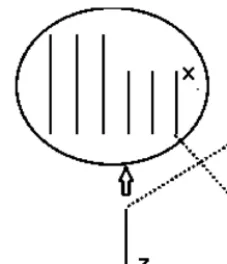
Fig. 1.Herez∈Mandϕe(z) containsx∈A, butψ(z) is outsideϕe(x).
3.5.6. Informaldiagrams
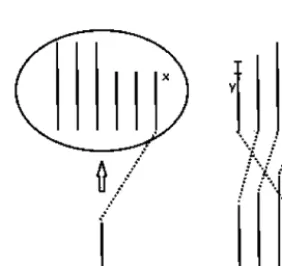
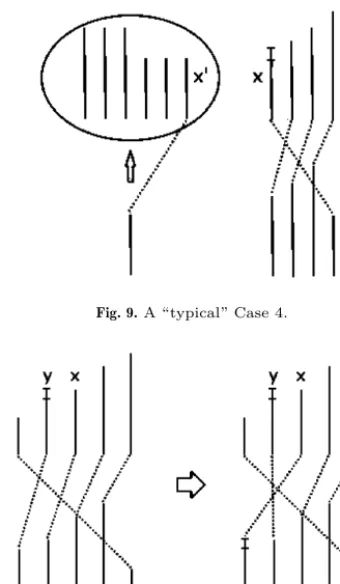
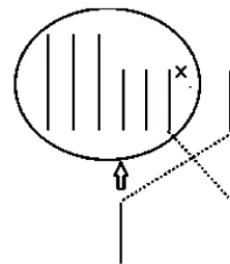
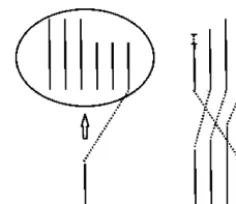
We will be using informal diagrams to represent parts of M and A. In such dia-grams, line segments represent class-elements, and the length of the segment reflects theheight/size of therespectiveclass-element withlonger segmentsrepresenting class-elementsofgreaterheights.Recallthatϕe(x) (which isidentifiedwithϕ∗e)isequaltoa finite collectionofclass-elements inA. This situationwill bereflected onthe diagrams aswell,andforthiswegrouptherespectiveclass-elementsofAinto aclique (the tech-nique of cliqueswas introduced in[10]). Inmany occasionswe will suppress cliquesto simplify a diagram. Then the clique is replaced with a class (typically of the highest priorityamongthose)havingtheheightequaltotheheightofthewholeclique(i.e.,the smallestinsize).ThestructureM (identifiedwithEM)willalwaysbeatthebottomof anydiagram,andA(orEA)willbeatthetop.Classesofahigherprioritywillbetothe left ofclasses having lower priority.We will define ψ so thatat everystage it matches aclass-elementinA with asingleclass-elementinM (andnotwith merelyafiniteset ofthose).Weusedashed linestorepresentψ (whichis identifiedwithψ∗). Andweuse arrowstorepresentcomputations ofϕe, andwecircletheclass-elements thatsharethe samepre-image underϕe. SeeFig. 1.
Disclaimer: Although such informal diagrams may help the reader to understand theconstruction,theformalproofdoesnotrelyonthediagrams.Thereadershould notcompletelyrelyonthesuggestedgraphicalintuition whichisoftenmisleading.
3.5.7. Tangles
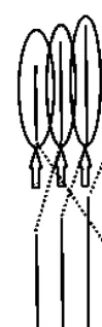
AteverystageoftheconstructionaclassxofAp oraclassz ofMpcanbeputintoa tangle.Thetanglesappearfromseveralrepeatedapplicationsofthebasicdiagonalisation strategy.Wewilldefinetanglesformallylater(byrecursionintheconstruction).Atthis pointwenotethata“typical”configurationofclassesandmapsthatformatanglecan be(informally) describedbyFig. 2.
Fig. 2.A “typical” tangle.
ψ and the arrows refer to ϕe. The diagram is quite informal, since the ϕe-image of a class-element of Mp is in general a linear combination of class-elements in Ap. In the tangle, we show only the class-element of the highest priority in ϕe(z) that real-izes its height. Note also that we require h(ϕe(z)) = h(z) for any z in the bottom, unless ϕe(z) is undefined (this could be the case for the right-most class-element on the diagram). All tangles will necessarily have at least two distinct class-elements of
A in it. Several elementary properties of tangles will be stated later in the verifica-tion.
3.5.8. ConditionforRe,x tobeeligibletoact
Let x be a class-element of Ap. The class-element will be permanently assigned to
Re,x and willbe assumed tobe currently not apartof anytangle. Recallthatat most oneclassofEA maygrowatany stage.WesaythatRe,x iseligibleto actif:
(1) There issomeclass-elementzinM forwhichx∈ϕe(z)↓andh(x)=h(ϕe(z)). (2) Foreveryclass-elementz∈Mp with indexlessthantheindex ofxwe haveϕ(z)↓,
andfurthermoreforeachsuchzeitherh(ϕ(z))=h(z) oralternativelybothh(ϕ(z)) andh(z) have grownlargerthanh(x).
(3) For every class-element x < x either h(x) > h(x) or there is some z ∈ M such that:
(a) x ∈ϕe(z)↓,
(b) h(x)=h(z) (seeLemma 3.8),
(c) ϕe(z) does not include the unique class-element y of Ap that is ready to in-crease itsheight sincethepreviousstage (itfollows from (4)thatthere is such aclass).
Fig. 3.A “typical” line-up.
(a) theindexof yisgreaterthantheindex ofx,
(b) y hasneverbeendeclaredused withrespect tox(tobedefined) (c) y tries topassxinheight.Thatis,h(y)[s−1]=h(x)[s−1]. (Notethat(c) of(3) and(4) sharethesameclass-elementy.)
3.5.9. Action atstages
Assumeaclassy∈Aisreadytogrowinsize(by1),accordingtotheenumerationofA. Beforeweletitgrow,weattempttomeetRe(whichcontrolstherespectivep-component
Apx).Pickthehighestpriority Re,x eligibletoactatthestage.ThenactforRe,x as follows:
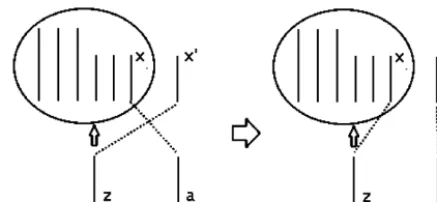
(1) Extending a tangle. If y is not currently a part of any tangle, or is the left-most element of a tangle, then first perform the line-up and then the swap substeps as describedbelow (donothingotherwise). This way weeitheradjoin xto the tangle ofyor willcreateanewtanglewithy.
(1.1): Line-up.Letz be suchthatϕs(z)xand h(z)=h(x).If ψ(z)=xthen do nothing.Otherwise,leta=ψ−1(x) andx =ψ(z).(SeeFig. 3.)
Noteh(z)=h(x) byassumptiononx(itrealizestheminimumheightamong allmembersofz).Resetψonz andabyswappingtheirimages:
ψ(z) =xandψ(a) =x.
(1.2): Swap.Suppose y isthe left-most A-class of atangle T,and let b =ψ−1(y).
Thenbistheright-mostM-classofthesametangleT.Theswappingsubstage isperformedintwo phases:
Phaze 1. Interchangetheψ-imagesofzandbbysettingψ(z)=yandψ(b)=
x.
Phaze 2. Growy insizethusincreasingh(y) byone,andgrowzaccordingly, to maintainh(z) =h(ψ(z))=h(y). Declare y used with respectto
x.(SeeFig. 4.)
Fig. 4.A“typical”swap.Intheleft-mostpartofthediagram,yisreadytoincreaseitsheight(asindicated bytheextrasegmentontopofy).
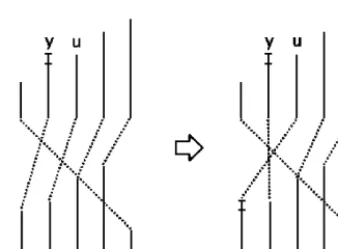
Fig. 5.A “typical” refining operation.
to u in T), then swap ψ−1 between y and u by interchanging their ψ-preimages, and then remove thepair (y,ψ−1(y)) fromthe tangleT. (SeeFig. 5.) Noteinthis
case the height/size the new ψ-preimage of the class u (that stays in T) must be increased.
3.5.10. Initialisationande-expansionary stages
There exists aΠ0
2 predicate thatholds one∈ω and twoinfinitestructures AandB
(thelattertwotakenas oracles)iffϕe:A→ Bisanonto-isomorphism.
Declare a stage e-expansionary if the predicate “fires” on A and M but does not “fire” onany e< e.Then initializeallRe with e> e bysettingall theirparameters undefined, and assign all the p-components previously used by the Re (plus at least oneextrap-componentontopofthese)toRe.Fromthesepointonwards,unlessRegets initialized, thesep-boxeswillbe permanentlyassociatedwith Re.
Remark 3.15. Onemaycome upwithadetailedcarefuldefinitionofwhatitmeans for
ϕetolookmorelikeanisomorphismatagivenstage,butitisclearlyaΠ02-condition.For
[image:25.485.146.315.225.349.2]3.5.11. Construction
Intheconstruction, we assumethatA hasacomplete effective decomposition (oth-erwise, uniformly pass to pGEAp). We do not distinguish between the elementary summands (in thefixed decompositionof A) and the respectiveequivalence classesin
EA.Underthisidentification,weadjusttheenumerationofAsothatat mostoneclass ofEAp growsbyat mostoneelement ateverystage,and furthermorethis happensfor atmostoneprimep.
We follow the definition of an e-expansionary stage to see which p-components are controlledbywhichrequirements.Ifat thebeginningofstage sthestructureAp[s−1] is ready to increase the height/size of one of its class-elements (according to its enu-meration), wefirst letthe respectiverequirement act accordingto itsinstructions (see actionatstage s),andthen we resumetheenumerationofAp. Ifanewclass-elementc isintroducedtoA,wealsointroduceanewclass-elementutoMp andsetψ(u)=c.
3.5.12. Verification
Thefollowing propertiesoftangles follow(byinduction)from thedescription ofthe construction.
(1) Each class-element x of A can be a part of at most one tangle at any stage of the construction.Indeed, to enter anew tangle,a class-elementmust be currently not inany tangle.Sinceψis aninjectionatany stage,andfurthermoreifx∈Ais ina tanglethenψ(x) mustalsobeinthesametangle,wealsoconcludethateveryz∈M
canbeamemberof atmostonetangleat anystage.
(2) A class-element x∈Ap the heightof whichis not maximal in its tangle leavesthe
tangle only if h(x) increases in the construction. Indeed, accordingto refining the tanglesubstep,theonlypossibility foraclass-elementinAp toleaveitstangleisto increaseinsize,unless the class-elementhasthe largest height among all elements inthetangle.
(3) If z ∈ Mp is in a tangle, and ψ(z) changes due to some other classes leaving the
tangle, then h(z) must have increased. This follows from the refining the tangle substage(seethelast lineofitsdescription).
(4) If x ∈ Ap, and h(x) < ∞ has reached its maximum at stage s, then either xwill
Fig. 6.A “typical” Case 1.
tangle (but not as the largest-height class-element), in the latter case it will stay there forever.
Lemma 3.16. Forany p,Ap∼=Mp.
Proof. Recallat everystage of theconstructionwe hadan isomorphismψ[s]:M[s]→
A[s] thatagreewith thefulldecompositions.Thus, regardlessofthetrueoutcomes, we always build M such that each Mp has Ulm type 1. We split the lemma into several claims.Although weusuallysuppressindex s,allourconsiderationsreferto asituation at somestage ofaconstruction(unless specificallysaidotherwise).
Claim 3.17. Suppose a class-element x ∈ Ap has finite height h(x) = k. Then ψ−1(x)
will be redefinedatmostfinitely oftenin theconstruction.
Proof of Claim. Note that,regardless of theoutcomes, eachparticular Ap canbe con-trolled by at most finitely many Re (one after another) during the construction, and eventuallyAp isstablyassociated withsomeRe.Inthecasesbelowweassumethatthe stage is largeenoughso thatAp is alwayscontrolledby somefixedRe. Thecasewhen
Ap= 0 givesMp = 0 forfree,sinceaccordingto theconstructionwenever getto start enumerating Mp.Soweassumethatx∈Ap andh(x)>0 isfinite.Wealsoassumethat
h(x) hasreacheditsstable finite value,i.e. xwill never“grow”.There couldbe several reasonsforψ(x) toberedefinedduringtheconstruction,theseareexhaustedbyxbeing potentiallyinvolvedineithertheline-upprocedure,ortheswap,ortherefiningatangle. Each of these possibilitieshas several possible subcases, we go through these subcases carefully.
Fig. 7.A “typical” Case 2.
Fig. 8.A “typical” Case 3.
Case 2. Line-up in which x is involved as a class “on the right”. (See Fig. 7.) Inthis case,for somex ∈ϕe(ψ−1(x)) the requirement Re,x initiates theline-upand asksforψtoberedefined onz=ψ−1(x) andto besetequaltox (onz).Note thatx mustbeequaltoxinsize,andalsox mustbeofahigherprioritythan
x. Case2 cannot happen again to x with thesame x becausex will now be placedinsometangle,andh(x) willhavetobeincreasedbeforeRe,x actsagain (ifever).
Remark 3.18. Note that Case 2 can potentially occur even if x is currently involvedinatangle,butonlyifxistheleft-mostclassinitstangle.Toseewhy
xhas to be left-mostin its tangle, note thatotherwise h(ϕe(ψ−1(x)))< h(x)
contrarytothenecessaryconditionh(x)=h(x).Therefore,sincexisleft-most in its tangle, the swap will result in particular in swapping the ψ-preimages of x and x which have equal height/sizes, and it will be consistent with our definitionofatangle.
Case 3. Swapin which xisinvolved as aclass“on the left”.Once this swapis done,x
[image:28.485.166.307.195.328.2]