EffECT of mulChINg maTErIalS oN ThE SoIl
TEmPEraTurE, SoIl WaTEr PoTENTIal, NumBEr aND
WEIghT TuBErS of orgaNIC PoTaToES
DVOřák, P 1, TOMáŠEk J 1, HAMOUZ, k 1 & kUCHOVá, P 1
Key words: grass mulch, textile mulch, yield, organic agriculture
Abstract
The mulching with chopped grass (GM) and black textile mulch (BTM) were compared to non-mulching control variant (C) with mechanical cultivation in two regions of the Czech Republic. Especially in plots with BTM were first formed ridges and covered by the black polypropylene non-woven textile and then they were planting. The surface mulching of potatoes affected the soil temperature (higher about 0.2 – 1.6 °C than in C) and water potential of the soil (higher only by 8 kPa than in C). GM had a significant effect on the yield of ware potatoes. The final tuber yield was higher by 22.9 % on plots with GM in comparison with C. GM resulted in a significant increase of the number and weight of tuber fraction 56–60 mm and over 60 mm.
Introduction
Mulching which has become more popular lately is an important way of soil protection in the plant production. Surface mulching is one of the most cost effective means (Shelton et al., 1995), because of a range of positive effects on the soil fertility and other factors important for plant production. Moreover mulch improves soil conditions, especially reduces water evaporation from soil and helps to maintain stable soil temperature (Ji and Unger, 2001; Kar and Kumar, 2007). The cover of mulch influences soil moisture as well (Ramakrishna et al., 2006). Mulch maintains stable soil moisture, especially in surface soil layer. In warmer areas the Colorado potato beetle (CPB) is considered as the most important pest species. The CPB is a great problem especially in organic growing potatoes, because the CPB has relatively few natural enemies (Rifai et al., 2004). The aim of this paper was to evaluate the effect of different mulch materials (of vegetable origin and plastic mulch) on the yield of tubers and on some factors influencing potatoes production in two regions of the Czech Republic. The research was mainly focused on the effect of mulching on soil temperature, soil water potential (SWP).
Materials and methods
field experiments were conducted over two years on two sites – Leškovice (LE) in the Czech-Moravian Highlands (potato growing region) and Uhříněves (UH) – sugar beet region. Leškovice is 498 m a.s.l., the average of annual temperature is 6.9 °C and annual precipitation is 630 mm.
1 Department of Crop Production, faculty of Agrobiology, food and Natural Resources, Czech University
Dactylis glomerata – 40 %, Festuca pratensis – 20 %, Lolium perenne – 20 %, Poa pratensis – 10 %,
Alopecurus pratensis – 10 %) was spread manually in a 25-mm thick layer 14th day after planting
(immediately after second hoeing). In plots with BTM ridges were formed firstly and then covered by the black polypropylene non-woven textile. During hand-planting potato tubers in demanded spacing (450 mm x 800 mm) were set to prepared holes in the textile. The fertilizers, fungicides, and other formulation against CPB or slugs were not applied in this experiment. The area of the trial plot was 7.9 m2. There were 4 replicates of each variant. Tubers were harvested by hand. Harvested tubers were sorted out with commercial potato sorters (tubers with potato blight, necrosis or grow green were previously removed) into four fractions (under 40 mm, 40–55 mm, 56–60 mm and over 60 mm). Statistical calculations were done with SAS ver. 9.1.3. (SAS Institute Inc., 2003).
Results
Soil temperature was generally about 0.2–1.6 °C higher in treatments with BTM (at both sites) than in control variant (without mulch). Comparing treatments with BTM at both sites in 2009, soil temperature was about 2.1°C higher in UH than in LE.
The course of soil moisture during the year is strongly influenced by annual precipitation and its distribution during the year. Nevertheless SWP was generally higher in the GM and BTM treatments (only by 8 kPa and 1kPa) than in the C variants in UH. Those trends were measured as well in LE.
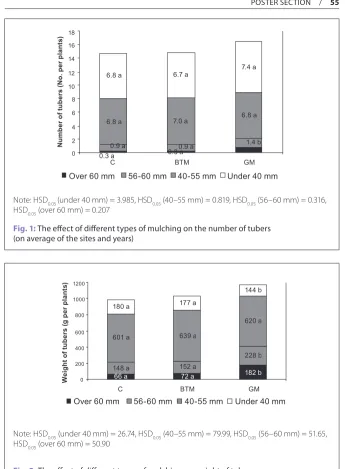
Tuber fractions and yields. An application of GM (fig. 1, 2) resulted in a significant increase of the number and weight of tubers (tuber fraction 56–60 mm and over 60 mm), on the other hand GM decreased weight of tubers under 40 mm.
Note: HSD0.05 (under 40 mm) = 3.985, HSD0.05 (40–55 mm) = 0.819, HSD0.05 (56–60 mm) = 0.316, HSD0.05 (over 60 mm) = 0.207
fig. 1: The effect of different types of mulching on the number of tubers
(on average of the sites and years)
Note: HSD0.05 (under 40 mm) = 26.74, HSD0.05 (40–55 mm) = 79.99, HSD0.05 (56–60 mm) = 51.65, HSD0.05 (over 60 mm) = 50.90
fig. 2: The effect of different types of mulching on weight of tubers
[image:3.420.48.386.49.231.2]Discussion
According to Brust (1994) potato is sensitive to higher soil temperature and low soil moisture and will not grow properly under these conditions. Brust (1994) mentioned that increase of tuber yields in mulching plots may have been result of lower soil temperature and higher soil water content. The higher soil temperatures was reported also in the plastic mulch by Ramakrishna et al. (2006) by 4 °C at 100 mm depth and by Wang et al. (2009) by 2 – 9 °C. The lowest yield of tubers in treatment with BTM in UH (Table 1) was related to higher occurrence of larvae of CPB and thereby with higher defoliation. In this experiment higher number of CPB egg clusters was found at on plots with BTM compared to C treatments. Potatoes can usually tolerate substantial defoliation without decrease of tuber yield, up to 30 % (when they are in vegetative stages). But they are more sensitive to the effects of defoliation (and bring decrease of tuber yield) when tuber are beginning to bulk and can only tolerate about 10 % defoliation (Hare, 1990). Zehnder and Hough-Golstein (1990) found out significantly lower number of overwintered adult beetles and first generation larvae on plots with straw mulch compared to those without mulch.
Conclusions
The mulching treatment systems affected the soil temperature and water potential of the soil on dependence of the physical and chemical properties of soil as well as organisms that live there.
This study indicated higher incidence of larvae and higher defoliation in BTM than in non-mulched potato plots.
In the experiment the mulching of chopped grass significantly decreased the small size tuber fraction (under 40 mm), while the large size fractions (56–60 mm and over 60 mm) were significantly increased.
Acknowledgments
Supported by the Ministry of Agriculture of the Czech Republic, Project No. QH 82149, by the Ministry of Education, Youth and Sports of the Czech Republic, Project No. MSM 6046070901 and by project CIGA reg. No. 20112004.
references
Brust G.E. (1994): Natural enemies in straw-mulch reduce Colorado potato beetle populations and
damage in potato. Biological Control, 4: 163–169
Ji S., Unger P.W. (2001): Soil water accumulation under different precipitation, potential evaporation
and straw mulch conditions. Soil Science Society of America journal, 65: 442–448.
Kar G., Kumar A. (2007): Effects of irrigation and straw mulch on water use and tuber yield of potato
in eastern India. Agriculture Water Management, 94: 109–116
Ramakrishna, A., Tam, H.M., Wani, S.P., Long, T.D. (2006). Effect of mulch on soil temperature, moisture,
weed infestation and yield of groundnut in northern Vietnam. field Crops Res., 95, 115–125. Rifai N.M, Astatkie T., Lacko-Bartosova M., Otepka P. (2004): Evaluation of thermal, pneumatic and
biological methods for controlling Colorado potato beetles (Leptinotarsa decemlineata Say). Potato Research, 47: 1–9.
Shelton, D.P., Dickey, S.D., Hachman, S.D., Steven, S., fairbanks, K.D. (1995): Corn residue cover on
soil surface after planting for various tillage and planting system. J. Soil and Water Conser., 50: 399–404.
Zehnder, G.W., Hough-Goldstein, J. (1990). Colorado potato beetle (Coleoptera: Chrysomelidae)
Members
Karin Stein-Bachinger (Germany) Jana Hajšlová (Czech Republic) Bernhard Kromp (Austria) Miloš Michlovský (Czech Republic) Otto Schmid (Switzerland) Atle Wibe (Norway)
Translation Ina Leckie, Jim Leckie Technical editor Milan Matoušek
Published by Bioinstitut, Křížkovského 8, 771 47 Olomouc, www.bioinstitut.cz Text in its original form without correction
1st Edition Olomouc, 2011