Coordinating Questions
MSc Thesis
(Afstudeerscriptie)
written by
Morwenna Hoeks
(born April 17th 1995 in Oss, the Netherlands)
under the supervision ofDr. Floris Roelofsen, and submitted to the Board of Examiners in partial fulfillment of the requirements for the degree of
MSc in Logic
at theUniversiteit van Amsterdam.
Date of the public defense: Members of the Thesis Committee:
August 27th 2018 Maria Aloni
Abstract
Acknowledgements
Some words of gratitude are in order here. First and foremost, I would like to thank my supervisor, Floris Roelofsen, for guiding me through all my persistent doubts and concerns and for having the patience to put up with my indecisiveness on thesis-related and thesis-unrelated fronts.
I would also like to thank Ronald de Wolf for being the chair at my defense, and Julian Schl¨oder for his useful and detailed comments. Very many thanks to Maria Aloni for being a great mentor, and for having more confidence in me than I found reasonable. A huge thank you goes out to Jakub Dotlaˇcil too, for all your generous support, the numerous trips to P.C. Hoofthuis, and for the (literary) introduction to Santa Cruz. I would like to thank Luca Incurvati as well, for finding the time to meet with me to discuss parts of my thesis that didn’t make it into the final draft.
Thanks to my partners in crime, theInqBabes, who probably taught me more than any textbook ever could. To Hana, for delivering some unwanted babies (thanks also to Max B. for this metaphor), and to Petsky for helping me make so many difficult decisions.
And then I’d like to thank this place called Botterweg 14 for providing more than just a roof above my head. In particular, thank you, Dean, for showing me a glimpse of your colourful mind, for the many hours spent talking about disjunction and kangaroos without tails while staring out of the kitchen window—and for teaching me some Irish along the way. Go raibh maith agat! To Grzesiek, the “Baloneyboy”, for his sense of hospitality and for teaching me the most important lesson of all: how to properly drink wodka. Thanks to “The Next Generation”, Rachael, Sam & Zhuoye for making me think back to these last weeks in Amsterdam with a smile on my face.
Thank you, Sa´ul, for your faith in me, but mostly just for being there.
Here’s a huge shout-out to all the other people in the MoL too. My life has been filled with laughter thanks to this crazy bunch.1
Finally, I owe my sanity to the pups, the best friends one ever could wish for.
De gullie bedankt z` et d` e witte` , war!
CONTENTS
1 Introduction 1
1.1 Overview of the thesis . . . 2
1.2 Preliminaries . . . 3
1.2.1 Alternative semantics . . . 3
1.2.2 Inquisitive semantics . . . 6
1.2.3 Typed inquisitive semantics . . . 11
1.2.4 Concluding remarks . . . 12
2 Some puzzles 14 2.1 Focus marking . . . 14
2.2 Rises and falls . . . 17
2.3 Disjunction Lowering . . . 20
2.4 Embedding . . . 23
2.5 Overt “or not” . . . 25
2.6 Mixed cases . . . 26
2.7 Summary . . . 28
3 Decomposing force 30 3.1 A first stab: Clause types & boundary tones . . . 30
3.1.1 Putting things together . . . 31
3.1.2 Predictions . . . 33
3.1.3 Disjunctive questions: size matters . . . 34
3.1.4 Problems . . . 35
3.2 Focus marking and the size of the disjuncts . . . 36
3.2.1 Movement and ellipsis . . . 36
3.2.2 Intervention effects without movement . . . 38
3.2.3 The problem of non-elided AltQs . . . 40
3.2.4 Disjuncts are CPs in Japanese . . . 42
3.2.6 Split CPs . . . 45
3.2.7 A note on narrow scope readings . . . 48
3.3 The question operator . . . 49
3.3.1 Exclusive strengthening again . . . 50
3.3.2 Conditional question operator . . . 50
3.3.3 Singleton PolQs . . . 51
3.3.4 Taking stock . . . 53
3.4 Conclusion . . . 56
4 Disjunction Lowering 58 4.1 Ruling out wide scope disjunction . . . 59
4.1.1 The proposition/speech act distinction . . . 60
4.1.2 Discourse contexts . . . 61
4.1.3 Speech act disjunction and commitment states . . . 63
4.1.4 Speech act disjunction and discourse moves . . . 66
4.1.5 A note on rising intonation . . . 68
4.2 Ruling out narrow scope conjunction . . . 68
4.2.1 “Disjunction lowering” is operator movement . . . 70
4.3 Solving some more puzzles . . . 72
4.3.1 Q in embedded questions . . . 72
4.3.2 Overt “or not” . . . 74
4.3.3 Mixed cases . . . 74
4.4 Conclusion . . . 75
5 Conclusions 76 5.1 Future directions . . . 77
Chapter 1
INTRODUCTION
Coordination of and within declarative clauses is a particularly productive phenomenon. When clauses with a different clause type are thrown in the mix, however, things be-come much less clear. In this thesis, I therefore look into coordination of questions and interrogative clauses.
The tight link between questions and disjunction has been studied extensively in different languages. The behavior of disjunction in questions is particularly interest-ing, not only because alternative questions (henceforth: AltQs) are formed out of dis-junctions in almost any language, but also because question particles are often ho-mophonous to, or derived from disjunctive particles. And yet, no fully satisfactory account of AltQs has been provided that deals with the meaning of these questions in a compositionally uniform way.
The focal point of this thesis will therefore most naturally be to account for the meaning of AltQs, but instead of focusing only on this particular type of question, I will look at it from a more general, compositional perspective. That is, the aim of this thesis is to derive the meaning of AltQsascoordinated questions, while making a more direct comparison to other types of questions that involve coordinated structures too.
intona-tion and the underlying syntactic structure of these quesintona-tions. In doing so, it will turn out that these issues are very much interrelated and demand an account that links the different behavior of disjunctions and conjunctions with a more generally applicable account of the effect of questions on discourse.
Throughout this thesis, it will also become clear that we need many ingredients to make the right predictions in a systematic way. We will see a wide range of different phenomena that will turn out to be very relevant to the meaning of coordinated ques-tions, like focus marking, the effect of boundary tones and the underlying syntax. I therefore hope the reader will bear with me on a tour which will take the semantics of these questions as its starting point, but will eventually cross many of its interfaces.
Even though I will show that the problems that are dealt with seem to be framework-independent, the proposed account is couched in the inquisitive semantics framework. The reason for adopting this framework is that it very naturally deals with the mean-ing of conjunctions and disjunctions—and it does so independently of clause type. The choice for this framework is therefore mostly one out of convenience as it allows us to make very direct comparisons between conjoined and disjoined questions, but also between specific types of interrogatives and their declarative counterparts. Moreover, the inquisitive perspective on sentence meaning interfaces very nicely with a broader notion of discourse structure, which will become useful later on in this thesis.
Before I dive into the issues that I am concerned with, I would like to add some notes on terminology. That is, throughout this thesis, I will distinguish between inter-rogatives and questions. With the terminterrogativeI solely refer to clauses that have an interrogative syntax, whilequestions will refer only to speech acts of questioning. The same distinction will hold fordeclarativeversusassertion. This distinction will turn out to be of crucial importance throughout this thesis. Moreover, I will explicitly limit my attention to canonical uses of different speech acts. For instance, the English ques-tionCan you hand me the salt? may be pragmatically used as a request, but we will focus exclusively on its use as a question here.
1.1
Overview of the thesis
I will briefly outline the structure of this thesis here. In Chapter 2 I will first show that placing AltQs within a broader scheme of different kinds of coordinated questions will give rise to several puzzles. The aim of the subsequent chapters will be to solve the six puzzles introduced in this chapter. In doing so, I will take on an incremental approach: I will show that the solution to one puzzle can be extended to solve the next. In this way, we will gradually build up an account of coordinated questions, that deals with their meaning and discourse effects as determined by their syntactic structure and the intonational patterns they exhibit.
taking these solutions as my starting point in Chapter 4, I will solve the third puzzle in two distinct steps. The solution to puzzle 3 will then be followed by a solution to the remaining three puzzles. In Chapter 5 I will conclude. In the remainder of this chapter I will go over the preliminaries of this thesis.
1.2
Preliminaries
As many accounts of coordinated questions make use of a Hamblin style framework, I will first discuss this approach to formalizing the meaning of questions at a very basic level before moving on to discuss the framework that I will be adopting, that is, the framework of inquisitive semantics. In discussing the inquisitive semantics framework, I will present both the basic version of this framework, first orderInqB, as well as the typed version. Readers familiar with these frameworks can skip these sections.
1.2.1
Alternative semantics
It has been proven useful to think of the meaning of questions in terms of their suitable answers. The key intuition in the way different frameworks capture the meaning of questions is therefore that we know what a question means if we know how to answer it. Just like the meaning of assertions can be captured by its truth conditions, the mean-ing of a question can thus be captured in terms of its answerhood conditions. Hamblin (1973), who first made use of this way of thinking of the meaning of questions, there-fore takes the meaning of a question to be a set of propositions—each corresponding to a possible answer to the question. For example, since polar questions have two possible answers, “yes” and “no”, this set will always contain exactly two elements in a Hamblin style framework. In other words, the denotation of the question whether or not it is raining will contain two sets: the set in whichit is rainingis true at any world, and the set in which it is not rainingis true at any world. These sets are generally called the
alternativesof a question, as they represent alternative ways of answering the question. The denotation of a question as in (1) can therefore be written as in (1a). Here and in subsequent chapters, I will write the set of worlds in which a sentenceϕis true, i.e. the truth set ofϕas|ϕ|.
(1) Is it raining?
a. ~(1)Alt={|it is raining|,|¬it is raining|}
(2) Who let the dogs out?
a. ~(2)Alt={|Ann let the dogs out|,|Bill let the dogs out|,|Chris let ...|}
Like a polar question, an alternative question like the one in (3) is usually taken to have two possible answers: “it is raining” and “it is snowing”. The denotation of such a question should therefore contain two propositions or alternatives, i.e. the propositions in which each answer is true at any world. The denotation of (3) should be as in (3a).
(3) Is it raining or snowing?
a. ~(1)Alt={|it is raining|,|it is snowing|}
To derive each of these denotations compositionally, some crucial assumptions have to made. For PolQs for example, the desired denotation can be derived by making use of a polar question operator as in (4) (Hamblin, 1973). This operator takes the proposition expressed by its prejacent and turns it into a set of propositions containing the original proposition and its set-theoretical complement. It is then assumed that any PolQ contains such an operator.
(4) ~Qpol=λphs,ti.λqhs,ti.q=p∨q=¬p
For AltQs, things work a bit differently: the alternatives of such a question are not introduced by a specific question operator, but by the disjunction itself. That is, it is often argued for in the literature that disjunctions always generate alternatives them-selves (Aloni, 2007; Alonso-Ovalle, 2006; Simons, 2005). This means that, at least at some point in the derivation, a sentence in which two clauses are disjoined will always denote not just a classical proposition, but a set of propositions. A sentential disjunc-tion takes two proposidisjunc-tions, the proposidisjunc-tions denoted by its two disjuncts, and turns it into a set which contains these two propositions. It therefore generates alternatives by taking the union of the denotation of each of its disjuncts.
(5) ~or=λp.λp0.λq.q=p∨q=p0
Due to this crucial assumption about the nature of disjunction, the meaning of AltQs that have full clauses as their disjuncts can be derived without making use to any other AltQ-specific operators.
However, the story becomes a bit more complicated if we want to have a more flex-ible definition of disjunction that also deals with subsentential disjuncts. A generalized version of the entry for disjunction as defined above would look like the following:
(6) ~or=λPτλP0τ.{P,Q}
typeτthat ist-reducible, wheret-reducible is defined as follows:
Definition 1. A typeτis calledt-reducible iffτ=torτ=hτ1τ2iwhereτ1,tandτ2 is a t-reducible type
Subsentential disjunctions now also introduce alternatives, but these alternatives are now not necessarily propositions anymore. What this means is that, in building larger constituents out of smaller disjunctions, we cannot just rely on our familiar notion of functional application. Hamblin therefore introduces a pointwise version of functional application, which applies objects of typehσ, τito objects of typehσi(Hamblin, 1973).
Pointwise Functional Application (PFA). If~α⊆Dhσ,τiand~β⊆Dhσi, then
~α(β)={c∈Dτ| ∃a∈~α∃b∈~β:c=a(b)}.
Successive applications of PFA enable the alternatives that have been introduced by the disjunction to stay intact up till the point where they become sentential expressions. At that point, an expression containing a disjunction denotes a set of propositions. For this reason, the denotation of AltQs can be defined by simply leaving these alternatives intact. That is, an AltQ operator is vacuous, and we derive the denotation of an AltQ as in (3a).
However, we want declarative disjunctions to denote propositions instead of sets of propositions. We therefore want to get rid of the alternatives introduced by the disjunction in declaratives, which is why we need an additional operator that turns the set of propositions back into a proposition. More concretely, we need an operator that flattens out the alternatives and turns it into a proposition that is true in a worldwiff at least one of the alternatives is true inw:
(7) ~∃α=λw.∃p∈~α:p(w)=1
Because it is really the disjunction doing the job for AltQs, these questions can simply be analyzed as disjoined questions in a Hamblin-style framework. Conjoining questions, however, is less straightforward in such a framework, since we cannot suggest that the denotation of (8a) is the intersection of the alternatives introduced by each of its conjuncts. That is, taking the intersection would leave us empty-handed: it would simply give us the empty set. Instead, we need to rely on pointwise intersection to derive the correct denotation of such a sentence. This is shown in (9).
(8) a. Is it windy and is it cloudy?
b. {|it is windy|,|¬it is windy|} ∩ {|it is cloudy|,|¬it is cloudy|}=∅
(9) a. ~Q1eQ2:={p∧q|p∈Q1∧q∈Q2}
b. {|it is windy|,|¬it is windy|}e{|it is cloudy|,|¬it is cloudy|}=
A Hamblin style system therefore runs into two important problems. The first is that it needs to rely on PFA, which means that the denotation of expressions can no longer be composed by means of the standard type-theoretic operations of function application and abstraction (see Ciardelli, Roelofsen, & Theiler, 2017 for discussion). Second, an extra notion for conjunction needs to be introduced in order to derive the meaning of conjunctive questions. Inquisitive semantics overcomes these problems, and I will therefore discuss this framework as presented in Ciardelli, Groenendijk, and Roelofsen (2013) below.
1.2.2
Inquisitive semantics
In contrast to alternative semantics, inquisitive semantics does not start out from the idea that the denotation of a question is the set of its possible answers. After all, it is often very unclear what a suitable answer to a question really is. This is why inquisitive semantics takes a slightly different perspective and looks at the meaning of questions in light of their function as requests for information. Inquisitive semantics therefore starts from the observation that one of the primary goals of language use is information exchange. The crucial difference between questions and assertions in this framework is that assertions only provide information, but usually do not request any further information, while questions request information but usually do not provide any.
Just as in alternative semantics, the denotation of a question is modeled as a set of sets of possible worlds, usually referred to as sets of information states. However, in inquisitive semantics these information states do not represent answers but reso-lutions. Since questions are viewed as requests for information to locate the actual world among others, resolutions are those sets of possible worlds that provide enough information to locate the actual world with a sufficient level of precision.
This focus on resolutions has an important formal consequence: it means that the denotation of a question is downward-closed. That is, if an information state provides enough information to resolve a certain issue, any information state that provides even more information will also resolve that issue. Therefore, if an information state sis a possible resolution to a questionQ, the information state s0⊆swill also be a possible resolution toQ. This means that we will both have thats∈Qands0∈Q.
We therefore define an inquisitive proposition as a non-empty, downward-closed set of information states. The proposition expressed by a sentenceϕis denoted as~ϕ. By using this richer notion of an inquisitive proposition, both the informative and the inquisitive content of a sentence can be captured. The union of the elements of
~ϕ, ∪~ϕ, is referred to as the informative content of ~ϕ, and is abbreviated as
info(~ϕ). We call a proposition~ϕinformative iff its informative content is non-trivial:
con-tain allw∈W.
The maximal elements of ~ϕ will be the weakest information states that resolve the issue raised by ~ϕ. I will call these the alternatives of ~ϕ, written asAlt(~ϕ). This notion of alternatives now generally corresponds to the notion of alternatives in a Hamblin style framework. We call a proposition~ϕinquisitive iff its inquisitive content is non-trivial, that is iff it has multiple maximal elements. Therefore,~ϕexpresses an inquisitive proposition iff:info(~ϕ)< ~ϕ. Given a finite set of worldsW a proposition will be inquisitive just in case it has multiple maximal elements.
Crucially, in inquisitive semantics interrogative sentences are taken to be of the same type as declarative sentences: both denote sets of info states. The difference between the two is that the proposition expressed by interrogatives have a trivial infor-mative content and a non-trivial inquisitive content. Propositions expressed by declar-atives on the other hand, always contain a single alternative and therefore have a trivial inquisitive content while they generally have a non-trivial informative content. For the basic inquisitive semantics frameworkInqBthis means that an atomic, declara-tive sentence denotes the set of all information states consisting exclusively of worlds whereϕis true. For atomic sentences that consist of a 0-place predicatePwithout any arguments this amounts to:
(10) ~P={s| ∀w∈s:w(P)=1}
Again, I will use|ϕ|to denote the set of worlds in whichϕis true, while I will denote the downward-closure of this set,℘(|ϕ|), as{|ϕ|}↓.
First orderInqB.The language of first orderInqBwill contain our usual connectives, as well as the inquisitive operators, ! and ?, and quantifiers, written as∃∃and\∀. That
is, it can be defined as follows:
Definition 2. The language of first orderInqB:
ϕ:=R(t1...t2)| ¬ϕ|ϕ∧ϕ|ϕ∨ϕ|!ϕ|?ϕ|\∀ϕ| ∃∃ϕ
(11) Semantics of first orderInqB(Ciardelli et al., 2013):
~R(t1...t2):={|R(t1...t2)|}↓ ~¬ϕ:=~ϕ∗
~ϕ∧ψ:=~ϕ∩~ψ
~ϕ∨ψ:=~ϕ∪~ψ
~!ϕ:=~ϕ∗∗
~?ϕ:=~ϕ∪~¬ϕ
~\∀x.ϕ(x):=∩d∈D~ϕ(d) ~∃∃x.ϕ(x):=∪d∈D~ϕ(d)
Negation.In this framework, the negation of sentenceϕ,¬ϕ, will express the downward-closed set consisting of all states in which ϕis false at any world in that state. More formally, negation will correspond to the notion of an absolute pseudo-complement: the absolute pseudo-complement of a proposition~ϕ, which will be denoted as~ϕ∗, is the weakest proposition~ψsuch that~ψ∩~ψentails any other proposition. Since the only proposition that entails any other proposition is{∅}, denoted as⊥,~ϕ∗can be characterized as the weakest proposition~ψsuch that~ϕ∪~ψ=⊥. In classical logic, it consists simply of all worlds that are not in~ϕitself, i.e. the complement of~ϕ. In
InqBit can be defined as follows (Ciardelli et al., 2013):
(12) ~ϕ∗:={s| ∀s0⊆s: ifs0,∅, thens0< ~ϕ}
Conjunction, disjunction and the quantifiers. Conjunction and disjunction can be expressed in terms of the algebraic notions of meetandjoin, where a conjunction of two sentences is the meet of each of its conjuncts and a disjunction the join of each of its disjuncts. That is, the meet of a set of propositions Σ will be defined as the intersection of all the propositions in that set. The join of a set of propositions will be the union of all the propositions in that set (Ciardelli et al., 2013). The universal and existential quantifier can also be defined in terms of the meet and join operations, as they correspond to infinitary meet and join respectively.
(13) InqB:TΣ:={s|s∈Pfor allP∈Σ}
(14) InqB:SΣ:={s|s∈Pfor someP∈Σ}
w1 w2
w3 w4
(a)
w1 w2
w3 w4
(b)
w1 w2
w3 w4
(c)
w1 w2
w3 w4
(d)
w1 w2
w3 w4
(e)
w1 w2
w3 w4
[image:16.612.159.455.125.331.2](f)
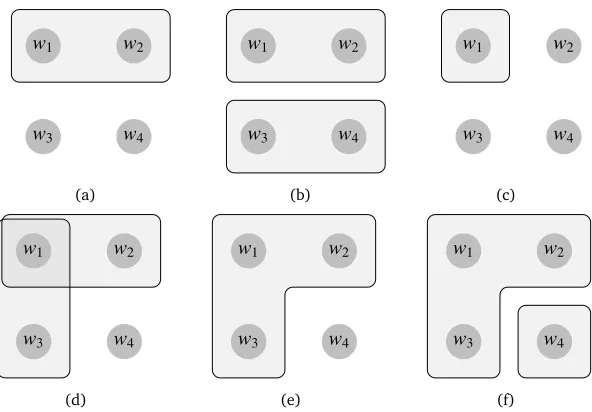
Figure 1.1: PropositionsP(j),?P(j),P(j)∧P(m),P(j)∨P(m),!(P(j)∨P(m)), and?!(P(j)∨ P(m))respectively
The ! operator, on the other hand, kills inquisitivity while leaving the informative content of an utterance intact. In this sense, it is comparable to the existential closure operation as defined in a Hamblin style system. The ! operator corresponds to dou-ble negation, and it will therefore always flatten out alternatives. That is, since the complement of a proposition will never be inquisitive, the double negation will also be non-inquisitive. This operator will therefore be equivalent to taking the powerset of the union of the proposition. It will therefore always hold thatin f o(ϕ)∈~!ϕ.
Examples and diagrams. In a very simple setting in which we consider only one 1-placed predicate,going to the party, translated asPand we have only two individuals John and Mary, j andm, in our domain, we can represent the proposition expressed by the sentence,John is going to the party,P(j)as in fig. 1.1(a). Here we interpret the topmost worldsw1 andw2as the worlds in whichP(j)is true and the leftmost worlds w1 andw3 as the worlds in which P(m)is true. Even though propositions are always downward-closed, to keep these figures readable, only the maximal elements of the proposition are depicted, which is in this case only a single set of worlds. I will make use of these visual representations of inquisitive propositions throughout this thesis.
The main source of inquisitiveness within this system is the join operation, and a proposition with non-trivial inquisitive content is therefore always formed out of a disjunction or an existential expression.
actual world is aP(j)or a notP(j)world.
(15) Did John go to the party?
Such a question will be modeled as the proposition~?P(j), which is formed out of a proposition ~P(j) by taking the join of ~P(j)and its absolute pseudo-complement. In other words, the question operator, ?, that is responsible for this, takes the set of alternatives introduced by the proposition~P(j)and adds in its negation. This can be represented as in fig. 1.1(b).
A natural language conjunction as in (16a), translated asP(j)∧P(m)can be rep-resented by the diagram in fig. 1.1(c), but the disjunctive sentence in (16b) cannot directly correspond to P(j)∨P(m). This is because P(j) ∨P(m), represented as in fig. 1.1(d), is a proposition with non-trivial inquisitive content and should therefore be interpreted as a question.
(16) a. John and Mary went to the party. b. John or Mary went to the party.
Just as in alternative semantics, we to get rid of the alternatives that are by default introduced by the disjunction. We thus need a flattening operation to derive the cor-rect meaning of declarative disjunctions. Declaratives like (16b) therefore correspond to !(P(j)∨P(m)), which is illustrated in fig. 1.1(e). This proposition will resemble a classical disjunction in the sense that it is a downward-closed version of the state that supports a classical propositionP(j)∨P(m).
An AltQ as in (17) will therefore roughly correspond to a sentence likeP(j)∨P(m), since this sentence expresses the proposition which raises the issue whether the actual world is a world which John went to the party or a or a world in which Mary went.
(17) Did John or Mary go to the party?
Representing alternative questions as disjunctions in this way will be a serious over-simplification of the actual facts, however. In the next chapter it will become clear why.
classical disjunction P(j)∨P(m) on the one hand and its complement on the other. Representing a polar disjunctive question in this way therefore means that in uttering such a question an issue is raised that can be resolved by either establishing that the actual world is aP(j)-or-P(m)world or a world in which neither John nor Mary went to the party.
A WhQ also denotes a set of alternatives, and like PolQs and AltQs, these alterna-tives can be understood as possible resolutions. For example, a question like the one in 2 will then denote a set of alternatives which are of the form ‘x let the dogs out’, where x is an individual in the domain. In other words, a question like (2) will be represented as containing an existential quantifier, quantifying over individuals in the domain. In a tiny universe with only two individuals, this can also be represented as in fig. 1.1(e) below, in whichw1 andw2 are worlds in which some individual aleft, w1 andw3 are worlds in which some individualbleft andw4a world in which no one left.
1.2.3
Typed inquisitive semantics
In InqB, no compositional translation procedure from natural language to semantic meaning is provided. In other words, the framework does not specify how exactly these logical formulas correspond to natural language expressions. I therefore briefly discuss the extended framework of typed inquisisive semantics, in which the denotation of sub-sentential constituents can also be derived.
Typed inquisitive semantics will simply add a type system to the basic inquisitive semantics framework, in which, as usual,eis the basic type for individuals,sis a basic type for worlds andtthe basic type for truth values.
A Hamblin-style proposition expressed by a sentence likeit is rainingcan be written as in (18a), and is therefore taken to be of type hsti. A proposition in inquisitive semantics is like a Hamblin-style proposition except that it is of a higher type and it is downward-closed. Adding downward-closure and lifting the type will give us the denotation as in (18b) for the proposition expressed by the same sentence in inquisitive semantics. An inquisitive proposition is therefore of typehhstiti: a set of information states (or sets of worlds) (Champollion, Ciardelli, & Roelofsen, 2015). I will abbreviate this asT throughout this thesis.
(18) a. λw.raining(w)=|raining|
b. λp.p⊆λw.raining(w)={|raining|}↓
following (Champollion et al., 2015). I will abbreviate this as in (20).
(19) ~le f t=λxeλp.p⊆λw.talk(x)(w). typehe,Ti
(20) ~le f t=λxe.{|Lx|}↓
Since we want to deal with sub-clausal coordinations as well, we need to adopt a generalized notion of inquisitive disjunction and conjunction. These may be defined as in (21). Just like in a Hamblin-style compositional system, we need to restrict arguments that andandorcan take to arguments of a specific type. Recall that in a Hamblin-style framework this meant that the type of conjuncts had to bet-reducible— they had to “end” in typet. Since the basic type of propositions isT in typed inquisitive semantics, we simply say that conjunctions apply to expressions that areT-reducible.
(21) a. ~and:=λPτλQτλRτ1.P(R)∩Q(R)
b. ~or:=λPτλQτλRτ1.P(R)∪Q(R) whereτis a T-reducible type
Definition 3. A typeτis calledT-reducible iffτ=T orτ=hτ1τ2iwhereτ1,T andτ2is
aT-reducible type
This will allow us to define the denotation of subsentential disjunctions. For example, an subsentential disjunction like ‘sings or dances’ will now denote a function from entities to propositions that contain enough information to establish that the individual sings or that the individual dances. Hence, the type of such a disjunction like 22 will be he,Ti—just like each of the disjuncts. Again, I abbreviate the denotation of subsentential negation as in (22b), using a similar notation as above.
(22) ~sings or dances
a. =~or(~sings)(~dances) b. =λxe{|S x|,|F x|}↓
1.2.4
Concluding remarks
In short, the treatment of coordinated questions is in many ways very similar in alter-native and inquisitive semantics. In both frameworks, the meaning of AltQs is crucially derived by relying on the assumption that disjunction generates alternatives. A flatten-ing operation is required in both frameworks to account for the meanflatten-ing of declarative disjunctions.
Moreover, in inquisitive semantics declaratives and interrogatives are of the same type, which makes it much more straightforward to compare conjunctions and disjunc-tions of and in different clause types. Since proposidisjunc-tions are always of the same type no matter their clause type, this will simplify things on the subsentential level as well.
Chapter 2
SOME PUZZLES
In this section, I will lay out the empirical landscape concerning coordinated questions by presenting some puzzles related to disjoined interrogatives. Since there are several factors at play in the construction of coordinated questions (the type of coordinator, the clause type of conjuncts, the intonational pattern on each conjunct, the size of the conjuncts and so on) spelling out the full range of possibilities along with their possible meanings would be a tedious and slightly boring task, so I will spare the reader such an overview. Instead, I will only discuss some of the highlights, by presenting several min-imal pairs that turn out not to have a minmin-imally different interpretation. It will become clear that many of these puzzles are part of two more general patterns, namely (i) alternative questions behave significantly different than polar questions and (ii) con-junctive questions behave significantly different from discon-junctive questions. Although the first pattern has been noted many times in the literature and is proven difficult to account for, the second pattern has received less attention. The goal of this thesis will be to account for these patterns by solving at least some of the puzzles discussed in this chapter.
2.1
Focus marking
The disjunctive question in (23) can be pronounced in at least four different ways, as shown in (23a–d). The specific way in which this question is pronounced is crucial in determining its meaning: (23a) is unambiguously a PolQ, while I will argue that both (23c) and (23d) are AltQs. In this section, I will discuss the contrast between (23a) and (23c). I will focus on the contrast between these two questions on the one and the questions in (23b) and (23d) on the other hand in the next section.
(23) Is it raining or snowing?
w1 w2
w3 w4
R
R
S S
ff
(a)
w1 w2
w3 w4
R
R
S S
ff
[image:22.612.186.409.129.244.2](b)
Figure 2.1: Denotation of a disjunctive PolQ and open AltQ respectively
b. Is it raining or snowingL-L% ?AltQ,?PolQ c. Is it rainingL*H- or snowingH*H-H% XAltQ,×PolQ d. Is it rainingL*H- or snowingH*L-L% XAltQ,×PolQ
What crucially distinguishes (23a) from (23c) is their intonational pattern. The ques-tion in (23a) should be read as a quesques-tion with a rising boundary tone (indicated with
H-H%) and no separate pitch accents on the disjuncts, while the question in (23c) has a rising pitch accent on the first disjunct (indicated withL∗H, cf. Bartels, 1999) as well as a rising boundary tone. Also note that the questions in (23) at first sight all seem to have the same syntactic structure: they both contain disjunctions and exhibit an interrogative word order.
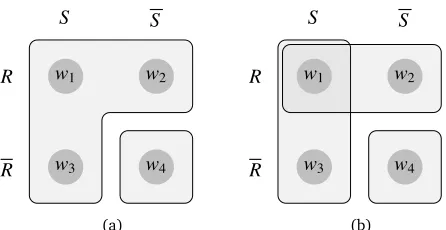
Semantically, these respective intonational patterns give rise to different readings: while we can think of (23a) as raising an issue which can be resolved with a “yes” or a “no” answer, this is not the case for the question in (23c). That is, we can interpret (23a) in case a speaker simply wants enough information to establish whether to ex-pect some kind of precipitation, and, if so, does not need any more specific information about whether it is raining or snowing. This means that the meaning of this question can be represented in an inquisitive system as a proposition containing only two alter-natives: the information state in which the classical disjunction is true in all worlds, and the information state in which the disjunction is false in all worlds. Similarly, in a Hamblin style system, the denotation of this question can be represented as the set of these two propositions.
The addressee has to be more specific to resolve the issue in (23c), however. In (23c), the disjunction actually introduces alternative ways of resolving this question: the only possible way of resolving this question is by establishing either that it is rain-ing, that it is snowrain-ing, or that neither is the case. The difference between (23a) and (23c) can thus be represented in fig. 2.1(a) and fig. 2.2(b) respectively.
the crucial property of an AltQ is that the disjunction itself introduces different alter-natives. The disjunction introduces two out of three alternatives in this case, while in a canonical AltQ the disjunction introduces all of the alternatives denoted by question as a whole. I will therefore refer to the question here as anopen AltQ, while I will call disjunctive questions with a final fall (as in (23d))closed AltQs.
Since the questions in (23) look very similar, these different meanings must arise due their distinct intonational patterns. So what are the crucial properties of these patterns? The fact that (23c) has multiple pitch accents distinguishes it as an AltQ from (23a) as a PolQ. It therefore seems reasonable to conclude that the presence of multiple pitch accents is ultimately responsible for the different readings in these questions.1
In particular, a widely accepted claim is that pitch accents correspond to focus mark-ing of the correspondmark-ing constituents: in AltQs, each disjunct is focus marked, but in PolQs it can be the whole disjunction or a different constituent that receives focus mark-ing (Han & Romero, 2004a; Roelofsen & van Gool, 2009). Below and in subsequent chapters, I indicate focus marking using small caps. Although it is not clear whether it is the focus marking itself that is responsible for the interpretative differences between PolQs and AltQs, it seems that the presence of multiple foci is at least crucial in telling them apart. The crucial question then is: how does focus marking ultimately affect the semantics?
A possible hint to answer this question might be found in the observation that this contrast between PolQs and AltQs disappears in bi-clausal disjunctive questions: (24) always receives the same interpretation as (23c). The question in (24) must be interpreted as an open AltQ, and—no matter the intonational pattern—we will never obtain a PolQ interpretation in bi-clausal disjunctions.
(24) Is itRAININGL*H-or is itSNOWINGL*H-H% ×PolQ,XAltQ
The fact that bi-clausal disjunctive questions always have an AltQ reading might be taken as evidence that bi-clausality is inherently linked to the availability of AltQ read-ings. This would mean that seemingly mono-clausal disjunctions with multiple foci are actually underlyingly bi-clausal too. If this is the case, then what is the link between focus marking and the underlying syntactic structure?
We can also compare these disjunctive questions with their conjunctive versions,
1Based on experimental data provided by Pruitt and Roelofsen (2013), it is often concluded that it is the
which will give us the mono-clausal conjunction in (25) and the bi-clausal one in (26). In doing so, we observe a similar relation between intonation and interpretation, where mono-clausal conjunctions with one pitch accent (or one focus marked constituent) are interpreted differently than the mono-clausal questions with multiple pitch accents as in (25). Just as in the disjunctive case, we also observe that the mono-clausal conjunctions with multiple pitch accents are interpreted similarly to their bi-clausal counterparts. That is, the question in (25b) have the same interpretation as the one in (26).
(25) a. Is it windy and cloudyL*H-in AmsterdamH-H% b. Is it windyL*H-and cloudyL*H-in AmsterdamH-H%
(26) Is it windyL*H-and is it cloudyL*H-in Amsterdam.H-H%
The question is therefore why we see this difference in questions with different into-national patterns. Since I assume here that it is crucially a difference in focus marking that is indicated by these intonational patterns, I summarize this first puzzle in the following way:
Puzzle 1. Focus marking: What is the exact relationship between focus marking, the underlying syntactic structure and the interpretation of coordinated questions?
2.2
Rises and falls
A different but related puzzle concerns the contribution of rising and falling intonation in polar questions as exemplified in (27a) and alternative questions as exemplified in (28a). In both these cases, I indicate a final fall with L-L% and a final rise with H
-H% again (Pierrehumbert, 1980; Pierrehumbert & Hirschberg, 1990). If we only focus on the boundary tone, and ignore the presence or specific nature of pitch accents, we observe that the boundary tone has an effect on the interpretation of AltQs, but not so much on PolQs. That is, the question in (27a) seems to have roughly the same resolution conditions as (27b), but we observe a difference in resolution conditions between (28a) and (28b).2
(27) a. Is it raining?L-L% b. Is it raining?H-H%
(28) a. Is it raining or is it snowing?L-L% b. Is it raining or is it snowing?H-H%
As in the previous section, I call (28b) an open AltQ, while I will refer to questions
2If there is a difference between (27a) and (27b) at all, this difference is mostly likely pragmatic in nature
like (28a) as closed AltQs. Before I go into their interpretational differences, I will first briefly discuss in what ways their intonational patterns are different.
The most obvious difference between (28a) and (28b) is that the first is pronounced with a falling boundary tone, while the second is pronounced with a final rise. How-ever, the final fall in closed AltQs is usually accompanied by a falling pitch accent too, giving rise to what is often called “contrastive intonation”, i.e. a rising first pitch accent and a falling final pitch accent. This is shown in (29) below.3
(29) a. Is it rainingL*H- or is it snowingH*L- in AmsterdamL-L% b. Is it rainingL*H- or is it snowingL*H- in AmsterdamH-H%
Semantically then, there seem to be two crucial differences between open and closed AltQs.
The first difference is that closed AltQs are usually interpreted as exclusive disjunc-tions, whereas open AltQs are interpreted inclusively (Zimmermann, 2000; Roelofsen & van Gool, 2009; Rawlins, 2008b; Roelofsen, 2015). For AltQs, this would mean that in response to a question as in (30), it is more natural to respond with an answer like the one in (30b) than with one like (30a). By using the intonational pattern of a closed AltQ, the speaker therefore seems to assume that the addressee does not have both a dog and a cat, and it is this assumption that needs to be explicitly cancelled by using a phrase likeactually.
(30) A: Do you have a catL*Hor a dog?H*L-L%
a. B: #Both.
b. B: Actually, I have both.
Many authors therefore conclude that contrastive intonation at least marks the dis-juncts to be exclusive in the sense that the at issue content is strengthened by exhaus-tifying each disjunct with respect to the other disjuncts. (Roelofsen & van Gool, 2009; Rawlins, 2008b; Roelofsen, 2015).4
Second, closed AltQs also differ from open ones in that they are interpreted exhaus-tively. That is, in closed AltQs, the alternatives that are introduced by the disjunction exhaust the possible ways in which the question itself can be resolved. Or, in other words, not only the “both” answer is odd, the “neither” answer seems to be out too.
3The way the term “contrastive intonation” is used in the literature is actually vague to some extent, as it
is not clear whether it specifically refers to a tune characterized by a final fall or a falling final pitch accent. Since the latter never goes without the first (see (i)), it seems difficult to really distinguish between the two.
(i) a. #Is it rainingL*H-or is it snowingL*H−in AmsterdamL-L%
b. #Is it rainingL*H-or is it snowingH*L-in AmsterdamH-H%
4Under many analyses, exclusivity comes in as a presupposition in closed AltQs, but it is not clear that it
w1 w2
w3 w4
R
R
S S
ff
(a)
w1 w2
w3 w4
R
R
S S
ff
[image:26.612.187.408.126.246.2](b)
Figure 2.2: Denotation of a closed AltQ and open AltQ respectively
This is illustrated in (31) below.
(31) A: Do you have a catL*Hor a dog?H*L-L%
a. B: #I only have a goldfish. b. B: Actually, I only have a goldfish.
For open AltQs, on the other hand, it is perfectly fine to respond with an alternative that is not introduced by the disjunction itself. That is, the following scenario is perfectly natural:
(32) A: Do you have a catL*Hor a dog?H-H%
B: I only have a goldfish.
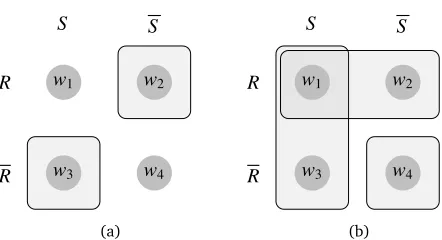
In short, the denotation of the open and closed AltQ in (28a–b) should be as in (33a–b) below. We can also visually represent this difference as in fig. 2.2(a) and fig. 2.2(b).
(33) a. ~(28a)={|it is only raining|↓,|it is only snowing|↓}
b. ~(28b)={|it is raining|↓,|it is snowing|↓,|¬it is raining∧¬it is snowing|↓}
Interestingly, we do not see any of these “special effects” of falling intonation in simple PolQs. Even though PolQs with a rising intonation are often considered less marked than PolQs with falling intonation, this latter type of question is actually a lot more common than one might expect. In fact, a large proportion of the polar questions uttered in natural occurring speech are marked with a final fall (Geluykens, 1988; Bartels, 1999; Savino, 2012). Intuitively, however, the question in (27a) still has two possible resolutions—just like it’s counterpart with a final rise.
oper-ator to be present in the syntactic structure: this question operoper-ator is required to add the third alternative in (33b). On the other hand, the denotation of the closed AltQ in (28a) should only have two alternatives, each introduced by one of the disjuncts. This means that there cannot be any question operator responsible for adding the set-theoretic complement of these alternatives present at all in the syntactic structure—or at least it does not directly manifest itself in such a question. The difference between rising and falling intonation in open and closed AltQs therefore seems to express itself semantically in the presence or absence of (i) an exclusive strengthening operator and (ii) a question operator, while in PolQs intonational patterns do not seem to have such an effect at all.
Again we can make the comparison with conjunctive questions too, and we also observe that such questions behave more like PolQs, since here too, the boundary tone does not seem to make a difference in their interpretation. In other words, the questions in (34a) and (34b) have a similar interpretation, just as was the case for a simple PolQ.
(34) a. Is it raining and is it snowing?L-L% b. Is it raining and is it snowing?H-H%
The problem is therefore that the presence of the question operator seems to be trig-gered by rising intonation in disjunctive questions, but this question operator is present in conjunctive questions no matter the intonational pattern. Note that this problem too is independent of the specific semantic framework that we adopt; both under an in-quisitive and alternative semantics treatment of polar and alternative questions, we run into this problem since in any case the question operator should introduce a new alternative, thereby leaving us with too many unwanted alternatives for AltQs with falling intonation. I thus summarize this second puzzle in the following way:
Puzzle 2. Falling intonation: How can we derive the semantic contribution of rising vs. falling intonation in a uniform, compositional way?
2.3
Disjunction Lowering
Another, perhaps surprising, contrast between PolQs, AltQs and conjunctive questions is what I will call the puzzle of Disjunction Lowering.5 Consider the minimal pair in (35b) and (35a):
(35) a. Is itWINDYL*H- and is itCLOUDY?L*H-H% b. Is itWINDYL*H- or is itCLOUDY?L*H-H%
5I adopt this term from G¨artner and Michaelis (2010) and Krifka (2001), who use it to refer to similar
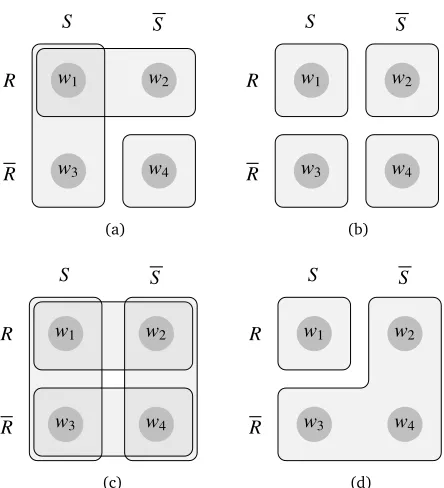
Intuitively, in the question in (35a), the speaker wants to know whether or not it is true that it’s windy and whether or not it is true that it’s cloudy. In responding to such a question, an addressee must resolve both issues raised by each conjunct. In total, this gives four minimally informative resolutions: we can resolve this question as a whole either by establishing that it is both windy and cloudy, by establishing that it is only windy but not cloudy, by establishing that it is only cloudy but not windy or by establishing that neither is the case. Hence, the denotation of such a question in an inquisitive system should have of four alternatives. Similarly, in a Hamblin-style system, the denotation of this question would be a set of four classical propositions.
In order to derive this, the complement of each conjunct, i.e. the “no” answer to each conjunct should play a role in the set of info states the question as a whole de-notes. In particular, this means that we need a question operator inside each conjunct. In a sense, this also means that we can derive conjunctive questions as conjunctions of PolQs: the meaning of (35a) can simply be taken to be the proposition expressed by the sentence?w∧?c.
Crucially, however, assuming that a question operator would be present inside each disjunct in (35b), would yield the wrong denotation for such a question. Even though (35b) could be resolved by establishing that it is neither windy nor cloudy (as already discussed above), just negating one of the disjuncts is not a good answer to this ques-tion, nor does it in any way resolve the issue raised by this question. To see this, note that the dialogue in (36) seems rather odd—in giving such a response the speaker should at least provide an explanation for their lack of informativeness.
(36) A: Is it raining or is it snowing?H-H% B: # It’s not raining.
B: # It’s not snowing.
Thus, the denotation of (35b) cannot be the one in (37a). What this means is that we do not want to assume that a question operator is applied to each disjunct in AltQs with rising intonation. This contrasts with what we saw for the conjunctive question in (35a), where we do need a question operator inside each conjunct.
In fact, for conjunctions it is exactly the other way around, in the sense that we cannot interpret (35a) with a question operator scoping over the conjunction. The question in (35a) cannot be interpreted as denoting the set of propositions in (37b), since this would mean that answering (35a) with “it’s not both raining and snowing” would resolve the issue raised by this question but it clearly does not do so.
(37) a. ~(35b) ,{|it is raining|,|it is snowing|,|¬it is raining|,|¬it is snowing|} b. ~(35a) ,{|it is raining∧ it is snowing|,|¬(it is raining∧ it is snowing)|}
w1 w2
w3 w4
R
R
S S
ff
(a)
w1 w2
w3 w4
R
R
S S
ff
(b)
w1 w2
w3 w4
R
R
S S
ff
(c)
w1 w2
w3 w4
R
R
S S
ff
[image:29.612.186.408.127.371.2](d)
Figure 2.3:?(S ∪R),?S ∩?R,?S ∪?Rand?(S ∩R)
fig. 2.3(d), the meaning of (35b) should be represented as in fig. 2.3(a), but not as in fig. 2.3(c).
This means that the underlying structure of disjunctive questions has to be cru-cially different from that of conjunctive questions, even though they not only receive a similar intonational pattern, but also really looksimilar in terms of their surface syn-tactic structure. Schematically, we can represent this difference as in (38a) and (38b) respectively: while the question operator has to scope over full disjunctions, conjunc-tions always take scope over question operators.
(38) a. Q(raining∨snowing)
b. Q(raining)∧Q(snowing)
Both semantically and syntactically there is no reason to expect this difference to arise, because on a sub-sentential level, conjunction does not seem to behave much differ-ently from disjunction at all. Moreover, both in a Hamblin-style and an inquisitive framework, there would be nothing intrinsically wrong with raising an issue as the one depicted in fig. 2.3(c) or fig. 2.3(d). I thus summarize this puzzle as follows:
2.4
Embedding
Similar to the distinction between AltQs and PolQs, we observe a difference between the following two sentences.
(39) a. John wonders whether it’s raining or snowing. XPolQ,XAltQ,XWS b. John wonders whether it’s raining or whether it’s snowing. XAltQ,XWS
The crucial observation here is that the sentence in (39a) has three possible readings, while the sentence in (39b) only has two. Not all of these readings are immediately obvious, so I will quickly go over them below.
Under one reading of (39a), John considers both the possibility that it is either raining or snowing and the possibility that it is neither, and he wonders which of the two is the case. This means that John’s state of mind is that of a disjunctive PolQ under this particular interpretation—that is, John is entertaining the issuewhether or not it is raining or snowing.
Under the second reading of (39a), John is wondering which of the following two is true: it is raining, or it is snowing. This means that John is entertaining the issue which corresponds to a closed AltQ.
The third reading is the wide scope disjunction reading (indicated as WS above), in which the speaker expresses uncertainty about the issue John is wondering about. Un-der this reading, eachwhether-clause is embedded under their ownwonderpredicate, which is elided in the second disjunct. Each embedded question corresponds to a PolQ in this case.
Intonation helps in distinguishing between these readings, but seems a much weaker cue than at the matrix level. The second AltQ reading might be the stronger one if the disjunction is pronounced with contrastive pitch accents—just as in an AltQ at the matrix level, but pronouncing the disjunction with a flat, block intonation does not unambiguously turn the embedded question into a PolQ. Similarly, the third WS read-ing might be the stronger one if the disjunction is pronounced with a pause after the first disjunct, indicating that parts of the second disjunct are elided, although an AltQ reading would not be ruled out under such a pronunciation.
Crucially, for (39b) only the closed AltQ and the WS reading are available. This therefore parallels the root case, where a PolQ reading is generally not available if the disjuncts are full clauses. Like in a PolQ at the root level, we need a question operator under the PolQ reading of (39a). Since (39a) may also be read as a closed AltQ, but, crucially, never as an open one, we again need the question operator to be absent under the second AltQ reading of (39a).
wants to find out what the answer is to the polar questionis it raining in Amsterdam
and he wants to know the answer to the polar questionis it raining in Rotterdam.
(40) John wonders whether it is raining in Amsterdam and whether it is raining in Rotterdam.
We thus see that embedded questions pattern with root questions that are marked with a final fall in the sense that we need a question operator in PolQs and conjunctions of PolQs, but not in AltQs.
A possible way of deriving this difference is to assume a different PolQ and AltQ operator, but in both the matrix and the embedded case, there does not seem to be any morphosyntactic difference between the two at all. In fact, cases like (39b) where each disjunct contains a whetherclause might provide evidence against such an approach. That is, for embedded interrogatives it is often assumed that it is the interrogative com-plementizer whetheritself, that is responsible for the question semantics (cf. Larson, 1985; Han & Romero, 2004a; Rawlins, 2008b). Given the different questions above,
whethershould then be ambiguous between the PolQ operator, an AltQ operator and an operator that is completely vacuous. If this is the case, bi-clausal embedded AltQs with twowhether’s should be interpreted as having two such operators, but these ques-tions are neither interpreted as a disjuncques-tions of PolQs, nor as a disjunction of AltQs. The problem with such an approach is therefore not only that we do not know how to determine which operator whetheractually corresponds to, but also that a bi-clausal embedded AltQs really should only have one question operator, not two.
Now, examples such as (39b) are often done away as either being ill-formed or as different constructions than embedded AltQs with a singlewhether. However, they do seem to have the exact same meaning and they are very commonly used—especially when the disjuncts are slightly longer. For the reader who is not yet convinced, here are some examples from the ‘wild’ which all just have a basic AltQ reading:
(41) It can then offer a suggestion to staff aboutwhetherto keep in custody a few more hours,whetherto release them on bail before a charge, orwhetherto remand them in custody.6
(42) The new chairman must now decide [...] whether to appeal to those who want war orwhetherto ignore them and forge ahead with his own road for this troubled club.7
(43) Whetherthat interpretation turns out to be correct, orwhetherMr. Gandhi’s swift installation as Prime Minister will exercise a stabilizing influence, is not
6
https://www.huffingtonpost.co.uk/entry/police-are-testing-an-ai-that-can-recommend-whether-a-suspect-should-be-held-or-notuk591427e8e4b00b643ebb54b4
7
clear.8
(44) At issue iswhetherthe payment the men are discussing was campaign-related and intended to influence the election [...], orwhetherit was merely meant to shield the married Trump from an embarrassing revelation harmful to his personal life.9
Thus, whethercannot straightforwardly be equated to any kind of question operator, but if that is really the case then where does the question meaning come from in embedded questions? Again we seem to have a similar problem as we saw in the root case, since bi-clausal AltQs look like disjunctions of PolQs but are really not interpreted as such. so we can perhaps ask ourselves the following question:
Puzzle 4. Q in embedded questions: What is the semantic contribution of ‘whether’, and if not from this complementizer, where exactly does the question interpretation come from in embedded questions?
2.5
Overt “or not”
In PolQs, the question operator should at least introduce the complement of the propo-sition expressed by its prejacent. Another way of deriving a similar meaning is to trigger this complement by overtly stating it, that is, by adding an overt “or not” clause. What is puzzling about this is that if we do so, the meaning of polar questions does not really seem to change all that much, while alternative questions become very odd or even hard to interpret. For conjunctive questions, it is unclear whether it is felicitous to add an overt “or not” clause to each conjunct. To see this, consider again a minimal pair like the one in (45)
(45) a. Is it raining or not?L-L%
b. #Is it raining or not or is it snowing or not?L-L%
c. ?Is it raining in A’dam or not and is it raining in R’dam or notL-L%
Semantically, it seems that (45a) denotes the same set of propositions as a polar ques-tion without the overt “or not” clause. The quesques-tion in (45b) on the other hand, is almost uninterpretable, while we would expect that it would simply denote a set of propositions corresponding to each of the four disjuncts. That is, assuming that the question operator does not appear in such an alternative question, just as it does not appear in the version without the overt “or not” clauses, we would expect (45b) to denote the set of propositions in (46). This might indeed be the denotation of such a question, but somehow this turns out to be very marked.
8https://archive.nytimes.com/www.nytimes.com/learning/general/onthisday/991031onthisday
big.html
9
(46) ~(45b)alt={|it is raining|,|it is snowing|,|¬it is raining|,|¬it is snowing|}
Note that even if both questions are pronounced with a rising boundary tone, we ob-serve the same contrast in which the polar question seems much more natural than the alternative question.
Turning to embedded overt “or not” questions, we see a similar effect, where adding such a clause to an embedded PolQ does not seem to have any effect on its semantics. For embedded AltQs, on the other hand, we do observe a change in meaning, but here it does not necessarily result in infelicity. Instead, such an example might be saved as the disjunction in the embedded AltQ can be reinterpreted as taking wide scope over the full sentence. Therefore, the example in (47b) only has a reading which is similar to the sentence in (47c).
(47) a. John wonders whether or not it is raining.
b. John wonders whether or not it’s raining or whether or not it’s snowing. c. John wonders whether or not it’s raining or John wonders whether or not
it’s snowing.
In both the matrix and the embedded case, it is unclear why an interpretation as in (46) results in infelicity in a Hamblin style system. Also in an inquisitive system there is no straightforward way of explaining this based on the semantics of such questions alone, since overlapping alternatives are perfectly fine in this framework. We already saw above that AltQs generally do not have a question operator inside each disjunct, and even if we explicitly force such a reading, we end up with an infelicitous sentence. The fifth puzzle can thus be summarized as follows:
Puzzle 5. Overt “or not”:Is the semantic contribution of overt “or not” clauses the same as that of covert question operators, and if so, why is this infelicitous in AltQs?
2.6
Mixed cases
Another difference between conjunctive and disjunctive questions is that disjoining a declarative and an interrogative clause is not always grammatical, while conjoining a declarative and interrogative usually is. For example, one might say something like (48a) or (48b) in the end of a meeting, but uttering something like (49a) or (49b) seems very odd. Therefore, it seems that “mixed” conjunctions can be felicitous, while “mixed” disjunctions are not.
(48) a. I want to end this meeting with two things: Where is John and someone should book a room for the next meeting.
(49) a. ??...where is John or someone should book a room for the next meeting. b. ??...someone should book a room for the next meeting or where is John?
There are, however, a few exceptions to this in which mixed disjunctions do seem to be fine. One might for example say:
(50) John is going for a walk, or is it raining?
The interpretation of such a disjunction cannot be that of a declarative disjoined with a polar interrogative. In other words, in a Hamblin-style system, the denotation of (50) is not the one in (51a)—if only because disjoining a declarative and an interrogative would result in a type mismatch between the two disjuncts. Even in inquisitive seman-tics, where both disjuncts would be of the same type, the denotation of (50) is hard to derive, since it’s clearly not the one in (51b). What (50)does mean is unclear, but it cannot be derived in any standard way.
(51) a. ~(50)alt,|John is going for a walk| ∪ {|it’s raining|,|¬it’s raining|}
b. ~(50)inq,{|John is going for a walk|}↓ ∪ {|it’s raining|,|¬it’s raining|}↓
Moreover, such cases are very sensitive to the order of the disjuncts. That is, a mixed disjunction that consists of an interrogative followed by a declarative is clearly out, as shown in (52). This order effect does not arise for mixed conjunctions.
(52) ∗Is John going for a walk or it is raining.
In the embedded case, it is a bit more difficult to test whether mixed disjunctions contrast with mixed conjunctions, because there is always a way to reinterpret em-bedded coordinations as coordinations of matrix clauses, where parts of the second conjunct are elided. However, assuming that disjoining a declarative and interrogative was grammatical, this would mean that such a disjunction itself denotes an inquisitive proposition. We would therefore expect that such a disjunction is embeddable under a rogative verb, but, in fact, it is not:
(53) a. ∗John wonders whether it’s raining or that it’s snowing.
b. ∗John wonders that it’s raining or whether it’s snowing.
(54) a. ∗John wonders whether it’s raining and that it’s snowing.
b. ∗John wonders that it’s raining and whether it’s snowing.
conjunction is equivalent to conjoining twoknowclauses that each embed a clause. However, if we look at examples like the following, we observe that both (55a) and (55b) are fine, but in this case, while (55b) can be the elided version of (56b), (55a) cannot be the elided version of (56a). That is, (56a) sounds very odd, presumably because of the exhaustive flavor that comes with the use of a pseudocleft.
(55) a. What John learned today is that it’s always cloudy in Amsterdam and where to buy an umbrella.
b. What John learned today is that it’s always cloudy in Amsterdam or where to buy an umbrella.
(56) a. ??What John learned today is that it’s always cloudy in Amsterdam and what John learned today is where to buy an umbrella.
b. What John learned today is that it’s always cloudy in Amsterdam or what John learned today is where to buy an umbrella.
At both the embedded and matrix level we observe a distinction between conjunctions that allow for mixed cases and disjuntions that do not. We can thus summarize our last puzzle as follows:
Puzzle 6. Mixed questions:Why is it possible to conjoin sentences with a different clause type, but does disjoining different clause types result in ungrammaticality?
2.7
Summary
The puzzles that are discussed in this chapter, repeated here again below, will form the questions that will be addressed in the remainder of this thesis. On a more abstract level we can summarize these puzzles by suggesting that there are some crucial differ-ences between the way disjunctions and conjunctions behave in questions. Also in com-paring disjunctive questions to polar questions we observe some puzzling differences. I also showed that these six puzzles are not mere artifacts of a specific framework of dealing with questions, but instead seem to be more general in nature.
Puzzle 1. Focus marking:What is the exact relationship between focus marking, the underlying syntactic structure and the interpretation of coordinated questions?
Puzzle 2. Falling intonation: How can we derive the semantic contribution of rising vs. falling intonation in a uniform, compositional way?
Puzzle 3. Disjunction lowering: Why does the question operator always take scope over disjunctions, while in conjunctive questions each conjunct contains a question operator?
Puzzle 4. Q in embedded questions: Where does the question interpretation come from in embedded questions?
Puzzle 5. Overt “or not”: Is the semantic contribution of overt “or not” clauses the same as that of covert question operators, and if so, why is this infelicitous in AltQs?
Chapter 3
DECOMPOSING FORCE
In order to solve any of these puzzles, we need to take a closer look at what sentential force really is, at what point it does its job semantically, how it is represented syntac-tically and in what way it affects the prosody of an utterance. In chapter 2, it also became clear that the presence or absence of the question operator can be predicted on the basis of two factors: intonation and syntactic clause type marking. This means that these two aspects together determine whether a clause is interpreted as a question or as an assertion. In this chapter I will try to disentangle these aspects of force, by identifying what the possible sources of questionhood really are.
3.1
A first stab: Clause types & boundary tones
In the literature on intonation, one can find several proposals on how to interpret the effect of boundary tones (in this and other chapters indicated asH-H% andL-L%). To
list a few, Pierrehumbert & Hirschberg (1990) analyze theH% boundary tone as
sig-naling dependence on a future utterance (i.e. response elicitation in case of question, incompleteness in case of lists). Bartels (1999) associates a final falling pitch with assertiveness. In her account, this is what makes the difference between alternative questions with a final fall and ones with a final rise: in the first case the speaker not only inquires which alternatives are true, but also asserts that at least one of them must be true. In Westera (2017), the H% boundary tone is analyzed as signaling that the speaker doesn’t believe themselves to be obeying the Gricean maxims. Truckenbrodt (2006) and Gunlogson (2008) argue that the difference between rising and falling in-tonation has to do with speaker commitments: only in cases with falling inin-tonation the speaker commits herself to a specific proposition.
ris-ing and fallris-ing intonation can often be derived from each other: non-commitment may signal a wish for the other participants in the conversation to commit to a proposition, and may therefore boil down to conveying dependence on future utterance; commit-ting to a specific proposition may mean assercommit-ting it, or obeying Gricean maximes may be interpreted as providing information and committing to it.
It is therefore very difficult to decide between these proposals at this point, but perhaps the take-home message is that rising intonation unambiguously turns an ut-terance into a prototypical question along with all its semantic and pragmatic ramifica-tions: it marks dependence on future utterance, speaker uncertainty, non-commitment and non-assertiveness.1 It is less clear what it is that is marked by falling intonation, as it does not seem to uniquely determine the sentential force of an utterance; it is mostly the morphosyntax of a sentence that determines whether it is interpreted as a question for utterances with a final fall. The simplest hypothesis that would capture this assumes that the effect of rising intonation is to turn the utterance into a question, while falling intonation does not have any effect at all.
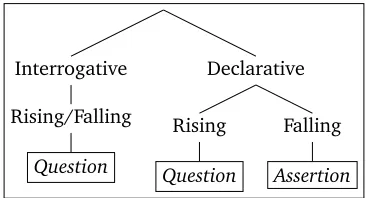
Syntactic clause type marking should thus affect the semantics too. Therefore, there should be a correspondence between interrogative morphosyntax—in the form of verb inversion or the presence of an interrogative complementizer like ‘whether’— and some semantic operation. Under many accounts, this correspondence is ensured by a question operator which only shows up in interrogative clauses and gives rise to the question meaning (Hamblin, 1976; Groenendijk & Stokhof, 1984; Krifka, 2001; Cable, 2007; Rawlins, 2008b). Similarly, it is common to assume that declarative mor-phosyntax corresponds to an assertion operator. Thus combining clause type marking and intonation in this way, we will get the following basic taxonomy of questions and assertions.2
3.1.1
Putting things together
Restricting our attention to mono-clausal cases first, i.e. questions and assertions that consist of only one clause, we can suggest that the force head specifies whether a clause is interrogative or declarative, meaning that it either has an [INT] or [DECL] feature (see Roelofsen, 2015; Roelofsen & Farkas, 2015 for a similar proposal). Clauses with a force head that bears an [INT] feature are always interpreted as questions—no
1In some cases, rising intonation does not give rise to a question meaning, but as Jeong (2018) showed,
these cases seem to be instances of a distinct intonational pattern. I will therefore ignore these cases here, and only focus on the specific type of rising intonational pattern that does unambiguously turn an utterance into a question.
2Note that I take the basic interpretation of rising declaratives to be questions, but this does not mean that