UNIVERSITI TEKNIKAL MALAYSIA MELAKA
INCORPERATING LEVY FLIGHT METHOD ON THE BEES
ALGORITHM WITH PSEUDO-GRADIENT TOWARDS
NUMERICAL BENCHMARK TEST FUNCTIONS
This report submitted in accordance with requirement of the Universiti Teknikal
Malaysia Melaka (UTeM) for the Bachelor Degree of Manufacturing Engineering
(Robotics & Automations) (Hons.)
by
MUHAMMAD `IZZAT BIN ZAKARIA
B051310033
920713145579
FACULTY OF MANUFACTURING ENGINEERING
UNIVERSITI TEKNIKAL MALAYSIA MELAKA
BORANG PENGESAHAN STATUS LAPORAN PROJEK SARJANA MUDA
TAJUK: INCORPERATING LEVY FLIGHT METHOD ON THE BEES ALGORITHM WITH PSEUDO-GRADIENT TOWARDS NUMERICAL BENCHMARK
TEST FUNCTIONS
SESI PENGAJIAN: 2015/16 SEMESTER 2
Saya MUHAMMAD `IZZAT BIN ZAKARIA
mengaku membenarkan Laporan PSM ini disimpan di Perpustakaan Universiti Teknikal Malaysia Melaka (UTeM) dengan syarat-syarat kegunaan seperti berikut:
1. Laporan PSM adalah hak milik Universiti Teknikal Malaysia Melaka dan penulis. 2. Perpustakaan Universiti Teknikal Malaysia Melaka dibenarkan membuat salinan
untuk tujuan pengajian sahaja dengan izin penulis.
3. Perpustakaan dibenarkan membuat salinan laporan PSM ini sebagai bahan pertukaran antara institusi pengajian tinggi.
4. **Sila tandakan ( )
SULIT
TERHAD
TIDAK TERHAD
(Mengandungi maklumat yang berdarjah keselamatan atau kepentingan Malaysia sebagaimana yang termaktub dalam AKTA RAHSIA RASMI 1972)
(Mengandungi maklumat TERHAD yang telah ditentukan oleh organisasi/badan di mana penyelidikan dijalankan)
Alamat Tetap:
No. 240, Jalan Sri Pulai 15,
Taman Sri Pulai,
70400 Seremban, Negeri Sembilan
Tarikh: 24 Jun 2016
Disahkan oleh:
Cop Rasmi:
Tarikh: _______________________
DECLARATION
I hereby, declared this report entitled “INCORPERATING LEVY FLIGHT
METHOD ON THE BEES ALGORITHM WITH PSEUDO-GRADIENT
TOWARDS NUMERICAL BENCHMARK TEST FUNCTIONS” is the results of
my own research except as cited in references.
Signature :
Author’s Name : Muhammad `Izzat Bin Zakaria
APPROVAL
This report is submitted to the Faculty of Manufacturing Engineering of UTeM
as a partial fulfillment of the requirements for the degree of Bachelor of
Manufacturing Engineering (Robotics & Automation) (Hons.). The member of
the supervisory is as follow:
………
i
ABSTRAK
“Bees Algorithm” (BA) adalah kecerdikan berasaskan populasi berkelompok baru yang diilhamkan oleh tingkah laku lebah dalam mencari makanan di alam semula jadi. BA telah diiktiraf oleh ramai penyelidik sebagai alat pengoptimuman yang kukuh dan cekap dalam kombinasi dan berfungsi dalam bidang pengoptimuman. Walau bagaimanapun, kadar penumpuan bagi BA untuk penyelesaian optimum masih memerlukan pembangunan dan memerlukan satu mekanisme untuk mengelakkan daripada terperangkap dalam optima tempatan. Oleh itu, kajian ini menumpukan kepada peningkatan prestasi BA dalam aspek kadar kelajuan penumpuan untuk menyelesaikan fungsi penanda aras berangka. Penambahan itu dicapai dengan menggabungkan pengagihan penerbangan Levy dalam carian kejiranan di BA dengan kaedah pseudo-kecerunan. Kaedah pseudo-kecerunan dilaksanakan sebagai strategi bimbingan untuk lebah pengakap. Sementara itu, penerbangan Levy itu dicadangkan untuk mempercepat proses pencarian algoritma. Algoritma yang lebih baik adalah tertakluk kepada beberapa fungsi penanda aras berangka dimensi yang tinggi. Hasil daripada eksperimen mengesahkan bahawa algoritma yang dicadangkan itu telah berjaya mengatasi prestasi optimisers lain dan versi standard BA dengan purata peningkatan peratusan kepada 71.42% dalam aspek kadar kelajuan penumpuan kepada penyelesaian yang optimum.
ii
ABSTRACT
iii
DEDICATION
To my beloved father, Zakaria Bin Hamid, my mother, Norhayati Binti Mat Isa, my
siblings and friends. Your prayer and hope encourage me to conduct this research.
To my supervisor, Silah Hayati Binti Kamsani and all staff in UTeM.
Thank you for all your supports, guidance, helps and co-operation, directly and
iv
ACKNOWLEDGEMENT
Alhamdulillah I am very grateful to the Almighty for his grace and blessing, I have
been able to complete my Projek Sarjana Muda I and II (PSM I and PSM II). First of
all, I would like to express my deepest gratitude to my supervisor, Silah Hayati Binti
Kamsani who had given me guidance and support from the beginning until the
completion of this thesis.
Then, immeasurable appreciation and gratitude for all my lecturers and friends who
involved in helping me formally and informally during the completion of this thesis.
Furthermore, a very special thanks to my beloved family: my parents and to my
brothers and sister for supporting me spiritually throughout the writing of this thesis
and my life in general.
Lastly, to all people without whom the thesis might not have been written, thank you
very much for your support and cooperation during entire project period. I am
v
TABLE OF CONTENT
Abstrak i
Abstract ii
Dedication iii
Acknowledgement iv
Table of Content v
List of Tables vii
List of Figures viii
List Abbreviations, Symbols and Nomenclatures x
CHAPTER 1: INTRODUCTION 1
1.1 Project Background 1
1.2 Problem Statement 2
1.3 Objectives 3
1.4 Scope of the Project 4
1.5 Report Structure 4
CHAPTER 2: LITERATURE REVIEW 5
2.1 Optimisation 5
2.1.1 Problem in Optimisation 7
2.1.2 Optimisation Techniques using Artificial Intelligence 9
2.2 Swarm Intelligence 12
2.2.1 Ant Colony Optimisation 13
2.2.2 Particle Swarm Optimisation 14
2.3 Foraging Bee-based Algorithms 15
2.3.1 Bees in Nature 15
2.3.2 Artificial Bee Colony 18
2.3.3 The Bees Algorithm 19
2.4 Levy Flight 26
vi
CHAPTER 3: METHODOLOGY 29
3.1 Research Processes 29
3.2 Software 32
3.3 Proposed Algorithm 33
3.4 Experiment Set-up 38
3.5 Summary 47
CHAPTER 4: RESULTS AND DISCUSSIONS 48
4.1 Comparing Success Rate of Proposed Algorithm with Other Optimisers 48
4.2 Comparing Convergence Rate of Proposed Algorithm with Other Optimisers 50
4.3 Comparing Stability of Proposed Algorithm with Other Optimisers 61
4.4 Percentage Improvement of Proposed Algorithm with Standard BA 66
4.5 Statistical T-test Analysis 68
4.6 Summary 70
CHAPTER 6: CONCLUSIONS AND FUTURE WORKS 71
5.1 Conclusions 71
5.2 Future Works 72
5.3 Sustainable Elements 72
vii
LIST OF TABLES
2.1 Parameters of Standard Bees Algorithm 20
2.2 Applications of BA in engineering 25
3.1 Sample of comparison table 31
3.2 Common parameters setting 38
3.3 Parameter Setting for ABC and SPSO2011 39
3.4 Benchmark function 41
4.1 Success rate over 30 run time 49
4.2 Percentage improvement of LevyPGBA compared with Standard
Bees Algorithm
67
4.3 T-test performance comparison between LevyPGBA with
SPSO2011, ABC and Standard BA
69
viii
LIST OF FIGURES
2.1 The Optimisation Process 6
2.2 Overview of Stochastic Search of Optimisation Technique 10
2.3 Honey Bees Foraging Process 17
2.4 Flowchart of The Basic Bees Algorithm 21
2.5 Graphical Illustration of The Basic Bees Algorithm 22
2.6 Flowchart of improved Bees Algorithm 24
2.7 Comparison Between Random Walk and Levy Flight Motion 27
3.1 Research Flow Chart 30
3.2 Flow Chart of Bees Algorithm with Levy Flight Pattern 36
3.3 Sphere Function in 2D 42
3.4 Schwefel 2.22 Function in 2D 43
3.5 Schwefel 2.21 Function in 2D 43
3.6 Step Function in 2D 44
3.7 Rastrigin Function in 2D 44
3.8 NCRastrigin Function in 2D 45
3.9 Rosenbrock Function in 2D 45
3.10 Griewank Function in 2D 46
3.11 Ackley Function in 2D 46
3.12 Weiersrass Function in 2D 47
4.1 Convergence curve between LevyPGBA, SPSO2011, ABC and
standard BA for f1
51
4.2 Convergence curve between LevyPGBA, SPSO2011, ABC and
standard BA for f2
52
4.3 Convergence curve between LevyPGBA, SPSO2011, ABC and
standard BA for f3
53
4.4 Convergence curve between LevyPGBA, SPSO2011, ABC and
standard BA for f4
ix 4.5 Convergence curve between LevyPGBA, SPSO2011, ABC and
standard BA for f5
55
4.6 Convergence curve between LevyPGBA, SPSO2011, ABC and
standard BA for f6
56
4.7 Convergence curve between LevyPGBA, SPSO2011, ABC and
standard BA for f7
57
4.8 Convergence curve between LevyPGBA, SPSO2011, ABC and
standard BA for f8
58
4.9 Convergence curve between LevyPGBA, SPSO2011, ABC and
standard BA for f9
59
4.10 Convergence curve between LevyPGBA, SPSO2011, ABC and
standard BA for f10
60
4.11 Stability performance between LevyPGBA, SPSO2011, ABC and
standard BA for f1
61
4.12 Stability performance between LevyPGBA, SPSO2011, ABC and
standard BA for f2
62
4.13 Stability performance between LevyPGBA, SPSO2011, ABC and
standard BA for f3
62
4.14 Stability performance between LevyPGBA, SPSO2011, ABC and
standard BA for f4
63
4.15 Stability performance between LevyPGBA, SPSO2011, ABC and
standard BA for f5
63
4.16 Stability performance between LevyPGBA, SPSO2011, ABC and
standard BA for f6
64
4.17 Stability performance between LevyPGBA, SPSO2011, ABC and
standard BA for f7
64
4.18 Stability performance between LevyPGBA, SPSO2011, ABC and
standard BA for f8
65
4.19 Stability performance between LevyPGBA, SPSO2011, ABC and
standard BA for f9
65
4.20 Stability performance between LevyPGBA, SPSO2011, ABC and
standard BA for f10
x
LIST OF ABBREVIATIONS, SYMBOLS AND
NOMENCLATURE
AI - Artificial Intelligence
ABC - Artificial Bee Colony
ACO - Ant Colony Optimisation
ANOVA - Analysis of Variance
BA - Bees Algorithm
CPU - Central Processing Unit
DE - Differential Evolution
EAs - Evolutionary Algorithms
GA - Genetic Algorithm
LevyPGBA - Levy with Pseudo-gradient
MATLAB - Matrix Laboratory
NS - Newton Search
PCB - Printed Circuit Board
PG - Pseudo-gradient
PSO - Particle Swarm Optimisation
SA - Simulated Annealing
SD - Steepest Descend
SPSO2006 - Standard Particle Swarm Optimisation 2006
SPSO2007 - Standard Particle Swarm Optimisation 2007
1
CHAPTER 1
INTRODUCTION
This chapter discusses the project background, problem statement, objective of the
project and scope of the project.
1.1 Project Background
Optimisation is a process of finding an alternative with the best possible solution or
highest achievable performance to solve a problem. Nowadays, there are many real
world engineering problems need the manipulation of a number of system variables in
order to optimize a given quality parameter such as the reliability or accuracy of a
process and the value or performance of a product produced (Pham and Castellani, 2009).
Therefore, Artificial Intelligence (AI) is applied in order to ease the engineers in solving
engineering problems. In simple terms, AI is a program which develops by engineers to
enable the computers to do things which are normally done by human. This AI program
adds the machine with the capability to imitate intelligent human behaviour for solving
problem.
Recently, nature-inspired metaheuristic have become increasingly popular among
researchers as a computational problem-solving methods in the AI area. Swarm-based
optimisation is one of population-based approaches typically inspired by natural
phenomenon such as insect behaviour that mimics insect’s problem solving abilities.
2 Colony (ABC) and the Bees Algorithm (BA) are the examples of these types of method.
The advantage of this feature is the ability to prevent getting trap from local optimum,
unlike the traditional approaches for example single-point scheme where the single
solution is generated at each time-step (Binitha and Sathya, 2012).
Developed in 2005, BA is a rather current member of the swarm-based optimisation
metaheuristics that mimics the food foraging behaviour of honeybees (Pham et al. 2007a; Ozbakir et al. 2010). The algorithm performs a kind of exploitative neighbourhood search combined with random explorative search. Compared to other swarm algorithms,
BA is proved to be highly competitive in terms of learning accuracy and speed (Pham
and Castellani, 2009).
In order to boost the algorithm performance especially in term of its search direction,
several researchers have combined BA with the local gradient-based techniques. Among
them are the works of Anantasate et al. (2010) that combined BA with Newton Search (NS) in electrical application, while Alfi and Khosravi (2012) hybridised BA with
Steepest Descend (SD) to solve non-linear numerical optimisation problems.
1.2 Problem Statement
Nevertheless, the gradient-based scheme requires the differentiation of the problem’s
objective function. Without prior knowledge, derivative information in many real world
optimisation problems are difficult to obtain.
In addition, BA uses a uniform random distribution in its initialisation phase where the
randomness helps the system to sample new solutions especially in complex problems.
Unfortunately, this has cause BA to have a slow convergence rate to the optimum
solution just like other stochastic algorithms (Alfi and Khosravi, 2012; Hussein et al.
3 To overcome this problem, a pseudo-gradient Bees Algorithm shall be used in this
project in place of the standard version of the Bees Algorithm to avoid the necessity of
having a differentiable objective function. Additionally, instead of using a uniform
random distribution for the local scout bees’ initialisation, this project proposes the use
of the Levy Flight method. Levy Flight is a heavy-tailed probability distribution that has
been attested by Reynolds et al. (2009) as the natural movement made by honeybees during food foraging process. It has been used by other researchers in swarm-based
optimiser for example Gang et al. (2011) for PSO algorithm as well as Sharma et al.
(2012) in ABC algorithm. Hence, the analysis and comparison of the outcomes of the
proposed algorithm shall be done against the other swarm based algorithm such as ABC
and PSO.
1.3 Objectives
The objectives of this research are:
i. To demonstrate the use of Levy Flight distribution in BA with pseudo-gradient in
improving its convergence speed.
ii. To compare the proposed algorithm with the standard BA and other swarm-based
algorithms.
4
1.4 Scope of the Project
This research focuses on the performance of the Bees Algorithm by using Levy Flight
approach. The proposed algorithm shall be applied to ten numerical benchmark test
functions to determine its convergence speed for each function. Apart from that, this
research also studies the previous works including the developments of Levy Flight in
other algorithms. The proposed algorithm shall be implemented by using a 64-bit
computer system consist of an Intel Core i5 processor 2.40GHz with a MATLAB
software installed on it. Then, the outcomes of the proposed algorithm is analysed and
compared with other well-known population based optimiser.
1.5 Report Structure
The remainder of the report is organised as follows:
Chapter 1 is the introduction of the research. This chapter consists of background,
problem statement, objectives of the report, scope and chapter review of the report.
Chapter 2 is the literature review. This chapter presents the literatures that relevant to
particular topic of this research, demonstrating the information of any previous work and
awareness of related theories and discussions.
Chapter 3 is the methodology of the report. This chapter discusses the review of the
methodology carried out in order to produce the desired result or outcome of the project.
Chapter 4 is the conclusion and future work . This chapter consists of expected results,
5
CHAPTER 2
LITERATURE REVIEW
This chapter provides a review of the findings and methodology from the previous
related studies in the fields of swarm based optimisation techniques.
2.1 Optimisation
Optimisation techniques are utilized in assorted fields such as engineering,
manufacturing, finance, medicine, computing art and music, chemistry, physics and
economics (Sholedolu, 2009). Optimisation is a process of finding an alternative with
the best possible solution or highest achievable performance to solve a problem.
According to Pham and Castellani (2009), there are numerous real world engineering
problems that need the manipulation of a number of system variables in order to
optimize a given quality parameter such as the accuracy or reliability of a process and
the value or performance of a product produced. This is the reasons why optimisation is
frequently needed in applications. In an optimisation process, usually one’s begins with a
real life problem, full of details and complexities which there are some relevant and
6
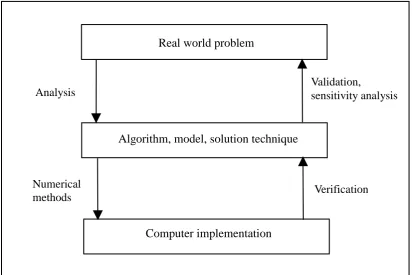
Figure 2.1: The optimisation process
According to Chinneck (2000), there is an unavoidable loss of realism as it moves down
to the schematic diagram shown in Figure 2.1 from real world problem stage to
algorithm, model or solution technique stage and finally to computer implementation
stage. The arrows indicate the normal process of the optimisation cycles. Verification
takes place after computer implementation. Verification refers to the process of
confirming the simulation model which is correctly translated into a computer program
(Okonkwo, 2009). The process of testing and improving a model to increase its validity
is commonly referred to as validation. Hence, validation is done to ensure that the model
is a true representation to what is obtainable in real system. Essentially, sensitivity
analysis is used to determine how sensitive the model parameters can be verified.
Numerical methods
Analysis
Verification Validation,
sensitivity analysis
Real world problem
Algorithm, model, solution technique
7
2.1.1 Problem in Optimisation
As stated earlier, the systems optimisation is very important to the efficiency and
economics of numerous science and engineering field nowadays. Therefore, as indicated
by Chai-ead et al. (2011) the optimisation problems are solved by using approximate or rigorous mathematical search techniques. The rigorous techniques have utilised linear
programming, integer programming, dynamic programming or branch-and-bound
procedures to approach the optimal solution for moderate-size problems.
One of the most well-known issues that may be experienced by optimisation algorithm is
premature convergence because of the search space boundary constraint (Rajarathinam,
2015). According to Ursem (2003), the process of an optimisation has prematurely
converged to a local optimum if it is no longer able to explore the other parts of search
space area than the currently being explore region which may contains a superior
solution. Premature convergence can happen when the optimisation algorithm cruises by
several local optima in the search space before a good solution is achieved. As a result, it
may likely get stuck on such an intermediate solution and unable to proceed in other
search area in the solution space (Sholedolu, 2009).
Furthermore, the other related problem in optimisation algorithm is ruggedness of the
objective function. Most of the optimisation algorithms rely on some type of gradient in
the fitness or objective space. According to Sholedulu (2009), a continuous objective
function exhibits low total variation to enable the optimiser to easily descent the gradient
in the fitness space. Conversely, when the objective function is fluctuates up and down,
it will make the optimiser more difficult to find the right direction to proceed. In other
words, the more rugged a function is, the harder it is to be optimised. However, this does
not mean that it is impossible to find a good solution, but it may take a longer time to do
8 Additionally, deceptiveness is one of the upsetting features of the fitness space. As
indicated by Sholedulu (2009), the deceptive of objective function gradient lead
optimiser far from the global optima. At the point when an optimisation algorithm has
found the region with better average fitness, legitimately it concentrate on exploring this
area with sureness to converge on true optimum. Intuitively, the deceptiveness happens
at whenever a good path leads to bad point or the other way around (Kauffman, 1993).
Then, according Liepins and Vose (1991), different objective functions are said to be
deceptive.
Next, the issue in optimisation is robustness of the algorithm. In global optimisation, the
researchers always find the global optima for the objective functions from the theoretical
perspective but not from the practical view. The reason for this is that the solutions of
practical issues often depend on parameters which can be identified if certain degree of
imprecision is determined as there is no process in the world that 100% accurate
(Sholedulu, 2009). The local optima of the search space with strong causality are once in
a while superior than global optima with weak causality while the level of acceptability
is rely on applications.
Lastly, noise disturbance is also one of optimisation problems. There are two types of
noise in optimisation (Sholedulu, 2009), there are:
i. In the training data, there is a noise that is used as the basis for learning which cause
over-fitting. The noise always exists when trying to fit a model to the data being
measured as there is no measurement 100% accurate.
ii. The second type of noise subsumes the annoyances that are expected to happen in
9
2.1.2 Optimisation Techniques using Artificial Intelligence
According to Venter (2010), the optimisation techniques are classified as either local
(neighbourhood) or global algorithms. Most of the local optimisation algorithms are
gradient based. The gradient based techniques are broadly used for solving the
optimisation problems in engineering field as it were efficient in terms of the number of
function evaluations required to find the optimum. However, these techniques also have
several limitations such as they can only locate a local optimum and have difficulty in
solving discrete optimisation problems. On the other hand, the global optimisation
algorithms typically non-gradient based give a better possibility of finding the global or
near global optimum compared to the local algorithms.
In the past few decades, the field of optimisation has grown rapidly. In order to solve
various problems in engineering and management, there are many algorithmic and
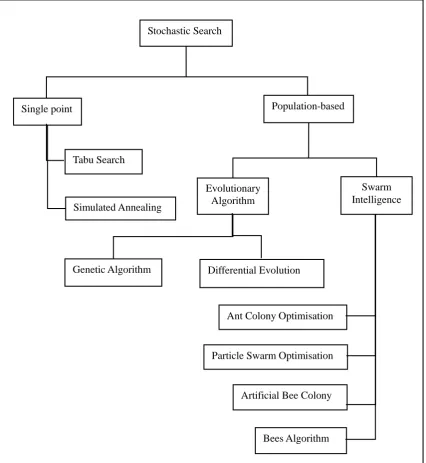
computational contributions of optimisation have been introduced. According to Lin et al. (2012); Binitha and Sathya (2012), optimisation technique can be divided into either deterministic or stochastic. Deterministic methods also known as direct search
algorithms are the traditional methods that take advantage of the analytical properties of
the problem to generate a sequence of points that converge to a global solution.
Deterministic methods such as linear programming, non-linear programming and
mixed-integer non-linear programming can give general tools for solving optimisation
10
Figure 2.2: Overview of stochastic search of optimisation technique
Bees Algorithm Artificial Bee Colony Particle Swarm Optimisation
Ant Colony Optimisation Differential Evolution Genetic Algorithm
Simulated Annealing Tabu Search
Evolutionary Algorithm
Swarm Intelligence
Single point Population-based