City, University of London Institutional Repository
Citation
:
Fabian, M., Jia, Y., Shi, S., McCague, C., Bai, Y., Sun, T. & Grattan, K. T. V.
(2016). Optimization of the accelerated curing process of concrete using a fibre Bragg
grating-based control system and microwave technology. Proceedings of SPIE, 9916,
99160P. doi: 10.1117/12.2236856
This is the accepted version of the paper.
This version of the publication may differ from the final published
version.
Permanent repository link:
http://openaccess.city.ac.uk/15478/
Link to published version
:
http://dx.doi.org/10.1117/12.2236856
Copyright and reuse:
City Research Online aims to make research
outputs of City, University of London available to a wider audience.
Copyright and Moral Rights remain with the author(s) and/or copyright
holders. URLs from City Research Online may be freely distributed and
linked to.
City Research Online:
http://openaccess.city.ac.uk/
[email protected]
Optimization of the accelerated curing process of concrete using a
fibre Bragg grating-based control system and microwave technology
Matthias Fabian*
a, Yaodong Jia
b, Shi Shi
b, Colum McCague
c,
Yun Bai
b, Tong Sun
a, Kenneth T. V. Grattan
aa
Research Centre for Photonics and Instrumentation, City University London,
Northampton Square, London EC1V 0HB, UK
b
Advanced and Innovative Materials (AIM) Group, University College London,
Gower Street, London WC1E 6BT, UK
c
Mineral Products Association, London SW1V 1HU, UK
ABSTRACT
In this paper, an investigation into the suitability of using fibre Bragg gratings (FBGs) for monitoring the accelerated curing process of concrete in a microwave heating environment is presented. In this approach, the temperature data provided by the FBGs are used to regulate automatically the microwave power so that a pre-defined temperature profile is maintained to optimize the curing process, achieving early strength values comparable to those of conventional heat-curing techniques but with significantly reduced energy consumption. The immunity of the FBGs to interference from the microwave radiation used ensures stable readings in the targeted environment, unlike conventional electronic sensor probes.
Keywords: Fibre Bragg grating, concrete, microwave curing, temperature monitoring
1.
INTRODUCTION
Microwave heating is a highly efficient technique used in various thermal processes, as microwave energy penetrates the specimens, thus heating them uniformly, as compared to conventional thermal curing (or steam curing) in an electric oven where temperature gradients often occur because the samples are heated from the outside inward. Due to its beneficial dielectric properties, accelerated and highly energy-efficient curing of concrete using microwaves is becoming increasingly attractive to facilitate the development of high early strength1. However, continuous monitoring of the internal sample temperature is required in order to prevent it from overheating which would result in diminished long term strength of the concrete and a poor quality product.
In an early study undertaken, curing was carried out using a domestic-type microwave whereby the fixed power was pulsed in order to achieve a desired average power output, i.e., temperature control to some extend2. Further studies in the 1990s explored the concept of ‘temperature feedback control’ in order to improve the curing efficiency3-5. For the internal temperature measurement, a thermocouple with appropriate shielding was used in order to avoid ‘sparking’ caused by the electromagnetic interference on the metallic surface. With this arrangement, however, additional bulk is added which may become intrusive, particularly if multiplexing is required. In another approach temperature control was partially achieved using a thermal imaging camera directed at a concrete sample6. However, the shortcoming of this method is that only the surface temperature of the sample can be monitored and thus an improved method is needed.
Unlike conventional electrical temperature sensors, fibre Bragg gratings (FBGs) are electrically passive and immune to microwave radiation. Added to this is their small size and multiplexing capability, giving confidence that FBG-based probes could be expected to offer improved stability and versatility in the design of temperature probes for use in microwave environments.
closed loop temperature feedback control algorithm. The results obtained showed that compressive strengths similar to those achieved by conventional thermal curing methods were achieved at less than 5% of energy being used.
2.
PRINCIPLE OF MEASUREMENT AND EXPERIMENTAL SETUP
An FBG formed within a fibre behaves like a ‘notch filter’ (in transmission), which reflects light around at a wavelength termed the Bragg wavelength that satisfies the so-called Bragg condition7. The effects of temperature and strain on a grating’s Bragg wavelength have been widely reported7 and thus are not discussed further here. However, a system has been developed to optimize the concrete properties, comprising the sensor probes, the data acquisition and the closed loop control. Each is considered below as an element of the system.
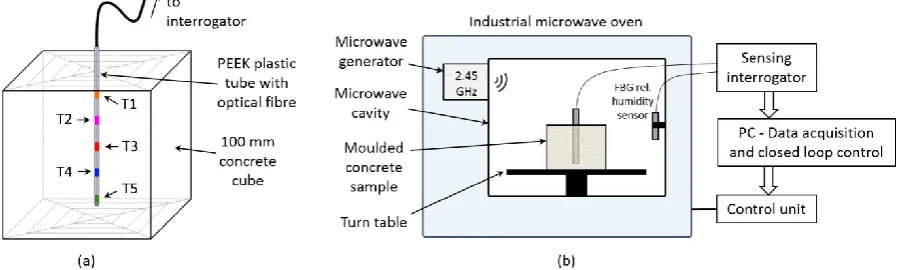
Figure 1. (a) Schematic of a 5-point multiplexed FBG sensor probe inserted into a 100 mm concrete sample cube as used in this investigation. (b) Schematic of the microwave oven developed for this work.
2.1 Sensor fabrication and integration
The FBGs used in the manufacture of the probes employed were manufactured using the phase mask technique. Photosensitive fibre (Fibercore SM1500) was illuminated using an ATLEX 300-SI laser at 248 nm. The gratings were annealed at 180 °C for approximately four hours for stability and subsequently calibrated against temperature. The fibres were then encased in a polyether ether ketone (PEEK) enclosure to provide a rugged environment for use and which were vertically inserted into moulds containing freshly mixed concrete samples. To enable the rapid and accurate transfer of the heat to the probe and thus the determination of the temperature, perforations were incorporated into the tubes at each grating position. PEEK was chosen as packaging material because of its transparency to microwave radiation and its rigidness, providing adequate protection for optical fibres in the probe and strain independent working condition. Finally, the sensor probes were wrapped in PTFE tape to prevent the freshly mixed concrete from entering the tubes. A schematic of a 5-point temperature probe in a 100 mm concrete cube is shown in Fig. 1(a).
2.2 The microwave oven
The microwave oven used in this investigation was purpose-built for use for concrete curing by Industrial Microwave Systems (IMS), UK, with the facility to be able remotely to control its power output via PC interface. The unit’s magnetron generates microwaves at a frequency of 2.45 GHz at a maximum power of 1 kW. For ease of instrumentation the microwave cavity has inlets for the optical fibres as well as for the humidity generator feed. A schematic of the microwave oven is shown in Fig. 1(b).
2.3 Data acquisition and closed loop control
[image:3.595.73.526.215.350.2]addition, a low-energy ultrasonic fog generator (Trixie Fogger XL) was used to maintain a humidity level of 100% within the microwave cavity during the curing process in order to avoid shrinkage cracks in the concrete causing durability problems in the long term.
3.
RESULTS AND DISCUSSION
For the concrete, a typical formulation was recommended by industry (Macrete, Ireland) which included pulverized fuel ash (PFA) as a cement replacement material of which 55% w.t. has been included within the cement content of the mix. A 100 mm cube mould, also made of PEEK, was used to cast the fresh concrete. The concrete samples were allowed to set at room temperature for approximately four hours to gain initial strength before being heat-cured in an electric oven as well as in the microwave oven for another two hours. Within those two hours the temperature was gradually increased from room temperature to 70 °C, according to the American Concrete Institute’s recommendation of no more than 25
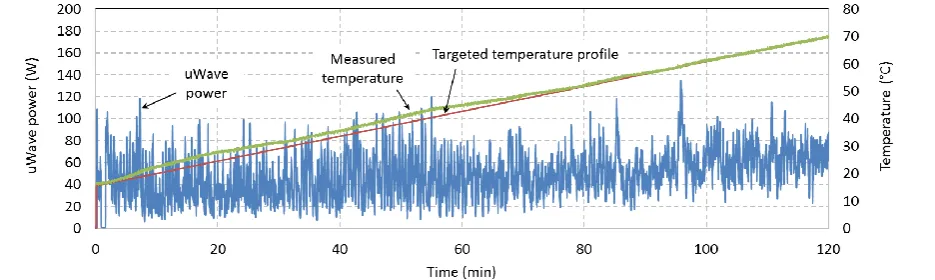
[image:4.595.66.534.290.430.2]°C/h9. In the case of the electric oven, the temperature was increased manually whereas for the microwave oven the FBG sensor based feedback control system described in section 2.3 was used. A third concrete sample from the same batch was cast and cured at room temperature for 24 hours for comparison. Figure 2 illustrates the success of the feedback control system whereby the precise regulation of temperature based on a pre-defined profile was achieved through continuous self-adjustment of the microwave power.
Figure 2. Feedback control data for a concrete cube cured for two hours in laboratory microwave. The microwave output power was self-regulated based on the FBG sensor data and a pre-defined temperature profile.
In Fig. 2, the actual internal sample temperature (measured using the embedded FBG sensors) matches well with the pre-defined heating rate (targeted temperature profile) showing only a very small deviation. The average microwave power needed to achieve this heating profile was only 51 W. The idea is that the recorded power profile of a particular concrete sample of a certain dimension and composition can scaled up for an industrial sensor-less batch-curing process.
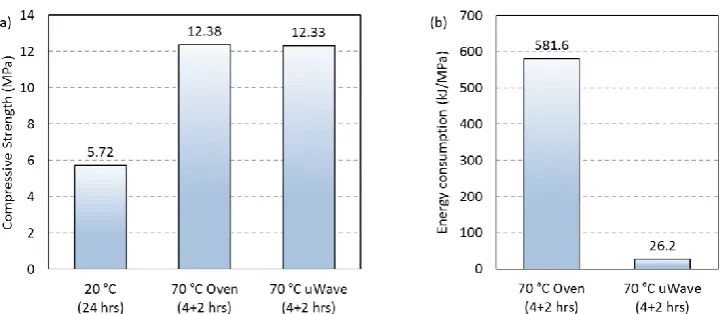
At the end of the two-hour accelerated curing period, the concrete cubes from both conventional heating and microwave heating were tested for strength using a compression machine (MCC 50-C4600/FR). It was found that the compressive strengths achieved by both methods are virtually identical (see values in Fig. 3(a)). At the same time these figures highlight the benefit of accelerated curing resulting in more than twice the strength in a quarter of the time when compared with normal curing conditions at 20 °C. Calculations also revealed that the microwave curing method used less than 5% of the energy required by the conventional oven at 70 °C (see values in Fig. 3(b)).
Figure 3. (a) Compressive strength results of concrete cured under conventional and accelerated heating conditions. (b) Cross-comparison of the energy consumption of both accelerated curing techniques employed.
4.
CONCULSIONS
In this preliminary study it was demonstrated that the process of accelerated heat-curing of concrete can be greatly improved using a combination of both microwave technology and an FBG-based temperature monitoring regime, creating a self-regulating and energy efficient curing environment. Future studies will focus on optimized temperature and humidity profiles targeting shorter curing times and therefore reducing significantly the carbon footprint and energy consumption of pre-cast concrete manufacturing.
5.
ACKNOWLEDGEMENTS
The authors wish to thank the UK’s Technology Strategy Board (TSB), now Innovate UK, for funding this project. Special thanks are given to Industrial Microwave Systems (IMS), UK, for the design and manufacture of the microwave used in this work; and to Macrete, Ireland, for useful discussions on the formulation of the precast concrete.
REFERENCES
[1] Makul, N., Rattanadecho, P. and Agrawal, D. K., “Applications of microwave energy in cement and concrete – A review,” Renewable and Sustainable Energy Reviews 37, 715-733 (2014).
[2] Wu, X., Dong, J. and Tang, M., “Microwave curing technique in concrete manufacture,” Cement and Concrete Research 17(2), 205-210 (1987).
[3] Leung, C. K. Y. and Pheeraphan, T., “Determination of optimal process for microwave curing of concrete,” Cement and Concrete Research 27(3), 463-472 (1997).
[4] Leung, C. K. Y. and Pheeraphan, T., “Very high early strength of microwave cured concrete,” Cement and Concrete Research 25(1), 136-146 (1995).
[5] Leung, C. K. Y. and Pheeraphan, T., “Microwave curing of Portland cement concrete: experimental results and feasibility for practical applications,” Construction and Building Materials 9(2), 67-73 (1995).
[6] Rattanadecho, P., Suwannapum, N., Chatveera, B., Atong, D. and Makula, N., “Development of compressive strength of cement paste under accelerated curing by using a continuous microwave thermal processor,” Materials Science and Engineering: A 472 (1-2), 299-307 (2008).
[7] Rao, Y.-J., “In-fibre Bragg grating sensors,” Meas. Sci. Technol. 8(4), 355-375 (1997).
[8] Collepardi, M., “A state-of-the-art review on delayed ettringite attack on concrete,” Cement and Concrete Composites 45(4-5), 401-407 (2003).
[image:5.595.119.482.72.229.2]