City, University of London Institutional Repository
Citation
:
Jarzabkowski, P. & Lê, J. (2016). We have to do this and that? You must be joking: Constructing and responding to paradox through humour. Organization Studies, doi: 10.1177/0170840616640846This is the accepted version of the paper.
This version of the publication may differ from the final published
version.
Permanent repository link:
http://openaccess.city.ac.uk/12593/Link to published version
:
http://dx.doi.org/10.1177/0170840616640846Copyright and reuse:
City Research Online aims to make research
outputs of City, University of London available to a wider audience.
Copyright and Moral Rights remain with the author(s) and/or copyright
holders. URLs from City Research Online may be freely distributed and
linked to.
We have to do this and that? You must be joking: Constructing and responding to paradox through humour
Paula Jarzabkowski1 ([email protected]) Jane Kirsten Lê2 ([email protected])
1Cass Business School, City University London 2Work & Organisational Studies, The University of Sydney
We have to do this and that? You must be joking: Constructing and responding to paradox through humor
This paper adopts a practice approach to paradox, examining the role of micro-practices in shaping constructions of and responses to paradox. Our approach is inductively motivated. During an ethnographic study of an organization implementing paradoxical goals we noticed a strong incidence of humor, joking and laughter. Examining this practice closely, we realized that humor was used to surface, bring attention to, and make communicable experience of paradox in the moment by drawing out some specific contradiction in their work. Humor thus allowed actors to socially construct paradox, as well as – in interaction with others – construct potential responses to the multiple small incidences of paradox in their everyday work. In doing so, humor cast the interactional dynamics that were integral in constructing two response paths: (i) ‘entrenching a response’, whereby an existing response was affirmed, thereby continuing on a particular response path, and (ii) ‘shifting a response’, whereby actors moved from one response to paradox to another, thereby altering how the team collectively responded to paradoxical issues. Drawing on these findings, we reconceptualize paradox as a characteristic of everyday life, which is constructed and responded to in the moment.
This paper was inspired by an observation we made a few months into our ethnographic study of a telecommunications firm beset with paradox: People make a lot of jokes about paradoxical conditions. We increasingly found ourselves sharing things participants had been laughing about, as we ‘checked in’ with each other after fieldwork. For example, one particular day managers were working with the paradoxical tensions occasioned by trying to implement a joined-up technology across divisions that had to maintain strict structural separation to comply with regulation. Tensions were running high as they discussed a ‘piece robot’ technology that might get around the problem without co-locating their engineers. Suddenly, laughing, one of them suggested that what they really needed was a ‘peace robot’ to help settle the tensions between them in trying to do their jobs in this paradoxical structural context. The others in the meeting quickly joined the joke, laughing and making peace signs in the air, insisting the peace robot should be included in the resulting action plans. Laughing, the team leader agreed and the meeting progressed with a better will to work with the paradoxical conditions to implement the joined-up technology. Sure enough, there was a humorous picture of a robot with a peace symbol on its chest and doves on its shoulders in the action plans, which occasioned further laughter at the next meeting.
considering the role of humor in paradox, particularly for those actors who perform paradoxical roles and tasks as part of their everyday work. The origin of this paper is thus inductive, building from our initial observation (see also Whiteman & Cooper, 2011).
Paradox is a pervasive characteristic of organizational life. Most organizations contain interrelated elements that seem consistent in isolation but incompatible or contradictory in conjunction (Lewis, 2000; Smith & Lewis, 2011), such as differentiation and integration or exploitation and exploration (Andriopoulos & Lewis, 2009; Smith, 2014). For example, managers must devote resources to exploring new opportunities while exploiting existing opportunities, taking care not to cannibalize their current sources of revenue (March, 1991; Smith and Tushman, 2005). While equally important, such goals often involve conflicting strategies and use of resources, and so are difficult to implement simultaneously. However, in organizations navigating complex strategic landscapes, such paradoxes are becoming ever more “prevalent, challenging and consequential” (Smith, 2014: 7; also Lewis, 2000; Smith & Lewis, 2011).
While paradox creates challenges for organizations, whether a paradox has positive or negative effects depends on how it is constructed by actors and their responses to it, rather than its innate properties. Studies have demonstrated that paradoxes may elicit a range of responses within organizations (e.g. Abdallah, Denis & Langley, 2011; Beech, Burns, de Caestecker, MacIntosh & MacLean, 2004; Clegg, Cunha & Cunha, 2002; Jay, 2013; Jarzabkowski, Lê & Van de Ven, 2013; Lewis, 2000; Lüscher & Lewis, 2008; Smith & Lewis, 2011). However, less attention has been paid to how such tensions are actually constructed in the micro interactions through which people perform their contradictory tasks and roles (Lüscher & Lewis, 2008; Smith & Lewis, 2011). Yet these micro interactions within which actors socially construct paradox are likely to be consequential to their responses and, hence, to how the paradox will be played out within the wider organization. That is the focus of this paper. Specifically, we examine humor as a means of socially constructing paradox that shapes the way actors formulate and legitimate their responses to that paradox.
contradiction in their roles and activities (Smith & Lewis, 2011). Paradox is embedded in the everyday actions and interactions of actors (Jarzabkowski et al, 2013), and reflected in their micro-practices, such as the humor that was so prevalent in our case. Indeed, humor, with its documented role in working with contradiction is theoretically relevant for illuminating how people construct and respond to paradox (Hatch & Ehrlich, 1993; also Martin, 2004). We therefore ask: (1) how does humor construct paradox within everyday work; and (2) how do these constructions shape the responses that actors make to paradox?
We explore these questions in a salient case of paradox: The tension between market and regulatory demands experienced by a telecommunications company as it separated its
distribution network and its retail assets. Such regulated but publically traded companies operate in a paradoxical environment, in which regulatory requirements mitigate the market power afforded by their structural advantage of owning the distribution network on which their competitors must rely (Marcus and Geffen, 1998). Using a real-time longitudinal, observational study, we show how managers construct and respond to paradox in their practice. In particular, consistent with our inductive approach, noticing a strong incidence of humor, jokes and laughter around paradoxical tasks, we analyzed the way that managers construct and respond to paradox through their everyday practice of humor. Our findings show that humor is central to the interactional dynamic in which actors (i) construct paradox within any particular task; (ii) formulate their responses to that paradox; and (iii) legitimate that response. Furthermore, we found that humor is an important enrolling mechanism, as actors co-construct the paradox in ways that either further entrench existing responses or generate the context for shifting these responses. Our work thus provides a central contribution to understanding the paradoxes of performing within which actors formulate their responses to paradoxes, and show how these are both shaped by but also shape paradoxical conditions that might have originated at
organizational or environmental levels. THEORETICAL FRAMING
Paradox as a pervasive characteristic of organizational life
ever-present across multiple levels (Jarzabkowski et al, 2013; Lewis, 2000), are generally
categorized into four types: organizing, belonging, performing, and learning. At the macro-level, paradoxes of organizing exist between the numerous subsystems that must act independently within an interdependent overarching organizational system (Clegg et al, 2002; Lawrence & Lorsch, 1967; Smith & Lewis, 2011), occasioning parts/whole tensions between structure and action (Clegg et al, 2002), and between organizational stability and change (Abdallah et al, 2011; Lüscher & Lewis, 2008). At the meso-level, actors experience paradoxes of belonging arising from different divisional and group memberships, loyalties and identities, often working towards different visions of success and failure (Jay, 2013) that are difficult to reconcile (Lewis, 2000). At the micro-level, people experience paradoxes of performing through opposing roles and tasks (Lüscher & Lewis, 2008; Smith & Lewis, 2011), which are driven by complex goals and
differentiated units (Denis et al, 2007; Jarzabkowski & Fenton, 2006; Smith & Lewis, 2011) but manifest in contradictory interpretations and actions as actors perform their work (Jarzabkowski et al, 2013; Lüscher & Lewis, 2008). Embedded in and reaching across these paradoxes is the paradox of learning (Jarzabkowski et al, 2013), based in the need to both build on and destroy the past to move forward (Lewis, 2000; Smith & Lewis, 2011). Naturally, there are ramifications across these different levels as actors and organizations attempt to cope with paradox (e.g. Jarzabkowski et al, 2013; Jay, 2013; Lüscher & Lewis, 2008). In this paper, we take a practice approach (Feldman & Orlikowski 2011), focusing primarily on the paradox of performing as it plays out in the interaction between actors in their everyday work.
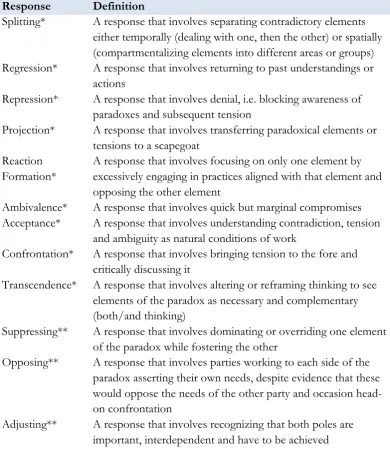
transcendence, and adjusting (cf. Lewis, 2000; also Jarzabkowski et al, 2013; Poole & Van de Ven, 1989). These responses are explained in Table 1.
** Insert Table 1 here**
Irrespective of type of response, responding to paradox is an iterative and dynamic process that actors negotiate as they experience situations as paradoxical, often shifting from one response to another (Jarzabkowski et al, 2013). Indeed, as paradox is a persistent underlying or endemic condition of organizations (Lewis, 2000), it is neither possible nor desirable to ‘resolve’ the paradox; rather, paradox requires ongoing response (Abdallah et al, 2011; Smith & Lewis, 2011). People in organizations enact this ongoing process within their everyday practice (Jarzabkowski et al, 2013).
We therefore argue that the existing focus on responses, while insightful, has two limitations. First, it tends to overlook the social construction within which such responses are formulated and that, hence, must be a precondition of any response. Yet paradox is avowedly social in its construction (Benson, 1977; Lewis, 2000; Smith & Berg, 1987), necessitating greater focus on the particular interactional dynamics within which paradox is constructed and how this shapes responses. Second, while paradox creates challenges within organizations, neither it, nor actors’ responses to it, are inherently good or bad. Studies suggest that the impact depends very much on how paradox is constructed (Hatch, 1997; Jay, 2013). Contradictory elements are always present, lying dormant or becoming salient according to how they are constructed at particular moments within organizational processes (Werner & Baxter, 1994). Indeed, the very purpose of hosting contradictory elements is to take advantage of their co-presence and levy mutual benefits (Lewis, 2000; Smets, Jarzabkowski, Burke and Spee, forthcoming; Thompson, 1967), even where this also occasions tension. Hence, it is important to shift from a primary focus on responses to paradox to understanding how these responses are constructed within everyday practice. Practice lens: Ongoing micro-responses to paradox
2014; Spee & Jarzabkowski, 2011). We therefore focus in this paper on paradoxes of performing, which is where people experience paradox in their everyday roles (Smith &Lewis, 2011).
While the responses to paradox identified in the literature may be large decisive actions – for example, decisions to restructure the organization, develop new organizational units, or pursue a different strategy – a practice perspective suggests that responses may also be
constructed within micro, everyday actions. For instance, the response of splitting (Lewis, 2000), which involves separating paradoxical elements, may comprise compartmentalizing different goals into different divisions. However, splitting may also be accomplished by asking someone to leave a meeting when sensitive information s/he should not be privy to is discussed or by not answering a phone call from someone with whom one should not have contact (Jarzabkowski et al, 2013). Similarly, the transcendence response (Lewis, 2000), which involves altering or
reframing thinking to see paradoxical elements as complementary (Bartunek, 1984), may involve changing incentive and reward systems, or it might simply involve someone juxtaposing the goals in discussion during a meeting (Hatch, 1997; Jarzabkowski and Sillince, 2007). Thus, many of the reported responses may be formulated within quite micro social constructions that have been somewhat obscured by the focus on more overt decisions or organizational-level responses.
Yet, small responses matter. Indeed, a practice perspective suggests that these smaller responses carry critical importance because the organization is ultimately a culmination of what people do (Niccolini, 2009; Schatzki, 2010). For example, strategic goals can only be reframed successfully if actors enact them in their everyday practice (Balogun & Johnson, 2004; 2005; Rouleau, 2005). That is, while the reframing necessary for transcendence of paradox (Bartunek, 1984; Seo et al., 2004) can occur at any level, transcendence itself can only occur when it is enacted in practice. We thus need greater focus on the actions and interactions of people in organizations.
existing literature does not lay bare the dynamics of how people, through the way they socially construct paradoxes, come to accept, confront or transcend them.
However, there is some empirical support for the existence and importance of micro-elements of response to paradox. For instance, Beech et al.’s (2004) study of the UK National Health Service show how playful managerial action enables actors to keep paradox open rather than attempting to close off an essentially irresolvable condition. Such playful actions are consequential in changing responses, as the authors’ note; “it is not necessarily the case that radically different actions are undertaken… rather playful actions can be simulacra of mundane actions in which there is a transformation of meaning that enables a transformation of taken-for-granted boundaries of behavior” (Beech et al, 2004: 1328). Other studies demonstrate how actors’ sensemaking about paradoxical outcomes, such as how they define success and failure,
can enable them to combine organizational means and ends in new ways, resulting in the
emergence of innovative practices (Jay, 2013); and that leadership practices supporting both sides of the paradox through domain specific and integrative roles sustain attention to strategic
paradoxes over time (Smith, 2014).
Constructing and responding to paradox through humor
Building on this work, we suggest that humor, as a key means through which actors construct paradox, is a critical micro-precursor to shaping the responses that are also socially constructed. In other words, humor is instrumental in both constructing paradox and, hence, in responding to paradox. From a practice perspective, such constructions and responses may occur within the moment, all within a single utterance or interaction, as an actor constructs the paradox through humor and, in doing so, generates the context in which different responses may be discussed and legitimated.
So, what do we already know about humor and its association with paradox? Despite
receiving significant research attention, humor remains poorly understood and variously defined (Cooper, 2008; Holmes, 2000). This is at least partially because, being easier to describe than define, “humor does not lend itself easily to definition" (Hatch & Ehrlich, 1993: 505). Yet, definitions are important for consistent empirical identification. We therefore define humor as “utterances…intended by the speaker(s) to be amusing and perceived to be amusing by at least some participants” (Holmes, 2000: 163; see also Cooper, 2008; Hay, 2000; Holmes & Marra, 2002). This definition operationalizes humor by facilitating the identification of “instances of humour…on the basis of paralinguistic, prosodic and discoursal clues” (Holmes, 2000: 163) and is consistent with a practice-based approach to the discursive construction of organizations (for a review, see Balogun, Jacobs, Jarzabkowski, Mantere & Vaara, 2014).
Existing theories propose three main reasons for humor: incongruity, superiority and relief (Monro, 1954). Incongruity theories suggest that humor is a response to ambiguity, irrelevance, impossibility, inappropriateness, or surprise (Hutcheson, 1750; Kierkegaard, 1846; Martin, 1987; McGhee, 1979; Monro, 1954; Morreall, 1987; Schopenhauer, 1818). Superiority theories suggest humor arises from a ‘sudden glory’ felt in recognizing superiority over others (Bergson, 1911; Hobbes, 1651; Pascal, 1660; Gruner, 1997). Relief theories suggest humor relieves nervous energy, describing it as a tension-release mechanism (Freud, 1905; Spencer, 1860). The organizational literature on humor adds a fourth purpose, whereby humor performs a ‘social function’, for instance, establishing group boundaries and identity (Lynch, 2010).
constructing paradox. First, paradox is characterized by contradiction (Lewis, 2000), which may be seen as impossible or inappropriate. Thus, humor can signal the recognition of paradox (see also Hatch, 1997; Martin, 2004). Next, paradox tends to be compartmentalized into different organizational units or actors (Lewis, 2000; Poole & Van de Ven, 1989), each of which may view their elements of paradox as superior and seek to assert this superiority, for instance, humor might act to ‘suppress’ one element of the paradox (Jarzabkowski et al, 2013). Further, as
paradox is often associated with tension (Lewis, 2000; Jarzabkowski et al, 2013), humor might be one way to relieve or make less threatening such tension (Hatch, 1997). Finally, humor may facilitate social processes (Lynch, 2010) within the context of a paradoxical setting by either bonding people in different groups together or enabling them to solidify their separate-ness.
The literature on organizational humor has produced some interesting results that have implications for the way that constructing paradox might shape actors’ responses. As “workers enact humor to negotiate and navigate their emerging organizational lives” (Lynch, 2010: 128), it is central to their everyday practice. Humor does not remove the paradoxical condition, which is by definition irresolvable, but provides a moment of playful or stress-relieving interaction (Collinson, 2002; Hatch and Ehrlich, 1993; Martin, 2004; Yovitch et al, 1990), within which actors have the potential to either reproduce or transform their response to organizational paradoxes (Dixon, 1980; Lynch, 2010). In short, “humor is more than a coping device in order to do your job; it is a means through which the workers actually make sense of and perform their organizing role” (Lynch, 2010: 154), including performing paradoxical roles and tasks.
and reframe situations; “by turning a provocative and offensive statement into a slightly ironic or nonsensical expression, the worker shows, in subtle and unobtrusive fashion, a fresh, balanced perspective” (Martin, 2004: 342). In short, humor assisted the women in blurring boundaries between their roles, transcending paradox, and negotiating new meanings.
Humor as a micro means of socially constructing paradox is central to our understanding of responses to paradox. Yet surprisingly few studies have examined the link between humor and paradox. That is the focus of this paper. Based on the above literature review, we address two theoretically informed research questions: (1) how does humor construct paradox within everyday work; and (2) how do these constructions shape the responses that actors make to paradox?
METHOD
As is common in practice-based interpretive research, we use a single in-depth case study to examine the phenomenon of interest. We first contextualize our study by describing the case setting, then review our data sources, and finally outline the rigorous analytical process we followed to arrive at our findings.
The Case Organization
Our study follows the case of Telco1, a regulated but publically-traded European
telecommunications company implementing a complex new strategy with inherently paradoxical elements. Such major restructuring efforts offer opportunity to observe salient paradoxes (Abdallah et al, 2011; Jay, 2013; Lüscher & Lewis, 2008; Jarzabkowski et al, 2013; Seo & Creed, 2002; Smith & Lewis, 2011). Indeed, the complex nature of the new strategy meant that Telco struggled with paradoxical tensions between regulatory and market goals. On the one hand, the strategy incorporated regulatory elements. Specifically, it responded to a new government requirement of granting all industry players fair access to the Telco distribution network. This was a major strategic and structural change involving three key elements: (1) creating a new independent business division, Distribution, which would house all distribution network assets and personnel and act as an independent supplier to industry; (2) trading all Distribution products on a fair and equal basis by separating all the complex products and services Telco
1 In order to preserve anonymity, we have disguised specific dates, names, products, and other contextual features.
offered through its integrated value chain; (3) changing existing working practices and relationships between Distribution and other Telco divisions to make these fair and equal to those between Distribution and industry, as Distribution could no longer share commercial information nor allow its decision-making to be affected by overarching Telco commercial objectives. In essence, to meet regulatory goals Telco had to virtually disintegrate its value chain by unbundling products and services, relationships, processes, and practices that crossed
divisional thresholds. If it failed to do so the consequences were severe: (1) it would be subject to a government inquiry and fines for unfair trading and (2) it might be required to physically sell its Distribution assets or division.
At the same time, the strategy incorporated market elements that were often
contradictory with or even in direct opposition to these regulatory goals. Telco was a key market player in telecommunications, holding the largest market share for all key telecoms
products/services. Telco had maximized its previously integrated value chain, leveraging its ownership of the distribution network to offer a differentiated service package that made it the market leader for quality service. Telco thus had an interest in ensuring that the restructuring improved or at least did not adversely affect its service offering, which would be difficult whilst relinquishing control of the distribution network. A key part of the strategy was therefore to implement the regulatory requirements for fair and equal trading without negatively affecting the ability of internal divisions to compete on service differentiation in the marketplace. Despite these paradoxical goals of commercial service differentiation and regulation-based fair trading being contained in different divisions, they clashed frequently as actors from different divisions interacted to implement the restructuring.
Data Sources
We collected real-time longitudinal qualitative data over 24 months as Telco implemented the new strategy. Our main data comes from non-participant observation of meetings in which the implementation team came together to oversee the process (N=71): Implementation Board. Implementation Board was a serial meeting that took place
corporate center. We took extensive notes during observations and also produced full verbatim transcriptions of the meetings from audio recordings. Implementation Board meetings were appropriate to study because the purpose of the meeting was to implement the new paradoxical strategy and, consequently, meetings brought together representatives from both sides of the paradox. This forms our core data source for the purposes of this paper; all data extracts and analysis come from these 71 meetings. However, in order to contextualize paradox and humor, we also draw on a larger dataset consisting of additional meeting observations, 125 interviews, 16 days of job shadowing, documents, interactions, feedback sessions, and social functions. While these data do not feature explicitly in our analysis, they necessarily inform our interpretation, as they provide a deep knowledge of the case.
Analysis
In order to make sense of our meeting data, we engaged in an iterative analytic process. First, we wrote a chronological case story of the strategy implementation in Telco (Langley, 1999; 2007), employing a thick description mode of analysis (Geertz, 1973). The case story captured the unfolding interactions between actors and provided evidence of paradoxes by identifying contradictory yet interrelated elements of implementing the new strategy (Lewis, 2000; Smith & Lewis, 2011). Having been selected specifically for its paradoxical condition – expressed through simultaneous commercial objectives to exploit the competitive advantage afforded to it by its integrated value chain and regulatory objectives to mitigate this competitive advantage by providing equivalent access to network products and services to other telecoms companies (Marcus and Geffen, 1988) – our context was rife with micro-examples of paradoxes of performing. For instance, the structural separation caused contradictions in performing tasks and roles because divisions had to collaborate on the tasks for some regulatory deliveries, yet regulation sometimes prevented them from collaborating (see also example 4 below). These paradoxes of performing continuously surfaced throughout our period of observation.
the following definition as the basis for identifying humor: “Instances of humour [...] are utterances which are identified by the analyst, on the basis of paralinguistic, prosodic and discoursal clues, as intended by the
speaker(s) to be amusing and perceived to be amusing by at least some participants [other than the speaker]” (Holmes, 2000: 163; text in parenthesis added). This meant that text was only coded as humor if: (a) it was clearly intended to be humorous by the speaker, as indicated through changes in intonation, pitch, volume, language use, smirks, etc., and (b) if at least one person other than the speaker audibly smirked or laughed (see also Hatch, 1997). The definition thus excluded all purely accidental or situational incidents that were perceived as humorous, e.g. technological failures or linguistic slips. However, if such failures or slips spurred additional intentional joking by participants that met our criteria, these were included in the corpus of data. Consistent with our definition, we only analyzed those humor episodes that were perceived to be humorous by someone other than the originator because “the absence of laughter indicates a lack of group involvement in the production of the humor” (Hatch, 1997: 279). However, if self-appreciated jokes were then followed by additional humor from others, these were also included in the corpus of data. As is common practice in humor research, we used deep field immersion and peer debriefing to authenticate our observations of humor (cf. Lynch, 2010). We also noted that many of the humorous topics were touched upon and joked about in subsequent meetings and interviews, indicating that they were indeed perceived as humorous by participants, thereby acting as informal member checks. Further, being sensitive to possible cultural influences on understandings of humor, we noted that the participants in our meeting were all born in the same country and were long-term participants within the telecoms sector in that country, many in Telco. Their easy and frequent laughter thus conveyed their familiarity with the cultural mores of humor within this national, industry and company context.
this would be coded as a separate humor episode. Following this method produced a list of 889 humor episodes across the set of 71 meetings.
Third, we checked each humor episode for evidence of performing paradoxes. We used three important mechanisms as signals for the presence of paradox. Our first indicator of paradox was linguistic clues (Hatch & Ehrlich, 1993), such as language of opposites,
contradiction, and contrast. Our second indicator of paradox was emotion such as frustration, anger, and urgency, which might reflect the moments of tension often associated with paradox (Jarzabkowski et al, 2013; Jay, 2013). Our third indicator was developed abductively by
continuously moving between our data and the literature (Locke, Golden-Biddle & Feldman, 2008) to compare our incidents of paradox with those previously suggested in the literature. Though our detailed empirical material necessarily meant that our evidence was more nuanced than existing categories of responses (see also Jay, 2013 on service paradox), we found that 57% of the humor data (N=507) could be categorized as linked to paradox. In addition, we found relatively generic humor (43%; N=382). This ‘generic’ humor included humor related to workload, personal teasing, weather, etc. As this type of humor could occur in any context and was not specifically relevant to paradox, we excluded it from our analysis. The analytic database we use for this paper thus consists of 507 humor incidents specifically associated with paradoxes of performing, grounded in the paradoxical tension between regulation-based equivalence goals and market-based service goals, as these representative examples show:
1Carl reports on the Connectif delivery. It is ‘red’ or ‘at risk’ because there are ongoing
2concerns about the capacity to handle operational service issues despite the need to continue
3increasing product uptake to meet equivalence deadlines.
4Jack (outraged): “…they have pulled the [feature] and have absolutely no right to do it…”
5Sally and Max smirk. “…That’s the story on Connectif. And now we’re going to have to red-
6status all our Connectif capability into additional product spec, equivalent spec, that can be
7 bought by Wholesale and others” (switches tone from serious to absurd) “…Basically we’ve
8got a product that’s equivalent, which can’t be made to work” John & Trevor laugh loudly.
that works. Language use thus signals paradox. Similarly, the ‘red’ or ‘at risk’ status also signals the urgency and tension associated with paradoxes of performing. Further, we see an expression of emotion through Carl’s outrage over the issues. Of course, sometimes the paradoxes of performing were acknowledged more subtly, as the following example shows:
1 Fritz says they explained the problems they have on a specific delivery to the regulator and
2 raised the possibility of a modification request. The regulator didn’t react adversely.
3 Fritz: “When we raised the wonderful issue (-sarcastic-) around the delivery and said
4 ‘whoops, we’reabout to f-ck up again’. Yes, that is a technical regulatory term…” Jody
5 laughs “…I did it fairly low key, asking would they consider some modification. They didn’t
6 immediately say...”
7 John: “…‘in your dreams’…” Snigger
8 Fritz (amused): “…‘in your dreams, you’re in breach [of regulation]!’ I don’t think for a
9 moment that this means they’re going to accept it but what they did say was ‘you put in a
10 written request and we’ll consider it’. Which, quite frankly, I think was obviously [due to]
11 the skill with which I raised the prospect.” Sally laughs
12 Jack (sarcastically): “I think it is all based on the major success of delivering Connectif
13 three month late!” Jack, Sally, John, Fritz, Eric laugh riotously
In this extract, managers foreground the difficulty associated with balancing paradoxical goals, which is not easy and can lead to failure. Using crass language as is done here when Fritz says they will ‘f-ck up’, acts to highlight such tensions. The phrase ‘in your dreams’ further expresses the ridiculous nature of the situation: The need to stringently adhere to regulatory requirements means they cannot collaborate over ways to separate without disrupting service, which in turn leads to delays in delivery that mean they fail to meet the regulatory timetable. As these examples show, humor episodes are innately embedded in the context in which they occur. Therefore, in the findings we present each humor episode within its surrounding context to enhance understanding of the specific paradoxes of performing in which it occurred.
Fourth, we examined humor incidents for how they constructed paradoxes of
performing. Like others (cf. Hatch, 1997; Martin, 2004), we found that humor constructed
paradoxes in different ways. By surfacing, bringing attention to, and making communicable paradox in the moment, it allowed people to draw out specific contradictions in their work and position them in certain ways. For instance, paradoxical elements could be positioned as
elements as held in enduring tension (see example 2). While at another time, humor might construct certain issues as creating (see example 4) or exacerbating existing tension (see example 1). Thus, through humorous interactions, people in organizations co-constructed paradox in a way that set the interactional context for how they responded to paradox in their everyday work.
Fifth, we coded humor against known responses to paradox (see Table 1 – cf. Lewis, 2000; Jarzabkowski et al, 2013; Smith & Lewis, 2011). We found that constructions of humor were largely associated with responding to paradox, alerting us to the fact that responses are not reified as agreed ways of dealing with paradox that actors then implement. Rather, in their humorous constructions, people respond to paradox on an ongoing basis as part of the mundane performance of their roles. This findings made sense for two reasons: (1) since Implementation Board was charged with the implementation of the new strategic initiative, which advanced paradoxical goals within the organization, its job was very much to respond to paradoxical conditions; and (2) since responses to paradoxes of performing occur at the micro-level as part of regular work, these responses are mundane, fluid and pluralistic. That is, people might iterate between different responses at different times, from accepting a paradoxical situation as a ‘fait accompli’ (example 4), to confronting the paradox by engaging senior managers in improving the conditions that are causing tension (example 4), to projecting tensions onto a scapegoat by ridiculing the internal audit team (example 1).
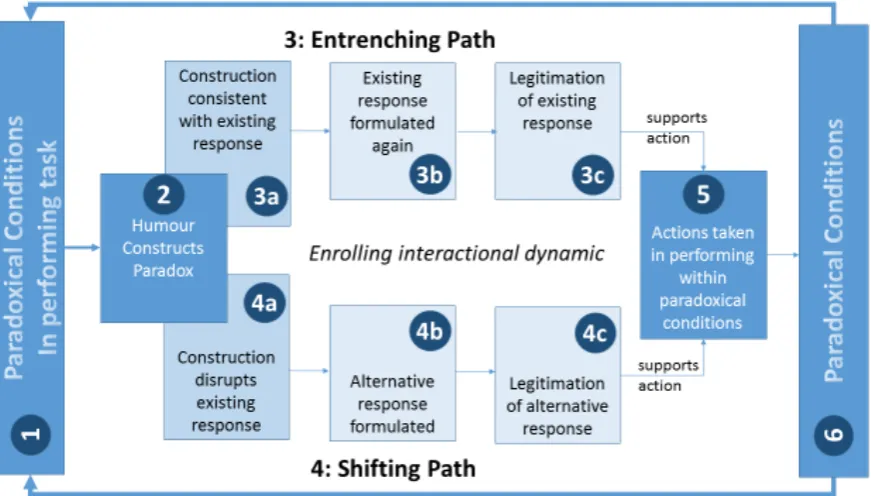
actions that people took. Humor episodes that entrenched an existing response were consistent with and affirmed an existing response pattern, while humor episodes that shifted a response created a moment of disruption to an existing response pattern – whereby the interactional pattern was to ridicule, problematize or question the existing response, followed by formulating and legitimating an alternative response. The interactional pattern shaped by humor is thus critical in responding to paradoxes.
Our iterative analysis enabled us to understand how actors formulate responses to paradoxes of performing through the micro-practice of humor, within their everyday work. By bringing paradox to the surface and socially constructing it in interaction, humor shaped the interactional context of organizational members and therefore laid the foundation for potential responses, including shifts in responses. Indeed, in shaping and shifting responses in-the-moment, humor affected the way that managers collectively responded to paradoxical issues through their actions. This ‘in-the-moment construction’ of paradox is thus a critical part of responding to paradoxes of performing.
FINDINGS
We now provide four representative examples that explain how the construction of paradox and responses to paradox emerge within humorous micro-interactional dynamics that result in either entrenching or shifting patterns of response. We offer two examples of each to demonstrate that these are not isolated examples but, rather, representative of the broader corpus of data in which they are embedded. Our illustrations begin by providing the context for each humor episode. Next, we present the interactional dynamics contained in the humor incident in rich detail. We then outline how the humor incident constructed a specific point of paradoxical tension. Finally, we explain how this laid the foundation for either the entrenchment of, or a shift in, the response to paradox. While we separate these elements analytically in order to offer a clearer illustration of the dynamics we wish to illuminate, these dynamics are entwined in practice. That is, actors engaged in humor, construction of paradox, and construction of response simultaneously in their everyday work, rather than approaching these in the ordered linear that we use as an analytic and presentational device.
The construction of humor through paradox often reinforced existing responses, entrenching them as the ‘right’ way to respond and maintaining continuity of response. Any response could be entrenched through humor. We now provide two representative examples. Example 1: The 28 MB Audit Submission
Humor Episode: This humor episode took place two weeks after the first major
regulatory deadline, some six months into the implementation program. The deadline mainly concerned the delivery of one specific product (Connectif), which was jointly delivered by Wholesale and Distribution. The delivery was ambitious and difficult, as it involved the separation of products, systems, services, and relationships formerly shared between divisions, which had to be reassembled in a new way so that the Distribution division could provide Connectif on an equivalent basis to Wholesale and competing Service Providers (SPs). Connectif was a key market product, used by virtually every Telco customer, and thus hugely visible and important – both for Telco and for the communications market more broadly. Telco had to deliver this major product restructuring to tight deadlines, while safeguarding service levels for existing customers. While project managers believed they had met this delivery, significant paradoxical tension arose between the regulatory goal to deliver the new products as quickly as possible in order to correct an existing market non-equivalence and the commercial goal to progress slowly enough to maintain high service levels.
In addition, as with all changes mandated under the new regulatory framework, independent internal auditors would audit the Connectif delivery. Telco was responsible for demonstrating that it had met its regulatory requirements. This meant that the Connectif delivery had to be documented to prove that the equivalence requirements were met, including providing specific detail about product, technology and process changes, to demonstrate that Telco would have no unfair market advantage either through the redesigned product, or the systems and processes used to deliver it. This involved considerable work in what was already a very tight delivery. Members of the Implementation Board were working evenings and weekends to keep up with the workload. To compound the issue, the internal auditors were known to be
altogether. This quickly earned the internal auditor the title of ‘the enemy within’. The humor episode that follows is set within this context.
1Sally is reporting for Distribution; she is talking about the amount of work the internal audit
2function is creating and, in particular, the size of some of the files she is sending the internal
3audit team to provide evidence that they have met the equivalence deliveries on Connectif.
4Internal audit is seen as interpreting the equivalence requirements too strictly, being non-
5pragmatic and creating additional work. Indeed Implementation Board members often
6blame the internal audit function for tension between equivalence and service goals.
8Sally: “We are about to submit our audit files…” (smirk) “…28 MB of zipped files.”
9John: “28MB of zipped files?” (laughs)
10Sally: “No, no, no. The 28MB of zipped file is only the Connectif audit…”
11John: “Alright. Sorry.”
12Sally (amused): “So, I’ve got 28Meg of zipped - within zipped – files”.
13Carl (smirks): “2.3 forests apparently.” Wendy laughs loudly
14John (amused): “Did we mention that we’re sending copies of the success criteria to them
15on paper (emphasized). Have you got it there, Bob?”
16Sally: “Just make sure it’s in a Distribution van!” Sally laughs, John sniggers.
17 John (smiling): “Yea. This is the Wholesale one.” He throws the document on the table
18with a thud. Sally laughs. “And it’s just the highlights.” Sally laughs. “That’s not all of it.”
19Fritz: “Sounds like they’re gunna need all those extra people then.” Sally laughs.
20Bob (smirking): “There were 740 pages of process diagrams, but I left them off.” Wendy &
21John giggle
22John (feigning incredulity):“What? I thought they’d enjoy those.” John, Sally & Bob
23laugh loudly.
24Jack (amused): “Wow – That’s almost as much as Sally sent!”
25Sally (cynicallyamused): “And I have gone for quality, not quantity, Bob.” Wendy laughs.
26 Andy (to Bob): “Oh – right – Got [the diagrams] whittled down to six.”
27 Fritz: “Actually, I’m not sure [the auditor] has even read that.” Fritz laughs
28 Andy (insisting): “Oh, no, he has.” Andy and Fritz laugh. “He has!” Andy & Simon laugh
29 “I’ve checked (deeply emphasized).” Wendy laughs
30 Fritz: “Oh. Good! I want him to read every single of piece that Wholesale sends. Of this
31 huge, huge report.” Wendy, Andy & Graham laugh
32 They turn to discussing the actual delivery more seriously, again making it clear that they
33 have met the requirements of the delivery. They then move on to discuss other deliveries.
Constructing Paradox: Highlighting that Audit Exacerbates Paradoxical Tension
In this episode, humor constructs paradoxical tension between the regulatory goal of delivering quickly to correct an existing market non-equivalence and the commercial goal of progressing slowly to maintain good service. Specifically, it constructs the audit function as exacerbating tension by taking resources away from delivering ‘real’ regulatory or commercial outputs – in this case the Connectif product – thus making it more difficult to achieve both
a structural mechanism that actually inhibited the commercial and regulatory requirement to deliver the product. Humor thus constructs the tension in a familiar way that is consistent with existing practice (L5-6). Sally’s humor emphasizes and makes seem incredible the volume of evidence being submitted for the audit (L8, 10, 12). Picking up on this dynamic, others support her through further humorous remarks about how much information is being sent to the auditor (Carl, L13; John, L15; John, L17; Jack, L24; Fritz, L31). Sally, jokes that, as the auditor is known to be picky, they must make sure the audit is delivered by the appropriate division in a branded vehicle (L16), thereby further proving to the auditor that they are kept separate. Her joking makes this idea – and the auditor itself – sound ridiculous. Fritz adds to the ridicule by indicating that the audit team is relatively overstaffed (L19), implicitly contrasting with this team, which works overtime to keep deliveries on track. He also suggests that their work is futile because the auditor will not read the submission (L27), at least without prompting (L28-31). This
interactional dynamic constructs the paradoxical tensions of performing these tasks as
challenging and, because of new structures implemented, such as internal auditing, often quite absurd. In their humorous talk, actors share and co-construct their frustration with such structural demands and the way these exacerbate tensions over performing in a paradoxical context. This construction aligned with their existing pattern of responding to paradoxical tension as something exacerbated by the auditor (L5-6).
Constructing Response: Entrenching Projection
tension onto the audit function (L8-13). Sally’s construction and projecting response establishes an interactional dynamic in which other managers can join in the projecting response (Carl, L13; John, L15; Jack, L24). In reinforcing this projecting response, the humor also reinforces the appropriateness of specific actions, such as engaging in displacement activity or political behavior to overload the internal audit function with information and slow their progress (L8-10, 14-15, 20). Building on Sally’s initial humorous remarks, Carl, John and Jack join in on the humor. Thus, they further co-construct their joint response to project the paradoxical tension onto internal audit, and to swamp them by sending an incredible amount of information (L8-12), including hardcopy paper files (L14-15) and/or unnecessary detail in the reports (L20-23). Laughing legitimates these actions and absolves managers from taking responsibility for their actions in working with paradox; tensions can be projected onto the internal auditors. Humor can thus perpetuate existing constructions of paradox, enrolling managers in reinforcing existing responses and entrenching them as appropriate, without necessarily thinking through the
implications. In this example, humor constructed paradox as consistent with existing constructions and responses, thereby further embedding this response pattern. Example 2: Complaining about the Broken Complaints Process
Humor Episode: The humor episode below occurred a few months into the
establishment of Implementation Board, when team members were still working out the
the INT37 delivery, which focused on corporate clients’ communications networks and associated services. This delivery was particularly contentious because there were problems translating the regulatory requirements into technological solutions that could produce the complex product features and service levels required commercially. This particular humor episode occurred approximately 10 minutes into the meeting, when Trevor joined.
1 They need an update about the INT37 delivery but Trevor, who is leading the delivery, has
2 not yet joined the meeting. No apologies were received, leading team members to speculate
3 about reasons for his absence. They are in midst of another report when Trevor joins.
4 John: “Ahhh! [as if to say ‘there he is’] I was just about to give you a ring, Trevor.”
5 Trevor: “It’s time to ‘blame Telco’ because my access card wasn't working” Sally laughs
6 John: “I assumed there must be some kind of technical problem.” Sally keeps laughing
7 Trevor: “There must be complaints process somewhere” John & Sally laugh
8 John: “And there are so many complaints. You know, I’ve had another one of those 0800
9 calls?” Sally giggles
10 Sally (interested): “Oh really?”
11 John: “Yeah, errm,,[name of well-known TV personality]. The TV bloke. His office. He was
12 trying to move house and he got given an 0800-number by Telco. Thought they were getting
13 through to the regulator and it’s been directed through to my phone.” Sally giggles “So…”
14 Trevor (mimicking the voice of the TV personality): “Who would work on a program like
15 this?” Sally & John laugh loudly
16 Sally: “Very good [impression]!” Sally sniggers
17 John: “It’s the third one. I’m going to have to find out what’s going on. I tried to get
18 switchboard to sort it out. They said they sorted it but haven’t…” Sally giggles; Jack snorts
19 Jack (pretending to be John): “I’m just the man to sort your problems. I’m right in the
20 middle of it!” John, Sally, Trevor, Jack laugh riotously.
21 John (laughing as he says this): “I was glaring rather at Jack there.” John laughs
22 (continues, directed at Jack, feigning annoyance)“We’ll have a chat later!”
23 They discuss more seriously why this occurred, deliberating various origins of error, and
24 note the fact that this is a common occurrence in the program, which they are quickly
25 getting used to. It is the status quo for things to go a bit awry.
Constructing Paradox: Goals as in Enduring Tension; Commercial Goals Suffering
because it draws parallels to and makes salient this tension, which they are already experiencing in the INT37 delivery, bringing focus to the commercial problems created by trying to
implement the technological solution to regulation. The construction is thus aligned with existing ways to construct this tension as enduring – in this case evidenced by recurring technological failures (L6). Trevor and John’s exchange provides the basis for further joking around these issues, e.g. referring to the ‘complaints process’ (L7), which exists to filter and respond to complaints on regulatory deliveries. This snowballs into a series of jokes about the complaints process, with which there are also problems (L11-21) – in short, there is a problem with the process designed to address problems! By drawing parallels from this situational incident to their actual difficulties with the delivery, they highlight the context of paradoxical tension in which they operate on a daily basis. Statements like ‘I assumed it was’ (L6), indicates that this was the most probable scenario based on what they all know about the implementation program; that the many technological problems (L6) mean core services are not available when needed (L5).
Similarly, emphasizing that there are ‘so many complaints’ (L8) that a ‘complaints process’ is needed (L7), and that he already received ‘three’ complaints personally (L17), constructs the paradox as an enduring problem for the Board. This creates an interactional dynamic into which others are enrolled (Trevor, L5; Sally, L7; Jack, L18). Thus, the interactional dynamic
co-constructs the paradox as an enduring tension they collectively face in their work, which has negative commercial impact, through technological problems (L6), blame (L5) and complaints (L7). This construction of paradox as enduring was aligned with the existing way of constructing paradox (L6). Responses were made in the context of and in line with this construction.
Constructing Response: Entrenching an Acceptance Response
consistent with existing constructions and responses (L6). Indeed, through humor actors acknowledge these challenges and accept that they must simply work pragmatically within paradoxical conditions (L7; 17-18). The complaints serve as micro indicator of consequences associated with their inability to concurrently address both elements of the paradox: in this case, providing stable technology to deliver reliable service (L5-6, 11-12). In using humor to construct the inevitability of these paradoxical conditions – here, technological problems – John (L6) and Trevor (L7) create an interactional dynamic that quickly enrolls others into expressing their acceptance of the situation. Humor socially constructs the absurdity of these issues, thereby also providing a context in which to feel and accept tensions. The humor reinforces the
appropriateness of the response by emphasizing multiple examples of tension, including repeat occurrence of the same issue (L6, L17). Participants in the meeting implicitly agree with the view they are co-constructing, for example, by laughing (e.g. Sally, L5), giggling (e.g. Sally, L9) or snorting (e.g. Jack, L18), so entrenching the response of accepting the enduring paradoxical tension. Humor can thus support the construction of and response to paradox by legitimating and embedding it within interactional dynamics. In this case, humor again constructs paradox as consistent with existing responses, thereby reinforcing an existing pattern of response.
SHIFTING RESPONSE TO PARADOX
Humor could also shift existing responses to paradox, by proposing and legitimating alternative responses. In these episodes, the construction of paradox through humor disrupted continuity of response, often fundamentally altering the nature of the group’s response. Any response could be shifted through humor. We provide two representative examples below. Example 3: Sneakily Extending all Contracts Prior to the Deadline
Humor Episode: The following episode occurred one year into implementation, when
effort. To address this matter, the two parties began to negotiate some ‘enhancements’ to
specific framework requirements and ‘exemptions’ from others. One critical issue was the case of existing customers. Telco had the largest market share and thus a significant existing customer base. Existing Telco customers – particularly ‘elite customers’ such as government, military, and public sector organizations – benefited from exceptional service, often negotiated on an
individual basis, containing bespoke terms and conditions, and contractually guaranteed. Such service differentiation was, obviously, not equivalent, and hence usually exacerbated the paradoxical tension between commercial and regulatory goals. However, acknowledging that a notable degeneration of service levels for such customers was not in the regulatory interest, the re-negotiated framework specified that existing contracts were exempt from meeting regulatory requirements. This meant that customers on valid contracts could be supplied in the old way until
the contract had to be renewed, allowing for a less abrupt transition to the new products, services and systems. The humor episode we reproduce below picks up on this condition.
1The conversation moves on to talks they are having with the regulator in order to exempt
2them from some regulatory requirements for existing customers. They want to work out a
3reasonable compromise to ensure they can satisfy service and equivalence goals. Specifically,
4 they are negotiating which engineering services they can offer to whom after the deadline.
5Carl: “We need to find a sensible way forward.”
6John (cheekily): “Can we go around and refresh all the contracts before then and make them
7longer-term?” Eric smirks audibly (“hm”).
8Fritz (flustered): “Err, I think they’ll wise to that one!” John & Sally giggle “…which is why
9 – Oh, I was hoping not to do all two pages of details. We’re getting there anyway…” Sally &
10Eric laugh “…There are certain contracts which clearly have provision for extension…”
11Others murmur agreement
12Fritz (jovially) “…Indiscreet responses were ‘Telco shouldn’t be allowed to extend them’…
13John laughs “I bet you’re really sorry you asked this question! The regulator thinks
14it has legal agreement that we won’t extend them but actually the legal wording that we
15have done is that we will not seek to extend them but if there are perfectly legitimate
16provisions in the contract, which the body we’ve contracted with wishes to supply, we can’t
17breach our contract, nor indeed can the regulator force us to.”
18 John (cheekily): “But driving a specific sales activity, which is what I had in mind, would
19probably not be helpful.”
20Fritz (conspiratorially): “Indeed – Although, of course, I didn’t hear that!” Sally, John &
21Fritz laugh loudly. Others smile or smirk.
22They express the need for careful consideration and expert advice on this complex and
23important issue. They agree to internally circulate a list of existing customer contracts using
24services no longer available under the new regulation. They also agree to ‘make sure we are
Constructing Paradox: Goals as Mutually Exclusive; Commercial Goals Prioritized
In this episode, humor is used to construct a particular point of paradoxical tension. Specifically, it highlights the incompatibility between the regulatory goal to minimize the period of non-equivalence with other SPs, which means not extending any contracts unnecessarily, and the commercial goal to extend as many contracts as possible in order to appease customers by providing differentiated, high quality service. When John suggests renewing the contracts before the deadline to get around the regulatory requirement (L6, see also L18), he implicitly positions the two goals as mutually exclusive. By suggesting refreshing contracts before they can expire as an alternative (L6-9) to the ‘sensible way forward’ of not renewing expiring contracts (L3, 5), he is casting these two as an either/or choice. This represents a shift away from the existing
construction of paradox in which both goals are viewed as needing to be achieved. Further, John is foregrounding the commercial goal by putting forward a solution based solely on maximizing service advantage through existing contracts, which ignores the regulatory goal of limiting non-equivalence by establishing new contracts. This different construction disrupts the original interactional dynamic and creates a dynamic in which others (L8, Fritz) are enrolled in the construction of paradox as an either/or choice, with preference for the commercial option (L10-17). John reinforces this construction toward the end of the episode (L18-19), prompting Fritz to implicitly agree (L20) and, through their assenting laughter, other participants to co-construct the paradox (L21) in the same way. This different construction, which positions paradoxical goals as either/or propositions, sets the interactional context for responses to also shift.
Constructing Response: Shifting from Adjusting to Opposing
Constructing paradox through humor generates an interactional dynamic in which responses to paradox are established and legitimated between participants. This particular episode demonstrates how, through humor, managers shifted their response from adjusting to
opposing. The early part of the discussion, prior to the introduction of humor, focuses on how to
by humor (L6), which introduces a different construction of the paradox and generates an interactional dynamic that moves the discussion away from the adjusting response toward an opposing response. The initial humorous comment explicitly suggests that Telco actors focus on their service needs, by extending contracts while still possible (L6), despite recognizing that such a response is focused on only the commercial element of the paradox and explicitly counter to the regulatory objectives (L6-7, L14-17, L18-19). This disruption, which introduces a different construction of paradox and a new response to paradox, lays the groundwork for a shift in response. Following John’s humorous expression of his preference for such a one-sided
response others are enrolled into considering subversive responses (e.g. John enrolls Fritz, L10; and others, L11). The initial adjusting response as a ‘sensible way forward’ was discarded and the new response of subtly opposing the regulatory goal through their contractual wording gained momentum. The interactional dynamic was thus altered, providing a context in which it was acceptable for managers to shift from adjusting towards an opposing response. Interactions no longer focused on whether this was sustainable in the longer term as a way forward but rather gave impetus to opposing the regulatory goal in order to advance the commercial goal. Indeed, opposing became the main focus of the discussion (L14-17). Humor thus fundamentally altered the nature of the group’s response, legitimating an action that would support the commercial goal in opposition to the regulatory goal. Humor thus introduced a construction of paradox that differed from the existing construction, and proposed an alternative response, thereby disrupting the interactional dynamic, and laying the groundwork for a shift in response.
Example 4: The ‘Not So Light Touch’ Governance Arrangement
Humor Episode: The following episode took place 18 months into implementation,
when some of the deliveries were starting to move into ‘business as usual’. While many key parts of the regulatory framework had been implemented, there was still difficulty associated with managing all of the separate implementation tasks as one integrated program. In particular, Telco was looking for an efficient and effective way to coordinate horizontally across all of the
deliver both regulatory and commercial objectives between them, they were limited in how they could work together. This created a paradoxical situation in which it was difficult for individual Telco managers to understand when they could or could not work with Distribution managers (and vice versa). To address this issue, Telco senior managers introduced an overarching
governance arrangement, “The Matrix”. This mechanism was designed to pull together all of the work done in all divisions and on all regulatory deliveries through a joint reporting mechanism, thereby implicitly integrating regulatory and commercial goals. Implementation Board members were unhappy about this development because (i) as the team delivering the implementation, they were responsible for coordinating activity, including negotiating between the different goals as tensions arose, whereas the new joint mechanism appeared to be about reporting without any way of negotiating between goals; (ii) the new structure required Implementation Board
members to report into the Matrix team, increasing the Board’s administrative load at a time when they were still heavily involved in the implementation which continued to throw up multiple paradoxical tensions. The following humor incident occurred after the new matrix structure had been explained to Implementation Board, as they reflected on the new initiative. Essentially, they were not convinced the new structure would address the paradoxical tensions arising from the ongoing structural separation, since joint reporting would not necessarily involve resolution of tensions between goals.
1 There is discussion of the ‘Matrix’ governance mechanism and the implications for the team’s 2 ability to implement ongoing projects. Team members talk about how their resources are
3 disappearing and how they will settle disputes under the restructuring. They lament being
4 able to do nothing about it, because it has been decided by senior managers and presented as
5 a ‘fait accompli’ that they think has not considered the structural problems they work with.
6 Max: “Let’s go into that changed world consciously with an agreed structure that we think
7 works rather than fall into it, which seems to me we’re doing at the moment. I don’t know
8 who is doing the notes, but…” Sally & John laugh “…try not to be flippant this time, Trev!”
9 Trevor, Sally and John laugh
10 Trevor (amused): “Can you all imagine me being flippant?” Max, John, Sally, Trev laugh
11 Max (seriously): “My suggestion for a note here, and excuse me if I caught the mood
12 wrong; I think there’s been concern expressed by everyone about how the structure fits with
13 the existing implementation program and that we need further discussions on that.”
14 Several people concur
15 Trevor: “Excellent summary, Max.” Trevor, Sally and Max chuckle
16 Max: “Are you being flippant again?” Riotous laughter – Max, Trevor, Sally, Barry, Bob
17 Sally (sarcastically, talking over the laughter, while also laughing): ‘They are good
19 Max…“You could perhaps add that there was support for a light touch program but what
20 we’re seeing doesn’t seem to be light touch.”
21 Several people concur
22 Barry (smirking): “Do I mention this bit about ‘only divisions’ [need to be coordinated]?”
23 Max (chuckling): “Well, ‘coordinating divisions’; that’s jumping into solutions. …”
24 Trevor: “You could note that that's for consideration…”
25 Others grin at the ‘only divisions’ terminology in the proposed Matrix structure
26 Trevor:“Okay, Barry, thanks.”
27 Max: “In which case you should also note that Barry is going down [to] the job center [to
28 look for a new job]!" Sally, John, Trevor, Barry laugh loudly
29 Trevor (smirking): “No, that (emphasized) would be flippant, Max.” Wendy laughs
30 Bob (excitedly to John): “However, the boss will be at your door soon…” Max laughs
31 “…‘Wait, you don't need to hire staff, you've got plenty of people’.”
32 Max (to Barry): “Can you show me where to go [to get a job] as well?” Bob giggles
32 They discuss the next steps in getting across to senior management that they need to
33 confront the structural issues they face in implementing the rest of the framework. They then
34 close the meeting, after what was a pretty emotive discussion of a fairly sensitive issue.
Constructing Paradox: Creating Tension by Trying to Balance Tensions
paradoxical tensions of meeting both goals in the remaining implementation tasks was co-constructed as challenging, particularly because of the ‘absurd’ structural Matrix approach introduced, which was not addressing the real issues of coordinating structurally separated divisions that worked to different goals (L22-25). Constructing the paradoxical conditions in this different way, i.e. as inappropriate and amendable through a different approach to structuring, sets the interactional context for responses to shift.
Constructing Response: Shifting from Accepting to Confronting
challenging the existing structure with murmurs of agreement (L14, 21, 25) and laughter (L8-10, 15-18, 28-31), despite noting potential personal consequences (L27, 30, 32). This provides another example of how humor introduces a different construction of and response to paradox, thus disrupting the existing interactional dynamic, and enabling a shift in response
Summary of Dynamic
The above findings show that, in constructing paradox through humor, actors generate an interactional dynamic in which they either entrench or shift responses to paradox. Entrenching
involves reaffirming an existing pattern of construction and response to paradox, thereby enhancing the legitimacy of the response. Shifting involves a moment of disruption that
ridiculed, problematized or questioned the existing pattern of construction and response,
laying the grounds for proposing an alternative response and legitimating that response. DISCUSSION
This paper was inductively motivated by our field observation that people performing roles within a context fraught with paradoxical tensions used a great deal of humor as part of their daily interactions about these paradoxes. We thus set out to address how humor constructs paradox within everyday work; and how these constructions shape the responses that actors make to paradox. Our aim was to gain theoretical insight into the interactional dynamics of paradoxes of