Adaptive broadband beamforming with arbitrary array geometry
A Alzin
∗, FK Coutts
∗, J Corr
∗, S Weiss
∗, IK Proudler
†, JA Chambers
‡∗Department of Electronic and Electrical Engineering, University of Strathclyde, Glasgow, Scotland †School of Electronic, Electrical and Systems Engineering, Loughborough University, Loughborough, UK
‡School of Electrical and Electronic Engineering, Newcastle University, Newcastle upon Tyne, UK
{ahmed.alzin,fraser.coutts,jamie.corr,stephan.weiss}@strath.ac.uk
Keywords: broadband array processing; minimum variance distortionless response beamforming; polynomial matrix; polynomial eigenvalue decomposition.
Abstract
This paper expands on a recent polynomial matrix formula-tion for a minimum variance distorformula-tionless response (MVDR) broadband beamformer. Within the polynomial matrix frame-work, this beamformer is a straightforward extension from the narrowband case, and offers advantages in terms of complexity and robustness particularly for off-broadside constraints. Here, we focus on arbitrary 3-dimensional array configurations of no particular structure, where the straightforward formulation and incorporation of constraints is demonstrated in simula-tions, and the beamformer accurately maintains its look direc-tion while nulling out interferers.
1. Introduction
Narrowband beamforming has been very extensively addressed over the past three decades, and many robust algorithms exist that offer optimality in various senses. When dealing with broadband signals, time delays cannot be implemented by phase shifts but require explicit tap delay line structures. With this, a number of narrowband techniques such as minimum variance distortionless response (MVDR) beamforming have been extended to the broadband case [21].
While for narrowband arrays, the array configuration can be arbitrary, broadband arrays often are restricted to linear or pla-nar structures, where the look direction of the array is towards broadside. This simplifies the formulation and incorporation of constraints through techniques such as cascades sums of differencing [9] but is practically very restrictive. As a result, most broadband beamformer designs assume presteering — i.e. an external provision of time delays — for the look direc-tion to appear at broadside [19,24,15]. Alternatively, the beam response can be tied down by a number of frequency domain constraints [16], which however does not guarantee a coher-ent protection of the constraint in between frequency bins as demonstrated in [23].
In this paper, we employ the recently proposed polynomial matrix formulation in order to denote and solve a broad-band MVDR beamformer [23]. The formulation is based
on a space-time covariance matrix which explicitly incorpo-rates time lags, and a broadband steering vector. Since every element of such a matrix or vector now is a finite impulse response filter, their transfer functions are polynomial matri-ces. Narrowband techniques such as eigenvalue (EVD ) and singular value decomposition (SVD) have been extended to cover the polynomial matrix case [6,20,10]. Algorithms for a polynomial EVD [10,13,14] have been driving forward applications in denoising-type [12] or decorrelating preproces-sors [7] for beamforming, transmit and receive beamforming across broadband MIMO channels [4,18], broadband angle of arrival estimation [2], and for optimum subband partitioning of beamformers [22].
The specific aim of this paper is to demonstrate the con-straint design and broadband beamformer implementation for an array with arbitrary configuration. The array element loca-tions have to be known, but the elements themselves can be randomly distributed as long as the spatial sampling theorem is satisfied. We extend the definition of a broadband steering vec-tor and metrics such as the directivity pattern to three dimen-sions, and show how this can be applied in a three dimensional example scenario.
The paper is organised as follows. Sec. 2 will define the array setup, Sec. 3 details the broadband beamformer. The implementation of broadband steering vectors and the block-ing matrix required for a generalised sidelobe canceller imple-mentation of the MVDR is addressed in Sec. 4. Finally, Sec. 5 presents some simulation results, followed by conclusions in Sec. 6.
2. Array Setup and Broadband Steering Vectors
2.1 Array Elements
We assume that an array consists ofM elements. There is no assumptions w.r.t. any particular structure of the array, but its element locations are known with Cartesian coordinatesrm=
[xm, ym, zm]T,m= 1. . . M. The locations may also be given
in spherical coordinates with elevationϑ, azimuthϕand radius ρ. In this case, a coordinatermcan also be expressed as
rm=ρm
sin(ϑm) cos(ϕm) sin(ϑm) sin(ϕm)
cos(ϑm)
2.2 Far Field Source
A far-field source has a planar wavefront travelling across the array, arriving at different array elements with different time delays. The normal vector of this wavefront is
kϑ,ϕ=
sinϑcosϕ
sinϑsinϕ
cosϑ
, (2)
If normalised by the propagation speed c in the medium,
kϑ,ϕ/cis also known as the source’s slowness vector. The time
delay which the wavefront experiences at the m-th element relative to the origin istm= 1ckTϑ,ϕrm. If the unit length in the
Cartesian coordinate system is chosen as half the minimum wavelength, then|kϑ,ϕ| = 1 =λmin/2 = c/(2fmax) =cTs,
whereTs is the sampling period assuming critical sampling.
Therefore,tm=τmTswith
τm=kTϑ,ϕrm (3)
is the wavefront’s delay relative to the origin in samples.
2.3 Broadband Steering Vector
If at least two array elements are spaced no further than one unit length apart, then a source with directionkϑ,ϕis uniquely
represented by theM delays that its wavefront experiences. This leads to the definition a broadband steering vector, or rather a vector valued function,
sϑ,ϕ[n] = √1
M
f[n−τ1]
f[n−τ2]
.. . f[n−τM]
, (4)
wheref[n−τ]is an ideal fractional delay filter creating a delay ofτ ∈ Rsamples, withn ∈ Zthe discrete time index. The
lag valuesτmon the r.h.s. of (4) depend on the elevationϑand
azimuthϕof the source via (3), which is reflected by the sub-script of the broadband steering vector,sϑ,ϕ[n]. Attenuation of
the wavefront while travelling across the array is neglected. Thez-transform ofsϑ,ϕ[n],
s(ϑ, ϕ, z) =
∞
X
n=−∞
sϑ,ϕ[n]z−n, (5)
leads to the narrowband steering vector at frequency Ω0
when evaluated on the unit circle for z = ejΩ0
. A trans-form pair as defined in (5) will be abbreviated below as
s(ϑ, ϕ, z)•—◦sϑ,ϕ[n]. Later, the broadband steering vector
in (5) will be used to formulate both the broadband MVDR beamforming problem and also its proposed broadband solu-tion.
3. Broadband Beamformer
3.1 General Broadband Beamformer
In a broadband beamformer, every sensor is followed by a tap delay line as shown in Fig. 1, such that the beamformer output
x1[n]
x 2[n]
x
M[n]
e[n]
+
w1[n]
w 2[n]
w
M[n]
..
[image:2.595.347.527.92.172.2]. ...
Figure 1. Beamformer with FIR filterswm[n],m = 1. . . M, following each of theMarray elements.
e[n]is a weighted average across a spatial and temporal win-dow of the data. If the input vector is defined as
x[n] = [x1[n] x2[n] . . . xM[n]]T (6)
andw[n]is a vector containing theM impulse responses of
the beamforming filters,
wH[n] = [w1[n] w2[n] . . . wM[n]] , (7)
then the output is
e[n] =X ν
wH[ν]x[n−ν]. (8)
3.2 Space-Time Covariance Matrix
The design of the MVDR beamformer as a statistically optimum array processor [21,5] requires the covariance matrix of the input. Here we choose a representation
R[τ] = Ex
[n]xH[n−τ] , which explicitly embeds the lag
valueτ; this lag can help express temporal correlations arising from time delay in the broadband array data.
The cross-spectral density (CSD) matrixR(z)•—◦R[τ]is
a polynomial matrix, containing cross- and power spectral den-sities as elements. Due to the structure ofR[τ],R(z)is para-hermitian, i.e. it is invariant under a parahermitian operation,
˜
{·}, implying Hermitian transpose and time reversal such that
˜
R(z) =RH(z−1) =R(z).
If the array is illuminated by L sources characterised by angles of arrival{ϑl, ϕl},l = 1. . . L, then using the
broad-band steering vector defined in (5) we obtain
R(z) =
L
X
l=1
s(ϑl, ϕl, z)˜s(ϑl, ϕl, z)Sl(z) +σ2
vI, (9)
whereSl(z)is the power spectral density of thel-th source measured at the origin, andσ2
vthe power of the additive noise,
whcih is assumed to be spatially and temporally uncorrelated.
3.3 Minimum Variance Distortionless Response
We denotew(z)∈CM to contain the complex conjugated and
˜
wq(z)
B(z) w˜a(z) +
− d[n]
e[n] y[n]
x[n]
[image:3.595.43.271.90.172.2]u[n]
Figure 2. Generalised sidelobe canceller with polynomial quiescent vector wq(z), polynomial blocking matrixB(z)and a multichannel adaptive filter
wa(z).
withwH[n]as defined in (7). Therefore, the output power
spec-tral density of the beamformer isw˜(z)R(z)w(z)leads to the MVDR problem formulation
min
w(z) I
|z|=1 ˜
w(z)R(z)w(z)dz
z (10)
s.t. ˜s(ϑs, ϕs, z)w(z) =F(z). (11)
The broadband steering vectors(ϑs, ϕs, z)protects the signal
of interest emitted by a source with an elevation and azimuth of
{ϑs, ϕs}. In this look direction, the array is expected to provide
a desired frequency responseF(z). For simplicityF(z) = 1
will be assumed below.
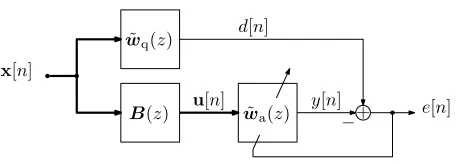
3.4 Generalised Sidelobe Canceller
Instead of solving the broadband MVDR problem in (10) and (11) directly, the formulation has been extended to a GSC [23] as depicted in Fig. 2. This requires a quiescent beamformer
wqwhich points in the look direction defined by{ϑs, ϕs}and
minimises the output power spectral densityw˜(z)R(z)w(z)
for spatially white noise. The output of this quiescent beam-former,d[n] = wH
qx[n], generally still contains interference.
By means of a blocking matrix B, whose rows span the
nullspace ofwqsuch thatBwq= 0, a signalu[n] =Bx[n]is
generated which contains only interference. Thereafter, uncon-strained optimisation is applied to a noise cancelling filterwa
such that the principle of orthogonalityE{u[n]e∗[n]} = 0is
satisfied. The outpute[n] = d[n]−wHau[n]then no longer
contains interference.
4. Implementation
Below, some details are provided into how broadband steering vectors for (4) can be extracted, and how to obtain a blocking matrixB(z)from the constraint equation (11).
4.1 Broadband Steering Vectors
Fractional delay filters can be obtained by resampling the sinc function, which is the assumed interpolation function when sampling at Nyquist rate. Due to the infinite support of the sinc, a truncation is required, leading to a discrete prolate spheroidal sequence [11,8]. Other alternatives exist, such as Farrow fil-ters [8]. In general, fractional delay filfil-ters cannot provide good accuracy towards fs/2, but tapered windows for sinc
func-tions [17] or the use of filter banks [1] can provide suitable
implementations. We here use the proposition in [17] and apply a raised cosine or Hann window of length2Lto the sinc, such that
f[n−τ] =
g[n] −L+τ < n < L+τ, n6=τ
2 n=τ
0 otherwise
(12)
for (4) with
g[n] =sinπ(n−τ)
π(n−τ)
1 + cosπ
L(n−τ)
. (13)
4.2 Blocking Matrix
The blocking matrix has to be designed such that
B(z)wq(z) = 0, (14)
which can therefore be achieved by completingwq(z) to a
paraunitary matrix as suggested in [23]. This can be accom-plished by applying a polynomial eigenvalue decomposition (PEVD, [10]) to the rank one matrix
wq(z) ˜wq(z) = ¯Q(z)D(z) ˜Q¯(z). (15)
This PEVD is ordered and due to the definition of the steering vector, we have
D(z) =diag{1 0 . . . 0} . (16)
The paraunitary matrixQ¯(z)is not unique even in the case where (15) has full rank. Defining the column vectors of the paraunitary matrix
¯
Q(z) = [¯q1(z) ¯q2(z) . . . q¯M(z)] , (17)
then e.g.q¯1(z)can be shifted w.r.t.wq(z),
¯
q1(z) =z−∆w
q(z), (18)
and yet satisfy both (15) and (16). Similarly, the remaining columnsq¯m(z)can be arbitrarily shifted without affecting the validity of the decomposition. Therefore, if the blocking matrix
˜
B(z) = [¯q2(z) . . . ¯qM(z)] , (19)
is selected, then B˜(z)wq(z) = 0 is guaranteed, but B(z)
could have a larger order than necessary. By appropriately shifting rows and truncation of small leading and trailing coefficients ofB(z)[3], it is possible to reduce this order.
5. Simulations and Results
Table 1. Sensor locations for scenario 1 .
i xi yi zi
1 -1.1242 -1.8617 0.7471 2 -1.8118 -1.7862 0.3559
3 0.7155 0.1188 1.7217
4 0.7172 0.6846 1.3847
5 1.7388 -1.9692 0.1077 6 -0.4660 -0.4663 -1.6321 7 0.0777 -1.7326 0.6157 8 1.3239 -0.3301 -0.3360
5.1 Performance Metrics
To assess the performance of broadband GSC beamformer, the mean square of the residual errorer[n]is a useful metric. Since
the beamformer outpute[n]should contain the signal of inter-est plus residual error, subtracting out the desired source sig-nal — appropriately delayed to compensate for propagation delays in wq(z)— provides a metric similar to echo return
loss enhancement known in acoustic echo cancellation. The directivity pattern represents the gain response of a broadband beamformer w.r.t. the angles of arrival and fre-quency. Assuming that a broadband source is located at{ϑ, ϕ}
as characterised by the broadband steering vectors(ϑ, ϕ, z), the overall transfer function of the beamformer w.r.t. this exci-tation is
A(ϑ, ϕ, z) = ( ˜wq(z)−w˜a(z)B(z))·s(ϑ, ϕ, z). (20)
By probing (20) with a series of steering vectors, the directivity pattern is obtained evaluating it on the unit circle and taking the gain only.
5.2 Scenario
An arbitary array withM = 8elements is generated by ran-domly drawing element locations from a uniform distribution for{xm, ym, zm} ∈[−2; 2], i.e. all elements lie within a cube.
The resulting coordinates are listed in Tab. 1.
The source of interest is set to illuminate the array from an elevation ϑs = 60◦ and azimuthϕs = −45◦. A first
inter-ferer is located at{ϑi,1= 0◦, ϕi,1=−45◦}, with a second at
{ϑi,2 = 20◦, ϕi,2 = 90◦}. Both interferers have a
signal-to-interference noise ratio of−30dB, and additive white Gaus-sian noise at a level of20dB relative to the signal of interest. Both interferers have a highpass characteristic, with passband edge atΩ = π
4.
5.3 Quiescent Response
The beampattern of the unadapted beamformer, i.e. withwa= 0, is the response of the quiescent beamformer only. The qui-escent beamformer has been designed as a broadband steering vector consisting of fractional delay filters of order 40, which was found to provide sufficient accuracy.
Figs. 3 and 4 show the directivity patterns|A(ϑ, ϕ, ejΩ)|for
two fixed points. Firstly, forϑ=ϑs= 60◦, the beamformer is
0 0.5
1
−150 −100 −50 0 50 100 150 −20 −15 −10 −5 0
azimuthϕ/[◦]
2
0
lo
g1
0
|
A
(
ϑs
,ϕ
,e
j
Ω )
|
/
[d
B
]
[image:4.595.313.556.289.434.2]Ω/π
Figure 3. Directivity pattern of polynomial quiescent beamformerwq(z)in elevation look directionϑs= 60◦for variable azimuth angleϕ.
0 0.5
1
−80 −60 −40 −20 0 20 40 60 80 −20 −15 −10 −5 0
elevationϑ/[◦]
2
0
lo
g1
0
|
A
(
ϑ
,ϕ
s
,e
j
Ω )
|
/
[d
B
]
Ω/π
Figure 4. Directivity pattern of polynomial quiescent beamformerwq(z)in azimuth look directionϕs=−45◦for variable elevation angleϑ.
pointing in the elevation direction of the source but with vary-ing azimuth angle. Note that the gain response in Fig. 3 sat-isfies the constraint forϕ, with a frequency-independent unit gain response in directionϕ =ϕs = −45◦. Secondly, fixing
the azimuth angle toϕ=ϕs=−45◦but varying the elevation
ϑin Fig. 4, the constraint is fulfilled forϑ=ϑs= 60◦.
5.4 Adapted Beamformer
Based on the quiescent beamformer, a blocking matrix was designed by paraunitary matrix completion, resulting in a blocking matrix of order 480 after appropriate truncation [3]. The adaptive filter wa(z)was chosen of order 140. Using a
normalised LMS algorithm for unconstrained optimisation, the mean square residual error is depicted in Fig. 5.
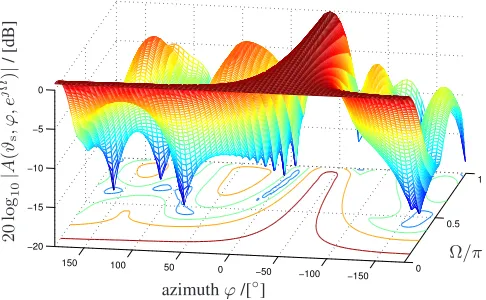
Figs. 6 and 7 show the directivity patterns of the GSC beam-former after adaptation. In Fig. 6, the elevation angle is fixed at ϑs= 60◦, such that the look direction of the array is observed
for the flexible azimuth angle atϕ= ϕs =−45◦. The
direc-tivity pattern differs from the one of the quiescent beamformer in Fig. 3 but fulfils the constraint.
In Fig. 7, the adapted directivity pattern is shown for a fixed azimuth angle of ϕs = −45◦. Compared to the quiescent
response in Fig. 4, the constraint is still fulfilled but the beam-former has placed a null at the interference angleϑi,1 = 0◦.
0 1 2 3 4 5 6
x 104 −10
−5 0 5 10 15 20
discrete time index n
[image:5.595.44.290.95.202.2]residual MSE /[dB]
Figure 5. Mean square residual error after switching adaptation on atn= 0.
0 0.5
1
−150 −100 −50 0 50 100 150 −20 −15 −10 −5 0
azimuthϕ/[◦]
2
0
lo
g1
0
|
A
(
ϑs
,ϕ
,e
j
Ω)
|
/
[d
B
]
[image:5.595.43.286.254.401.2]Ω/π
Figure 6. Directivity pattern of polynomial adapted beamformerw(z)in elevation look directionϑs= 60◦for variable azimuth angleϕ.
0 0.2
0.4 0.6
0.8 1
−80 −60 −40 −20 0 20 40 60 80 −40 −35 −30 −25 −20 −15 −10 −5 0
elevationϑ/[◦]
2
0
lo
g1
0
|
A
(
ϑ
,ϕ
s
,e
j
Ω )
|
/
[d
B
]
Ω/π
Figure 7. Directivity pattern of polynomial adapted beamformerw(z)in azimuth look directionϕs=−45◦for variable elevation angleϑ.
spatial discrimination towards low frequencies by the beam-former has no impact on the beambeam-former’s performance.
6. Conclusion
This paper has expanded on a proposed broadband beam-former design using polynomial matrix formulations. The design is derived using broadband steering vectors and a space-time covariance matrix that explicitly contains a lag parameter; the definition of the MVDR beamformer thus becomes a convenient extension of the narrowband case.
We have previously established some of the advantages of the proposed design — this includes the decoupling of orders in the quiescent beamformer, the blocking matrix, and the adaptive filter. Also, the proposed beamformer permits a sim-ple handling of constraints. In the examsim-ples of this paper, we have shown that for an arbirary array configuration, constraints are straightforward to implement and are protected coherently across the spectrum. This is in contrast to state-of-the-art broadband beamformers, where off-broadside constraints or arbitrary array configurations generally require presteering before any processing can be performed.
Acknowledgement
This work was supported by the Engineering and Phys-ical Sciences Research Council (EPSRC) Grant number EP/K014307/1 and the MOD University Defence Research Collaboration in Signal Processing.
References
[1] M. Alrmah and S. Weiss. Filter bank based fractional delay fil-ter implementation for widely accurate broadband steering vec-tors. In5th IEEE International Workshop on Computational Advances in Multi-Sensor Adaptive Processing, Saint Martin, December 2013.
[2] M. Alrmah, S. Weiss, and S. Lambotharan. An extension of the music algorithm to broadband scenarios using polynomial eigenvalue decomposition. In19th European Signal Processing Conference, pages 629–633, Barcelona, Spain, August 2011. [3] J. Corr, K. Thompson, S. Weiss, I. Proudler, and J. McWhirter.
Row-shift corrected truncation of paraunitary matrices for PEVD algorithms. In23rd European Signal Processing Con-ference, pages 854–858, Nice, France, August/September 2015. [4] M. Davies, S. Lambotharan, and J. McWhirter. Broadband MIMO beamforming using spatial-temporal filters and polyno-mial matrix decomposition. In15th International Conference on Digital Signal Processing, pages 579–582, Cardiff, UK, July 2007.
[5] L. Godara. Application of antenna arrays to mobile commu-nications. II. Beam-forming and direction-of-arrival considera-tions.Proceedings of the IEEE, 85(8):1195–1245, Aug. 1997. [6] I. Gohberg, P. Lancaster, and L. Rodman.Matrix Polynomials.
Academic Press, New York, 1982.
[7] C. L. Koh, S. Redif, and S. Weiss. Broadband gsc beamformer with spatial and temporal decorrelation. In17th European Sig-nal Processing Conference, pages 889–893, Glasgow, Scotland, August 2009.
[8] T. I. Laakso, V. V¨alim¨aki, M. Karjalainen, and U. K. Laine. Splitting the Unit Delay. IEEE Signal Processing Magazine, 13(1):30–60, January 1996.
[9] W. Liu and S. Weiss.Wideband Beamforming — Concepts and Techniques. Wiley, 2010.
[10] J. G. McWhirter, P. D. Baxter, T. Cooper, S. Redif, and J. Fos-ter. An EVD Algorithm for Para-Hermitian Polynomial Matri-ces. IEEE Transactions on Signal Processing, 55(5):2158– 2169, May 2007.
[11] A. Papoulis.Signal Analysis. McGraw-Hill, New York, 1984. [12] S. Redif, J. McWhirter, P. Baxter, and T. Cooper. Robust
broad-band adaptive beamforming via polynomial eigenvalues. In
OCEANS, pages 1–6, Boston, MA, September 2006.
[image:5.595.44.283.434.612.2][14] S. Redif, S. Weiss, and J. McWhirter. Sequential matrix diag-onalization algorithms for polynomial EVD of parahermitian matrices. IEEE Transactions on Signal Processing, 63(1):81– 89, January 2015.
[15] M. R¨ubsamen and A. Gershman. Robust presteered broadband beamforming based on worst-case performance optimization. In5th IEEE Sensor Array and Multichannel Signal Processing Workshop, pages 340–344, Darmstadt, Germany, July 2008. [16] M. Sayyah Jahromi and L. Godara. Steering broadband
beam-forming without pre-steering. In IEEE/ACES International Conference on Wireless Communications and Applied Compu-tational Electromagnetics, pages 987–990, April 2005. [17] J. Selva. An efficient structure for the design of variable
frac-tional delay filters based on the windowing method. IEEE Transactions on Signal Processing, 56(8):3770–3775, August 2008.
[18] C. H. Ta and S. Weiss. A Design of Precoding and Equalisa-tion for Broadband MIMO Systems. In15th International Con-ference on Digital Signal Processing, pages 571–574, Cardiff, UK, July 2007.
[19] I. Thng, A. Cantoni, and Y. H. Leung. Derivative constrained optimum broad-band antenna arrays. IEEE Transactions on Signal Processing, 41(7):2376–2388, July 1993.
[20] P. P. Vaidyanathan. Multirate Systems and Filter Banks. Pren-tice Hall, Englewood Cliffs, 1993.
[21] B. D. Van Veen and K. M. Buckley. Beamforming: A Versa-tile Approach to Spatial Filtering.IEEE Acoustics, Speech, and Signal Processing Magazine, 5(2):4–24, April 1988.
[22] P. Vouras and T. Tran. Robust transmit nulling in wideband arrays.IEEE Transactions on Signal Processing, 62(14):3706– 3719, July 2014.
[23] S. Weiss, S. Bendoukha, A. Alzin, F. Coutts, I. Proudler, and J. Chambers. MVDR broadband beamforming using polyno-mial matrix techniques. In23rd European Signal Processing Conference, pages 844–848, Nice, France, September 2015. [24] S. Zhang and I.-J. Thng. Robust presteering derivative
![Figure 1.Beamformer with FIR filters wm[n], m = 1 . . . M, followingeach of the M array elements.](https://thumb-us.123doks.com/thumbv2/123dok_us/1575288.110122/2.595.347.527.92.172/figure-beamformer-fir-lters-wm-followingeach-array-elements.webp)