ISSN(Online): 2320-9801
ISSN (Print): 2320-9798
I
nternational
J
ournal of
I
nnovative
R
esearch in
C
omputer
and
C
ommunication
E
ngineering
(An ISO 3297: 2007 Certified Organization)
Vol. 3, Issue 6, June 2015
An Array System of Multi-Cell Multiuser
MIMO Network in Uplink Transmission
G Shilpa1, Lipsa Dash2
M.Tech, Dept. ECE, New Horizon College of Engineering, Bangalore, India1
Assistant Professor, Dept. of ECE, New Horizon College of Engineering, Bangalore, India2
ABSTRACT: The multiuser MIMO system having large number of base station antennas compared to the number of users is considered. It is assumed that the channel estimation is performed by employing the uplink training. The numerous transmit antennas at the BS can be exploited widely and such systems implicitly serves the users in large further providing high data rates. But, to carry out the processing of received signal, the receiver on the uplink depends on the estimates of channel, which are well-known to get corrupted due to interference called pilot interference. Having this impairment, in this project an analysis on large system is carried out where the receiver utilizes a minimum mean square error filter, matched filter and zero forcing filter considering a channel estimate to be contaminated. A Rayleigh fading channel is considered and the analysis is done for different cases of users received powers. As the antennas at the BS and number of users become larger, the asymptotic signal to interference noise ratio (SINR) improves by retaining a ratio fixed. Using the SINR equation it is found that the users in a cell that are served are equivalent to the antennas at the BS. Furthermore, the precise equation for the suppression of interference is acquired employing an MMSE filter. When there are considerable users in the system in contrast to the antennas at the BS, formula becomes a significant aspect. The simulation outcomes are got through MATLAB. It is seen that the rates achieved are comparable to the extent of large system consisting 10-antenna BS along with 3 or further users per cell.
KEYWORDS: MIMO, Massive MIMO, MU-MIMO, channel state information, pilot contamination, estimation of channel, pilot reuse, path loss, channel models.
I. INTRODUCTION
ISSN(Online): 2320-9801
ISSN (Print): 2320-9798
I
nternational
J
ournal of
I
nnovative
R
esearch in
C
omputer
and
C
ommunication
E
ngineering
(An ISO 3297: 2007 Certified Organization)
Vol. 3, Issue 6, June 2015
II. RELATED WORK
As per [1] wireless communication links with multiple antenna assure very high data rates with less error probabilities, given that channel response is known at the receiver. In particular, channel response is obtained by transmitting known training data to the receiver. The paper describes the effects of training data on the capacity of a fading channel. By sending too little training data it leads to channel being improperly learned. And by using too much training data, it results in no time left for uplink or downlink data transmission prior to changes in the channel. Paper [3] discusses the new pilot optimization as well as channel estimation scheme for MU-MIMO system for downlink condition. With K signal antenna mobile stations, the channel estimation is performed by using TDD method utilizing N pilot sequences. First the channel estimation problem has been formulated as a WSMSE minimization problem with pilot symbols and variables are introduced. Secondly, the introduced variables for fixed pilot symbols are been optimized using MMSE and generalized Rayleigh quotient methods. Paper [4] explains the limitations imposed on a non-cooperative cellular multiuser MIMO system due to improper acquisition of channel state information and phenomenon called pilot contamination. The result shows that the consequence of uncorrelated fast fading and noise fade away and the only remaining impairment is the inter-cellular interference that results from pilot contamination. The analysis in this paper assumes that the receptions from the different cells are synchronized which is the worst possible case. In paper [5], the techniques based on existing long term evolution (LTE) measurements such as open loop power control (OLPC) and pilot sequence reuse schemes are discussed. The performance of least squares channel estimator and that of minimum mean square error estimator is evaluated. And also the performance of recently proposed coordinated pilot allocation (CPA) technique is presented. The normalized mean square error of channel estimation, the signal to interference pulse noise ratio and zero forcing precoding at the base station are the main contributions of the paper. According to paper [10], nonlinear channel estimation schemes in massive MIMO systems can overcome the pilot contamination problems. The scheme is based on a subspace projection. It uses singular value decomposition. It is studied both by the means of analytical and simulative. Further, the paper shows simulations benefits of proposed scheme based on a cellular network model.
III.CONTRIBUTIONS
Huge number of transmit antennas at the BS mitigates the fading effects of channel and can potentially provide high data rates to the large number of users. This is achieved by learning the channel state information (CSI) between all the user terminals or MSs and the base station.
The work is been carried out considering the uplink MU-MIMO system in multi-cell scheme. For uplink transmission, CSI is predicted using TDD approach. In TDD approach, initially from each user its own training data or a pilot is sent to the BS. Next, the BS on the uplink will estimate the channel and uses the conjugate of the estimated channel as its version of downlink. The system is been employed with orthogonal frequency division multiplexing (OFDM) scheme where the time-frequency resources are split into physical resource blocks (PRB) of coherence time coherence bandwidth product. Each PRB is used and adequate for channel estimation. Apart from some time slots or frequency channels being used for channel estimates, remaining portion of resources are used for uplink or downlink data transmission. According to [2], the number of required pilot symbols is equal to the number of MSs in the system. Therefore having taken the consideration of large scale antenna system in project, the allocated pilot sequences utilize a major portion of the PRB, which is undesirable. Thus, only a part of resources is used for learning the channel. However, by restricting only small portion of resources for pilot transmission it results in overlap of pilot sequences in different cells over time-frequency resources. In this case, the channel estimates are subjected to errors or is said to be pilot contaminated. In other words, reuse of pilot sequences in nearby cells in order to reduce pilot overhead causes corruption of the channel estimates. The inter-cell interference caused is called as pilot interference. Another important thing to mention about pilot symbols allocated to users is that the symbols are orthogonal to each other within the cell and not the case in multi-cell scenario due to pilot reuse.
ISSN(Online): 2320-9801
ISSN (Print): 2320-9798
I
nternational
J
ournal of
I
nnovative
R
esearch in
C
omputer
and
C
ommunication
E
ngineering
(An ISO 3297: 2007 Certified Organization)
Vol. 3, Issue 6, June 2015
system under this pilot contamination condition by using different filters at the receiver through MATLAB simulations. The results of simulations carried out in MATLAB are been investigated for different path loss models. The graphs of SINR v/s α, achievable sum rate v/s and loss rate v/s propagation coefficient for different received powers is been plotted and analyzed. The number of users per base station and the number of antenna base station is to be increased yet maintaining the fixed ratio of both. The ratio of number of users per base station to number of antennas is denoted byα. The system analysis is carried out for regime α > 0.1 which is not been done in works of [3], [4], [10].
IV.SYSTEM MODEL
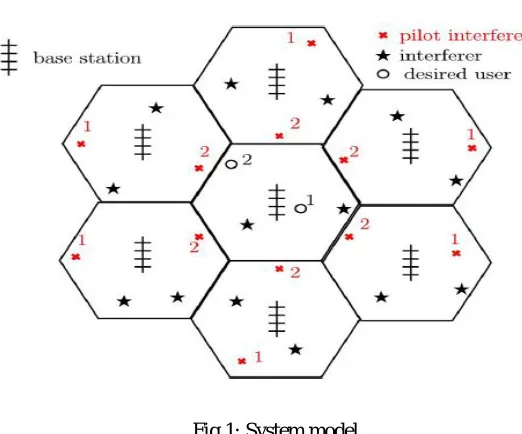
The system with B non-cooperating base antennas and K users per BS is been considered. The channel vector is given by a M × 1 vector h ( ) representing the small scale fading between the user k in cell j and the base antenna l. The h ( ) entries are assumed to be zero mean i.i.d Gaussian random variables. The fig.1 shows the system model. A
large scale fading coefficient is denoted byβ ( ). Thus according to assumption the channel vector is given by β ( )
h ( ).
A. Uplink transmission:
Denoting as the symbol transmitted by user k in cell j, ( ) as the × 1 noise vector with entries of zero mean circularly symmetric Gaussian variables such that [ ( ) ( ) ]= , then the signal that is received at base station l is
given by
( )=∑ ∑ ( )ℎ ( ) + ( )
(1)
The base station at the start of physical resource block must relearn the channel vector of each user. But once it is learnt, it remains same within that resource block for all subcarriers.
B. Restrictions in obtaining channel knowledge:
Let be the transmit SNR of data symbol and be the average transmit SNR per symbol. Then with K resource elements meant for channel estimation is given by
= ( ) (2)
With denoting the SNR duting pilot transmission, N ℂ × denoting the additive complex Gaussian noise matrix
with i.i.d entries with variance 1/M, the received signal is given by
( )=∑ ∑ ( )
ℎ ( ) + / (3)
The noise variance of 1/M for entries of is assumed since the transmission power of pilot symbols are not scaled by the number of antennas. Then for user k in the first cell, the MMSE channel estimate is given by
ℎ = +∑ ∑ ( )
(4) Where ℎ is the estimate of channel of the user k in cell 1 to the base station . The in-cell pilots are been repeated across the cells to get some analytic insight which implies that = for all k. With pilot contamination when in-cell orthogonal pilots are repeated across the in-cells, then MMSE channel estimate is given by
ISSN(Online): 2320-9801
ISSN (Print): 2320-9798
I
nternational
J
ournal of
I
nnovative
R
esearch in
C
omputer
and
C
ommunication
E
ngineering
(An ISO 3297: 2007 Certified Organization)
Vol. 3, Issue 6, June 2015
Where ( )=∑ .This is essential because the entries of ℎ ( ) is defined to be complex i.i.d with variance 1/M. Thus, the additive noise affecting the channel estimation can be ignored, assuming the pilot power is high enough. Therefore, with Thus, the additive noise affecting the channel estimation →∞ the channel estimate is given by
ℎ = ( ) ∑ ℎ (7)
C. Linear receivers
Fig 1: System model
The property of MMSE estimate [ℎℎ ] is used to obtain the expression. The channel estimation incurs no error in an ideal situation and ℎ =ℎ for all k, then
∗= (∑ ℎ ℎ + ( + ) ) ℎ (8)
This will serve as a standard for the performance of the MMSE filter with pilot contamination which is a favourable scenario. The zero forcing filter is given as follows
̇=(∑ ℎ ℎ + ) ℎ (9)
D. Filters With Pilot Contamination
After the received signal is processed using the linear filter c, let P (c), P (c), P (c), P (c) be defined as the signal power, noise power, pilot interference power and interference power, respectively as a dependent of function of the filter c. Then
( ) = ℎ ℎ (10)
( ) = (11)
( ) = ∑ ℎ ℎ (12)
( ) = ∑ ∑ ℎ ℎ (13)
ISSN(Online): 2320-9801
ISSN (Print): 2320-9798
I
nternational
J
ournal of
I
nnovative
R
esearch in
C
omputer
and
C
ommunication
E
ngineering
(An ISO 3297: 2007 Certified Organization)
Vol. 3, Issue 6, June 2015
= ( ) ( )( ) ( ) (14)
The SINR at the output of the filter ̂ as M, K tends to infinity with K/M = conflux to
= (∑ (∑)/ )/
(∑ )/ ( [ ] ( ))
(15)
The SINR expression of a large system with MMSE filter with a perfect estimate as M, K tends to infinity with K/M= merges to
∗=
∑ ∗ (16)
The SINR expression of matched filter with matched filter with a pilot contaminated estimate as M, K tends to infinity with K/M= assemblage to
= (∑(∑ )/ )/
(∑ )/ [ ]
(17)
The SINR expression for zero forcing filter is given by
̇ = (∑ )/
(∑ )/
(∑ )/
(18)
Next the asymptotic SINR with MMSE filter and matched filter with pilot contaminated channel estimate is expressed as
( ) =
( ) (19)
V. SIMULATION RESULTS
The hexagonal cells with randomly distributed users in each cell is been considered for numerical evaluation as depicted in fig. 1. Further, the 6 cells are located close to the center cell. The situation where, 6 closest cells are interfering with the centre cell is been considered. The received powers from all the users within a cell is thought to be unity which is denoted = 1. whereas the received powers from other all other users in other cells are said to take constant value of = 0.01 0.01 0.001 for j≠1 and a high SNR of 20dB. As is close to 1, the interference from other cells grows to be stronger. The SINR for the user 1 in the center cell is found out. The plot of the asymptotic SINR of the MMSE with a pilot contaminated estimate given by for different significant set-up is shown in fig. 2 and fig. 3.ie. it is plotted for different received powers. The plot of SINR and ∗ is been shown as the guideline for comparing performances of filters as in fig. 4. When = 0.1 for j≠1, it is seen that ∗ is drastically affected by other-cell interference. Hence, the SINR of MMSE filter with pilot contaminated estimate is not expected to perform better than MMSE filter with perfect estimate. In the case when power from other cell users are 20db less compared to powers of in-cell users, remarkable gains are achieved by MMSE and ZF in contrast to matched filter.
ISSN(Online): 2320-9801
ISSN (Print): 2320-9798
I
nternational
J
ournal of
I
nnovative
R
esearch in
C
omputer
and
C
ommunication
E
ngineering
(An ISO 3297: 2007 Certified Organization)
Vol. 3, Issue 6, June 2015
Lower α implies that less users are served and hence lesser sum rate and larger results in SINR of MMSE filter
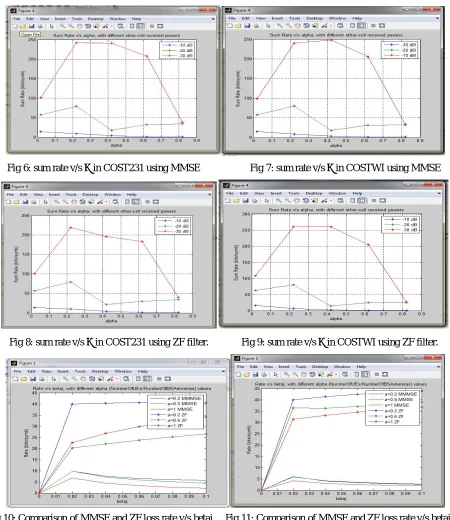
with pilot estimate is found to be lower such that the term α outside the is insignificant to improve the sum rate. For most of the operating point curve is flattened and the sum rate is found to be constant when the other-cell received powers are large. The sum rate of ZF is shown in fig. 8 and fig. 9.
The difference of MMSE filter achievable rate with a perfect estimate and MMSE filter achievable rate with a pilot
estimate is been plotted and shown in fig. 10 and fig.11 for different values of other-cell received power. The training overhead is not considered and the perfect estimate is obtained with the same training time. Since the SINR of MMSE filter with pilot estimate is close to that of perfect estimate, the analysis is limited to <0.1.
A. Five percent SINR
As specified, the same in-cell orthogonal training data is been repeated across the cells and channel estimation is based on this pilot reuse. The plot is shown in fig. 12. Literally, comparison of five percentile SINR is done with the actual channel estimation.
Fig 2: SINR v/s for COST231 model Fig 3: SINR v/s in COST Walfisch-Ikegami model
ISSN(Online): 2320-9801
ISSN (Print): 2320-9798
I
nternational
J
ournal of
I
nnovative
R
esearch in
C
omputer
and
C
ommunication
E
ngineering
(An ISO 3297: 2007 Certified Organization)
Vol. 3, Issue 6, June 2015
Fig 6: sum rate v/s in COST231 using MMSE Fig 7: sum rate v/s in COSTWI using MMSE
Fig 8: sum rate v/s in COST231 using ZF filter. Fig 9: sum rate v/s in COSTWI using ZF filter.
Fig 10: Comparison of MMSE and ZF loss rate v/s betaj Fig 11: Comparison of MMSE and ZF loss rate v/s betaj in
ISSN(Online): 2320-9801
ISSN (Print): 2320-9798
I
nternational
J
ournal of
I
nnovative
R
esearch in
C
omputer
and
C
ommunication
E
ngineering
(An ISO 3297: 2007 Certified Organization)
Vol. 3, Issue 6, June 2015
Fig 12: five percent SINR
VI.CONCLUSIONANDFUTURESCOPE
The expression for SINR for a system consisting of more number of antennas at the base station compared to users is been found. The equation is derived by mainly implementing MMSE filter at the receiver to decode the
received signal considering the channel estimate being corrupted. In addition to MMSE filter, two more filters such as matched filter and zero forcing forcing filter are utilized. The SINR equation is verified upon simulations and appeared that a 50 antenna base station serving significant number of users is adequate enough to retain the mutli-antenna system results. The plot shows the asymptotic SINR of different filters with and without pilot contamination in a seven cell scenario. It is found that the performance of zero forcing filter with pilot contaminated estimate is better compared to the other three in terms of achievable rate for different received powers and also interms of loss rate. The analysis is carried out considering COST231 model and COST Walfisch-Ikegami model. Since the work is carried out assuming the training time devoted to users as K symbols, further studies can be carried out considering the training overhead for various values of training time and dependency on the coherence time by users. This could be accomplished through the analysis of training time against the number of users per cell. It would also be appealing if the expression for the deterministic equivalent of the SINR be more simplified into instinctive form for other channel models.
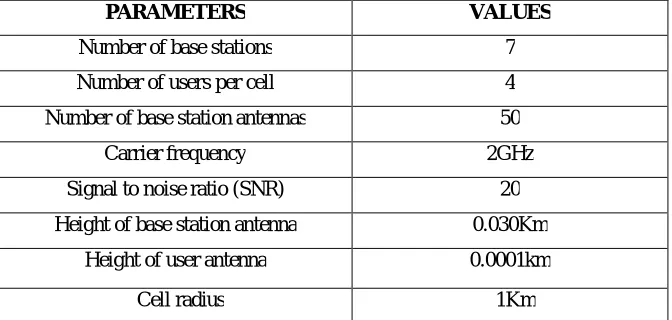
PARAMETERS VALUES
Number of base stations 7
Number of users per cell 4
Number of base station antennas 50
Carrier frequency 2GHz
Signal to noise ratio (SNR) 20
Height of base station antenna 0.030Km
Height of user antenna 0.0001km
Cell radius 1Km
Table 1: performance parameters
REFERENCES
[1] B. Hassibi and B. M. Hochwald, “How Much Training Is Needed For Multiple-Antenna Wireless Links?,” IEEE Trans. Inf. Theory, vol. 49, pp. 951–963, Apr. 2003.
ISSN(Online): 2320-9801
ISSN (Print): 2320-9798
I
nternational
J
ournal of
I
nnovative
R
esearch in
C
omputer
and
C
ommunication
E
ngineering
(An ISO 3297: 2007 Certified Organization)
Vol. 3, Issue 6, June 2015
[3] Tadilo Endeshaw Bogale, “Pilot Optimization And Channel Estimation For Multiuser Massive MIMO Systems,” INRS, cannada.
[4] T. L. Marzetta, “Non-Cooperative Multiantenna Base Stations With Unlimited Number Of Antennas,” IEEE Trans. Wireless Commun., vol. 9, no. 11, pp. 3590–3600, Nov. 2010.
[5] Vidit Saxena, Gabor Fodor, “Mitigating Pilot Contamination By Pilot Reuse And Power Control Schemes For Massive MIMO Systems,” Ericsson Research, Sweden.
[6] J. Jose, A. Ashikhmin, T. L. Marzetta, and S. Vishwanath, “Pilot contamination problem in multi-cell TDD systems,” in Proc. IEEE ISIT, Jun. 2009, pp. 2184–2188.
[7] Hien Quoc NGO, “The Multiuser MIMO Uplink with Very Large Antenna Arrays and a Finite Dimensional Channel,” IEEE trans. On comm., vol. 61., no. 6. June 2013.
[8] J. Jose, A. Ashikhmin, T. L. Marzetta, and S. Vishwanath, “Pilot contamination and precoding in small-cell TDD systems,” IEEE Trans. Wireless Commun., vol. 10, no. 8, pp. 2640–2651, Aug. 2011.
[9] David Neumann, A. Michael, “Pilot Coordination for Large Scale Multi-Cell TDD Systems,” Associate institute for signal processing, Germany, 2012.
[10] R. Mueller, M. Vekhapera, and L. Cottatellucci, “Blind pilot decontamination,” in Proc. 17th Int. ITG WSA, Mar. 2013, pp. 1–6.
BIOGRAPHY
G shilpa is a MTECH (communication systems) Student in New Horizon College of Engineering, Bangalore, India.