DEPARTMENT OF MATHEMATICS
MINOR CLASSES
by
Dirk Llewellyn Vertigan B.Sc. (Hons)
Submitted in fulfilment of the requirements for the degree of
Except as stated herein, this thesis contains no material which has been accepted for the award of any other degree or diploma in any university, and to the best of my knowledge and belief, contains no copy or paraphrase of material previously published or written by another person except where duly
acknowledged.
Whittle for his guidance, encouragement and unending patience.
Abstract: For many classes of combinatorial structures, such as graphs and matroids, there exists a concept of point removal. Minors are obtained by various manners of point removal. In this thesis, these ideas are abstracted to give the definition of minor class. It turns out that minor classes are algebras, in the sense of universal algebra, which makes much universal algebra theory available to the study of minor classes. For example, varieties of minor classes are studied, as well as subalgebras (sub minor classes), homomorphisms, and direct products. Amongst the theory developed, is a natural connection between varieties of minor classes and categories. Also it is shown how a minor class can be described in terms of its so called '!/>-structures and natural excluded minors (which are its excluded minors in the so called completion of the minor class). Many well known minor classes are described in this way, including the minor class of matroids, various minor classes of graphs, and minor classes of subspaces of certain vector spaces over a field (related to Tutte's chain groups). For any field, the latter minor class has, as a
Section 1
Introduction. Section 2
Notation and Conventions. Section 3
Minor Class Definitions. Section 4
Examples of Minor Classes. Section 5
Minor Classes as Algebras. Section 6
Constructions which Modify the Signature. Section 7
Equivalent Characterisations of Varieties. Section 8
Two Embedding Theorems. Section 9
A Connection with Category Theory. Section 10
The Core and Completion of a Unary Algebra. Section 11
The ?/>-description of Minor Classes with Finite Ground Sets.
Section 12
The Minor Class of Matroids and Related Minor Classes.
1
4
6
14
18
34
36
40
49
55
71
Section 13
Minor Classes of Linear Dependencies. Section 14
Minor Classes of Graphs. Section 15
Ideas for Further Consideration References
92
112
134
SECTION 1: INTRODUCTION
This paper draws from a range of mathematical topics, but no specialist
kriowledge is assumed. Of course, it is unavoidable that the introduction
mentions terms which are not defined until later in the text. Section 2
explains some notation and conventions used in this paper.
In the literature there are many examples of
structures
based on theirground sets.
Isomorphisms between structures are induced in a natural way bybijections between their ground sets. In some cases, for example matroids
[18)
and graphs
[16],
a stru~ture can havepoints
(ground set elements)removed
in variousmanners,
yielding another structure whose ground set lacks the removedpoints. This structure is a
minor
of the original structure. Aminor class
consists of a collection of structures together with the operations of point .removal and isomorphism, provided certain desirable conditions are satisfied.
Section 3 presents these ideas formally. Thus minor classes abstract certain
aspects common to various topics in the literature, and the study of minor
classes has consequences for these topics.
Minor classes of a certain form are presented as an example in section 4.
An enlightening visualisation is given for their structures and for the operations
of point removal and isomorphism. In section 8 it is shown that any minor
class can be
embedded
(see section 5) in a minor class of the form described insection 4, so that the given visualisation, can be used in general.
Section 5 shows that minor classes are algebras, in the sense of universal
algebra
[1,6,5,3),
which immediately makes a large-body of universal algebratheory available to the_ study of minor classes. The elements of the algebra are
the structures, and the operations of the algebra are the operations of point
removal and isomorphism. The conditions imposed on minor classes are of ~
-2-homomorphisms, and direct products of minor classes. Section 6 presents some
minor class constructions related to more peripheral parts of universal algebra
theory.
Birkhoff's equivalent characterisations of varieties are presented in section
7, together with similar characterisations for proper varieties and regular unary
varieties. (Varieties of minor classes are proper and regular unary varieties.)
Free algebras, in particular free minor classes, are defined. Section 9 shows
how a category can be associated with a regular unary variety, and describes
this category in the minor class case. There is an intimate connection between
the category, and the free algebras, freely generated by one element. When
the category or the free algebras satisfy certain conditions, the regular unary
variety is a special unary variety (which includes the minor class case).
Complete algebras are defined in section 10, and in a special unary variety
the completion of an algebra is defined, which is the "~mallest" complete
algebra having the given algebra as a subalgebra. Other results of an algebraic
nature are given.
The theory :of section 10 is specialised to minor classes (in which ground
sets are finite, the case.of current~ interest) in section 11. It is shown how a
minor class can be described in terms of its· so-ealled 'l/J-structures and natural
excluded minors (which are its excluded minors in the completion of the minor
class). Many well known minor classes are described in this way in sections
12, 13 and 14, and this description is· often surprisingly simple. For example,
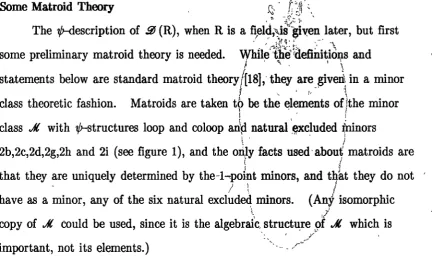
the minor class of matroids [18] has only two 'l/J-structures and six natural.
excluded minors.
Section 12 examines the minor class of matroids, which is a sub minor
class of the minor class of closure operators. Section 13 examines minor classes
of linear dependencies which have as homomorphic images, minor classes of
minor class homomorphisms could have consequences for some difficult
combinatorial problems. Minor classes of graphs and digraphs [16], in which the ground sets are either the edge sets or the vertex sets, are examined in section 14, together with some interesting homomorphisms.
-4-SECTION 2: NOTATION AND CONVENTIONS
Let A and B be sets. The power set of A is denoted 2A and the cardinality of A is denoted
I
AI ·
The set difference A-B denotes {aI
aEA and a~B}.Let I be a set. A function f:I-+A can be denoted as a family or vector
(f(i)liEI). If (AiliEI) is a family of sets, then its cartesian product II Ai is iEI
the set {( ai
I
iEI)I
aiEA i for every iEI}. In particular A I= II A is the set of all iEIfunctions from A to I.
Let !t be a set. A !lrlabelled partition, or a !lrpartition, of a set A is given by a function f:A-+!t (associating a "label" f(a)E!t with each aEA) and is denoted <AslsE!t >where As={alaEA and f(a)=s} for each sE!t. It is convenient to write A=<As
I
sE !t > to indicate that A can be treated as a set, or when relevant, can be partitioned into disjoint subsets labelled by elements of !t.Let B=<BslsE!t> and C=<CslsE!t>. Define B~C to mean Bs~Cs for every sE!t. Define B~C and B=C similarly. Let A=<As
I
sE!t > and suppose Ai=<A!lsE!t >andAi~A
for every iEI. Definen
Ai to be<n
A!lsE!t >andiEI iEI
define U Ai to be < U A!
I
sE !t >. Define II <A!I
sE !t > to be < II A!I
sE !t >.iEI iEI iel iEI
(The notation II Ai risks being ambiguous.)
i EI
Let A=<As
I
SE.ft> and B=<BsI
sE!t >. A function a:A-+B is!lrrespecting if a(a)EBs for every sE!t and every aEAs. In this case we can
talk of the !lrpartition <as:As-+Bs
I
sE!t > of a:A-iB, where as(a)=a(a) for everysE !t and every aEAs. This situation is expressed as
(a:A-1B)=<as:As-1BslsE!t >.
Let A=<As
I
SE.ft>. A relation q~AxA is ft-respecting if (a,b)Eqthe ~partition <qs~AsxAs,lsE-2
>
of q~AxA where aqsb exactly when a,bEAs'and aqb.
A complete lattice can be thought of as a partially ordered set with the
property that for any set of elements, there is a unique smallest element greater
than the elements, called their join, and a unique greatest element smaller than
the elements, called their meet. (Often join and meet are defined first and the
partial order derived from them.)
Often a symbol calls for a set to be written in a certain position, for
example the set X in rrE(x)/eqX(
~
). But if X is the single element set {x}then it is more convenient to replace { x} by x in the symbol, for example
rrE(x)/eqx(~)
rather than rrE({x})/eq{x}(tf ).Most papers do not precisely define "set" and neither will this one.
However, it is assumed that "set" is well defined, and each set is a well defined
collection of well defined elements (although not all such collections can be sets,
as Russell's Paradox shows). It is also assumed that the definition of "set"
satisfies certain desirable criteria (such as: any subset of a set is a set, the
power set of a set is a set, the union and cartesian product of a family of sets
are sets). Let "class" and "metaclass" be defined subject to the same criteria,
but with every set (respectively class) being a class (respectively metaclass) and
the collection of all sets (respectively classes) being a class (respectively
metaclass ), so that the definitions themselves must be different. Thus, a
theorem using the words "set" and "class" (but not "metaclass") which does
not make use of the particular definition of these words, could have "set"
(respectively "class") changed to "class" (respectively "metaclass") and remain
true. The modified theorem would appear more general, relative to a fixed
definition of "set" and "class" but really it would be saying exactly the same
-6-SECTION 3: MINOR CLASS DEFINITIONS
This section develops the definition of minor class in stages. The elements of a minor class are called structures, and associated with each structure is a set called its ground set. Isomorphisms between structures are represented by bijections between their ground sets. Finally there are
operations
of
point removal, which when applied to one structure, yield another structure whose ground set is obtained by removing points from the ground set of the first structure.A
structure
is a pair (S,Q) where Q is a set.(If
the structure is a well known mathematical object, its conventional name is used.) When Q is knownI
from the context, (S,Q) is abbreviated to S. The set Q is the
ground set of
Sand is denoted by G(S). While no conditions are imposed on S in the pair (~,Q), each concrete example of a structure in this paper satisfies the intuitive
notion of being based on its ground set, in the way that a matroid or group or ring is based on a set.
A
structure class
consists of a class # of structures, together with a class!t of sets, such tha_t G(S)E!t for every structure SE#. The elements of !t
are
ground sets.
This structure class can be denoted by the pair ( # , !t ) or abbreviated to # when !t is clear from the context. Often the symbol !t is not mentioned, but rather, the sets which are ground sets are specified. For the structure class ( #, !t ) and any ground set QE !t , let # Q denote{SI SE# ,G(S)=Q}, that is, the class of structures in # which have ground set Q. For distinct ground sets P ,QE !t it is dear that <ff'pn#Q is empty and hence <#QI QE !t
>
is a !t -partition of #. It is permissible that # Q be empty for some ground set QE !t (so that there are no structures in #, on ground set Q) ~ecause when various structure classes are compared, it is desirable that they have the same class of ground sets.finite sets. Let "fr be the class of all pairs (W,Q) where Q is a finite set and
W!;;2Q. (Observe that W satisfies the intuitive notion of a structure based on
the set Q.) Clearly "fr is a structure class with finite ground sets.
If a structure S is genuinely based on its ground set Q, then for any
ground set PE!l, a bijection w:Q-.P induces an isomorphic structure on- ground
set P in a natural way. A description of the i'somorphic structure naturally
induced by w is obtained from a description of the structure S, by replacing
every occurrence of each qEQ (in the description of S) by w( q). (For example,
consider this construction applied to the multiplication table of a group whose
elements are the elements of Q.) However, it is desirable to axiomatise the
behaviour of isomorphism for the more abstract definition of structure given
above, as the following definition does.
An
isomorphism class
consists of a structure class ( &' , !l ) together witha class J of functions; one function from &'Q to &'p for all ground sets
Q,PE!l and every bijection w:Q-.P. This function maps each structure SE&'Q
to a structure in &'p denoted w(S),
the isomorphic copy of
Sinduced by
the bijection w:Q-.P. (It may seem that w(S) is an abuse of notation, since ingeneral S~Q, but there is no ambiguity and the notation is convenient.) Also,
the structure w(S) is
(structure) isomorphic
to the structure S, via the(structure) isomorphism w.
If the structure TE&'p is such that_ T=w(S) thenT~S. An isomorphism class is required to satisfy the following two conditions. (Ml) For any ground set QE!l, if l:Q-.Q is the identity function, then l(S)=S
for every structure SE&'Q.
(M2) For all ground sets Q,P,RE!l and all bijections w:Q-tP and r:P-.R it holds
that r(w(S))=(row)(S), for every structure SE&'Q.
It is clear that (Ml) and (M2) will hold if all structures are genuinely based on
their ground sets, and isomorphism' is defined "naturally" as described above.
-8-For any ground set QE~ and any structure Se<?Y'Q, a (structure) automorphism of S is a (structure) isomorphism from S to itself, that is, a
\
bijection w:Q-+Q (a permutation of Q) such that w(S)=S. Let Aut(S) denote
{ wl
w:Q-+Q is a bijection and w(S)=S}, the set of (structure) automorphismsof S. Conditions (Ml) and (M2) ensure that Aut(S) is a group of
permutations of Q, with respect to composition of functions. For any bijection r:Q-+P, the automorphisms of structure SE<#'Q uniquely determine the
automorphisms of structure r(S)E<#'p since if w is a permutation of Q, then w(S)=S if and only if ( rowor-1)( r(S))=r(S). (This uses conditions (Ml) and (M2). Observe that rowor-1 is a permutation of P.) Thus
Aut( r(S))={ rowor-1
I
weAut(S)}.Returning to our previous example, the structure class "fr becomes an isomorphism class if isomorphism is defined in the natural way, as follows. For ground sets Q,PE.Z, let w:Q-+P be a bijection. Any structure WE"frq can be explicitly written out as a set of subsets of Q, and so replacing every
occurrence of each qEQ by w( q), yields w(W) explicitly written out as a set of subsets of P. More formally, define w:2Q-+2p by setting
w(N)={ w(
q)I
qEN} forevery
N~Q,
and define w:2(2Qt2(2P) similarly. (Recall that (W,Q)E"fr,exactly when
W~2Q,
that is, WE2(2Q).) So the isomorphism w sends (W,Q)to (w(W),P) as required. Conditions (Ml) and (M2) are guaranteed to hold when_ isomorphism is defined "naturally", so that
Y
is indeed an isomorphism class.points. The definitions below develop this idea.
A class of sets !t is
hereditary
if every subset of each element of !t , ~so is· an element of !t. That is, if QE!t and P~Q, then PE!t. Apre
'
point-removal class
consists of an isomorphism class (<ff', !t , J) where !t is a hereditary class of finite sets, together with a class K and another class .9 of functions; one function from <f/'Q to <f/'Q-{q} for every ground set QEi, every point qEQ and everymanner
£EK (as the elements of K are called). This function sends each structure Se<fl'Q to a structure in <fl'Q-{ q} denoted 8[£,q]. The structure S[f,q] isobtained from
Sby removing point
qin manner£.
In addition to (Ml) and (M2), a pre point-removal class is required to satisfy the following conditi9n.(M3') For all ground set's Q,PEJ, every bijection w:Q-+P, every point qEQ and every manner £ E K, it holds that
wl Q-{ q} (S[f,q])=(w(S))[l,w(q)] for every structure SE<fl'Q.
The bijection wlQ-{q}:Q-{q}-+P-{w(q)} is the restriction of w to Q-{q} and is used because S[f,q] has ground set Q-{q}. Condition (M3') simply ensures that point removal behaves sensibly with respect to isomorphism. This is guaranteed if isomorphism is defined naturally (so that (Ml) and (M2) hold) and the definition of point removal is invariant with respect to renaming ground set elements. This applies to all the concrete examples in this paper,
0
so that (M3'), along with (Ml) and (M2), are guaranteed to hold. Returning again to our example, one way to make
Y
into a pre point-removal class is as follows. Let K={ delete, contract}. For everyground set (finite set) Q, every structure WeYQ and every point qEQ, let W\q denote W[delete,Q] and let W /q denote W[contract,q]. Define W\q, the
deletion
of q from W, to be { wI
wEW and q~w} and define W / q, thecontraction
of q from W, to be {w-{q} lwEW and qew}. Observe that W\q and W/q are both subsets of 2Q-{q} and hence elements of YQ-{q} as10
-required. By earlier comments, condition (M3') clearly holds, so that '1r is indeed a pre point-removal class.
The examples of point removal in the mathematical literature generally have the property that points can be removed "in any order" yielding the same result. The following definition incorporates this property.
A
point-removal class
is a pre point-removal class in which the following condition holds.(M4') For every ground set QEi., all distinct points q,rEQ and all manners f ,mEK it holds that
(S[f,q])[m,r]=(S[m,r])[f,q] for every structure SE&1Q r
(It is necessary that q and r be distinct, since once a point is removed, it is absent from the ground set and cannot be removed again. However f and m need not be distinct.) Condition (M4') says that, starting with a structure Se&1Q, the effect of removing point q in manner f and then removing point r in manner m, is the same as first removing point r in manner m and then point q in manner f. It follows by induction that a sequence of point removals can be performed in any order yielding the same result (provided the manner of
removing any particular point is not changed).
Our example, the pre point-removal class '1r, is in fact a point-removal class, since for any ground set (finite set) Q, any structure WeYQ, and all distinct points q,rEQ, it holds that
as required.
(W\r)\q={wlwEW and q,r~w}=(W\q)\r ,
(W\r)/q={w-{q}lwEW and qEw and r~w}=(W/q)\r, (W/r)/q={w-{q,r}lwEW and q,rew}=(W/q)/r,
structures in #Q. Since the order of the point removals makes no difference
(as guaranteed by condition (M4')), it suffices to specify for each point qEQ, ·
whether or not q is removed, and if it is, in which manner (an element of K) it
" .
is removed. This can be encapsulated in a single symbol as follows. · Let
K=KU{®} where ®~K. (This definition remains in place throughout the paper.) For any
prescription
Jte~
(that is, Jt:Q-+K), let G(Jt)={qlqeQ. andJt(q)=®} and let S[Jt] be the structure with ground set G(Jt), obtained from the
struct'ure Se#Q by removing point q in manner ~(q) for each point qEQ-G(Jt), and not removing any point in G(Jt). It does not matter in which order the
points are removed, and in fac~ they could be considered to be removed
simultaneously.
So far, in this discussion about point removals, all ground sets have been
finite. One could allow infinite ground sets, but only finitely many points can
be -removed by removing only one point at a time. However, in the definition
of S[Jt] in the previous paragraph, one can consider all points in Q-G(Jt) to be
removed in a single operation determined by the prescription Jt. So it is
reasonable to allow Q-G(Jt) to be infinite w~en Q is, although S(Jt] could not
then be obtained from S by removing one point at a time. A new
formulation is required, and is given below.
A
minor class
consists of an isomorphism .class ( #, !l , J) where !/, is a hereditary class of sets, together with a class K and another class 9' offunctions; one function from #Q to #G(Jt) for every ground set QE!/, and
every prescription
itE~.
This function sends each structure SE#Q to astructure in #G(Jt) denoted S[Jt]. In addition to
(Ml)
and (M2), a minor classis required to satisfy the three conditions (M3), (M4) and (M5), given below.
Firstly, two definitions are needed. For all ground sets Q,Pe~ any
12
-by (w(Ji))(w(q))=Ji(q) for all qEQ. (That is, w(Ji) is actually Jiow-t.) For all classes A,B,C,D with B~A, and all functions f:A-tC and g:B-tD, the function (f~g):A-tCUD is given by setting (f~g)(b)=g(b) whenever bEB and
(f~g)(a)=f(a)
whenever aEA-B. In particular, for prescriptionsJE~
and .ceK°(J), it follows that the prescription Jie:K'l, where Ji=JM! is such that ~(q)=.C(q) whenever qEG(J) and Ji(q)=J(q) whenever qEQ-G(J).The three conditions are as follows.
(M3) For all ground sets Q·,PE !t , every prescription Jie:K'l and every bijection
w:Q-tP it holds that
wl G(Ji)(S[Ji])=(w(S))[w(Ji)] for every structure SE&'Q.
The bijection wl G(Ji) is the restriction of w to G(Ji) and is used because S[Ji] has ground set G(Ji). Condition (M3), like (M3'), simply ensures that point removal behaves sensibly with respect to isomorphism.
(M 4) For every ground set QE !t , if the prescription me:K'l is such that G(SJl)=Q (that is,
91(
q)=® for every point qEQ) then S[SJl]=S for every structure SE&'Q.This says that removing no points from S leaves it unchanged.
(M5)
For every ground set rQE !t and all prescriptions Je:K'l and .CEKG(J), if· prescription
Ji=(J~.C)e:K'l,
then S[Ji]=(S[J])[.C]f~r
every structure SE&'Q.I
This says that the effect of removing some points, prescribed by J, and then I
removing some more points, prescribed by .C, is the same as removing them all at once, as prescribed by Ji=J~.C. (Note that each point qEQ-G(Ji) is
removed in manner Ji( q) in both cases.)
For any structure SE&'Q and any prescription Jie:K'l, the structure S[Ji] is a minor of S. If G(Ji):fG(S) (that is more than zero points are removed), then S[~] is a proper mirior of S. A structure which is isomorphic to a minor of S is an isominor of S.
class and minor class are equivalent (up to change of notation), since all the mappings S-+S[l,q] determine all the mappings S-+S[~] and visa versa, and the conditions on these mappings (and the structure isomorphisms) are equivalent. This means that one can use either formulation, or even mix the two, whatever is most convenient. (Also, when necessary, one can verify whichever
conditions are easier to show.)
A minor class can be denoted by the quintuple (rt/, !t , J,K, !/') often abbreviated to rt/. Generally !l ,J and !/' (and quite often also K) remain unnamed, while their elements are all specified. For an alleged minor class
(rt/ ,!l J,K,!1') it is necessary to verify that conditions (Ml)-(M5) hold. As
discussed earlier, conditions (Ml)-(M3) are guaranteed when isomorphism is defined naturally and is respected by point removals, a case that is easily recognised. Conditions (M4) and (M5) should be cheGked, although (M4) is generally trivial. Note that the conditions (Ml)-(M5) are independent, that is, it is possible to construct a quintuple (rt/, !t , J,K, !/') satisfying any subset of these conditions, and only that subset.
Recall our example of a point-removal class
Y.
It follows thatY
is a, minor class. The idea of Y is easily generalised to a minor classr
(for any hereditary class of sets !t) with !l being the class, of ground sets andK = {delete, contract}. Adopting a convenient notation let
WI~=
{ w-B I weW and Anw=0 and B!;w}!;2Q-(AUB) be the structure on ground set Q-(AUB)14
-SECTION 4: EXAMPLES OF MINOR CLASSES
Let K,C,B be classes with KnC=0, and let A=KUC, for the duration of this section. Let !t be a hereditary class of sets. In this section, a minor class, denoted .:F !t(K,C,B), is defined, where !t is the class of ground sets and K is the class of manners (of point removal). This is quite a general example because any minor class can, in a sense to be defined later, be 11embedded11 in a
minor class of the form .:F iK,C,B).
The definition is developed in stages, starting with .:F iK,C,B) as a structure class. The structures in .:F!t(K,C,B) with ground set .QE!t are all the
pairs (f,Q) where fEB(A Q), that is, f is a function from A Q to B. Note that the elements of A Q are themselves functions from Q to A, and can be denoted as vectors (section section 2) x=(x I qEQ) or
(x(
q) I qEQ) wherex
=x( q)EA for' q q
all qEQ.
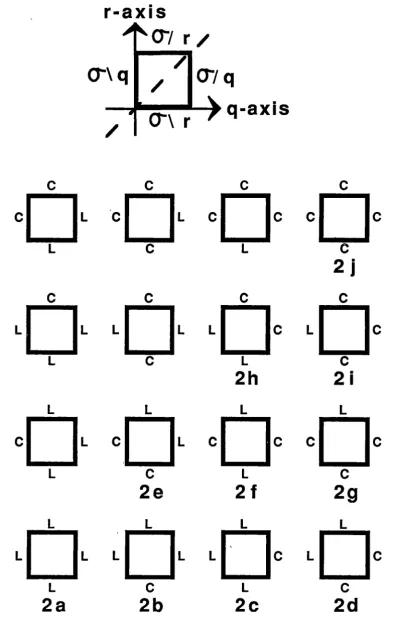
These structures, that is, functions of the form f:A Q-+B, can be conveniently visualised in the special case that Q,K and C are finite. Say
To make .51" 1K,C,B) an isomorphism class it is necessary to define structure isomorphism, and this is done "naturally" (see section 3). For all
.
Q
ground sets Q,PE.2, any function f:A Q-+B (that is, fEB(A )) and any bijection p
w:Q-+P, the function w(f):A p -+B (that is, w(f)EB(A )), isomorphic to f via
w,
is defined "naturally" as ~ollows. In the above visualisation, the q-axis is simply renamed as the w( q)-axis for each qEQ, so that the "coloured grid", while itself unchanged, now sits in IRP. More formally (but equivalently) w:A Q-+Ap andw:B(A Q)-+B(A p) are defined as follows. For xEA Q (that is, x:Q-+A) let
w(x)EAP (that is, w(x):P-+A) satisfy [w(x)](w(q))=x(q) for all qEQ (so that
w(x)
is actually xow-t). (Recall that w(~) was defined in this way in section 3.)
For fEB(A Q) (that is, f:A Q-+B) let w(f)EB(Ap) (that is, w(f):Ap -+B) satisfy (w(f)](w(x))=f(x) for all xEA Q. Since isomorphism is defined
natu~ally,
conditions (Ml) and (M2) automatically hold, (although it is routine to show this formally).To make .51" 1K,C,B) a minor clas (and a point-removal class when all ground sets are finite), it is necessary to define point removal. The
visualisation of point removal is much more illuminating than the formal definition (as was the case with structure isomorphism) and so it is given first. Recall the coloured grid in IRQ, associated with f:A Q-+B. For any point qEQ and any manner £EK, consider the mxmx ... xm (n-1 times, where n= IQ I) coloured subgrid consisting of those gridpoints with qth coordinate
.e.
(This is the "cross section" of the coloured grid taken by the hyperplane of IRQ,perpendicular to the q-axis and intersecting this axis at coordinate
.e.)
This coloured sub grid can be "projected 11 into IRQ-{ q} by sending each gridpoint16
-Q-{ q} (a function from A -Q-{ q} to B) obtained from f by removing point q in manner f. {Multiple point removals are defined soon.) It is clear that this definition of point removal respects isomorphism so that {M3') holds. Also for any distinct points q,rEQ and any manners f,hEK the coloured grid sitting in IRQ-{ q,r} obtained by removing point q in manner f, and point r in manner h {in either order) is obtained from the coloured grid for f sitting in IRQ, by taking the mxmx ... xm (n-2 times) coloured subgrid consisting of those gridpoints with qth coordinate
£
and rth coordinate h, and projecting it into IRQ-{ q,r} (while preserving grid point colour) by discarding the qth and rthcoordinates. {Note that this {n-2)-dimensional subgrid is the intersection of the two (n-1)-dimensional subgrids associated with the two removals of a single point.) This shows that {M4') holds.
More generally, for any prescription
~E~,
consider the mxmx ... xm(I G{~)
I
times) coloured subgrid consisting of those gridpoints with qthcoordinate ~( q) for all points qEQ-G{~). {This is the intersection of all the subgrids associated with removing a single point qEQ-G(~) in manner ~(q).) This coloured subgrid can be projected into
IRG(~)
by sending each gridpoint(xt
I
tEQ)EA Q withxq=~(q)
for allqEQ-G(~),
to the gridpoint(xt
I
tEG(~))EA G(~),
discarding the qth coordinate for allqEQ-G(~).
With each such gridpoint retaining its colour, this yields a coloured grid sitting inIRG(~),
which depicts the structure obtained from f by removing point q in manner ~(q) for all qEQ-G{~), (as prescribed by~). ,Again, point removalI
respects isomorphism so that {M3) holds, and it should be clear that (M4) and (M5) also hold (see the interpretations below the statements of these
conditions), making :Y 2(K,C,B) a minor class. (This is shown formally below.)
Here is the formal definition of point removal. For any structure fin
structure
f[~]
on ground setG(~)
is the following function fromAG(~)
to B.For every x=(x( q)
I
qEG(~))EA G(~)
it holds that(f[~])(x)=f(~~x).
(See section 3 for the definition of~.) With prescription mas in condition (M4), it follows thatm~=x
for all xEA Q and hence(f[m])x=f(~)=f(x)
so that f[m]=f and (M4) holds. With prescriptions J,.C as in condition (M5), it isclear that
(J~.C)~x=J~(.C~)
for all xEA G(.C). It follows that(f[J~.C])(x)=f((J~.C)~)=f(J~(.C~x))=(f[J])(.C~)=((f[J])[.C])(x) so that
f[J~.C]=(f[J])[.C] and (M5) holds. Clearly conditions (Ml),(M2) and (M3) hold
(it is routine to show this) so that .!? iK,C,B) is indeed a minor class.
The "coloured grid" visualisation appears in later sections, including some
proofs, to provide insight into a situation, but it is never a formal part of a
18
-SECTION 5: MINOR CLASSES AS ALGEBRAS Introduction
In this section, it is shown how minor classes can be treated as algebras, making much of the theory of universal algebra available to them. Some basic universal algebra definitions are given, along with minor class examples showing their relevance.
For convenience it will be required, until further notice, that a minor class ( &', ~ , .7,K, .9') must have <ff',~ ,K and hence .7 and .9' being sets. I suggest that this involves no loss of generality. (While this appears less general, it is equivalent (by changing the word "set" to "Class") to the case where ~ is a class of classes, which appears more general. See the discussion in section 2.) Readers can draw their own conclusions.
Universal algebra originated with Birkhoff's 1935 paper [1], which gives a general definition of what an "algebra" is, (covering many well known
mathematical entities of the time), and develops a large body of theory. Higgins' 1963 paper [6] extends this definition (admitting other well known mathematical entities as algebras), and shows that the theory can be extended similarly. Higgins' "algebras" are called
many-sorted
orheterogeneous
while those of Birkhoff are called1-sorted
orhomogeneous.
By Higgins' definition, a (many-sorted) algebra A consists of a ~-partition A=< AsI
sE~>
(for some set ~) together with a set of functions, each of the form A x · · · xAs -iAs for someSt n
- integer n~O and sorts s1,. • • ,sn,sE~. (Birkhof's definition has I~
I
=1.)When n=l the function is
unary,
and when all the functions are unary, the algebra isunary.
When universal algebraists specialise, minor classes are often among the algebras to miss out, since they are very different from algebras that are commonly studied. Nonetheless, unary algebras (including minor classes) are easier to deal with than algebras in general, making it easier to develop specialised theory for them.
Given below are some standard universal algebra definitions, with examples putting minor classes into context. The definitions only cover the unary case, since that is all that is needed here, and the notation is simpler. Full definitions appear in [3], while [5] contains more theory (but only for l-i!orted algebras).
Definitions
A
unary signature
is a pair ~( !l , tJ) where !l is a set whose elements are calledsorts
and tJ =< °s,t I (s,t )E !l x !l>
is a !J, x !},-partition of a set whoseelements are called
operator symbols.
(It is permissible that some °s,t may be empty.)A (
unary) algebra
Aof signature
E,
or a'fr-algebra,
consists of a!},-partition of a set A=<As I SEb, the
universe
of A, together with a set of functions; one function f A:As-1At for all sorts s,te!l and every operator symbolfE°s t" {It is ,permissible that some As, or some
°s
t' may be empty.) Except'
'
for minor classes (which are denoted by script letters) any algebra is denoted by the boldface version of the letter used for its universe. (For example, the universe of B is always B=<Bs I sE!l
>.)
A minor class ( &', !J,, J,K, .9') can be formulated as a unary algebra where
20
-p~:
c#'Q-+c#'p sends each SE&'Q toS[~]Ec#'p·
It is convenient to call operator symbols of the form iw, and also the corresponding unary functions,(structure)
isomorphisms,
and to call operator symbols of the formp~,
and also thecorresponding unary functions,
point removals.
(Note that a point removal can correspond to removing all, some, one or none of the points in the ground set of a structure.) So as a unary algebra, the minor class ( &', .2, J,K,!/J)
has · universe c#'=<c#'QIQE~ with functions in J and !/J. The signature (~0 is determined by !t and K. Observe however, that unary algebras with this signature need not be minor classes, since they need not satisfy conditions (Ml) to (M5). Fortunately tliese conditions are of a form which universal algebra handles best, namely equations. These are defined below.Equations and Varieties
Let E=( !t , ()) be a unary signature and consider a !t -partition of a set
X= <Xs I SE !t
>.
The elements of Xs shall be calledvariables of sort
s, for each sort sE!t. AE-term of sort
soin variables
X is a (possibly empty) string of operator symbols followed by a variable, f1f2 .. .fnx for some integer n~O such that operator symbols fiE(}_. s· for i=l,· · ·,n and variable xEX for some sortsS1-1, 1 Sn
so,si, · · · ,snE !t . In particular if n=O, this says that xEXso is a term of sort so.
Let
T~{X)
be the set of E-terms of sort s in variables X and letTE(X)=<T~{X)
I sE !t>.
For allY~X,
defineT~{Y)
and TE{Y) similarly. For any Y~X and any E--algebra A, anassignment
is a !t -respectingfunction a:Y-+A. The
extension
ofa
is the ft-respecting function a:TE(Y)-+A which sends each term f1f2. ·.fnxE~~
0
(Y)
to fA
(f_A ( ...(f~
( a(x)) · · · ))EAso· (The definition of term ensures that this last expression makes sense, that is, the unary functions are only applied to elements on which they act.)holds that a(t')=a(r). Observe that if there were some sort se.i with Ys-10
but As=0, then the equation would automatically be valid, since there would be
no assignment a:Y-+A. It follows that adding extra variables to Y can change
the validity of the equation in some algebras.
Define var(
t'
,r) to be the set of variables which. appear in termt'
or term r (there are one or,two of them). The equation (Y,t',r) is aproper equation
ifY=var(t',r) and in this case is abbreviated to the pair (t',r), usually written
t'=r. Almost all equations in the literature are proper. The proper equation
t'=r is a
regular equation
if var(t',r) has only one element, that is, the same variable appears on both sides.An
equational specification
(respectivelyproper
equational specification,regular
equational specification) is a pair A=(E,0) where 0 is a set ofE-€quations (respectively proper E-€quations, regular E-€quations). A
E-algebra A is an
algebra of the specification
A, or aA-algebra,
if every equation in 0 'is valid in A. (Note that E can be treated as a regularequational specification in which 0 is empty.) A class of algebras is a
variety
(respectively
proper
variety,regular
variety) if it is the class of all A-algebras for some equational specification A (respectively proper equational ~pecificationA, regular equational specifications A). The adjective
unary
can also precedethe word variety, if it is to be emphasised that it is a variety of unary algebras: It should be noted that all varieties of 1-sorted algebras are proper varieties,
but this does not hold for many-sorted algebras.
For any set of E-equations 0, let alg(0) be the class of all (E,0)-algebras. So all (proper, regular) varieties of E-algebras are of the form alg( 0) for some
22
-is alg(eq( 'if)) (respectively alg(peq( 'if)), alg(req( 'if))). If 'if is a proper
variety then the equations in eq( 'if) are exactly those of the form (Y,£,r) for
proper equations (£,r)Epeq('if ). If 'if is a regular unary variety then all
proper equations in peq('if) are regular, that is peq('if )=req('if ). Incidentally,
eq(alg(eq( 'if )))=eq( 'if) for every 'if and alg(eq(alg(0)))=alg(0) for every 0.
A set of E--equations of the form eq( 'if) is deductively closed. There are
rules [3] by which any equation in eq(alg(0)), the deductive closure of 0, can be
derived from equations in 0. (These correspond to the way equations are
manipulated in practice.) For all sorts sE !t , let eq; ('if ) be the set of all pairs
( i
,r) where the equation (Y ,£ ,r), of sorts, is in eq( 'if ) (that is, is valid in everyalgebra in 'if) and let eq y( 'if) be <eq; ('if)
I
sE!t>.
Then eq y ('if) is a !!,-respecting equivalence relation on TE(Y). So two terms f,rET~(Y),
ofsort s, are equivalent by eq y ('if) exactly when the equation (Y,£,r) is valid in
every algebra in 'if. In particular when 'if =alg(0), the term r can be
obtained from the term f (and visa-versa) by a sequence of formal
manipulations [3] involving the equations in 0. (Again these manipulations
correspond .to what is done in practice.)
The truth of conditions
(Ml)-(M5),
imposed on minor classes, is '
-equivalent to the validity of all of a certain set of regular unary equations of
the appropriate signature (which depends on !t and K). For example, by
simple conversion of notation, .condition
(M5)
is equivalent to the validity of allequations
pJ~.Cx=p.CpJx,
for every sort QEi.,
some variable x of sort Q, andevery J and .C as given in condition
(M5).
LetEM5
be the set of theseequations. Similarly, with the superscripts below taking all possible values as
given in the corresponding condition, and x being a variable of the appropriate
consist of all equations i wl G(Ji)pJix=pw{Ji)iwx and let EM4 consist of all
equations pmx=x. Let EM be the union of EMl to EM5. Note that the
universal quantifier "for every structure SE~" is not mentioned when listing these equations, since it is incorporated in the definition of validity of these
equations. (See the definition of "valid" given earlier.)
It is convenient to call a minor class, with set of ground sets !t and set of /
manners K, a ( !t ,K) minor class. Then the class of all ( !t ,K) minor classes,
is the class of all algebras of the appropriate signature, in which all the (regular
unary) equations in EM are valid, so that it is a regular unary variety. There
is a separate variety for each distinct pair ( !t ,K). Similarly there is a (regular
unary) variety of structure classes, and one of isomorphism classes, for each !l ,
and there is a (regular unary) variety of pre point-removal classes, and one of
point-removal classes, for each ( !l ,K).
Any minor class term will consist of a variable preceded by a (possibly
empty) string of isomorphisms and point removals. The term manipulations,
mentioned above, allow any such term to be put into a standard form.
Firstly, the equations in EM3 allow all the isomorphisms to be taken to the left
of the point removals. Then the equations in EMl and EM2 allow any
(possibly empty) string of isomorphisms to be reduced to one isomorphism, and
the equations in EM4 and EM5 do the same for point removals. So any minor
class term of sort PE !l , with variable x of sort QE !t , is equivalent (in the
presence of the equations in EM) to the
canonical term
iwPJix
for some prescriptionJiE~
and some bijectiqnw:G(Ji)~P.
(Note that Ji and wareuniquely determined by the original term.) So applying any sequence of minor
class functions (isomorphisms and point removals) to a structure, is equivalent
24
-Subalgebr38, Homomorphisms and Direct Products
In (1], Birkhoff gives two equivalent characterisations of when a class of E-algebras (for some signature E) is a variety. Higgins (6] extends this to many-sorted algebras. One characterisation is the definition given earlier, while the other is that the class of algebras is closed under certain constructions (by which some algebras are constructed from others). These three
constructions, namely, subalgebras, homomorphic images, and direct products, are given below, together with related theory. The above equivalence ensures that when these constructions are applied to ( !t ,K) minor classes (for some i, and K) they yield ( !t ,K) minor classes (since these form a variety).
Subalgebras
Let
E=(
i, , ()) be a unary signature and let A and B be E-algebras. Then B is a subalgebra of A, and A is an extension of B if Br.;.A and f A (a)=fn(a) for all sorts s, tE !t , every operator symbol fE°s
t and every element aEB s· In this'
case we write B~A and B~A and say that B is a subuniverse of A.
Equivalently, B is a subuniverse of A if Br.;.A and fA (a)EBt for all sorts s,tEi-,
every operator symbol fe
°s
t and every element aeBs, and B is the unique'
subalgebra (of A) with universe B, where each function fB:Bs-+Bt is defined by setting fB(a)=f A (a) for all such s,t,f and a.
definition of these functions in <ff', on structures in 9. In this case, 9 is a
sub minor class of <ff' •
For any ~algebra A, the partial order $ on subuniverses of A, induces a complete lattice, so that the meet and join of any set of subuniverses is defined.
(See section 2.) The same is true for subalgebras, since there is an obvious
one-to-one correspondence between subalgebras and subuniverses. The meet of
subuniverses is the intersection of subuniverses. For any C~A, there exists a unique subalgebra of A, denoted Aincq, such that the corresponding
subuniverse, denoted AincC, minimally contains C. That is AincC is the
intersection of all subuniverses containing C. If AincC is A, then A is
generated by C (or C generates A).
What appears in the previous paragraph holds for all algebras. However,
a property which rarely holds for algebras in general, but which holds for all
unary algebras, is that the join of subuniverses is the union of subuniverses.
This is the major reason why unary algebras are simpler to study than algebras
in general. For any E-algebra A (where Eis a unary signature) and any C~A,
there exists a unique subalgebra of A, denoted AexcC, such that the
corresponding subuniverse, denoted AexcC, is maximally disjoint from C.
That is, AexcC is the union of all subuniverses disjoint from C.
Define a relation $ on elements of A (this cannot be confused with the
partial order $ on subuniverses of A) where for all elements a,beA it holds that
a$b exactly when aeAinc{b} or equivalently b~Aexc{ a}. That is, every
subuniverse containing element b, also contains element a. An equivalent
definition, independent of the previous two paragraphs, is given inductively by
saying that a$a for every element aeA and for all elements a,beA, if a5b then
fA(a)5b for any fA which acts on element a, (that is, if aeAs for some sorts
then the operator symbol fE°s t for some sort t). So a5b exactly when element
'
-26-functions of A, and Ainc{b} consists of all such elements a.
This relation 5, on elements of A, is a quasi order (that is, it is reflexive and transitive). Let a~b be defined to mean a5b and b5a, so that ~ is clearly an equivalence relation. Let a<b be defined to mean a5b and b!a (or
equivalently, a5b and a*b). For any C~A, observe that AincC consists of all elements aEA such that a5b for some bEC and that AexcC consists of all elements aEA such that b!a for every element bEC.
If a5b then element a is an isominor of element b. For minor classes, this is equivalent to the earlier definition; since as shown before, any structure obtained from another structure by a sequence of minor class functions, can be obtained by performing a point removal followed by an isomorphism. For any two structures S and T in a minor class with only finite ground sets, s~T if and only if S~T. (Since s~T means that both S and T are isomorphic to a minor of the other, so that I G(S) I
5
I G(T) I and I G(T) I5
I G(S) I and henceI G(S) I= I G(T) I· Since ground sets are finite, neither S nor T is isomorphic to a proper minor of the other, so that S~T. Also S~T clearly implies s~T.) This need not hold when there are infinite ground sets. For example, consider the minor class 1r .ft (see section 3) such that there exists a countably infinite
ground set QE!t. Define structures Wi,W2E1f" !t, on ground set Q, where
W1={P I P~Q and IP I is odd} and W2={P I P~Q and IP I is even}. Then contracting any one point from one of them gives a proper minor, isomorphic to the other, while W1 is not isomorphic to W2. That is, w1~w2 while Wi'/.W2.
Given a E-algebra A and a subuniverse B of A, we often wish to find C~A such that B=AexcC, and to express C economically. An infinite (strictly) descending chain in A is an infinite sequence of elements ai,a2,as, · · · of A such that · · · <as<a2<a1. If such a sequence exists then A has an infinite
the above infinite descending chain, and that B=Aexc{a1,a2,a3,· · · }. Then for
any C such that B=AexcC, it must be that C has redundant elements which
can be removed from C without changing the subuniverse. (That is, there
exists D~C with D/:C and B=AexcD.) This is because any element of C is strictly above (>) some ai while some other element must be below (~) ai
making the former element redundant.
An element bin a quasi ordered set is
minimal
if for any element a witha~b it holds that b~a, so that a~b. Now if A has no infinite descending chain (as is the case for minor classes with only finite ground sets) then every
element of A-B is bounded below by a minimal element of A-B. If element b.
is minimal in A-B then so is every element aeA-B such that a~b. Let b~ be the set {a I aeB-A and ~b} of such elements. If B=AexcC then C must
contain at least one element of b~ (any one will do) but it need not contain more than one (since the exclusion of any element ae(b~) from A, removes every element c~a and in particular every element ce(b~)). So if C consists of exactly one element of b~ for each element b, minimal in A-B, then C has no
redundant elements.
A minor class r!/, with only finite ground sets, has no infinite descending
chain · · · <Sa<S2<S2<Si, since this would require an infinite descending chain
· · ·<I G(Sa) I< I G(S2) I< I G(S1) I of positive integers - an impossibility. So for
any sub minor class 9' of r!/ , any structure in r# -9' is bounded below by a
minimal structure in r//-9'. These minimal structures are the
excluded
isominors of
9'in
r!/ . Let C~ r!/ -9' contain exactly one of each of these (anyone will do) up to isomorphism, or equivalently, as shown earlier, up to
~-equivalence. Then 9'=r//excC and C hasµ~ redundant elements. The elements of C are the
excluded minors of
9'in
r#. These excluded minors are determined up to isomorphism. Often an excluded minor is described, not as a28
-which is all that is needed anyway.
Recall the minor class Y, defined in section 3, which has only finite ground sets. Let YU consist of those structures (W,Q)EY (recall that
W~2Q)
which have the property that if PEW andP~R~Q,
then REW.Equivalently, if PEW and qEQ-P, then PU{q}EW. It follows that if (W,Q)E(Y-Y U) then there exists PEW and qEQ-P such that
PU{q}~W.
Contracting every point in P from W, and deleting all other points except q leaves ({0},{
q}) which is also in 1r -if"u.
This shows that1r U = Y exc{( {
0}, {
q})}, where { q} is an arbitrary one element ground set. So1r U is a sub minor class of 1r with a single excluded minor (in Y ).
Recall the minor class .Y !l (K,C,B), defined in section 4. For any
D~B
the minor class .Y !l(K,C,D) is a sub minor class of .Y !l (K,C,B). However, we cannot talk of excluded minors when there exist infinite ground sets.lloinoinorphisrns
Let E=( !l ,
tJ)
be a unary signature and let A and B be E-algebras. A'frhomomorphism from A to B is a !l-respecting function a:A-1B, with
!l-partition <as:As-1BslsE!l >,such that a respects f, that is,
at(fA(a))=fB(as(a)) for all sorts s,tE!l, every operator symbol fE!ls t and every
'
element aEAs. Observe that this condition ensures that if C~A and C
generates A, then specifying the effect of
a
on the elements of C, determines its effect on all of A.If &' and 3' are ( !l ,K) minor classes (for some set of ground sets !l and set of manners !l ) then a:. &' -1 3' is a minor class homomorphism provided that the following three conditions hold. Firstly, a respects ground sets (sorts), that is, G( a(S) )=G(S) for every structure SE#. Secondly, a respects point removals, that is a(S[~])=(a(S))[~] for every structure SE# and every
on structures in rff' while the point removal on the right hand side acts on structures in :J'. The same goes for the structure isomorphism in the next condition.) Thirdly,
a
respects (structure) isomorphisms, that is,a(w(S))=w(a(S))
for every structure SE#, every ground set PE.!l and every bijection w:G(S)-1P.Let A,B,C be b--algebras and let a:A-1B and ,8:B-1C be b--homomorphisms. · The composition of homomorphisms
a
and,8
is ({Joa):A-1C, that is,<(,8soas)
I
SE !l >. Clearly{Joa
isa
b--homomorphism from A toc.
Thehomomorphic image a(A) of A under a is the subalgebra of B with universe
a(
A)=<as(
As)I
sE !l > where as(As)={ as(a)I
aEAs}· The homomorphism a:A-1B is an isomorphism ifa
is a bijection (that is,as
is a bijection for each sort sE !l ) . In this case A is isomorphic to B, denoted A~B. An embedding is an injective homomorphism a:A-1B (that is,as
is injective for each sort sE.!l ). In this case, A can be embedded in B. (This is equivalent to saying that A is isomorphic to a subalgebra of B, namely a(A).)A congruence on A is a .!l -respecting equivalence relation q~AxA, with .!l-partition <qs~AsxAslsE.!l>, such that aqsb implies (fA(a))qt(fA(b)) for all sorts s,tE.!l, every operator symbol fE°s t and all elements a,bEAs. For every
'
sort sE !l and every element aEAs, let aq be {b
I
bEAs and aqb}, letAsf
q be { aqI
aEAs}, and let A/ q=<As/ qI
SE !l >. The algebra A/ q, with universe A/ q, is defined by setting fA/q(aq)=(f A(a))q for all sorts s,tE.!l, every operator symbols fE°s t' and every element aEAs. The conditions on q ensure that this'
is well defined. The function which sends each aEA to (aq)eA/q is a homomorphism, and the homomorphic image of A is A/ q.
30
-algebra B. Also the homomorphic image a(A) is isomorphic to A/ker(a) via the isomorphism which sends a(a) to a·ker(a) for every element aEA.
Let q and t be congruences on A. Define q~t to mean q~t (as subsets of AxA) or equivalently, aqb implies atb for all elements a,bEA. The partial·_ order ~ on all congruences on A induces a complete lattice (see section
2).
The meet of congruences is the intersection of congruences (as subsets of AxA) and the join of congruences is the smallest congruence containing their union._An interesting property, possessed by every unary variety '8 is the so called
congruence extension property
[5]. This says that every congruence t on a subalgebra B of unary algebra AE '8 , can be extended to all of A. That is, there exists a congruence q on A such that aqb exactly when atb, for all elements a,bEB. For example if i=<{(a,a) laEAs} lsE2 >,which is trivially a congruence on A, then one possibility is q=tUi. An equivalent statement of the congruence extension property is that any subalgebra of any homomorphic image of any algebra AE <8 is a homomorphic image of a subalgebra of A. (The converse is true for all varieties.)Some congruences on unary algebras can be obtained in the following way. Let A be a unary algebra and G a group of automorphisms of A. Define a relation q on A where for all elements a,bEA it holds that aqb exactly when a=a(b) for some automorphism aeG. Since G is a group, q is an equivalence. Also q is 2 -respecting, since each automorphism aeG is. For any sort sE 2
and any elements a,bEA, if aqb then there exists automorphism aeG such that a=a(b), by definition. Since
a
is a homomorphism it follows thatfA(a)=fA(a(b))=a(fA(b)) for every sort tE2 and every operator symbol fE°s,t· Therefore q is a congruence. Not all congruences can be obtained in this way.
We now illustrate some of the above concepts with familiar examples of minor classes. If g:B-1D is a function then there is a (minor class)
(where A=KUC) to (gof):A Q-+D. (For non-injective g:B-+D, the effect of this
homomorphism is like looking at the "coloured grid" for f with a partial colour
blindness, in the visualisation given in section 4.) The homomorphism is an
isom~rphism if g is a bijection, and an automorphism if B=D and g is a
permutation of B. If
E~C,
then there is a homomorphism from :7 !t(K,C,B) to.:?1K,E,B) which sends each f:A Q-+B to the restriction off to (KUE)Q. (This
amounts to discarding some of the "coloured grid" for f.)
The minor class
Y
!t is isomorphic to :7 !t(K,0,B) where K={delete,
contract}
and I BI =2, say B={in, out}.
For every ground set QE!t and everyP~Q let P:Q-+K be the function with P(
q)=delete
whenever ~p andP(q)=contract
whenever qEP. This means that KQ is {PIP~Q}.
For everyW~2Q
let W:KQ-+B be the function withW(P)=in
whenever PEW andW(P)=out
wheneverP~W.
This means that B(KQ) is {WIW~2Q}·
Thefunction from Y !t to .:? 1K,0,B) which sends (W,Q) to (W,Q) is an
isomorphism. So we can visualise (W,Q) as the points of a 2x2x ... x2 (IQ I
times) _grid, or equivalently, the vertices of a IQ I-dimensional hypercube, each
with one of two possible labels, like in/out, black/white, etcetera. Any
automorphism of this particular .:? 1K,0,B) corresponds to an automorphism of
Y
!t_
From the previous paragraph it follows that, the identity function Y .2and the function sending each (W,Q)E1f' !t to (2Q-W,Q), are both
automorphisms of Y !t. The second of these comes from swapping the two
elements of B for each function f:KQ-+B, or for
W~2Q,
swapping membershipand non-membership of 2Q, giving 2Q-W, the complement of W. These two
automorphisms form a group so there is a congruence q on Y !t where V qW if
and only if G(V)=G(W) (let these equal Q), and either V=W or V=2Q-W.
32
-structure (W,Q), where
W~2Q
and for any P,REW, ifP~R
then P=R. The clutters with finite ground sets form a subset of 1f' which is actually a subminor class of "If", (since it is closed under deletion, contraction and clutter isomorphism). However, Seymour [14] defines a different minor class whose structures are clutters, and this is not a sub minor class of "If". However it is isomorphic to "If" U (defined earlier in this section) via the isomorphism which sends each clutter W, on ground set Q, to the structure {PI R~P~Q for some
REW}, on ground set Q, in
.,,-.u.
Since "If" U is a sub minor class of "II', ,.,Seymour's minor class of clutters can be embedded in "II'.
Direct Products
Let
E= (
.2 ,l7)
be a unary signature. If I is a set and (Ai I i El) is a family of~algebras
then the algebra P= II Ai, defined below, ·is thedirect product
ofiEI
(AiliEI). The universe of P is P= II <A!lsE.2 >(see section 2). That is, for iEI
any sort sE.2, the elements of P s are of the form (ai I iEI) where aiEA! for all iet. (The components of ( ai I iEI) all have the same sort.) For all sorts
s,tE.2, every operator symbol fE°s t' and every element (ailiel)EPs it holds that
'
fp((ailiEl)}=(f i(ai)liEI). In particular; if 1=0 then IPsl=l for every sort
A
se .2 and fp:P s-+P t is defined in the only possible way for every fe °s,t and all s,tE .2.
For example, let I be a set and ( &' i I iEI) a family of ( .2 ,K) minor classes (for some set of ground sets .2 and set of manners K). Then II r#'i has
iEI
Suppose I is a set, (Bi
I
iEI) is a. family of sets, and let B= II Bi. Then iEIII
~
.i(K,C,Bi) is isomorphic to~
.i(K,C,B) via the isomorphism which sends iEIeach (ri
I
iEI) on ground set Q, (so that if fi:A Q-1Bi for each iEI) to the function f:A Q-1B, on ground set Q in~
1K,C,B), where f(x)=(ri(x)I
iEI) for every xEA Q. IfI
II
=2 and we use our coloured grid visualisation, thenII
~
.i(K,C,Bi) consists of pairs of coloured grids (with the same ground sets), iEIwhile the elements of