Theorems of Birkhoff Type
in Pseudovarieties and
E-varieties of Regular Semigroups
Genevieve Churchill, B.Sc.(Hons)
Submitted in fulfilment of
the requirements for the degree of
Doctor of Philosophy
Department of Mathematics
University of Tasmania
I declare that this thesis contains no material which has been accepted for the award of a degree or diploma by the University or any other institution, and that, to the best of my knowledge and belief, it contains no material previously published or written by another person except when due reference is made in the text of the thesis.
This thesis may be made available for loan and limited copying in accordance with the Copyright Act 1968.
Abstract
This thesis is concerned with the problem of being able to use, or general-ize, Birkhoff's fundamental theorems for classes of algebras which do not form varieties - particularly in pseudovarieties and e-varieties. After giving an intro-duction to these areas in Chapter 1, we first look at pseudovarieties, focusing on certain generalized varieties.
Let Corn, Nil, and
Al
denote the generalized varieties of all commutative, nil, and nilpotent semigroups respectively. For a class W of semigroups let L(W) andg (vv)
denote respectively the lattices of all varieties and generalized varieties of semigroups contained in W. Almeida has shown that the mapping n Corn) U n Corn} —+g
(Al n Corn) given by W W n Al
is an isomorphism, and asked whether the extension of this mapping to ,C(Aid)U{Ari/}is also an isomorphism.
In Chapter 2 we consider this question. In Section 2.2 we show that the extension is not surjective. Non-injectivity is then established in Sections 2.4 - 2.6; this involves analysing sequences of words of unbounded lengths derived from the defining identities of certain nil varieties. Results of a more general nature are also given, in Section 2.3, involving the question of when two arbitrary semigroup varieties possess the same set of nilpotent semigroups.
In Chapter 3 we turn to the problem of establishing analogues of Birkhoff's theorems for e-varieties. In Section 3.1 Auinger's Birkhoff-style theory for locally inverse e-varieties is expanded, to obtain a unified theory for e-varieties of locally inverse or of E-solid semigroups - that is, for the entire lattice of e-varieties in which nonmonogenic bifree objects exist. In addition an alternative unification, based on the techniques used by KaClourek and Szendrei to describe a Birkhoff-style theory for E-solid e-varieties, is given in Section 3.2.
in an e-variety V of regular semigroups if and only if V is locally E-solid; this extends KaClourek's work on the existence of trifree objects in locally orthodox e-varieties and generalizes Yeh's result on the existence of bifree objects.
In conclusion, a theory of "n-free" objects is outlined in Section 3.4, indi-cating how analogues of the concept of a free object can be defined for any e-variety.
Acknowledgements
I would like to thank my supervisor Peter Trotter for his guidance and ever encouraging and helpful attitude. I am grateful to Peter for giving me the ideas that formed the basis of the work on e-varieties presented in the third chapter of this thesis, and for his great care in proofreading.
Without the help of my husband Leigh in keeping homelife afloat, especially with two babies, this thesis would have been an impossibility. Impossibility also without the help of my God. The work is His rather than mine.
Contents
1 Introduction
1.1 Universal algebra
1
4 1.1.1 Subalgebras, direct products, homomorphisms, and con-
gruences. 5
1.1.2 Varieties and identities 6
1.1.3 Free objects and Birkhoff's theorems 7 1.2 Pseudovarieties and generalized varieties 9 1.2.1 Pseudoidentities and free profinite algebras. 10
1.2.2 Generalized varieties 14
1.3 E-varieties of regular semigroups. 16
1.3.1 Preliminaries 17
1.3.2 E-varieties and regular unary semigroup varieties 20
1.3.3 Some relevant e-varieties. 22
1.3.4 Orthodox e-varieties 26
1.3.5 Bifree objects in e-varieties. 29
1.3.6 E-solid and locally inverse e-varieties. 32
1.3.7 Locally orthodox e-varieties 33
2 Almeida's Generalized Variety Problem 36
2.2 The mapping a is not surjective. 38 2.3 Semigroup varieties whose nilpotent parts coincide. 40 2.4 Nil varieties whose nilpotent parts coincide. 45 2.5 The sequences (an)n>0 and (An)n>0 49 2.6 The varieties U and V are distinct. 65
3 Biidentities 71
3.1 E-varieties of E-solid or locally inverse semigroups. 72 3.2 An alternative approach to e-varieties of E-solid or locally inverse
semigroups 87
3.3 E-varieties of locally E-solid semigroups . 99 3.3.1 The existence of trifree objects in locally E-solid e-varieties.100 3.3.2 Only locally E-solid e-varieties admit trifree objects. . . 108
Chapter 1
Introduction
The classes of finite semigroups and regular semigroups are important examples of classes of semigroups that do not form varieties or admit free objects, and are therefore without the direct advantages of Birkhoff's fundamental theorems of universal algebra relating varieties, identities, and free objects. For both cases the definition of a variety of algebras, as a class of algebras of a given type closed under taking homomorphic images, subalgebras and direct products, is weakened: a pseudovariety of semigroups is a class of finite semigroups closed under taking homomorphic images, subsemigroups and finite direct products; and an e-variety of regular semigroups is a class of regular semigroups closed under taking homomorphic images, regular subsemigroups and direct products. Various theories have been developed in both cases, by considering links with varieties, or by devising analogues of the notions of identity or free object that allow for "Birkhoff-style" theorems.
dovarieties, focusing on a link with varieties by which Birkhoff-style properties can be used for pseudovarieties. We then turn to the problem of developing Birkhoff-style theories for e-varieties of regular semigroups. This chapter gives an introduction to these areas, with preliminary results.
In Chapter 2, we investigate certain generalized varieties, which are used in the study of pseudovarieties. In [6], Ash defined a generalized variety as a directed union of varieties, and proved that a class of algebras is a generalized variety if and only if it is closed under the formation of homomorphic images, subalgebras, arbitrary powers and finite direct products. Ash showed that gen-eralized varieties provide a link between varieties and pseudovarieties: a class of algebras is a pseudovariety if and only if it consists of the finite members of some generalized variety. Several authors including Almeida and Reilly [4], Almeida [1], Pastijn [31], and Pastijn and Trotter [32] have investigated pseudovarieties and therefore generalized varieties from this point of view.
In Chapter 2 we look at this connection between pseudovarieties and varieties in a special case. Let Corn denote the variety of all commutative semigroups, let Aril denote the generalized variety of all nil semigroups, and let
Al
denote the generalized variety of all nilpotent semigroups. For any class W of semigroups letr(v)
denote the lattice of all varieties of semigroups contained in W, and letg (Iv)
denote the lattice of all generalized varieties of semigroups contained in W. Almeida [1] has shown that the mappingr(Arii n
Corn)u n
coin}g (Al
n
Corn)given by W W n Ar is an isomorphism, and asked ([3, Problem 10]) whether the extension of this mapping to r(Ard) U {Nil} is also an isomorphism.
possess the same set of nilpotent semigroups. The question of when two nil semigroup varieties have the same set of nilpotent semigroups is more complex. In Sections 2.4 - 2.6 two varieties U ,V E G(Aril) are defined and used to show that the extension described above is not injective. These varieties have a remarkable property: there is an infinite sequence of words with unbounded lengths, derived from the defining identities of U and V, such that for any set X, with IX I > 3, the terms of the sequence constitute a congruence class of both the fully invariant congruence on the free semigroup X+ which corresponds to U and the fully invariant congruence on X+ which corresponds to V.
Chapter 3 deals with analogues of free objects for e-varieties of regular semi-groups. The concept of an e-variety of regular semigroups was introduced inde-pendently by Hall [20], and Kaaourek and Szendrei [26]. Kaaourek and Szendrei used the term bivariety, and considered only classes of orthodox semigroups. With this restriction they gave definitions of bifree objects, biidentities and bi-invariant congruences, and were able to generalize Birkhoff's theorems. Yeh [43] investigated the existence of bifree objects in arbitrary classes of regular semigroups, and proved a necessary and sufficient result; namely that non-monogenic bifree objects exist in an e-variety V if and only if V is contained in either the e-variety of all E-solid semigroups or the e-variety of all locally inverse semigroups.
techniques of Kaaourek and Szendrei in [27].
In [25], Kaaourek considered classes of locally orthodox semigroups. By Yeh's results, bifree objects do not always exist in these classes. Generalizing the ideas used to develop the theory of bifree objects, Kaaourek defined trzfree objects. He showed that trifree objects exist in every e-variety of locally orthodox semigroups. However, he also showed that other Birkhoff-type theorems do not hold in this context. In Section 3.3 we extend Kaaourek's work to classes of locally E-solid semigroups. In fact we show that trifree objects exist in an e-variety V of regular semigroups if and only if V consists of locally E-solid semigroups.
In conclusion, a theory of "n-free" objects is outlined in Section 3.4, indi-cating how analogues of the concept of a free object can be defined for any e-variety.
This chapter is meant as an introduction to our subject - that is, pseu-dovarieties of finite semigroups and e-varieties of regular semigroups, with the underlying common theme of using or generalizing Birkhoff's theory of vari-eties, free objects and identities. We therefore start with a section on universal algebra, proceeding to discuss pseudovarieties in Section 1.2, and e-varieties in Section 1.3.
1.1 Universal algebra.
Throughout this section let T be a fixed type of algebras, with set 0 of
oper-ation symbols. All algebras will be considered to be of type 7 unless otherwise
stated. We fix C as a class of algebras of type T.
For every n > 0 let Or, = E 0 : f has arity n}. For every f E 0 we write
fA for the corresponding operation on an algebra A.
For this section let X be a nonempty set of distinct objects called variables or letters such that X n 00 = 0. The set X is sometimes called an alphabet.
1.1.1 Subalgebras, direct products, homomorphisms, and
congruences.
Let A and B be two algebras. The algebra B is a subalgebra of A, written B < A, if B C A (as sets) and for every f E 0 the operation fB is the restriction of fA
to B.
The direct product A = MEI Ai of a family
{A :
i
E /} of algebras is such thatfA (ai, • an)(i) = fAt (ai(i), • • • an(i))
for all i E
I
whenever f E On and al, , a E fJj A,. The product A is said to be a direct power when all the A, coincide.An equivalence relation p on an algebra A is a congruence if whenever f E and az, bz E A satisfy (at, bz) E p for 1 < < n we have
(fA (ai,• • • ,an), fA (b1,..• bn)) E P.
The quotient algebra A p is such that fAIP(aip, , anp) = fA (ai,. . ., a)p for every al, , a E A and f E
O.
A homomorphism from A to B is a mapping a : A -4 B which satisfies
Notation 1.1.1 Let A and B be two algebras. The kernel of a homomorphism
a : A -4 B is the congruence a o a -1 = {(a, b) EAxA: aa = ba}. Given a congruence p on A, the homomorphism A —> Alp given by a 1-4 ap, a E A, is denoted by p . For a relation p on A let p -1 = {(a, b) : (b, a) E p} . Let (p)
denote the congruence on A generated by p; that is, the least congruence on A
that contains p. 0
Result 1.1.2 ([11]) Let a : A -- B and 0 : A C be two homomorphisms such that [3 is surjective and 0 o 13 - I C a o a 1 . Then there is a homomorphism C B given by a0 1-4 aa, a E A. 0
1.1.2 Varieties and identities.
Recall that C is defined as a fixed class of algebras of type T.
Definition 1.1.3 We write:
/(C) for the class of all isomorphic images of members of C;
H (C) for the class of all homomorphic images of members of C;
S(C) for the class of all subalgebras of members of C;
P(C) for the class of all direct products of members of C; P1(C) for the class of all finite direct products of members of C;
Pow(C) for the class of all direct powers of members of C. 0
A variety is a class of algebras (of type 7) closed under H, S and P. Let V(C) denote the variety generated by C, which is the intersection of all varieties containing C. We write V(A) when C has only one member A.
The set T(X) of terms (of type 7) over X is the smallest set such that
• X U 00 C T(X), and
• if E T(X) and f E On then f(p. ,p,,) E T(X).
The term algebra (of type 7) over X is the algebra T(X), for which
1T(X)
(p1, . . . ,p,) is the term f(pi,. ,p,) whenever f E On and pl, . . . E
T (X). So T (X) is generated by the set X.
An identity (of type 7) over X is a pair (p, q), also written p = q, where p, q E T(X). We write Id x for the set of all identities over X. We may regard Id x as being a binary relation over T(X) or a set of equations over X.
An identity (u, v) is said to be trivial if u and v are the same element of
T (X), and nontrivial otherwise.
An algebra A satisfies an identity p = q over X, written A p = q, if
pa = qa for every homomorphism a : T(X) A. The class C satisfies an identity p = q, and we write C = p = q, if A = p = q for every A E C.
We write Idx(C) for the set of all identities satisfied by C (or Idx(A) if
C = {A}). We sometimes write simply Id(C) or Id(A). If every member of a set E of identities is satisfied by a class C (or algebra A) we say that C (or A) satisfies E, and write C = E (or A 1= E).
A congruence p on an algebra A is fully invariant if (aa, ba) E p whenever a is an endomorphism of A and (a, b) E p. For a set E of identities let e(E) denote the fully invariant congruence on T(X) generated by E. We write E= p = q if
(p, q) E
e(E).
1.1.3 Free objects and Birkhoff's theorems.
first of these establishes that a class of algebras is a variety if and only if it is equationally defined. Given a set E of identities, let [E] be the class of all algebras that satisfy E.
Theorem 1.1.5 ([9]) If V is a variety and the set X is denumerable then V = [Idx(V)]; and conversely, for a set E of identities the class [E] is a variety. 0
Notice that for a class C of algebras (of type 7) we have Idx(C) = Idx(V(C)), which is a fully invariant congruence on T(X) by the next theorem of Birkhoff. We often write p(C) for Idx(C).
Theorem 1.1.6 ([9]) Suppose X is denumerable. The lattice of varieties of algebras of type T is antiisomorphic to the lattice of fully invariant congruences
on T(X) (with respect to C) via the mutually inverse mappings
V Id(V) and p [I)]. 0
An algebra F, together with a mapping t : X -4 F, is said to have the
universal mapping property for C over X if for every S E C and mapping 0 :
X —> S there is a unique homomorphism (to : F S such that y = 0.
Theorem 1.1.7 ([9]) The algebra T(X)IIdx(C), together with the natural in- jection t : X --4 T(X)IIdx(C), has the universal mapping property for C over
X. 0
We write F(X) = T(X)IIdx(C), and call this algebra the C-free algebra on
X. So Fc(X) = Fv(c)(X). We usually assume that X C Fc(X).
Theorem 1.1.8 ([9]) We have F(X) E I S P(C). In particular, if C is a
vari-ety then F(X) E C. If C is a variety and X is denumerable then C = V(Fc(X).
Remark 1.1.9 By Theorems 1.1.7 and 1.1.8, if C is a variety then the members of C are precisely the homomorphic images of the C-free algebras.
A semigroup is an algebra (S,-) of type (2) where • is associative. We write
a b, or ab, so that a semigroup satisfies the identity x(yz) = (xy)z. An algebra
(8, • ) of type (2,1), where • is associative, is called a unary semigroup. An
algebra (S, •, s) of type (2,2), where • is associative, is called a binary semigroup.
We will use the terms "semigroup homomorphism", "unary semigroup
ho-momorphism", and "binary semigroup homomorphism" to distinguish
homo-morphisms between algebras of these types. We often simply use the term
"homomorphism" when the meaning is clear. The same applies to the terms
"congruence", "variety", "identity", etc.
Notation 1.1.10 For any nonempty set X, let X+ denote the free semigroup on X. We will call the members of X letters or variables, and the members of
X+ words. The free monoid X* on X is obtained by adjoining the empty word
1 to X+ as an identity.
1.2 Pseudovarieties and generalized varieties.
Classes of finite algebras do not usually form varieties, and so a pseudo
vari-ety is defined to be a class of algebras (all of the same type) closed under
taking homomorphic images, subalgebras, and finite direct products. The term
"pseudovariety" was introduced, for semigroups and monoids, by Eilenberg and
Schiitzenberger in [16]. Pseudovarieties of semigroups and monoids are
funda-mental to automata and formal language theory, and most of the early results
concerning pseudovarieties were motivated by the applications in these areas
In the 1980's Reiterman [36] and Ash [6] began investigating
pseudovari-eties from a universal algebraic perspective. Reiterman proved an analogue for
pseudovarieties of Birkhoff's Theorem 1.1.5, establishing that a class of finite
al-gebras is a pseudovariety if and only if it is "pseudoequationally" defined. This
result has led to a Birkhoff-style theory for pseudovarieties, which we briefly
review in Section 1.2.1.
In Section 1.2.2 we discuss Ash's work from [6]. In this paper Ash considered
the concept of pseudovariety for algebras of arbitrary type, and described a
certain kind of connection with varieties, namely generalized varieties, which involves the characterization of pseudovarieties in terms of nets of identities.
There are several other characterizations of pseudovarieties apart from those
already mentioned. For instance, they may be described in terms of filters of
congruences (see [37]) and varieties of languages (see [15]). See Almeida's book
[3] as a reference for the contents of this section.
1.2.1 Pseudoidentities and free profinite algebras.
Of course pseudovarieties do not usually admit free objects, as these algebras
are usually infinite. For example, the smallest semigroup variety that contains
the pseudovariety G of all finite groups is the variety of all semigroups; and so
FG(A) = A+, the free semigroup on A, for every alphabet A. So the free object Fv(A) is often too general to be useful for the study of a pseudovariety V - for
example, a finite A-generated homomorphic image of FG(A) need not be in G. An alternative candidate for a concept of "free" object for pseudovarieties is
the relatively free profinite algebra. These algebras can be large and somewhat
unwieldy, but behave quite like the usual free objects, as will be seen below. For
more details concerning relatively free profinite semigroups and monoids see the
Throughout the remainder of this section let V be a fixed pseudovariety.
A partially ordered set I is directed if each pair of elements has a common upper bound. A directed system of algebras (Si)iEi is a family of algebras indexed by a directed poset I such that:
• whenever i > j in I there exists a homomorphism co ij : Si, • cpii is the identity map on
• if i > j > k in I then (pik = (Pij 0 jk •
The projective limit of a directed system of algebras (Si)ie/ is the following subalgebra of the direct product {L E/ Si :
lim(Si)i e r = 4-- {(xi)iei E
H
S: =
xi whenever i > j}.E
We consider all finite algebras to be endowed with the discrete topology.
Then all homomorphisms of finite algebras are continuous, and all finite algebras
are compact. An algebra is said to be profinite if it is a projective limit of finite algebras. An algebra is said to be pro-V if it is a projective limit of elements of V. Notice that every member of V is pro-V.
Let A be a finite set. A profinite algebra S is said to be A-generated if there exists a mapping /2 : A such that (Ait) is a dense subalgebra of S. Let VA be the class of all A-generated members of V, with isomorphic algebras
identified; thus VA = {A+ 1 0 : 0 E OAV}, where A+ denotes the free semigroup on A and O A V is the set of all congruences 0 on A+ for which A/0 E V.
The set O A V is a directed poset with respect to D (the common upper
bound for 0 1 , 02 E 0AV is 01 1102), and it follows that the class VA is a directed system of algebras. We write FA (V) for the projective limit of VA.
as the following details show, the free pro-V algebra
PA
(V) behaves quite like free objects in some respects, and Birkhoff-style theorems have been proved in this setting.Theorem 1.2.1
(i) There exists a mapping t v : A —* PA(V) such that the subsemigroup of
PA(V)
generated by Atv is dense inPA(V)
and is isomorphic to FA(V). (ii) The algebraFA
(V) is the free pro-V algebra over A: if S is a pro-Valgebra and co : A —> S is a mapping then there exists a unique continuous homomorphism : FA(V) S such that tv(7) = (to •
(iii) A finite algebra S is in V if and only if S is a continuous homomorphic
image of
FA
(V) for some A. 0A pro-V -identity is a pair (x, y), also written x = y, of members of
PA
(V)for some A. When
IA 1
= n we say that x = y is an n-variable pro-V-identity. If V is the pseudovariety of all finite semigroups then pro-V-identities are calledproidentities or pseudoidentities. A pro-V algebra S is said to satisfy the pro-V-identity x = y if xa = ya for each continuous homomorphism o: PA(V)
-4
S.Let E be a set of pro-V-identities (not necessarily involving a bounded num-ber of variables). A class W of pro-V algebras is said to satisfy E if each element of W satisfies each pro-V-identity in E; we write W = E. The class of all finite algebras which satisfy E is denoted by [Ely.
The first part of the next result is a consequence of Theorem 1.2.1. The second is from [33].
Theorem 1.2.2
(ii) For all x,y E PA(V) we have W = x = y if and only if x7r = yir. CI
The following result is Reiterman's analogue of Birkhoff's Theorem 1.1.5, and states that pseudovarieties are exactly the "pseudoequationally" defined classes.
Theorem 1.2.3 ([36]) Let V be a pseudovariety, and let W C V. Then W
is a pseudovariety if and only if W = [E]v for some set E of pro-V-identities.
0
Remark 1.2.4 If
V
is a variety we call any pair (p, q) of members of F(X) a V-identity. Then Theorem 1.1.5 can be stated in the form of Theorem 1.2.3: given a variety V, a class VI) C V is a variety if and only if W is defined by a set of V-identities. 0Almeida gave an analogue of Birkhoff's Theorem 1.1.6, for which we need to consider an infinite number of variables.
If A and B are two finite sets with I Al = 1BI then PA(V) and ilB(V) are isomorphic. If the cardinality of the set A is of interest, we write P,-,(V) instead of
P
A
(V) if Al = n. We may assumeP(V) C P
1
(V) for every n > 1. LetP(V)
be the union (that is, inductive limit) of the topological algebrasP'
7,V,
n > 1. Thus we may assume that any set E of pro-V-identities is contained inP„(V)
xP(V).
A set E of pro-V-identities is said to be strongly closed if • E is a fully invariant congruence on
The set of all strongly closed sets of pro-V-identities, denoted by P IV,
is a complete lattice (under inclusion). We write 'PsV for the lattice of all
subpseudovarieties of V. For a subpseudovariety W of V, let PidvW be the
set of all pro-V-identities that are satisfied by W.
Theorem 1.2.5 ([2]) The lattice PsV is antiisomorphic to P IV via the mu- tually inverse correspondences W PidvW and E [E]v. 0
Remark 1.2.6 Theorem 1.2.3 was originally given in terms of implicit
opera-tions, which are defined as follows.
For a finite set A an A-ary implicit operation on a pseudovariety V is a
family 7r = (7s)sEv such that
• 7rs is a function SA S for each S E V;
• given any homomorphism : S T for S,T EV, and (s.).EA E SA we
have (sa)aEA 7sCo --= (s.40)a€A 7T.
The set of all A-ary implicit operations on V forms a topological algebra that
is isomorphic to the free pro-V algebra PA (V). 0
1.2.2 Generalized varieties.
In [6] Ash gave the name generalized varieties to classes satisfying the conditions
of the next result. A filter over a set I is a family of subsets of I closed under taking supersets and finite intersections.
Theorem 1.2.7 ([6]) The following are equivalent for a class C of algebras (of type 7).
(iii) C is the union of some directed family of varieties. (iv) There exists a filter F over Id x such that
A E C <=> Idx(A) E F for all algebras A (of type r).
Remark 1.2.8
• Note that condition (ii) of Theorem 1.2.7 implies that for every class C of algebras the class Gen(C) = HS PfPow(C) is the least generalized variety containing C.
• For a finite class C of algebras the class HSP/(C) is the least pseudovariety
containing C. (See [22].) 0
For a class C of algebras, let C F denote the class of all finite members of C. A pseudovariety V is said to be equational if V = VF for some variety V. The pseudovariety B = [x2 = x]F of all bands (that is, semigroups of idempotents) is an example of a equational pseudovariety.
An example of a pseudovariety that is not equational is the class N of all finite nilpotent semigroups. For every m > 1 the class Arm of all m-nilpotent semigroups is the variety of semigroups with zero for which each product of m
elements is zero. So
= = yx1 ...xm =Xi ...x,], and
N(U
Arm)
F
= UV.
m>i m>igroups, which can also be represented as a union of equational pseudovarieties: we have G = Um>i [x mY = Yxm = YiF •
In general, unions of equational pseudovarieties do not form pseudovarieties. However, as will be stated in Result 1.2.9, every pseudovariety is the union of a directed family of equational pseudovarieties. As shown by Eilenberg and Schiitzenberger in [16] for pseudovarieties of semigroups and monoids, and Ash in [6] for pseudovarieties of algebras of arbitrary type, if the algebraic type of a pseudovariety V is finite then the family may be chosen to be a chain, and there exists . a sequence (E n ) n>1 of identities such that V = Uk>i[En : n > k] F'•
The next result is Ash's characterization of pseudovarieties as the finite parts of generalized varieties, which thus connects varieties and pseudovarieties via generalized varieties: a generalized variety is a directed union of varieties, and the finite members of a generalized variety form a pseudovariety. This construction has proved to be very useful in transferring information about varieties to pseudovarieties; see for example Almeida and Reilly [4], Almeida [1], Pastijn [31], Pastijn and Trotter [32].
Notice that the operators U and F commute; that is, UAEA VT = (UAEA VA)F
for a family {VA : A E A} of classes of algebras.
Theorem 1.2.9 ([6]) A class V of algebras is a pseudovariety if and only if V = V F for some generalized variety V. In particular, if V is a pseudovariety
then V = (Gen(V))F . 0
1.3 E-varieties of regular semigroups.
[26], independently. In Section 1.3.2 we discuss some of the material contained in [20], which concerns the whole lattice of e-varieties and describes connections with varieties of unary semigroups. In Section 1.3.3 some background infor-mation about relevant e-varieties is given. We then review the Birkhoff-style results obtained by Kaaourek and Szendrei [26], for orthodox e-varieties alone, in Section 1.3.4. This work involves an alternative concept of free object that can be used for e-varieties, namely "bifree objects". In Section 1.3.5 we dis-cuss Yeh's work in [43], where he established that nonmonogenic bifree objects exist precisely in E-solid or locally inverse e-varieties; and in Section 1.3.6 we give an account of the extensions of the results of [26] for orthodox e-varieties to the lattices of all E-solid e-varieties and all locally inverse e-varieties, by Kaaourek and Szendrei [27] and Auinger [7, 8] respectively. Finally, in Section 1.3.7 we discuss KaCiourek's work in [25], in which he broadened the concept of a bifree object, and thus gave partial Birkhoff-style results for locally orthodox e-varieties.
1.3.1 Preliminaries.
As a general reference for semigroup theory, the reader is referred to the book [23] by Howie.
For a semigroup S without an identity, let S 1 denote S with an identity adjoined. If S has an identity let 5 1 = S.
Green's relations on a semigroup S are given by ,C = {(a,b) : S l a = S i b},
and they are equivalence relations. For A E {.C,R,14,1)} and x E S we write Ax ={yES:xAy}.
Let S be a semigroup. An element y E S is said to be an inverse of an element x E S if xyx = x and yxy = y. We denote the set of all inverses of an element x E S by V(x). A semigroup S is said to be regular if V(x) 0 for every x E S.
For a subset A of S let (A) be the subsemigroup of S generated by A. For a subsemigroup R of a regular semigroup S, let R, denote the subsemi-group generated by the conjugates of R in S';
R, = (xrx' : r E R, x E Sl, E V(x)).
For n > 2 define Re = (k.-i) c . We say that R is self-conjugate if R, C R. Clearly R C Rc, and hence Rc.-1 C Re, for all n > 2. So Un7=1 Rc. is a self-conjugate subsemigroup of S. Moreover, it is the least self-conjugate subsemigroup of S that contains R.
The set of idempotents of S is denoted by E(S), or simply by E. The core of S is (E) and is denoted by C(S), or C if the context is clear. The semigroup U 1 Ccn is called the self-conjugate core of S, and is denoted by C(S), or simply C.
The next results are well known.
Result 1.3.1 ([23]) Let (,o : S T be a surjective homomorphism of regular semigroups. For every e E E(T) there exists f E E(S) such that Pp = e. 0 Result 1.3.2 ([23]) Let cp : S T be a surjective homomorphism of regular semigroups. If a E T and b E V(a) then there exist c E S and d E V(c) such
that a = ap and b = dc,o. 0
ri , si E SI- and (di, ei) E pup' for 0 <i <m such that a = rodoso, b = rmernsm,
and ri_ l ei_ i si_ i = ridsi for 1 < i < m. 0 Result 1.3.4 ([14]) Suppose that a,b are elements of a semigroup S. Then ab E Ra
n
Lb if and only if Rbn n
E(s)
0. If this is so then Hai, = Ran
Lb • 0Result 1.3.5 ([23]) If H is an 7-1-class in a semigroup S then either H 2
n
H = 0 (so H contains no idempotents) or H 2 = H and H is a subgroup of S. Therefore an element a of S is in a subgroup of S if and only if a 74 a2 . 0 Notation 1.3.6 If k lies in a subgroup H of a semigroup S then the inverse of k in H will always be denoted by k-1 , and the identity of H by k° 0We note the following well known result.
Result 1.3.7 Let (,o : S T be a homomorphism. If a is in a subgroup of S then acp is in a subgroup of T, and a -1 c,o = (ac,o)' 0
We will conclude this section with some notes on the absolutely free unary
semigroup and the absolutely free group. Let X be a nonempty set.
Notation 1.3.8 Let Y denote the set X U {(,)'}. By [18], the free unary semigroup Fu(X) on X, with unary operation ', can be seen as the least
sub-semigroup F of the free sub-semigroup Y+ such that X C F and (w)' E F whenever w E F. We write w' = (w)' and denote the set {x' : x E X} C Fu(X) by X'. Thus the set X = X U X' is a subset of Fii(X), and X' is a disjoint bijective
copy of X. 0
The class of all groups, considered as unary semigroups (G,.,') where V( u ) =
The fully invariant unary semigroup congruence p(g) on Fu(X) correspond-ing to the variety
g
is the least unary semigroup congruence on Fu (X) contain-ing the relation{(u, uu'u), (u', u'uu1), ((u')', u), (uu', vv') : u, v E Fu(X)}
For a word u E (X), the group-reduced form 'IL of u is the word in the free monoid X* obtained from u by applying the rules (v w)' -4 w'v', (v') 1 v, and
xx', xix -4 1 for u, v E Fu(X) and x E X. The set {U : u E Fu(X)} of all
group-reduced words on X, together with the multiplication given by • T) = UT,
is well-known as a model for the free group Fc(X) on X, and p(g) = {(u, v) E Fu (X) x Fu(X) : =
1.3.2 E
-varieties and regular unary semigroup varieties.
A subsemigroup of a regular semigroup need not be regular, and thus classes of regular semigroups do not necessarily form varieties of semigroups (that is, of type (2) algebras). In particular the class of all regular semigroups, considered as type (2) algebras, is not a variety.
Some classes of regular semigroups have been studied as varieties; not as varieties of semigroups as such, but of unary semigroups (that is, as varieties of type (2,1) instead of type (2)). Examples are the varieties of groups, in-verse semigroups and completely regular semigroups. An inverse semigroup is a semigroup in which every element has a unique inverse. A completely regular
semigroup is a semigroup which is a union of groups. For inverse semigroups and groups the unary operation xi-4 x' takes an element x to its unique inverse. For completely regular semigroups x' is the group inverse of x.
as a class of regular semigroups closed under taking homomorphic images, reg-ular subsemigroups and direct products. Examples of e-varieties include the class of all groups, and the classes of all regular, inverse, and completely regu-lar semigroups. In particuregu-lar, the varieties mentioned above of groups, inverse semigroups, and completely regular semigroups coincide with the corresponding e-varieties, since in these cases the unary operations are uniquely specified.
In [20] Hall developed links between e-varieties and varieties of regular unary semigroups, which we will briefly outline. We write (S,') to denote a semigroup
S with a unary operation '. A regular unary semigroup is a unary semigroup
(S,' ) that satisfies the identities xx'x = x and x'xx' = x'. A unary operation of this kind is called an inverse unary operation. The class of all regular unary semigroups thus forms a variety, which is denoted by RU S . For any regular semigroup S, a unary operation' can be selected (by the axiom of choice) such that s' is an inverse of s for each s E S. Thus ' is an inverse unary operation on S, and (8,') E RUS.
Result 1.3.9 ([20]) For a given e-variety V the class V' = {(S,') E RU S :8 E V}
is
a variety of regular unary semigroups. 0Hall showed that not every subvariety of RV S is of the form V' for an e-variety V.
Notice that for an e-variety V and S E V there may be many copies of
S in V', each with a different inverse unary operation. In fact, in the free regular unary semigroup Fs(X) the elements x', (x')',... are distinct for every
x E FR/43(X) (see [34]). For every e-variety V of inverse semigroups we have
however in which inverses are not unique, and so for example the e-variety CR
of all completely regular semigroups is not equal to CR'.
Let RS denote the e-variety of all regular semigroups. Hall obtained the
following analogue for e-varieties of Birkhoff's Theorem 1.1.5.
Theorem 1.3.10 ([20]) For an e-variety V, a set E of 'RUS-identities is a
basis for the identities of V' if and only if
V = IS E RS: there exists an inverse unary operation' on S
such that (5,' ) 1= El and
V = {S E RS : (8,' ) = E for every inverse unary operation' on S}.
0
Under the conditions of Theorem 1.3.10 the e-variety V is said to be strongly
determined by E. Hall considered a regular semigroup
S
to satisfy a set E of R1AS-identities if for every inverse unary operation ' on S the regular unarysemigroup (8,' ) satisfies E. Hall called the class [E], = E RS : S 1= E} an equational class. When [E], is an e-variety E is said to weakly determine the
class [E],.
By Theorem 1.3.10 every e-variety V is an equational class, and is both
weakly and strongly determined by each basis of the identities of V'. However,
not every equational class is an e-variety, as is demonstrated in [20].
1.3.3 Some relevant e-varieties.
In this section we introduce some important e-varieties and provide background
An E-solid (regular) semigroup is a regular semigroup such that whenever
e,f,g E E(S) satisfy e
r f
R.g
there existsh
EE(S)
for which e R.h G
g.By Hall (see the supplement to [42]) and Trotter [39] we have:
Result 1.3.11 The following conditions are equivalent for a regular semigroup
5:
(i) S is E-solid,
(ii) ef lies in a subgroup of S for every e, f E E(S),
(iii) C(S) is completely regular,
(iv) C(S) is completely regular. 0
Remark 1.3.12 By Result 1.3.11(ii), every E-solid semigroup S admits a par- tial binary operation -1 given by (e, f) i- (ef) -1 , the 94-related inverse of ef, ,
for all e, f E E(S). 0
If S is a regular semigroup then
C(S)
is a regular subsemigroup of S by [17], and for every e E E(S) the local submonoid eSe is regular. For a class V of regular semigroups, Hall [20] defined the classesLV = IS E RS : eSe E V for every e E
E(S)}
and
CV
=
IS
E RS :C(S)
E Vl.locally inverse, locally orthodox and locally E-solid semigroups respectively are
also e-varieties.
Notation 1.3.13 We mostly use bold capitals to denote e-varieties, and script
capitals to denote the corresponding varieties of regular unary semigroups
de-scribed in Result 1.3.9. So for example we write LI = (LI)/ and ES = (ES)'.
0
Definition 1.3.14 The sandwich set S(a,b) of elements a, b of a regular
semi-group S is the set S(a,b) = bV(ab)a. 0
The following are due to Nambooripad [30] or are easily deduced (see [39]).
Result 1.3.15 Let S be a regular semigroup. Suppose a,b E
S,
a' E V(a),b' E V(b) and e, f E E(S). Then
(i) S(e, f)
c
V(ef)n
E(S), (ii) S(a,b) = S(a'a,bb'), (iii) b'S(a,b)a' C V(ab),(iv) aS(a,b)b = {ab}, (v) S(e,e) = {e},
(vi) if (,o : S —> T is a homomorphism of regular semigroups then S(a,b)cp C
S(a(p,byo). 0
Nambooripad also proved the following characterization of locally inverse
semigroups in terms of their sandwich sets.
LI
LCR
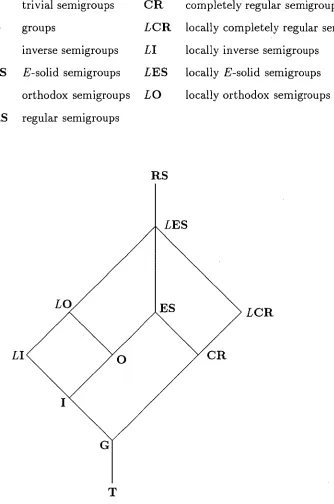
[image:34.571.116.450.138.642.2]The following list gives some classes of regular semigroups which form e-varieties.
Figure 1.1 arranges these as they appear in the lattice of all e-varieties.
T trivial semigroups CR completely regular semigroups
G groups LCR locally completely regular semigroups
I inverse semigroups LI locally inverse semigroups
ES E-solid semigroups LES locally E-solid semigroups
0 orthodox semigroups LO locally orthodox semigroups
RS regular semigroups
RS
Remark 1.3.17 By Result 1.3.16 a second binary operation s, given by (a, b)
s(a, b), can be defined on a locally inverse semigroup S, and S becomes a type (2,2) algebra.
By the axiom of choice, for any regular semigroup S a binary operation s may be defined such that s(a , b) E S (a , b) for all a, b E S. Such an operation will be called a sandwich operation.
Result 1.3.18 ([43]) Let cio : S —> T be a homomorphism of locally inverse semigroups. Then s(a,b)co = s(wp,bcp).
We will need the next well-known result.
Result 1.3.19 ([23]) A regular semigroup S is inverse if and only if its
idem-potents commute.
1.3.4 Orthodox e
-varieties.
Whereas in [20] Hall considered arbitrary e-varieties, independently Kadourek and Szendrei considered the same concept just for classes of orthodox semi-groups, and were able to prove analogues of Birkhoff's fundamental theorems for varieties. They used the term bivariety for an e-variety of orthodox semi-groups, and developed notions of biidentities and bifree objects, as follows. Notation 1.3.20 Let X be a nonempty set, with a disjoint bijective copy X' =
{x' : x E X}. We write
=
X
u X'.
A biidentity over X is a pair (u, v), also written u = v, where u, v are members of the free semigroup (X) + . The following definition was given in [26] for orthodox semigroups.
An orthodox semigroup S is said to satisfy the biidentity u = v for u, v E (X) + if whenever 0 : X -4 S is a matched mapping, and 0 : (X) + S is the unique homomorphism extending 0, we have u0 = vO.
For a nonempty set X and class V of orthodox semigroups, let bIdx (V) (also written p(V, X), or simply p(V)) be the set of all biidentities over X that are satisfied by V. Kafciourek and Szendrei gave a generating relation for bIdx(0).
The original definition for orthodox semigroups of a biinvariant congruence found in [26] is equivalent to the one given below, which is from [27].
Definition 1.3.22 ([26]) For u, p, q E (T) +. and x E X let u(x -+ p, x' q) denote the word in (X)+ obtained from u by substituting p for all occurrences of x, and q for all occurrences of x'. A congruence p on (X)+ is said to be closed under regular substitution if
u p v, p p pqp,
whenever u, v,p,q E (X) + and x E X.
A congruence p on (X)+ is said to be biinyariant if p(0, X) C p and p is
closed under regular substitution. 0
The following definition was originally given in [26] for orthodox semigroups.
Definition 1.3.23 ([26]) For a class V of regular semigroups, a semigroup
F E V together with a matched mapping t : X —> F is a bifree object on X in V if, for any
S
E V and matched mapping 0 : X —> S, there is a uniquehomomorphism : F S satisfying LO = 0. 0
F S be such that tO = 0. Then FO is a regular subsemigroup of S that contains A and is contained in every regular subsemigroup of S that contains A; that is, FO is the least regular subsemigroup of S that contains A.
Thus if an e-variety V is to admit a bifree object, then for every S E V and A C S such that A n V(a) 0 for all a E A there must exist a least regular
subsemigroup of S that contains A. 0
Using the next result, Kaaourek and Szendrei showed that the conclusion of Remark 1.3.24 is true for orthodox semigroups.
Result 1.3.25 ([35]) If S is a regular semigroup then S is orthodox if and only if V (a)V(b) C V(ba) for all a,b E 5.
Corollary 1.3.26 ([26]) If S is an orthodox semigroup and A C S is such that A
n
V(a) 0 for every a E A then (A) is a regular subsemigroup of S.From Corollary 1.3.26, KaClourek and Szendrei proved the following analogue of Birkhoff's Theorem 1.1.7.
Theorem 1.3.27 ([26]) Let V be a class of orthodox semigroups closed under taking regular subsemigroups and direct products. For every nonempty set X there exists a bifree object F on X in V, and F is isomorphic to (X) + I p(V , X).
0
Notation 1.3.28 For a class C of semigroups, let Sr(C) be the class of all
regular subsemigroups of members of C. 0
Ka2c-lourek and Szendrei proved the following generalization of Theorem 1.1.4.
The next result contains analogues of Birkhoff's Theorems 1.1.5 and 1.1.6. Given a set E of biidentities, we write [E]b for the class of all orthodox semi-groups that satisfy E.
Theorem 1.3.30 ([26]) A class V of orthodox semigroups is an e-variety if and only if there exists a set E of biidentities such that . V = [E]b. If X is denumerable then the mappings
V 1-* p(V , X) and p 1-+ [p]b
define an antiisomorphism between the lattice of all e-varieties of orthodox semi- groups and the lattice of all biinvariant congruences on (x)i-. 0
Remark 1.3.31 ([29]) We may also speak of a regular semigroup (not neces-sarily orthodox) satisfying a set of biidentities. The proof of Theorem 1.3.30 also shows that the class of all regular semigroups which satisfy a given set of biidentities is an e-variety. However, the converse does not hold. For example, in [8] Auinger showed that every biidentity satisfied by the e-variety of all com-pletely simple semigroups (that is, comcom-pletely regular semigroups without zero and with only one D-class) is also satisfied by every regular semigroup. 0
KaCiourek and Szendrei noted the following result.
Result 1.3.32 ([26]) A congruence p on (7)+ is biinvariant if and only if p(0, X) C p and the congruence p I p(0, X) is a fully invariant semigroup
con-gruence on (X)+ I p(0, X). 0
1.3.5 Bifree objects in e-varieties.
to admit a bifree object, then for every S E V and A C S such that
An
V(a) 0 for all a E A there must exist a least regular subsemigroup of S that contains A. With the following result, Yeh extended Corollary 1.3.26.Result 1.3.33 ([43]) Suppose that S E ES U LI. Let A C S be such that A
n
V(a) 0 for every a E A. Then there is a least regular subsemigroup of Sthat contains A. 0
The next result gives details of the constructions of these least regular
sub-semigroups.
Result 1.3.34 ([43]) Under the conditions of Result 1.3.33, let T be the least regular subsemigroup of S containing A. Then T = U1>0 7121+1, where
To = A T1
=
(To)T21 = T21-1 U 11_1
T21-1-1 = (7-21
and 71_ 1 is defined for every i > 1 as follows.
If S is E-solid then 71_ 1 = {(ef)-I : e, f E E(T21_ 1 )} for every i >1; the subsemigroup T is the closure of A under the operations • and -1 , where -1 is the partial binary operation on S described in Remark 1.3.12.
The bifree object on X in V is unique up to isomorphism if it exists; we denote it by bFv (X). In [43], Yeh gave an example of a semigroup that is both locally completely regular and locally orthodox, for which Result 1.3.33 fails. He also showed that if S is a regular semigroup with a subset A, where A n V(a) 0 for all a E A, such that there is no least regular subsemigroup of
S containing A, then no e-variety that contains S admits a bifree object on any set 1X1 with X > Al. In Yeh's example the set A has two members, and as a consequence he proved the following remarkable result.
Theorem 1.3.35 ([43]) For an e-variety V and set X with IXI> 2 the bifree
object bFv(X) exists if and only if V C ES or V C LI.
Monogenic bifree objects do exist in e-varieties not contained in ES or LI. In [10] it is proved that monogenic bifree objects exist in every sub e-variety of
L CR.
Remark 1.3.36 If a class V of regular semigroups is closed under Sr and P then, by the proof of Result 1.3.9, the corresponding class V = V' of regular unary semigroups is closed under S and P. Therefore by Theorem 1.1.8 the free object (Fv(X),' ) exists for every nonempty set X and, considered as a type (2) algebra, is a member of V.
Recall the assumption X C Fv (X). We write X' = {x' : x E X} C F(X)
and X = X U X'. 0
Result 1.3.37 ([43]) Suppose that V is a class of regular semigroups closed under P and Sr , and such that V C ES or V C LI. Then the least regular subsemigroup of Fv,(X) containing the set X is bifree on X in V. 0
Yeh proved the following result, which extends Theorem 1.3.29.
1.3.6 E-solid and locally inverse e-varieties.
In this section we outline the work of Auinger in [7] and [8] on locally inverse semigroups and Kaaourek and Szendrei in [27] on E-solid semigroups. In both cases concepts of biidentity and biinvariant congruence were defined, and the Birkhoff-style results previously obtained by Kadourek and Szendrei in [26] for s orthodox semigroups were generalized. So a Birkhoff-style theory holds for the whole lattice of e-varieties that admit nonmonogenic bifree objects, but via two very different approaches.
By Results 1.3.34 and 1.3.37, the bifree locally inverse semigroup on
X
is the closure in the free regular unary locally inverse semigroupFLT
(X)
of the setX
under the operations • and .s; and Auinger defined biidentities for locally inverse semigroups to be formal equalities between members of F(2,2)(X), the free type (2,2) algebra on the setX
that is a semigroup with respect to one of its operations. A locally inverse semigroupS
satisfies the biidentity u = v if u0 = v0 whenever (/) : XS
is a matched mapping and0
: F(2,2)(X) S is the unique extension of 0.Auinger generalized all the Birkhoff-style results previously obtained for or-thodox semigroups. In particular, he described a generating relation for the congruence p(LI, X) on F(2,2)(X) which is equal to the set of all biidentities satisfied by LI, and is such that F(2,2)(X)I p(LI, X) is the bifree locally inverse semigroup. His definition of a biinvariant congruence is a direct generalization of Definition 1.3.22, with (X)+ and p(0 , X) replaced with F(2,2)(X) and p(LI, X) respectively.
subsemigroup U of Fu(X) such that X C U and the set fu E
U
: = 1} is a unary subsemigroup of U, where rt is the group-reduced form of u. By Result 1.3.11, a regular semigroup S is E-solid if and only if the self-conjugate core ofS is completely regular, and in this setting Kaclourek and Szendrei considered s a biidentity to be a pair u = v, where u, v E F''(X). They showed that any matched mapping 0 : X —* S, where S is an E-solid semigroup, has a (unique) extension 0 : F'°°(X) S, such that whenever 7.7 = 1 the element u0 lies in the self-conjugate core of S and u'O is the 1-1-related inverse of u0. An E-solid semigroup S satisfies a biidentity u = v if whenever : X --* S is matched, and
0 is the extension described above of 0 to F'°°(X), we have u0 = v0.
Kaaourek and Szendrei also generalized all the Birkhoff-style results previ-ously obtained for orthodox semigroups. In particular, they gave a generating relation for the set p(ES, X) of all biidentities satisfied by ES, which is such that F'°°(X)/p(ES, X) is the bifree E-solid semigroup. Their definition of a biinvariant congruence is also a direct generalization of Definition 1.3.22, with (X)+ and p(0, X) replaced with F'°°(X) and p(ES, X) respectively.
1.3.7 Locally orthodox e-varieties.
In [25], KaClourek investigated e-varieties of locally orthodox semigroups. By Re-sult 1.3.35, bifree objects do not generally exist for these e-varieties, so Kaaourek s developed a theory of trifree objects and triidentities. With bifree objects the nonexistence of the usual free object on X is compensated for by extending the alphabet to X. In the case of trifree objects, the alphabet is further extended by the addition of certain sandwich elements.
Firstly, Kaaourek gave an extension of Result 1.3.25, which was vital to Kaaourek and Szendrei's original work on classes of orthodox semigroups.
Result 1.3.39 ([25]) A regular semigroup S is locally orthodox if and only if
V (b).S(p, q).V (a) C V (ab)
whenever p,q E S and a E Sp, b E qS. 0
Corollary 1.3.40 ([25]) If A, C are subsets of a locally orthodox semigroup S such that
(i) A
n
V(a) 0 for every a E A,(ii) C CU{S(a,b): a,b E A}, and (iii) C
n
S(a,b) 0 for every a, b E A,then the subsemigroup of S generated by A U C is regular. 0 Notation 1.3.41 Recall the definition of the set X from Notation 1.3.20. Let X1 = {s(x, y) : x, y E X} be a set of (distinct) labels disjoint from X, and let
X1 = Xux1 . 0
Kaaourek defined a triidentity to be a pair (u, v), also written u = v, where u, v are members of the free semigroup (X i ) + .
Definition 1.3.42 ([25])
• A tied mapping is a mapping ck : X i S where S is a regular semigroup,
x'ck E V(x0) for every x E X, and s(x, y)0 E S(x4o, yck) for every x,y E X. • A trifree object for a class V of regular semigroups is a pair (S, t), where
t : X i —> S is a tied mapping, such that for any T E V and tied mapping T there is a unique homomorphism 0 : S T such that
KaClourek proved an analogue of Theorem 1.3.27: the trifree object on X
exists in any e-variety V of locally orthodox semigroups, and is isomorphic to
(X1 )1-/p(V,
X),
where p(V , X) is the congruence on (TO+ consisting of all triidentities satisfied in V.However, other Birkhoff-style theorems do not hold for locally orthodox
semigroups. For example, Kaaourek proved that if V is an e-variety of locally
orthodox semigroups then V is exactly the class of locally orthodox semigroups
which satisfy all triidentities satisfied by V; but the converse is not true: for a set
E of triidentities, the class [E] t of all locally orthodox semigroups which satisfy
each member of E need not be an e-variety. Moreover, Theorem 1.3.38 fails in
Chapter 2
Almeida's Generalized Variety
Problem
2.1 Introduction.
This chapter consists of an answer to a problem posed in Almeida's book [3], which concerns generalized varieties of nil and nilpotent semigroups.
All varieties mentioned in this chapter will be assumed to be semigroup varieties. Consider the following varieties:
• S, the variety of all semigroups;
• Corn = [xy = yx], the variety of all commutative semigroups;
• Man = [sny = yxn = xn], the variety of all nil semigroups of index n > 1; and
Notice that Mir, and Arn consist of semigroups with zero. For u E X+ we write u = 0 as an abbreviation of ux = xu = u where x is a variable not occurring in u, so that for example Ali = [xn = 01.
Let Aril denote the class of all nil semigroups, and Al denote the class of all nilpotent semigroups. Then
JViI = U Aran and
Al = U Arn.
n>1 n>1Observe that Aril and Al are generalized varieties, although they are not vari-eties. For any class W of semigroups let f(W) denote the lattice of all varieties
contained in W, and
g(vv)
denote the lattice of all generalized varietiescon-tained in W.
Almeida proved the following result.
Theorem 2.1.1 ([1]) r(A/3/11Com)U{Ariii1Com} is isomorphic to g (A I nCom) via the correspondence
n
A
l,
W E L(Aril n Corn) U n Coml.The motivation for this result was the question of the structure of the lattice
r(Com). In [1] Almeida established an embedding
r(Com)\ {Com} —÷
r(g
n Corn) x N x G(Ariln
Corn)of semilattices for the meet operation, where N is the semilattice of natural numbers under < and
g = un>i[xny =
y
= yxn] is the generalized variety of all groups. The lattice.c(g
n
Corn) is isomorphic to the lattice of natural numbers ordered by division, and so the structure of f(Ari/ n Corn) became of interest. Information aboutg
(Al
n
Corn) is known from £(A/n
Corn), and can be transferred to r(Ari/n
Corn) by Theorem 2.1.1.As a consequence of Result 1.2.9, Almeida (also in [I]) obtained the following
these results. Let G =
gF ,
N =ArF ,
and Corn = Comb' denote respectivelythe pseudovarieties of all finite groups, finite nilpotent semigroups and finite
commutative semigroups. There is an embedding
Ps
Com 'Ps(Gn
Corn) x (N U loon x Ps(Nn
Corn)
of meet semilattices (note that
Ari/F
= N, by [15, Proposition 9.2]). The latticesg(g
nano
and Ps(Gn
Corn) are isomorphic, as are the latticesg (N
ncom)
and 'Ps(N n Corn) (both via the mapping V i— VF), and information about
g(g
n
Corn) is known fromc(g
n
Coin).In [3, Problem 10], Almeida asked whether the mapping
a : W i—
w n
Ar, w
Ecoriou
{Aril},defines an isomorphism between
.C(Ari/)
U {Aril} andg
(Al) -
that is, whetherTheorem 2.1.1 can be extended to non-commutative semigroups.
Notice that Aril ct L(Aril) as
Ara
is not a variety; but .N. Eg(Ar).
SinceAl C
Aril
then Arila =Al.
We begin by showing in Section 2.2 that a does not map onto
goo.
We thenconsider the question of whether a is injective. First in Section 2.3 we give some
more general results, involving the question of when two arbitrary semigroup
varieties (not necessarily nil) have the same set of nilpotent semigroups. The
remainder of the chapter is devoted to the proof that a is not injective.
2.2 The mapping a is not surjective.
From this point onwards X will denote a fixed denumerable set.
Proof: Let U E r(W). Then Fu(X), the free object on X in the variety U, is a member of Wy for some -y E F, and this implies that U C W.,, by Theorem
1.1.8. 0
Corollary 2.2.2 Every variety U E r(Arii) is a member of L(Afilni) for some
We will need the next two results. Recall that for a class W of semigroups the variety generated by W is denoted by V(VV).
Result 2.2.3 ([4]) If W is a generalized variety of nilpotent semigroups then
W -= V (N)
n
Al.
0
Result 2.2.4 ([4]) If W is a generalized variety of nilpotent semigroups such
that Al n Com ZW then V(W) C .Aril. 0
We can now show that a does not map onto
goo.
Recall that for a variety V we often denote the fully invariant congruence onx+
corresponding to V by p(V).Theorem 2.2.5 The image of the mapping a is the set
{W E
goo : Ar
ncom
g W}.
Proof: Let U E r(Ari/). Then U E 4A/dm) for some m by Corollary 2.2.2. If A/. n Com C U n Ar then .Ar n Com C Ari/m . But Ar n Com =
U
n>i (Jrn
n
Com), so that we now haveArm
+
i
n Corn C Nil,. This means that for every x Ex+
{ry's : r,s E X*,y E
xl-}
= xm p(Arilm)C xm p(AI;n+i n Corn) = fxml,
which is false; and so Ar n Corn
g
U nAl.
2.3 Semigroup varieties whose nilpotent parts
coincide.
The question of the injectivity of a remains of interest however. First we take a look at the more general question of when two semigroup varieties have the same set of nilpotent semigroups.
For u = xi ... xn where xi E X, the length u of u is defined to be n, and the content c(u) of u is the set {x1, • . • , xri}•
Suppose that /A is a variety of semigroups. Let B(U) denote the set of all words u E X+ for which there exists r such that 1y1 < r for all y E up(U). We say that B(U) is the set of all bounded words for U, and that the set U(U) X+ \ B(U) is the set of all unbounded words for U. Let
BId(U) = -Cu = v E Id(U) : u E B (U)} ,
the set of all bounded identities for U. For u E B(U) let
B(u) = max{1v1 : v E up(U)}.
Remark 2.3.1
• BId(U) = {u = v E Id(U) : u,v E B(U)}
• If U,V are two varieties for which BId(U) = BId(V) then B(U) = B(V), and for every u E B(U) we have up(U) = up(V) and Bu(u) = Bv(u). • The set U(U) is a subsemigroup of X+ that is closed under endomorphisms
of X+ .
• If u E B(U) then c(v) = c(u) for all v E up(U).
As the following theorem shows, the nilpotent part of a variety of semigroups is completely determined by its bounded identities.
Theorem 2.3.2 Let U,V be varieties. Then
unAr=vn.v<#.
BId(U) = BId(V).Proof: Suppose that U n Al* = V n Al. Then p(U n Arm ) = p(V n
Arm )
for every in by Theorem 1.1.6. Let u = v E BId(ZI). Let r = Bu (u) + 1. Then up(U) = up(Un Al,.) =
up(Vn Ai
r). Therefore Ii 1 < r for all y E up(V), and up(U) = up(V nAl,.) =
up(V). Hence u = v E BId(V). So BId(U) C BId(V), and a dual argument shows that BId(U) = BId(V).Now suppose that BId(U) = BId(V). Then U(U) = U(V). Let m > 1 and u E X+. If u E
WO,
or if u E B(U) and Bu (u) > m, then(u, u m ) E p(U
n Aim) n
p(Vn Aim);
so up(LIRAirn ) and up(VnAirn) are the zeros of X+ /p(UnAim) and X+ I p(VnN.,,) respectively. Otherwise, we have u E
B(U)
and Bu (u) < ni, and in this case up(Un
Arm ) =
up(U) = up(V) = up(Vn
Arm )
(by Remark 2.3.1).It now follows that for all in > 1 the semigroups X+ I p(U
n
Arm ) andx+ 1,0 n Arm )
are isomorphic, and p(U n Arm ) = p(Vn Arm ).
ThereforeLi
n Arm = V n
Ar,
for all m by Theorem 1.1.6, and hence Li fl Al = V n Ai. 0By Remark 2.3.1 we have the following corollary.
Corollary 2.3.3 If U,V are varieties such that U n Ai