by
June Hazzlewood MEd
Submitted in fulfilment of the requirements for the degree of Doctor of Philosophy
University of Tasmania
Third age learners and ICT: Training and support issues
Declaration
I certify that this thesis contains no material which has been accepted for the award of another degree or diploma in any institute, college or university, and that, to the best of my knowledge and belief, it contains no material previously published or written by another person, except where due reference is made in the text of the thesis.
Signed
This thesis may be made available for loan or for limited copying in accordance with the Copyright Act, 1968.
Signed
Third age learners and ICT: Training and support issues
ACKNOWLEDGEMENTS
Firstly, I would like to thank my supervisor for the bulk of my candidature, Associate Professor Sue Kilpatrick for her invaluable support, untiring patience and objective advice during both my Masters and my Doctoral studies, also my co-supervisor in the last months of my candidature, Dr. Thao Le.
Secondly, I wish to thank University of Tasmania, Launceston, Education Faculty members Dr. Margaret Barrett and Dr. Margaret Robertson and Professor Ian Falk, now at Charles Darwin University, also fellow postgraduate students Susan Johns, Tammy Jones, Dr. Rosa McManamey, Dr. Pat Millar, Tony Smith and Dr. Paul Throssell.
Thirdly, I wish to acknowledge the support and generosity in sharing of information by Ros Foskey, e-mail list manager of NEAT, the network of education, ageing and technology, University of New England, Armidale New South Wales, and NEAT members including Dr. Karen Barnett, Nan Bosler, Men Forest, Helen Scott, Dr. Rick Swindell, Dr. Deborah West and Dr. Kirsty Williamson.
ABSTRACT
An increasing number of older adults joining the third age of active retirement are
learning to use computers to access information and communication technology (ICT)
for a variety of intrinsic and extrinsic reasons. This thesis describes a three year
research study of a group of such men and women, aged fifty and older, who live in a
regional Australian community.
Answers are sought to the questions how, when, where, why or why not these older
adults are learning to use computers and to access the Internet in later life. The
primary focus is on the effect that available and affordable training and support has on
the gaining of the skills necessary to achieve the ICT literacy that is required to
function in a rapidly changing technological globalised society.
The study seeks to identify the factors which foster or inhibit both the uptake and the
continuing use of those aspects of computer generated technology which match the
needs, interests and aspirations of third age learners living longer lives in an
economically and socially advantaged society such as Australia.
The implications of the study to a range of stakeholders are both social and economic,
as older adults enter the third age of active retirement earlier and remain there longer
and seek to learn about and via new technology by choice or from necessity. The
background to the research project is sketched, seminal and recent theoretical and
practical research literature and government policy reports are reviewed. The results
of data gathered during this study are discussed and opportunities for further research
are indicated.
The qualitative natural ethnographic research methodology chosen employs
semi-structured interviews, participant observation, focus groups, case studies and
document examination. A series of filters were employed in an attempt to assess the
nature, the extent and the use made of the new knowledge and skills acquired. The
initial coding of the data resulted in a broad grouping of participants into early and
Third age learners and ICT: Training and support issues
development of the concept of adult lateracy (Hazzlewood 2004), which identifies
two-dimensional and three-dimensional ICT uptake and use.
The main findings from this study relate to adult learning theory, research and
practice in general and, since the advent of the Internet, about the transfer of these
adult learning concepts to third age ICT learning. Other findings relate to more
specific aspects of the available and affordable ICT training and ongoing support
offered to older adults, and to the implications for a range of stakeholders.
Volunteer service human capital is found to contribute to the well being of the
individual learners, their families and friends, as well as adding social capital to both
the local and the wider community. The study, however, finds a lack of relevance and
effectiveness of a training and support system for older adults dependent almost
entirely on dedicated but largely untrained peer volunteer contribution. Implications
for policy makers and keepers of the public purse are indicated as an urgent need is
identified for the adoption of a broad strategic approach to equitable 'age neutral'
(Stretton 2005) training and support. This need for a vision for the future, which is
designed to include rather than exclude older adults, is critical as the age imbalance is
CONTENTS
ACKNOWLEDGEMENTS iii
ABSTRACT - iv
GLOSSARY
CHAPTER ONE: BACKGROUND TO THE RESEARCH 1
INTRODUCTION 1
THE STRUCTURE OF THE THESIS 3
SIGNIFICANCE OF THE RESEARCH PROJECT 3
ESTABLISHMENT OF ICT-LINKED POST-RETIREMENT NETWORKS 4 ICT LITERACY: AN INTEGRAL PART OF CONTEMPORARY SOCIETY 5
CHANGE AND CHOICE, TRENDS AND MEGATRENDS 7
MYTHS AND STEREOTYPES ABOUT AGEING 11
POSITIVE AGEING 14
NEW TECHNOLOGY LEARNING FOR OLDER ADULTS 14
THE RESEARCH QUESTIONS 15
CONCLUSION 16
CHAPTER TWO: REVIEW OF THE LITERATURE 17
INTRODUCTION 17
THEORY, RESEARCH, POLICY AND PRACTICE 17
THEORIES ON AGEING 18
RESEARCH QUESTION 1 22
INTRODUCTION 22
ADULT EDUCATION TO ADULT LEARNING 23
LIFELONG LEARNING 24
LEARNING IN LATER LIFE 27
LEARNING ICT IN RETIREMENT 27
EARLY AND LATER ADOPTERS OF NEW TECHNOLOGY 28
NON ADOPTERS OF NEW TECHNOLOGY 31
COMPUTING AS A SECOND LANGUAGE 32
EARLY CHILDHOOD EXPERIENCES 34
COGNITIVE AGEING ISSUES 35
SUMMARY 38
RESEARCH QUESTION 2 39
INTRODUCTION 39
LEARNING STYLES AND PREFERENCES 39
MOTIVATION OR MOBILISATION 42
GENDER AND AGE DIFFERENCES 42
AGE DIFFERENCES 46
SUMMARY 47
RESEARCH QUESTION 3 47
INTRODUCTION 47
OLDER ADULTS AND DIGITAL DIVIDES 48
COST AND AVAILABILITY OF RESOURCES 49
DIGITAL MYTHS 51
ADULT LITERACY 53
• ACCESS TO ICT FOR OLDER ADULTS 54
AGE RELATED IMPAIRMENTS 55
SOCIAL ISOLATION 55
SUMMARY 56
RESEARCH QUESTION 4 57
INTRODUCTION 57
THE ADULT LEARNER 57
THE LIFELONG LEARNER AND ICT 60
THE OLDER ADULT LEARNER 61
THE TRAINER OR FACILITATOR 63
THE POLICY MAKER 63
SUMMARY 65
Third age learners and ICT: Training and support issues
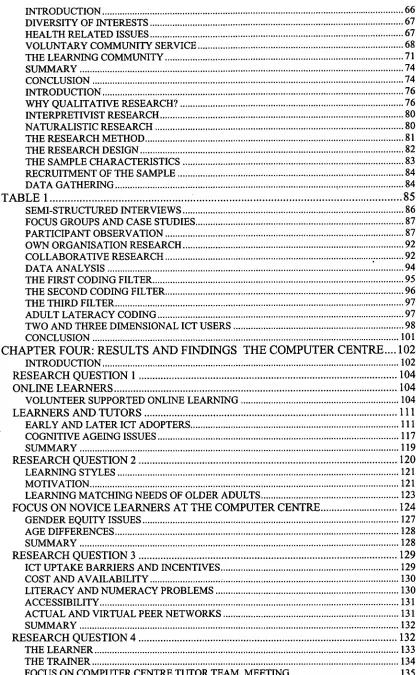
INTRODUCTION 66
DIVERSITY OF INTERESTS 67
HEALTH RELATED ISSUES 67
VOLUNTARY COMMUNITY SERVICE 68
THE LEARNING COMMUNITY 71
SUMMARY 74
CONCLUSION 74
INTRODUCTION 76
WHY QUALITATIVE RESEARCH? 76
INTERPRETIVIST RESEARCH 80
NATURALISTIC RESEARCH 80
THE RESEARCH METHOD 81
THE RESEARCH DESIGN 82
THE SAMPLE CHARACTERISTICS 83
RECRUITMENT OF THE SAMPLE 84
DATA GATHERING 84
TABLE 1 85
SEMI-STRUCTURED INTERVIEWS 86
FOCUS GROUPS AND CASE STUDIES 87
PARTICIPANT OBSERVATION 87
OWN ORGANISATION RESEARCH 92
COLLABORATIVE RESEARCH 92
DATA ANALYSIS 94
THE FIRST CODING FILTER 95
THE SECOND CODING FILTER 96
THE THIRD FILTER 97
ADULT LATERACY CODING 97
TWO AND THREE DIMENSIONAL ICT USERS 98
CONCLUSION 101
CHAPTER FOUR: RESULTS AND FINDINGS THE COMPUTER CENTRE 102
INTRODUCTION 102
RESEARCH QUESTION 1 104
ONLINE LEARNERS 104
VOLUNTEER SUPPORTED ONLINE LEARNING 104
LEARNERS AND TUTORS 111
EARLY AND LATER ICT ADOPTERS 111
COGNITIVE AGEING ISSUES 117
SUMMARY 119
RESEARCH QUESTION 2 120
LEARNING STYLES 121
MOTIVATION 121
LEARNING MATCHING NEEDS OF OLDER ADULTS 123
FOCUS ON NOVICE LEARNERS AT THE COMPUTER CENTRE 124
GENDER EQUITY ISSUES 127
AGE DIFFERENCES 128
SUMMARY 128
RESEARCH QUESTION 3 129
ICT UPTAKE BARRIERS AND INCENTIVES 129
COST AND AVAILABILITY 130
LITERACY AND NUMERACY PROBLEMS 130
ACCESSIBILITY 131
ACTUAL AND VIRTUAL PEER NETWORKS 131
SUMMARY 132
RESEARCH QUESTION 4 132
THE LEARNER 133
THE TRAINER 134
FOCUS ON COMPUTER CENTRE TUTOR TEAM MEETING 135
SUMMARY 140
[image:8.559.56.474.55.730.2]DIVERSITY OF INTERESTS 140
VOLUNTARY COMMUNITY SERVICE IN RETIREMENT 142
SUMMARY 142
CONCLUSION 143
CHAPTER FIVE: RESULTS FOCUS GROUPS AND CASE STUDIES 147
INTRODUCTION 147
FOCUS ON COMMUNITY GROUP VOLUNTEERS 149
THE GREYING OF THE NGOs 149
SUM:MARY 156
FOCUS ON FURTHER EDUCATION IN 'RETIREMENT' 158
INTRODUCTION 158
INCENTIVES AND BARRIERS TO ICT LEARNING 167
MATURE AGE STUDENTS AND ICT 168
SOCIAL CAPITAL ISSUES 169
PAM'S STORY RETIREMENT INTO, NOT OUT OF, THE COMMUNITY 170
QUEENrES' STORY ONE WOMAN'S WAY OF KNOWING 174
ALF AND JAEL A CYBER-SENIOR PARTNERSHIP 178
SUMMARY 184
AMES FOCUS GROUP. 185
A MULTICULTURAL PERSPECTIVE 185
SUMMARY 189
CONCLUSION 189
CHAPTER SIX: DISCUSSION AND CONCLUSION 191
INTRODUCTION 191
RESEARCH QUESTION 1 FINDINGS 197
RESEARCH QUESTION 2 FINDINGS 207
RESEARCH QUESTION 3 FINDINGS 213
RESEARCH QUESTION 4 FINDINGS 221
RESEARCH QUESTION 5 FINDINGS 227
SUMMARY OF RESEARCH QUESTIONS FINDINGS 231
OPPORTUNITIES FOR FURTHER RESEARCH 232
CONCLUSION 233
REFERENCES 236
Abaya C. (1992). Sandwich Generation. Retrieved 5/6/04, from
http://www.TheSandwichGeneration.com 236
APPENDIX A: LITERATURE REVIEW CORE PAPER SUMMARY 259 APPENDIX B: INFORMATION SHEET, CONSENT FORM AND INTERVIEW
QUESTIONS 265
APPENDIX C: CANADIAN/AUSTRALIAN STUDY INFORMATION SHEET, CONSENT FORM AND INTERVIEW QUESTIONS 269 Australian and Canadian Percentages for Survey Responses on a 5-Point Likert Scale
272 APPENDIX D: AMES STUDY INFORMATION SHEET, CONSENT FORM AND
INTERVIEW QUESTIONS 273
Third age learners and ICT: Training and support issues
TABLES
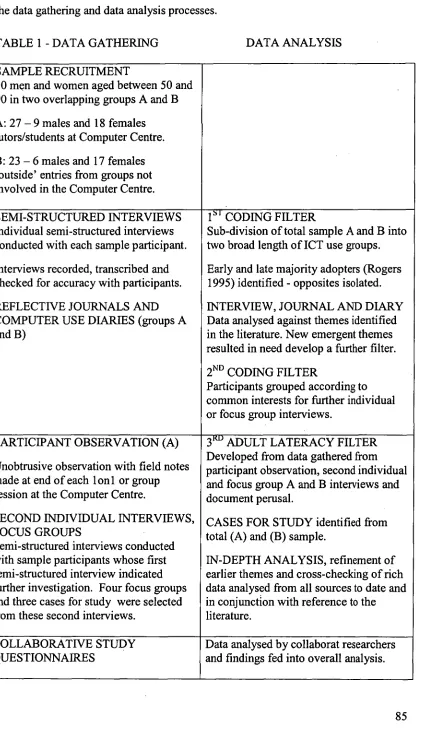
TABLE 1: DATA GATHERING AND DATA ANALYSIS 85
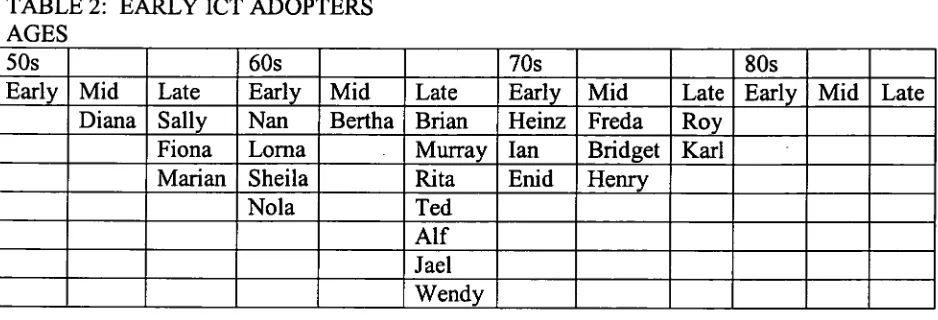
TABLE 2: EARLY ICT ADOPTERS 99
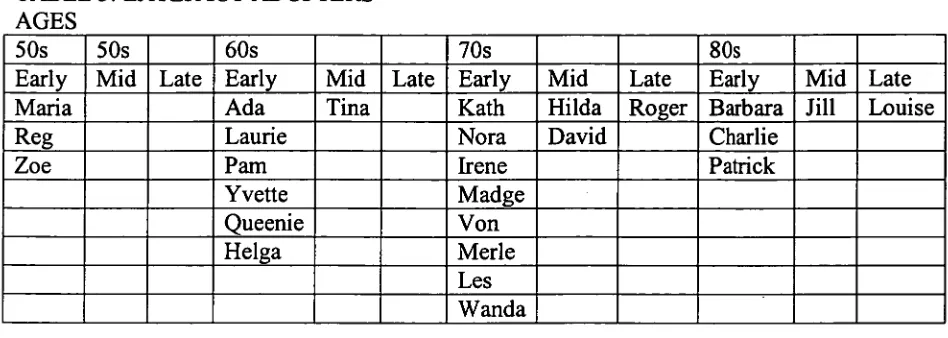
TABLE 3: LATE ICT ADOPTERS 100
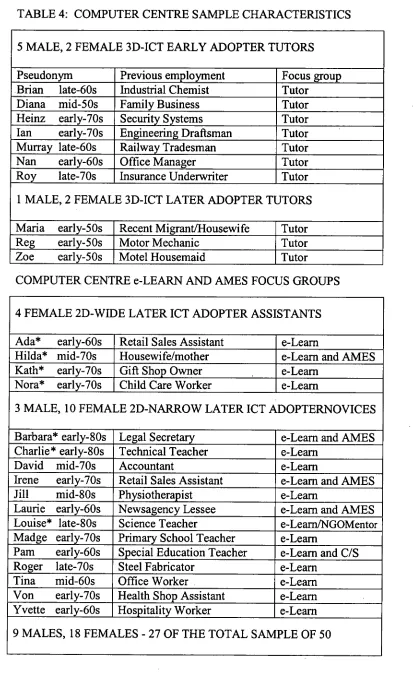
TABLE 4: COMPUTER CENTRE SAMPLE CHARACTERISTICS 103
GLOSSARY
ABS Australian Bureau of Statistics.
ACE Adult Community Education
ALNARC Adult Literacy and Numeracy Australian Research Consortium.
ANTA Australian National Training Authority
ATM Automatic Teller Machine
ClRCIT Centre for International Research on Communications and IT
DCITA Department of Communications Information Technology and the Arts.
DEST Department of Education, Science and Training, Australia.
EFTPOS Electronic Funds Transfer at Point of Sale
ICT Information and Communication Technologies
IFLA International Federation of Libraries Associations
IL Internet literacy
IT Information Technology
MRI Magnetic Resonance Imaging
NGO Non-Government Organisation
MACE National Institute of Continuing Education
NUA Scope Communications Group, Dublin, Ireland.
OECD Organisation for Economic Cooperative Development
PEW American Research Center For The People & The Press
QANTAS Queensland and Northern Territory Air Service
RMIT Royal Melboutne Institute of Technology
TASCOSS Tasmanian Council of Social Services
Third age learners and ICT: Training and support issues
CHAPTER ONE: BACKGROUND TO THE RESEARCH
INTRODUCTION
There are a variety of ways in which seniors can continue to work and continue to learn both during the final years of their careers and into their retirement. (Jarvis, p.95, 2001)
Australia's population in the early 21 st century is ageing as a result of the increased
life expectancy of both men and women in retirement. This is due in part to medical
advances and healthy lifestyle choices. At the same time the falling birth rate and
immigration is impacting on the percentages of the old and the young in the
population. This national population trend parallels the global ageing demographic
reported by Toomel (2001), and is particularly noticeable in Tasmania, which state
has overtaken South Australia as the Australian State with the highest proportion of
people over sixty years of age. This trend highlights the significance of the primary
focus in this thesis, which is on issues affecting older men and women learning about
and via new technology, and the implications for stakeholders in, or involved with,
the third of Laslett's (1989) four life stages—the age of active retirement. Laslett's
'third age' concept is described by Hurworth and Crombie (1995) as socio-cultural
with obvious biological and demographic underpinnings, as an age of independence
and opportunity for self-development by Manheimer, Snodgrass and
Moscow-McKenzie (1995) and as a 'post work' period by Withnall (2006).
The numbers in the third age are continually increasing and the age range is extending
as entry is gained through early retirement and premature workplace redundancy and
as exit into the fourth age of dependency is delayed. Third age ranks are further
swelled by post World War II baby boomers—those born between the mid-1940s and
the mid-1960s. The resulting population age imbalance is increasingly looked upon
as a disaster that will impact on the young, who are expected to carry the economic
burden of this increased longevity of the aged. Horst (1999), for example, states that
this imbalance means that in the foreseeable future, there will be fewer workers, who
will be expected to support a greater number of retirees.
In a Tasmanian Seniors Bureau (2005) discussion paper, it is reported that by 2019 in
the OECD countries, one in four people will be over sixty years of age. The paper
replaced by only 5 million new workers. These figures, when contrasted with the
previous period when 45 million retirees are reported to have been replaced by 120
million baby boomer workers, add substantially to the significance of information and
communication technology (ICT) literacy acquisition by all post-compulsory
education cohorts. These figures also reinforce the urgency of the provision of
appropriate and affordable ICT training and support, which is essential not only to fill
the inevitable employment void, but also to ensure that the experience and enthusiasm
that older adult volunteers contribute to community social capital is not lost and that
large numbers of third age learners are not marginalised. There are implications here
for all stakeholders, including government policymakers at local, state and federal
levels, non-Government organisations (NG0s), service and training providers,
researchers and individual third age learners themselves.
The demographic of ageing constantly features in government reports, academic
research and the popular media. In Tasmania, for example, Jackson (2005) writes that
the Tasmanian population shows a significant and sustained rate of growth despite the
brain drain caused by the departure of younger people for interstate and overseas
destinations. Jackson states that this outflow is more than compensated for by the
arrival of post-World War II baby boomers and older adults in the Tasmanian island
state. For example, in 2003, almost 50% of the 29 to 65 age group, who arrived in
Tasmania were aged between 50 and 64. Jackson reports that 10,000 more adults
over 65 are added to Tasmania's population every five years by both natural addition
and new arrivals. In what could be called a brain gain, this exchange also adds to the
age imbalance in this regional Australian area.
McCrindle (2005) reports that the Australian population has doubled since 1960 with
members of 'generation X', those born between 1965 and 1981 and 'generation Y',
those born between 1982 and 2000, making up 51% of the population. Those over 60,
born before 1946, the 'builders', account for 15%. As the first of the baby boomers
born between 1946 and 1964, swell the third age numbers to somewhere above 25%
of the population. McCrindle states that it is a common but unfounded myth that
Generation X will bear the burden of Australia's ageing society. Warburton and
Bartlett (2004) also decry the negative ageing problem mantra, suggesting that the
Third age learners and ICT: Training and support issues
in emphasis, which acknowledges the positive and extensive, if largely unrecognised,
contribution of older people to social capital and civil society.
THE STRUCTURE OF THE THESIS
The thesis is arranged in six chapters. This chapter provides the background to the
research project and the demographics affecting the distribution of older adults in a
globalised society. It outlines the choices available to third age learners in a
constantly changing technological age. Trends are indicated that shape these changes
where older adults have little choice but to learn new skills to avoid being
marginalised in a youth-skewed society (Williamson, Bow & Wale 1997; Barnett &
Adkins 2004; Paul & Stegbauer 2005). The myths and stereotypes of ageing are
touched on as well as the new learning needed for transfer of adult learning skills to
computer-based, ever changing new technology. The research study questions are
introduced at the end of the chapter. In Chapter 2, literature relating to the research
questions is reviewed. In Chapter 3 the history and development of both quantitative
and qualitative methodology paradigms is outlined and the methodology employed in
this study is discussed and justified. The concept of adult lateracy (Hazzlewood
2004), the categorising of sample participants according to the nature and extent of
their ICT use, is introduced and developed. Chapters 4 and 5 present the results and
discussion from an analysis of the data gathered from observation, interviews, focus
groups, case studies and documents provided by sample participants. Implications for
stakeholders are mentioned as they occur in each chapter. Chapter 6 contains
discussion of the results recorded in Chapters 4 and 5 as they relate to the questions
asked and the literature reviewed. Topics for further research are identified.
SIGNIFICANCE OF THE RESEARCH PROJECT
The primary focus of this thesis is on issues of third age learning as men and women
in retirement seek voluntarily, or of necessity, to learn to use computers to access the
new technology available in the early 21st century. Throughout this thesis,
information and communication technology is referred to as ICT, except where
quoted literature refers simply to IT—information technology. A secondary focus is
on the implications for trainers and policy makers and the impact on the learners'
family and friends and the wider community. The significance of the study lies in the
the paid or volunteer workforce, where they will need ICT skills, as well as in their
everyday lives. As the greying of society is a focus in many countries and many
sectors, and as the technology age is giving way to the global connectivity age (Davis
2003), the need for ICT literacy for third age learners intensifies. ICT literacy
training and support for older adults in 'retirement' is needed now and will be for the
next few years until the younger X, Y and Z techno-generations inhabit what is
already promising to be a very different third age from the present one. New
strategies will be then be needed for a future, as yet unpredictable, age.
• This research project is conducted by an 'insider', a third age learner, who is
accessing new technology herself and who has assumed the pseudonym of Jenni in
this thesis. The study aims to provide an overview of third age ICT learning
opportunities in an urban/regional area and also to narrate some of the cyber
experiences of her fellow travellers on the 'Super Highway'. A causal relationship
between the gaining of new knowledge and the promotion of wellness, which stems
from the mental stimulation involved in learning new ICT skills, is well documented
(Manheimer, Snodgrass and Moscow-McKenzie 1995; Scott 1999; Swindell &
Vasella 1999; Foskey 2000; Millar & Falk 2000; Fraser 2002; Barnett & Adkins
2004). Researchers note that becoming computer and Internet literate is not only
necessary to function in the new, technology age, but is seen as a hedge against social
isolation in later life.
ESTABLISHMENT OF ICT-LINKED POST-RETIREMENT NETWORKS
Kearns (2005, p.6) finds that the impact of ICT is creating new ways to build
interactive networks and that a "diverse range of community and virtual learning
partnerships have emerged in Australia and overseas." The importance of
establishing new community networks to replace work-related ones is stressed by
MacErlean (2005). These networks largely disappear with traditional 'cliff edge'
retirement—at work today, at home for good tomorrow. Role change, which is
discussed in Chapter 2 in relation to role theory (Rosow1976), occurs when
employees "switch from 35 hours or more work a week to zero on their 60th or 65th
birthday" (MacErlean 2005, p.1). The Tasmanian Seniors Bureau (2005) notes that
retirement at 65 years of age was a life-stage marker set in 1909 when the average
Third age learners and ICT: Training and support issues
from the workplace, one's personal worth becomes questionable, as one is sidelined,
put out to pasture or considered a 'has been'. This view is confirmed by Warburton
and Bartlett (2004), as they find that social networks tend to shrink as people age.
They advocate helping others by volunteering, as a way to establish new support
systems. The Tasmanian Seniors Bureau (2005, p.16) stresses the importance for
"individuals to build a complex environment, providing mental stimulation beyond
the world of work". New technologies are also opening up opportunities to join
virtual e-mail networks and online learning groups for senior Australians and for
those unable to access courses at the times or places on offer (Swindell & Vasella
1999; Brown 2000; Foskey 2000; Shepherd 2003; Kearns 2005).
Faris (2002) writes that as we move from resource-based to knowledge-based
economies and societies, traditional economic core values are being challenged. Faris
further suggests that:
the new global knowledge-based economy will demand a new model of lifelong learning in which electronic networking will play an increasingly important role in enabling globalization to become `glocalization' (p.2).
ICT LITERACY: AN INTEGRAL PART OF CONTEMPORARY SOCIETY
Faris (2002, p.1) states that the three forms of traditional capital—land, labour, and
financial—are now being "augmented by an understanding of the important role of
human and social capital", as the intangible assets of a knowledge-based society.
Nayak (2001) writes that participation in the information society actually involves
adopting new perspectives, skills, knowledge, strategies and structures and this is
principally an educational endeavour. Riley (2003, p.4) reinforces these views as he
observes that as the world is rapidly moving towards information and "knowledge
intensive societies", a change in the whole education system is essential to ensure a
"wide base of knowledge workers who understand and use IT". McDonald and
Denning (2002, p.2) report a growing interest among "academics, teachers, urban
planners, politicians, community educationalists, entrepreneurs and others", in
narrowing the digital divide by providing local communities with online access to the
information society, the knowledge economy and the technological age.
Haddad (2000) editorialises that basic education for all in a modern world entails
technology must be considered to be a necessity and not a luxury. Haddad joins with
other researchers in her view that "the new economic and social challenges force us to
think of basic education as a learning activity, anytime, anywhere, and for
everyone"(p.7). "At every age" could well be added here, as lifelong or lifespan
learning is implied. Chronological age is not seen to be as much a predictor of mental
acuity as is attitude (Scott 1999; McKie 2000). Researchers generally agree that age
is no bar to activity, even though older people might act a little more slowly than
younger learners (Burns 1995; Jarvis 2001).
Lifelong learning in relation to third age men and women is the first of the themes that
emerged from a literature review relating to third age learners accessing new
technology (Hazzlewood 2001). The lifelong learning theme underlies the search of
the research literature described in Chapter 2 about older men and women who, in
active retirement, are coming to terms with a rapidly changing world, where new
technology dominates every facet of living. The other emergent themes, which relate
directly to the uptake of computer-based technology, are the significance of older
adults' attitude toward technology, gender and age learning differences, incentives for
and barriers to the uptake of computer technology, and training and support
implications for third age learners, their trainers, service providers, training course
developers and policy makers. A summary of core papers from the literature review,
which followed a research study of seniors online (Kilpatrick & Hazzlewood 2001), is
attached as Appendix A. Four typologies identified in the seniors online study,
window shoppers, e-mailers, searchers and e-seniors, are discussed in more detail in
Chapter 3. These themes and typologies form the scaffolding of the research and
therefore of the thesis itself.
Although the ICT training and support theme is the primary focus of this thesis, the
other themes inform each part of the research as it concentrates on the theoretical,
practical and policy issues confronting older adults, who are acquiring new
knowledge and learning new skills in a technological age by choice or necessity.
Redding, Eisenman and Rugolo (1998, p.1) set the scene as they report that many
older adults are "deciding or being forced to use a computer for the first time",
Third age learners and ICT: Training and support issues
This cohort of adults over the age of 50 not only contains a large proportion of the
population, but it also spans a wide age range, as promotion of positive ageing and its
accompanying idea of wellness rather than illness lengthens the active period of
retirement and shrinks the fourth age of dependence and inactivity. The uptake of
ICT in the third age is claimed to promote healthy ageing and postpone the entry into
the age marked by frailty and decline. Third age older adults, who Gergen and
Gergen (2003) claim have emerged at last from the 'dark age', are increasingly the
subject of theorists, researchers, policy makers and practitioners.
This current research project is timely, in that it examines the availability,
affordability and appropriateness of ICT training and support for older adult third age
learners and identifies implications for stakeholders and gatekeepers. Men and
women of retirement age will be needed to fill employment gaps, albeit in a part time
capacity, as the 'baby bust' depletes the second age workforce. Other third age
learners, who apply their new ICT skills in the non-government organisation
volunteer sector, contribute significantly to community social capital with benefits
accruing to individuals, families, friends and the wider community.
CHANGE AND CHOICE, TRENDS AND MEGATRENDS
It's not the strongest of the species who survive, nor the most intelligent, but the ones most responsive to change. (Darwin 1859)
As is shown in the literature review in Chapter 2, the words 'change' and 'choice'
permeate the literature about older adults and new technology. The exceptional extent
and rapid pace of change, as forecast by Faure (1972), has become a global reality in
the late 20th and early 21st centuries and is featured in much of the current and recent
literature. Nasseh (1998, p.12) comments that "the penetration of technology in life,
work, and social interaction has changed the traditional assumptions and operation of
societies" at both national and global levels. This saturation of technology is also
argued by Manheimer (2000), Adler (2002) and West (2003b). Faris (2001, p.2)
suggests that there are three contemporary, inter-related drivers of change in an
emerging knowledge-based society—globalisation, the rapidly increasing pace of
technological change sparked by research and innovation, and the advance of new
drivers that impact on Australian society and make learning for all throughout life an
imperative. These drivers, which are of particular relevance to this study, are:
• globalisation;
• the knowledge economy;
• demography (which Kearns sees as especially important);
• technology;
• changes in work and labour markets; and
• sustaining communities.
Colwell (2000) believes that information technology (IT) can guide us to new
frontiers in fundamental research and draw different disciplines together. She writes
that "IT can integrate research and education and most of all, it can link science and
society in ways we never imagined" (p.15). Adding the 'c' of communication to
information technology (ICT), Johnston (2001) stresses that it is how the technologies
work together that matters. Faris (2004, p.1) contends that the explosion of new
knowledge and learning is transforming the world we live in and is the result of
"skilled intelligence that is the stem cell of an emerging knowledge-based economy
and society". Adler (2002), on the other hand, looks at the bigger picture as he
identifies what he believes to be the two mega-trends that are driving American
society in the early years of the 21st century. These trends are the technology wave,
which Toffler (1980) alludes to as the third wave where the introduction of computers
and the Internet have changed daily lives markedly, and the age wave. The term 'age
wave' was coined by Americans Ken and Maddie Dychtwald in 1986 (Dychtwald &
Flower 1989) and describes the continuing ageing of the population as creating an
unprecedented set of challenges and opportunities. Hurworth and Crombie (1995)
foreshadow this as they comment on the need for positive new thinking, policies and
programs in response to the age wave. They refer to many of the myths about older
non-working people as a 'cultural lag', deriving from the time when people moved
straight from Laslett's (1989) second age of employment and parenting to a
comparatively short fourth age of decline and decrepitude.
Stretton (2000) chairs a UK government ageing-population panel that concludes that
changes caused by population ageing can be anticipated and that behaviour can be
Third age learners and ICT: Training and support issues
longer and birth rates are falling in what it describes as the 'age shift'. An implication
of this is that while more people are now living healthier lives and entering retirement
with higher education levels (Chan 2002), the sheer numbers living longer mean that
eventually there will be a great many more frail aged people in the fourth age. Davis
(2003) refers to the greying of society; Kleiman (1997), Horst (1999), Geddes (2002),
Chan (2002) and Klatz (2004) dub the phenomenon global greying. It would appear
that age tsunami would be a more appropriate way to refer to the predicted greying of
the world. Edwards (1997, p.60) notes that what had been thought of as a
"demographic time bomb" in the 1980s and into the 1990s, with its attendant fear of
economic insecurity, has largely been replaced by a concern about how to support an
ageing population. Chan (2002) issues a global warning as she equates global greying
with monetary instability, the information revolution and climate change.
McConnell (2004) uses a similarly concerning analogy describing this population
eruption as an agequake, which also has within it the elements of 'be afraid' doom
and gloom ageism stereotypes. Disney (2002, p.1) sounds a warning as he writes:
In some ways globalisation is like a river. It can bring substantial economic and social and environmental nourishment to those who are in a position to benefit from it. But like a river, it can erode and devastate and overwhelm if it rushes too fast or spreads too far.
Disney expands this view as he writes that economic and technical globalisation has
outpaced appropriate systems of international governance. Change is a process of
learning according to Falk, Sefton and Billett (1999, p.v) who argue that "if we are
looking for a way to change the culture, we should rely heavily on research". They
advocate this quality-assured process not only for industry, but also for any
organisation or for society itself. Adler (2002) links this focus on research to life
course planning throughout the third age where, he states, research is crucial.
Redding, Eisenman and Rugolo (1998) see a direct relationship between intentional
learning and external societal or internal personal change, both of which occur with
ageing and trigger motivation to learn new skills. The rapidity of change and the
resulting new learning needs, which are brought about by the reality of the nature of
new technology, have been described in the literature as 'pervasive' by countless
Gergen (2003), West (2003a) and Barnett and Adkins (2004). Cornford (2000) relates
the advent of computerisation to the enormous technological change over the past two
decades where, he writes, "industrially advanced societies have been subjected to the
maelstrom of technological, economic and social revolutions" (p.2).
Recommendation 19 from the UK National Committee of Inquiry into Higher
Education Dearing Report (1997) states that the world of work is in continual change
and that individuals will increasingly need to develop new capabilities and manage
their own development and learning throughout life. Participation in new
environments brought about by these changes gives rise to ever more complex literacy
practices (Lo Bianco & Freebody 2001). As a result, individuals must acquire,
develop and improve their literacy skills throughout life in response to changes in
society: at home, in the workplace and in the broader community.
Jarvis (2001) argues that while older people have certain choices in this rapidly
changing society, they do not always have the freedom of choice, "sometimes having
experiences they would rather not have" (p.34). Nelson (2004) agrees with this
argument and goes further as he suggests that our biggest challenge is how we
manage that which we fear most as human beings. These fears relate to change, and
people and ideas that we do not always understand or perhaps want.
Redding, Eisenman and Rugolo (1998), in discussing self-directed learning, note the
gradually occurring developmental changes that affect the way adults think about
themselves and the world around them. They suggest that in learning to use a
computer in later life, both the desire and the decision to respond to change can also
occur over an extended period. Whitehead (1929) pointed out that education could be
defined as a process of transmitting what is known only when "the time span of major
cultural change is greater than the life-span of an individual". The shrinking
time-spans of technological cultural changes in the late 20th and the early 21st centuries
could not be further from the gentle leisurely changes of Whitehead's day. McKie
(2000) links technophobia in part with the inability to keep pace with digital
development but also suggests that although both learning and enjoyment can stem
from association with computer applications, there may be some fear of change not
Third age learners and ICT: Training and support issues
Kirkwood (2001) states that the freedom of older adults to make and continue making
choices is perhaps the greatest single index of well-being. Kirkwood considers that
choice matters in ageing for two very powerful reasons:
• First, although many fruits of the scientific revolution lie in the future, scientific understanding of the ageing process tells us already that there is a great deal we can do now by making the right choices; and
• Second, as we get older, choice often seems to be taken away. The infirmity of age undoubtedly sets barriers to certain kinds of choice, while financial hardship, an all-too-common companion of old age, sets others (p.1).
Kirkwood's concern is that "choice tends to be limited by age much more than is
really necessary, either through negative expectations or just poor planning". Delors
(1996, p.9), in referring to education systems in general, grounds the argument with
the statement that "all the choices made should be predicated upon the principle of
equal opportunity".
The literature discussed in this section clearly suggests that today's older adults will
have to adapt to more and more changes, and that ICT skills will be crucial to
negotiate these changes. There are implications for policy makers in that changes are
occurring at a faster rate than the provision of training and support linked to the needs
of an ageing population. The next section addresses myths and stereotypes that
suggest that older adults struggle to learn new skills.
MYTHS AND STEREOTYPES ABOUT AGEING
Ageism, like racism and sexism, creates its own self-prophecies and promotes lifestyles that damage individual potential. It is a cumulating process: the older people get, the more inferior they are assumed to become, and the more difficult it is for them to swim against the tide that can so easily swamp them. (Job 1984)
There is a body of anecdotal and recorded evidence about the invisibility and reduced
worth of older adults in the community, which is gathered together under the heading
of 'ageism'. Foskey (2002, p.1) presents a consensus view as she claims that "one of
the most pervasive, yet often unacknowledged forms of discrimination in our society,
likely to affect most of us at some point in our lives, is ageism".
Marshall (1986) and Glanz (1997) reflect Rosow's (1976) promulgation of the role
Marshall writes of the early attempts to link macro and micro theory. He comments
that the debate between activity theory (Havighurst 1963) and disengagement theory
(Cumming & Henry 1961), resulting in role theory claims that the modernisation of
society is alleged to deprive older people of meaningful society roles. The loss of
roles and status as people age, such as at demarcation retirement mentioned earlier, or
due to changed family circumstances, can exclude them from significant social
participation and devalues them. Role theory is one of a number of theories of
ageing, which is discussed in detail in Chapter 3.
Much of the research in the last three decades to 2005 has stressed the need to counter
the loss of systematic role transition and status by an entire cohort and has resulted in
the development of such learning environments as the University of the Third Age
(U3A) and, since the mid 1990s, actual and virtual computer networks for seniors.
The loss of status by the elderly is not new as it is noted by Walden (1992), who
initiated Launceston's School for Seniors, a U3A equivalent. Walden quotes Comfort
(1977, p.35), who writes that ageism promotes "the notion that people cease to be
people, cease to be the same people or become people of a distinct and inferior kind,
simply by virtue of having lived a specified number of years".
Campbell-Smith (1997, p.99) confirms this ageism perception, observing that "the
dominant discourse is that older people are lesser people and all too often considered
useless". Narushima (2000, p.1) dubs this perception the Grandpa Simpson
syndrome, "where older people are portrayed, like the cartoon character, as
incontinent and liable to walk into walls in their old folks' homes". Sidotti (1999,
p.48) echoes this view as he writes that ageism is "all pervasive in our society . . .
elderly people are expected to be muddled or confused". McConnell (2004) qualifies
these stereotypical comments, as he generalises that the young regard older people as
'fuddy-duddies who've had a humour bypass', but that, on the other hand, many old
people stereotype and even demonise the young. A view based on recent national
statistics (Tasmanian Seniors Bureau 2005) refutes the myth that older people are ill,
poor and dependent, reporting that "people over 55 years of age. . . have higher levels
of satisfaction (happiness) than younger age groups". UN Secretary General Annan
(1998), introducing the 1999 International Year of the Older Person, chooses a middle
Third age learners and ICT: Training and support issues
A society for all ages is multi-generational. It is not fragmented, with youths, adults and older persons going their separate ways, rather it is age-inclusive, with different generations recognising and acting upon their commonality of interests.
A United Nations (UN 2000) World Population Ageing Wall Chart amplifies this
declaration as it includes rural and city dwellers, public and private sector identities,
families and individuals, old and young alike. It states that it is "critical that societies
adjust to this human paradigm as record numbers of people live into very old age, if
we are to move towards a society for all ages". Alvarez (1998) points out that the UIsT
Charter does not stipulate retirement at 60.
Throssell (2004) also considers society as age inclusive in his study of people who
conduct their lives in ways that are not chronologically age stereotypical in relation to
the culture they live in. He remarks that these people are sometimes referred to as
possessing agelessness, an attribute that enables them to choose lifelong learning
options as these present themselves. Another perspective on ageing is offered by
Alvarez (1998, p.4) who writes that "ageing is about life, not just the continuation of
life statistically, or painlessly, but life as an ongoing endeavour, engaging change,
solving new problems, growing, learning, creating and sharing".
While Glanz (1997) contends that enrolment and participation in formal or informal
education grants an older person the social status of 'student', both in his own eyes
and in the view of society, Manheimer, Snodgrass and Moscow-McKenzie (1995,
p.27) draw attention to an Arabian proverb inscribed on the wall of a North Carolina,
US, education building – "Learning in old age is writing on sand, but learning in
youth is engraving on stone". Findsen (2001) reinforces this ageism view as he
reports that a frequently asked question is what older adults need education for—the
inference being that this is a wasteful activity. Jarvis (2001, p.110) adds to this
argument, as he warns that "elder learning if not relevant or useful to contemporary
society will result in not only rejection of learned experience, but of the elderly
themselves". Jarvis also comments about the importance of differentiating between
the person and the person's usefulness to society. The damaging effects of ageism are
countered by a society beginning to respond to the notion of an age inclusive
population. The concept of positive ageing challenges stereotypical views of older
POSITIVE AGEING
Campbell-Smith (1997, p.101), herself a third age learner and positive ageing
advocate, is confident that "older people can stop clinging to the past, adapt to the
present and live in the future". Campbell-Smith believes that the choice between
boredom and frenetic activity is the responsibility of the individual, while Beddie
(2002, p.5) suggests that "older people too, need sometimes to be encouraged to
change their attitudes". Manheimer (2000) puts forward the idea that generational
shifts in attitude about longevity, leisure and quality of work, occur as retirement
undergoes dramatic changes influenced by public and private sector policies.
Negative and unfounded concepts become self-fulfilling prophecies as the time-worn
jokes about old dogs and new tricks drain confidence in managing the constant
changes and meeting the new challenges of new technologies, "which tend to be
associated with youth and youth culture" (Williamson, Bow & Wale 1997, p.1).
Barnett and Adkins (2004, pl) reinforce this bias as they examine older "adults'
struggle in the field of information technology that is dominated by the orthodoxy of
young experts" while Paul & Stegbauer (2005) contend that producers of electronic
devices widely neglect the needs of the elderly, whom they regard as a marginal
group. Scott (1999) prefers 'old dogs—new clicks', as she observes that older adults
are neither technophobes nor passive dependents but are rather uninformed
consumers. Knowles (1991, p.153) comments that at significant life stages "some of
the most meaningful learning may occur, when an older dog may learn some tricks
better than younger dogs who have yet to be confronted with some of the critical
events of life". Gergen and Gergen (2003) contend that positive public programs are
needed to counteract the presence of pervasive negative stereotypes.
NEW TECHNOLOGY LEARNING FOR OLDER ADULTS
Edwards (1997) suggests that economic, cultural, technological and demographic
forms of change in the contemporary world have produced a lifelong learning
discourse that supports the need to become a learning society closely linked with
economic competitiveness. Edwards describes this discourse of change as one that
"supports an interest in lifelong learning. . . to meet the needs of employers and
individuals active in the labour market—waged and unwaged" (p.63). Withnall
(2000b) considers Edwards' analysis of change in an uncertain world, perceptive. She
Third age learners and ICT: Training and support issues
economic competitiveness in tandem with moral panics about the ageing population"
(p.289).
The discussion to date confirms the importance of learning to use ICT for today's
third age cohort. This research explores issues of an ageing population and the
impending imbalance in the workplace resulting in older adults needing to postpone
their retirement and making the acquisition of ICT literacy socially responsible. The
increased life expectancy of both men and women adds weight to this argument as
older adults volunteering in the community in retirement, use new technology
knowledge and skills not gained when in the paid workplace. The ever-changing
nature of new technology reinforces the need for research into new learning
approaches to enable those who have not grown up with technology to keep pace with
an increasingly complex knowledge society. The research questions reflect this
concern.
THE RESEARCH QUESTIONS
The research questions addressed in this thesis were developed from earlier research
(Kilpatrick & Hazzlewood 2001) and a literature review (Hazzlewood 2001):
1 What are the issues relating to adult learning in the third age of active retirement in the technological age?
2 How do older men and women learn to use computers and access the Internet?
3 What are the incentives for and the barriers to, learning about and via new technology in later life?
What are the ICT training and support implications for older adult learners, trainers, service providers, researchers and policy makers?
5 How do the skills, knowledge and information gained from accessing computer technology, add to community social capital?
A qualitative design has been chosen to study a sample of older northern Tasmanian
adults, whose ages range from the early 50s to the late 90s. The methodologies used
CONCLUSION
In this chapter, the background to the research project is outlined and some of the
issues affecting older adults who are learning to use computer-based technology are
discussed. The burgeoning third age and its relationship with the baby boom and the
subsequent baby bust and the projected workplace imbalance are described. The
implications of the demographics of an ageing population are referred to and the
significance of this study for a range of individual, community and government
stakeholders is portrayed. The need for older adults to cope with constant multiple
changes in the technological age is contrasted with the changes experienced in earlier
ages, when these occurred almost imperceptibly over several generations.
The importance of instigating choice is stressed at all levels of formal and informal
learning throughout the lifespan, but particularly in this study, in relation to the new
learning needed for the transfer of adult learning skills to computer-based technology.
It is not questioned that older adults have little choice but to continually learn new
skills to keep up with the irreversible technological changes and to avoid being
marginalised in a youth-skewed society.
Examples of myths and stereotypes of ageing that form part of the psyche of both
active and involved, and inactive and socially isolated, older adults are given. Older
adults are shown to be victims of negative ageism myths that have become part of
much second age policy and wider societal thinking and are adopted as self-fulfilling
prophecies by some older people. The concept of agelessness (Throssell 2004) is
suggested as a counter to limiting chronological age stereotypes. The themes and
typologies that inform this research are outlined and the research questions, which
were developed as the focus was narrowed, are listed. The next chapter, Chapter 2 is
a review of literature that is directly related to the background and the outline of the
thesis and to the aim and the significance of the study as it seeks answers from a range
Third age learners and ICT: Training and support issues
CHAPTER TWO: REVIEW OF THE LITERATURE
INTRODUCTION
This chapter reviews hard copy and online seminal and recent journal articles and
monographs, conference papers and government policy documents. Extensive use is
made of the Internet as a document source in keeping with the title of the thesis.
Following an introductory discussion linking adult learning theory, research, policy
and practice, an overview of theories of ageing is given. There is a special focus on
adult education theories and practices that have been transferred to the new learning
needed by older adults to enable them to access ICT. The remainder of the chapter is
divided into sections, which correlate broadly with the research questions.
THEORY, RESEARCH, POLICY AND PRACTICE
Theory put into practice, informing research and generating theory, has been a well
trodden path writes Field (2000, p.10), who suggests that "historically, the lines of
communication between investigators and practitioners in our [lifelong learning] field
are relatively short and uncluttered". Field adds that as the interest in the adult
education sector grows and its boundaries are blurred, "we may need to look for ways
of renewing and strengthening dialogue between research and practice". Findsen
(2005) also advocates a better integration of theory and practice in educational
gerontology and an exploration of links with the concept of lifelong learning.
Mezirow (1991, p.xi) on the other hand, comments that "a disturbing fault line
separates theories of adult learning from the practice of those who try to help adults
learn". It is arguable that Mezirow today would consider this fault line to be a digital
divide. A researcher who does not believe that there should be a divide between
theory and practice is Jarvis (2001, p.xiv), who asserts that "indeed practice should,
and does, often precede theory".
The vital two-way link between the ivory tower and the coalface, or as Kilpatrick
(2003) writes, the ivory tower and reality, is not always recognised, acknowledged or
even present. This comment may relate more to lack of coordination of research and
perhaps a need for a clearinghouse. Research into learning, however, that matches the
special needs of older adults, holds both theoretical and practical implications for
training as King (1997) and Mott (2000) attest, the cyclic nature of which is reflected
Another perspective is offered by Glanz (1997, p.2), who reflects that:
the history of the relationship between computers and older persons is relatively short, but no one person can lay claim to encompassing the entire phenomenon. . . the real truth is that academics tend to work at a much slower pace than the "real world" operates and that we simply have not caught up with the accelerating pace of social change.
Falk, Sefton and Billett (1999) do not support this line of reasoning as they argue that
if we are looking for the answer to the question "how to change the training culture
within an industry, in any organisation or for society", the answer should rely heavily
on research". Bassey (2000, p.14) offers a UK view that "one way forward is to
distinguish between 'big' research and practitioner research". Bassey explains that
the former is the search for general statements where originality is prized but context
is not, while the latter is the application of 'big' ideas in local contexts. The argument
is that these two forms of educational research imply a fundamental notion that
mediates research ideas with places of learning—schools, colleges, universities and
workplaces. Coghlan and Brannick (2001, p.3) acknowledge the linking of research
and practice by Gummesson (2000), as he sees both groups as knowledge workers
who mutually peck at and contribute to each others' disciplines.
Some theories of ageing, which are relevant to this study of ICT learning by older
adults, are discussed in the next section. The development of these theories spans
more than half a century from the 1950s to the present day and a number of
disciplines are drawn on in the discussion, including anthropology, sociology,
psychology and social gerontology.
THEORIES ON AGEING
There is no single measure or specific point on a scale that separates the 'literate' from the 'illiterate'. (Wickert 1989, p.17)
Borrowing from Wickert's pronouncement about there being a number of adult
literacies, I argue that there is no one ageing theory that fits the diverse cohort of third
age learners. Several theories are reviewed and described according to their relevance
to this study of older adults and ICT uptake. Bright (1989, pp.50-60) links adult
education and psychology in his reference to both good and bad eclecticism. As the
Third age learners and ICT: Training and support issues
balance is suggested between the extremes of choosing parts of many paradigms and
the 'tunnel vision' concentration on a single theory. Knowles (1991, p.110) warns
that "if you are not clear about what your theory is, or even whether you have one, the
chances are that you will end up with a hodgepodge". An example of such 'cherry
picking' is provided by Arley-Smith (2004), an American practitioner teaching older
adult ICT learners. He encourages trainers to mix and match teaching methods as
appropriate. On the other hand, an exainple of the danger of indiscriminate cafeteria
eclecticism is given by Slattery (2005). Gardner (1993) decries the recent
misinterpretation and mixing of his multiple intelligence hypothesis with other
teaching methods in order to popularise accelerated learning in schools in New South
Wales, Australia. According to Slattery, Gardner's recent criticisms were
instrumental in the cancellation of what Gardner called a 'mishmash of practices',
combined to produce a well-intentioned but fatally flawed educational program.
Age stratification theory (Cockerham 1991) employs chronological age as a
delineator. While this is a convenient marker for policymakers, it is one of the
theories that Williamson (1995) suggests contributes to the generalisation that older
adults are an homogeneous group. Laslett's (1989) third age life-stage categorisation
over-rides older age compartmentalisation where the epithets old, aged, elderly or
seniors tend to compress people with different characteristics into a single category.
Williamson (1995) shares this view as she comments that generalisations of this
nature are often followed by negative stereotyping. Throssell (2004), in his research
into agelessness, adds another dimension as he posits that cultural perceptions relative
to chronological age could limit involvement in learning throughout life.
Disengagement theory (Cumming & Henry 1961) describes the gradual withdrawal
by older adults from society. Adelmann (1994) comments on the negative association
between disengagement theory and its extension role change theory (Rosow 1976),
which is discussed below. Disengagement from society resulting in isolation is seen
as a risk factor for cognitive impairment among elderly persons, however, Bors,
Altpeter, Luken and Butler (2004) consider it a myth that older people disengage from
society as a natural stage of ageing. With reference to the uptake of ICT by third age
learners, it is necessary to distinguish between passive disengaged and active
vaguely aware but lack information about accessible training and support options,
while the latter have both the information and the opportunity to embrace ICT, but
consciously reject new technology or they may simply choose to defer this due to a
number of reasons including time constraints or perceived lack of current need.
Smith (2005) cites McGivney (1993, p.17) as commenting that a common finding in
participation research is that non-participants have little or no knowledge of available
opportunities. Smith (2005, p.7) suggests that a lack of information available to
adults who are disengaged from, or not engaged in, learning should be added as a
barrier to the overlapping and inter-connected "situational, institutional and
dispositional" factors. The provision of accurate, timely and appropriate information
is stressed by researchers to be important in encouraging continued social
engagement. Maintaining social connections and participation in a range of physical
exercise and mentally stimulating activities in later life, is thought to arrest cognitive
decline (Bassuk, Glass & Berkman 1999; Swindell & Vasella 1999; Quigley 2004).
Activity theory (Havighurst 1963) states that adults will maintain levels of activity
into old age. Adelmann (1994) finds that activity theory and role enhancement
theory, with the resultant multiple role involvement in late life, is linked to greater
psychological well-being. Adelmann lists multiple roles in later life as paid worker,
spouse, parent, volunteer, homemaker, grandparent, caregiver or student, as do
Warburton and Bartlett (2004, p.3), who also acknowledge the contribution to society
of older people who include volunteer service among their multiple retirement roles.
Williamson (1995, p.54) notes that although the generalisation of homogeneity is
implicit in applying activity theory to older adults, it does have a more positive
connotation than age stratification theory. Withnall (2006, p.2) notes the persuasive
influence of activity theory on current provision of educational opportunities for older
people and warns that we should consider "shifting the focus of debate away from
policy maker and practitioner perspectives and ensure that the voices of older learners
themselves are heard".
The socio-psychological continuity theory, which emerged from the work of early
social gerontologists such as Havighurst, Neugarten and Tobin (1968) and Atchley
(1972), states that personal characteristics, values and behaviours are consolidated in
Third age learners and ICT: Training and support issues
rather than the similarity between people as they age. Continuity theory, which can
be seen in the application of ICT by many older adults to post-retirement activities, is
based on the premise that core basic personality characteristics, which often become
apparent at an early age (Withnall 2006) are retained into old age, but become more
pronounced as experience accumulates to match the growing complexity of the
personally specific learning required. This new learning encompasses the wide range
of knowledge and skills required for involvement by older adults in the personal
micro-, the local group meso- and the wider society macro-community levels.
Three decades ago, before the advent of ICT for all, Rosow (1976) generalised that, as
a cohort, older adults in retirement in a contemporary, global-industrial society
occupy a role-less position. The fundamental argument of role theory is that, as people
age, they are less well integrated with the structures of society and so experience role
loss and subsequent decline in morale and life satisfaction. Building on role theory, it
is hypothesised that multiple role involvement in later life is a predictor of
psychological well-being (Hong & Seltzer 1995; Reid & Hardy 1999).
Tomstan (2005) reflects current thinking in that the disengagement and activity
theories may well be out of step with contemporary society. Tomstan offers an
existential positive ageing theory, which he calls gerontranscendence. He suggests
that the individual in retirement is less interested in self and in material possessions,
more selective in choosing meaningful social activities. The participants in this study
belong to the third age—an age of active retirement—who therefore choose
meaningful participation in peer social activities to enhance the time they have free
after fulfilling regular or occasional enjoyable though time-consuming
inter-generational family commitments. Social interaction making meaning of
post-retirement identity includes a return to formal study and both general membership and
ICT and non ICT-linked volunteer service in sporting clubs, church groups and a
variety of NGOs and is exemplified in the stories of the sample participants reported
in Chapters 4 and 5. Tomstan (2005) finds that a feature of positive ageing is a close
affinity with the past and this is borne out in this study as genealogy sessions are the
most popular of all classes as older men and women access the Internet to trace their
family trees and produce family histories to hand on to their children and
re-invents the "old dualism" of activity and disengagement. It can be argued that no
theory of ageing can be entirely rejected due to the extraordinary diversity of the third
age cohort. Both activity and continuity theories, for example, can be seen to apply to
self-directed third age learners, who exhibit a high locus of control as they cope with
externally generated role changes. These changes may be gradual, anticipated and
prepared for, or sudden and dramatic as in unexpected retirement from the workplace
(MacErlean 2005) referred to in Chapter 1.
Four corner stones of lifelong learning, theory, research, policy and practice, are
equally important in relation to ICT learning in later life. There is a strong argument
for a pro-active approach from occupiers of each corner towards the other three to
provide a concerted and coordinated program to help older adults to gain ICT literacy
proficiency. The theories of ageing presented above are as diverse as the members of
the cohort they seek to describe. The implications for third age ICT learners, trainers
and training providers lie in the need for an awareness of this dual diversity and the
synergies that exist to foster the uptake of ICT in retirement. The remainder of this
chapter reviews literature relating to each of the research questions.
RESEARCH QUESTION 1
What are the issues relating to adult learning in the third age of active retirement in the technological age?
INTRODUCTION
This section explores the development of adult learning theory within the life span of
the current third age adult cohort. The concept of lifelong learning from its genesis
early in the twentieth century is discussed. This leads to the consideration of some of
the implications of learning in later life and, in particular, learning to access and use
ICT in retirement. Early and later adopters of ICT are delineated and parallels are
drawn between the acquisition of a second or subsequent language by older migrants
and the gaining of computer and Internet literacy in adulthood. Cognitive ageing
issues are discussed as they affect new technology learning, myths about learning and
the ageing brain and advances in neuroscience are mentioned. Some early childhood
experiences and the possibility of their affecting learning in later life, as well as the
importance of continuing lifespan mental stimulation, are examined in the light of
Third age learners and ICT: Training and support issues
ADULT EDUCATION TO ADULT LEARNING
Subtle kaleidoscopic semantic changes of focus from adult education to the education
of adults (Knowles 1991), to adult learning, have occurred in the latter half of the
twentieth century as seminal writers theorise about learning in adulthood. Gelpi
(1985) links lifelong education with international understanding, and commends the
use of the term to educational planners. Smith notes a shift in much of the literature
and policy discussion from lifelong education to lifelong learning. Holmes (1998)
observes that whereas a little more than two decades previously discussions would be
about education and training, such discussions now tend to be framed in terms of
learning. Boshier (2001) regrets the tendency for scholars and political analysts to
consider lifelong learning and lifelong education as synonymous. Coffield (1999), in
reviewing the impact of research on policy-making in the UK, claims that the learning
society is a form of social control while Jarvis (2001) appears to imply a full circle
shift in emphasis as he asks if we actually live in a learning society, or an educative
one. Jarvis remarks that this is not a matter of semantics but rather "a major question
about the control of the individual's learning and about how lifelong education is
being defined for the next generation" (ibid. p.195). He questions the rationale behind
the vision of the learning society outlined in the policy documents where everybody is
expected to be a lifelong learner, with the responsibility placed on the individual
'apparently autonomous learner' to learn, grow and develop. Jarvis (2001, p.195)
sees the primary economic rationalist purpose of government policy makers as the
provision of a workforce to compete in the global economy, with the enrichment of
the population added almost as an afterthought.
An Australian Government policy speech on lifelong learning (Nelson 2005)
mentions a range of stakeholders, but not adult learners, or even older adults.
Descriptive terms used by researchers and practitioners to qualify third age lifelong
learning include learning across the lifespan, learning in later life, learning in
retirement, third age learning, through life learning, longer life learning, continuing
learning and the more recently coined lifewide' learning (Jarvis 2001; Faris 2002).
The French term 'education perrnanente', which spawned the university of the third
age (U3A) concept in the 1970s, epitomises the lifelong learning concept in its
broadest sense, as it encompasses voluntary formal, informal, non-formal, incidental,