SECOND SKIN
BY
TRUDY HUMPHRIES
BFA (HONS)
Submitted in partial fulfilment of the requirements for the Degree of
Master of Fine Arts
This thesis contains no material that has been accepted for a degree or
diploma by the University or any other institution, except by the way
of background information and duly acknowledged in the thesis, and to
the best of my knowledge and belief no material previously published or written by another person except where due acknowledgement is
made in the text ofthe thesis.
Signed:
iomf
This thesis may be made available for loan and limited copying in
accordance with the Copyright Act 1968.
n
ACKNOWLEDGEMENTS
Thank you to the following persons for their assistance and support
leading to the final production of my project Second Skin
Professor Vincent McGrath
Dr Deborah Malor ^
Mr Gregory Leong
Ms Jo Pitchford
Dr Roger Hooley
m
SECOND SKIN
TABLE OF CONTENTS
Acknowledgements n
Abstract IV
Introduction 1
Chapter 1 Context and Method 6
Chapter 2 Bandage History; Cultural, Social & Medical
16
Chapter 3 Artists and Practices 25
Chapter 4 Artwork Wrappings and Skins 41
Conclusion 56
Second Skin - Bibliography 57
Appendix A - Survey Questioimaire 63
Appendix B - Survey Letter & Ethics Clearance 65
IV
ABSTRACT
The project examines the textile component of surgical dressing - the
bandage. My search for the meaning of bandage has concentrated on
three main areas: the performance of care in relation to bandage, the
concept of bandage as a metaphor for healing, and bandage as an
object that signifies both absence and presence.
I found textile, with its capacity to convey meaning, to be the most
appropriate medium to make the intangible 'seen' or 'felt'. Bandage
has an alliance with the body where its ability to temporarily replace
skin, together with its ability to record, absorb and imprint from the
body, makes it suitable for the construction of bodily memory. These
characteristics have been deliberately intensified through the scale of
the artwork.
A survey of long-term wearers of bandage revealed an array of
personal thoughts and feelings of personal physical and emotional
conditions. The data provided the primary focus for the work. This
was further informed by a study of the history of bandage that revealed
a history shrouded within literature on ancient dressings and colonial
medicine - as well as those of textile and cultural origins.
My bandages were created from gauze, cotton, linen, silk and hemp, as
well as many synthetic fabrics that were either woven or non-woven.
The fabrics have been dyed with natural dyes that I have extracted
from the bark of Tasmanian trees, and commercial synthetic dyes,
before being painted, stitched and sutured. They were then moulded
with glues and varnishes. In my interpretation of the bandage
experience, I have endeavoured to unravel the impalpable and
unseeable effects and implications of wearing bandage. I have represented the effects as a void within each of the three dimensional
V
viewers time to reflect on their own experience of bandage as well as
the experience of others.
1 An investigation into bandage, its reception and impact in relation to the human body and represented as art through the medium of textile.
INTRODUCTION
This is a study with bandage as the primary subject and, as such, the
study concentrates on bandage presence, its appearance and impact on
the individual victim and others. In my search for the meaning of
bandage, I have scrutinized the relationship and performance of
bandage to the human body. I have considered care and healing, and
the presence of what is unseen and unseeable, together with that which is visible.
Bandage in this project, unless otherwise specified, is the most basic of
all bandage - a strip of cloth or occasionally a triangle bandage,
consistent with the apparent versatility and value of these shapes in
respect to bandaging the human body. Bandage as a product of textile
origins is intertwined within the history of mankind. The fi:equent
absence of it being mentioned in historical accounts is not evidence of
its non-existence, but it appears that its importance is overlooked.
Similarly, bandage rarely rates in conversations with bandaged
persons, perhaps for the same reasons. There could be many reasons,
for example, reluctance to disclose feelings and fear, concerns for
others' feelings, worrying others unnecessarily, or the unknown extent
involving the bandage incidents. What is unseen, together with the
circumstances of what is unknown regarding the cause and effect of
that prevailing condition, generally has priority over what can be seen. Bandage therefore is the signifier of what lies below - the injury, woimd and thoughts of the bandaged person.
Technically, bandage exists as the appliance that holds a dressing or healing substance, or as a means of maintaining the position of
wounded or damaged parts of the body (Bishop 1959, p. 13). It exists
2
Physically, a bandage acts as a support, or indeed, an extra skin for damaged parts of the body. It controls spewing membrane and seeping
fluids, when skin is imable to perform these tasks. Bandage acts as a
metaphoric skin. Bandages have existed as bravery badges, as
mementos of heroic deeds, of battle or of death defiance.
French artist, Orlan, who used plastic surgery as performance art
where the body is the site (Moos 1996), used her blood on bandages as
self-portrait material. Within my visual project, strips of cloth or bandage materials have been manipulated by many techniques to hide or reveal, attract or repulse, or to intrigue, which draws a parallel to bandages acting as shields in the hiding of deformity. The Elephant Man's (Campbell 1994, p. 22) body deformities both attracted and
repulsed the viewer.' Bandage as object became a psychological
barrier as well as a physical barrier that was of dubious value as it also
drew unwanted attention to the deformities that were concealed. Bandage symbolises care. The bandage is a fundamental support to the
healing process, and is a visual signifier of care by those committed to
protecting and sustaining life. Absence of bandage would reveal a
wound or injxuy, demonstrating neglect, or lack of care. It may be
worn for protection either on a wound or injury or to prevent such an
occurrence. Bandage also signifies the presence of a carer who may be
ever absent subsequent to furnishing the bandage. This was
highlighted (by absence) in the questionnaire responses, where fear of
the unknown, of future outcomes, and closeness to death were
expressed. These were obvious concems. Few respondents mentioned
the carers, doctors or nurses that had attended to their body's needs. I
also sensed a degree of pessimism at being in bandage jfrom most of
the respondents, although all lived to tell of their experiences.
However, through time and their sense of having healed, they had
'moved on'. Memories also healed and obscured the worst of the
experience. The subjects of my study had ultimately survived their
*IanCampbell communicates theexperience of illness through the arts in Through
3 ordeals and the urgency of the situations involving them in bandage
appeared to have passed, lost in time.
The role of bandage is broad. Bandage cloth has particular importance
in the support of life, from basic first aid through to post-operative
applications, a bandage is physically an aid. It immobilises or protects
the body, and its use is often restricted to a specific part of the body. In
practice, a bandage generally conforms to the shape of the body part,
and the cloth of the bandage is often imprinted with the stain, smell,
and remnant waste shed by the body. Ambiguities exist within the
subject of bandage and focus attention on its many roles and
associations. On the body, bandage can absorb, repel, separate,
obscure and support at any one time, while acting as a protection. It is
also an undecidable. It appears to belong to one genre, as a protector to
a wound or injvuy; however, as a strip (or triangle) of cloth that in my
work is an art material, bandage is capable of communicating
information consistent with a traumatic experience. Derrida (Jeffries
2001, p. 7) referred to 'undecidable' as something that crosses the
border of description and genre. Sarat Maharaja suggested questioning
a textile garment as an indeterminate - as a sign, where cloth is
powerfvil in suggesting something else, and questioned whether textile
art was comprehended as a chameleon figure of undecidable (Jeffries 2001, pp. 7-8).
The purpose of the study is to provide a compilation of information
focusing on bandage from which I interpret and create artwork relating
to the human body. My chosen mediiun for this project is textile, and
the artwork consists of sculptural pieces reflecting my interpretations
of the survey questionnaire findings. The artwork is created with
textile materials that are primarily bandage materials, either
ready-made bandage or fabrics that have in the past or may in the future be
4
understanding to the person experiencingthe artwork thoughts of
another's misfortune, and be an experiential reflector of one's own
bandage incidents. Then again, it may present merely as the extraneous residue of an action.
Cultures and civilisations with demonstrable bandage practices include
the West generally, as well as Australian Aboriginals, Ancient Egypt
and China, and these have been included in the investigation. Within
the Ancient Egyptian culture, bandage wrapping of dead bodies also
demonstrated care in the preparation of the body for the afterlife. This
was not concemed with the preservation of lives, but with life in a
spiritual context, the preservation in death and preparation for eternal life (Public Broadcasting Service 2000). Bandage cloth, resins and wrapping techniques aided the process of embalming to achieve
artificial mummification. Ultimately, it too demonstrated care.
The Chinese custom of foot-binding, which continued into the last
century, was believed to improve the chances in life for the female
child so inflicted, demonstrating what I consider to be a patriarchal
self-serving view of the female subject.
My project researches the meaning of bandage through a personal, as
well as a collective accoimt of bandaging as a signifier of the
preservation of life and also relating to care in death. Bandage as a
wrapper hides evidence of its need while it intensifies attention and
predicates concern. In position on the body, bandage acts as a mediator
in the preservation of life. A significant part of the project
concentmted on the integrity of its existence in the context of its
historical, contemporary and future roles.
In my analysis, had I been able to attend and interview subjects in a
fracture clinic, or in the acute stage of bandage requirement, I
anticipate there may have been more reference to carers, along with a
5
field' was not feasible. Through observations of early stages of bandage situations, inevitably a different body of work would have eventuated. My project lies further alongthe time line of injury and illness than I had originally anticipated would be the case. It no longer
relies on the turmoil of the action, but rests on the cusp of recovery, or the memory of bandage experience.
Substantial information for the project was gained from the responses
to the surveythrough the preparationand administration of the
questionnaire to participants (see Chapter 1 and Appendix A). Through
the sentiments of people's experiences as relayed either as bearers of bandage or as carers, I anticipated sufficient data to interpretthe
findings through the medium of textile, as artwork. I have researched
individual contemporary artists (Chapter 3) and their chosen ways of working to expand on my previous knowledge. I have
exploredthen-methods and techniques together with their ways of communicating
meaning through art. Artists working with fibre, textiles, sculpture or installation have been my focus. My study of bandage as object, where it signifies both absences and presences, compares with the ways many contemporary artists are working. By investigating and comparing and contrasting other artists engaging in similar ways of working, I have grormdedmy work within the realm of contemporarypractice (see
Chapters 3 & 4).
My project, fuelled by textile experimentation, combined with knowledge gained through historical research (Chapter 2), and questionnaire responses (Appendix C), exists as a basis for
interpretative expression for my artwork (Chapter 4) demonstrating
both absences and presences (Chapter 4).
The significance and value of the compilation is yet to be proven;
CHAPTER 1
CONTEXT AND METHOD
Dictionaries generally give the meaning of bandage as a fabric used to
cover a wound, or to bold a dressing in place, and 'to prevent infeetion
of a wound, or to apply pressure to control bleeding...' Triangular bandage is the most popular bandage and can be made by cutting a 40 inch [100 centimetre] square of muslin or any similar cloth in half diagonally, making two triangular pieces. It will bold a dressing or splint in place on nearly any part of the body... roller bandage is made of light cloth, such as gsaxze... four-tailed bandage is a strip of cloth
cut so that it forms two tails at each end. It holds dressings on certain
parts ofthe body, such as the nose or chin... adhesive compress is a
commercially manufactured bandage that may be applied to very small
wounds. Bandage compress is a small square of gauze presewed to a
strip of muslin. The bandage compress ties on, also mentioned are
rubber bandage, elastic bandage and plaster bandage (World Book
1990, Vol 2, p. 75).
Bishop (1959 p. 13), stated: 'To deal with all the ramifications [of
dressings] would be a task almost as great as the history of surgery
itself, which is itself aligned to the history of humankind. This project
deals with one small section of surgical dressing - the bandage.
Researeh to support the project has embraced cultural, scientific and
medical sources; however, the project is developed solely from the
perspective of visual arts practice and from survey results.
Background
As backgroimd to this project, 1 have explored various aspects of bandage. The investigation has included mummification and
foot-binding and the Australian Aboriginals' alternatives to cloth bandage,
which are detailed in Chapter 2 together with historical backgroxmd to
medical bandage. Physical aspects of bandage incorporating
7 resultant immobilization, inconvenience and involimtary rest are
detailed later in this chapter as part of the questionnaire survey
findings. Various non-physical effects of bandage, including emotions
such as those associated with care, trauma, and loss associated with
accident or injury, have influenced the creation of my artwork.
Survey
As this project is an intra-societal inquiry, I chose to use the method of survey as a basic tool to investigate these issues. The Social Sciences Ethics Sub-Committee approved the survey (Appendix B).
Information was gatheredthrough the strategy of a questionnaire. The target audience comprisedpreviously bandagedpersons, and basic
information was voluntarily provided. Other information was gathered
from informal talks with carers and people with backgrounds in
medicine and nursing, and eligible persons with memories of
then-feelings and thoughts during past episodes of being bandaged. Second-person information through interviews with the medical profession has
also contributed to the primary research. These included doctors,
nurses, paramedics, and carers - all experienced in people care, and
considered to have usefiil general and specific information on bandage
and the bearer of bandage.
The importance of gathering information by questionnaire allowed
details to be recorded in a written form and subsequently revisited.
Persons responding to this type of information gathering can tell as
little or as much as they choose. While the questioimaire relies on the
subject filling in information, it is also dependant on the subject taking
the time and effort in returning the completed exercise.
The ages of respondents ranged between 10 and 90, and experiences
varied from past childhood accidents to recent operations. Therefore some incidents were as remembered from a long time ago, whereas
others spoke oftheir recent experience while still recovering, or living
8 Survey Questionnaire
The questionnaire (Appendix A) was designed as a starting point for dialogue between the artist and the person responding anonymouslyto their experienceof bandage. I createdthe questionsto elicit qualitative information and perceptions of a personal nature from respondents to
fulfil these aims and to be able to consequently express the subject
matter in artistic terms. The question set needed to stimulate discussion.
The first question requested information from the individual about the reason for bandage. This was asked to ground each individual
response, from which to launch further relevant questions. Initiating response detailing the beginning of the relationship of the person to their bandage was expected to give an indication of their attitude to the wrapping and wrapped section of their body. In Question 2 acceptance
or rejection of bandage and the circumstances could enlighten me on
the accidental, or self-inflicted or planned breach of the skin surface of
their body. The memory of the person, or indeed their willingness to
impart information was queried in Question 3 when subjects were
asked about pain and anxiety. Responses to this questioning were
expected to give some description, and lead into an account of medical
attention [Q4].
I then reverted to bandage psychology - inquiring further about their
attitude to the bandage by asking whether there existed an emotional
sense of healing [Q5a], and checking the degree of acceptance or
rejection of the bandage by asking whether bandage presence
restricted activity [Q5b]. I further questioned the mind-set of the
bandaged person toward their personal frustration, approval or
resignation to their bandage. This revealed any strong feelings,
9 Encouraging the respondentto share what they felt was happening beneath the bandage allowed for an imaginative possibility in regard
to what was felt but remained unseen [Q6]. I hoped for both truth and
colourfiil description. What they knew and could feel or their
interpretation of such, could not be seen or felt by any other person, as
it was an intemal happening. Question 6 tested their internal responses
of thought and feelings, which proved a valuable contribution to the
project.
In Question 7,1 checked whether the respondents' exhibited evidence of sensitivity to their own position of being bandaged and to others'
reactions to their bandage incident. As such, I felt I could assess how
their self-esteem was faring. By inviting the persons to describe their
feelings on the removal of the bandage, I hoped to encourage further
information as to the status of their bandage. I expected to gauge
acceptance, levels of value and degrees of security or insecurity
associated with the removal of the skin support that is bandage [Q8].
The questions were integral to the further understanding of a person's
experience with bandage, and their personal information was expected
to add to my knowledge on the subject and therefore inform the
artwork.
Method of Questionnaire Interpretation and Analysis
Eighty questionnaires were photocopied in three batches of thirty,
twenty and thirty. Twenty-five of those were handed to peers
following a meeting of Postgraduate and Honours candidates and
staff of the art facility I attended. Persons outside this group who had offered information were also given a questionnaire. These included fnends, peers, students, relatives and some contacts arranged by them. The overall response was judged on the number of returned questionnaires. These totalled thirteen, which was less than expected. Subsequent approaches yielded information by way of conversations
10
eighteen responses. Knownbandage incidents that I was able to
recall and record with some help from family members added another seven responses. Four other works grew from statements
overheard - one at a hairdressing business, two while shopping and
one outside the local post office. Two episodes of haunting bandage description and detail were told in the third person and recorded by
myselfshortly after the conversations concluded. These yielded
positive detail to case studiesprojectpieces 9 and 13. Six additional
people have told me of significant feelings and thoughts during past
experiences, with less information than wouldhave been achieved
from them completing a questionnaire.
The total of possible pieces could be fifty-two as I am aware of two exceptional bandage stories yet to be written down and returned to me. Thirteen questionnaires were handed back to me from people
who have never experienced bandage, and therefore were not
appropriate to the study. I am unable to account for twenty-seven questionnaires and their return is not expected twelve months on.
Deductions from Data
My primary concem was to react as soon as possible after reading the questionnaire response. I acted on the significant points of each
response to obtain a fresh approach for each interpretation. For
those that had to be kept, without immediate artwork responses, I
recorded details of my immediate ideas and evaluations and
possible interpretations as 'artist responses' in two journals [32 &
J3]. Questionnaire responses are recorded in order of acceptance.
Two A3 size pages were allotted to each response, with several
extra pages every eight or ten cases, for reflection and additional
information.
Additionally, I found myself mentally coding the responses to the
questionnaires to one or other of two groups. One group consisted of
those with similarities, and were generally less flamboyant. The other
11
with some distinct difference, creating an appeal and challenge for
making art. Some respondents described dramatically only the major point of their bandage experience. Others described situationsof
discomfort, dependence, helplessness and pain. An unexpected
response to those two groups has been in relation to the colour of the pieces developed in association with the two groups. It appears that I have responded in colour to the most dramatic, sad and debilitating
individual case studies and, for most of the less flamboyant cases, I
have created pieces predominantly in colours of white or cream. Descriptions of physical and psychological states, impressions and
recollections were revealed in the responses to the questionnaire.
I am aware of some female and some male respondents, but they
have not necessarily been identified as such. The gender of some
of the other respondents remains unknown, and is irrelevant
within this project.
In the final assessment of the respondents' replies, a general lack of
urgency or immediacy was detected in the tone of the replies. I define this as complacency after the event, or a dulling of memory of the experience of wound or injury. Nevertheless, the information within
the replies detailing causes, effects and outcomes have achieved a
satisfactory starting point to the artwork. Therefore, the
questionnaires' responses, while lacking a sense of urgency that I had
initially anticipated, enabled a detailed understanding to the level
required to satisfy my creative intentions.
Artwork Concepts and Background
I have drawn on knowledge gained from observations and experiences
together with supporting research to inform artwork. Aspects of the
12
added interest through the possibility of constructing bodily memory as a visual discourse.
The physical and psychological aspects of anonymous human subjects in bandage situations have informed the outcomes of this project's visual research. The process for making this artwork is loosely based on the process of bandaging, using various common bandaging
materials and other non-conventional textiles, in many assorted
methods based on the printing, moulding and dyeing of textile.
Deconstruction and re-assemblage of fabrics have also been utilized in
the creation of the textile, which was centred on ready-made bandages
and woven cotton fabrics, and included firmly woven cottons and
assorted other weaves including crepe and gauze. The ever-increasing numbers of synthetics, woven and non-woven, fi*om which medical
bandages are currently produced, were incorporated into the
experimental work.
Personal Background
I have not experienced a long-term bandage, sutures, or anything more
than a large bandaid. (Since beginning this project, I have experienced
a small suturing and a covering synthetic adhesive dressing.) I have no
medical training or substantial knowledge of medicine. My limited
experience in this field was gained during twelve months employment
as a receptionist in a medical general practice.
Observations
As a way of gathering data, I used chance sightings to add to the
knowledge gained in the survey. As the domain of the bandaged
person is generally one requiring some confinement, frequent resting
or restricted movement, chance observations in public places such as
shopping malls, chemist shops and close proximity to doctors'
surgeries and hospitals became prime zones of observation. Knowing
that I could always visit the general hospital thereby increasing the
13
of twenty-eight bandaged persons sighted during that period. With
many observations of bandagedpersons remembered from past employment in a doctor's surgery, a shop close to a hospital, and
several banks, I believed I was prepared to commence the practical
research based on bandage.
From the strategy of chance observations, I discovered that the
majority of the general public were inclined to watch a bandaged
person. Although not a 'pretty' sight, the bandaged person
nevertheless attracts people's gaze, in a similar way to the spectacle of the Elephant Man, as told in Through Elephant Eyes (Campbell 1994).
Influential Material
My research into bandage beganwith information revealing the more
unusual use of bandage within cultures. Egyptian mummy binding,
Chinese foot-binding and Western society medicine and surgery,
provided background informationon past uses of cloth bandage.
Cloth bandage is only one form of bandage. Within the medical field
plaster bandage has been used to set breakages, plastic to replace skin
over wounds, and non-woven synthetic fabrics are increasingly being
used as slings where once strong cotton triangular bandage would
have been the most suitable material. For various reasons and beliefs,
other fibres and paper have also been used as bandage (see p. 23).
Exclusions within the Project
All the uses for bandage chosen to be included in this project were
associated with the giving of care. Headdresses, cranial swaddling,
bondage and taping as a preventative measure have all been considered
for inclusion in the primary research; however, they exist outside of
the parameters of this study.
Headdresses, head-binding
As such, those cultural examples excluded were turban headdresses, as they originate from scarves, and were associated with religious
practices. I have chosen not to include head binding, such as the Sikh
14
bandage. They are turbans, 'formed from scarves' (World Book
Encyclopedia 1990, Vol. 17,p. 455). Headdress is done for religious
reasons, as could be argued in the case of the mummies of Egypt, but the Sikh wrapping of the head does not make a long term physical change to their body, and also has not been imposedas a result of
injury. Primarily worn to satisfy a religious belief, a change can be
made if the subject does not wish to wear the cloth on their head. An Ethiopian custom of cranial swaddling is mentioned only as a past minor usage of bandage material outside the medical field, and was
only used for a few shortmonths of a baby's life when memory of the
event could not be ascertained. This act produced an elongated shaped skull on the offspring that was a source of parental pride in Ethiopia. It
is another example of bandage custom outside the medical purpose,
and it is a tradition that has been largely abandoned, according to
guide Getenet Akalu, and reported by Sorrel Wilby (1995 p. 186) in
her book 4^/cfl, after encountering children subjected to this practice,
during a trek in Afnca's Simian mountain range.
Bondage
The bandage as bondage for sexual restraint was also considered.
Bondage is not exclusive to any one culture and the bandage is only
one of many possible restraints used. Bondage by bandage cannot be
considered as long-term bandaging and therefore is excluded as a
major part of the investigation.
Taping
Bandage is mentioned within practical guides concerning the
application of dressings and techniques of taping to prevent sporting
injury. They explain 'how to' rather than 'what, when and why'.
Sports bandage has grown out of necessity and has become a fashion
statement. Co-ordinated team colours are used in some preventative bandaging, and the Australian colours of green and gold were observed in various bandaging products available during the Sydney
Olympic games. These were available throughout Australia. A
15
in the form of a gladiatorial image of superiority, and also demonstrate
coimection with and support for a country or team.
It could be imagined that the bandage could be exploited as a site of
advertising in the future. Brand name bandage could follow current
16
CHAPTER 2
BANDAGE HISTORY: CULTURAL, SOCIAL & MEDICAL
Bandage Evolution
A comprehensive written history of bandage remains elusive. Written
historic accounts of a medical nature that give attention to many areas
of medical science and specific directions of treatments make little or
no mention of bandage or the materials used for bandage. Lyons in
Rawls (1978) in the preface to Medicine: An Illustrated History, states:
There are few more fascinating subjects in human history
than man's age-long efforts to cure the sick, heal the
wounded, and nurse the ailing. Since man first walked the Earth, they have sought to prolong life - with prayer and magic, with natural remedies discovered by accident, and with increasingly scientific modem medicine.
Although implicated in the above, as is often the case, bandage is not
mentioned. Bandage appears to have never really had an official
beginning. To adequately understand the nature of bandage, one has to
ask how and why it came to be. Human beings throughout history have had their own survival as a prime concern and it is realistic to assume
that man did not allow blood to flow from wounds unchecked for long
before realising that substantial blood loss led to death. Therefore, one
can believe that bandage has existed in one form or another since
human kind realised the concept and value of care. The first bandage
may have been a humble leaf, as suggested by Bishop (1959, p. 15).
Assorted cloth derived from many fibres has been used for the purpose
of bandage through history. Cloth has been made since Neolithic
times, and injury and wounding are recorded on the walls of caves
from that era. Bandage, therefore may have preceded language and recorded history.
Written recordings of bandage appear in the 1600 BC Edwin Smith
papyrus (believed to be a copy of an even more ancient manuscript
circa 3000-2500 BC). It established that the Egyptian civilization was
17
purposes. For example, the treatment in response to a gaping woimd to
the head - 'Thou shouldst bind [fresh meat upon the first day; thou
shouldst apply for him two strips of linen, and treat afterward with grease, honey (and) lint] everydayimtil he recovers' (Wilkins 1964, pp. 240-244). Two splintswere recovered from Egyptiantombs ofthe Fifth Dynasty, and described by Sir Grafton Elliot Smith in 1908, one
made of bark and the other of wood. Both of the splints were bound
with linen before they were used. Other appliances, possibly made of linen stiffened with plaster or gum to hold fractures in place, were
mentioned in the Edwin Smith papyrus, according to Bishop (1959, p.
22). Entries in the Ebers papyrus, written about 1550 BC and dating
back to 3000 BC, and also mentioned by Bishop, detailed many
dressings, including ingredients such as 'fly's blood, gall of ox,
powder of beans, grease of ox, or ox beef, and dry excrement;' ... 'and it is bandaged therewith for four days' having been a typical remedy'
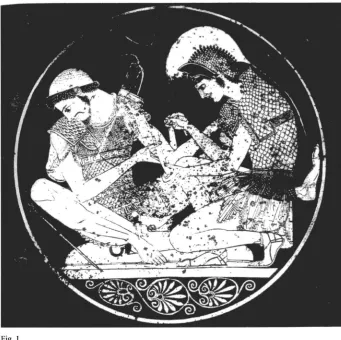
(Bishop 1959, pp. 23-24). Visual evidence of medical bandage from
early history is recorded on ceramic pieces and fragments from ancient
*•- ^luM T ^ *V««*r(..A
mm
Fig. 1
Detail from bowl of Sosias (c. 50B,C.)
Achilles bandaging the wounds of Patroclus.. .battlefield scene of warriors caring for the welfare of others.
Staatliche Museum, Berlin
(Rawls 1987, p. 163).
Cultural Bandage
The research for Second Skin included some cultural non-medical uses
for bandage from three diverse cultures - the Egyptian, Chinese and
Australian Aboriginal cultures.
Ancient Egyptians and Mummy-cloth
My decision to include the Egyptian cultural uses for bandage within
this study is due to the close association of the medical and funerary
industries. Secondly, historical records of bandage date back to the
Ancient Egyptian papyri. Additional research revealed that the strips
of cloth used to bind mummies were referred to as bandage (World Book Encyclopedia Vol 13, p. 925). Mummification was sacred and details of exactly how it was done were never publicly recorded. The
earliest written account (from about 450 BC) was recorded by a Greek
traveller, Herodotus (Davies & Friedman 1998, p. 200). The process
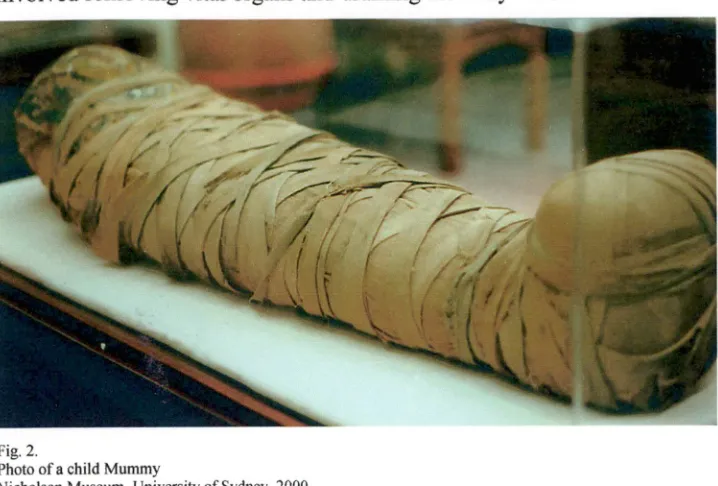
[image:24.555.133.474.47.387.2]that the soul would return to the body in the afterlife. The process
[image:25.557.136.495.81.324.2]involved removing vital organs and draining the body fluids.
Fig. 2.
Photo of a child Mummy
Nicholson Museum, University of Sydney, 2000 (Photo taken by Trudy Humphries)
19
The body was anointed with oils and resins, followed by a period of drying that lasted approximately 40 days (Davies & Friedman 1998, p.
202). Gauze, shroud-like wrappings, topped with many metres of
bandage bindings^ were then added (Fig. 2). Finally, the bodies were
coffined and entombed.
I have excluded veterinary use of bandage for animals from this
project despite the Ancient Egyptian practice of embalming pets as
seen in the well-preserved examples at the Nicholson Museum, at the
University of Sydney. However, this is evidence of another way
bandage has been used by humans.
[Varying lengths of bandage wrappings have been reported. 30 lbs. of linen -Davies, V., & Friedman, R., (1998) 'Egypt' British Museum Press, London, p. 194; and 'half a mile (0.75 km) of linen wrappings' {ibid, p. 202}].
20
Another unusual direction that bandage has been used is in the
recycling of bandage cloth from mummies, where it was used for
paper production during the American Civil War.'^
Chinese Foot-binding
In China, cloth bandage has been used to bind the feet of young girls
since before the 10*'' century A.D. (De Mause 1999, p. 1) in a bidto
enable them to be culturally acceptable. The bearer of these bandages
endured much pain. The continual rebinding of girls feet prevented normal growth. The aim was to produce 'golden lotus' feet by
breaking the bones and causing the front half of the foot to turn under.
This led to the mature woman being unable to walk naturally, and to
have an unnatural gait, considered sexually attractive to the Chinese
male ofthe era. The 'preserving' of these women was for the man's
exclusive pleasure, to be his possession; and was considered to be for
the betterment of the woman's position in life (Rawls 1987, p. 121-149).
Foot binding apparently raised the woman's status, making her
desirable, but realistically they would have foimd life difficult in such
a handicapped state. It can be imagined that the custom caused iimer
trauma to the women concerned, together with the inconvenience of a
life with an unnatural gait, altered balance and limited mobility, with
the added risk of their feet rotting (deMause 1999, p. 1). Personal
accounts of the experience of bound feet are limited, as the only living
examples are in their very senior years now. The Australian (1/7/2001,
p. 13) carried an interview of one woman's story, where she appeared
to have lived a hard life, 'raking out an existence begging for
cardboard boxes from businesses, and in turn reselling them for a
pittance, to enable her survival, as she was imsuitable for general work
21
due to the enforced handicap of bound feet'. The practice of the
binding of feet in contemporary and commerciallyoriented China appears to attract no status. The practice of foot-binding was banned by the new Republic in 1912 (Garrett 1994, pp. 92-93).
Australian Aboriginal Alternatives to Cloth Bandage
The Australian Aborigines used bark as splints to set breakages of
bones, and clay was used to cover wounds. Spider web has been used by Australian Aboriginals to close wounds.
Bandage Materials
Early Europeans used spiders' webs for closing wounds and, in 1346, English soldiers at the Battle of Cressy were issued with a medical chest containing a box of spiders' webs (Bishop 1959, p. 16). Bishop (1959, p. 16) also noted that other alternatives to cloth wrappings for
wounds have included leaves and soft inner tree barks, as used by American Indians. Bark and leaves fit within the contemporary
understanding of textile. It appears possible that throughout history the
availability of bandage materials influenced their usage. In 600 BC the
father of Hindu surgery, Sushruta, wrote in his Samhita about;
... the dressing of woimds, and advises that the important art
of bandaging should be learned by tying bandages round the
limbs and members of full-sized dolls or manikins made of stuffed linen. He [Sushruta] mentions the following materials as being suitable: cloth, manufactured from the fibre of plants, flax, cotton, wool, blankets, silk, leather, Chinese cloth, inner bark of trees, bark of the bottle gourd, tendrils of twining plants, cane or pieces of split bamboo, rope, fruits,
blades of knives and plates of metals as gold, lead, or iron
(Bishop 1959, p. 24).
However, in the nursery rhyme Jack & Jill an exception is noted: 'Jack
fell down and broke his crown' ... 'up he got and home did trot' ...
'went to bed and bound his head vdth vinegar [dressing] and brown
paper [bandage]'.
As already noted bandage materials over time have consisted of
differing fibre content and are therefore generally identified simply as
'bandage', precluding identification ofthe actual textile used. Bishop
dressings, i.e. plain bandages, dressing with water, diachylon, open dressings etc. - those which may be called dressings of the ancients'.
Cloth Bandage
Throughout history, man has shared his life with cloth. New babies are generally wrapped in cloth or swaddling. Their very first non-human skin experience is often with cloth. Cloth is made from fibre, which in
turn can be turned into clothing - something we are all familiar with
for the whole of our lives. In the past, the dead have been wrapped in a
shroud or embalmed in long strips of cloth; today the dead are covered
with a sheet. From life to death, cloth has an everyday familiarity, and
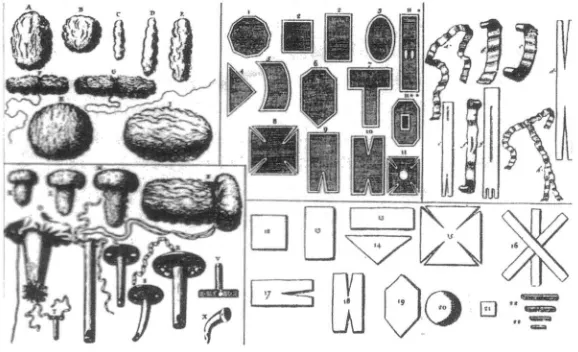
has predominated as a bandage material. The shapes of bandage have also changed according to practicalities and technological
developments, but the triangle bandage and the roller bandage (from a
strip of cloth) have prevailed. There are examples in history where
many materials and styles have been explored in the pursuit of the
ideal bandage (see Fig. 3).
?e.
."•i
19tI
• n
[image:28.555.132.421.409.585.2]I rJ0 a
Fig. 3.
Dressings and bandagesfrom Heister's General System ofSurgery, 1757. (Bishop 1959, p. 14).
Advancements in Bandage through History
Modifications to bandage and bandage practices have been occurring throughout history, aligned to the current beliefs and discoveries of the
times. Purpose-made bandage, in the form of hand woven bandage was
23
are various company accounts of surgical dressings, written for the
prime objective of recording company histories and beginning when
these enterprises began. In the preface of the company history of
Robinson & Sons Limited, Bishop (1959, p. 6) claims that no history
ofthe use and development of surgical dressings [of which bandage is one component] existed before the publication of this book. During the mid 1880s the great advancements in the technique of dressing wounds
was due to the advent of antiseptic practice by Sir Joseph Lister
(Johnson & Johnson Company History2001). This, together with the mechanization of textile industry, has seen the production of surgical dressings within factories become commonplace. Surgical bandages, produced from paper were used as a substitute for cloth bandages during the Great War (1914-1918), due to a shortage of cotton
(Museum of Victoria, 1999). Bandagehas been, and still is, part of all surgical dressings and the 'search for the ideal dressing has been pursued during more than four thousand years of recorded history, and still goes on' (Bishop 1959, p. 86). Travis (1999, p. 1) cites MacPhee (an investigator with American Red Cross in the 1990s) referring to
treatment of life threatening blood-loss as having not improved over
the centuries and that about half of all soldiers who die bleed to death. Instead of the reliance on the application of pressure, gauze or bandage
and the hope of the body's natural ability to stem the flow of blood,
MacPhee advocates 'high-tech versions of the traditional bandage'...
'impregnated with concentrated amounts of the natural proteins that
form blood clots, the new instruments of healing instead of passive
pieces of cloth' (Travis 1999, p. 1). Dressings that donate or absorb
moisture to keep the wound at optimum moisture level (Technical
Textiles Index 2000) and electrically conductive textiles have heen
produced to promote healing, reduce pain and assist circulation
(Chamberlain 1999, pp. 1-4), and Travis (1999, p. 5) reports 'an effort
to develop bandages derived from a substance made by a marine
24 Skin as Bandage
'The concept of artificial skin to replace skin on the human body dates
back to at least the late-seventeenth century, during which water lizard
skin was applied in wound care' (Leung 1998, p. 1). It is also noted by Leung (1998, p. 1-2) that many possibilities have been explored including, cow collagen, plastic sprays, fresh cadaver skin, silicone
basedproducts and cultured skin (keratinocytes) and neonatal foreskin
cells, and a newspaper article (The Examiner 7 July 2001, p. 42),
reported that fibres can be implanted withEscherichia coli to feed on
odour-causing chemicals and perspiration.
These all could have future application in respect to bandage
25
CHAPTERS
ARTISTS AND PRACTICES
... we must search amongst the absences, the spaces in between, wherein dwell the elusive places of memory.
In these shadowy and sometimes watery spaces there is loss, but there also a passage of light unfolds
(Lawrence, quoted in Emmett 1998).
An investigation of the work of contemporary artists who engage with
the unseeable, the unseen and presence within absence has helped to
position my currentpractice. Following is a surveyof selected artists who have a common purpose while at the same time differ in the
diverse intentions of their work. The points of similarity between their
works are matched by equally distinct differences. These mark points
of departure from which sometimes deeply personal, and sometimes complex conceptual concerns dominate the development of the work.
Doris Salcedo, Mona Hatoum, Saadeh George, Judith Kentish, Sarah
Lovitt, Montien Boonma, Ann Wilson, Adriana Varejao, Lyn Plummer
and Orlan, represent an international cross-section of practitioners who
in the last twenty-five years have referenced the body in new and
defining ways.
Each of these artists has considered the body as a vessel for human
suffering as well as the physical marks that are the outward emblems
of traiunatic experience. Related to these ideas are the human
conditions of vulnerability and resilience, all of which have been
investigated in the artwork.
Identity Politics - Race and Religion
Saadeh George and Mona Hatoum have both produced installations depicting the fragility of life. It is work that, in addition, focuses on issues of identity, religion and race. Mona Hatoum and Saadeh George
both have middle-eastern backgrounds that give their work a unique
26 Salcedo.
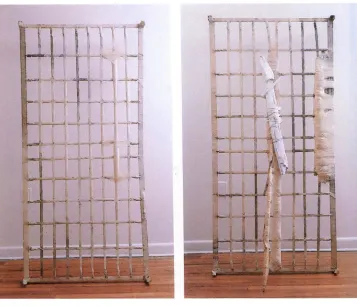
Fig. 4
DORIS SALCEDO, Untitled, 1989-90
Steel, animal fibre, plaster
200 X 90 X 8 cm each
(Princenthal, Basualdo & Huyssen 2000, p. 44),
With her first-hand knowledge of the violence and terror in her
country, Salcedo sees her work as 'questioning the elements of
violence endemic to human nature' (Princenthal, Basualdo & Huyssen
2000, p. 142). The work of these three artists is fuelled by political
concerns. The body of the political victim becomes the site of human
suffering.
Salcedo's (Fig. 4) furniture pieces are embedded with human hair or
clothing and the gridded bed-frames with bandaged, thickened struts. They evoke a sense of the absent body and loss. Salcedo says she chose to use 'materials for their capacity to convey specific meanings' (Doris Salcedo 2000, p. 10).
[image:32.555.137.494.66.373.2]rtssj^--- ^ ^ t-^*
/-t ,j;—.^J|^..- ^4 H" )(-.Ik-—^
Fig. 5
DORIS SALCEDO, Atrabiliarios 1993 (detail) Wall niches, shoes, animal fibre, surgical thread
Dimensions variable
(Princenthal, Basualdo & Huyssen 2000, p. 53).
27
•.
"M
.,P
.-9
"'1^'^
•"S
Her artwork always suggests a knowledge or experience of the acutely uncomfortable implications of traumatic events. Another work
Atrabiliarios^ (Fig. 5)does not show bodily fragments, but various
pieces of body apparel and sutures that all suggest torture, violation or
pain. The viewer is precluded from any defined action against the
body. It is, however, felt.
^ Footnote: Atrabiliarios 1993.
[image:33.553.136.475.48.533.2]MONA HATOUM, The Negotiating Table, 1983
Live work
(Araeen 1988, p. 69).
Mona Hatoum, a Palestinian, is another who works with thoughts of
the 'fragilityof life' with her performance works. In 'The Negotiating
Table' (Fig. 6) she appears - bound in ropes, and coveredin blood,
with blood stained gauze on her head, and wrapped in plastic, on top of a table. The dimly lit installation draws the viewers toward the table where they think they will better see the carcass of an animal wrapped
in plastic, only to find it is the artist herself. Here, we see the powerful
SAADEH GEORGE, Today I ShedMySkin, Dismembered and Remembered, 1998.
Gauze
30cm X 30cm x 30cm approx.
(Lloyd 1999, p. 127).
Saadeh George has created transparent organic forms resembling body
pieces that she likens to the fragility of life (Fig. 7). The pieces pay
homage to the painful stateof being the other, of which she probably
would have had extensive experience. She was bom an Iraqi, grew up in Lebanon, studied in England, experienced a mixed marriage and
practised medicine in a battlefield. Her work tells her personal story.
Her recent works Windows and Echoes in Today I Shed My Skin:
Dismembered & Remembered, produced in 1998, reflect her physical
and mental experiences of change, loss, transformation and integration
\
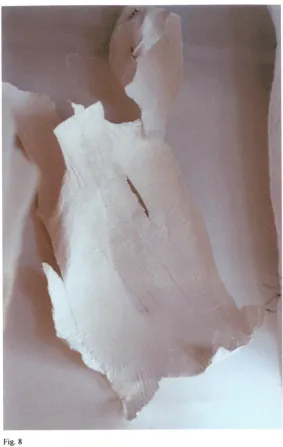
Fig. 8
TRUDY HUMPHRIES, Second Skin - Cast, 2000 Plaster, gauze, sutures
Irax 50cmx30cin
(Photo by the artist).
30
Containers - Skins and Bandages
A common thread in the work of the three artists discussed above is
how the political impacts in physicallyviolent ways on the personal.
In the case of Saadeh George, the memory and depiction of pain is part
of her personal history. What she leaves behind is her skin, the
remnant but also the container of her physical past.
My work differs from hers in that the origins of my artworkwithin this project represent major incidents in the lives of others. Despitethe
similarities in materials, methods and visual outcomes, the scale is
[image:36.555.131.414.46.493.2]31
work to emphasize the importance of the incident in the mind of the person experiencing the traumatic episode.
I am looking at bandage as a container (Fig. 8). The sculptural forms
or 'containers' have been inscribed with (created) bodily evidence to
demonstrate restriction and the greater role of bandage in wound care
practice. These include the vulnerability and resilience of the body,
wounds, injuries and their healing, and the non-physical effects of
bandage, including uncertainty and insecurity. My questionnaire
research findings confirmthat bandages primarily play a role to
support the body.
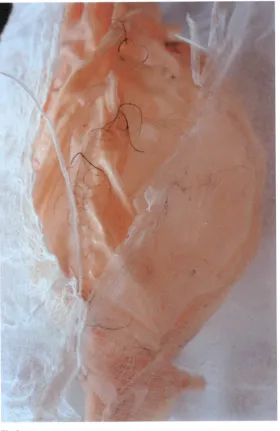
Fig. 9
TRUDY HUMPHRIES, 5econ</Sfa/i-f/eceVo. 10, (detail), 2003
Gauze, nylon, hair, dye & glue
Synthetic& cotton fabric, dyes, glue, hair
2m X 50cm x 50 cm
[image:37.554.135.416.272.704.2]At times, illness was present and not obvious until operated on. This
often was where the bandage was the only sign. In Piece No. 10, the
cancer is a hard lump. It has a large flesh-coloured firm bulge (Fig. 9)
and is veiled in soft white gauze to cover what else may exist. Hair is a
feature of the smface.
After making this work, I discovered Anne Wilson's Feast (Fig.
[image:38.556.135.477.232.584.2]10-see below) in which she also uses hair on the surfaces.
Fig. 10
ANNE WILSON,, Feast, (detail), 2000 Hair, thread, cloth, pins, wood table
80 X 168 x671cm
(Jef&ies 2001, Plate 5, p. 64).
-t
While I use cloth to suggest an unseen physical condition (one that
exists beyond the surface), Anne Wilson's cloth has become the skin.
'The link between skin and cloth is rich and varied and can be traced
back to ancient times'. Ferris (2000, p. 41) observes that 'white cloth
is metaphorically associated with light, life and health...' Wilson has
33
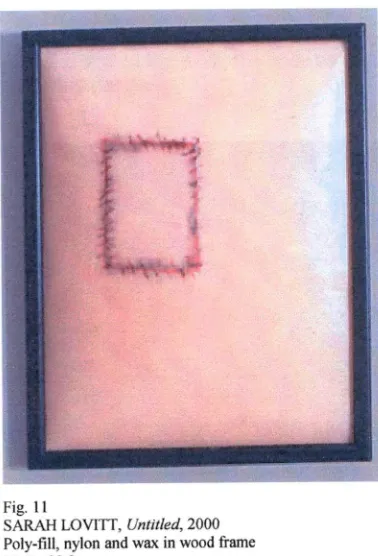
surface of the fabric to that of skin, as Sarah Lovitt (Fig. 11) has done
with her wax surfaces that have sutures at times appearing to patch the
[image:39.554.133.322.117.395.2]surface, as one would do roughly to a hole in a curtain.
Fig. 11
SARAH LOVITT, Untitled, 2000
Poly-fill, nylon and wax in wood frame
29.5 X 23.2 cm.
(Honigman 2002, p. 27).
Although she considers her work 'a type of portraiture', Lovitt's
artwork has medical influences, including wounds, scars and sutures,
and she enjoys the imperfections physically evident within her work.
However, her bodily works are described as '.. .of death mingled with
passion and life' and 'death's ubiquity that trace the volatile conflict
between medicine and faith' (Honigman 2002, p. 25-29). I consider that her artwork sits a little further along the lifeline toward death than
my current project, which is more concemed with past suffering and
34
Fig. 12
ADRIANA VAREJAO, Tilework in liveflesh, 1999
Mixed media on canvas
2 X 1.5M approx.
Museum of Contemporary Art, Biennale of Sydney, 2000 (Photo taken by Trudy Humphries),
The evocation of the memory of suffering is strong in the work of Brazilian artist Adriana Varejao. In her wallpiece (Fig. 12), the
ruptured surfaces of tiled wall spilling a membranous-looking interior
down onto the floor attracted and simultaneously confused a child
when it hung at the SydneyBiennale. Everything is something to a child, so the child asked, 'What is that!' I feel sure that the child
perceived it as being fundamentally human, while it remained
unidentifiable. To me the piece of artwork allegorised human
suffering, in the same waythat the paintings (see Fig. 13)of Moira
•• V
%•
b •• ••
[image:41.554.134.449.48.339.2]t
Fig. 13
MOERA DRYER, More Random Fire, 1991.
Acrylic on wood
78 X 86 ins.
(Gomey Bravin + Lee, viewed 24 April 04,
<http://www.gblgallery.com/aitists_individual_pages/dryer.html>).
35
Dryer's personal illness and suffering was felt in the red and black
chaos that described her battle for life while dying of cancer. The
power of both the Varejao and Dryer images is to shock while also
instilling deep thoughts of misfortune and tragedy that are experienced
by some people.
Strength and Fragility - The Seen and Unseen
So far, I have looked at work that talks about the suffering of the body.
Anne Wilson, for example, 'accentuates holes and worn areas on the cloth/skin with stitching of thread and hair... the holes also allude to
wounds, orifices, bums, disease and decay' (Jeffries 2001, p. 41). In
my work it is not only the vulnerability of the body but also its
strength and its resilience that is implied in the healing process that the
1
Fig. 14
MONTIEN BOONMA (1953-2000), Temple ofthe Mind: Sola for ike Mind, 1995 Wood, brass, bells, medicinal herbs
3m X2m X2m approx. (Heartney 2004, p. 50).
36
For Thai artist Montien Boonma, however, the body is fragile but it is
also the container of something indestructible (Fig. 14). Boonma, who
reflected upon the relationship between material and non-material aspects of life, referred to the body as a container for the soul. The
sense of foreboding present in Montien Boonma's artwork may well
be grounded in the fact of his early death. (Boonma died of a brain tumour at the age of 47 in August 2000.) 'His nearness to death led to
for his quietly meditative sculptures imbued with the spirit of
Buddhism' (Heartney 2004, pp. 50-52).
The soul is indeed unseeable. For some, however, it is present. Judith
Kentish, in Silent Infestations (Fig. 15) deals with forces which cannot
be seen, but which give the body life and strength. Throughout the
project, I have been drawn to artists whose work depicts the unseen,
[image:43.555.131.425.228.478.2]demonstrating what is absent or invisible.
Fig. 15
JUDITH KENTISH,, Silent Infestations (\nsVit\tlLion detail), 1994
Cloth, wire.
50cm X35cm x 15cm - each object (Bamford 1998, p. 120).
Judith Kentish, in her depiction of breath and thought in visual forms made physical work from unseeable subjects. This was also my aim. Combining this understanding of the unseeable - another person's
thoughts, with the viewers' existing knowledge should enhance that
person's experience of the artwork. In addition, many contemporary
artists have queried the perception and the existence of objects that,
through familiarity, have become invisible. Objects, invested with
many layers of meaning, become the signifiers of much more than can
be seen. Although working from a totally different perspective and
scale, a work such as Christo's Pant Neufasks us, amongst other
38
In the work of Judith Kentish, as well as in my current output, we are
actually giving material form to that which cannot be normally seen.
[image:44.554.132.387.131.575.2]We are both dealing with making the intangible visible.
Fig. 16
TRUDY HUMPHRIES, Second Skin - Piece No, 53
Synthetic & cotton fabric, stitch, glue
2.5in X 50cm x 50cm
(Photo by Kevin Humphries, manipulation of image by Greg Leong).
• --ffr-V
My Second Skin - Piece No. 53 (Fig. 16) is white gauze hanging
above a sheer box. The memory of the respondents bandage incident is
39
[image:45.553.129.408.64.516.2]M
Fig. 17
TRUDY HUMPHRIES, Second Skin - Piece No. 6„ (detail), 2000 Silk, glue, suture thread
2.5ni X 50cm x 50cm
(Photo by the artist).
Sutures on the surfaces of my pieces suggest pain or suffering, either physical or psychological. The depth of pain suffered by my survey
respondents cannot be truly imderstood from my perspective. Piece
No. 6 (Fig. 17), for example, strongly coloured, is sutured to embody
the pain of the operation. With a wound, one 'must also take into
account psychological factors that have an influence on healing.
Stress, anxiety and depression have been demonstrated to reduce the
efficiency of the client's immune system' (Carville 1994, p. 19).
In this Chapter, we have seen how the work of artists who view the
40
practice. How these concerns are realised in my large-scale bandages
41 CHAPTER 4
ARTWORK
WRAPPINGS AND SKINS
Bandage wrappings remain an outward sign that much may be hidden
beneath the outer layer. The unknown gives rise to mystery. The
wound beneath the bandage is presumed and acknowledged but not
seen. Mystery exists when all is not revealed to one's eyes. In this
project, I have made the wrappings to encompass and reference the
body, while signifying the mind (Fig. 18 - below). Each textile piece
represents the physical and/or psychological state of a bandaged
person - their thoughts, feelings and behaviour at a time in their life
when the outcome of their condition, and indeed their future, was
[image:47.553.132.491.335.609.2]unknown.
Fig. 18
TRUDY HUMPHRIES, Second Skin-Piece No. 17, (detail), 2001 Gauze, glue, sutures
2m X 30cm x 30cm
(Photo by the artist).
Basically, the origin of the artwork represents physically what was
recalled from the subject's memory of that time.
Memory is an information processing system of the brain in
which the brain receives a constant flow of details Ifom both
during normal waking consciousness to be recalled at some later time, as memory (Grivas, Down & Carter 1999, p. 250).
When either the mind or the body is in turmoil, there is no
equilibrium. Minds and bodies can react unpredictably in
travuna. Traumatic experience on an emotional or psychological
level can manifest itself physically, and cause bodily responses.
Movement can appear uncomfortable, abnormal and even
[image:48.555.133.416.175.671.2]distorted.
Fig. 19
TRUDY HUMPHRIES, Second Skin - Piece No. 4. (Detail), 2000 Gauze, Procion dye - printed & painted, glue
2m X 50cm x 50cm
(Photo by the artist).
c
Second Skin - Piece No. 4 (Fig. 19), for example, is large and
with twisting fabric, and the respondent had thoughts of their leg
43
cracking open. Is the unseen mind at times causing the
contrapposto, the twisting of the body - ill at ease with itself
(Elkins 1999, p. 72) and pushing through the outer layer? 1
created this piece wondering how powerful the mind could be.
The effect visible on a surface may be interpreted as being caused by that which is beneath the smface. The mind lies
beyond a surface, behind bandage, and beyond the skin, and
could be in charge of the body's reactions.
The memories of bandaged persons have influenced me in the
shaping of the forms. They are not visual reports, or portraits,
but interpretations of incidents of bandage experience. Similarly,
the French performance artist, Orlan, proposed a project
involving her skin, blood and gauze, where the gauze (bandage
fabric) performs the function of skin in retaining the blood, and
forming what is a transitional self-portrait. Her repeated
cosmetic surgeries in the context of techno-biological art have
been described as creating a nomadic identity (Miglietti 2003, p.
171), in which the last known physiognomic address can never
Fig. 20
TRUDY HUMPHRIES, Second
Skin-Gauze, glue
2m X 30cm
(Photo by the artist).
Piece No. 20, Ltfe - Hanging by a Thread, 2002
45
Memory, on the other hand, can be entirely selective. The
psychological factors behind Second Skin- Piece No. 20, Life ~ Hanging by a Thread (Fig. 20), constructed from white stiffened
gauze, were that there was no memory of the accident. The respondent
only knew what he was told, and he appeared not to be troubled by
that, even to the point of knowing that he had stopped breathing in the
emergency department. I created a point of tension in the work to
express the closeness to a tragic end.
The following sections give a siraunary of various aspects of the work, specifically relating to the themes of absence/presence, 'beauty' and
memory and to how the work was made, and so give an overview of
technical process and choice of materials.
Unconventional Methods
Textile is a complex discipline. It has a strong craft tradition over the
centuries in the making of cloth and decorating clothing and
furnishings. I have utilized various textile traditions, drawing on my
existing skills of knitting, knotting and stitching with those recently
explored, including weaving, suturing, printing and embroidery.
However, the skills have often been combined with unconventional
art-making methods such as the melting, gluing and moulding of
textiles. Knowing the possibilities and capabilities of particular
textiles, I realised the need to utilize other products to combine with
46
Fig. 21
TRUDY HUMPHRIES, Second Skin,- Small-scale Samples, 2000 Gauze, glue, sutures
SO X 20 X 20cm each
(Photo by the artist).
The Small-scale Samples (Fig. 21) marked the beginning of the studio
work. Working with gauze, (a soft, filmy, loosely woven cotton) and
requiring an inner void in each piece, I realised I needed support from other media. Periods of experimentation were required, where testing
for compatibility with other materials for the construction of large
works was essential. Gravity and the weight of materials affect each
piece, and balance is crucial to their self-supporting nature. I required
sheemess and opacity, sculptural strength and the ability to withstand
variations in temperature and moisture in both winter and summer.
There exists a rawness of finish in the work, signifying an interruption
to the normal day-to-day life of the bandaged person. I liken this to the
viewer being present before visiting hours (prior to the final neatening
of the bandages) or after bandage is removed and discarded. The
subject, bandage itself, is not often associated with beauty - except
perhaps, in the most ironic sense, with Orlan and plastic surgery.
Bodily Memory
The surfaces of the organic forms became the primary site of the body
reference, suggesting or confirming the tangibility of the textile forms
47
have been constructed of gauze, silk or synthetic fabric, textured or
smooth, demonstrating likeness to areas of the body. Some of the pieces have hair, another distinct reference to the body and its
cast-offs.^
Others have surfaces oozing, damp-looking surfaces resembling those
created by Lyn Plummer. Her sculptural textile pieces are of
membranous surfaces stretched onto frames. The richly textured translucent surfaces elicited a sense of unconventional beauty and
resplendence. I had not consciously been influenced by her treatments
of surfaces, but I had prior knowledge of them and rediscovered them
after completing several similar surfaces on my works. The body and, in particular, skin were paramount in both her works and mine, despite prevailing contextual differences. The interesting part of
SecondSkin-Piece No. 9 (Fig. 22) is that it is strongly red coloured and crinkly, and
yet gives a visceral appearance of wetness.
Fig. 22
TRUDY HUMPHRIES, Second Skin ~ Piece No. 9, (detail), 2002 Silk, Procion dye, glue
1.5m X 30cm
(Photo by the artist).
Body Presence and Absence
48
Various pieces of the artwork resemble a shed skin. Others, while
primarily representing bandage or skin, suggest a likeness to cast off
clothing pieces, reflecting and indicating bodily absence, and implying
i
TRUDY HUMPHRIES, Second Skin - Piece No. 30, (detail). Bound into a Straight Jacket, 2004 Gauze, synthetic string, glue, dye
1.8m X .4m x .2m
(Photo by the artist).
49
Second Skin - Piece No. 30 is represented in this way, as the
respondent mentioned feeling bound into a straight-jacket (Fig. 23).
Residual wastes on numerous other pieces suggest body fluids, and, despite the surfaces being synthetic or in some cases gauze and varying in colour, a sense of body and body casings is evoked.
My artwork also involves lived experience and memories, together
with possible change and transformation (either short-term or
long-term) of others' circumstances. The description of Sadeeh George's
artwork moulded from her own body in gauze or tissue paper given by
Lloyd (1999, p. 176), suggests identity and empty shells, and their
translucent appearance as 'ghostly materialisations' has a similar
connection to the way I project my ideas through textile.
Textile Choices
In the visual research a range of textiles were utilized. They included
fine and raw silks, several common cottons including gauze, calico,
voile and broadcloth, and hemp. Synthetic fabrics, including curtaining