Recursive State Machines
Salvatore La Torre1and Gennaro Parlato1,2
1Universit`a degli Studi di Salerno, Italy 2
University of Illinois at Urbana-Champaign, USA
Abstract. Recursive state machines (rsms) are models for programs with recursive procedural calls. WhileLtlmodel-checking isExptime -complete on such models, on finite-state machines, it isPspace-complete in general and becomes Np-complete for interesting fragments. In this paper, we systematically study the computational complexity of model-checkingrsms against several syntactic fragments ofLtl. Our main re-sult shows that if in the specification we disallownext anduntil, and re-tain only theboxanddiamondoperators, model-checking is inNp. Thus, differently from the full logic, for this fragment the abstract complexity of model-checking does not change moving from finite-state machines to rsms. Our results on the other studied fragments confirm this trend, in the sense that, moving from finite-state machines torsms, the complex-ity of model-checking either rises from Pspace-complete to Exptime -complete, or stays withinNp.
1
Introduction
Linear temporal logic (Ltl) is a specification language commonly used for
ex-pressing correctness requirements of reactive systems [10,11]. An Ltl formula
is built from atomic propositions, boolean connectives, and temporal modalities such asnext,diamond,box, and until, and is interpreted over infinite sequences of states which model computations of reactive programs. A typical temporal re-quirement is “every requestpis followed by a responseq,” and can be expressed inLtl as2(p→3q ).
Given an abstract model M of a reactive system and an Ltl formula ϕ, Ltl model-checking asks whether an infinite computation of M satisfying ϕ
exists. WhenM is finite-state, this decision problem is Pspace-complete [12].
Despite the high computational complexity, solutions toLtlmodel-checking are
implemented in verification tools and successfully applied in practice (see [5,9]). The control flow of programs with recursive procedure calls can be naturally captured with recursive state machines (rsms). In an rsm, vertices can either
be ordinary states or can correspond to invocations of other state machines in a potentially recursive manner. We recall that rsms correspond to pushdown
This research was partially supported by the MIUR grant ex-60% 2005, Universit`a degli Studi di Salerno.
L. Arge et al. (Eds.): ICALP 2007, LNCS 4596, pp. 937–948, 2007. c
systems, and the related model-checking problem has been extensively studied in the literature [1,4,8,13]. Among the many interesting results, we recall that
Ltlmodel-checking ofrsms isExptime-complete [4].
On finite-state systems, the computational complexity of model-checking for meaningfulLtlfragments improves (see [6]). In particular, for the logic of all
for-mulae obtained by allowing an arbitrary nesting ofdiamond andbox operators, which we denote withL(3), model-checking isNp-complete [12]. This fragment
is very rich and can express many interesting properties of reactive systems, such as liveness (as the above response property) but also safety, fairness, and others. In this paper, we systematically study the computational complexity of model-checkingrsms with respect to specifications from natural syntactic fragments of Ltl. Our goal is the discovery of more efficient algorithms for interesting classes
of specifications and a better understanding of the computational complexity of this decision problem. The main result of this paper concerns the computational complexity of model-checkingrsms with respect toL(3) specifications. We show
that this problem is inNp, that matches the known lower bound for finite-state
machines. Thus, differently from fullLtl, the computational complexity ofL(3)
model-checking stays unchanged while moving from finite-state systems torsms.
Considering the simple structure ofL(3) models [12], this result may not seem surprising. However, the effects of mixing this logic with the use of a stack were not completely clear. In the Exptime-hardness proof forLtl [4], the stack of
the model is used to linearize computations of an alternating Turing machine working in polynomial space and this basically allows the authors to carry over thePspace-hardness proof of the Ltl model-checking of finite-state machines.
Moreover, the expressiveness ofL(3) combined with the alternation provided by a 2-player game graph suffices to prove a matching lower bound for deciding full
Ltlgames [3].
To show Np membership for the model-checking of rsms with respect to
L(3) specifications, we define a certificate (a finite sequence of alternate nodes and set of nodes of thersm) and then show that the problem can be reduced to
answering two distinct queries: (1) checking that the certificate satisfies the given formula, and (2) checking that there exists a run of the givenrsmwhich matches
the certificate. To complete theNpmembership argument we also show that we
only need to investigate certificates of length bounded by the size of the formula. Observe that the smallest model of an L(3) formula among all the runs of an
rsmcan be of size over-polynomial, thus looking for an abstract representation
of runs is needed and clearly the arguments used in showingNpmembership of
this problem on finite Kripke structures [12] cannot be applied here.
The other results of this paper concern the model-checking of rsms with
respect to specifications expressed in other syntactic fragments of Ltl. For
fragments whose model-checking problem on finite-state machines is Pspace
-complete, we showExptime-hardness, and therefore the model-checking
prob-lem is Exptime-complete. For fragments whose model-checking problem on
finite-state machines isNp-complete, we instead give an Npupper bound.
membership forL(3). All the results are summarized in a table in the conclud-ing section.
2
Logic and Models
2.1 Propositional Linear Temporal Logic
In this section, we briefly recall the logicLtlandLtlmodel-checking (see [7]).
Given a set of atomic propositionsAP, a propositional linear temporal logic (Ltl) formula is composed of atomic propositions fromAP, the boolean
connec-tivesnegation (¬),conjunction(∧) anddisjunction (∨), the temporal operators next (f),diamond (3), box (2), and until (U). Formulae are built up in the usual way from these operators and connectives, according to the following gram-mar
ϕ:=p| ¬ϕ|ϕ∧ϕ| fϕ|ϕU ϕ,
wherepis an atomic proposition ofAP. The other formulae can be introduced as abbreviations in the usual way. In particular, the diamond operator is a restricted form of until (i.e.,3ϕ≡trueU ϕholds), and the box operator expresses the
logical negation of the diamond operator (i.e.,3ϕ≡ ¬(2¬ϕ) holds).
Ltlformulae are interpreted on linear-time structures. Alinear-time structure
(or simply astructure) is a pair (π,labπ) whereπis anω-sequenceπ=s0s1s2. . . ofstates andlabπ is a mappinglabπ:{s0, s1, s2, . . .} →2AP labeling each state si with the set of propositions that hold atsi.
Let π be a structure, i ∈ N0 be a position, and ϕ an Ltl formula. The
satisfaction relation|= is inductively defined as follows.
– (π, i)|=p⇔def p∈labπ(si);
– (π, i)|=¬ϕ⇔def (π, i)|=ϕholds false (i.e., (π, i)|=ϕ);
– (π, i)|=ϕ∧ψ⇔def (π, i)|=ϕand (π, i)|=ψ;
– (π, i)|= fϕ⇔def (π, i+ 1)|=ϕ;
– (π, i)|=ϕ U ψ⇔ ∃def j≥isuch that (π, j)|=ψ, and∀k∈[i, j−1],(π, k)|=ϕ;
When (π,0)|=ϕ, we also write π|=ϕand say thatπis amodel ofϕ.
An Ltl-formula ϕ is satisfiable if there exists a model ofϕ. Given an Ltl
formulaϕ, we denote with|ϕ|its length. We denote withL(3) theLtlfragment
that allows only3and2as temporal operators (no next or until operators are allowed).
Given a set of atomic propositionsAP, aKripke structure overAP is a tuple M = (S, Δ,lab, I) where:S is a (possibly infinite) set ofstates; Δ⊆S×S is a transition relation;lab:S →2AP is alabeling functionthat associates with each statesa set of atomic propositionslab(s) (meaning that the atomic propositions that hold true at s are exactly those inlab(s));I ⊆S is the set of the initial states ofM.
and (si, si+1) is a transition ofM, with i≥0. Notice that, each run inM is a linear-time structure. We writeM |=ϕwhen there exists an infinite runπofM such thatπ|=ϕ. Themodel-checking problem is: “given a Kripke structureM and anLtlformulaϕ, doesM |=ϕ?” With|M|we denote the size ofM, that
is|S|+|Δ|.
In the following, we use the result.
Theorem 1 ([12]). The model-checking problem of a finite Kripke structure
against an L(3) formula isNp-complete.
2.2 Recursive State Machines
In this section, we recall the recursive state machines (rsms) introduced in [1].
Syntax. LetIM={1, . . . , k}. Arecursive state machine (rsm)Mover a set of
atomic propositionsAP is a tuple (M1, . . . , Mk), whereMh= (Nh, Bh, Yh,Enh, Exh, Eh,trueh), for h∈ IM, is a module and consists of the following compo-nents:
– A finite nonempty set ofnodes Nh, and a finite set of boxes Bh.
– A labelingYh:Bh→IM that assigns to every box a module index.
– A set ofentry nodesEnh⊆Nh, and a set ofexit nodesExh⊆Nh.
– Let Callsh = {(b, e)|b ∈ Bh, e∈ Enj, j =Yh(b)} denote the set of calls of Mh, and Retnsh = {(b, x)|b ∈ Bh, x ∈ Exj, j = Yh(b)} denote the set of returns in Mh. Then, Eh ⊆ ((Nh∪Retnsh)×(Nh∪Callsh)) is the set of edges ofMh.
– Alabeling function trueh:Nh→2AP that associates a set of atomic propo-sitions to each node ofMh.
We assume that N1, . . . , Nk (respectively, B1, . . . , Bk) are pairwise disjoint. We define with N =i∈I
MNi the set of all nodes ofM, with B =
i∈IMBi the set of all boxes of M, and with E = i∈I
MEi the set of all edges of M. Also,Y : B → IM denotes the extension of all the functionsYh, h ∈IM, and true : N → 2AP denotes the extension of all the functions true
h (h ∈ IM). ModuleMk is theinitial module ofM.
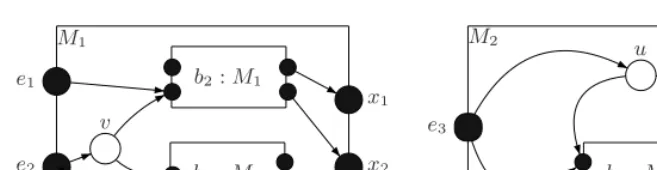
Fig. 1 illustrates the definition. Thersm has two modules. The moduleM1
has 5 nodes, of whiche1 ande2 are the entry nodes andx1 andx2 are the exit nodes, and two boxes, of whichb1 is mapped to moduleM2 andb2 is mapped toM1. The entry and exit nodes are the control interface of a module by which it can communicate with the other modules. Intuitively, think of modules as procedures, and an edge entering a box invoking the procedure associated with the box.
Semantics. With each module of an rsm, we associate a Kripke structure by
e2 x2
e3
M2
x3
b3:M1
u
b1:M2
b2 :M1
v e1
M1
x1
[image:5.513.49.378.55.140.2]x4
Fig. 1.A sample recursive state machine
– α=andu∈Nh, or,
– α=b1. . . b(with ≥1), b1∈Bh,bi+1∈BY(bi) for everyi∈[1, −1], and
u∈NY(b).
The initial states of MhF are Ih = {e|e ∈ Enh}. The labeling function is labh(αu) = true(u). In the following, for the ease of presentation, we also denote the states of M of the form αbu, where (b, u) is a call or a return, as α(b, u). Therefore, states corresponding to calls or returns will have two representations and of the two we will always use the more convenient one, as for the following definition. Given two states X, X of MF
h, we define the transition relationΔh as: (X, X)∈Δh iff X =αu,X =αv, and (u, v) is an edge ofM. (Note that in order to make the above definition consistent, we implicitly use the representation of the formβ(b, z)forX, if (b, z) is a return, and for X, if (b, z) is a call, and the standard representation in all the other cases.) The expansionMF
k of the initial module ofMis also denotedMF. Given a state X = αuwith u ∈N, we denote with node(X) the node u, and say thatuis thenode ofX.
An rsm M satisfies an Ltl formula ϕ, written M |= ϕ, iff MF |= ϕ. The
model-checking problem of anrsmMagainst anLtlformulaϕis to determine
whetherMsatisfiesϕ. The following result holds.
Theorem 2 ([1]). The problem of model-checking anrsm against anLtl
for-mula isExptime-complete.
3
The Complexity of
L
(
3
) Model-Checking on
rsm
s
In this section we show that model-checking ofL(3) formulae against rsms is Np-complete. We prove first some preliminary results and then use them to argue
the claimed result.
Fix anrsmMand anL(3) formulaϕ. Our first goal is to define a finite
cer-tificate for a run that will be used in the argument to show membership inNp.
runs,node(X2i) =u2i, and all the nodes of states occurring inπ2i+1 belong to U2i+1, for everyi∈[0, ], and for allu∈U2+1,uis the node of infinitely many states inπ2+1.
It is crucial for our argument to be able to decide in polynomial time whether there exists anMF run that matches a givenM-sequenceγ. We can construct a simple B¨uchi automatonAof size linear in the sizes ofMandγwhich accepts infinite sequences matchingγ. Therefore, the above problem reduces to checking for emptiness the intersection ofM andA. Thus, by the results shown in [1,8] we have:
Lemma 1. Given anM-sequenceγ, deciding if there exists a run ofMF
match-ing γ can be done in deterministic polynomial time in the size of M and the length ofγ.
The second important step in our argument for showingNpmembership consists
of defining a notion of satisfiability of formulae on M-sequences that can be checked efficiently and that is sufficient to show satisfiability on a matching run ofMF.
Fix anM-sequence γ=u0, U1, u2, U3, . . . , u2, U2+1. We denote withBD(ϕ) the set of all the box/diamond sub-formulaeψ ofϕ, and for a linear structure π=s0s1s2. . ., we denote withBDϕπ(si) the set of all formulaeψofBD(ϕ) such that (π, i)|=ψ.
We say thatγ satisfiesϕif:
1. the sequence π = u0u2. . . u2π is a model of ϕ, where π is any infinite sequence overU2+1such that eachu∈U2+1occurs as the node of infinitely many states ofπ;
2. for every i ∈ [1, ] and for every u in U2i−1, BDϕπˆ(u) = BDϕπ(u2i) where ˆ
π=uu2i. . . u2π.
The following proposition elaborates on some results shown in [12] for the logic we are considering.
Proposition 1. Letπ=s0s1s2. . .be a structure andπ be the suffix ofπ such
that for each state s in π there are infinitely many states s in π such that labπ(s) =labπ(s).1
1. For an L(3) formula ϕ, the set of ϕ sub-formulae that hold at a state si depends only on the atomic propositions that hold atsiand the box/diamond sub-formulae that hold at si+1 along π.
2. For ϕ∈L(3), BDϕπ(s) =BD ϕ
π(s) for every pair of statess, s withinπ.
The following lemma states that satisfaction of a formula ϕ on a given M -sequence can be efficiently verified.
Lemma 2. Given an L(3) formula ϕ and an M-sequence γ, checking that γ
satisfiesϕcan be done in polynomial time.
1
Proof. Checking part 1 of the definition of satisfiability onM-sequences is trivial and can be done in linear time (see [12]). From Proposition 1, we can start computingBDϕπ(u) for auinπ, and then we compute the subsetsBD
ϕ
π(u2i) for i= , . . . ,0. Therefore, the lemma is proved.
A crucial step in our argument for showing membership inNpis to prove that we
can answer to our model-checking question simply searching for anM-sequence γ which satisfies the given formula and checking for the existence of a run of MF matchingγ. The next two lemmas prepare such a result.
Lemma 3. If anM-sequenceγsatisfiesϕthen each run ofMF which matches
γ also satisfiesϕ.
Proof. Letγ =u0, U1, u2, . . . , U2−1, u2, U2+1 be an M sequence satisfying ϕ andπbe a run ofMF that matchesγ. Thus,πcan be factorized asX0π1X2π3. . . X2π2+1 where for all u ∈ U2+1, u occurs infinitely often in π2+1 and for i∈[0, ]: X2i are states,π2i+1 are runs,node(X2i) =u2i, and all the nodes of π2i+1 states belong toU2i+1. By part 2 of Proposition 1, we have that we can compute the setBDϕπ(X) for each stateX ofπ2+1 by simply computing it for one of them. Since the sets of atomic propositions which occur infinitely often in π2+1are exactly the sets of atomic propositions which label the nodes ofU2+1, by part 1 of Proposition 1,BDϕπ(u0) =BDϕπ(X0) holds. Therefore,πsatisfiesϕ
and the lemma is proved.
Lemma 4. If a runπofMF satisfiesϕthen there is an M-sequenceof length
≤ |BD(ϕ)|+ 1 which satisfiesϕand matches π.
Proof. Let π = X0X1X2. . . be a run of MF that satisfies ϕ. Denote with ρ the sequences0s1s2. . .where si =node(Xi) for alli= 0,1,2. . .. We construct a matching M-sequence γ as follows. For each diamond sub-formula ψ of ϕ, consider the maximum indexisuch that (ρ, i)|=ψ(if defined). Instead, for each box sub-formula ψ of ϕ, consider the maximum index i such that (ρ, i) |= ψ (if defined). Take the nodes corresponding to such indices and denote them as u2, . . . , u2−2 (by increasing indices). Observe that ≤ |BD(ϕ)|+ 1. Since the number of Mnodes is finite, there is a suffix ρ of ρ starting afteru2−2 such that all nodes of ρ occur infinitely often in ρ. Take as node u2 an arbitrary node in ρ and as u0 the first node of ρ. Therefore, ρ can be factorized as u0ρ1u2. . . ρ2−1u2ρ2+1. (Note thatρ2+1 is a suffix ofρ.) Thus, we defineγas u0, U1, u2, . . . , U2−1, u2, U2+1, whereU2i+1 is the set of all nodes ofρ2i+1 for i= 0, . . . , . By construction,γ satisfiesϕ, and the lemma is shown.
By Lemmas 3 and 4, we get the following theorem.
Theorem 3. M |= ϕ if and only if there are an M-sequence γ of length at
most|BD(ϕ)|+ 1and anMF runπsuch that πandγmatch, andγsatisfiesϕ.
Now we are ready to show membership inNp for the model-checking of L(3)
Lemma 5. L(3)model-checking on rsms is in Np.
Proof. Let M be an rsm and ϕ be a formula. To check in nondeterministic
polynomial time if there is a run ofMF satisfyingϕwe can guess anM-sequence γ of length at most|BD(ϕ)|+ 1, then check if it satisfiesϕand if there exists a run ofMF which matches it. The correctness and the time complexity of this algorithm are a consequence of Lemmas 1 and 2, and Theorem 3.
From Lemma 5 and from the fact thatL(3) model-checking isNp-hard already
on finite Kripke structures (see [12]), we have the main result of this section.
Theorem 4. L(3)model-checking on rsms is Np-complete.
4
Syntactic Fragments of
Ltl
In this section, we show the complexity bounds on other natural syntactic frag-ments ofLtl. We start introducing a notation for systematically defining such
logics.
We denote with L(H1,H2, . . .) the fragment which allows only the temporal operatorsH1,H2, . . .. For instance L(U) is “Ltl without f”. Consistently, we
have denoted with L(3) the fragment with only 3 and 2. For a formula ϕ, thetemporal height ofϕis the maximum number of nested temporal operators in it. We write Lk(H1, . . .) to denote the fragment of L(H1, . . .) where k ≥ 0 corresponds to the maximum temporal height which is allowed. We omit the indexkwhen no bound is imposed, i.e.L(H1, . . .) =Lω(H1, . . .).
Formulae of Temporal Height 1
The logicL1(U, f) contains all Ltl formulae of temporal height 1, that is, all
such formulae where temporal operators are not nested.
Model-checkingrsms against formulae of L1(U, f) isNp-complete. To show
this we observe that since temporal height is 1, formulae of this fragment are boolean combinations of simple formulae with just one temporal operator. For-mulae which use only the until operator without nesting it have simple properties as those shown forL(3) formulae in Section 3. Therefore, we can handle boolean combinations of such formulae as we have done for formulae ofL(3). Being the next operator non nested, we can only use it to specify properties on the second state of a run, and therefore we get membership toNpforL1(U, f). SinceL1(3)
is alreadyNp-hard for Kripke structures [12], we have the following theorem.
Theorem 5. L1(U, f)model-checking of rsms is Np-complete.
As a corollary of the above result and sinceL1(3) isNp-hard, we get:
Corollary 1. Model-checking of rsms for the logics L1(3, f) and L(U) is Np
Fragments with Only “Until” Formulae
In this section, we show that model-checking ofrsms is alreadyExptime-hard
forL2(U) formulae, and thus for the fragmentsL2+k(U), L2+k(U, f) andL(U). We adapt the proof given in [4] to show hardness for fullLtl. We briefly sketch
the differences with the original proof and ask the reader to refer to [4] for further details.
Theorem 6. L2(U)model-checking of rsms is Exptime-complete.
Proof. Recall that the proof given in [4] consists of a reduction from the mem-bership problem for linearly bounded alternating Turing machines. Given an alternating Turing machine M and an input word w, the reduction constructs a pushdown systemAand anL(3, f) formula ϕsuch thatM accepts w if and only if there exists a sequencexaccepted byAsuch thatx|=ϕ. The idea is that xencodes a computation of M starting withwon the input tape. The formula ϕ is mainly responsible for checking consistency between consecutive configu-rations. The automatonA takes care of the tree structure of M computations and ensures that consecutive configurations of the computation tree are encoded consecutively in the wordx.
The wordxencodes configurations position by position and consecutive con-figurations are separated by symbol #. Formulaϕhas the form
2((p#∧ fn+2p#)⇒(ϕ1∧ϕ2∧ϕ3))
where ϕ1, ϕ2 and ϕ3 are boolean combinations involving sub-formulae of the form fiψor simple atomic propositions. Note that the condition (p#∧ fn+2p#) holds true on the beginning of each configuration except the last one. We aim to show that we can replace every sub-formula of the form fiψ with an until formula, and therefore the reduction will hold for also for the fragmentL2(U).
For such purpose, let 0,1,2 be fresh atomic propositions. We label all the positions of a configuration with an atomic proposition from{0,1,2}and require that the first configuration inxis marked with 0, the second with 1, the third with 2, the fourth with 0, and so on. We also require that each position can be distinguished by the other positions in the configuration (i.e., we use pairwise disjoint sets of atomic propositions for encoding the content of each position). We use superscripts on the atomic propositions to denote the position in the configuration.
Consider a ϕ sub-formula fjpa, j ≤ n, we recall that according to the en-coding from [4], the purpose of this formula is to check that thej-th position of the current configuration contains symbola. We substitute this formula with ∧2
i=0(i→(iU pja)).
Consider now aϕsub-formula fn+j+2pa,j≤n, we recall that the purpose of this formula is to check that thej-th position of the next configuration contains symbola. We substitute this formula with∧2
i=0(i→((i∨(i+1))U (pja∧(i+1))), where (i+ 1) is modulo 3.
Moreover, we do not use more than an until operator for each maximal sub-formula of nested next operators. Therefore, the sub-formula obtained by translating ϕin the above way has temporal height 2. Besides, the size of the new formula is linear in the size ofϕ. Thus, we have the theorem.
Thus, from Theorems 2 and 6, we have the following corollary
Corollary 2. Model-checking of rsms for the logics L2+k(U), L2+k(U, f) and
L(U), for each k, isExptime-complete.
The Complexity of Nesting “Next” Operator
We consider first the logicLk(3, f), that is, the logic containing only formulae over the boolean operators and the temporal operators diamond and next, whose temporal height is bounded byk.
For a formula ϕ in such fragment we can push the next operators on the atomic propositions with a quadratic blow up. Then, we can replace each maxi-mal next sub-formula with a fresh proposition thus obtaining anLk(3) formula ϕ of quadratic size in |ϕ|. For a givenrsm M = (M1, . . . , Mh) we consider a
newrsmM such that for each machineMi we add a machineMv1...vk
i for each sequencev1. . . vk ofM nodes. Each such machine simulatesMi and maintains in the control the tuple of the nextknodes. Thus nodes, boxes and transitions are added consistently with this meaning. We label each node with the atomic propositions of the corresponding node ofMand with the new atomic proposi-tions corresponding to the next formulae that are satisfied on the sequence of the nextknodes which is paired with it. Observe that sincekis constant the size of M is polynomial in the size ofM. Therefore, model-checkingϕonMreduces in polynomial time to model-checking ϕ on M. Observe that, on formulae of
Lk(3), for each fixedk, we can determinize the nondeterministic algorithm we have given in theNpmembership proof ofL(3) such that the resulting algorithm
runs in polynomial time (recallk is constant). Therefore we have the following theorem.
Theorem 7. Lk(3, f)model-checking of rsms is in Ptime.
If we allow nesting the next operator an unbounded number of times, then the model-checking problem becomes Np-complete. Membership in Np is trivial:
we just guess a sequence of k nodes and simulate the rsm according to this
sequence. Np-hardness is inherited from the complexity of model-checking the
same fragment ofLtl on finite Kripke structures [6].
Theorem 8. L(f)model-checking ofrsms is Np-complete.
5
Conclusion
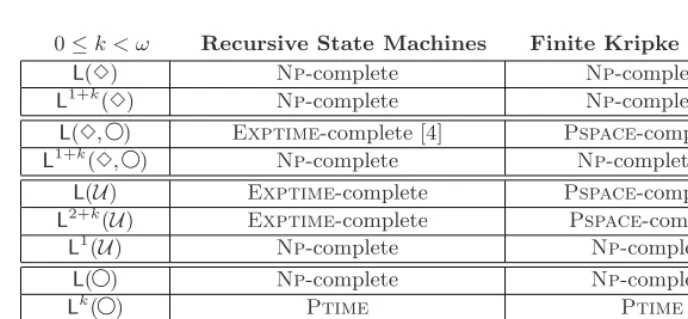
Table 1. Model-checking of rsms against Ltl fragments by bounding the temporal height
0≤k < ω Recursive State Machines Finite Kripke Structures
L(3) Np-complete Np-complete [12] L1+k(3) Np-complete Np-complete [12]
L(3, f) Exptime-complete [4] Pspace-complete [12] L1+k(3, f) Np-complete Np-complete [6,12]
L(U) Exptime-complete Pspace-complete [12] L2+k(U) Exptime-complete Pspace-complete [6]
L1(U) Np-complete Np-complete [6] L(f) Np-complete Np-complete [6]
Lk(f) Ptime Ptime[6]
L(U, f) Exptime-complete [4] Pspace-complete [12] L2+k(U, f) Exptime-complete Pspace-complete [6]
L1(U, f) Np-complete Np-complete [6]
temporal height of formulae. The complete picture of the complexity results for the considered Ltl fragments is summarized in Table 1. Observe that the
model-checking of fragments that arePspace-complete on finite Kripke
struc-tures becomesExptime-complete onrsms, instead for all the remaining
frag-ments this problem stays in the same complexity class on eitherrsms or finite
Kripke structures.
Our main result is showing thatL(3) is inNp. The argument we use relies on
two main properties: the ability of solving in polynomial time a variation of the reachability problem on thersms and the possibility of having a small
represen-tation for the instances of such problem which we need to check. The first result is not surprising, though it requires some expertise, since the set of reachable configurations in a pushdown system is regular and thus reachability-like queries can be efficiently computed. For the reasons discussed in the introduction, what was not clear was the kind of certificate to use in our arguments and also if a “small” certificate existed for such problem.
In [1], it is shown thatLtlmodel-checking forrsms and for pushdown systems
are inter-reducible in linear time. Moreover, the acceptance problem of linearly bounded alternating Turing machines can be reduced to Ltl model-checking
on pushdown systems (see [4]). Thus, theExptime-completeness ofLtl
model-checking problem forrsms comes directly from pushdown systems. Actually, the
proof given in [4] also constitutes a proof ofExptime-hardness forL(3, f).
Investigating logics of formulae with bounded temporal height is interesting and gives a better understanding of the actual complexity of real instances of the model-checking problem. In fact, in the applications, the temporal height often turns out to be at most 2 (or 3 when fairness is involved) even when the specification is quite large and combines a large number of temporal constraints. A bounded height is often invoked as a reason whyLtlmodel-checking is feasible
more interesting because of the extremely high complexity of the problem for fullLtl.
The logicLtl does not allow to express non regular properties on the runs
of an rsm, such as properties of the call-stack. The logic CaRet [2] extends Ltl with operators that allow for example to check the call-stack content or
express properties on the effects of runs within modules (local properties). Model-checkingCaRetspecifications is alsoExptime-complete. An interesting line of
future research is to systematically study the impact of theCaRet operators
on the complexity of model-checking. It is simple to verify that, except for the operators that refer to the call-stack content, there are no changes with what we have shown in this paper. Remarkably, we can show that model-checking formulae that allow to inspect the stack sequence using the diamond operator is
Pspace-hard, and we conjecture that is also inPspace.
References
1. Alur, R., Benedikt, M., Etessami, K., Godefroid, P., Reps, T.W., Yannakakis, M.: Analysis of recursive state machines. ACM Trans. Program. Lang. Syst. 27(4), 786–818 (2005)
2. Alur, R., Etessami, K., Madhusudan, P.: A temporal logic of nested calls and returns. In: Jensen, K., Podelski, A. (eds.) TACAS 2004. LNCS, vol. 2988, pp. 467–481. Springer, Heidelberg (2004)
3. Alur, R., Torre, S.L., Madhusudan, P.: Playing games with boxes and diamonds. In: Amadio, R.M., Lugiez, D. (eds.) CONCUR 2003. LNCS, vol. 2761, pp. 127–141. Springer, Heidelberg (2003)
4. Bouajjani, A., Esparza, J., Maler, O.: Reachability analysis of pushdown auto-mata: Application to model-checking. In: Mazurkiewicz, A. W, Winkowski, J. (eds.) CONCUR 1997. LNCS, vol. 1243, pp. 135–150. Springer, Heidelberg (1997) 5. Clarke, E., Kurshan, R.: Computer-aided verification. IEEE Spectrum 33(6), 61–67
(1996)
6. Demri, S., Schnoebelen, P.: The complexity of propositional linear temporal logics in simple cases. Inf. Comput. 174(1), 84–103 (2002)
7. Emerson, E.A.: Temporal and modal logic. In: Handbook of Theoretical Computer Science. Formal Models and Sematics (B), vol. B, pp. 995–1072 (1990)
8. Esparza, J., Hansel, D., Rossmanith, P., Schwoon, S.: Efficient algorithms for model checking pushdown systems. In: Emerson, E.A., Sistla, A.P. (eds.) CAV 2000. LNCS, vol. 1855, pp. 232–247. Springer, Heidelberg (2000)
9. Holzmann, G.J.: The model checker spin. IEEE Trans. Software Eng. 23(5), 279– 295 (1997)
10. Manna, Z., Pnueli, A.: The temporal logic of reactive and concurrent systems: Specification. Springer, Heidelberg (1991)
11. Pnueli, A.: The temporal logic of programs. In: FOCS, pp. 46–57. IEEE Computer Society Press, Los Alamitos (1977)
12. Sistla, A.P., Clarke, E.M.: The complexity of propositional linear temporal logics. J. ACM 32(3), 733–749 (1985)