S1
HOBS methods for enhancing
resolution and sensitivity in small DNA
oligonucleotide acid NMR studies
Josiah M. McKenna and John A. Parkinson
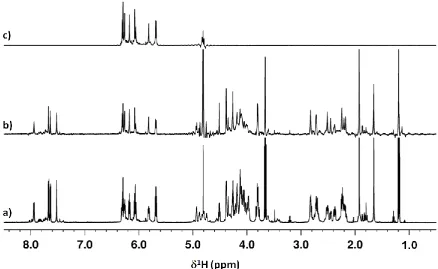
S9 Figure S8: 600 MHz 1D 1H NMR spectra for d(GCCTGC) in D2O using various data acquisition schemes. a) Standard 1D 1H NMR spectrum using a single pulse/acquire acquisition scheme incorporating solvent presaturation – number of transients (ns) = 16; b) Pure-shift (HOBB) 1D 1
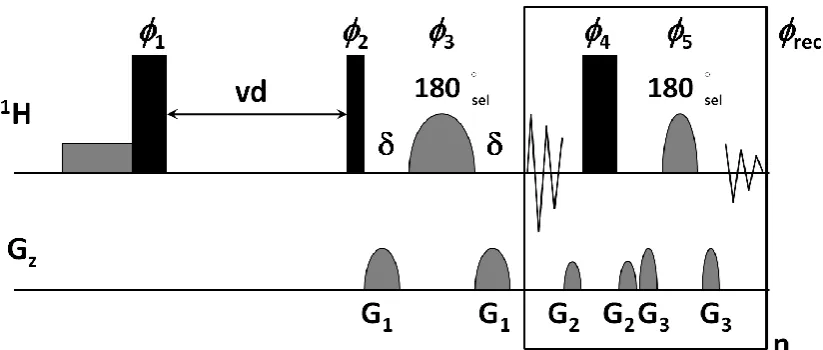
[image:9.595.78.517.76.345.2]S10 Table S1: HOBS-1H T1 inversion-recovery relaxation data for H5 and H1’ resonances from the
oligonucleotide d(GCCTGC).
H5/H1’ Resonance Region
Peaka T1 by Integration (s) T1 by Peak Picking (s)
#1 #2 #3 Avg. St. Dev. #1 #2 #3 Avg. St. Dev.
1 1.845 1.852 1.846 1.848 0.004 1.673 1.670 1.665 1.669 0.004 2 2.059 2.051 2.054 2.055 0.004 2.166 2.165 2.177 2.169 0.007 3 1.742 1.746 1.747 1.745 0.003 1.707 1.699 1.712 1.706 0.007 4 1.852 1.853 1.861 1.855 0.005 1.918 1.905 1.924 1.916 0.010 5 1.908 1.910 1.931 1.916 0.013 1.852 1.860 1.857 1.856 0.004 6 2.405 2.386 2.347 2.379 0.030 2.520 2.512 2.614 2.549 0.057 7 2.114 2.119 2.125 2.119 0.006 1.878 1.885 1.893 1.885 0.008 8 2.882 2.853 2.854 2.863 0.016 2.804 2.822 2.842 2.823 0.019 9 2.699 2.751 2.807 2.752 0.054 2.986 2.980 2.976 2.981 0.005 a
Peak Assignments: 1 – C6H1’ , 1H = 6.308 ppm; 2 – C3H1’, 1H = 6.292 ppm; 3 – C2H1’, 1H = 6.291 ppm; 4 – G5H1’, 1H = 6.173 ppm; 5 – G1H1’, 1H = 6.075 ppm; 6 – C3H5, 1H = 6.057 ppm; 7 – T4H1’, 1H = 5.816 ppm; 8 – C6H5, 1H = 5.691 ppm; 9 – C2H5, 1H = 5.675 ppm. Measurements are reported from experiments carried out in triplicate.
Table S2: Standard-1H T1 inversion-recovery relaxation data for H5 and H1’ resonances from the oligonucleotide d(GCCTGC).
H5/H1’ Resonance Region
Peaka T1 by Integration (s) T1 by Peak Picking (s)
#1 #2 #3 Avg. St. Dev. #1 #2 #3 Avg. St. Dev.
1 --- --- --- --- --- 1.849 1.826 1.819 1.831 0.016
2 --- --- --- --- --- 2.072 2.060 2.051 2.061 0.011
3 --- --- --- --- --- 1.725 1.702 1.686 1.704 0.020
4 1.864 1.842 1.845 1.850 0.012 1.872 1.848 1.841 1.854 0.016
5 --- --- --- --- --- 1.912 1.879 1.863 1.885 0.025
6 --- --- --- --- --- 2.543 2.505 2.464 2.504 0.040
7 2.048 2.043 2.058 2.050 0.008 2.007 2.005 2.001 2.004 0.003
8 --- --- --- --- --- 2.870 2.817 2.780 2.822 0.045
9 --- --- --- --- --- 2.779 2.774 2.711 2.755 0.038
a
[image:10.595.66.541.439.639.2]S11 Table S3: HOBS-1H T1 inversion-recovery relaxation data for aromatic resonances from the
oligonucleotide d(GCCTGC).
Aromatic Resonance Region
Peaksa T1 by Integration (s) T1 by Peak Picking (s)
#1 #2 #3 Avg. St. Dev. #1 #2 #3 Avg. St. Dev.
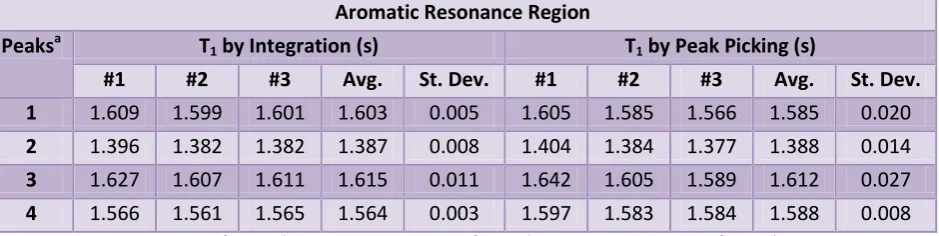
1 1.658 1.663 1.642 1.654 0.011 1.384 1.390 1.395 1.390 0.006 2 1.382 1.381 1.384 1.382 0.002 1.384 1.406 1.395 1.395 0.011 3 1.589 1.583 1.577 1.583 0.006 1.624 1.639 1.629 1.631 0.008 4 1.587 1.582 1.581 1.583 0.003 1.631 1.637 1.629 1.632 0.004 a
Peak Assignments: 1 – C3H6 , 1H = 7.940 ppm; 2 – C2H6, 1H = 7.670 ppm; 3 – C6H6, 1H = 7.630 ppm; 4 – T4H6, 1H = 7.520 ppm. Measurements are reported from experiments carried out in triplicate.
Table S4: Standard-1H T1 inversion-recovery relaxation data for aromatic resonances from the oligonucleotide d(GCCTGC).
Aromatic Resonance Region
Peaksa T1 by Integration (s) T1 by Peak Picking (s)
#1 #2 #3 Avg. St. Dev. #1 #2 #3 Avg. St. Dev.
1 1.609 1.599 1.601 1.603 0.005 1.605 1.585 1.566 1.585 0.020 2 1.396 1.382 1.382 1.387 0.008 1.404 1.384 1.377 1.388 0.014 3 1.627 1.607 1.611 1.615 0.011 1.642 1.605 1.589 1.612 0.027 4 1.566 1.561 1.565 1.564 0.003 1.597 1.583 1.584 1.588 0.008 a
[image:11.595.72.542.341.459.2]
![Figure S5 : Combined data sets from band-selected- (a) and HOBS- (b) 2D [1H, 1H] NOESY for the 10-mer DNA duplex d(CGATATATCG)2](https://thumb-us.123doks.com/thumbv2/123dok_us/1602511.113105/6.595.108.494.95.447/figure-combined-data-selected-hobs-noesy-duplex-cgatatatcg.webp)
![Figure S6: Expansion of the aromatic and H1’/H5 to H2’/H2’’/CH3 cross-peak regions of combined data sets from band selective- (a) and HOBS- (b) 2D [1H, 1H] NOESY NMR spectra for the 10-mer DNA duplex d(CGATATATCG)2](https://thumb-us.123doks.com/thumbv2/123dok_us/1602511.113105/7.595.76.526.77.398/figure-expansion-aromatic-regions-combined-selective-spectra-cgatatatcg.webp)
![Figure S7 : Strip plot in the H1’/H5/H3’/H4’/H5’/H5’’ resonance region of the 600 MHz 2D [1H, 1H] NOESY NMR spectrum of the 16-mer DNA duplex d(CGACGCGTACGCGTCG)2 in D2O displayed with a high threshold level](https://thumb-us.123doks.com/thumbv2/123dok_us/1602511.113105/8.595.96.502.74.384/figure-strip-resonance-spectrum-duplex-cgacgcgtacgcgtcg-displayed-threshold.webp)