EMPOWERMENT THROUGH COMMUNITY-DRIVEN DEVELOPMENT: A STUDY OF THE CHIASE PROGRAM IN VIETNAM
Truong Chi Trung
A thesis submitted for the degree of Doctor of Philosophy of The Australian National University
Declaration
Except where otherwise indicated, this thesis is my own original
work carried out as a PhD student at the Australian National
University from July 2005 to December 2008.
Truong Chi Trung
Acknowledgement
At the completion of this thesis, I am happy to express my gratitude to a number of people and institutions. First of all, I would like to acknowledge my deepest sense of gratitude to Dr. Patrick Kilby, whose contribution was essential to the completion of this thesis. His theoretical guidance, critical comments and constructive suggestions were of immense help in giving me direction and focus while working on my thesis. For his constant encouragements and moral supports from the beginning to the end of this study, I would always be grateful.
I am also deeply grateful to Prof. Ben Kerkvliet, member of my supervisory panel, for his critical comments and helpful suggestions throughout different stages of the study. My profound gratitude is also extended to Dr. Sharon Bessell, member of my supervisory panel, whose invaluable comments and suggestions are very important to the completion of this thesis. Without the help of Prof. Ben Kerkvliet and Dr. Sharon Bessell, this thesis would not have been in its present form.
This study would have been inconceivable without the contribution of the key nformants and respondents in Gio Linh district in Vietnam who spent their precious time o talk to me. For these hundreds of people who sit with me and opened their minds to me ibout their lives, I am deeply acknowledged. I am also thankful to staff of the Chiase nogram, particularly, Mr. Hoang Van Suu, Mr. Duong Dinh Dung, Mr. Vo Phuc Thinh, vfs. Nguyen Thi Le Hang, Mr. Tran Van Khoa, for various sources of support.
I am also grateful to Dr. Soparth Pongquan and Prof. Jayant Kumar Routray, my teachers at Asian Institute of Technology. Their endless encouragement and inspiration play a key role in the accomplishment of this thesis.
I would like to thank all staff members of the School of Anthropology & Archaeology (ANU) for creating a good academic and social environment and providing me great facilities for my research. In particular, I want to say many thanks to Prof. Nie Peterson, Dr. Patrick Guinness, Ms. Liz Walters, Ms. Sue Frazer, Ms. Christine Dwyer, and Mr. David Me Gregory for various types of support extended to me.
A heart-felt thank is given to Ms. Minh Kauffman, Ms. Nguyen Thi Thanh Binh, Ms. Nguyen Thi Xuan Huong, Mr. Loren Jutzi (The Center for Educational Exchange with Vietnam) for providing me a wide range of supports throughout the course of my study. I am also thankful to Ms. Billie Headon, Ms. Maurette MacLeod, and Ms. Le Thi Ngan (The Crawford School for Economics and Government - ANU) for profound interest and moral supports from the beginning to the end of my study in the ANU.
I am also thankful to Dr. Jeff Wood for his precious advices on the statistical analysis of my thesis. My sincere appreciation also goes to Dr. Gail Craswell and Ms. Judy Bell for their reading and commenting on the writing of this thesis.
My gratitude is also extended to many friends, especially, Mr. Doan Dung, Ms. Le Thi Thuc, Ms. Tran Minh Hang, Ms. Nguyen Thi Thanh Binh and Mr. Khalid Chauhan, who offered various helps during my study in the ANU.
Abstract
Community-Driven Development (CDD), which is characterized by the devolution of control over decision-making and resources to the local communities, is claimed as an effective mechanism for empowering the poor and has been widely promoted. At the same time, several studies find that CDD is incapable of challenging existing local institutions and social relations. The aim of this thesis is to examine the effectiveness of the CDD approach in empowering the poor, using an analysis of the Chiase program in the socio political context of Vietnam, as a case study. The analysis involves three components: meaning of empowerment in the Chiase program, effectiveness of the program in transforming local power relations, and the factors affecting empowerment in the program.
This thesis has three groups of findings. First, it found that empowerment in the Chiase took many forms with different characteristics and consequences, which were all valued by the local people. It was also found that the elite tended to experience empowerment through gaining political power, the ability to influence the distribution of community resources, while the empowerment of the non-elite was mostly characterized by the increase in personal power, such as an improved awareness, confidence and basic skills. There were changes in power relations between local political patrons and the people, and between women and men, while the relationships between the economic ‘better-offs’ and the poor remained unchanged. The effects of collective processes in the Chiase program on empowerment were limited.
transformation was the increased relevance of community decision-making and improved people's access to available resources and support provided by the government. The transformative effect, however, was impeded by inappropriate poverty targeting schemes. Finally, downward accountability of the commune-echelon government, the extent one participated in local organizations and the amount of material support and training one received from the program were the factors that significantly affected people’s empowerment.
The findings suggest that empowerment of the poor should go beyond the realm of political domination, to include broader processes involving both the improvements of access to assets and capabilities at individual level, as well as capacity to act at higher levels of decision-making. The CDD approach has a great potential to empower the poor, however, while changing the ‘uppers-lowers’ relationships between the local political patrons and the people, and women-men relationships are possible in this approach, reversing power relations between the elite and non-elite is much more difficult.
Table of Contents
Declaration ii
Acknowledgement iii
Abstract v
Table of Contents vii
List of Tables
Error! Bookmark not defined.
List of Boxes, Diagram, Maps and Appendices xii
Abbreviations xiii
CHAPTER ONE: INTRODUCTION 1
1.1. Introduction 1
1.2. Research Issues 3
1.2.1. Empowerment 6
1.2.2. Empowerment through the CDD Approach 8
Poverty Targeting 10
Community Organizing 11
Participatory Decision-making
1.2.3. Factors Affecting Empowerment in the CDD Approach
1.3. Research Questions and Scope of the Research 17
1.4. Rationale and Limitations 18
1.5. Organization of the Thesis 19
CHAPTER TWO: EMPOWERMENT 21
2.1. Introduction 21
2.2. Theories of Empowerment 22
2.2.1. Conceptions of Empowerment 22
2.2.2. Individual Empowerment 24
2.2.3. A Theoretical Framework for Empowerment 25
2.245. Agency and Empowerment 27
2.2.5. Collective Dimension of Empowerment 28
2.2.6. Resources for Empowerment 31
2.2.7. Gender Dimension of Empowerment 32
2.2.8. Empowerment of the Poor 34
2.3. Measurement of Empowerment 36
CHAPTER THREE: COMMUNITY-DRIVEN DEVELOPMENT AS AN
EMPOWERMENT MECHANISM 40
3.1. Introduction 40
3.2. Conceptualization of the CDD Approach 41
3.3. Transformation of Power Relations in the CDD Approach 44
3.3.1. Poverty Targeting 45
3.3.2. Community Organizing 50
3.3.3. People’s participation in local decision-making 54
3.4. Downward Accountability as a Key Factor of Empowerment through the CDD 60
3.4.1. CDD as a Decentralization System 60
3.4.2. Downward Accountability as an Empowerment Process 62
For what is a Public Body held Downwardly Accountable 63
How the Downward Accountability is Ensured 65
3.4.3. A Framework for Analyzing Decentralization Systems 67
Actors in Decentralization 67
Type of Power 68
Accountability Relations 69
3.5. Conclusion 69
CHAPTER FOUR: CONTEXT OF THE CDD APPROACH IN VIETNAM 71
4.1. Introduction 71
4.2. Poverty and Inequality in Vietnam in Early 2000s 72
4.3. Poverty Reduction in Vietnam 80
4.4. Socio-Economic and Institutional Context of the CDD Approach in Vietnam 84
4.4.1. Social Stratification 84
4.4.2. Community Autonomy and People’s participation in local decision-making 89
4.5. The Chiase Program 100
4.5.1. The Chiase Program Principles 101
4.5.2. The Chiase Program Structure and Responsibility 105
4.5.3. The Local Planning and Management for Development Cycle 108
4.5.4. Analysis of Democratic Decentralization in the Chiase Program 112
The Distribution of Power among Local Actors 113
The Actors in the Decentralization 116
The Accountability Mechanisms 117
4.6. Conclusion 122
CHAPTER FIVE: METHODOLOGY 124
5.1. Introduction 124
5.2. Methodological Considerations 125
5.2.1. Combining the Qualitative and Quantitative Approaches 125
5.2.2. Problems Associated with Survey Research 126
5.3. Data collection 129
5.3.1. Pre-fieldwork Survey 129
Selection of Study Communes 130
Questionnaire Development 132
5.3.2. Survey 134
Sampling and Sample Size 134
Interview Process 136
Secondary Data 136
5.4. Data Analysis 137
5.4.1. Meaning of Empowerment 137
5.4.2. Effectiveness of the Chiase Program in Transforming Local Power Relations 139
Performance of Poverty Targeting Mechanisms 140
Change in People’s participation in local decision-making 141
Change in People’s Network 142
5.4.3. Factors Affecting Empowerment in the Chiase Program 143
Educational Attainment 143
Participation in Local Organizations 144
Wealth Level 144
Material Support 145
Training 146
Downward Accountability of the CPMU 146
5.5. Profile of Study Area 147
5.5.1. Quang Tri province 147
5.5.2. Gio Linh District 150
5.5.3. Study Communes 151
5.6. Conclusion 153
CHAPTER SIX. THE RESULTS 155
6.1. Introduction 155
6.2. Meaning of Empowerment 156
6.2.1. Responses of Empowerment 156
‘Influence Household Decisions’ 158
‘Handle Household Issues Independently and Efficiently’ 160
‘Influence Community Decisions’ 161
‘Query the Local Government Officials’ 163
‘Influence the Construction of Community Works’ 165
6.2.2. Domains of Change in the Chiase Program 166
6.3. Effectiveness of the Chiase Program in Transforming Local Power Relations 168
6.3.1. Poverty Targeting in the Chiase Program 168
6.3.2. Changes in People’s participation in local decision-making 173
6.3.3. Changes in People’s Networks 183
6.4. The Factors Affecting Empowerment in The Chiase Program 191
6.4.1. Material Support 194
6.4.2. Training 195
6.4.3. Participation in Local Organizations 196
6.4.4. Downward Accountability of the CPMU 196
6.4.5. Educational Attainment 198
6.4.6. Wealth Level 198
CHAPTER SEVEN: DISCUSSION OF RESEARCH FINDINGS 201
7.1. Introduction 201
7.2. Meaning of Empowerment in the Chiase Program 201
7.2.1. People’s Perception of Empowerment in the Chiase Prgram 201
7.2.2. Implications for the Transformation of Power Relations 204
7.2.3. Implication for Women’s Empowerment 205
7.2.4. Individual and Collective Empowerment in the Chiase 205
7.3. Effectiveness of the Chiase Program in Transforming Local Power Relations 207
7.3.1. Poverty Targeting in the Chiase Program 207
7.3.2. Impacts on People’s participation in local decision-making 211
7.3.3. Impacts on People’s Networks 214
7.4. Factors Affecting Empowerment in the Chiase Program 216
7.4.1. Downward Accountability of the CPMU 216
7.4.2. Participation in Local Organizations 219
7.4.3. Material Benefit and Training 220
7.5. Conclusion 221
CHAPTER EIGHT: CONCLUSION 223
8.1. Introduction 223
8.2. Meaning of Empowerment in the Chiase Program 224
8.3. Poverty Targeting in the Chiase Program 226
8.4. Transformation of Local Power Relations through the Chiase Program 227 8.5. Implications for the Implementation of the CDD Approach in Vietnam 230
REFERENCES 235
List of Tables
Table Page
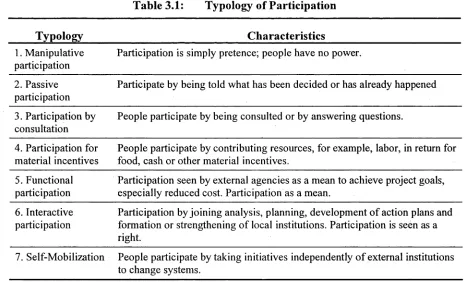
3.1 Typology of Participation 56
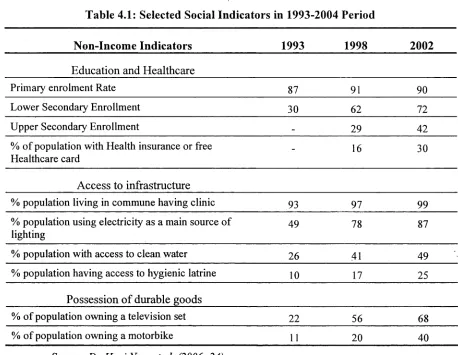
4.1 Selected Social Indicators in 1993-2004 Period 76
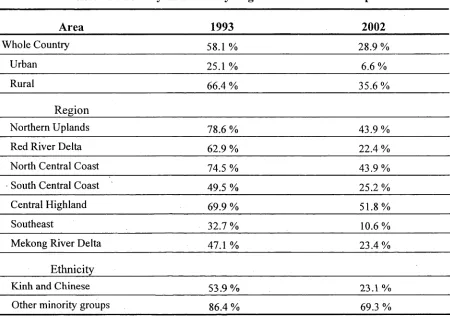
4.2 Poverty Incidence by Regions and Ethnic Groups 78
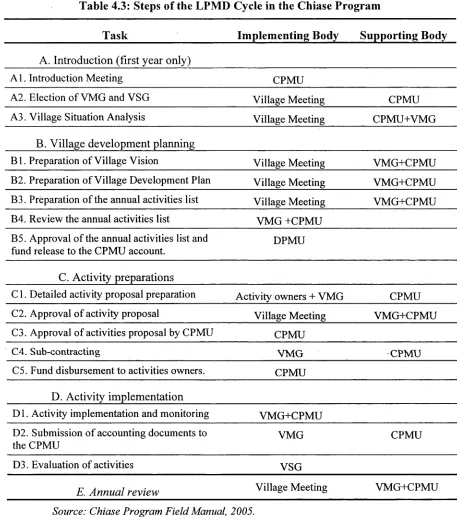
4.3 Steps of the LPMD Cycle in the Chiase Program 109
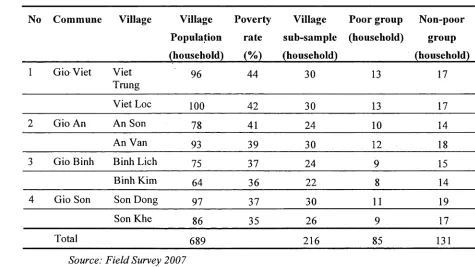
5.1 Summary of Sub-samples 135
6.1 Responses of Empowerment 157
6.2 Empowerment in the Household and Community Domains 168
6.3 Number of Households Receiving Material Support in 2005 170
6.4 People’s preference of alternative targeting policies 171
6.5 Frequency of Attendance at Village Meetings in 2005 176
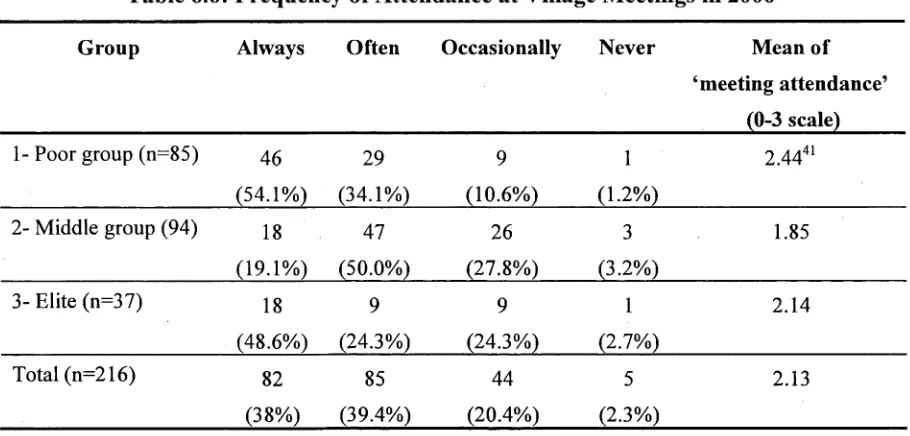
6.6 Frequency of Attendance at Village Meetings in 2006 178
6.7 Frequency of Taking the Floor in Village Meetings in 2006 179
6.8 People’s Perception about the Relevance of Village Activities 182
6.9 Most Important Sources of Support for Local Households 184
6.10 Changes in People’s Social Networks 187
List of Boxes, Diagram, Maps and Appendices
Box Page
4.1 E s t i m a t i n g P o v e r t y in V i e t n a m 7 4
4 . 2 A p p r o a c h e s t o P o v e r t y R e d u c t i o n a t L o c a l L e v e l o f t h e C P R G S 83
6.1 H o a ' s S t o r y 188
6 . 2 H a i ' s S t o r y 189
Diagram
4.1 S t r u c t u r e a n d R e s p o n s i b i l i t y in t h e C h i a s e P r o g r a m 107
Map
4.1 M a p o f V i e t n a m 102
4 . 2 L o c a t i o n o f t h e C h i a s e P r o g r a m 103
4 .3 M a p o f Q u a n g T r i P r o v i n c e a n d L o c a t i o n o f S t u d y A r e a 148
4 . 4 M a p o f G i o L i n h D i s t r i c t a n d L o c a t i o n o f S t u d y C o m m u n e s 149
Appendix
1 D a t a C o n c e r n i n g R e s p o n s e s o f E m p o w e r m e n t 2 4 0
2 D a t a C o n c e r n i n g F a c t o r A f f e c t i n g E m p o w e r m e n t 2 4 4
3 Q u e s t i o n n a i r e 2 4 8
4 C h e c k l i s t f o r K e y I n f o r m a n t I n t e r v i e w 2 5 4
5 K e y C o n t e n t s o f t h e C P R G S 2 5 5
6 R e s u l t s o f S t a t i s t i c a l T e s t s 2 5 6
Abbreviations
A U S A I D A u s t r a l i a n A g e n c y f o r I n t e r n a t i o n a l D e v e l o p m e n t
A D B A s i a n D e v e l o p m e n t B a n k
C B O s C o m m u n i t y - B a s e d D e v e l o p m e n t O r g a n i z a t i o n
C B D C o m m u n i t y - B a s e d D e v e l o p m e n t
C D D C o m m u n i t y - D r i v e n D e v e l o p m e n t
C D F C o m m u n e D e v e l o p m e n t F u n d
C D D C o m m u n i t y - D r i v e n D e v e l o p m e n t
C P C C o m m u n e P e o p l e ’ s C o m m i t t e e
C P M U C o m m u n e P r o j e c t M a n a g e m e n t U n i t
C P R G S C o m p r e h e n s i v e P o v e r t y R e d u c t i o n a n d G r o w t h S t r a t e g y
D D F D i s t r i c t D e v e l o p m e n t F u n d
D P C D i s t r i c t P e o p l e ’s C o m m i t t e e
D P M U D i s t r i c t P r o j e c t M a n a g e m e n t U n i t
F A F a r m e r s ’ A s s o c i a t i o n
L D F L o c a l D e v e l o p m e n t F u n d
M D G s M i l l e n n i u m D e v e l o p m e n t G o a l s
M O L I S A M i n i s t r y o f L a b o r , I n v a l i d s a n d S o c i a l A f f a i r s
P P C P r o v i n c i a l P e o p l e ’s C o m m i t t e e
S I D A S w e d i s h I n t e r n a t i o n a l D e v e l o p m e n t A g e n c y
V D F V i l l a g e D e v e l o p m e n t F u n d
V A V e t e r a n s ’ A s s o c i a t i o n
V M G V i l l a g e m a n a g e m e n t G r o u p
V S G V i l l a g e S u p e r v i s i o n G r o u p
W U W o m e n ’s U n i o n
Chapter One: Introduction
1.1. Introduction
Voicelessness and powerlessness are widely seen as important dimensions of poverty, and empowerment is becoming a key component of poverty reduction (Narayan et al., 2000: 31). The emphasis on empowerment has led to increasing popularity of the Community-Driven Development (CDD) approach to poverty reduction. The CDD approach, which is characterized by devolution of control over decision-making and strengthening of community-based organizations, is increasingly being promoted by World Bank and other multi-lateral development banks (Mansuri and Rao, 2004: 2; Tanaka et al., 2006: 6; Wassenich and Whiteside, 2004: 2). According to the proponents of the CDD approach, ‘the speed and directness with which the CDD empowers the poor people is rarely matched by other institutional framework for poverty reduction’ (Dongier et al., 200T. 308). At the same time, some empirical studies find that Social Funds' — a branch of the CDD approach - is incapable of changing local institutions and social relations (Babajanian, 2005: 457; Rao and Ibanez, 2003: 33). These studies found that the Social Fund even strengthened and reinforced the existing positions and dominant roles of local leaders. In Vietnam, the CDD approach has also been recognized by the Comprehensive Poverty Reduction and Growth Strategy (CPRGS) of the Vietnamese government, as the key mechanism for poverty reduction at the local level (Government of Vietnam, 2002:
63).
The main focus of this thesis is the effectiveness of the CDD approach in empowering the poor in the socio-political context of Vietnam. Two related questions are examined: (1) How and to what extent the CDD approach empowers the poor; and (2) What are the factors affecting empowerment in this development approach. The analysis is facilitated through an examination of the Chiase poverty reduction program in Vietnam . The Chiase program was initiated in November 2003, operated in three provinces of Quang Tri, Ha Giang and Yen Bai, and used a CDD approach, characterized by devolution of control to local community and people's participation in local decision-making(Chiase Program Document, 2003: 36). In many ways it can be seen as an experiment of the approach to poverty reduction at local level of the Vietnam CPRGS.
The first question on empowerment is inspired by the argument of the scholars at the World Bank that the CDD approach is an effective mechanism for empowering the poor, and can do it on a large scale (Dongier et al, 2001: 307-308). This thesis examines the effectiveness of the Chiase program in empowering the poor through two components of analysis: the meaning of empowerment which involves people’s perception of empowerment as well as its implications for the change in power relations; and the effectiveness of the Chiase program in transforming local power relations which involves the performance of poverty targeting mechanisms and improvement in people’s participation in local decision-making and social networks.
The second question explored in this thesis asks what are the factors affecting empowerment in the Chiase program. The examination is mainly undertaken through a quantitative logistic regression analysis of survey results of factors which may have some
bearing on empowerment in this program, and supplemented by a qualitative analysis relying on people’s perception of empowerment and an institutional analysis of democratic decentralization in this program. The aim of this thesis is to provide a critical evaluation of the empowering potential of the CDD programs in a context in which this approach is becoming increasingly popular in development practice, and to point out areas where improvement of the CDD programs in the socio-political context of Vietnam may be made. This chapter will now outline the key issues of the study, the research questions, the scope of the study, and its rationale and limitations.
1.2. Research Issues
The language of empowerment has become popular in the development lexicon since the introduction of a new approach to development termed ‘alternative development’, ‘people-centered development’ or ‘participatory development’ (Oakley et al., 1991: 2; Rahman, 1993: 206). The key issue of the new approach was that although physical development is important, it must be carried out in such way that the beneficiaries have both a central role in its implementation, and some control over it. There were two arguments being put forward: first, poverty is structural and has its roots in the economic and political system, and therefore it is essential to develop the abilities of the poor people to have a say in and have some influence on the forces which control their livelihoods if poverty is to be tackled. Second, development interventions have by-passed the majority of poor people, therefore poverty-targeted programs must be adjusted so that the previously neglected people have a chance to benefit from development initiatives (Oakley et al.,
1991: 2; Rahman, 1993: 206). In short, the people-centered approach saw the poverty reduction effort as a process that benefits the poor and marginalized people by giving them the power to control their own life.
including NGOs and international organizations, as a key strategy in poverty reduction. The popularity of the empowerment approach relies on the recognition that to make poverty reduction sustained, the involvement of the poor in the social, economic, and political spheres is essential. Recent literature on the nature of poverty largely sees it not only in terms of material deprivation but also as a disempowerment process. The ‘Voices of the Poor1 report of the World Bank and ‘World Development Report 2000/2001: Attacking poverty1 establish that in different social, economic, cultural and political contexts, among important factors underlying the poor people’s exclusion are voicelessness and powerlessness (Narayan et al., 2000: 31; World Bank, 2001: 15). Similarly, Amartya Sen (1999) defines poverty in terms of capacity deprivation and lack of freedom to lead the life people value. The relationship between disempowerment and poverty is explained by the World Bank (2002: 10) as the poor ‘are unable to influence and negotiate better terms for themselves with traders, financiers, government and civil society’ (p.lO). This Tack of voice1 severely affects the capacity of the poor to build assets and get out of poverty.
Millennium Development Goals (Wassenich and Whiteside, 2004: 1).
In Vietnam, since the 1990s, poverty and inequality have become central concerns of development partners in Vietnam including the government, International Organizations, and NGOs. In 2003, with the support of the World Bank and other international development agencies, the CPRGS was put forward in order to shape the framework for poverty reduction efforts in the country (Conway, 2004: vii). The CPRGS is a set of policies that center on four key approaches to poverty reduction:
• promoting a sustainable pro-poor economic growth;
• facilitating empowerment of the poor people by ensuring people’s basic needs and promoting good governance through decentralization and people’s participation;
• enhancing human capital and reduce inequality; and
• establishing ‘social safety nets’ for those marginal to or adversely affected by adjustment processes.
discussed.
1.2.1. Empowerment
Several points can be extracted from the literature on empowerment in development that are fundamental to the conceptualization of empowerment in this thesis. First, the concept of power is less about domination but ‘[is]...logically tied to that of action’ (Giddens, 1979: 94). Power can be conceptualized in term o f ‘transformative capacity’, or ‘...the capacity or likelihood of actors to achieve desired or intended outcomes’ (Giddens, 1979: 88). The emphasis on the transformative nature of power suggests the close relationship between the concept of empowerment and that of agency. This relationship provides the ground on which the definition and measurement of empowerment in this thesis are based. Here, empowerment is defined in terms of change in agency, or in the other words, as the improvement in the range of choice and the ability to make choices (Kabeer, 1999: 436; Kilby, 2006a: 2). Second, empowerment is a multi-directional social process. Giddens (1979: 6) argues that the very presence of a social relationship implies that even the subordinates have some power over the other parties. Power lies in social relationship and is always two-way; therefore in a society, empowerment is multi directional.
(political values and institutional practices) which prevent others voicing their interests. The third version explains that power is exercised where the interests of the dominant party are taken to be natural or “God-given” and no alternative to the status quo can be imagined. These versions of power show that power can be exercised not only as domination, but also as the confining of decision-making spaces. This point, therefore, facilitates the understanding of how and why disempowerment is experienced and what can be done to achieve empowerment. Fourth, empowerment has both cognitive and political components (Goetz, 2001: 35; Sen, 1997: 2) that are not mutually exclusive. The expanded sense of self-efficacy and awareness is a precondition for people to question and initiate action. Conversely, changes in opportunities to act, often caused by structural or collective processes, increase the likelihood that one can exercise agency successfully. Further, Gita Sen (1997: 2) contends that genuine empowerment includes both elements, and is less likely to be sustainable without either.
Fifth, empowerment has a collective dimension. According to Giddens (1979: 89), power can be exercised at the collective level. More specifically, power is ‘a property of the social community’, ‘a network of decision-making’ or ‘an institutional phenomenon’. Power can be seen as a collective resource, such as a collectivity of support and an institutional framework to maximize the effectiveness of individual actions, as Giddens (1984: 16) stated:
‘Power within social system, which enjoys some continuity over time and space, presumes regularized relations o f autonomy and dependence between actors and collectivities in contexts o f social interaction’.
community development. When empowered individuals act more autonomously, the sense of community is undermined. Therefore, the emphasis on personal agency and control may negatively affect community solidarity, which is crucial for the capacity of community to achieve its common goals. This raises the importance of balancing individual empowerment in community development.
Finally, as empowerment is basically related to changing power relations in favor of those who have little control over their own lives in the first place (Sen G.,1997: 2), therefore, the transformation in power relations between the poor and powerful elite is essential for the empowerment of the poor - the issue of concern in this thesis. While the evaluation of ‘transformation’ is controversial, one realistic approach to measure ‘transformation’ is to focus on the change in ‘political capabilities’ of the poor, which is defined as ‘institutional and organizational resources’ to support effective political action (Whitehead and Gray-Molina, 1999: 6), or in other words, the ability to ‘create new rules, transform social preferences, and secure new resources as they become available’ (Whitehead and Gray-Molina, 1999: 7).
1.2.2. Empowerment through the CDD Approach
people’s participation, the CDD represents a broad set of participatory initiatives. Therefore, the amount of power devolved, or in other words, the level of people’s participation informs the nature of a CDD initiative. Based on the level of community control and the level of people’s participation in stages of the project cycle, Tanaka et al. (2006: 7) propose five defining characteristics of a CDD initiative: community focus, participation in planning, participation in implementation, community control of resources, and Community-based monitoring and evaluation. These five characteristics show the continuum of the level of community participation in a CDD. Only the new generation of the CDD programs has all these characteristics while the earlier generations of the CDD may just have the first three characteristics (Tanaka et al., 2006: 7). The CDD approach is characterized by three underlying processes: poverty targeting, participatory decision making, and community organizing (Dongier et al, 2001: 4-8) which significantly affect people’s access to material benefits, political power and social capital.
poor.
Poverty Targeting
Poverty targeting refers to the extent to which scarce resources provided by the donor or government, are targeted to the poorest group. Each targeting mechanism is characterized by two factors: the method of targeting and the intermediary agent who implements the targeting (Conning and Kevene, 2002: 378). In participatory development interventions, of which the CDD forms a part, the donor or government agencies work in partnership with the local communities to implement the targeting. The responsibility of setting the criteria by which eligibility and assistance level will be judged is to a certain extent devolved to the community agents. Complete devolution is not common and most participatory targeting mechanisms give local communities a varying level of discretion within a set of rules and regulations (Conning and Kevene, 2002: 381).
According to the proponents of the CDD (Chebil and Haque, 2003: 126; Dongier et al, 2001: 307), by mobilizing local knowledge through direct participation, this approach can effectively target the poorest and the most marginal groups. The key advantage of participatory targeting is that it can target the poor in the absence of reliable information to allow means testing (Dongier et al, 2001: 307) and reduces likelihood of the adverse selection problem (Chebil and Haque, 2003: 126). Better information also helps to enhance the enforcement, reduce administration costs, and increase benefits delivered to the poor (Conning and Kevene, 2002: 382). As economic security is essential for collective actions and the mobilization of the poor (Osmani, 2000: 23), the effective poverty targeting in the CDD can have significant impacts on their 'political capabilities’.
Bergeron et al. (1998: 1989-1901) found that local knowledge may be unreliable. Poverty rankings by local informants should be used with caution as there are many factors which may affect the reliability of this technique: training of informants, choice of ranking criteria, informant selection, and definition of target population. Second, the understanding of social justice and poverty reduction may vary among communities; and may be different from that of national welfare agencies (Chan et al., 1992: 189; King, 1997: 361) . If the preference of local communities is not pro-poor, the public resource is less likely to reach the poor. Third, elite capture, which denotes the situations where decentralized power is used to influence political outcomes through manipulation of information and perceptions, or by limiting the voice of others, may significantly influence the effect of targeting mechanism. For instance, Galasso and Ravallion (2000: 25-26) find that the performance in targeting the poor of the communities significantly decreased when the village inequality increased. Finally, inappropriate design of participatory programs may create tensions between achieving poverty targeting and other objectives that may worsen targeting effect of the programs (Conning and Kevene, 2002: 388).
Community Organizing
Community organizing, characterized by the strengthening of Community-based organizations, can enhance people’s networks and community social capital (Dongier et al, 2001: 308). These improved networks and social capital are directly related to institutional and organizational resources supporting political and collective actions, or in other words, ‘political capabilities’ of the poor. Therefore, community organizing has a great potential to transform the existing power relations. However, the notion that the improved social capital through the CDD approach can create transformation in local power relations is challenged
by both theoretical reasoning and empirical evidence.
Portes (1998: 15-18), Woolcock and Narayan (2000: 231) contends that social capital can be destructive as well as constructive, and identify a number of its negative consequences, including: the strong ties among group members can prevent the outsiders from access; the closed community, under certain circumstances, may prevent the success of business initiatives by their members; group participation necessarily creates demand for the conformity of the members, which results in a strong social control and restrictive personal freedom; and there are situations where group cohesion obstructs individual success and force the more ambitious to escape from it. Harriss (2001: 113-115) argues that the notion that the strengthening of the Community-based organization can improve social capital of the poor does not take into account the class differentiation and power relations, and Rao and Walton (2004: 16) point out that as social capital is characterized by the social ties that one can mobilize to gain material benefits, it can increase the inequality. This is because the elite may have better external and internal networks than the poor and may use these networks to reproduce unequal systems of domination. Empirical findings also support this point, for example, an evaluation of the World Bank Social Fund - a form of the CDD - found that this approach does not change the nature of the existing institutions and social relations, but rather it strengthened the positions and dominant roles of local leaders (Babajanian, 2005: 457). Similarly, the World Bank OED (2002: 43) found that Social Funds use rather than produce social capital, and the social networking skills developed through social funds tend to help the elite attract external resources, rather than empower the poor.
Participatory Decision-making
characterized by the incorporation of local knowledge into the decision making process, which controls the local development and resources. In principle, through the participatory decision making process, the local development is driven by the local needs and demands what can be seen as the exercise of ‘voice1 and ‘choice’. Therefore, participatory decision making can directly improve the control over resources of the poor, or in other words, their ‘political capabilities’ (Dongier et al, 2001: 308).
However, the mobilization of ‘local knowledge’ through participatory decision making is problematic for a number of reasons. The key obstacles impeding participatory decision-making include: the dependence of the rural poor on those with power (Oakley et al., 1991: 13), the lack of organizational skills (Korten, 1981a: 191), the high ‘cost’ of participation in terms of time or the conflicts arising from decision-making (Johnson, 2001: 525; Mansuri and Rao, 2004: 6; Moore and Putzel, 1999: 10), the heterogeneity of the community (Korten, 1981a: 193; Oakley et al., 1991: 13), and how the agency is accountable in supporting participation (Mansuri and Rao, 2004: 7). These obstacles can result in two important issues in participation: first, participatory decision-making can may be influenced and shaped by the local power relations. That is, since local communities are often not homogenous social and economic entities and given the various limitations of the poor and marginalized touched on above, it is likely that the better-off would dominate the local democratic decision making. In addition, the local planning process often requires several types of inputs - time, effort, technical, managerial and political skills - that the poor are less likely to be able to provide. This operational demand further makes the local decision-making, to a large extent, rely on and therefore, be controlled by the dominant group.
‘local knowledge' are strongly influenced by the pre-existing relationship between a development agency and the local communities. Patronage-type relationship between agency and communities may result in ‘local knowledge’ which is actually shaped by an outsider’s agenda (Mosse, 2001: 32). Therefore, the commitment to people’s participation of the development agency is essential for the creation of ‘indigenous knowledge’ rather than the knowledge shaped by planning context.
1.2.3. Factors Affecting Empowerment in the CDD Approach
There are a wide range of factors that can affect how the local people can be empowered in a CDD program. This study focuses on three groups of factors: the household endowment, the benefits provided by the CDD programs, and the downward accountability of the local government involved in the CDD approach as the facilitator of community development processes. Specifically, potential factors being examined in this study include: education level, wealth level, participation in local organizations, amount of material support received, number of training courses attended, and downward accountability of the commune-level government, the partner supporting local communities in the Chiase program.
The level of wealth is important because it may be indicate access to physical assets which affect not only people income but also access to community decision-making. Relating to theories of agency, wealth level in part represents the agent’s resources, which form the 'vehicle’ or ‘media’ for the exercise of power (Giddens, 1979: 91). More specifically, control over land, assets, and capital features the economic resources of power (Uphoff, 2005: 225). Furthermore, at a practical level, a number of studies of Social Fund - a branch of CDD approach - found that the elite dominated the decision-making at local level (Babajanian, 2005: 457; Rao and Ibanez, 2003: 33).
The extent of participation in local organizations in part reflects the social networks which is important to economic development of a household (Kozen and Parker, 2000: 66; Woolcock and Narayan, 2000: 232). Further, group processes can provide the member with support, resources, and a sense of empowerment with the groups (Drury and Reicher, 1999: 383; Kroeker, 1996: 124). In the context of Vietnam’s rural societies, impact of the local organizations may be even more important because they play a key role in facilitating the provision of government services to people. In addition, being members of local organizations should have positive impacts on people’s social and political skills. Therefore, participation in local organization should have a significant bearing on empowerment.
support may be even more significant in influencing empowerment outcome.
As discussed above, empowerment involves both changes in cognitive processes, and control over resources (Sen G., 1997: 2). Therefore, training can be a potential determinant of empowerment in that it can raise awareness, confidence, and a sense of self- efficacy among the poor people. At a practical level, in poverty reduction programs, the training courses often focus on a number of poverty-related themes, such as production skills, health, and gender equality, therefore, it can be expected that the more training courses a respondent attends the higher awareness and confidence he/shc has in dealing with issues in different life domains.
Therefore, the downward accountability of the local government may be important to the empowerment effect of the CDD programs.
1.3. Research Questions and Scope of the Research
The objective of this study is to examine the effectiveness of the Chiase program in empowering poor people, and to identify the measures to improve the performance of the program in this respect. This objective involves two broad questions: how and to what extent the Chiase program empowers poor people in the socio-political context of Vietnam; and, what are the factors affecting empowerment in this program. To explore these broad questions, three sub-questions are posed:
(1) What does empowerment mean to the people in the Chiase program?
(2) How effective is the Chiase program in transforming local power relations?
(3) What are the factors affecting empowerment in the Chiase program?
The analysis of factors affecting empowerment in this program examined six potential factors; these are: educational attainment, wealth level, extent of participation in local organizations, amount of material support received, number of training courses attended, and downward accountability of the commune-level government, which is the key partner responsible for facilitating community development activities in the Chiase program.
1.4. Rationale and Limitations
The rationale of this study is the persistence of poverty in developing countries in general and in Vietnam particularly; the importance of empowerment as a key dimension of poverty reduction; and thus to examine the CDD approach as an effective mechanism for empowering the poor. These three elements together form the significance of the potential contribution of this study.
The study has two key limitations. First, due to time and financial constraints, the study relies on data collected from one case CDD program. This limitation certainly affects the generalizability of the findings of this study. However, as the goal of this study is to examine the theoretical arguments about the CDD approach, this limitation does not seriously affect the validity of the study. According to De Vaus (2001), a study relying on a single case can be ‘appropriate when we have a clear theory with well-formulated propositions and we have a single case that meets all the requirements of the theory’ (p.227). Though the single case study is by no means statistically representative, its findings can be theoretically generalized to help ‘refine, develop, and test theory’ (De Vaus, 2001: 237). In this context, reliance on the Chiase program, which features a typical CDD program, is justified.
its fourth year of implementation, the duration of time might not be long enough for empowerment effects of the program to have matured. However, the design of this study has gone some way to remedying this problem. First, the study focuses on both people’s self-evaluation of empowerment outcomes and factual data about program impacts in order to explore not only matured effects but also the subtle implications for people’s empowerment. Second, the use of two sources of analysis also increases the reliability of findings.
1.5. Organization of the Thesis
Chapter One identifies the key issues of empowerment, the CDD as an empowerment mechanism, the factors affecting empowerment, and sets out the scope, research questions, rationale and limitation of the study. Chapters Two and Three provide the theoretical background for the thesis. Chapter Two looks at the theories which informs empowerment and how it may be measured. Chapters Three examines the characteristics of the CDD and how it can be an empowering mechanism, and it relates the CDD approach to decentralization in order to highlight the importance of downward accountability in this development approach.
Chapter Two: Empowerment
2.1. Introduction
The term ‘empowerment’ is used to ‘represent a wide range of concepts, and to describe a proliferation of outcomes’ (Malhotra et al., 2002: 4). It is used in different fields of social science, such as business management, education, public health, politics and international development, to the point the concept and its application seem to blur (Page and Czuba, 1999: 2; Rowland, 1995: 9). In the field of poverty alleviation and international development, empowerment is a central strategy pursued by many international development agencies (World Bank, 2002: 1). However, despite the central role of the term ‘empowerment’ in development today, its meaning varies among different social, cultural and political contexts. Some examples are self-strength, control, self-reliance, own choice, being capable of fighting for one’s rights, independence, being free, and life of dignity in accordance with one’s values (World Bank, 2002: 10). To some extent it has become a buzzword in development practice referring to activities and processes often unrelated to changes in power relations among various actors or groups in society (Cheater, 1999: 7; Page and Czuba, 1999: 1).
issues: theories of empowerment, transformation of power relations, and the measurement of empowerment.
2.2. Theories of Empowerment 2.2.1. Conceptions of Empowerment
Although empowerment is often used with a diverse range of meanings, Mosedale (2005: 244) contends that, there are four aspects of empowerment which are generally accepted.
• First, to be empowered, one must be disempowered at least in certain aspects in the first place;
• Second, empowerment cannot be bestowed by an external actor; the most that development agencies can do is to facilitate people empowering themselves;
• Third, empowerment is about capacity to make decisions on matters which are important in one’s life and capacity carry them out; and
• Finally, empowerment is an ongoing process rather than a product.
connection between a sense of personal competence, desire for, and a willingness to take action in public domain’ (Zimmerman and Rappaport, 1988: 746). Similarly, Korten (1981b) stressed that helping the poor to develop the ‘understanding of their needs’ and ‘the opportunities and constraints they face’ is critical to people’s self development (p.214). This view of empowerment eschews the notion of power relations and equality, and is based on the model of power which is termed ‘power to’, and is often explained by the metaphor of human development (Nelson and Wright, 1995: 8). It suggests that power can grow infinitely when we work at it, and the ‘growth’ of one person does not necessarily negatively affect another (Nelson and Wright, 1995: 8), and it is also closely related to the notion of human capability (Sen G., 1997: 3)
The second view of empowerment focuses on the changes in social relationship and the role of the individual in social relations, and by definition it is political (Kabeer, 1999: 436; Riger, 1993: 283). It is based on a power model described as ‘power over’ in which, power is treated as ‘a property of a social community, a medium where community interest and class interest are realized’ (Giddens, 1979: 89-92). In the other words, power is directly related to domination and is treated as a finite amount in a closed system, or in other words a zero-sum game, so that, if one party gains more power, other parties would gain less (Nelson and Wright, 1995: 9). In this empowerment framework, empowerment is more about changes in social, institutional relations and directly link to political issues, which can be in the realms of family , organization or community power structures (Kabeer, 1999: 436). It suggests that empowerment has a collective dimension.
without corresponding changes in opportunities to act is just a 'sense of empowerment’ (Riger, 1993: 281). According to Gita Sen (1997: 2), increased self-confidence and a transformation of consciousness can enable one to overcome external barriers to access resources. On the other hand, control over resources and external world also gives one with an increase of awareness and confidence. Further, Gita Sen contends that genuine empowerment includes both elements, and is less likely to be sustainable without either. An improvement in the control of access to external resources without consciousness-raising can leave people ‘without resilience, motivation and awareness to retain and build on that control’, and the control is rarely secured. Conversely, programs that aim at raising consciousness but are unable to deliver more control over resources can lead to ‘frustration and high dropout rates’ (Sen G., 1997: 2). The next sections examine the notion of empowerment at individual level.
2.2.2. Individual Empowerment
and at the community level, empowerment involves the increase o f ‘political power’, which is characterized by the ability to influence the allocation of social and economic resources (Schulz and Israel, 1991: 10). These are by their nature related to power structures.
There are three ways through which power structures can be constituted: as ‘a network of decision-making’ through which the superiors made the subordinate to do what they would not otherwise have done; or it can be an ‘institutional phenomenon’ - where power is exercised by confining an individual’s decision-making space (Bachrach and Barantz, 1970: 18)4 5; or power is exercised where the interests of dominant party are taken to be natural (or God-given), and thus, supports the status quo (Lukes, 1974: 17)\ These explanations of the constitution of power structure suggest various strategies through which empowerment can be achieved. The next section discusses a theoretical framework for empowerment, the relationship between empowerment and agency, and then the relationship between individual and collective empowerment
2.2.3. A Theoretical Framework for Empowerment
Giddens (1979) establishes a theoretical background for understanding empowerment and its relationships with collective and structural processes. He argues that power is ‘logically tied to that of action’ and can be ‘understood as a transformative capacity’ (p.88), and power is ‘the capacity or likelihood of actors to achieve desired or intended outcomes’ (p.88). As power is exercised, structured properties of social systems are drawn upon and at the same time reproduced through the activities of the participants in
4 Bachrach and Barantz refer to power as the 'mobilization o f bias’ - the establishing barriers (political values and institutional practices) which prevent others voicing their interests. This results in ‘non decision-making’ on key issues.
the system of interactions (p.88). In that sense, power has a transformative nature (p.88). Furthermore, power in social system can be treated as ‘involving reproduced relations of autonomy and dependency in social interaction' (p.93). Power relationships are always two-way, even if the power of one actor in a social relation is minimal as compared to another (p.6). That means ‘however subordinate an actor may be in a social relationship, the very fact of involvement in that relationship gives him or her certain amount of power over the other’ (p.6). In the other words, the subordinates in power relationships are adept at mobilizing whatever resources they possess to increase their control over ‘the conditions of reproduction of those social systems’ (p.6). Therefore, power is multidirectional and lies in social relationships.
of structure’ is that power has two interrelated dimensions: ‘capacity of an actor to achieve his or her wilf, and (2) ‘a property of the collectivity’ (Giddens, 1979: 69). That means power is concurrently the transformative capacity of actors or collectives, and at the same time, a structural resource of a community.
What emerge from the points made by Giddens is that power is a social resource with structural and collective aspects, lying in social relationships and being multi directional, and is characterized by the capacity to achieve outcome - or in the other words, a transformation process. The next section establishes the relationship between concept of empowerment and that of agency.
2.245. Agency and Empowerment
Agency is conceptualized by Giddens (1979: 55) as a ‘stream of actual or contemplated causal interventions of corporeal beings in the ongoing process of events-in- the-world’, a ‘continuous flow of conducts’ and as such, a feature of being human. For Giddens (1984: 3): ‘to be a human being is to be a purposive agent’, who both has reason for her activities and is able to elaborate on them. Further, agency is also a ‘continuous process by which action transforms both structures and individuals’(1984: 14), and so, an intervention. Agency refers to both the range of choices (Kabeer, 1999: 436) and ability to exercise them (Giddens, 1984: 9).
Agency is about more than observable action; it also encompasses the meaning, motivation and purpose which individual bring to their activity ... [agency] can take the form o f bargaining and negotiation, deception and manipulation, subversion and resistance as well as more intangible, cognitive processes o f reflection and analysis. It can be exercised by individual as well as collectives (p.438).
Furthermore, it is not that all choices are equally relevant to the definition of power (Kabeer, 1999: 437). Some choices may have more significant impacts on people’s lives than others. Therefore, it is necessary to make a distinction between strategic life choices, and second-order choices, where the former are those which are critical for people to live the life they want while the latter, though important to people’s lives, do not constitute the defining characteristics of power.
Power - defined as the capability to reach outcome, is related to the access to and the performance in certain socio-political domains. Studying the empowerment of Adivasi women in India, Vijayalakshmi (2002) finds that power is in part determined by access to five domains: the household, local institutional structure, political community, broader economy, and civil society, and the ability to mobilize resources in these domains (p.271). Similarly, Jandhyala (1998) argues that power is related to access to ‘new spaces’ (p.205). This point is inline with Bachrach and Barantz (1970: 18) and Lukes (1974: 17) who see the exercise of power as defining or confining decision-making spaces. This view of power as access to and performance in decision-making spaces suggests the areas that empowerment programs can focus.
2.2.5. Collective Dimension of Empowerment
(Schulz et al., 1995: 310). Such critical understanding and skills can be effectively achieved through changes in structures and forms of interaction. Structures can shape individual resources, agency, and achievements, and thus, individual interest (Kabeer, 1999: 461). Therefore, individual empowerment may involve societal transformation by challenging powerful people and institutions either through confrontation or collaboration. Such processes can be facilitated by organizational changes (Kroeker, 1996: 124).
There is also an interrelationship between individual empowerment and collective empowerment which is defined as collective processes derived from psychological empowerment of individuals (Pilisuk et al., 1996: 17-18; Rissel, 1994: 39). According to Pilisuk, when several members are psychologically empowered and share their empowering experiences, then a collective self-efficacy emerges (p. 18). This means objectives which were previously seen beyond the power of individuals now may be seen within the collective grasp. Conversely, the collective processes can significantly affect individual empowerment. In the group, one gains voice, value and support (Kroeker, 1996: 124). The collective processes facilitate ones’ access to social and economic resources and to arenas of decision-making (Schulz et al., 1995: 310). In a nutshell, the collective processes, on the one hand, can provide members the organizational resources, such as the communication and ability to co-ordinate collective actions, and on the other hand, transform the self of the participants and increase their confidence (Drury and Reicher, 1999: 383).
the level of critical consciousness is increased, the individual as well as group together develop the capacity to act more effectively. Thus, through the building of 'critical consciousness’, both individual and communities develop their capacity to act to promote development.
Critical consciousness grows through an interactive process Freire’s (1973: 18-19) which is characterized by two aspects. The first aspect of interactive process involves constructive dialogue with other in similar situations and the opportunity to connect personal experience with larger social processes. The second aspect involves the combination of action and reflection. As group members initiate action and discuss results with other members, insights gained promote the development of skills for effective action. This dialogic process of reflection and action is the basis of the individual and collective empowerment.
In community development, collective empowerment is often referred to as community empowerment, however, community empowerment is not the sum of individual empowerment. Community empowerment is defined as a mixture of a raised level of psychological empowerment among its members, a political action in which people actively participated, and a redistribution of decision-making authority favorable to this community (Rissel, 1994: 41). The distinction between individual and community empowerment is that community empowerment is comprised of three components: the subjective experience of psychological empowerment; the objective reality of structural changes for reallocating resources; and the existence of successful collective actions. Individual empowerment defined as perceived greater control over their lives can be experienced through participation in group processes in the absence of structural change.
individual and collective empowerment, and argues that there is a tension between individual and collective action. For Riger, the situation that fosters collective values, say connectedness and consolidation, contrasts with those foster individual agency, masters and control which feature individual empowerment. Therefore, psychological empowerment may undermine community empowerment as the empowered individual acts more autonomously. She argues that: ‘finding one’s voice, controlling one’s resources, becoming empowered may reduce the interdependence that produces a strong sense of community’ (Riger, 1993: 289). That is empowering efforts which increase people’s voice and control over their own lives may lead to conflict and reduce the interdependence and cohesion between people. The above tensions points to an important task of development agencies aiming at empowering the poor: to balance personal empowerment and the community solidarity. Riger (1993) argues that:
Competition among groups for dominance and control without the simultaneous acknowledgement of common interests can lead to conflict ... One of the primary tasks ... is to articulate the relationship between empowerment and community (p.290).
2.2.6. Resources for Empowerment
As discussed previously, empowerment can be conceptualized as agency - the ability to reach outcomes. This conception suggests a concern about the factors that affect a person’s chance of achieving his/her desired objectives. These factors are termed by Uphoff (2005: 225) as power bases or power resources which can be categorized into six types. First, economic resources refer to the control over land, labor, capital as well as the goods and services produced from them. This category includes not only economic form of production but also such goods and services as influence on public policies and access to higher education.
roles or meeting social values. These resources can provide the owner with personal satisfaction, esteem, respect, or deference. They can be drawn upon to achieve further goals such as getting public service or employment. In addition, political resources are basically a consequence of authority that entitle the employment of the resources of the state institutions possess to enforce decisions. The ability to influence the exercise of authority by voting or other means also can be seen as a political resource. Furthermore, informational resources are related to the knowledge which is productive and beneficial to the owner. Next is moral resource, which means the legitimacy accorded to the decision makers, their roles, and the decisions they made. Finally, is physical resource, or the physical force that people can exert against people to compel their compliance (Uphoff,2005: 225).
2.2.7, Gender Dimension of Empowerment
While empowerment applies to all disadvantaged or socially excluded groups, women’s empowerment, encompasses some unique additional elements (Malhotra and Schuler, 2006: 71-72): women are a cross-cutting category of individuals that overlaps with other disadvantaged subsets of society, such as the poor or ethnic minorities; household relations are the central locus of women's disempowerment in a way that is not the case for other disempowered groups, therefore, the policies or interventions aiming at gender equality must be cognizant of their household-level implications (p.71); and while empowerment in general requires institutional transformations, women's empowerment requires specific changes of those institutions supporting patriarchal structures (p.72).
affected by the access to and control over key spaces within the domestic arena: physical, economic, socio-cultural, and political. There is a feedback loop between one’s position in domestic hierarchy and access to these spaces, that is when a woman’s position in domestic hierarchy changes (for instance, through marriage, birth of a child, or death of a family member), her access to spaces may increase or decrease, and conversely, new access to the above spaces can influence a woman’s capacity to act and thus her position.
Each of these spaces can affect the empowerment of women in particular way. Physical space refers to women’s access to and control of their houses, immovable property outside the home and place of work, and also includes personal mobility and control over their body and its reproductive, productive, and consumptive functions (Deshmukh- Ranadive, 2006: 110). Economic space is determined by the ownership of immovable and movable, access to both tangible and non-tangible asset, and income, which thereby can enhance a woman’s economic independence (p.l 11). Socio-cultural space is closely related to a woman’s position within kin-based hierarchies, which is influenced by a number of social and cultural factors: type of family (nuclear or extended), kinship structure (unilateral or bi-lineal), marital status, child bearing capacity, caste, class, religion, and ethnic origin (p.l 12). Finally, political space can be perceived at two levels: private political space refers to political situation within a domestic unit, which correlates to hierarchal allocations of authority and responsibility; and public political space relates to access and control of public offices and the participation in political processes (p.l 12).
is an expansion of their cognitive space which can be achieved through two processes: to bring the women together in new settings, such as collectives organized around issues of women's concern; and to raise people’s awareness of rights and duties both as citizen of civic society and members of families which mainly involve the knowledge about legal processes, human rights and entitlements.
In addition, Narayan et al. (2000: 205) highlight a common problem associated with the approach to women’s empowerment of development agencies, that is the emphasis on ‘women in development’ rather than developing approaches to both poor men and women, and propose a women’s empowerment strategy which targets both men and women. As women’s and men’s well-beings are intertwined, to help women, it is also critical to understand men’s role and reach men. Thus, women’s empowerment efforts must address two key issues: greater access to economic opportunities should be provided to both men and women; and awareness of both men and women about their worth of human beings should be improved (Narayan et al., 2000: 205). At practical level, gender equality must be reflected in ‘institutional goals, designs, incentives, and criteria of success that are monitored and evaluated' in poverty reduction programs; and discussion of gender issues must include both men and women to increase the probability of less traumatic transition toward gender equity.
2.2.8. Empowerment of the Poor