Int. J. Electrochem. Sci., 12 (2017) 9914 – 9924, doi: 10.20964/2017.10.25
International Journal of
ELECTROCHEMICAL
SCIENCE
www.electrochemsci.org
Short Communication
Structural Modification, Synthesis Mechanism and Properties
Analysis of Li
4Ti
5O
12Anode Materials
Cheng Liu, Ju Rong, Yannan Zhang, Xiaohua Yu*, Jianxiong Liu*, Zhaolin Zhan
Faculty of Materials Science and Engineering, Kunming University of Science and Technology, Kunming, 650093, P.R.China.
*
E-mail: [email protected], [email protected]
Received: 2 June 2017 / Accepted: 2 August 2017 / Published: 12 September 2017
Li4Ti5O12 microsphere was synthesized by hydrothermal method. The effects of amount of lithium
hydroxide, hydrothermal time and sintering temperature on properties of sample were studied. The synthesis mechanism of Li4Ti5O12 microsphere was preliminary analyzed. The structural
characterization was analyzed by X-ray diffraction, and the morphology was investigated by scanning electron microscopy and transmission electron microscopy. The properties of galvanostatic charge, discharge and cycle stability were also studied. The results indicated that when 2.55 mmol LiOH•H2O
reacted with 0.2 g hydrolysate, the sample had pure phase, when the hydrothermal condition was 36 h and 180 oC, the structure of sample particle was intactly spherical. The volume average size of samples were between 400 nm to 600 nm. The charge and discharge voltage plateau of samples were very stable. When the sintering temperature was 700 oC, the first discharge capacity was 148.3 mAh•g-1 at 0.1 C. After 10th cycle, the discharge capacity retained at 132.5 mAh•g-1.
Keywords: Lithium titanate; hydrothermal condition; electrochemical property; hydrothermal method
1. INTRODUCTION
Spinel Li4Ti5O12 is one of the hot spots in lithium ion battery anode material research due to its
zero strain effect, stable charge and discharge platform, as well as good cycle stability [1,2].These good features offer an attractive option for a lot applications, especially where high safety and reliability is required such as hybrid electric vehicles and electric vehicles [3,4]. However, the inherent defects such as low conductivity and low capacity also hindered its large-scale application. Currently, many studies are mainly focusing on the modification of Li4Ti5O12, the strategies include metal ion
For Li4Ti5O12, structural modification is one of the effective ways to improve its
electrochemical performance and keep its “zero-strain” characteristic [12,13]. The special shape can not only improve the bulk density of the powder, but also retain a high specific surface area. As a result, high rate of lithium ion diffusion can be maintained in the case of high current discharge, the electrode polarization is inhibited, and capacity loss is reduced. So many studies have focused on the preparation of special shapes of Li4Ti5O12, such as sheet structures [11,14], three-dimensional ordered
porous structures [15], nanowires/tube structures [16,17], hollow sphere structures [18] and so on. No wonder almost all the structures above are nano-sized, surface effect of nanomaterial ensure a high specific surface area of them. The main synthetic methods are hydrothermal method [19-21], template method [17], Sol-gel method [22,23] and so on. Liquid-liquid interface between two immiscible liquids could give a very unique non-equilibrium reaction environment with high surface energy, which may lead to complex crystallization processes and interesting materials [24,25].In this work, Li4Ti5O12 microspheres with spinel structure were synthesized by hydrothermal method using
tetrabutyl titanate, lithium hydroxide and absolute ethanol. The synthesis conditions were optimized and synthesis mechanism of Li4Ti5O12 microsphere was preliminary analyzed.
2. EXPERIMENTAL
2.1. Synthesis
A mixture of 200 ml absolute ethanol and 0.8 ml 0.1mol/L KCl solution was homogeneously mixed. The 8.80 g of tetrabutyl titanate (TBT) was added dropwise to the above mixture under ultrasonic conditions, and ultrasonic vibration was continued for 10 minutes to obtain white precipitate. The suspension was slowly stirred for 6 hours and aged at room temperature for 24 hours, after centrifugation and washed by alcohol for several times, the sedimentation of the sample was drying at 60 oC. A certain amount of LiOH•H2O was added to a mixture of 30 mL of ethanol-water
(V(A)/V(B) = 1: 1). 0.2 g of hydrolyzate was added and stirring was continued for 10 min. Then it was transferred into a PTFE-lined autoclave at 180 oC for a certain period of time. After cooling naturally, the light yellow precipitate was separated by filtration, followed by washing and vacuum drying at 60
o
C. Finally, the dried precipitate was sintered under a certain temperature conditions.
2.2. Material characterization
and particle size distribution of the powder samples were tested with a MALVERN Zetasizer 3000HSA particle size analyzer.
2.3. Electrochemical measurement
CR2025-type coin cells were assembled in an argon-filled glovebox in which both oxygen and water concentrations were less than 1 ppm. In the cell, pure lithium sheet acted as the reference and counter electrode. The working electrode was composed of active material, acetylene black as conducting agent, polyvinylidene fluoride (PVDF) as binder dissolved in N-methyl pyrrolidinone (NMP) and the mass ratio of the three matters was 85:7:8.The mixture was grinded in a carnelian mortar for 1 hour to be a slurry substance.The slurry was uniformly coated on an aluminum foil having a thickness of 20 μm, dried at 60 oC, pressed with a roll machine, dried at 120 oC for 10 hours, and cut into small pieces of Φ12 mm. The electrolyte used in the cell was of 1 M LiPF6 in a mixing solvent of ethylene carbonate (EC) and diethyl carbonate by the volume ratio of 1:1. The galvanostatic charge-discharge measurement was conducted on Land battery test system (LAND CT2001A) by Wuhan Jinnuo Electronics Co., Ltd with the voltage range from 1.0 to 2.5 V at room temperature.
3. RESULTS AND DISCUSSION
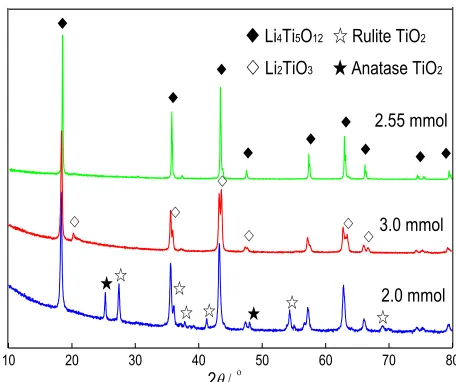
Figure 1 shows the XRD patterns of different amounts of lithium hydroxide hydrothermal at 180 oC for 12 h and heat treatment at 600 oC for 1 h. It can be seen from Fig.1 that when the amount of lithium hydroxide is 2.0 mmol, the main crystal phase of the sample is Li4Ti5O12, anatase TiO2 and
rutile TiO2. It can be seen that the amount of LiOH is insufficient during the hydrothermal process. The
excess amount of hydrated TiO2 is hydrolyzed to form anatase or rutile TiO2 during the sintering.
Similar phenomena also appear in research of Liu [27] and Sha [28].
Figure 1. X-ray diffraction pattern of samples synthesized at different amounts of lithium hydroxide hydrothermal at 180 oC for 12 h and sintering at 600 oC for 1 h.
10 20 30 40 50 60 70 80
2.0 mmol
☆
☆ ☆
☆ ☆ ☆
★
2
★
◆Li4Ti5O12
◇Li2TiO3
☆Rulite TiO2
★Anatase TiO2
3.0 mmol 2.55 mmol
◇
◆ ◆
◆ ◆
◇
◇ ◇ ◇
◇
◆
◆ ◆ ◆
[image:3.596.182.410.533.724.2]
When the amount of lithium hydroxide is 3.0 mmol, the main crystal phase of the sample is Li4Ti5O12 and Li2TiO3. It is evidently that lithium hydroxide is excessive, so excess Li atoms combine
with Ti atoms to form Li2TiO3. Some studies show that its necessary for excess of lithium hydroxide,
but the key is to control the level of excess[29-31]. When the amount of lithium hydroxide is 2.55 mmol, the sample is pure phase Li4Ti5O12, no other heterogeneous peaks. In summary, when the
[image:4.596.82.515.443.685.2]amount of lithium hydroxide is 2.55 mmol, there is no miscellaneous phase. So it is applied as optimum amount of lithium hydroxide in the following experiment.
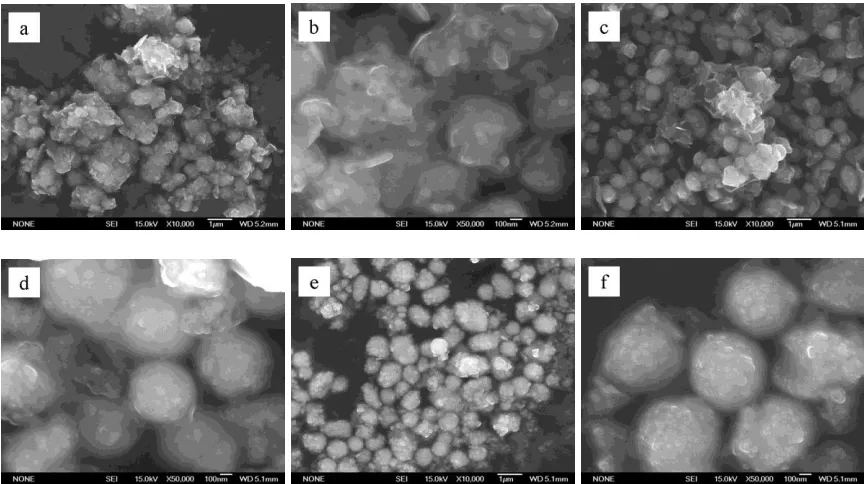
Figure 2 is the SEM image of the sample hydrothermal at 180 oC for 12 h, 24 h, 36 h and heat treatment at 600 oC for 1 h. It is well known that hydrothermal time make a great difference to sample morphology. Many researcher obtain different shape under different hydrothermal time, such as hollow microsphere [30], mesoporous microsphere [31], sawtooth-like nanosheets [32] and nanotubes [33]. After hydrothermal for 12 h, the sample does not appear spherical morphology, but formed by the accumulation of small sheet. It is noticed that individual places have a trend to formed a spherical, it is consistent with Shao’s work[28]. When the hydrothermal time is extended to 24 h, the most of sample have a spherical morphology, and the dispersion is more uniform. However, there are still sheet shape inside, the surface is more rough, individual balls stick together, the diameter of 400-700 nm. Compared with study of Wang [34], sphere of Li4Ti5O12 is much faster here, this may attribute to
higher temperature accelerate the diffusion process. When the hydrothermal time is 36 h, the sample morphology is almost all spherical, the ball surface is also very rough, but the dispersion is better, basically no bonding, the diameter is also around 400-700 nm.Likely, it is applied as optimum hydrothermal time in the following experiment.
It can be seen that with the extension of the hydrothermal time, the spherical structure is getting better and better. When the hydrothermal time is short, the sample is mostly irregular sheet. After the extension of the hydrothermal time, the sheet gradually disappear, replaced by monodisperse microspheres, which is due to particles gather more closely to maintain a good spherical shape during longer hydrothermal process.Therefore, 36 h is the appropriate hydrothermal time.
Figure 3 shows the XRD patterns of samples obtained at different heat treatment temperatures for 1 h after 36 h hydrothermal process. It can be seen from figure 3 that the samples are pure phase Li4Ti5O12 (JCPDS no. 49-0207), no miscellaneous phase appears. The peak width of sample is large at
500 oC. With the temperature rise, Li4Ti5O12 diffraction peak strength is higher and higher. The peak
becomes more and more sharp, indicating that with the temperature rise, the crystal development of the sample is getting better and better. In Wu’s work [36], the heat treatment is at 450 oC, 550 oC, 650 oC and 750 oC. Similar law is confirmed.
10 20 30 40 50 60 70 80
500C 600C 700C ◆
2
800C◆ ◆
◆ ◆ ◆
◆ ◆
◆ Li4Ti5O12
Figure 3. X-ray diffraction pattern of samples synthesized at different sintering temperatures for 1 h after 36 h hydrothermal process
Table 1. The grain size and particle size distribution of samples synthesized at different sintering temperatures for 1 h after 36 h hydrothermal process
Sintering Temperature /oC
Grain size /nm Volume average size /nm Particle size distribution /nm
500 22.12 449.4 146.4-734.5
600 36.97 525.8 84.7-673.8
700 63.27 530.3 135.4-679.3
800 67.15 555.7 141.0-890.6
[image:5.596.192.403.278.455.2] [image:5.596.53.540.573.663.2]
distribution is 100-900 nm, which is consistent with the SEM results in figure 2. Particle size of sample at 800 oC has tendency to increase, the sample size distribution range is the largest. May be the temperature rise, making the material diffusion intensified, so the particles grow.
The synthesis of lithium titanate microspheres can be roughly divided into three steps: the hydrolysis of tetrabutyl titanate, the hydrothermal process and the heat treatment process.
Figure 4 shows the XRD pattern of the tetrabutyl titanate hydrolyzate after drying at 60 oC. The hydrolyzate shown in the figure is substantially amorphous. There is weak diffraction peak at 2θ = 25.14 °, 37.98 °, 49.40 °, 55.36 °. Compared with the standard spectrum (JCPDS no. 83-2243), the diffraction peak is consistent with anatase TiO2. In combination with the experimental results and
literature [37-38]. It is presumed that Ti (C4H9O)4 is first hydrolyzed into hydrated [TiO6] octahedron
in the first stage with Ti-OH group structure; the presence of Cl- makes the Ti- protonated to form Ti-OH2+. These protonated surfaces are easily combined with other hydrated [TiO6] octahedral-OH, which
lacks a water molecule to form a Ti-O-Ti oxide bridge-bound system in which the coplanar structure occurs during hydration [TiO6] octahedral formation of amorphous hydrated anatase phase TiO2
microspheres.
10 20 30 40 50 60 70 80
2000 3000 4000 5000 6000
★ ★
★ ★
★Anatase TiO2
2
Int
ens
it
y
/
a.
[image:6.596.173.417.354.540.2]u.
Figure 4. X-ray diffraction pattern of hydrolysate after drying at 60 oC
Figure 5 shows the XRD pattern of the sample hydrothermal reaction for 36 h without heat treatment. It can be seen that LiTiO2 and complex hydrate titanium oxide appear in the process of
hydrothermal process, the crystallinity is poor and the diffraction peak is weak. It is also speculated that in the process of hydrothermal, adding LiOH ethanol-water solution, OH- and H2O may enter the
hydrated TiO2 microspheres, and the combination of titanium ions or lattice oxygen may form HTiO3-
10 20 30 40 50 60 70 80 0
150 300 450 600 750
2
● ●
●LiTiO2
◇ ◇ ◇ ◇
◇Lithium Titanium Oxide Hydrate
Int
ens
it
y
/
a.
[image:7.596.184.409.68.240.2]u.
Figure 5. X-ray diffraction pattern of hydrothermal products without sintering
In the final stage, the heat treatment causes the H2O in the hydrothermal product to be lost,
while the original phase is recrystallized at a higher temperature to form Li4Ti5O12.
Combined whith result of XRD above, hydrothermal process can be described briefly. Under the condition of KCl, the hydrated TiO2 microspheres are formed by hydrolysis of tetrabutyl titanate:
(C4H9O)4Ti + 4H2O↔TiO2·2H2O +4C4H9OH (1)
Lithium inserts into the TiO2 can form mesophase lithium titanium oxide:
TiO2 + 2LiOH↔Li2TiO3 + H2O (2)
Further reaction of mesophase lithium titanium oxide and TiO2 can form the precursor of
Li4Ti5O12 phase Li+ is reacted with cation in hydrated TiO2 microspheres The Li-Ti-H-O system was
formed by the substitution reaction:
Li2TiO3 + 4TiO2 + 2LiOH↔ Li4Ti5O12 + H2O (3)
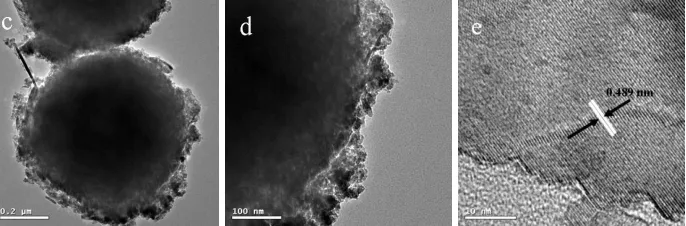
Figure 6 is TEM images of samples before and after heat treatment. From Fig. 6a and 6c, it can be seen that the size of the sample after the hydrothermal process is about 600 nm, and the size of the sample is not changed after heat treatment. As can be seen from Fig.6b and 6d, many tiny particles are attached to the surface of the spherical particles.
[image:7.596.123.474.576.729.2]
Figure 6. TEM images of samples before and after sintering. a,b is the TEM of the sample hydrothermal at 180 oC for 36 h without sintering, c, d and e are the TEM of the sample sintering at 600 oC for 1 h under the same conditions.
There are some small gaps before the heat treatment. After heat treatment, small particles seem more fluffy, more compact, and the gap is reduced, indicating that the heat treatment process appeared dense. Figure 6e is high magnification TEM picture of the sample. We can get the surface spacing of about 0.489 nm by calculation. Comparison with the standard spectrum (JCPDS no. 26-1198), it is very close to Li4Ti5O12 d (111) = 0.483nm. This means that the sample is pure phase Li4Ti5O12, which
is consistent with the previous XRD results. It is known that the size of spherical particles is not changed during the formation of lithium titanate microspheres. The spherical particles are composed of many smaller particles with a size of about 10-40nm, and the heat treatment process makes the microspheres denser.
0 20 40 60 80 100 120 140 160
0.9 1.2 1.5 1.8 2.1 2.4
4
V
o
lta
g
e
/
V
Capacity / mAhg-1
1-500℃
2-600℃
3-700℃
4-800℃
3 2 1
Figure 7. The first charge and discharge curves for the samples synthesized at different sintering temperatures
[image:8.596.129.472.71.184.2] [image:8.596.176.421.435.625.2]
123.5, 138.5, 148.3 and 140.9 mAh·g-1
, respectively. All the charge and discharge curves are very obvious and stable charge and discharge voltage platform. Charge and discharge voltage were 1.60V and 1.55V respectively. The voltage difference is very small, indicating that the charge and discharge process reversible degree is better. For sample with 700 oC heat treatment, the first discharge capacity of up to 148.3 mAh·g-1, the charge capacity of 147.0 mAh·g-1
, Coulomb efficiency is 99.1%. In this case, the initial charge-discharge capacity is the highest, and the platform area is also the widest.
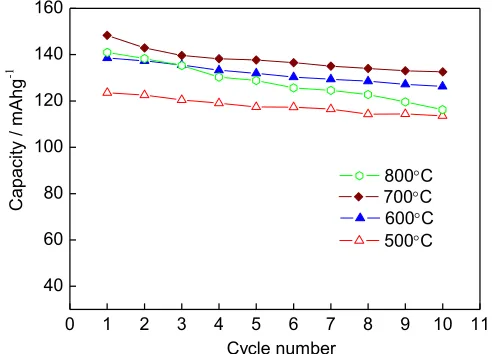
Figure 8 shows the 10 cycles of the sample at different sintering temperatures under 0.1C. When heat treatment temperature is 700 oC,the specific capacity of the discharge was reduced from 148.3 mAh•g-1
to 132.5 mAh•g-1 after the 10 cycles of discharge, the capacity retention rate was 89.3%. After heat treatment at 600 oC and 500 oC, the capacity retention rate of the sample was 91.1% and 91.7%, respectively. While the capacity of the sample under 800 oC heat treatment had a larger attenuation, capacity retention rate of which was only 82.3%. It may be due to the particles in the high temperature had a tendency to grow, which made the transmission of Li+ during the process of charge and discharge become more difficult. This causes a certain degree of polarization. Which lead to attenuation of discharge capacity.
0 1 2 3 4 5 6 7 8 9 10 11
40 60 80 100 120 140 160
700C
Cap
a
city /
m
Ah
g
-1
Cycle number
[image:9.596.170.416.347.524.2]600C 500C 800C
Figure 8. Cycling performance curves for the samples synthesized at different sintering temperatures
4. CONCLUSIONS
1) The spinel Li4Ti5O12 microspheres were synthesized by hydrothermal method using
tetrabutyl titanate, potassium chloride and lithium hydroxide. When the 0.2 g hydrolyzate was reacted with 2.55 mmol LiOH·H2O, the heat-treated product was pure phase Li4Ti5O12; when hydrothermal at
2) The synthesis process of lithium titanate microspheres may be: in the hydrothermal reaction, Li+ is replaced with cation in hydrated TiO2 microspheres, and then Li4Ti5O12 microspheres are formed
by heat treatment;
3) The discharge platform of sample is 1.55 V, the charging platform is 1.60 V, and the reversibility is good; when the heat treatment temperature is 700 oC, the sample has the highest initial discharge specific capacity of 148.3 mAh·g-1 at 0.1C, After the charge and discharge cycle, the discharge capacity decreased to 132.5 mAh·g-1
, the capacity retention rate was 89.3%.
ACKNOWLEDGEMENTS
The authors make great acknowledgments for the foundation supports NO 51165016 and 51301144.
References
1. N. Nitta, F. X. Wu, J. T. Lee, G. Yushin, Mater. Today, 18 (2015) 252.
2. W. N. Chen, H. Jiang, Y. J. Hu, Y. H. Dai, C. Z. Li, Chem. Commun., 50 (2014) 8856. 3. M. Armand, J. M. Tarascon, Nature, 451 (2008) 652.
4. J. B. Goodenough, Y. Kim, Chem. Mater., 22 (2010) 587.
5. Q. Zhang, M. G. Verde, J. K. Seo, X. Li, Y. S. Meng, J. Power Sources, 280 (2015) 355. 6. B. B. Tian, H. F. Xiang, L. Zhang, H. H. Wang, Solid State Electrochem, 16 (2011) 205.
7. C. C. Chen, Y. N. Huang, H. Zhang, X. F. Wang, G. Y. Li, Y. J. Wang, L. F. Jiao, H. T. Yuan, J. Power Sources, 278 (2015) 693.
8. X. H. Yu, Z.L. Zhan. Nanoscale Res. Lett. 9 (2014) 516. 9. A. K. Haridas, C. S. Sharma, T. N. Rao, Small, 11 (2015) 290.
10.G. Y. Liu, H. Y. Wang, G. Q. Liu, Z. Z. Yang, B. Jin, Q. C. Jiang, J. Power Sources, 220 (2012) 84.
11.L. Gao, S. H. Li, D. K. Huang, Y. Shen, M. K. Wang, J. Mater. Chem. A., 3 (2015) 10107. 12.A. J. Wei, W. Li, L. H. zhang, X. H. Li, X. Bai, Z. F. Liu, nano, 12 (2017) 1750054.
13.H. Song, T. G. Jeong, S. W. Yun, E. K. Lee, S. A. Park, Y. T. Kim, Sci Rep., 7 (2017) 43335. 14.H. C. Chiu, X. Lu, J. G. Zhou, L. Gu, J. Reid, R. Gauvin, K. Zaghib, G. P. Demopoulos, Adv
Energy Mater., 7 (2017) 1601825.
15.X. F. Wang, B. Liu, X. J. Hou, Q. F. Wang, W. W. Li, D. Chen, G. Shen, Nano Res., 7 (2014) 1073.
16.L. F. Shen, E. Uchaker, X. G. Zhang, G. Z. Cao, Adv Mater., 24 (2012) 6502. 17.J. Liu, K. P. Song, P. A. van Aken, J. Maier, Y. Yu, Nano letters, 14 (2014) 2597. 18.L. Yu, H. B. Wu, X. W. Lou, Adv. Mater., 25 (2013) 2296.
19.X. H. Yu, Z. L. Zhan, J. Rong, Z. Liu, L. Li, J. X, Liu. Chem. Phys. Lett. 600 (2014) 43. 20.Y. F. Tang, L. Yang, S. Fang, Z. Qiu, Electrochim. Acta, 54 (2009) 6244.
21.H. Yan, Z. Zhu, D. Zhang, W. Li, Q. Lu, J. Power Sources, 219 (2012) 45.
22.N. Zhang, Z. Liu, T. Yang, C. Liao, Z. Wang, K. Sun, Electrochem. Commun, 13 (2011) 654. 23.Y. C. Kuo, H. T. Peng, Y. M. Xiao, J. Y. Lin, J Solid State Electr., 6 (2016) 1625.
24.R. Krishnaswamy, A. K. Sood, Growth, J. Mater. Chem., 20 (2010) 3539. 25.X. H. Yu, J. Rong, Z. L. Zhan, Z. Liu, J.X. Liu. Mater. design. 83C (2015) 159. 26.C. Kursun, M. Gogebakan, J. Alloys Comd., 619 (2015) 138.
27.G. Y. Liu, R. X. Zhang, K. Y. Bao, H. Q. Xie, S. L. Zheng, J. L. Guo, G. Q. Liu, Ceram Int., 42 (2016) 11468.
28.Y. J. Sha, X. M. Xu, L. Li, R. Cai, Z. P. Shao, J. Power Sources, 314 (2016) 18.
30.Y. Tang, L. Yang, S. Fang, Z. Qiu, Electrochim. Acta, 54 (2009) 6244.
31.L. F. Shen, C.Z. Yuan, H. J. Luo, X. G. Zhang, L. Chen, H.S. Li, J. Mater. Chem., 21 (2011) 14414.
32.J. Z. Chen, L. Yang, S. H. Fang, Y. F. Tang, Electrochim. Acta, 55 (2010) 6596. 33.R. Xu, J. R. Li, A. Tan, Z. L. Tang, Z. T. Zhang, J. Power Sources, 196 (2011) 2283.
34.Y. Q. Wang, L. Gu, Y. G. Guo, H. Li, X. Q. He, S. Tsukimoto, Y. Ikuhara, L. J. Wan, J. Am. Chem. Soc., 134 (2012) 7874.
35. X.Wang, J. Rong, Y.M. Song. X.H.Yu, Z.H. Zhan, J.S. Deng. Phys. Lett. A. 381 (2017) 2845. 36.Y. C. Li, G. Y. Fu, M. Watson, S. Harrison, M. P. Paranthaman, ChemNanoMat., 2 (2016) 642. 37.H. Y. Wu, M. H. Hon, C. Y. Kuan, L. C. Leu, Rsc Adv., 5 (2015) 35224.
38.H. B. Yin, Y. Wada, T. Kitamura, J Mater Chem., 11 (2001) 1694. 39.Y. W. Wang, H. Xu, X. B. Wang, J Phys Chem B., 110 (2006) 13835.