COMMISSION OF THE EUROPEAN COMMUNITIES
Brussels, 8.4.2009 SEC(2009) 443
COMMISSIO STAFF WORKIG PAPER
accompanying the
COMMUICATIO FROM THE COMMISSIO TO THE EUROPEA PARLIAMET, THE COUCIL, THE EUROPEA ECOOMIC AD SOCIAL
COMMITTEE AD THE COMMITTEE OF THE REGIOS
Supporting developing countries in coping with the crisis
Aid Effectiveness after Accra
Where does the EU stand and What more do we need to do?
TABLE OF COTETS
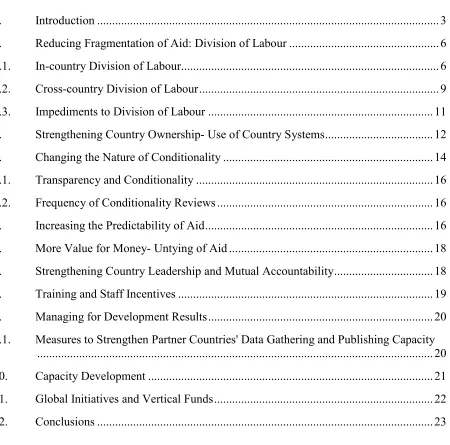
1. Introduction ... 3
2. Reducing Fragmentation of Aid: Division of Labour ... 6
2.1. In-country Division of Labour... 6
2.2. Cross-country Division of Labour... 9
2.3. Impediments to Division of Labour ... 11
3. Strengthening Country Ownership- Use of Country Systems... 12
4. Changing the Nature of Conditionality ... 14
4.1. Transparency and Conditionality ... 16
4.2. Frequency of Conditionality Reviews ... 16
5. Increasing the Predictability of Aid... 16
6. More Value for Money- Untying of Aid ... 18
7. Strengthening Country Leadership and Mutual Accountability... 18
8. Training and Staff Incentives ... 19
9. Managing for Development Results... 20
[image:2.595.78.528.85.530.2]9.1. Measures to Strengthen Partner Countries' Data Gathering and Publishing Capacity ... 20
10. Capacity Development ... 21
11. Global Initiatives and Vertical Funds... 22
1. ITRODUCTIO
Today, more than ever, there is a need for effective aid. We have an obligation to the world's poor to make the most of every cent spent on development. That obligation is particularly pressing in times like these, when multiple crises are hitting the globe. We also have an obligation to our own citizens, the taxpayers, to ensure that their money is accountable and used transparently. When society demands efficiency and effectiveness in all other matters of economy and finance, how could development cooperation remain on the sideline?
After the Third High Level Forum on Aid Effectiveness, held in Accra, Ghana, in September 2008, which built on the commitments made at the First and Second High Level Forums in Rome (2003) and Paris (2005) respectively, the international agenda for improving aid effectiveness is in place. What is needed now is determined implementation.
Implementation is a formidable task. Today the aid effectiveness agenda is wider and more challenging than ever before: following the adoption of the Accra Agenda for Action (AAA)1 there are now, in addition to the 12 indicators agreed to in the Paris Declaration2, 48 new or strengthened commitments for the development community as a whole of which 34 for the donors to implement. The EU has four additional targets from 2005, confirmed in the European Consensus3 and now partly reflected in the AAA. The Accra High Level Forum deepened the international aid effectiveness agenda. It brought together 130 countries, 40 international organisations, over 80 civil society organisations and representatives from the private sector and academia. In Accra, the developing countries exerted much more influence in the process than in the previous forums. A number of new issues, such as South-South cooperation, the role of civil society organisations and situations of fragility now form part of the agenda and must be dealt with.
The 2008 Survey on Monitoring the Paris Declaration4 showed that progress has been made, but too little and too slow. Efforts need to be stepped up dramatically if we are to achieve the Paris targets, and the four additional EU ones, in 2010, just one year away. Responsibilities, however, go beyond meeting the Paris targets. Development cooperation is starting to be in its late middle age, in its respectable 50s. It is time to show that the world is learning from past experience, from successes and mistakes. It is high time to prove that the development community and the EU can reform.
This paper cannot and does not aim to cover the whole aid effectiveness agenda. Neither is the aim to duplicate the Paris Survey. It focuses on the four key areas to which the EU committed itself in the Council conclusions of May 2008 and in the EU Guidelines for Accra: division of labour, use of country systems, predictability of aid and mutual accountability for results, including less conditionality.
1
http://siteresources.worldbank.org/ACCRAEXT/Resources/4700790-1217425866038/AAA-4-SEPTEMBER-FINAL-16h00.pdf
2
http://www.oecd.org/dataoecd/11/41/34428351.pdf 3
Joint Statement by the Council and the representatives of the Governments of the Member States meeting within the Council, the European Parliament and the Commission on European Union Development Policy: "The European Consensus"; Brussels 22 November 2005; OJ C 46, 24.2.2006); paragraph 32 4
The question addressed in this paper is: how well is the EU implementing the Paris and Accra commitments? The responses to the Commission's recent questionnaire "From Monterrey to Doha- EU Progress on Financing for Development"5, which included a section on aid effectiveness, shed some light on this question and are an opportunity to take stock and re-engage.
Monitoring the Paris Declaration: EU status on some of the key targets6
Paris Indicators EU (Member
States and EC)
EC 2010 Target
3. Aid flows are recorded in countries' budgets
44% 57% 85%
4. Technical assistance is aligned and coordinated
53% 43% 100% (EU target; Paris
target is 50%))
5a. Donors use Country Systems for public financial management
47% 35% 50-80 (EU and now
Accra global target is 50%, targets for each individual partner country depends on performance)
5b. Donors use country procurement systems 54% 34% 50-80 (EU and now
Accra global target is 50%, targets for each individual partner country depends on
performance)
6a. Donors reduce stock of parallel PIUs with two-third
780
(Per Member State: 56)
203
Indicative EU: 118
Indicative EC: 68
7. Aid is more predictable 43% 53% 71%
8. Aid is untied 94% .A. Indicative: 100%
9. Donors use coordinated mechanisms for aid delivery (through programme-based approaches)
46% 44% 66%
10a. Donors coordinate their missions 33% 33% 66% (EU target; Paris
target is 40%)
10b. Donors coordinate their
(country)studies and analytical work
62% 72% 66%
5
http://ec.europa.eu/development/icenter/repository/EU-progress-on-financing-for-development-and-MDGsQuestionnaire11-12-2008.pdf
6
2. REDUCIG FRAGMETATIO OF AID:DIVISIO OF LABOUR
The EU Guidelines for the Third High Level Forum on Aid Effectiveness state that donors should apply division of labour by "reducing the number of sectors where they are active" and by "reviewing their own aid procedures which hinder in-country division of labour processes"7. In the AAA the development community agreed to a set of measures to reduce the costly fragmentation of aid. The EU has promoted division of labour especially by adopting the EU Code of Conduct on Complementarity and Division of labour8. The Fast Track Initiative (FTI, see information box), co-led by Germany and the Commission, was set up to speed up division of labour by facilitating the process at the country level. The FTI operates in tandem with the Commission's initiative on delegated cooperation (see information box). An EU Toolkit has also been developed to support the process on the ground.
"Ownership of aid and division of labour", Bamako, Mali 20 ovember 2008
At the initiative of France, a high-level meeting was organised between donors and the government of Mali to discuss how to concretely promote aid effectiveness and division of labour. The government took leadership of the event and was represented through several ministries. The government emphasised the need for the donors to align themselves to the country's budgetary processes and policies and also to the need for donors to have a harmonised approach. The donors agreed to coordinate their approaches within a joint assistance strategy (the "Stratégie Commune d'Assistance Pays- SCAP") and assured that division of labour will not lead to less funding.
2.1. In-country division of labour
The responses to the Monterrey survey show that EU donors are taking division of labour seriously. When it comes to sector concentration, at least five EU donors have translated the commitment of the EU Code of Conduct to reduce the sectors of involvement into their bilateral development policy documents. Almost all use the concept of comparative advantage as a guiding criteria, though often linked to historical presence on the ground and not necessarily to an analysis of current strengths and weaknesses as a donor. One Member State indicated that sector concentration is difficult precisely because of historical ties and expectations for continued multi-sectoral engagement.
Almost all Member States (20) are interested in engaging in joint donor responses and looking for more complementarity and division of labour, whether in the framework of their multiannual programming by withdrawing from or entering into a sector or entering into delegated cooperation arrangements. For two this is already standard policy. The interest in joint responses concentrates naturally on existing priority countries.
Five Member States however are not yet ready for division of labour. The reasons given are capacity constraints or prohibitive current policies and/or legislation.
Most Member States report that they already concentrate their aid in three sectors or less, although six indicated concentration on more than three sectors in most of the countries they
7
Third High Level Forum on Aid Effectiveness (HLF-III)-Accra, Ghana, 2-4 September 2008. Guidelines for the participation of the European Union, 11 July 2008
8
were involved in. Smaller donors have a natural tendency to focus on fewer sectors than those with high aid volumes.
According to the answers to the questionnaire there are more than three times as many developing countries where EU-donors practise intensive sector concentration than there are with a wide range of sectors. A quick comparison with the EU Donor Atlas 20089 however suggests that there may be a positive bias in the questionnaire findings perhaps owing to lack of clarity on sector definition (OECD/DAC definition, the donors own definition or partner countries' definitions).
For the Commission, the Guidelines for Country Programming call for more concentration, division of labour and complementarity10. Following the sector definitions laid down in the European Consensus, the current average for country programmes stands at 2.9 sectors in Latin America, 3.3 in Asia, 5.6. in ACP and 6.2 in the Neighbourhood countries. Generally speaking, while activities in Latin America and Asia fulfil the concentration requirement, assistance in ACP countries is less concentrated, in particular in post conflict/fragile situations in order to respond to the needs in the context of "Linking Relief Rehabilitation and Development". In the case of the pre-accession candidates and potential candidates and the countries covered by the European Neighbourhood Policy, assistance is often driven by acquis-related rather than development considerations. The ensuing broader political framework may call for a more multi-sectoral approach with less sector concentration.
As regards delegated cooperation, one modality for division of labour, the majority of Member States (18) are managing or preparing to manage funds from each other or the Commission, or vice versa. Findings on the Fast Track Initiative (see also information box) indicated that several donors still had impediments in their rules and procedures to use this modality. Seven Member States were not involved in these exercises, but two were in the process of changing their legislation in order to make delegated cooperation possible.
The Commission's initiative on delegated cooperation
In May 2008, the Commission identified a number of countries and sectors with potential for delegated cooperation. These concerned country programs under the 10th EDF 2008-2013 and the Budget 2007-2013. This initiative acts in tandem with other donor processes at the country level for fast tracking division of labour. The combined efforts have so far led to a total of around 51 proposals11: (i) 37 for delegation by the Commission to a Member State in a sector, for a value of around €162 million, (ii) 14 concrete proposals for delegation from a Member State to the Commission for a total value of around €90 million .
For example: in Bangladesh the Commission is planning to delegate €2.3 million to Germany for a project on labour law. In Sierra Leone the Commission is preparing to delegate €6 million to the UK for civil society capacity building. In Haiti, France is planning to delegate to the Commission the implementation of a road project.
The current financial rules and regulations covering delegated cooperation make delegation possible from a Member State to the Commission and vice versa12. Delegation from the Commission to a Member State requires the Member State financial systems to be audited by the Commission to test their capability to manage EC/EDF funds. Six Member States or their
9
http://development.donoratlas.eu/ 10
Communication from the Commission to the Council and the European Parliament - Increasing the impact of EU aid : a common framework for drafting country strategy papers and joint multiannual programming (COM (2006) 88 of 2.3.2006)
11
As per 24th March 2009 12
agencies have gone through this audit and six more audits have been or are about to be launched13. One Member State will request the audit as soon as legal obstacles are removed. As part of the joint programming process, most Member States (22) plan to participate in joint reviews (annual and mid term reviews of Country Strategy Papers) in their priority partner countries. One Member State regarded this as possible and two do not yet participate in joint programming. Capacity constraints limit the scope for some EU donors to join on a regular basis. Some Member States showed an interest in building on existing joint approaches, such as the one in South Africa.
There is a large interest, as shown above, in the second step of the joint programming process –joint donor response, looking at opportunities for more complementarity and division of labour. It is important to keep in mind that designing and agreeing on the modalities is not an end in itself. The focus should remain on the overall goal of increased aid effectiveness, which calls for simplifying and rationalising the way we work.
As part of the Mid Term Review of country and thematical programmes, which started in 2009 with the review of the DCI and ENPI and will continue into 2010 with that of the EDF, the Commission delegations are encouraged to deepen the joint programming progress in order to achieve further division of labour through full concentration and/or delegated cooperation. This opportunity for closer cooperation with the Member States and other donors must not be missed.
Fast-track initiative on Division of Labour: progress and obstacles
The Fast Track Initiative seeks to speed up division of labour, with the Commission or a Member State playing a facilitating role on the ground in a number of selected countries. On the basis of a brief questionnaire sent out in ovember 2008 fifteen facilitators provided responses that show that
Some progress has been made on:
- Donor mapping: carried out in 11 of 15 countries
- Lead donor arrangements: established in 9 countries covering most sectors
- Assessments of comparative advantage: carried out in 6 countries
But there are also some obstacles:
- in many cases, the rather limited leading or active role of the partner country
- Reluctance of donors to limit their involvement in certain sectors
- Unclear definitions of "lead", "active" and "silent" donors
- Lack of information of the overall picture of aid flows per (sub)sector (who does what and where)
- Legal and administrative barriers on the donor side
2.2. Cross-country division of labour
The EU Guidelines for Accra sought to make operational commitments on cross-country complementarity, and as a result of a determined effort by the EU, the Third High Level Forum decided to launch an international dialogue on division of labour and cross country approaches.
According to the OECD-DAC study on aid fragmentation,14 which looked at the situation in 153 developing countries, 63 partner countries (41 % of the total) are supported by more than 20 donors. A further 49 partner countries (33 %) are supported by 11-20 donors. On average each partner country has 17 donors with a country program.
The responses to the Monterrey questionnaire show that the number of partner countries to which a Member State directs government-to-government ODA varies greatly. Four Member States provide no government-to-government ODA15, while five Member States provide it to 70 countries or more16, with the highest figure being 132. Because of its mandate the EC is by design present in most (144) developing countries.
The number of priority countries varied between 2 and 57 per Member State, most often there were 8-12 priority countries. The number usually correlates closely with ODA-levels, but on the whole low-level ODA-donors also have many priority partner countries.
14
www.oecd.org/dac/scalingup; The scope of donors in this study encompasses 34 donors, 23 bilateral OECD-DAC donors (including 15 Member States), the EC and 10 multilateral donors
15
The most common priority partner countries for Member States are Mozambique, Vietnam (12 Member States named them as priority countries), followed by the Palestinian territories, Moldova, Ethiopia, Afghanistan and Tanzania (10) and Uganda, Mali, Zambia, Yemen and Ukraine, Angola Georgia and DRC (7-9). Nineteen developing countries are regarded as priority countries by two, 23 by one and 39 countries were prioritised by 3-6 Member States. The choice of priority country normally stems from donor government policy, in at least one case the priority countries are stipulated by law and in another the parliament establishes the criteria.
Estimation of the share of ODA that goes to priority countries can help to measure the success of concentration, though obviously the percentage can be high if the number of priority countries is also high. The responses to the Monterrey questionnaire showed that for Ireland and Belgium nearly all their bilateral aid commitments is allocated to their priority countries, while six more Member States estimate the share to be around 80 % or more17. Altogether 18 Member States estimate that more than half of their ODA goes to priority countries, while in two cases the percentage was around 45. For many Member States, particularly with small aid volumes, the share of bilateral aid was negligible when compared to other means of funding. Conscious efforts have been made to concentrate a larger share of ODA to priority partner countries (Spain has a target of 85%).
According to the OECD/DAC study, in 2005-2006 38 partner countries had 25 or more DAC and multilateral donors. In 24 of these countries 15 or more donors provided less than 10 % of that country's total aid. This shows that there clearly is plenty of room for donors to further concentrate their aid. Donors with higher volumes of ODA tend to spread it over a higher number of partner countries, while donors with smaller volumes seem to add to fragmentation disproportionately to their size. While fully respecting the principles of ownership and partner country leadership, the EU should exert its influence to reduce aid fragmentation by stepping up division of labour.
Six Member States have made an overall assessment of their comparative advantage as a donor and 13 have made such assessments at country level, in some cases linked to Joint Assistance Strategy exercises. Two Member States will soon make an overall assessment and one will update its assessment when it renews its overall development strategy. At least two Member States regularly update country-level self-assessments. Donor self-assessments clearly need to be discussed during the dialogue on cross-country division of labour under the aegis of the OECD/DAC Working Party on Aid Effectiveness.
Several EU donors have been working to reduce their number of priority countries: Belgium reduced the number of priority countries in 2003 from 25 to 18, the Czech Republic in 2005 from 40-50 to 8, Germany in 2001 from approximately 118 to 70 and again in 2007 from 70 to 57, and Sweden decided in 2007 to limit the number of priority countries to 33. Luxembourg has withdrawn from two and is planning to withdraw from a further six countries and The Netherlands will be phasing out from seven countries. At least one more Member State is considering further concentration.
These voluntary and independent processes must include tough prioritisation and courageous political decisions. Still, they are taking place without an EU-dialogue. There is a need to initiate such a dialogue, as called for in the Council Conclusions on the Code of Conduct, in
order to work towards a common EU position for the upcoming discussions on international division of labour.
2.3. Impediments to Division of Labour
In the answers to the questionnaire the EU donors reported several impediments to coordinated programmes and multi-donor arrangements. Most issues centred on "bureaucracy" and different donor priorities, procedures and programming calendars, as well as limited delegation of powers to country-level. The report on the Fast Track Initiative revealed reluctance by donors for sector concentration: headquarters sometimes pushed field offices to remain or get engaged in "politically attractive" sectors. On a more positive note, two Member States reported no major impediments and three regard joint work as standard practice.
Several responses to the questionnaire indicated that coordination was seen as time-consuming and not at all cost-effective for small-scale interventions. This seems to reveal a "donor fatigue": the impression that work on division of labour and complementarity creates an additional burden whilst the dividends for partner countries and for donors that should logically follow from division of labour are not yet apparent. The multitude of different donor coordinating mechanisms at various levels in partner countries, particularly in "donor darling countries" show that rationalisation is needed.
One challenge to division of labour is the lack of overview of what different donors exactly are doing in a given country or region. The EU Donor Atlas, launched in 2004, was designed and has been further developed to address this issue. Another promising initiative is the EC web-based TR-AID (Transparent Aid) system which, with apt data included from different donors' systems, can help to show which donors are active in which countries, and for which sectors.
On the other hand some EU-donors, particularly those with smaller aid volumes, are concerned about the lack of visibility when entering into delegated cooperation. This is especially valid when new aid programmes or agencies are being set up and there is a need to boost domestic support for increased ODA.
Division of labour is particularly important in the context of scaling up of aid. Delivering and managing aid has to become less labour intensive. Focus needs to be put on where it belongs: on achieving concrete development results. The additional work load caused by the preparation process of division of labour is only temporary and should start to pay off very quickly by a reduced workload for partner countries and donors alike once division of labour is in place. Some specific arrangements, such as joint cooperation including a "traditional" donor and a donor with possibly less experience can be used to overcome some of the issues concerning volume, visibility and capacity.
The EU Code of Conduct is clear on this issue: the first principle states that primary leadership and ownership of in-country division of labour should first and foremost lie with the partner country government. There is a need to dispel the fear that division of labour will be imposed by donors, regardless of partner country opinion. Guarantees need to be given that partner countries' areas of development priority will not become underfunded. If partners are concerned about "losing" donors, delegated cooperation and silent partnerships can be considered instead of complete withdrawal.
3. STREGTHEIG COUTRY OWERSHIP-USE OF COUTRY SYSTEMS
The 2008 Paris Declaration Monitoring Report revealed that, although clear progress had been made in the quality of developing countries' public financial management systems, there was no corresponding increase in donors' use of those systems. In the EU Guidelines for Accra it was recognised that "the use of country systems will lead to strengthening those systems and this progress should be supported by donors. The choice of aid modalities should reduce transaction costs and strengthen country ownership."
Despite the 2005 Paris and EU commitments on the use of country systems and programme-based approaches, which were renewed and strengthened in Accra, project aid and technical assistance remain by far the most widely used method by EU donors to deliver aid. Six EU-donors deliver practically all their bilateral ODA through project aid and technical assistance. Altogether the share of project aid and technical assistance varies between 16 and 100% of bilateral aid.
Six EU donors18 provide a quarter or more of their ODA support through programme-based approaches. For three this consists mainly of budget-support. Ireland delivered (in 2007) 42% of its aid through programme-based approaches, excluding budget support, for the UK the combined percentage for budget support and other programme-based approaches was 38. The Netherlands provided 25% of its bilateral aid through budget support (general budget support 15% and sectoral budget support 10%). As far as the EC is concerned, for non-ACP-countries 28% of total budget funds will be provided as budget support, whilst for the ACP-countries 46% indicative amounts of the National Indicative Programmes of the 10th EDF are programmed as budget support (30% general budget support and 16 % sector budget support). For a number of reasons several EU-donors were unable to give a breakdown of budget support by general and sector budget support. For those that could, five donors19 reported using more general budget support and five20 more sector budget support. The reasons for preferring the sector approach are its professed suitability for smaller donors and comparative advantage resulting from sector-expertise.
The take up of country public financial or procurement systems was obviously low for donors that did not use programme based approaches. The percentages reported in the questionnaire were quoted from the OECD/DAC Paris Declaration monitoring survey and many EU-donors were unable to answer due to lack of data.
18
EC, DE, IE, LU, NL,UK 19
For the eleven EU-donors that answered, the take up of PFM systems for the government sector varied between 0 and 79%, with eight EU-donors21 exceeding the 50% EU target and AAA benchmark. The use of country procurement systems varied between 0 and 88%, with seven EU-donors22 above the Paris Declaration 61% target.
The reasons given why some Member States' use of country systems remains under the 50 % target corresponded to the reasons why programme-based approaches were not used. For certain donors it is a question of legislation: the arrangements making programme-based approaches are simply not in place. Two countries were reviewing their legislation to make new methods of delivering aid possible.
For most EU donors, the situation at country level, the local context, quite naturally guides the choice of modalities being used. General budget support is still seen to have the highest political risk as a result of potentially poor public financial management, high fiduciary risks and insufficient leadership. Few responses looked at the risks under a fragmented project approach.
Technical cooperation because of its very nature is for many donors difficult to reconcile with the use of country systems. These issues are however starting to be addressed (see Chapter 10 on Capacity Development). For some donors, the preference of projects is a question of capacity. When a large share of ODA is channelled through NGOs and multilateral organisations the ratio of the use of country systems falls.
Similarly, in situations of fragility the use of country systems is seen as problematic. At the same time the international community agrees that the building of resilient and legitimate states should be the central objective of external intervention. The newly founded OECD International Network on Conflict and Fragility (INCAF) is working on this issue. The European Commission is currently, following up on the 2007 Commission Communication and Council Conclusion "Towards an EU response to fragile situations", working towards a common approach on the use of budget support in situations of fragility with the World Bank, the IMF, and the African Development Bank. Efforts to come to a more strategic and coherent EU response is also ongoing in six pilot countries. Both exercises will, together with other elements, feed into the EU Implementation Plan for fragile situations which the Commission will present in the second half of 2009 The Commission services also foresee this year the development, in cooperation with the Council Secretariat, of an EU Action Plan on the Nexus between Security and Development. The aim of the plan will be to ensure a coherent and coordinated response when contributing to the global efforts supporting sustainable development and peace.
More strikingly, however, in certain cases the partner countries themselves were reported to favour the use of donors' systems as national systems were perceived as slow and/or inefficient.
Plans to promote programme-based approaches and use of country systems were put in place by five Member States. The Commission is applying a strategy on the use of country systems, with the aim of reaching the Paris Declaration, Accra and EU commitments. EU donors' internal guidance concentrated on training and programming guidelines. One Member State has integrated the Paris targets in its own performance frameworks.
21
An important issue concerning aid effectiveness in general and the use of country systems in particular is the role of the "control institutions", which some respondents regarded as highly conservative when it comes to applying aid effectiveness principles, postulating that these principles will weaken the existing control mechanisms.
It is important to have the institutions that decide, control and audit the use of finances on board in the aid effectiveness debate, both in donor and partner countries. The Commission and the Member States need to remain actively engaged with national parliaments and the European Parliament. At least one Member State holds frequent discussions on aid effectiveness with its control institutions. The Commission does the same, also at a very practical level: for example the European Court of Auditors increasingly participates in Commission-organised training on aid effectiveness.
It is clear that the use of country systems remains a challenge for EU donors. However, some have been able to reconcile risk management and control to a much larger extent with the commitments on aid effectiveness. This is yet another clear example where EU donors should learn from each others' practices.
4. CHAGIG THE ATURE OF CODITIOALITY
An important international discussion on how donors should apply conditionality has been going on for the past decade, especially on conditions linked to macroeconomic governance. Significant steps to address the proliferation of conditions have been taken by individual institutions, but much remains to be done, as indicated by the EU Guidelines for Accra: "The EU is convinced that conditionality must be reformed in order to give partner countries the necessary sovereignty on their development strategies. Donors and partner countries should work together in a partnership. Imposed conditions should be avoided."
In the answers to the questionnaire practically no EU donor reported having issues with conditionality, as only two Member States state that they apply conditions that are not mutually agreed with partner countries and based on national development strategies. The responses to the questionnaire also suggest that Member States are relatively split on the process to reduce the number of conditionalities: five Member States replied that they are actively reducing conditionalities, while thirteen were not.
Some of the EU donors that provide budget support23 use Performance Assessment Frameworks (PAF) jointly agreed with partner governments as instruments for monitoring and for presenting expected results (conditions) and also as the basis for the policy dialogue with the partner country government.
In Mozambique, for example, the government and the donors have agreed on a multi annual Performance Assessment Framework that is based on the targets of the PARPA, the Poverty Reduction Strategy of Mozambique. The PAF covers issues such as macro-economics and poverty, governance, economic development, human capital and cross cutting issues like HIV, gender, rural development and environment. During joint reviews the Government and the 19 donors that provide general budget support discuss progress against the jointly agreed targets (the conditionalities), update targets and confirm disbursements for the next period. This joint review links in with similar, more detailed, joint reviews at the sector level. Thus donors and partner countries work in partnership and unilaterally set conditions are avoided.
The Public Expenditure and Financial Accountability (PEFA) Performance Measurement Framework, based on a programme jointly financed by the World Bank, the Commission, the UK, Switzerland, Norway, France and the IMF has established itself as a successful tool to provide a common pool of information for donors and partner countries. PEFA helps deliver a common measure and shared understanding of the status of public financial management (PFM), greatly facilitating agreement on the appropriate responses thus reducing and harmonising PFM conditions at the country level.
The Public Expenditure and Financial Accountability (PEFA) Performance Measurement Framework
The PEFA Framework is a standardised tool to assess a country's Public Financial Management (PFM) performance with regard to achieving of fiscal discipline, efficient delivery of services and strategic allocation of resources. By using a detailed set of high-level performance indicators, the PEFA assessment delivers reliable and consistent results giving a systematic method of monitoring progress over time. By identifying PFM weaknesses rather than providing concrete reform recommendations it enables countries to formulate their own reform strategies, thereby enhancing local ownership and policy alignment. As a widely accepted multi-donor approach the PEFA Framework provides for a single diagnostic tool, which reduces transaction costs and allows donors' actions being more harmonized. Around 90 countries have used the PEFA assessment so far and there have been some repeated assessments.
The discussion around conditionality, also in responses to the Monterrey questionnaire, revolves almost entirely around budget support. The conditions for budget support are at least easily identifiable. The application of conditionality in project-based approaches is probably more difficult to detect. In any case, the project-approach limits the room of manoeuvre of the partner countries to a much larger extent per intervention than programme based approaches. Project approaches pose a more serious challenge for harmonisation and require increased attention.
As pointed out by one response to the questionnaire, the application of conditions should be clarified in the light of the Paris Declaration and the Accra Agenda for Action. EU donors need to make assessments of their own application of conditionalities and to engage proactively in the forthcoming international dialogue on good practices in conditionality within the OECD/DAC Working Party on Aid Effectiveness.
4.1. Making Conditionalities transparent
The responses to the questionnaire reveal that in several cases conditions are already public, and annual reports/reviews and the use of internet are the most common way of informing the general public. For some EU donors, the lack of technical capacity poses a challenge to widespread publication. In many cases, reports are discussed by national parliaments, a practice very much to be encouraged to boost domestic accountability.
Many EU donors (14) do not yet however make public their conditions, according to the replies given to the Monterrey questionnaire. A major reason for this is that conditions- in their most easily identifiable sense- are often embedded in financing agreements or policy matrices related to general budget support. These agreements are not automatically made public; they might even be a priori confidential. Disclosure of the terms of these agreements would require the consent of the partner country or partner in question.
One way of addressing this issue could be to reach a global consent to publicise these agreements. A standard clause could be drafted to be inserted in agreements. This way transparency would be the norm and an explicit veto would be needed to keep conditions secret.
4.2. Frequency of conditionality reviews
The survey revealed little overall enthusiasm to move to less frequent reviews of conditions, with 13 Member States replying that they do not intend to move in this direction. Most EU donors would stick to annual assessments. The main reason given for this is domestic control, linked to annual budget cycles. Disbursements are made on an annual basis and eligibility criteria are verified before disbursements are made. Only two Member States check conditions less often than annually, while two others intend to follow suit.
Many respondents also referred to the need to have the assessments as an essential part of the policy dialogue with partner countries, which also usually follows annual cycles.
It can be argued that the criteria for disbursements need not themselves be subject to change even if the fulfilment of criteria is checked annually. Conditionality is closely linked to predictability: financing obviously cannot be predictable if the conditions are subject to frequent change.
5. ICREASIG THE PREDICTABILITY OF AID
In the EU Guidelines for Accra it was recognised that "greater predictability in aid flow programming, commitment and disbursement is needed to support the more effective absorption and expenditure of aid. This is urgently needed to facilitate the short-, medium and long term planning, budgeting as well as the execution of expenditure by partner countries." The EU also called for developing a measurable target to enhance predictability of programmable aid flows for a period of a least three years in advance, based on indicative forecasts and on a rolling basis.
legislative initiatives in order to allow for multiannual programming. As for the Commission, programmable aid is predictable within the timeframe of the Financial Perspectives and the European Development Fund.
Several Member States have moved to multiannual programming through multiannual cooperation partnerships with developing countries24. Under these partnerships multiannual commitments, or at least indicative information on future financing, are now possible. Although Member States differ on whether and how much these multiannual commitments are subject to annual budgetary processes, EU donors can clearly learn from each others' experiences here.
Commitments of fixed duration remain the norm, both for the Commission and the Member States. A number of Member States are, however, making an effort to move to rolling forecasts, for example under their forthcoming plans to implement the AAA.
The "MDG contract" is a new approach being so far implemented under the 10th EDF which aims to improve the effectiveness of budget support in accelerating progress towards MDGs by increasing its predictability and focusing on results. Perhaps reflecting that the MDG Contract is still early in its implementation, most Member States reported that they were still considering whether they wished to co-finance or apply the principles of the MDG Contract to their own budget support programmes. However, provided some regional differences are accounted for, Member States were supportive of an MDG Contract approach being used beyond the ACP countries by the European Commission. The Commission continues to explore with Member States options for co-financing MDG- Contracts.
The MDG Contract
Predictability of aid helps a country more effectively plan and manage its development. This is particularly important with respect to the social sectors which are characterised by the high level long term recurrent costs. In 2008, recognising the benefits of greater aid predictability, the Commission launched a new form of budget support for ACP countries - the MDG Contract. It features a six year timeframe and a strong focus on results related to the MDGs. The Commission has finalised proposals for MDG-Contracts in 7 countries (Burkina Faso, Ghana, Mali, Mozambique, Rwanda, Uganda, and Zambia) and is considering Tanzania. Collectively these account for about €1.8bn, representing 50% of all General Budget support. The first MDG Contract was signed with the Government of the Republic of Zambia in early March 2009. The UK and Belgium have already indicated an interest in co-financing the MDG Contracts.
6. MORE VALUE FOR MOEY-UTYIG OF AID
In general, EU donors are well beyond the DAC-recommendations on untying25 aid. Seven Member States were able to report that their aid was fully untied, while six have untied their ODA to all developing countries. Most EU-donors have no problems with implementing the DAC recommendations. Five would be ready to expand the recommendation to other groups of developing countries and four to types of development aid not yet covered by the DAC-recommendations. There is the political will to further untie food aid, but untying technical assistance was seen to cause legal and administrative problems.
Seven Member States have instruments that are voluntarily tied in one way or another. These include technical assistance and scholarships as well as concessional loans, mixed grants, debt swaps and support to national NGOs. Two Member States are in the progress of untying aid further through legislative reforms, either by making new aid modalities possible or by renewing laws on concessional loans.
Almost all Member States procurement rules on bilateral ODA guarantee access to other Member States. The few exceptions to this rule include aid tied to developing countries in specific programmes. Three Member States' national legislation do not, however, provide access and the impact of EC Directives on this was being studied.
The level of untying of Community aid is based on the regulations of the financing instruments. A decision was taken on 24 March to grant access to Australia to EC external aid contracts in Asia (except, as yet, in Indonesia). This follows a request by Australia and a decision by the Australian government to untie their aid in this region. Untying will therefore take place on a reciprocal basis - as foreseen in the Development Cooperation Instrument. As concerns the rules on public procurement in the Cotonou Agreement which apply to the 10th EDF, the European Commission will propose to the ACP-countries the alignment of EDF rules to those of the DCI in the context of the revision of the Cotonou Agreement. This would be a major step forward in untying aid administered by the Commission.
The EU remains in the forefront in the debate on untying. It must continue to lead by example to get both traditional and emerging donors on board and get the best value out of aid money.
7. STREGTHEIG COUTRY LEADERSHIP AD MUTUAL ACCOUTABILITY
Partner country leadership has been a clearly stated guiding principle for the EU. It is reflected in EU donor policies and at least two Member States have introduced a reporting requirement on how this principle of leadership has been taken into account in their cooperation. As a major obstacle, many respondents cited the lack of capacity of partner countries to exert leadership. The development policies of partner countries were also often regarded as too general to provide guidance and not focused on achieving the MDG's.
surveyed partner countries had functioning mutual accountability mechanisms between partner governments and donors.
There were a few concrete cases of mutual accountability reviews, such as in Mozambique, in which many EU-donors participated. PEFA-assessments, which also include indicators on donor-behaviour, were also quoted as examples. Germany has set itself a target of being involved in at least five country-level mutual accountability assessments by 2011.
The EU needs to continue to promote mutual accountability both at international and country level. One important forum for this is the Working Party on Aid Effectiveness (see information box). In its joint comments on the new mandate and structure of the Working Party, the EU emphasised the need to safeguard the role of the partner countries, including through guaranteeing co-chairmanship positions to partner countries.
The Working Party on Aid effectiveness
The Working Party on Aid Effectiveness (WP-EFF), supported by the OECD/DAC secretariat, is the main body for international dialogue on Aid Effectiveness. The WP-EFF and its sub-bodies are responsible for monitoring the implementation of aid effectiveness and also for preparing the High Level Forums.
The Working Party is currently being restructured and its mandate is being renewed. The plan is to base further work on 4 to 5 thematic clusters. Germany and South Africa have been leading the work on forming the cluster "Transparent and Responsible Aid", while The etherlands and Ghana have had the lead on the cluster "Country systems". WP-EFF has included DAC-donors, multilateral donors and partner countries. The aim of the restructuring is also to ensure that the WP-EFF will be a representative body for the whole donor community. This will mean stepping up participation by the partner countries and including other actors, such as emerging donors and the civil society.
8. TRAIIG AD STAFF ICETIVES
In the Guidelines for Accra, the EU-donors committed themselves to "streamlining processes and to encouraging staff to systematically integrate aid effectiveness into their work programmes, structures and reporting mechanisms in order to promote the importance of aid effectiveness as the way of working for development."
EU donors provide staff guidance and organise training on aid effectiveness, for example training on multiannual programming. There are as of yet few concrete examples on staff incentives to promote aid effectiveness. The good practice guidance on incentives for aid effectiveness and self-assessment tool presented by the UK and the World Bank to the OECD Joint Venture on Managing for Development Results remains the most promising initiative on incentives. The UK, The Netherlands and IFAD are piloting the self assessment tool to identify existing barriers to aid effectiveness.
9. MAAGIG FOR DEVELOPMET RESULTS
Before Accra, in the Guidelines, the EU called for "a stronger culture and incentives for Managing for Development Results (MfDR)". The answers in the Monterrey questionnaire on this subject centred on training and providing staff guidance. In addition, four EU donors have recently embarked on strengthening their country offices, four more on reviewing their administrative processes and one has gone through an organisational change to increase coherence in development cooperation.
At least five EU-donors26 have renewed the methodology or indicators used to monitor aid to apply more successfully a results-based approach. In one case this was expected to lead to organisational changes.
The Commission is increasingly putting more focus on development results in its monitoring of projects, programmes and overall country programmes, amongst others through the mid-term review.
9.1. Measures to strengthen partner countries' data gathering and publishing
capacity
In 2004 the second roundtable on Measuring for Development Results agreed on the Marrakech Action Plan to improve the availability and quality of statistics to support the goals and measure the results of aid. Amongst other tasks this is done by mainstreaming the strategic planning of statistical systems and the preparation of national strategies to development of statistics (NSDS) for all low-income countries, increasing financing for statistical capacity building and urgent improvement in monitoring Millennium Development Goals.
According to the responses to the Monterrey questionnaire, the Paris 21 Consortium, which aims to build the systems and capacity of the partner countries to measure their own development, remains a main vehicle for EU donors to support the development and implementation of statistical strategies in developing countries. The Paris 21 secretariat has developed a Partner Report on Support to Statistics, which aims to increase knowledge on what development partners are doing to support statistical development; make available this information to improve donor harmonisation and collaboration on statistics with the aim of ensuring greater coherence at country level and minimising duplication of efforts and to increase visibility of statistical support and identify countries or statistical areas where additional support is needed.
One Member State was no longer financing Paris 21 in view of other donors' active involvement and is refocusing on bilateral support. A new Statistics for Results Facility, housed by the World Bank and working through country partnerships, is supported by the UK and the Netherlands.
EC Development Co-operation in conjunction with other Commission services in order to provide support to delegations and to the EC's external service generally about using statistics and identifying and preparing statistics actions. Eurostat is also developing the DISC (Database for International Statistical Cooperation) which aims to collect and publish "under one roof" summarised details on the statistical projects undertaken by the European Commission and ideally also its partners, on the one hand, and, on the other, redistribute and publish material on which the statistical capacity of potential partner countries can be measured to judge more clearly the potential areas of need and benefits of statistical aid.
10. CAPACITY DEVELOPMET
A few EU donors regard most of their support, excluding debt-relief, as capacity building. Many EU-donors provide this support through joint work, such as through UNDP, while some run only bilateral projects.
The respondents to the questionnaire recognised non-existing or non-prioritised national strategies by partner countries as major obstacles to capacity building. It was also observed that there were not enough incentives on the ground to change the behaviour of development actors, including the donors and their consultants and advisors, to focus more on capacity building.
The rules applicable to technical cooperation vary from donor to donor much more than the rules on programme-based approaches. This works against effective coordination, which leads to a fragmented approach, particularly when the donors are under time pressure to deliver results.
The EU Guidelines for Accra stressed that "the donors should assure that their support to capacity development of partner countries, including technical cooperation, is needs based and/or demand driven and integrated in the national strategies and programs". In July 2008 the Commission adopted a Backbone Strategy for Reforming Technical Cooperation and Project Implementation Units for External Aid"27 to provide guidance for a more needs-based, harmonised and aligned approach. Member States were involved in preparing the strategy and a dialogue on guidelines on technical cooperation ensued. At least one Member State, according to the survey, uses the strategy as guidance. The strategy and the continued work on the follow-up, including training sessions, could provide a basis for a joint European approach on capacity building and technical cooperation.
27
11. GLOBAL IITIATIVES AD VERTICAL FUDS
Global Vertical Programmes (GVP)28 are issue based, multi-country programmes allowing a group of development partners to address specific urgent issues of relevance to a wide public29, representing around 6% of total ODA30. While there is no consolidated recording of EU funds spent on GVP – as these register as multilateral aid in line with DAC requirements – anecdotal information available at EU level shows that some Member States spend up to 10% of their aid on GVP and the amounts allocated have steadily risen over the last years. The increasing importance is shown by the fact that in some countries the Global Fund, for example, has become one of the four largest donors, ahead of many bilateral donors.
Despite the increasing support, the multiplication of GVP schemes in the recent past has raised criticism. The European Consensus on Development in 2005 recognised the positive aspects of GVP but indicated that "the added value of global initiatives and funds will have to be assessed on a case by case basis". More recently, the May 2008 GAERC Council Conclusions "call on the Commission and the Member States to consider financing through existing financing mechanisms before creating new vertical funds". The Community is therefore encouraged to engage in Global Programmes only when GVPs are seen as an adequate response to the issue considered, and with due respect for the overarching "subsidiarity" principle and the preference given to geographic approaches which facilitate the implementation of the aid effectiveness agenda. Finally, in the conclusions of November 2008, the EU "agreed to work on guidelines on global initiatives and vertical funds to assess their added value, and to avoid their proliferation and the increasing transaction costs associated." This work must be taken forward in order to tackle the fragmentation of the global aid architecture while taking advantage on the emerging good practice in some of the vertical funds.
The Monterrey questionnaire did not produce comprehensive information on the situation at EU level, with only four Member States providing analysable information on past trends and forecasts. Responding to the European Consensus for Development proposal to "draw up criteria for Community participation in global funds and contributions to them" would therefore require an active involvement of both the European Commission and Member States to gather relevant data and analysis. Figuring out the EU engagement in details and its perspective would be a first step toward a harmonised and coordinated approach to supporting key global public goods in the future.
28
"Global Vertical Programs are multi-country programs that contain a significant element of earmarked funding for specific objectives with thematic, sectoral or sub-sectoral breadth. The globalnature refers to the multi-country and multi-regional level of the program. These programs are generally structured as “partnerships” involving shared decision-making by several different organizations or partners. The vertical nature refers to the significant level of earmarking of the program; funds are earmarked to a specific issue (with thematic, sector, or sub-sector breadth)". Source: "Global Vertical Programs at Country Level: What have we learned?", The Global Programs and Partnership Group, Concessional Finance and Global Partnerships Vice presidency, WB, July 2008.
29
Education For All – Fast Track Initiative, Global Fund for AIDS, Tuberculosis and Malaria, Cities Alliance, Business Link Challenge Fund, Public Private Infrastructure Advisory Facility, Global Alliance for Vaccines and Immunisation, Consultative Group on International Agricultural Research, Special Climate Change Fund…
30
Education FTI as a "good practice example" of global initiatives promoting country leadership
The Education for All (EFA) Fast Track Initiative (FTI) is a global partnership to help ensure accelerated progress towards the Millennium Development Goal of universal primary education by 2015. The FTI is founded on the principle of collective support for a single country-led process towards the development and implementation of an Education Sector Plan (ESP). Partner Countries take the lead in designing and implementing ESPs through broad-based consultation. The Local Donor Group and Civil Society Organisations work together with government to support the development, implementation, monitoring and evaluation of the ESP. Donors commit to align and harmonise additional support around the ESP. At the same time partner governments are expected to increase domestic expenditure on education. The FTI explicitly links increased donor support for primary education to partner countries' policy performance and accountability for results. The FTI has recently issued guidelines- FTI Country Level Process Guide- to further strengthen the country-led and –based process (available at: http://www.education-fast-track.org/).
12. COCLUSIOS
The EU has a collective obligation to meet the aid effectiveness commitments and targets. The overall view emerging from the Monterrey questionnaire exercise is mixed. On the whole the responses to the questionnaire are encouraging and show a genuine willingness of EU-donors to move towards further aid effectiveness. On the other hand, several other monitoring exercises have shown that the international and EU commitments will not be met without stepping up investments in the aid effectiveness agenda. At present there are too many contradictions between aid effectiveness and other priorities. Aid effectiveness should not be seen as a residual task but as the core agenda. The EU needs to put aid effectiveness on top of its priority list and ensure that all its institutions, political processes, and policies, instruments and procedures support aid effectiveness. Work is also needed on the "soft side" of the equation to ascertain that the mind sets and behaviour of staff working in headquarters and in the field offices are oriented towards aid effectiveness. To address these issues the Commission adopted an operational action plan in January 2009 including strategies for use of country systems, technical cooperation and implementation arrangements, division of labour and outreach to staff in headquarters and delegations.
Some EU donors are more advanced on aid effectiveness than others. Experience and capacity seem to be some of the contributing factors, but each donor has its own strengths and weaknesses. Some small volume donors for example coordinate all their donor missions, simply because they never initiate missions alone. On the other hand a high volume donor acknowledged that its system of cooperation is complex and results in significant internal transaction costs. Whilst certain EU donors will more likely face bigger challenges than others, it is clear that all EU donors have considerable work to do to achieve the agreed international and EU commitments on aid effectiveness.
Experience or capacity cannot replace the will to act. Neither are lack of experience or capacity excuses to renege on our commitments. There is an urgent need to move forward. In order to learn, we have to do. Determination is the prerequisite for implementing what is already feasible and for addressing impediments to process.
efforts are needed to make the fulfilling of individual commitments easier. The responses to the questionnaire show several cases where EU donors could learn from each other, such as aligning and harmonising technical assistance, promoting programme based approaches and use of country systems or moving to multiannual programming and commitments to increase predictability.
The issues touched upon in this report merit further discussion with EU Member States. There is a growing need to further identify specific issues which would merit being worked upon together, to formulate joint approaches and to promote honest, self-critical donor action plans to implement the aid effectiveness commitments.
Annex I: Member State Priority Countries (for four or more Member States) 31
Mozambique BE DK IE FI DE IT NL PT ES UK SE FR 12
Vietnam BE CZ DK IE FI DE LU HU NL ES UK FR 12
Palestine T BE DE GR IT HU NL ES FR CY PL 10
Moldova CZ EE GR LV HU NL RO SE LT PL 10
Afghanistan CZ EE DE GR NL ES UK SE LT PL 10
Ethiopia IE FI DE GR HU NL ES UK SE FR 10
Tanzania BE DK IE FI DE NL UK SE FR PL 10
Mali BE DK DE LU NL ES SE FR CY 9
Zambia CZ DK IE FI DE NL UK SE 8
Uganda BE DK IE DE NL UK SE FR 8
Yemen CZ DE IT HU NL UK FR CY 8
Ukraine EE DE GR LV HU SE LT PL 8
Angola CZ DE IT PT ES FR PL 7
Georgia EE GR LV NL SE LT PL 7
DRC BE DE NL ES UK SE FR 7
Senegal BE DE LU NL ES FR 6
Bangladesh DK DE NL ES UK SE 6
Bolivia BE DK DE NL ES SE 6
Burkina Faso DK DE LU NL SE FR 6
Cambodia DE HU ES UK SE FR 6
Egypt DK DE GR IT NL CY 6
Nicaragua DK FI DE LU NL ES 6
Kenya DK FI DE NL UK SE FR 6
Sudan DE NL ES UK FR 5
Rwanda BE DE NL UK FR 5
Iraq CZ GR ES SE LT 5
Bosnia-H CZ DE HU NL SE 5
Benin BE DK DE NL FR 5
Burundi BE DE NL SE FR 5
Cap Vert LU NL PT ES FR 5
Ghana DK DE NL UK FR 5
Kosovo DE IT NL SE 5
Niger BE DE LU ES FR 5
Serbia CZ DE HU RO SE 5
Lebanon GR IT ES FR CY 5
Morocco BE DE IT ES FR 5
Algeria BE IT ES FR 4
Colombia DE NL ES SE 4
FYROM HU NL SI SE 4
Guatemala DE NL ES SE 4
Laos DE LU HU FR 4
Mauritania DE IT ES FR 4
Mongolia CZ DE HU NL 4
Nepal DK FI DE UK 4
South-Africa BE DE NL FR 4
Belarus LV SE LT PL 4
Ecuador BE DE IT ES 4
31