Int. J. Electrochem. Sci., 13 (2018) 1614 – 1628, doi: 10.20964/2018.02.56
International Journal of
ELECTROCHEMICAL
SCIENCE
www.electrochemsci.org
Effect of the Degree of Rolling Reduction on the Stress
Corrosion Cracking Behavior of SUS 304 Stainless Steel
Shanlin He*, Daming Jiang
School of Materials Science and Engineering, Harbin Institute of Technology, Harbin 150001, China *
E-mail: [email protected]
Received: 23 October 2017 / Accepted: 14 December 2017 / Published: 28 December 2017
In this study, SUS 304 stainless steel was cold rolled with various degrees of rolling reduction. The microstructure and stress corrosion cracking behavior before and after cold rolling were investigated. Electrochemical noise measurements coupled with slow strain rate testing were performed in a 3.5% NaCl solution. The results indicated that the microstructure of SUS 304 stainless steel transformed from a single austenite phase into a compound with both the martensite phase and original austenite phase after cold rolling. The martensite phase increased with an increase in the degree of rolling reduction. During the slow strain rate test process, mechanical properties such as the breaking elongation and tension strength, corrosion resistance and stress corrosion cracking resistance significantly decreased after cold rolling. All the rolled specimens, the mechanical properties were highest for the specimen when the degree of rolling reduction was 14%. The stress corrosion cracking susceptibility depended on the crack initiation time during the slow strain rate test process.
Keywords: SUS 304 stainless steel; cold rolling; stress corrosion cracking; electrochemical noise; slow strain rate test
1. INTRODUCTION
solution at a temperature of 143 ℃, and almost intergranular when the solution concentration was 25% at a temperature of 115 ℃[22]. Szklarska-Snialowska summarized the minimum oxygen content for stress corrosion cracking of sensitized 304 stainless steel in high-temperature water at different temperatures using slow strain rate testing[23]. Singh indicated that the fracture mode of cold-rolled and sensitized 304 stainless steel in polythionic acid showed dimples when the degree of rolling reduction values were 60% and 80%, and when the degree of rolling reduction values were 20% and 40%, the fracture mode was intergranular[24]. Cragnolino found that intergranular stress corrosion cracking occurred for sensitized 304 stainless steel in a H2SO4 solution at a concentration of more than 3%; however, cracking did not occur at a concentration less than 3% after 60 days[25]. Li observed the intergranular stress corrosion cracking behavior for type I and type III WOL specimens of sensitized 304 stainless steel in a Na2S2O3 solution at a concentration of 7×10⁻⁴ mol/L and a temperature of 50 ℃, and found that the KISCC was 20 MPa/m1/2 and the da/dt values for type I and type III WOL specimens were 4×10⁻⁶/s and 4×10⁻⁶/s, respectively[26].
With the development and application of 304 stainless steel, cold rolling has been extensively used and is considered to be beneficial to the mechanical properties of steel due to work hardening but harmful to the corrosion resistance due to the martensite phase formed during the rolling process[27-29]. Nevertheless, according to the author’s knowledge, the effect of cold rolling on the stress corrosion cracking behavior of 304 stainless steel has not been fully elucidated, so the related research has great practical significance. Therefore, we focued on the influence of cold rolling, and the results in the present study could be very useful for studying stress corrosion cracking prevention technology of the cold worked 304 stainless steel.
2. EXPERIMENTAL
2.1 Materials
A commercially available SUS 304 stainless steel sheet at a thickness of 3 mm was used in this work. The chemical composition is shown in Table 1.
Table 1. Chemical compositions (wt.%) of SUS 304 stainless steel sheets.
Element Fe C Si Cr Mn Ni P S
Content Balance ≤0.08 ≤1.00 18.00~20.00 ≤2.00 8.00~11.00 ≤0.045 ≤0.03
2.2. Heat treatment and cold rolling
After solution treatment, the stainless steel sheets were cold rolled to various degrees of rolling reduction (8%, 14% and 23%) through plastic deformation by unidirectional rolling in a laboratory rolling mill. The content of the martensite phase induced by cold rolling in the specimen was determined by a ferrite content detector.
2.3. Slow strain rate test
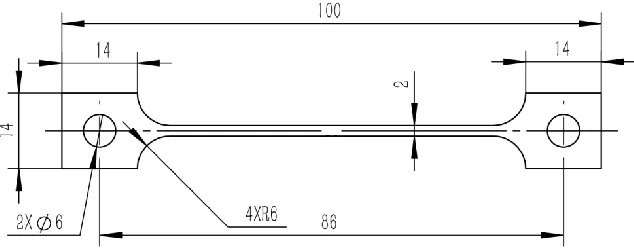
[image:3.596.140.457.299.425.2]The stress corrosion cracking behavior of SUS 304 stainless steel was measured by LETRY WDL-1000 slow strain rate tester at a strain rate of 10-6/s in a 3.5% NaCl solution at room temperature. The dimensions of the tension specimen are shown in Figure 1.The tension specimens were covered with silicone rubber, and only the middle section with an area of 1 cm2 was exposed to the test solution.
Figure 1. Dimensions of the tension specimen, mm.
2.4. Electrochemical noise measurements
The stress corrosion cracking behavior of SUS 304 stainless steel was investigated by employing electrochemical noise using a Gamry Reference 3000 electrochemical measurement system coupled with slow strain rate testing. The modified electrochemical noise technology called electrochemical emission spectroscopy (EES) was employed in this study. The reference electrode was a saturated calomel electrode (SCE); the working electrode was the tension specimen; and a platinum wire tip called the microcathode was used as the counter electrode[30-32]. Electrochemical noise measurements without a bias voltage or current were performed every 5 h during the entire slow strain rate test process; the sampling time was 512 s, and the sampling frequency was 2 Hz for the data collection. The electrochemical noise data were analyzed using ESA 410 Analysis software.
2.5. Microstructure and fracture surface analysis
The specimens were treated according to the standard metallographic preparation (cut, ground, polish and etch), and the microstructures were analyzed by an Olympus PMG2 light microscope.
3. RESULTS AND DISCUSSION
3.1 Microstructures of SUS 304 stainless steel before and after cold rolling
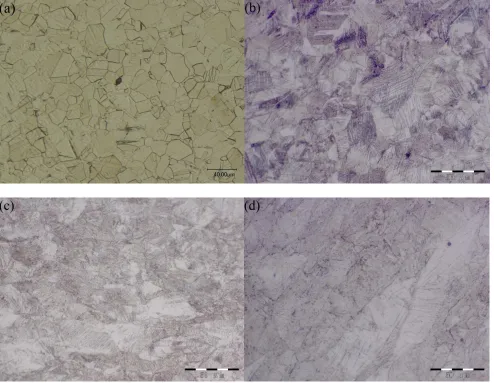
Figure 2. Microstructures of SUS 304 stainless steel before and after cold rolling: (a) specimen before cold rolling; (b) specimen when the degree of rolling reduction was 8%; (c) specimen when the degree of rolling reduction was 14%; and (d) specimen when the degree of rolling reduction was of 23%.
3.2. Slow strain rate test
hardening. However, for the welded specimens, the failure time (ductility) depended on several phenomena (recrystallization, the recrystallized grain growth and thermal transformation of strain-induced martensite) that occurred in the heat affected zone. These phenomena decreased with an increase in the degree of cold work until a level of 20% was reached and then increased. Furthermore, the tension strength did not represent the significant variations in the cold work level, and the failure time was more sensitive to the corrosive environment than was the tension strength for any cold work level. The cold-worked and welded specimens showed a ductile fracture mode in corrosive environment, which was not characteristic of stress corrosion cracking[44].
[image:7.596.134.461.239.476.2]
Figure 4. Fractographs of SUS 304 stainless steel before and after cold rolling during the slow strain rate test process: (a) specimen before cold rolling; (b) specimen when the degree of rolling reduction was 8%; (c) specimen when the degree of rolling reduction was 14%; and (d) specimen when the degree of rolling reduction was of 23%.
3.3 Electrochemical noise analysis with slow strain rate testing
[image:8.596.135.461.548.758.2]
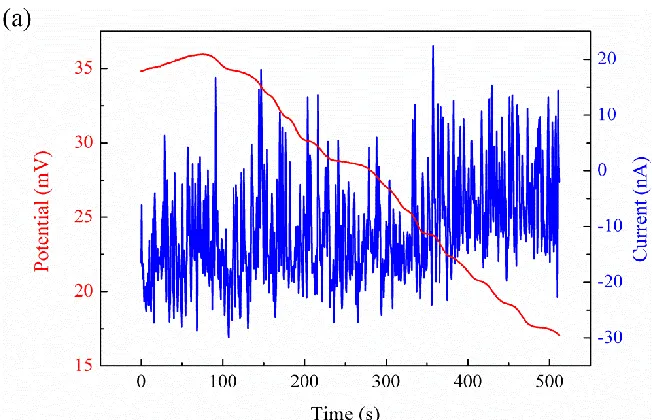
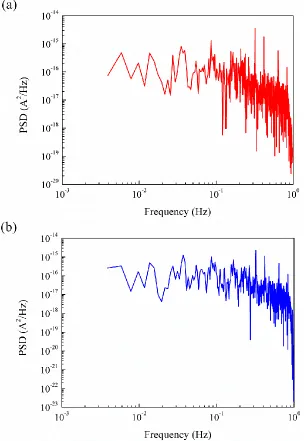
Figure 5. Noise data (obtained from the segment from 0~512 s) of the non-rolled specimen before and after removing the direct current component during the slow strain rate test process: (a) before removal; and (b) after removal.
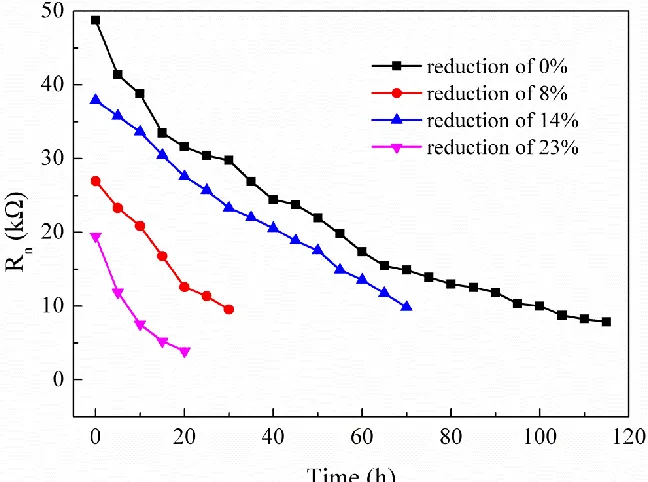
Figure 6. Noise resistance Rn of SUS 304 stainless steel before and after cold rolling during the slow strain rate test process.
[image:9.596.137.461.363.604.2]
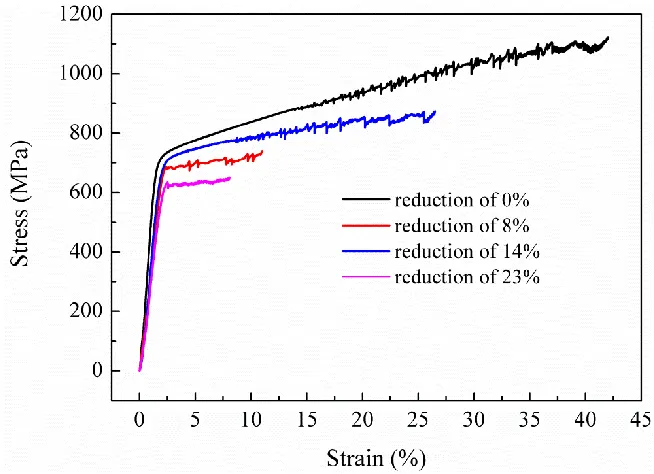
interactions[54], which states that the applied stress could enhance the electrochemical activity of the specimen and a higher applied stress could induce a stronger corrosion tendency; thus, the corrosion resistance was gradually reduced with increasing applied stress during a slow strain rate test process. The noise resistance decreased after cold rolling, which demonstrated that the cold rolling led to a decline in the corrosion resistance of the rolled specimen compared with that of the non-rolled specimen. It should be noted that when the degree of rolling reduction was 14%, the specimen presented the highest corrosion resistance among all the rolled specimens, which agreed with the conclusion obtained from the stress-strain curves in Figure 3.
[image:10.596.147.451.262.703.2]A frequency domain analysis can estimate the corrosion type through transforming the noise data to a power spectral density (PSD) with a fast Fourier transform (FFT) method[32,55-65].
For instance, Figure 7 shows the PSD (obtained from the segment from 0~512 s) of current noise of the non-rolled specimen before and after smoothing with a Hanning window during the slow strain rate test process. All of the PSD were smoothed before the frequency domain analysis.
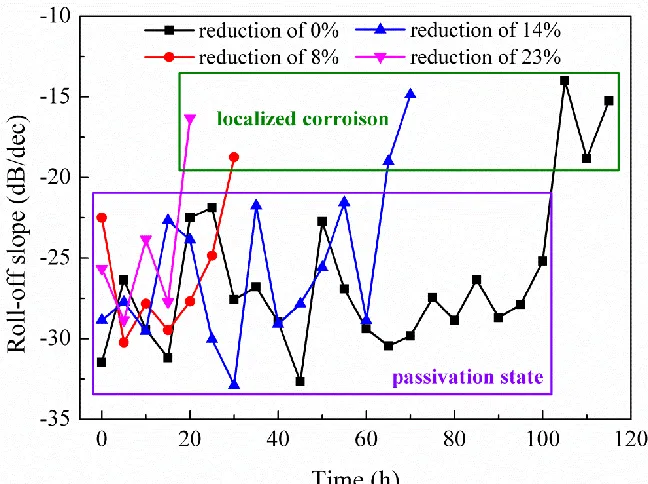
Figure 8 reveals the roll-off slop of the PSD of the current noise of the specimens before and after cold rolling during the slow strain rate test process.
Figure 8. Roll-off slop of the PSD of the current noise of SUS 304 stainless steel before and after cold rolling during the slow strain rate test process.
As shown in the figure, for the non-rolled and rolled specimens, when the degree of rolling reduction was 8%, 14% and 23%, the roll-off slop of the PSD was lower than -20 dB/dec in the 0~100 h, 0~25 h, 0~60 h and 0~15 h segments, but higher than -20 dB/dec in the 105~115 h, 30 h, 65~70 h and 20 h segments. Uruchurtu found that the material was in a passivation state when the roll-off slop was lower than -20 dB/dec, and the roll-off slop that was higher than -20 dB/dec represented localized corrosion such as pitting corrosion of the material[66]. Therefore, it could be concluded that there were obvious differences in the occurrence time for the pitting corrosion between the non-rolled and rolled specimens during the slow strain rate test process.
[image:11.596.136.460.178.420.2]
accumulating tension stress and a corrosive medium during the tension process. The pitting corrosion is considered as the induced source of the crack; thus, the stage is called the crack initiation stage. In the second stage, there is a high level of stress concentration at the crack tip after the crack initiation. The tension stress and a corrosive medium led to dissolution and propagation at the crack tip until the specimen fractures; therefore, the stage is called the crack propagation stage. During the slow strain rate test process, the stress corrosion cracking susceptibility depends on the crack initiation time, which takes up a large part of the total fracture time[67-71]. From the frequency domain analysis results of the current noise of the non-rolled and rolled specimens during the slow strain rate test process, it was quite clear that the non-rolled specimen showed the latest occurrence time of pitting corrosion, which means the longest crack initiation time due to the highest corrosion resistance; therefore, the non-rolled specimen exhibited the lowest susceptibility to stress corrosion cracking. For the rolled specimens during the slow strain rate test process, the pitting corrosion occurred earlier than the non-rolled specimen due to the lower corrosion resistance and was considered to be symbols of the shorter crack initiation time and the higher stress corrosion cracking susceptibility. When the degree of rolling reduction was 14%, the specimen showed the highest corrosion resistance among the rolled specimens; hence, the lowest stress corrosion cracking susceptibility was exhibited because of the late occurrence time of pitting corrosion and the long crack initiation time. In summary, cold rolling played a role as a promoter of SUS 304 stainless steel during the stress corrosion cracking process. However, in this study, by choosing the appropriate degree of rolling reduction (such as 14%), an effective approach to slightly reduce the stress corrosion cracking resistance and significantly enhance the strength at the same time was demonstrated.
4. CONCLUSIONS
In this study, the effect of cold rolling on the stress corrosion cracking behavior of SUS 304 stainless steel was investigated by employing electrochemical noise measurements coupled with slow strain rate testing. The results are summarized as follows:
(1) The microstructure of SUS 304 stainless steel transformed from a single austenite phase to a compound of the martensite phase and original austenite phase after cold rolling with various degrees of rolling reduction. An increase in the degree of rolling reduction caused the content of the martensite phase to increase in the SUS 304 stainless steel specimen.
(2) The mechanical properties and stress corrosion cracking susceptibility of SUS 304 stainless steel obviously deteriorated after cold rolling. Compared with the non-rolled specimen, when the degree of rolling reduction was 23%, the breaking elongation and tension strength of the specimen decreased by 81% and 42%, respectively, after cold rolling. Additionally, when the degree of rolling reduction was 14%, the specimen showed the highest mechanical properties and lowest stress corrosion cracking susceptibility among the rolled specimens.
rolled specimens when the degree of rolling reduction was 14%.
(4) The stress corrosion cracking susceptibility depended on the crack initiation time which was determined by occurrence time of pitting corrosion and accounted for a large part of the total fracture time during the slow strain rate test process. Compared with the non-rolled specimen, the pitting corrosion for the rolled specimens occurred much earlier, which means a shorter crack initiation time and a higher stress corrosion cracking susceptibility. Among all the rolled specimens, the specimen exhibited the lowest stress corrosion cracking susceptibility when the degree of rolling reduction was 14% because of the latest occurrence time of pitting corrosion and the longest crack initiation time.
References
1. M. Mihalikova, M. Hagarova, D. Jakubéczyová, J. Cervová and A. Lišková, Int. J. Electrochem. Sci., 11 (2016) 4206.
2. H.J. Lee and H.W. Lee, Int. J. Electrochem. Sci., 10 (2015) 8028.
3. M.A. Amin, M. Saracoglu, N. El-Bagoury, T. Sharshar, M.M. Ibrahim, J. Wysocka, S. Krakowiak and J. Ryl, Int. J. Electrochem. Sci., 11 (2016) 10029.
4. A. Torres-Islas, A. Molina-Ocampo, R. Reyes-Hernandez, S. Serna, M. Acosta-Flores and J.A. Juarez –Islas, Int. J. Electrochem. Sci., 10 (2015) 10029.
5. A.P.I. Popoola, Int. J. Electrochem. Sci., 9 (2014) 1273.
6. A.H. Ramirez, C.H. Ramirez and I. Costa, Int. J. Electrochem. Sci., 8 (2013) 12801.
7. J. Wang, Y. Liu, Y.F. Qiao, Y.D. Hu, Y.S. Cui and P.D. Han, Int. J. Electrochem. Sci., 12 (2017) 6492.
8. Y.T. Sun, X.Y. Wu, X. Wu, J. Li and Y.M. Jiang, Int. J. Electrochem. Sci., 11 (2016) 9666. 9. L. He, X.Y. Wu, Z.Y. Zhang and J. Li, Int. J. Electrochem. Sci., 11 (2016) 8046.
10.X.Y. Liu, K.D. Xia, J.C. Niu, Z. Xiang, B. Yan and W. Lu, Int. J. Electrochem. Sci., 10 (2015) 9359.
11.B.H. He, J.J. Sun and Q.A. Tu, Int. J. Electrochem. Sci., 10 (2015) 10631.
12.H.W. Wang, C. Yu and S.W. Huang, J. Li, Int. J. Electrochem. Sci., 10 (2015) 5827. 13.H. Liu, Int. J. Electrochem. Sci., 10 (2015) 2130.
14.B. Li, J.H. Wang, X.H. Wang and X. Yue, Int. J. Electrochem. Sci., 11 (2016) 1.
15.W.W. Wu, Y.J. Guo, H.F. Yu, Y.M. Jiang and J. Li, Int. J. Electrochem. Sci., 10 (2015) 10689. 16.C.J. Ortiz-Alonso, J.G. Gonzalez-Rodriguez, J. Uruchurtu-Chavarin and J.G. Chacon-Nava, Int. J.
Electrochem. Sci., 10 (2015) 5249.
17.S.S.M. Tavares, J.S. Corte and C.A.B. Menezes, Eng. Fail. Analy., 16 (2009) 552. 18.A.K. Jha, V. Diwakar and K. Sreekumar, Eng. Fail. Analy., 10 (2003) 669.
19.M. Suresh-Kumar, M. Sujata and M.A. Venkataswamy, Eng. Fail. Analy., 15 (2008) 497. 20.R.M. Horn, G.M. Gordon and F.P. Ford, Nucl. Eng. Design., 174 (1997) 313.
21.D.R. Johns and K. Shemwell, Corros. Sci., 39 (1997) 473. 22.H. Okada, Y. Hosoia and S. Abe, Corrosion, 27 (1971) 424.
23.S.Szklarska-Snialowska and G. Gragnolino, Corrosion, 36 (1980) 653. 24.R. Singh, J. Mater. Proc. Tech., 206 (2008) 286.
29.B. Ravi-Kumar, R. Singh, B. Mahato, P.K. De, N.R. Bandyopadhyay and D.K. Bhattacharya, Mater. Charact., 54 (2005) 141.
30.J.F. Chen and W.F. Bogaerts,Corros. Sci., 52 (1996) 753.
31.D. Gang, W. Weikui, S. Shizhe and J. Shijin, Anti-Corros. Methods Mater., 57 (2010) 126. 32.G. Du, J. Li, W.K. Wang, C. Jiang and S.Z. Song, Corros. Sci., 53 (2011) 2918.
33.M. Mahmoudiniya, S. Kheirandish and M. Asadiasadabad, Trans. Indian. Inst. Met., 70 (2017) 1251.
34.Y.F. Li, F.M. Bu, W.B. Kan and H.L. Pan, Mater. Manuf. Process., 28 (2014) 256.
35.D.N. Wasnik, I.K. Gopalakrishnan, J.V. Yakhmi, V. Kain and I. Samajdar, ISIJ. International., 43 (2003) 1581.
36.N. Mubarok, H.A. Notonegoro, K.A.Z. Thosin and A. Manaf, AIP Conf. Proc., 1746 (2016) 020022-1.
37.S. Palit Sagar, B. Ravi Kumar, G. Dobmann and D.K. Bhattacharya, NDT&E. Int., 38 (2005) 674. 38.J.M. Wang and L.F. Zhang, Anti-Corros. Methods. Mater., 64 (2017) 252.
39.J. Kuniya, I. Masaoka and R. Sasaki, Corrosion, 44 (1988) 21.
40.H.S. Khatak, P. Muraleedharan, J.B. Gnanamoorthy, P. Rodriguez and K.A. Padmanabhan, J. Nucl. Mater., 168 (1989) 157.
41.C. Garcia, F. Martin, P. De Tiedra, S. Alonso and M.L. Aparicio, Corrosion, 58 (2002) 849.
42.P. Muraleedharan, H.S. Khatak, J.B. Gnanamoorthy and P. Rodriguez, Metall. Mater. Trans. A., 16 (1985) 285.
43.J.H. Zheng and W.F. Bogaerts, Corrosion, 49 (1993) 585. 44.P. De Tiedra and Ó. Martín, Mater. Design., 49 (2013) 103. 45.R.A. Cottis, Corrosion, 57 (2001) 265.
46.A.M. Hombor, T. Tinga, X. Zhang, E.P.M. Westing, P.J. Oonincx, J.H.W. Wit and J.M.C. Mol, Electrochim. Acta., 70 (2012) 199.
47.Y.J. Tan, S. Bailey, B. Kinsella, Y. Sun and J. Hu, Corros. Sci., 38 (1996) 1681. 48.F. Mansfeld, Z. Sun, C. Hsu and A. Nagiub, Corros. Sci., 43 (2001) 341.
49.U. Bercotti, F. Huet, R. Nogueira and P. Rousseau, Corrosion, 58 (2002) 337. 50.D.A. Eden, K. Hladky and D.G. John, Corrosion, 86 (1986) 274.
51.F. Mansfeld and H. Xiao, J. Electrochem. Soc., 140 (1993) 2205.
52.G. Gusmano, S. Pacetti, A. Damico, A. Petitti and G. Montesperelli, Corrosion, 53 (1997) 860. 53.J.F. Chen and W.F. Bogaerts, Corros. Sci., 37 (1997) 1839.
54.E.M. Gutman, Mechanochemistry and Corrosion Prevention of Metals, Science Publication, (1989) Peking, China.
55.R.A. Cottis, A.M. Hombor and J.M.C. Mol, Electrochim. Acta., 202 (2016) 277.
56.B. Ramezanzadeh, S.Y. Arman, M. Mehdipour and B.P. Markhali, Appl. Surf. Sci., 289 (2014) 129. 57.J.L. Luo and L.J. Qiao, Corrosion, 55 (1999) 870.
58.T. Anita, M.G. Pujar, H. Shaikh, R.K. Dayal and H.S. Khatak, Corros. Sci., 48 (2006) 2689. 59.M. Leban, V. Dolecek and A. Legat, Corrosion, 56 (2000) 921.
60.T. Dorsch, R. Kilian and E. Wendler-Kalsch, Mater. Corros., 49 (1998) 659.
61.J.G. Gonzalez-Rodriguez, M. Casales, V.M. Salinas-Bravo, M.A. Espinosa-Medina and A. Martinez-Villafane, J. Solid. State. Electr., 8 (2004) 290.
62.C.R. Arganis-Juarez, J.M. Malo and J. Uruchurtu, Nucl. Eng. Des., 140 (1993) 2205. 63.Z.M. Shi, G.L. Song, C.N. Cao, H.C. Lin and M. Lu, Electrochim. Acta., 52 (2007) 2123. 64.M. Gomez-Duran and D.D. Macdonald, Corros. Sci., 48 (2006) 1608.
65.J.G. González-Rodriguez, V.M. Salinas-Bravo, E. García-Ochoa and A. Díaz-Sánchez, Corrosion, 53 (1997) 693.
66.J.C. Uruchurtu and J.L. Dawson, Corrosion, 43 (1987) 19. 67.R.C. Newman, Corrosion, 50 (1994) 682.
69.M. Takano and S. Shimodaria, J. Japan. Inst. Metal., 29 (1965) 553. 70.T. Nakayama and M. Takano, Corros. Sci., 37 (1981) 226.
71.T.P. Hoar and J.M. West, Proc. Roy. Soc., 268 (1962) 304.