University of New Orleans University of New Orleans
ScholarWorks@UNO
ScholarWorks@UNO
University of New Orleans Theses and
Dissertations Dissertations and Theses
5-20-2011
Transcendence
Transcendence
Holis HannanUniversity of New Orleans
Follow this and additional works at: https://scholarworks.uno.edu/td
Recommended Citation Recommended Citation
Hannan, Holis, "Transcendence" (2011). University of New Orleans Theses and Dissertations. 1316. https://scholarworks.uno.edu/td/1316
Transcendence A Thesis Submitted to the Graduate Faculty of the University of New Orleans in partial fulfillment of the requirements for the degree of
Table of Contents
List of Illustrations ... iv
Abstract ... v
Introduction ... 1
Genital Casting ... 3
Hybrid Utterance ... 5
Transparent Corporal Embodiments ... 10
Transcendence ... 20
Cutting Straight to the Point ... 26
Conclusion ... 37
Bibliography ... 39
List of Illustrations
Figure 1: Genital Portraits ... 4
Figure 2: Cindy Sherman, Untitled #263 ... 6
Figure 3: Glory Hole ... 7
Figure 4: Antony Gormley, Untitled (for Francis) ... 11
Figure 5: Conduit ... 12
Figure 6: Conduit (detail) ... 14
Figure 7: Sustain ... 18
Figure 8: Sustain (detail) ... 18
Figure 9: Transcendence ... 21
Figure 10: Transcendence (detail) ... 22
Figure 11: Dialectic Within ... 25
Figure 12: Untitled ... 28
Figure 13: La La Land ... 30
Figure 14: Medusa’s Gaze (detail) ... 32
Figure 15: Fix Me(detail) ... 32
ABSTRACT
This thesis is a description and critical analysis of the processes, concepts
and imagery of my artwork. I am interested in creating visual narratives,
often figurative, in the form of sculpture, collage, and installation. In my
work I attempt to call attention to the human condition, specifically
addressing sexuality, mortality, psychological issues and power struggles.
I incorporate both cultural and personal references and use traditional and
non traditional materials and processes that are intended to conceptually
inform the viewer further. My intention is to create distinct embodiments
that provoke contemplative emotion and in which the object and the
aesthetic experience allow us to consider and re‑consider who we are and
how we progress as a culture.
Key Words: Contemporary art, Sculpture, Installation art, Performance art,
INTRODUCTION
My work focuses on creating visual narratives in the form of
figurative sculpture, painting and collage. Like many artists and thinkers, I
attempt to call attention to the human condition. Much of the work deals
with death, chaos, disquiet, and tragedy, but not entirely absent in these
works is hope, beauty, or levity. It is my intention to create distinct
embodiments that provoke contemplative emotion with a strong purport
regarding life. Furthermore, I am intrigued by tension in art and aspire to
insert this element on some level into each piece I create. My work
combines natural and synthetic materials in an attempt to create tension
using opacity and translucency, realism and fantasy, clarity and
ambiguity.
I wish to continue exploring the ways in which I can present
situations and activities from our shared culture. I believe the art object
and the aesthetic experience allows us to consider and re‑consider who we
are and how we progress as a shared culture. Although this point of view
is broad and my artwork is specific, I require this open framework to
Genital casting
.
Early in my graduate studies, my interest lay narrowly in the
curiousness of identity based on sexuality. Focusing specifically on adult
female and male genitalia I created two relief sculptures of the frontal
portion of the pelvic region based on the scale of my body; one
represented the female sex organ and the other the male (fig. 1). I utilized
my own body to represent the female and created the other using images
of the male genitals from various sculptures, photos, and models. I then
cast and reproduced several pairs of each intending the use of repetition to
create works that communicate the greater complexity of sexuality.
The exposed genitalia are confrontational, and through the use of
repetition and their position at eye level, which forces the viewer to
confront them face on, the effect is more compelling and uncomfortable.
In addition, I assigned new identities to some of the forms by modifying,
reversing, or inventing genitals through appropriating culturally accepted
signs associated with gender. Furthermore, the reliefs are hung in thematic
pairings which are meant to add yet another layer to the overall
Figure 1. Genital Portraits, 2007, plaster and mixed media, 10x13x3‑4”ea
Presented as such, the pairings are at once disconcerting and
uncanny, in particular the pairs of invented genitalia. A “stand‑in” for the
genitals was made with found objects such as hand tools (trowel, hammer,
or screwdriver) or household/kitchen items (feather duster, whisk, or
corkscrew) and could be detached or attached to either the male or female
form. There is a correlation here with the “Mr. Potato Head” toy but
presented here with a sinister tone. The reliefs were painted realistically
and void of genitals (similar to Barbie dolls), and steel wool was used to
supplement pubic hair, all of which added to the eeriness of the
Hybrid Utterance
During the experimental stages of working on this series of work it
became apparent that in this manifestation, these forms seemed to
moralize and classify sexuality, hence enforcing the binaries of sexual
difference. My interest veered toward obliterating this absolute
categorization of such binary opposition. In an effort to clearly
communicate my intent – to confront the viewer with questions of identity
through psychological disturbance ‑ I created “hybrid” forms by
combining multiple genitals. Using a set of the previous cast crotches I
molded the loins connecting the two together forming a complete three‑
dimensional slice of a figure with male genitalia on one side and female
genitalia on the other.
The resulting form dismantles total classification of an either/or
sexual identity and ultimately challenges conventional thought which
links our genitals to our social position (as women or men). Much like the
image depicted in Cindy Sherman’s Untitled #263 (fig.2), these forms depict
a body that is both male and female, and that, as Rosalind Krauss states,
is meant, precisely, to blur their meaning, rather than to reify it, or better,
to create meaning itself as blurred.” 1
Figure 2. Cindy Sherman. Untitled #263, 1993.
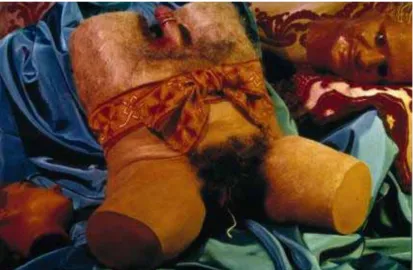
Glory Hole, 2007 (fig.3), is a postmodern reaction to the sharply
classified previous pairs. The work pays a kind of homage to the Surrealist
figuration practiced by René Magritte, whose work Delusions of Grandeur II
bears some resemblance to this piece. Here, however, there is only the
lower section of Magritte’s oneiric female form and the illusion is found
when walking around to the other side which has male genitalia. The
artifice is tilted toward the uncanny in that it is rendered hyper‑realistic,
complete with human hair in the pubic area adding to the already
apparent sinister tone. Furthermore, a keyhole surrounded by red velvet is
implanted slightly above the genitals, on either side, completing this
uncanny surreal milieu.
Figure 3. Glory Hole (front and back), 2008, plaster, hair, velvet, keyhole, acrylic, 10x13x8”
Once again the viewer is intentionally confronted and
disturbed by the uneasiness of the strange exposure. However now the
surprise in discovering the additional and contradictory genitalia; and the
tension created through presenting the viewer with the challenge of
whether or not to investigate the keyhole more closely, forcing him or her
to come in even closer proximity to the exposed genitals.
With Glory Hole, I address ambiguous identity, which I feel is
part of the human condition. Technological and scientific developments in
genetic modification and cosmetic surgery – taken to the extreme in sex
reassignment surgery – have become part of our times, and part of the
human search for identity. We have access to these previously private
parts of human life through the media, and especially the internet, where
we are able to fabricate identity with our fingertips alone. The most
private aspects of ourselves have proven mutable and easily made public,
which is something I wanted to explore further in my work.
Transparent Corporeal Embodiments
The ease with which we can show ourselves led me to an interest in
exploring the interior space of the corporeal form. My initial idea to
express the body as a vessel for identity was to create transparent forms
of materials in order to communicate a greater complexity of identity. At
first, I contemplated casting the forms in clear resin or glass; however, this
would have required two things I was lacking: the skill to work in such
material and the financial backing to provide them. I also had no desire to
delegate a third party to create them, forgoing my participation, which I
feel is crucial to my practice. Through extensive investigations of material I
encountered an alternative material and casting method that satisfied my
provisions and “gave birth” to an entire new body of work which I
continue to explore.
My tape sculptures are created by arduously wrapping the original
form‑my body, a taxidermy animal, or mannequin‑ in a non‑traditional art
medium, that is clear plastic packing tape. The original form becomes
trapped and is visibly suffocated beneath the clear tape surface.
Subsequently, I release the form by carefully cutting it out with a blade
and then remove it. Ultimately I re‑assemble the form, meticulously
mending the seams with packing tape and obscuring the incisions.
The resulting form is a clear, hollow casting, void of the original
crustaceans, arachnids, and cicadas that are part of our tenacious
ecosystem – the forms emphasize the presence of the original through its
absence. I feel that the exoskeleton can also be related to “shedding skin,”
or renewing identity. We, as humans, are unable to do this literally, but
metaphorically this could parallel our ability to shift and change how we
are perceived.
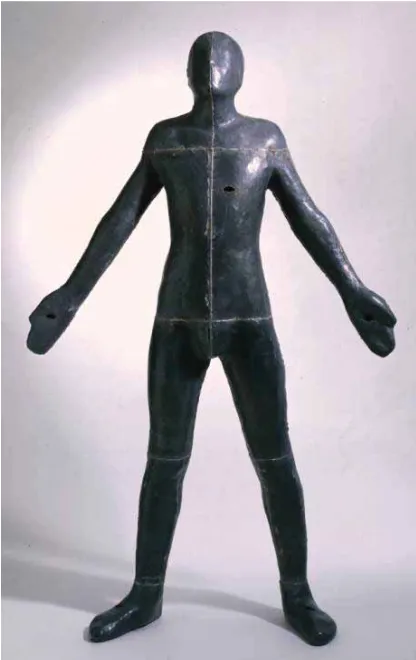
My first tape sculpture was cast from my body, an idea generated by
my interest in creating a dialog with the work of Antony Gormley.
Gormley’s early figures (fig. 4) are made from plaster casts of the artist’s
body which are then overlaid with sheets of lead. “He has spoken of
becoming passive while being wrapped in clingfilm and plastered over,
and the need to have the right pressure in his lungs as the plaster dries, to
give the body interior space. The aim is not personal expressiveness but
the right relationship of space within and the outside the body (‘my work
is to make bodies into vessels that both contain and occupy space’).”2
Intrigued by Gormley’s notion of making bodies into vessels that contain
and occupy space and his physical relation to the work I set off to embrace
Figure 4. Antony Gormley, Untitled (for Francis), 1985
this notion. My approach, however, was to add a more ephemeral and
what I would argue a feminine counter to his dark, heavy lead forms.
The production turned out to be arduous and quite torturous, not to
mention it often required the help of an assistant who would have to cut
me free‑often resulting in actual cutting my flesh. Although the ideas
surrounding all of these implications were profoundly suggestive and
directed toward an overall narrative and opted to use mannequin forms to
make my casts.
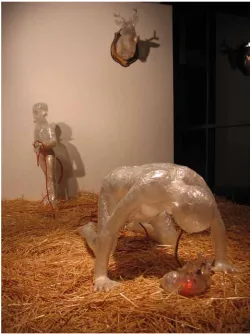
Figure 5. Conduit, 2008, packing tape, straw, extension cord, light, wood plaque, dimensions variable
Conduit, 2008 (fig. 5‑6) is an installation consisting of four tape cast
forms‑ three human forms on a floor covered with straw and a mounted
deer head hanging on a wall. The central figure (a cast made directly from
my body) is positioned on hands and knees as if crawling, her form is
her vagina, winds through her pregnant belly and exits through her
mouth. She faces the floor below her where there is an infant attached to
the end of the cord projecting from her mouth. Blue wire and glossy clear
tape wrap the cord as it exits her mouth, suggesting wetness. It coils
toward and penetrates the navel of the infant form. Given the small,
obscured light source illuminating the baby’s interior the cord becomes the
apparent conductor of life. Now an umbilical link, the cord parallels the
gesture of the infant, who reaches toward her face with one hand frozen in
the sign of a holy blessing. This gesture evokes images of the Virgin with
the infant Christ. It is difficult to discern a definitive reading of this sign,
which, in this context, the distinction is blurred as to whether it is
intending toward either a religious or impious connotation.
This elusiveness continues throughout the installation. The hunched
central figure is poised to elude the view of the other figures behind her,
either ashamedly hiding the projected baby or vigilantly protecting it. The
cord, fifteen feet in length, extends from behind her and winds like a snake
toward an electric outlet on a white wall. A small standing figure molded
Figure 6. Conduit (detail), 2008, packing tape, straw, extension cord, light, wood plaque, dimensions variable
contrapposto‑like pose suggestion the classicism of Renaissance sculpture.
One arm carries a coil of the cord and the other extends toward the outlet
grasping the plug. It is unclear whether the figure is plugging in or pulling
out the cord, yet its dominant position of control can be discerned. In
contrast to the other two human forms, this figure is more reminiscent of a
stuffed in the legs and up to the mid torso, on its head, and coming out of
its mouth creating a goatee. The unimposing size and fantasy
characteristics contradict its dominant position over the central figure.
A deer head, cast from a taxidermy mount from a trophy hunt hangs
on the wall; its base is the original wooden one, but the animals head has
been replaced by a replica, made in transparent tape and thus diaphanous.
A golden glow comes from within this shell (created by the reflection from
the mylar that is mounted on the wood beneath the surface of the deer)
which adds to the ethereal feeling of the work. Furthermore, the head of
the enchanted stag is slightly skewed and appears to look down toward
the central crawling figure. The meaning of this trophy is enigmatic; is it a
stand in for a supernatural being‑ the divine‑ that is witnessing or
controlling the event that lies before it? Is it meant as a signifier of man’s
power; if so, is it a semiotic nod toward man’s power over nature or
women?
The whole installation is intentionally ambiguous. The absence of
color and abstracted features mask specific identity; the scene floats
religious and impious allegory, and invokes moral dilemmas. Once again
I am pleased with the ambiguity, I feel it addresses the many uncertainties
related to the human condition that I did not achieve with the genital
castings; addressing the fears of childbirth, questioning the origins of
procreation, and confronts various forms of oppression. The installation
allows for mystery regarding the human condition. There is a level of
anxiety attained in confronting the unknown, which in combination with
the juxtaposition of natural and synthetic materials, and the provocative
nature of the central form creates an overall tension, further complicating
any extrapolation of conclusive reading of the work.
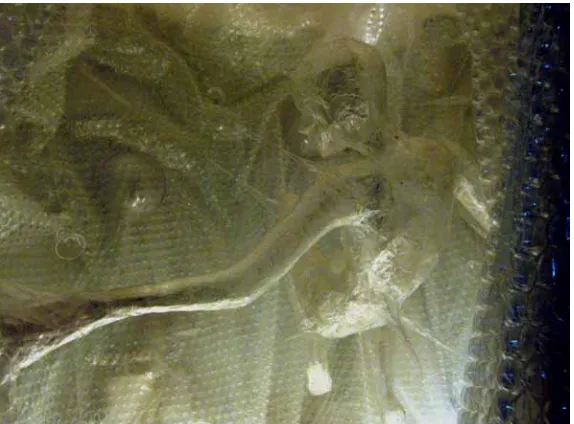
Tension takes a different form in Sustain, 2008 (fig.7‑8). A small
illuminated room is concealed by a set of mini‑blinds which emit a glow of
light. Clear plastic sheeting and bubble wrap cover the walls and ceiling of
the room. These materials seep out around the blinds into the exterior of
the room. The ceiling is illuminated by a coil of lights beneath the plastic
membrane. Several transparent tubes filled with glowing lights and
draped in plastic rise up from the floor. In the center of the room a life‑
like tendrils attached to multiple places on its body. The figure hovers
weightlessly, in a semi‑supine position with its back toward the viewer. It
is frozen in a moment with its head and one arm stretching backwards yet
not quite completely engaging the viewer’s gaze.
It is ambiguous whether this is a moment of torture, the figure being
pulled in all directions by its projecting tendrils, or a moment of
conception, the space mirroring that of a womb which the figure is
attached to by its life‑supporting umbilical cords. Here the tension is
created in a power play of unsolvable and inconsolable intensity: should
the cords be cut to release the captive, or must they remain connected to
sustain it?
The installation had an additional, unintended visceral effect as
result of the suffocating feeling one experienced in viewing it. The plastic
covering of the walls, ceiling, and floor enveloped the figure; this was an
intentional representation of a womb or cocoon. In effect, however, the
plastic conjures a familiar image of consumer safety labels seen frequently
on plastic bags that warn of the dangers of child suffocation. Although this
Figure 7. Sustain, 2008, packing tape, clear plastic, bubble wrap, dimensions variable
objective to create an embodiment that both attracts and repulses the
viewer; attracting with its intriguing illuminated etherealness, and
repulsing, with its torturous tendrils and this feeling of impending
suffocation.
Furthermore, it was my intention to evoke an unsettling
psychological effect which dealt with the nature of voyeurism. By far the
most infamous work of art dealing with voyeurism being Duchamp’s Étant
donnés, which I prefer not to rival, however, cannot escape comparison.
Much like Duchamp’s enigmatic work I have created an installation that
deals with the interaction of intimate privacy and voyeuristic gaze, and the
intertwining of eroticism and violence. I feel I added a futuristic (in the
sci‑fi sense) spin that is grounded in my use of materials. Additionally, the
figure I have created does not read strictly as violated woman, rather it is a
more alien form, intending an ambiguous reading toward the fragility of
all creatures. In concluding, I feel the strongest similarity of the works was
impart to a voyeuristic feeling that is conjured as the viewer must peer
through an obstruction, in my case the mini‑blinds, in order to engage in
Transcendence
In Transcendence, 2008 (fig. 9‑10), the spectacle is also veiled. The
installation is enclosed within four walls of white sheer fabric. The central
figure lies on a bed of chips of tree bark that covers the entire inner area of
the square enclosure. The life‑sized body is human in form but has a deer’s
head, also of natural size. The figure lies on its side in a fetal position and
is formed of the same material it lies on. The head of the figure appears to
have been severed from the body with the opening of the neck lined in red
velvet. There is a shift in material also as it is made of plaster that is left
unfinished. Several strings of white lights flow out of the neck and up into
the ceiling. Laying beside the form is a pair of gilded horns which are
joined in a circle that resembles a crown of thorns.
This artwork is a result of an unresolved childhood trauma of which
has appeared and reworked itself in repetitive dreams and nightmares and
has since coalesced with a recent unresolved adult trauma. My intention
was to re‑create this vision in a fantasy‑like setting; one which speaks to
Figure 9. Transcendence, 2008, plaster, bark, gold‑leafed antlers, lights, velvet
exorcise the painful and unsettling vision and in turn embrace the
mourning and loss. There are several levels on which I feel have
successfully achieved my intended goals.
which children may dream under or the elderly may die. I feel this was
effectively achieved through the use of enclosing the space with the sheer
drapery. The bed of bark within the perimeter of the walls signifies a
freshly torn forest bed. Deer renew their antlers by shredding bark on
trees, rubbing off fresh velvet to reveal dead bone. An intentionally
mystifying and bewildering fantasy creature formed of bark lies on the bed
in the installation (fig. 10). Its human‑like shape emphasizes the
decapitated head of the creature.
I cast the head of a deer, which belonged to my fathers trophy
collection, one which I grew up with, one which I saw gutted and flayed in
my backyard (specifically on my childhood swing set). I had used the same
form to create the transparent tape sculpture for Conduit. Here, however, I
have chosen to transform the previously oneiric form. In a process which
involved destroying the ritualistically swathed ethereal form, I poured
plaster inside of the shell, casting the insides of the fragile form. I left the
interior hollow, resulting in something now closer to a vessel than a cicada
shell. The form remains frozen, like a death mask, and its exterior remains
in its natural state; pure, white plaster with all the imperfections and scars
the tape cast exposed. There is an overall feeling of empathy evoked that is
intensified when confronted with adjoining crown of golden horns that lie
besides the fallen stag.
The fantasy is soon raised up to a moment of enlightenment made
apparent by the multitude of lights that escape the creature and appear to
float into the air above it, culminating at the ceiling. This gesture is
intended as a nod of respect toward the late conceptualist artist Felix
candy, to signify the profound sense of loss felt for those who have died
prematurely, including loved ones. In addition, my intention was to
appropriate Gonzales‑Torres use of lights in respect in order to signal to
the lost spirit. In concluding, the work “transcends” my emotions of loss,
using materials in Gonzales‑Torres visual language to express feelings of
mourning and absence. The intention to transcend a visceral emotion
carried over into my next work.
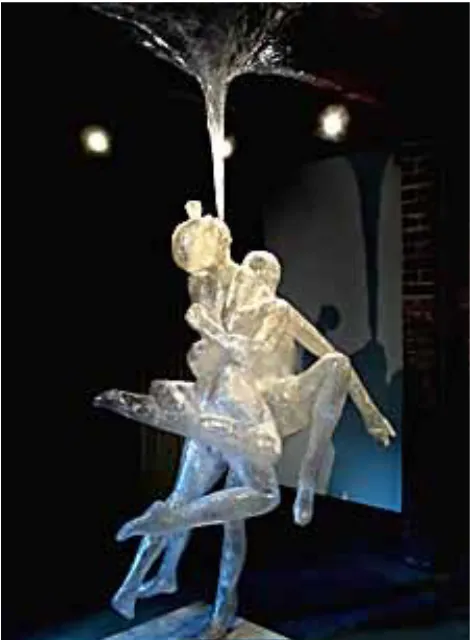
Dialectic Within, 2009 (fig. 11) is a life‑sized figure consisting of two
heads and torsos which are entwined in its multiplicity of limbs. The
figure is formed entirely of transparent tape and cellophane and its interior
is hollow. As New Orleans critic, D. Eric Bookhart, pointed out in his
reading of the work, “the multiplicity of limbs belies the fact that there are
only two torsos rapturously engaged in what might be a Hindu deity
rendition of a Merce Cunningham moment — or maybe an inner dance of
approach‑avoidance.”3
The head of one torso, which is tilted upward and back, emits a
stream‑like projectile that attaches to the ceiling. The other head is buried
3 D. EricBookhart, “Thank You Sir May I Have Another,” Gambit Weekly, Vol. 30, No. 33,
in the bosom of the torso which it embraces. Two arms embrace one torso
as the others are caught in a moment‑fighting, stretching out for help or as
sign of rebellion. The multiplicity of legs are similarly frozen in an act‑
wrapping around, kicking backwards, spread open, and standing off
balanced. It is unclear whether this is a moment of sexual ecstasy,
frustration, joyful exhilaration, spiritual bliss, excruciating agony, or
revolt.
Figure 11. Dialectic Within, 2009, packing tape and Saran wrap, dimensions variable
This work shows the discord between feeling and behavior, another
aspect of the human condition. I wanted to transcend an emotional
conflict; one of both love and violence that begins in the body and then
becomes realized through action, which in turn becomes cathartic. I
concluded that when these opposing emotions merge an abject code of
communication is born, where disfigurement is struggling to be beautiful.
I feel the resultant form successfully expresses this collision of emotional
states and the body’s erratic manifestation of what is felt.
Cutting straight to the point
I have always considered how the media – television, internet, the
printed word and image ‑ effects the human condition and the search for
identity. I initially adopted collage, using various magazines as source
material, to sidestep a period of artist’s block. Though this practice was
initially “the artist at play,” I realized I was using a medium that was
about the media, and began to construct a visual vocabulary with it that
incorporated both cultural and personal references. With collage, I was
able both to investigate the fantastic nature of the carnivalesque and the
Much like the carnivalesque, the resulting work lived in an uncanny and
whimsical universe all its own, separate but linked to the work I had
previously created.
In addition, I have also worked to understand the history of collage,
which is imbedded in the movements of Surrealism and Dada. This, in
turn, has heightened my desire to create a dialog that pays homage to its
predecessors and the traditions while simultaneously probing the position
of collage in contemporary art. In keeping with the traditional notions of
collage, I embrace incoherence, fragmentation, and disjunction.
Concurrently, I combine the traditional methods of collage with unique
non‑traditional methods, such as using pins and letting the cut outs float
vicariously, instead of pasting them down. In addition, in more recent
work, the final piece is a photograph of the collage which flattens out the
work and melds it into one media. In my most recent work, I incorporate
collage in an installation in which the spectator becomes implicated in its
creation. Furthermore, it is my hope that these works not only coincide
with the shared intentions of many female predecessors of Surrealism,
transformation, but also to challenge societal ideologies, expose our shared
cultural constructs both accepted and hidden, and ultimately bring to
question formation of identity.
I feel that I address these aspirations through the construction of my
collages which are made in layers, each one cutting away part of the
subject matter. The remainder is then combined with other images. Skin,
for example, is cut away, so that only the outlines of human shapes
remain. I feel my approach makes for perplexing shifts of identity and
meaning within the different layers of the collages; these shifts, ultimately
create a new reality.
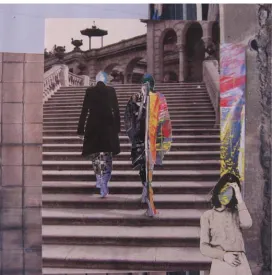
In Untitled, 2007 (fig. 12) reality is abstracted. I have cut away the
facial and some body features and replaced them with an abstract,
painterly image, in order to obscure the identity of the figures, allowing
them to represent the “other.” In addition, I have re‑ordered the
architecture and incorporated the abstract pattern used in the figures into
it, giving an over‑all otherworldly feel to the setting.
A similar eerie feel is carried over into the narrative. A female figure
stands, off‑centered, in the foreground of the composition. She holds her
head as if in distress as two ominous figures loom high at the center of the
frame, appearing to be leaving the scene. Additionally, the paper is pinned
onto Styrofoam, allowing edges to fold, slightly peel, and, as seen in the
female figure, float vicariously, enhancing the awkwardness of the piece.
Furthermore, the piece is left untitled, leaving out clues which could aid
the viewer decipher the event which has unfolded. There is a sense of
anxiety and tension brought on both by the restructuring and the
ambiguous narrative.
In La La Land, 2010 (fig. 13), this anxiety is intensified. The
schizophrenic sense brought on by the surreal feeling evoked and the
ambiguity of the narrative. This discomfort is fostered likewise in the
manipulation of the materials. The images are further distorted by folding
and warping the cutouts and pinning them in place on to the styrofoam.
Hair, for example, wraps around objects and the legs float and the feet are
unhinged from the piece.
Figure 13. La La Land, 2010, digital print, 12x12”
In the end, the image is photographed and its final manifestation is a
high gloss digital print in the original proportions of the collage. My
process parallels the process used to make the original source material.
Much like the manipulation of the models in the images (i.e. hair, make‑
up, and lighting effects), but also the way the photographs themselves are
manipulated to make ideologically beautiful imagery. Yet, here I have
taken this imagery and distorted it and made visible manipulations the
incisions, pins are left in and grotesqueness of the process exposed.
The title, La La Land, is derived from a slang term which refers to a
precarious semiconscious state of mind, but it also means, as I found when
I had a temporary residency at Otis College of Art, to the city of Los
Angeles, in a sarcastic manner. At the time I made this piece, I was living
in my studio, unable to afford the high cost of rent in LA, and in a
complete state of flux, both physically and mentally. It was during this
transitional period that I began an intense investigation of the fragility and
temporality of my work and ultimately the psychological effect that
I recalled my work (fig. 14‑15) that I had created during the early
experimental stages with the transparent packing tape figures. The figures
had balloons and collage incorporated in and on them. I utilized the
seductive and glossy language of commercial photography found in
magazines intending to produce works that probe the false promises of
perfection. Magazine images of ideal eyes, lips and skin tone were taped to
the transparent, plastic‑looking tape figures‑ sort of my twist on modern‑
day plastic surgery (fig.14). The resulting image subverts the pervasive
language of the slick photography as it is used in advertising and
publicity, creating edgy images that intrigue and disturb.
Figure 14. Medusa’s Gaze (detail), 2008 Figure 15. Fix Me (detail), 2008
The use of balloons was also intended to push the idea of cosmetic
alteration. Balloons were the breasts and stomach in Fix Me (fig. 15). The
balloons were inflated during the initial presentation with the intention
that as they lost air they would alter the shape of the figure and ultimately
the reading of the work. Limbs were missing, an amputated breast was
replaced with bulbous red balloons, and facial features that were visible
through the use collage were sharply cut and overemphasized. All this
added to the anxiety of the piece. In choosing to incorporate the collage
sparingly, I emphasized the unfinished quality and furthered the feeling of
anxiety. Mirrors implicated the viewer in the work, suggesting his or her
own discomfort with identity and complicity in the consumption of the
source material.
These pieces had an unfinished and chaotic quality. I eventually felt
that although the overall effect was extremely disturbing, aspects of this
work were too heavy handed and literal. I abandoned it due to an
unfavorable critique and my lack of critical art historical understanding,
needed to ascertain and articulate its purpose. After a year of intense
these pieces. Furthermore, I began to surmise their importance in directing
the trajectory of my work.
I realized that the collages I was making as mental diversions were
linked to my original thoughts about identity and manipulation of the
body. Installation, however was too removed. Though installation asks for
interaction with the space, I had created spaces that were more like
Baroque theater. They were dramatic and appealed to the emotions, but
they were separate, much like the surface of a painting or the “fourth wall”
in theater that blocks true interaction with the audience. By using my own
body in performance, I feel I can better address and explore the ongoing
ways we build identity, and incorporate the viewer to complete the work.
I am now focusing away from the traditional object and towards temporal
and ephemeral performance based installation art, which I feel fulfills my
artistic goals outlined in this thesis.
Other artists like Marina Abramovic, Andrea Fraser, and Sophie
Calle, have used performance to personally connect with the viewer. These
artists have not hesitated to express deep feelings about the world,
own lives, and setting up situations that blur the division between art and
life, these artists explore arts potential for transformation and catharsis.
In her latest performance, The Artists is Present (fig. 16), Marina
Abramovic sits silently in a chair throughout the day with museum
visitors taking turns sitting across from her. The performance took place
over the three months of the exhibition and was estimated to have lasted
for a total of 716 hours and 30 minutes. Many who interacted were brought
to tears, others simply sat contemplatively.
My forthcoming performance for my thesis presentation shares
certain themes/does similar things as performances by Marina Abramovic.
For this piece, I will live in the gallery space for the duration of the show.
The space will be divided in two: on one side will be a traditional gallery
space where art will be shown, and on the other will be a living space/
studio that resembles my living/studio quarters in LA. My audience will
be able to enter my space, interacting with me within it, as I work on
pieces that will fill the traditional gallery space. I intend to communicate
that not only is human identity never finished – the changes are perpetual,
as we seek and enact them ‑ the identity of art is never finished. In both
cases, context changes meaning. Aspects of this performance will be
undetermined until it is enacted; this too parallels the unpredictable nature
of the human search both for self and meaning.
In retrospect, while my work has evolved over time, I see I have
maintained a clear trajectory. Despite variations among my individual
projects, I feel the perspective and formal language is evident throughout.
Simultaneously, while the assortment of images and symbols I select may
undefined narratives, as seen in many examples herein. Thus, my choices
are intentional but the associated meanings are not, I leave this up to the
viewer. I prefer to create work with little or no intention of communicating
a specific idea, much to the chagrin of many critics searching for meaning
behind the art. For me, it is more important to create something that is
uncontrolled and unresolved, reflective of contemporary human condition,
which I feel that my latest installation embodies.
Conclusion
My artwork typically addresses the subjects of death and dying,
disquiet, chaos and tragedy, balanced with levity and by expressions of
hope and beauty within the confines of a narrative. My work engages the
audience through its focus on the human condition, whether referring to
the presumed relationship between my earlier, and more formally
traditional sculptural works’ facile reference to figurative statuary, or the
more recent body of work that employs imagery from the
advertizing/fashion industry in the form of paper collage. My art has
always stressed the psyche, rather than the physical sculptural object. I
toward the art history of the Italian Renaissance and Baroque period and
in deference to pre‑Freudian thought. My most current artistic endeavors
incorporate current collage and installation art that quotes, reinterprets
and re‑contextualizes Surrealism and Dada; a more recent direction in the
modernist and contemporary culture. I continue to embrace the
exploration of the manners in which the artist can present interactions and
gestures existing within the artist can present interactions and gestures
existing within our shared culture. It is my personal stance that the
aesthetic experience can allow us to contemplate and reconsider who we
are as individuals and how we progress as a shared culture. I require
access to the most broad and flexible framework in order to genuinely take
as much into consideration as is feasible. My work combines natural and
synthetic materials in order to create tension based upon dichotomy and
the juxtaposition of opposites.
Bibliography
Krauss, Rosalind Cindy Sherman 1975‑1993, New York: Rizzoli, 1993.
Causey, Andrew, Sculpture Since 1945, New York: Oxford University Press,
1988.
Brookhart , D. Eric, “Thank You Sir May I Have Another,” Gambit Weekly,
Vol. 30, No. 33, August 2009, 55.
Vita
Holis Hannan was born and raised in New Orleans, Louisiana. In 1988 she enrolled at the University of New Orleans and began her quest for higher learning which lasted on and off for over twenty years. In that time she prospered in several arts related careers from jewelry designer to mural decoration. She obtained her Bachelor’s degree in art from the University of New Orleans in 2007, graduating on the Dean’s List with honors and receiving the Excellence in Studio Arts Award. After
graduating she attended an artist creativity workshop given by the extremely inspirational author of The Artist’s Way, Julia Cameron, which inspired her to continue her quest and pursue a Master’s Degree in Fine Art. Hannan has exhibited her work in New Orleans and Los Angeles, where she spent a year of graduate studies at the Otis College of Art and Design. She was awarded the Peter Goulds Scholarship to attend Otis and while there she was highly influenced by artists that taught and lectured, including among them John Knight and Andrea Fraser. She has also studied abroad in Italy while during her graduate studies, attending the 53rd Venice Biennale which she deems the highlight of her educational studies. She currently resides in New Orleans with her dog, LuLu, and is looking forward to returning to Venice to attend the 54th biennially.