THE FIT OF MOBILE WORK SUPPORT FUNCTIONALITIES WITH PHARMACEUTICAL
SALES-FORCE WORKER TASKS
Markus Lembach,
[email protected]
, School of Information Systems, University of
Southern Queensland
Michael Steven Lane, School of Information Systems, University of Southern Queensland,
[email protected]
ABSTRACT
This paper reports on research which sought to identify and understand why specific mobile work support functionalities are a good fit with mobile work tasks of pharmaceutical sales-force. The findings from the case interviews support the notion that specific mobile work support functionalities are useful and in some instances innovative in improving customer service, communication with customers and colleagues, reduce double-handling of data entries, and facilitate the handling of administrative work during dead times. This research also identified that mobile work support functionalities such as location-related services and mobile job scheduling and dispatching of work are not a good fit and are likely to be strongly resisted by sales-force workers.
Keywords: Mobile computing technologies (MCT),
task-technology fit, pharmaceutical sales-force work, usefulness of MCT support functionalities, innovativeness of MCT.
INTRODUCTION
Background to the study
There are over 38,000 pharmaceutical drugs available in Germany [9], hence a physician cannot know all these drugs and their pharmacodynamics in detail. Furthermore, German “Heilmittelwerbegesetz” (Law on advertising in the healthcare system) does not allow a pharmaceutical company to advertise drugs directly to patients [3], hence a sales force is needed that informs target physicians about pharmaceutical products that are available in the market place. A pharmaceutical company’s sales and marketing strategy is put in practice when the sales-force worker is visiting the physician to inform him/her about the company’s products, medical education programs, clinical trials etc.
The innovative use of MCT is expected to add value for pharmaceutical sales-force workers by (1) reducing paper-based work, (2) by providing online access to a company’s systems and the internet during ‘dead times’ and (3) by enhancing existing business processes. Nevertheless, a wide-spread diffusion of MCT within pharmaceutical companies in Germany has not taken place yet [6]. As sales and marketing functions of pharmaceutical companies traditionally rely on specialized sales-force activities, the innovative use of MCT provides the opportunity to increase work performance of pharmaceutical sales-force workers [5] and thereby contribute to the operational efficiency and competitiveness of a pharmaceutical company [25]. This research aimed to determine what and understand why tasks of
pharmaceutical sales-force workers are a perceived good fit with the use of mobile work support functionalities, and their degree of innovativeness.
This paper is structured as follows. First, relevant background literature is reviewed to provide a context and justification for the mobile work support functionality framework and task/technology fit theory used in this research. Then, the main objectives and research questions of this phase of the research project are outlined. Next, we describe and justify the methodological approach deployed for this research. Then, the key findings of the first phase of this research are presented and discussed in the context of existing literature. Finally, we conclude with the contributions of this research and implications for existing knowledge and practice.
LITERATURE REVIEW
Mobile computing
A broad definition [4] defines mobile computing systems as “computing systems that may be easily moved physically and whose computing capabilities may be used while they are being moved. Examples are laptops, personal digital assistants (PDAs), and mobile phones”. Mobile computing should not replace but complement desktop computing while the main difference between both forms of computing is the fact that desktop computers have a fixed location (the user’s desk) and are not supposed to be moved [17].
Innovative use of mobile computing technologies
• A computing hardware and systems that can easily be moved and used while on the move, have wireless access to the internet and a company’s intranet, are based on most current hardware and use wireless broadband bandwidth (at least 3G).
• It fulfills the definition of a technical innovation as the ‘the embodiment of technical advances or new technologies in products/services and/or their production and delivery systems’ in the context of this research (cf. [23],[20],[4]).
Nature of pharmaceutical sales-force work in Germany
Functionalities provided by the use of MCT must address the specific nature of pharmaceutical sales-force work in Germany. Pharmaceutical sales-force workers are considered to be mobile workers as they are working away from their office desk for more than 20% of their working day [11]. As pharmaceutical sales-force workers are mainly dealing with information, ideas, and expertise in their mobile work setting, they can be considered mobile knowledge workers [33]. They have many working locations inside a geographically limited area and thereby the ‘yo-yo’ metaphor is applicable [20]. The main purpose is to promote pharmaceutical products (‘detailing’) and maintain and enhance customer relationships by visiting traditional customers in the German pharmaceutical market like physicians, hospitals and pharmacies [9].
A technology like MCT per se is not the silver bullet to solve all business problems. Instead, it must facilitate and reduce specific business problems and must be adjusted to the sales-force worker’s needs. [5] identified three main issues pharmaceutical sales-force worker face in their mobile work setting, namely (1) large intervals of time between sales calls, (2) high costs associated with travelling and waiting time and (3) raised regulatory pressure on physicians’ prescribing freedom. [21] conducted a survey of physicians with the aim to analyze the expectations and attitude towards pharmaceutical sales-force workers. Several issues that marketing and sales teams of pharmaceutical companies need to consider have been identified, namely:
• Physicians want most of all unbiased, evidence-based scientific information about products including head-to-head comparisons as well as risks and side effects [21].
• In order to make the interaction with the sales-force worker more valuable, a substantial 57 percent of physicians are willing to spend more time with representatives who bring additional information and value added services [21]. • Thirty-eight percent of the physicians surveyed have decided … to make less time for sales-force worker [21]. This research assumes that the use of MCT has the potential to add value to pharmaceutical sales-force work tasks and thereby help to improve the relationship between sales-force worker and physician.
Mobile work support functionalities
In order to examine the perceived fit of MCT with pharmaceutical sales-force worker tasks, this research focused on gaining an deeper understanding of pharmaceutical sales force workers’ perceptions of the usefulness of six mobile work support functionalities which is a sub set of MCT [34]
defined as:
• Mobile communication
to interact with their colleagues and their clients through voice and text messages.
• Mobile information searching to obtain time-critical information in real-time in a mobile work setting.
• Mobile transaction processing of routine organizational and business transactions on the spot in a more efficient and cost effective way.
• Location-related services providing
job-related location information and showing the availability of certain resources or colleagues that are within reach. • Mobile job scheduling includes both scheduling of shared resources (like e.g. equipment) and scheduling of appointments (like e.g. tasks, time and location).
• Mobile office applications such word processing, spreadsheet, presentation software and personal information software while being on the move [34].
These mobile work support functionalities provide a comprehensive framework for examining the perceived fit of pharmaceutical sales-force worker task characteristics with MCT.
RESEARCH MODEL AND QUESTIONS
Zheng’s research [34] is based on contingency theory and Task Technology Fit (TTF) research and uses the construct of perceived usefulness to measure the fit between tasks and MCT [34] and argues that ‘task-technology fit and perceived usefulness are the same constructs’ which is supported by other researchers [27], [8]. Building on previous research in this area (i.e. [12],[18],[34]), we will use the “predicted outcome” approach to gain a better understanding of the perceived usefulness of a technological innovation (use of mobile computing technologies in the field by sales-force workers) that is not in place yet in an pharmaceutical company.
For this research, the TTF model has been adapted to the context of use of MCT (technological innovation – this implies that MCT will result in change in product and process) and the sub set of six mobile work support functionalities [34] and pharmaceutical sales-force worker tasks. In particular in this first research phase reported on this paper, we wanted to determine how well each of the mobile support functionalities fit with pharmaceutical sales-force worker task characteristics by interviewing a cross section of sales-force workers. Drawing on previous work of [34] in other words how useful each of the six mobilesupport functionalities are perceived to be by pharmaceutical sales-force workers indicates the degree of fit with their mobile work tasks. Furthermore is the perceived usefulness of mobile work support functionalities influenced by individual characteristics of mobile sales force workers and does the perceived usefulness of mobile work support functionalities also imply innovativeness.
The first phase of this research aimed to determine if mobile tasks of pharmaceutical sales-force workers are a perceived good fit with use of MCT, and whether a high level of perceived usefulness also implies a high level of innovativeness. Hence in this phase of the study following research questions were investigated:
functionalities to be useful in their mobile work?
Q2 Does the perceived usefulness of mobile work support functionalities also imply a degree of innovativeness in the way sales-force workers conduct their tasks?
METHODOLOGY
A case study research design is appropriate as this research fulfills all three conditions as proposed by Yin [32], namely descriptive in nature, the researcher has little control to influence the overall research project’s dependent variables and independent variables and the analysis of perceived usefulness of mobile support functionalities and their degree of innovativeness across a range of pharmaceutical sales-force workers is a contemporary event. Data was collected through a series of in-depth semi-structured interviews in one case organization, the German division of a global pharmaceutical company. The interview protocol and specific questions used for the semi-structured interviews were framed within the context of Zheng’s six mobile work support functionalities [34].
We collected both qualitative and quantitative data from each interviewee to gain a deeper understanding of what and how each specific mobile support functionality was perceived to be useful and possibly innovative in conducting mobile sales-force worker tasks. The semi-structured interviews allowed us to collect a rich set of data about the perceived usefulness of mobile work support functionalities in the context of pharmaceutical sales-force workers. The strengths of both qualitative and quantitative data complement each other in establishing a better understanding of a real world phenomenon [10].
Twenty sales-force workers in the case organization were interviewed. A cross-section of sales-force workers with different levels of (work) experiences, employee status, tenure and gender were purposively selected for the interviews to gain a variety and range of viewpoints across the sales-force worker group regarding the proposed use of mobile computing in their field work. In order to achieve triangulation and to capture a diverse set of viewpoints from across the sales-force workers, two different categories of sales-force workers (4 sales-force workers, 1 supervisor) from four different pharmaceutical business units are interviewed. The interviews took 30 to 60 minutes, were tape recorded in German, and translated and transcribed in English. Qualitative data analysis software Weft QDA was used to support and manage the data analysis process in a rigorous and verifiable manner.
Results of data analysis
A good cross-section of operational and managerial employees, gender, and tenure were represented in the 20 interviews conducted in this study. This is in contrast to many previous studies of mobile computing which have only represented one viewpoint and often very little representation of female gender. With respect to the research project’s non-disclosure agreements, the names of the case organization’s business units have been intentionally disguised.
The following Tables presents a summary of the main findings regarding the perceptions of the 20 interviewees in relation to each of six mobile support functionalities as to whether these are considered to useful and their degree of innovativeness in conducting their tasks in the field.
[image:3.595.307.555.147.231.2]Mobile Communication
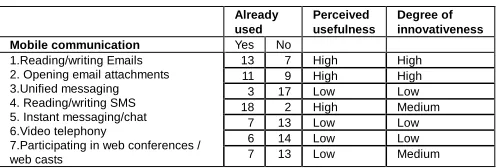
Table 1. Mobile Communication ratings
While email handling in the mobile work setting is considered to be highly useful and innovative by the interview informants, Table 1 shows that almost no support could be found for the usefulness or innovativeness of chatting, video telephony, web conferences or UMS in the mobile work setting of the interviewees. This indicates that these functions of mobile communications are not a good fit with sales-force workers tasks. Pharmaceutical sales-force workers have most likely been using the “reading/writing SMS” functionality for many years. However, it can be concluded that mobile email communication in general (reading/writing of emails and opening email attachments in the mobile work setting) does fit well with pharmaceutical sales-force worker tasks. The following interviewee quotation supports this assumption:
“Some emails cannot wait until the evening to be written. Waiting times can effectively be used for such purposes. With this increased flexibility, I can concentrate more effectively on my daily work.” (P10)
Email handling is considered to be effective for both internal communication with colleagues and external communication with their customers - physicians. Several interviewees stated that customer satisfaction might be increased through prompt email responses to open questions raised by customers. Eighty-nine percent of German physicians use the internet at least once a day and 85% of them check their emails at least once a day [7], we can assume that email communication and information gathering via email is an integral part of their working life.
In addition, several interviewees noted that information exchange with colleagues (sales force and headquarter) via email might be improved through quicker response cycles. For example, marketing department wants collect information on a specific topic (e.g. on the performance of specific product; impact of a health care law on physician; the impact of specific sales method etc.) via email. With the help of mobile communication as a specific function of MCT, a sales-force worker could communicate more quickly and the internal department could respond sooner if necessary. Otherwise, the internal colleagues would have to wait until the evening for a response or would have to call the respective sales-force workers.
Already used
Perceived usefulness
Degree of innovativeness Mobile communication Yes No
1.Reading/writing Emails 2. Opening email attachments 3.Unified messaging 4. Reading/writing SMS 5. Instant messaging/chat 6.Video telephony
7.Participating in web conferences / web casts
13 7 High High
11 9 High High
3 17 Low Low
18 2 High Medium
7 13 Low Low
6 14 Low Low
Another positive aspect not only specific to mobile email communication is the possibility to use dead times more effectively and efficiently. For example, some interviewees mentioned that email communication might also be helpful in dead times in order to communicate with internal support departments (e.g. HR, IT etc.) in order to handle administrative work in the mobile work setting.
[image:4.595.40.290.165.285.2]Mobile information searching
Table 2. Mobile information searching ratings
Table 2 shows that the online access to corporate systems (i.e. Intranet, CRM, ERP etc.) and the internet in the mobile work setting is considered to be highly useful and innovative by the sales-force workers. Practically no support could be found for the usefulness and innovativeness of video access, eBooks access, audio content or m-learning content in the mobile work setting of pharmaceutical sales force workers in this case organization.
The interviewees provided a number of reasons why mobile information searching functionalities have the potential to support pharmaceutical sales-force work in several ways. First, sales-force workers can prepare more effectively for ad hoc/unplanned sales calls as he/she can gather new information in real-time by accessing corporate databases and the internet in the mobile work setting. By having online access to customer-related data from the company’s CRM system, a sales-force worker can look up basic data (address, opening hours, prescribing behavior, customer value/priority, turnover etc.) and the latest activities (last visits, last feedback, open issues from last call etc.) with regard to a specific customer. There is a need to support those ad hoc sales calls as during a usual working week, 10-20% of all sales calls are ad hoc calls as highlighted in following interviewee quotation:
“MCT is the appropriate tool in order to prepare for ad hoc sales calls.“ (P4)
Second, a sales-force worker might receive time-critical information during a usual working day that might be of value for upcoming sales calls. The following quotations from interviewees support this notion:
“A critical part of pharmaceutical sales-force work is to provide new information for the customer. If this is not the case, the sales call was a waste of time.” (P1)
“Especially my business unit, current knowledge about our and competitor’s products is crucial during the sales call. Mobile information searching could help solving knowledge
gaps during the working day. Reality is too complex in order to prepare for all unexpected events in advance.” (P6)
Third, customer inquiries (like e.g. product-related questions or services offered by the respective company) that cannot be solved in advance might either be handled during the sales call by accessing online systems in presence of the customer or directly after the sales calls. In the next break, all necessary information can be collected and delivered by the sales-force worker to the customer, either by revisiting, calling or emailing. The customer might feel more valued and will receive the information requested more quickly. Current research on physician internet usage proves their increased information needs [7]. A well-prepared pharmaceutical sales-force worker can add value to the sales call by providing additional information collected through mobile information searching functionalities.
Based on the explanations provided by the interviewees, we can conclude that information delivery which can be effectively supported by MCT can be considered as a competitive differentiator for pharmaceutical sales-force workers.
[image:4.595.306.555.340.423.2]Mobile transaction processing
Table 3 Mobile transaction processing rating
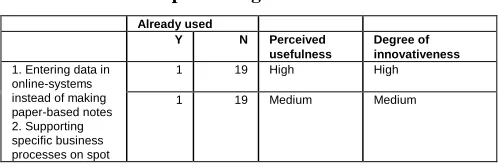
Table 3 shows that there is a strong support for the usefulness and innovativeness of mobile transaction processing functionality to capture business-relevant data in real-time instead of making paper-based notes and feeding the data into a system at the end of the working day. Only medium support could be found for the support of specific business processes in real time as currently there is no specific business process that could be supported online. In contrast to other mobile business models, pharmaceutical sales-force work in Germany is limited by German law as a sales-force worker is not allowed to directly sell products to a customer. They can promote products but cannot sell them.
Currently, sales-force workers make paper-based notes of their sales activities and all sales-/CRM-relevant data (call feedback, customer response, plans for next calls, customer network information etc.) is entered in appropriate systems at the end of a working day. Most of the interviewees welcome this mobile transaction processing functionality as evidenced in the following interviewee quotation:
“Great idea - double work will be significantly reduced!” (P17)
In addition, customer service can be increased as medical inquiries from a physician could be typed in an online system in front of the physician (or directly after a sales call). Sample management process would be facilitated as the system could check whether the respective customer is allowed to receive a
Already used
Mobile information searching Yes No Perceived usefulness
Degree of innovativeness
1.Online access to intranet Online access to corporate databases 2. Online access to CRM system 3. Online access to ERP system 4. M-learning: accessing learning modules
4.Internet search 5. Accessing e-books with medical/product information 6. Accessing video, audio content (e.g. IPTV broadcast, online videos, podcasts etc.)
7 13 High High 4 16 High High 5 15 High High 2 18 Medium Medium 0 20 Medium Medium
12 8 High High
3 17 Medium Medium
5 15 Low Low
Already used
Y N Perceived usefulness
Degree of innovativeness
1. Entering data in online-systems instead of making paper-based notes 2. Supporting specific business processes on spot
1 19 High High
specific medical sample. (Medical samples of products are handed out in order that physicians have the chance to try out. Due to legal restrictions, sales-force workers are only allowed to hand over a specific amount of medical samples to a customer). The organization’s specific event management process that is currently enhanced by a complex web application can be enriched by mobile functions. For example, data about customers participating in educational events sponsored by the case organization can directly be handled online via mobile transaction processing as a specific function of MCT.
Mobile transaction processing is considered as useful and innovative when the creation of paper-based notes can be eliminated and thereby data can be collected on-the-spot and online. Capturing/collecting CRM data directly after a sales call has taken place (like e.g. customer feedback, plans for next call, inquiry data, participation in company-sponsored events etc.) into an online system is considered as useful as this increases overall data quality (as data is still in the sales-force worker’s short term memory), reduces the amount of paper-based notes and thereby increases a sales-force worker’s overall efficiency as double work will be reduced.
[image:5.595.305.556.202.313.2]Mobile job scheduling and dispatching
Table 4. Mobile job scheduling and dispatching ratings
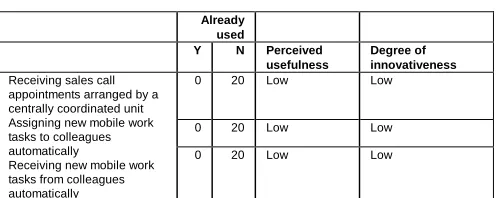
Table 4 shows that no support could be found for the usefulness and innovativeness of any mobile job scheduling and dispatching functionality rated by interviewees.
Interviewees emphasized that Pharmaceutical sales-force workers are used to working with a high degree of autonomy and do not like the idea that someone else tells them whom to visit. They make weekly plans to determine which customers they visit and they align these plans with colleagues and supervisors. They think that they know their customers best and no other colleague would be able to guide them better. The following interviewee quotations provide further support for this finding:
“In the field, we are ‘lone wolves’. We do not need someone who tells us whom to visit/what to do. We know where our customers are located and if not, we have a navigation system to find it out.” (P12)
“I know my customers best – why should someone else decide who I should visit?” (P2)
As there is a weekly planning process that is done in every business unit, ad hoc calls take place too seldom (10-20%) to justify automating this process. Furthermore, if a sales-force worker wants another sales-force worker to visit a certain
customer, a phone call is considered sufficient. Mobile job scheduling and dispatching functionalities add value in those businesses where we have a high criticality of tasks and customer relations are of low importance as it is the case in the utilities industry [1]. Given the specific nature of pharmaceutical sales-force work in Germany, we can conclude that mobile job scheduling and dispatching functionalities do not provide added value in the current business environment as there is no need to dynamically assign tasks to sales-force worker in their mobile work setting.
Location-related services
Table 5. Location-related services ratings
Table 5 shows that similar to the mobile job dispatching and scheduling functionality, no support was found for the usefulness or innovativeness of the location-related services functionality.
In general, a number of interviewees were quite hostile regarding the location-related services functionality and asked the interviewer whether this functionality complies with German law and whether the workers council is involved in this project. It was noted that there was strong resistance to use the location-related services functionality. The following interview quotations underline this strong sentiment:
“Sounds like George Orwell in his novel ‘1984’ - Big brother is watching you!’ (P12)
“Abuse (by the employer) is certain.” (P20)
“Do you want to spy on me?” (P9)
“Does the organization want to hand out electronic ankle manacles?” (P3)
Due to the high work autonomy of the pharmaceutical sales-force workers, there is no specific business need to know the location of another working colleague. Again, a phone call is considered sufficient in order to find out the location of a colleague. While this functionality might be useful in other industries with different business models [1],[16], we can conclude that location-related service functionalities do not fit with pharmaceutical sales-force work.
In addition, the usefulness of both navigation system functionalities is not considered in further discussions as it is already installed in all of the sales-force workers’ company vehicles.
Similar to mobile job scheduling and dispatching functionalities, location-related services are not considered to be useful and innovative by the interviewees. Moreover, some
Already used
Y N Perceived usefulness
Degree of innovativeness
Receiving sales call appointments arranged by a centrally coordinated unit Assigning new mobile work tasks to colleagues automatically
Receiving new mobile work tasks from colleagues automatically
0 20 Low Low
0 20 Low Low
0 20 Low Low
Already used
Location-related services Y N Perceived usefulness
Degree of innovativeness
1.Receiving information about the location of colleagues or customers 2. Receiving information from navigation system regarding the current position and the distance to a specific location
3. Receiving additional information about the current location like hotels, gas stations, restaurants etc. that are within reach
2 18 Low Low
20 0 High High
[image:5.595.42.292.354.453.2]sales-force workers interviewed showed a strong resistance to using these functionalities as they fear that their autonomous way of work could be changed (through mobile job scheduling) and they feared that their employer might misuse the tool for unnecessary controlling purposes (location-related services).
[image:6.595.39.291.155.294.2]Mobile Office
Table 6. Mobile Office ratings
Table 6 shows that no support could be found for the usefulness or innovativeness of mobile device as dictation machine. Some limited support could be found for the usefulness and innovativeness of modification/collaboration of MS office documents in the mobile work setting. The following interviewee quotations underline this assumption:
“Please fill my dead time with life.” (P13)
“Day-to-day work can be done during the day in dead times – and not in the evening hours.” (P3)
According to the interviewees, there are several scenarios for mobile office functionalities which add value to their tasks conducted in the field. First, office-related work that is normally handled in the home office after a usual working day could now be handled in the dead times of a sales person’s mobile work setting. In addition, all additional data collected where no corporate system is available can be captured via mobile office functionality like e.g. Excel. Third, tasks entered in an online task list do not need to be noted on a piece of paper. Fourth, some interviewees already take their laptop with them and use mobile office functionalities, but offline. Online access would provide additional value for them.
“Accessing mobile office functionalities in my dead time (like e.g. after lunch break) would be helpful as I would not have to do all administrative tasks (like e.g. expense reports etc.) late at night in my home office. Headquarter colleagues could receive the information they requested more quickly.” (P13)
“Mobile office can help me to accomplish tasks in dead times of my mobile work environment that I would have to otherwise at home. Great!” (P18)
For an effective use of mobile office functionality, a clarification is necessary on how it will be technically provided – thus via laptop/netbook with UMTS card or a Smartphone application? In addition, a general decision needs
to be made whether the case organization wants their employees to hold presentations via Laptop during a sales call.
Most mobile office functionalities are considered to have a medium level of usefulness/innovativeness, especially using Microsoft Office products in dead times like waiting times or meal breaks. The interviews also revealed that mobile office functionalities are more useful for supervisors than operational sales-force workers, as they have more contact with headquarter colleagues, make fewer sales calls and have more administrative and reporting responsibility.
DISCUSSION OF DATA ANALYSIS RESULTS
Q1. Do sales-force workers perceive mobile work support functionalities to be useful in their mobile work?
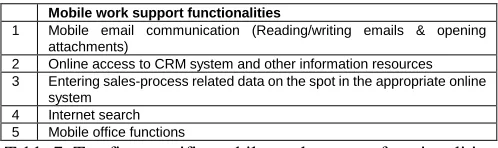
Certain sub functionalities of mobile email communication, mobile information searching, mobile transaction processing and mobile office fit well with pharmaceutical sales-force worker tasks. However the interviews revealed that mobile job scheduling and dispatching and location-related services functionalities are not considered useful or innovative by sales force workers. The following table summarizes the top five specific mobile work support functionalitie that are considered by the interviewees to be a good fit (useful and possibly innovative) with sales-force worker tasks.
Mobile work support functionalities
1 Mobile email communication (Reading/writing emails & opening attachments)
2 Online access to CRM system and other information resources 3 Entering sales-process related data on the spot in the appropriate online
system 4 Internet search 5 Mobile office functions
Table 7: Top five specific mobile work support functionalities that fit well with sales force work tasks
This research also identified that specific mobile work support functionalities such as location-related services and mobile job scheduling and dispatching of work are likely to be strongly resisted by sales-force workers.
Q2. Does the perceived usefulness of mobile work support functionalities also imply a degree of innovativeness in the way sales-force workers conduct their tasks?
While the interview data indicated a relationship between perceived usefulness of mobile work support functionalities and the degree of innovativeness, it was also apparent that many of interviewees felt that usefulness and innovativeness were difficult to separate as constructs. As one interviewee puts it:
“In my humble opinion, your differentiation between usefulness and innovativeness is only of academic nature.” (P16)
CONCLUSIONS AND IMPLICATIONS
The real potential of MCT can be exploited when using [34] mobile work support functionalities in combination. For example, if you combine two or mobile work support functionalities, (like e.g. looking information up and the communication via email), the real usefulness and
Already used
Mobile office Y N Perceived usefulness
Degree of innovativeness
1.Outlook: Accessing online calendar, arranging appointments
2. Excel: Using calculating software while on the move
3. PowerPoint: Reading, editing and creating presentations
Holding presentations in front of the customer
4. Accessing and editing online task lists
5. Using mobile device as dictation machine
6. Accessing and manipulating documents which are stored online
12 8 High Medium 9 11 Medium Medium 4 16 Medium Medium
2 8 Low Medium
6 14 Medium Medium
4 16 Low Low
[image:6.595.306.555.382.456.2]innovativeness of MCT is revealed. Thus, there are synergies among those functionalities. All in all, we can conclude that the use of mobile work support functionalities does not stand for a radical change in the way pharmaceutical sales-force work is done in Germany. Our findings indicate that the degree of change can be considered as incremental change as the innovative use of mobile work support functionalities can be considered as an enabler that has the potential make every sales-force worker more effective and thereby to make the company as a whole more effective.
This research provided rich insights in how mobile work support functionalities fit with sales force worker tasks in the field in a large pharmaceutical company. Mobile work support functionalities framework was used to establish with sales-force workers which specific mobile work support functionalities are perceived to be useful and a good fit with sales force work tasks. We also sought to establish which mobile support functionalities were also considered to be innovative.
REFERENCES (BIBLIOGRAPHY)
[1] Accenture. (2004) Field Operations: The Next. Opportunity for Productivity Gains. [Online]. Available: http://www.google.de/url?sa=t&source=web&cd=1&ved=0C BkQFjAA&url=http%3A%2F%2Fwww.accenture.com%2F NR%2Frdonlyres%2F88C1DC24-DFD9-4FAB-82D5-0360 C8B5DC06%2F0%2Ffield_force.pdf&ei=ZNk9TOGuJ8P_4 Aaat-DGAg&usg=AFQjCNFdseZCF3GNQZL3hHPY4EuiA TurYw&sig2=CZOqqMt9g4DNOV7ORUED0w.
[2] T. Adegbesan and J. E. Ricart, What we really know about when technological innovation improves performance (and when does it not)?, IESE Business School Working Paper No. 668, 2007.
[3] AOK Bundesverband. (2008). Heilmittelwerbegesetz - Law on Advertising in the Health Care System. [Online]. Available:
http://www.aok-bv.de/lexikon/h/index_02455.html.
[4] R. B'Far, Mobile Computing Principles: Designing and Developing Mobile Applications with UML and XML, Cambridge University Press, 2005.
[5] C. BenMoussa, Supporting the Sales Force through Mobile Information and Communication Technologies: Focusing on the Pharmaceutical Sales Force, Ph.D. dissertation, Turku Centre for Computer Science, TUCS Dissertations No. 75, 2006.
[6] Computerwoche 2008, Einsatzgebiete, Verbreitung und Zukunft von Mobile Commerce Applikationen, Edition 27.
[7] DocCheck. (2009). DocCheck Online Studie
Internetnutzung von Ärzten In Europa's Big Five. [Online], Available:
http://load.doccheck.com/de/digitale-zeitschriften/doccheck-online-studie-internetnutzung-von-aerzten-2009-in-europas-b ig-five.html.
[8] M. T. Dishaw and D. M. Strong, Extending the technology acceptance model with task-technology fit constructs, Information & Management, Vol. 36, 1999. [9] D. Fischer and J. Breitenbach, Die Pharmaindustrie: Einblick – Durchblick – Perspektiven, 2nd Edition, Elsevier, 2007.
[10] G. Gable, Integrating case study and survey research methods: an example in information systems, European Journal of Information Systems, 3:2, 112–126, 1994. [11] Gartner Group (2002). Trends and developments in wireless data applications. [Online], Available: http://www.siventures.com/portfolio/pdf/070202/Wireless%2 0Data%20Applications.pdf.
[12] E. J. Garrity and G. L. Sanders, Dimensions of Information Systems Success, Information Systems Success Measurement, Idea Group Publishing, London, UK, 1998. [13] J. Gebauer and Y Tang, Applying the theory of task-technology fit to mobile technology: the role of user mobility, International Journal of Mobile Communications, Vol. 6, No. 3, 2008.
[14] D. L. Goodhue and R. L. Thompson, Task-Technology Fit and Individual Performance, MIS Quarterly, Vol. 19, Issue 2, 1995.
[15] I. Henri and L. Aurelie, Give me a mobile phone, and I will work harder! Assessing the value of mobile technologies in organizations: An exploratory research, International Conference on Mobile Business 2006, 2006.
[16] IBM Corporation, Mobilising your workforce: A blueprint for the utilities industry, IBM, 2004.
[17] R. Kling and S. Iacono, The Institutional Character of Computerized Information Systems, Information Technology & People, Volume: 5, Issue: 1, p. 7 – 28, 1989.
[18] Y. H. Lee, K. A. Kozar and K. R. T. Larsen, The technology acceptance model: past, present, future, Communications of AIS, Vol.12, Article 50, pp. 752-780, 2004.
[19] K. C. Lee, S. Lee, and J. S. Kim, Analysis of Mobile Commerce Performance by Using the Task-Technology Fit, IFIP International Federation for Information Processing, Springer Boston, Volume 158/2005, 2005.
[20] S. Lilischkis, More Yo-yos, Pendulums and Nomads: Trends of Mobile and Multi-location Work in the Information Society, Issue Report 36, Star-project/Empirica, 2003. [21] A. Mackintosh, Innovation in pharmaceutical marketing strategy: How to overcome the 30-second detailing dilemma, International Journal of Medical Marketing, Vol. 4, No.1, pp.15-17, 2004.
[22] C. Middleton, Illusions of Balance and Control in an Always-On Environment: A Case Study of BlackBerry Users, Continuum: Journal of Media & Cultural Studies, 2007. [23] M. Perry, K. O’Hara, A. Sellen, B. Brown, and R. Harper, Dealing with mobility: Understanding access anytime,
anywhere, ACM Transactions on Computer-Human
Interaction, 2001.
[24] M. Rogers, The Definition and Measurement of Productivity, Working Paper no. 9/98, Melbourne Institute of Applied Economic and Social Research, Melbourne, 1998. [25] E. Scornavacca and A. Sutherland, The Perceived Impact of Mobile Sales Force Automation Systems on Salespeople’s Performance, ICMB, 7th International Conference on Mobile Business, 2008.
[26] H. Sheng, F. F. Nah, and K. Siau, Strategic implications of mobile technology: A case study using Value-Focused Thinking, The Journal of Strategic Information Systems, Vol.14 No. 3, p. 269-290, 2005.
technology-to-performance chain model, Journal of Organisational and End User Computing, Vol. 16 No.4, pp.17-36, 2004.
[28] S. Tamminen, A. Oulasvirta, K. Toiskallio, and A. Kankainen, Understanding mobile contexts, Personal and Ubiquitous Computing, 8 (2), pp. 135-143, 2004.
[29] A. Urbaczewski, J. Valacich, and L. Jessup, Mobile commerce opportunities and challenges, Communications of the ACM, 2003.
[30] H. Xianpei, L. Wenli, and H. Qing, Are Mobile Payment and Banking the Killer Apps for Mobile Commerce?, Proceedings of the 41st Annual Hawaii International Conference on System Sciences, 2008.
[31] C. Yan and H. Lihua, Mobile Technologies adoption – An exploratory case study, Tsinghua Science and Technology, ISSN 1007-0214, Volume 13, Number 3, 2008.
[32] R. K. Yin, Case Study Research: Design and Methods, Third Edition, Sage, 2003.
[33] Y. Yuan and W. Zheng, The Fit between Mobile Task and Mobile Work Support: A Theoretical Framework, ICMB, Proceedings of the International Conference on Mobile Business, ISBN: 0-7695-2595-4, 2006.