
Mental models of teaching, learning, and assessment: a longitudinal study
338
0
0
Full text
(2) 1. Mental models of teaching, learning, and assessment: A longitudinal study.. Thesis submitted by. Christine Elizabeth Edwards-Leis: Dip.T, B.Bus, B.Ed, PC.Ed (Qld). for the degree of Doctor of Philosophy in the School of Education, James Cook University in June 2010.
(3) 2. ABSTRACT This doctoral thesis is a significant research project that contributes to complete gaps in the literature on mental models of middle years school students and their teachers.. The research aimed to determine how a study of a teacher’s and students’. mental models can inform the educational community about effective pedagogy. The research questions included the identification of the participants’ mental models before, during, and immediately after applied problem-solving in a robotics program. A more in-depth investigation exposed the teacher’s and four of her students’ mental models of teaching, learning, and assessment. Once these mental models had been established, the matches, mismatches, and/or changes over time of such mental models and the effect, if any, on teaching, learning, and assessment were examined. The investigation was designed to understand how the mental models of multiple participants were managed over an extended period of time. This empirical qualitative study was centred within information processing theory and linked with the introspection mediating process tracing paradigm. The study involved close contact with the participants over an extended period of time. The methodology focussed on learner centredness and how the participants integrated new experiences with existing conceptual, declarative, and procedural knowledge in the areas of teaching, learning, and assessment. This was not a simple “input-output” focus, but rather an investigation that ascertained the mental models of the teacher and learners as they carried out pedagogical tasks. It made no fundamental assumptions about links between input, for example, the lesson, and action but utilised mental model theory to understand the participants’ mental models. The study used a technology-based learning context, robotics, although the findings could be applied across curriculum areas. It was situated in a suburban Australian school and involved one Year Six teacher and a group of 24 volunteer students from her shared class of 54 students. Four of these 24 students were selected anonymously from face-down piles of names and participated in the in-depth aspects of the study. Rigorous adherence to ethical procedures was maintained throughout the study. Data collection tools used to identify the participants’ mental models included Likert Scale Questionnaires, Semi-Structured Interviews (individual and shared), Stimulated Recall Interviews, Participants’ Journals, a Teach-Back episode, a Focus.
(4) 3. Group Interview, and the Researcher’s Journal. The study’s pre-experience investigations commenced in March 2005 and the post-experience phase occurred six months later in September, 2005. The study found that specific teaching strategies are required to identify and redress ineffective mental models that inhibit the students’ active participation in problem-based learning activities. Significant remediation was apparent for two of the participant students: one who failed to manage her mental models of problem-solving; one whose mental models of working with others inhibited her capacity to engage effectively in a social constructivist environment. Implications from these findings include a recommendation that teachers avoid making assumptions about students’ ability to engage effectively either with discovery-based learning activities or with their peers without the relevant scaffolded instruction. The study also determined that mental models are, in the main, stable over time. This finding is significant and has implications for remediation if the established mental model is inaccurate or incorrect and, therefore, limits application or communication of effective problem-solving efforts. The implication is for teachers to ensure that students are engaged in challenging learning experiences that enable the development, application, and communication of accurate and effective conceptual, declarative, and procedural knowledge. The reflective application of such knowledge enables students to create processes for and products of learning: robust, rich, and useful mental models. This unique longitudinal study of mental models offers significant data to the educational community’s constant quest for relevant information about productive pedagogical practice in the middle years of schooling..
(5) 4. TABLE OF CONTENTS ABSTRACT ................................................................................................................ 2 TABLE OF CONTENTS .......................................................................................... 4 LIST OF TABLES ..................................................................................................... 9 LIST OF FIGURES ................................................................................................. 12 CHAPTER ONE: Introduction ............................................................................... 14 Introduction ........................................................................................................... 14 The Research Aims ............................................................................................... 14 Methology, Scope, and Limitations ...................................................................... 15 Methodology .......................................................................................................... 15 Scope ..................................................................................................................... 16 Limitations………………………………………………………………………………...15 Thesis Format ....................................................................................................... 14 Voice and Literacy Aspects………………………………………………………15 Document Format and Pseudonyms………………………………………………......16 Chapter Outline ..................................................................................................... 16 Chapter One: Introduction ............................................................................ 16 Chapter Two: Literature Review ................................................................... 17 Chapter Three: Methodology......................................................................... 17 Chapter Four: Pre-Experience Mental Models ............................................. 17 Chapter Five: In-Action Mental Models ........................................................ 18 Chapter Six: Post-Experience Mental Models ............................................... 18 Chapter Seven: Teach-Back and Focus Group ............................................. 18 Chapter Eight: Longitudinal Mental Models (March 2006) ......................... 18 Chapter Nine: Longitudinal Mental Models (October 2006) ........................ 19 Chapter Ten: Conclusion ............................................................................... 19 And so the story starts … ...................................................................................... 19 CHAPTER TWO: Literature Review ..................................................................... 20 Introduction ........................................................................................................... 20 Mental Models ...................................................................................................... 21 The Journey to Find a Definition .......................................................................... 21 How Mental Models Compare with Other Cognitive Structures .......................... 22 The Nature of Mental Models ............................................................................... 27 A Question of Process and Product ...................................................................... 28 The Multiple Functions of Mental Models ........................................................... 29 A Question of Unravelling Problems .................................................................... 29 Explanatory Function .................................................................................... 30 Predictive Function ........................................................................................ 31 Control Function............................................................................................ 32 Diagnostic Function....................................................................................... 33 Communication Function............................................................................... 34 Memory Mechanism Function ....................................................................... 36 Memory load. ............................................................................................. 37 Patterning. ................................................................................................. 38 Summary of the Multiple Functions of Mental Models .................................. 38 Robotics and Mental Models ................................................................................ 39 A Problem-Based Learning Environment ............................................................. 39 Assessment and Mental Models ............................................................................ 42 A Question of What and How to Measure ............................................................. 42 Distributed Mental Models ................................................................................... 46.
(6) 5. A Question of Sharing ........................................................................................... 46 Novices and Experts .............................................................................................. 47 A Question of How We Undertake a Journey of Learning.................................... 47 Finding a Path through the Trees .......................................................................... 49 Where to From Here? ........................................................................................... 49 CHAPTER THREE: Methodology ......................................................................... 52 Introduction ........................................................................................................... 52 Nature of Mental Models Research ....................................................................... 52 Research Aim and Questions ................................................................................ 56 Research Aim ........................................................................................................ 56 Research Questions ............................................................................................... 56 Context of the Study.............................................................................................. 56 Robotics Laboratory .............................................................................................. 57 Robotics ................................................................................................................. 58 Participants ........................................................................................................... 59 Teacher Participant ....................................................................................... 60 Student Participants ....................................................................................... 60 Ethics ..................................................................................................................... 64 Data Collection...................................................................................................... 62 Timeline of Collection ........................................................................................... 62 Tools of Collection ................................................................................................ 67 Likert Scale Questionnaire ............................................................................ 67 Interviews ....................................................................................................... 68 Semi-structured interviews......................................................................... 68 Longitudinal interviews. ............................................................................ 71 Stimulated recall interviews....................................................................... 73 Value of protocol change. .......................................................................... 75 Teach-Back and Teach-Back Interviews ........................................................ 77 Participant Journals ...................................................................................... 80 Students’ journal. ....................................................................................... 80 Teacher’s journal. ...................................................................................... 82 Researcher’s journal.................................................................................. 82 Focus Groups or Distributed Cognition ........................................................ 83 Coding ............................................................................................................ 86 Maximising Validity and Reliability...................................................................... 87 Conclusion............................................................................................................. 88 Chapter Four: Pre-Experience Mental Models ...................................................... 90 Introduction ........................................................................................................... 90 Espoused Mental Models ...................................................................................... 90 Conceptual Knowledge ......................................................................................... 90 Robots and Robotics ...................................................................................... 90 Robots and What They Do ............................................................................. 91 Robotics – Programming and Intelligence .................................................... 96 Robots Summary ............................................................................................ 98 Social Construction ............................................................................................... 99 A Shared Learning Environment ................................................................... 99 Predictions of Success and Assessment............................................................... 104 An Assessed Learning Environment............................................................. 104 Making Mistakes and Problem-Solving .............................................................. 110 Trying a New Formula ................................................................................. 110 In Summary ......................................................................................................... 114.
(7) 6. Chapter Five: In-Action Mental Models ............................................................... 116 Introduction ......................................................................................................... 116 Stimulated Recall Methodology.......................................................................... 117 Change of Protocol .............................................................................................. 120 Quantity of Response........................................................................................... 121 Quality of Response............................................................................................. 124 In-Action Mental Models .................................................................................... 126 Journals ............................................................................................................... 126 Problem-Solving .................................................................................................. 131 Social Construction ............................................................................................. 141 In Summary ......................................................................................................... 147 Chapter Six: Post-Experience Mental Models ...................................................... 150 Introduction ......................................................................................................... 150 Reflective Mental Models ................................................................................... 150 Conceptual Knowledge ....................................................................................... 150 Robots and Robotics .................................................................................... 150 Teacher. ................................................................................................... 151 Students. ................................................................................................... 153 Robotics – Programming and Intelligence .................................................. 158 Richness of the Robotic Environment .......................................................... 161 Reflective Mental Models ................................................................................... 162 Social Construction ............................................................................................. 162 Assessment and Predictions of Success............................................................... 168 Teacher. ................................................................................................... 169 Students. ................................................................................................... 171 Making Mistakes and Problem-Solving .............................................................. 176 Teacher. ................................................................................................... 177 Students. ................................................................................................... 179 In Summary ......................................................................................................... 185 Chapter Seven: Teach-Back and Focus Group .................................................... 187 Introduction ......................................................................................................... 187 Teach-Back ......................................................................................................... 187 Mental Models of Teaching and Learning .......................................................... 188 Preparation: Designing the Teaching Tasks ............................................... 188 Teaching Robotics ........................................................................................ 189 Data Analysis ............................................................................................... 191 Teach-Back Episode ............................................................................................ 191 Mental Models of Teaching Strategies ........................................................ 192 Mental Models of Learning and Teaching Strategies .................................. 195 Focus Group ........................................................................................................ 197 Mental Models of Assessment ............................................................................. 198 Teacher’s Mental Models ............................................................................ 199 Preparation: Designing the Assessment Tasks ............................................ 199 Assessing Robotics ....................................................................................... 200 The Focus Group Interview: Another Journey into Unknown Territory! ........... 203 Mental Models of Assessment Design .......................................................... 206 Types of assessment. ................................................................................ 207 How assessment results can be reported. ................................................ 208 How assessment can show what you have learned. ................................. 210 Mental Models of Assessment Help ............................................................. 213 How much help is too much? ................................................................... 214.
(8) 7. Is completing the whole task necessary? ................................................. 215 Matches and Mismatches of Mental Models of Assessment................................ 217 Where To Now? .................................................................................................. 223 Chapter Eight: Longitudinal Mental Models (March 2006)................................ 224 Introduction ......................................................................................................... 224 A Longitudinal Study .......................................................................................... 224 Mental Models of Teaching and Learning .......................................................... 225 Working in Groups of Two or More ............................................................ 225 Problem-Solving .......................................................................................... 231 Metacognition .............................................................................................. 233 Mental Models of Assessment ............................................................................. 236 Types of Assessment ..................................................................................... 237 Timing of Assessment ................................................................................... 240 Communication of Assessment ..................................................................... 243 Mental Models: What Can We Learn?................................................................ 246 In Summary ......................................................................................................... 250 Chapter Nine: Longitudinal Mental Models (October 2006) ............................... 252 Introduction ......................................................................................................... 252 A Longitudinal Case Study .................................................................................. 252 Interview Methodology ................................................................................ 253 Teaching and Learning with Robotics ......................................................... 254 Pedagogical practice. – teaching robotics. ............................................. 255 Pedagogical practice – what can be learned? ......................................... 258 Learning Through Problem-Solving ............................................................ 261 Assessment ................................................................................................... 264 In Summary ......................................................................................................... 269 Chapter Ten: Conclusion ..................................................................................... 271 Introduction ......................................................................................................... 271 Contribution to Research .................................................................................... 271 Research Focus ............................................................................................ 272 Research Methodology................................................................................. 273 Limitations of the Research ......................................................................... 274 Implications of Research ..................................................................................... 275 Pedagogical Implications: Teaching, Learning, and Assessment ............... 275 Timeliness of intervention. ....................................................................... 275 Intensity of intervention. .......................................................................... 276 Intervention for social constructive collaboration. ................................. 277 Appraising mental models for problem-solving....................................... 277 Communicating assessment strategies..................................................... 278 Multiple authors for multiple assessment strategies. ............................... 278 Proactive Strategies for Improved Learning and Problem-Solving ............ 279 In Closing ............................................................................................................ 281 And so the story goes ................................................................................... 282 REFERENCES ....................................................................................................... 283 APPENDIX A ......................................................................................................... 298 APPENDIX B ......................................................................................................... 300 APPENDIX D ......................................................................................................... 303 APPENDIX E ......................................................................................................... 304 APPENDIX F ......................................................................................................... 306 APPENDIX G ......................................................................................................... 308 APPENDIX H ......................................................................................................... 310.
(9) 8. APPENDIX I .......................................................................................................... 312 APPENDIX J .......................................................................................................... 313 APPENDIX K ......................................................................................................... 315 APPENDIX L ......................................................................................................... 316 APPENDIX M ........................................................................................................ 318 APPENDIX N ......................................................................................................... 319 APPENDIX O ......................................................................................................... 320 APPENDIX P ......................................................................................................... 322 APPENDIX Q ......................................................................................................... 324 APPENDIX R ......................................................................................................... 326 APPENDIX S .......................................................................................................... 327 APPENDIX T ......................................................................................................... 328 APPENDIX U ......................................................................................................... 329 APPENDIX V ......................................................................................................... 330 APPENDIX W ........................................................................................................ 332 APPENDIX X ......................................................................................................... 334 APPENDIX Y ......................................................................................................... 336 APPENDIX Z ......................................................................................................... 337.
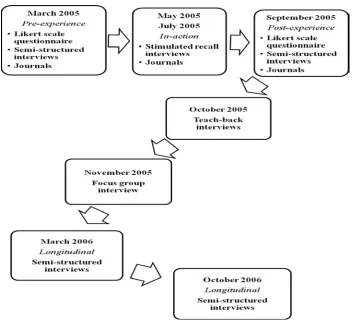
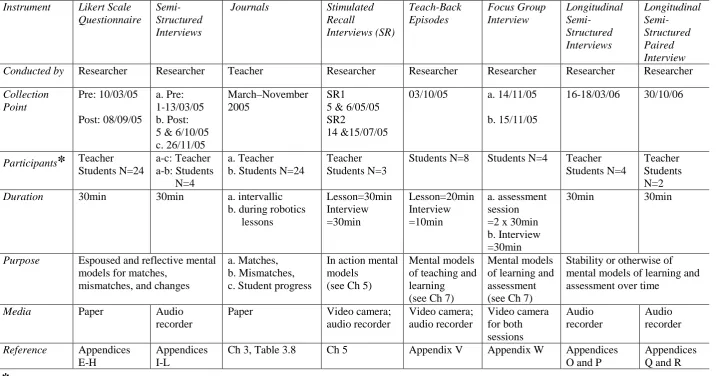
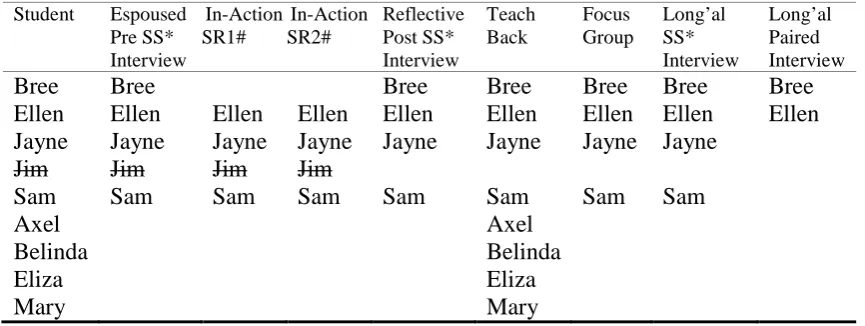
(10) 9. LIST OF TABLES Table 3.1: Synopsis of Activities from “Introducing Robotics” (QSA, 2003, p. 1) 61 Table 3.2: Detail of Data Collection Instruments Used in the Study 65 Table 3.3: Student Participants’ Involvement from March 2005 to October 2006 68 Table 3.4: Pre- and Post-Experience Likert Scale Questionnaire: Students (2005) 70 Table 3.5: Themes of Mental Models Addressed with Sample Questions in SemiStructured Interviews with the Students 72 Table 3.6: Themes of Mental Models Addressed with Sample Questions in SemiStructured Interviews with the Teacher 73 Table 3.7: Number and Percentage Change in Responses after Protocol Change 78 Table 3.8: Student Journal Entries 83 Table 4.1: Teacher’s mental models of students’ mental models of robots 94 Table 4.2: “What is a robot?” 95 Table 4.3: “What actions do robots do?” 95 Table 4.4: “How useful are robots?” 96 Table 4.5: Student responses to Pre-Experience Likert Scale question about robots 97 Table 4.6: Pre-experience semi-structured interview responses to questions about thinking and brain function of robots 100 Table 4.7: Student responses to the Likert Scale questions about social construction 103 Table 4.8: Semi-structured interview responses to group work 105 Table 4.9: Working with others 106 Table 4.10: Student responses to class journal sentence starter, “The things that I am most looking forward to in making my robot include. . .” 109 Table 4.11: Student responses to class journal sentence starter, “The things that I am most worried about when making my robot include. . .” 110 Table 4.12: Predictions of the forthcoming robotics activity 111 Table 4.13: Students’ general predictions of robotics 111 Table 4.14: Student responses about their forthcoming robotics activity 115 Table 4.15: Students’ strategies for correcting mistakes 115 Table 4.16: Students’ responses about where they would find help 117 Table 5.1: Segment of initial Stimulated Recall1 Interview with Pamela, 3 May 2005 121 Table 5.2: Segment of initial Stimulated Recall 2 Interview with Ellen, 15 July 2005 124.
(11) 10. Table 5.3: Segments of Stimulated Recall Interviews with Sam, May and July 2005 128 Table 5.4: Pamela, Sam, and journal writing (14 July 2005) 132 Table 5.5: Ellen and Jayne and journal writing (15 July 2005) 133 Table 5.6: Ellen and Jayne predicting outcomes (15 July 2005) 134 Table 5.7: Ellen and Jayne problem-solving with sensors (15 July 2005) 136 Table 5.8: Ellen and Jayne refit the robot (15 July 2005) 137 Table 5.9: Pamela and Sam observe Sam’s robot in a spin (14 July 2005) 139 Table 5.10: Pamela and Sam troubleshoot through the problem (14 July 2005) 142 Table 5.11: Ellen and Jayne at the computer (15 July 2005) 145 Table 5.12: Ellen and Jayne work together to program (15 July 2005) 146 Table 5.13: Ellen and Jayne share the computer (15 July 2005) 148 Table 6.1: Comparison of teacher’s mental models of students’ concepts of robots 155 Table 6.2: Student responses to question, “What is a robot?” 160 Table 6.3: Student responses about thinking ability and brain function of robots 163 Table 6.4: Student responses on the success of their experiences with robots 175 Table 6.5: Student responses about problem-solving effectiveness 184 Table 6.6: Student responses about solving problems 185 Table 6.7: Student responses about frustration felt when encountering problems 185 Table 6.8: Student responses about receiving guidance from the teacher 187 Table 7.1: Observed teaching methods. Students’ reasons for selecting those methods and preferred learning style 196 Table 7.2: Assessment tasks designed by students and Pamela’s predictions 204 Table 7.3: Thoughts and emotions during assessment 207 Table 7.4: Types of assessment 210 Table 7.5: Reporting on assessment 212 Table 7.6: Showing what you have learned (A) 214 Table 7.7: Showing what you have learned (B) 215 Table 7.8: How much help is too much? 217 Table 7.9: Is completion of the task essential for achievement? 219 Table 7.10: Student journal entries about assessment 220 Table 7.11: Participants’ mental models of assessment from four data sources 222 Table 8.1: Student responses about working in groups 229 Table 8.2: Student responses about the quality of robots 232 Table 8.3: Student responses about the importance of problem-solving skills 235.
(12) 11. Table 8.4: Student responses about what they had learned about themselves as learners 237-238 Table 8.5: Student responses about why showing what has been learned is a suitable assessment strategy during 240 Table 8.6: Student responses about whether completing a task means you have or have not learned 241 Table 8.7: Student responses to questions: What if you needed more time to finish the assessment? Is it fair that students have different time limits for assessment? Should everyone be at the same stage at the same time? 244 Table 8.8: Student responses to question: Do you understand what the teacher is looking for in an assessment item? 246 Table 8.9: Student responses about what can they learn about themselves when completing assessment tasks 250 Table 9.1: Student responses to general questions about planning for research 256 Table 9.2: Student responses to questions about teaching robotics 258 Table 9.3: Ellen’s responses to questions about what she had learned about herself 261 Table 9.4: Bree’s responses to questions about what she had learned about herself 262 Table 9.5: Students’ mental models of the importance of problem-solving skills 265 Table 9.6: Students’ mental models of assessment issues 268 Table 9.7: Students’ mental models as to how assessment can help learning 270.
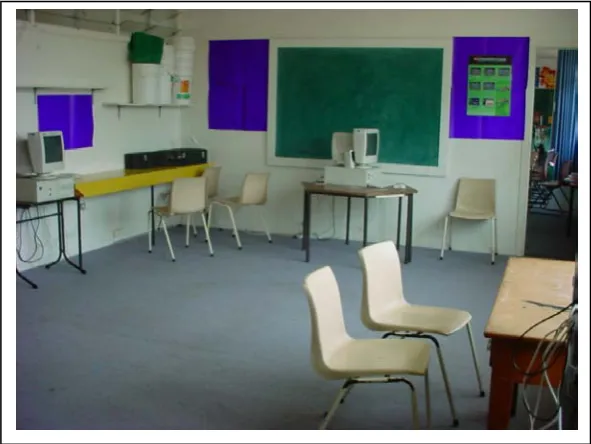
(13) 12. LIST OF FIGURES Figure 3.1 Robotics laboratory showing three of six stand-alone computers (left, centre and right) 59 Figure 3.2. Data collection points and instruments used with participants in the study 66 Figure 4.1. Screen capture of pilot program from RoboLab™ illustrating iconic language used to program robot. Image ©2010 The LEGO Group. Used with permission 108 Figure 5.1 Change in number of useable responses from first Stimulated Recall episode (SR1) in May 2005 to the second Stimulated Recall episode (SR2) in July 2005 125 Figure 5.2 Decrease in “no responses” from the first Stimulated Recall episode (SR1) in May 2005 to the second Stimulated Recall episode (SR2) in July 2005 127 Figure 5.3 Sam’s journal entries for the robotic lesson held on 5 May 2005 130 Figure 5.4 Sam’s journal entries for the robotic lesson held on 14 July 2005 131 Figure 6.1.Comparison of responses to Item 17 on Pre- and Post-Likert Scale Questionnaire on the usefulness of robots 156 Figure 6.2 Example of robot [RCX] used in the activities associated with the study where wheels form the foundation of movement. Image ©2010 The LEGO Group. Used with permission 157 Figure 6.3 Comparison of responses to Item 6 on Pre- and Post-Likert Scale Questionnaire on the ability of robots to do more than one thing 158 Figure 6.4 Comparison of responses to Item19 on Pre- and Post-Likert Scale Questionnaire on the usefulness of robots who can talk 159 Figure 6.5 Comparison of responses to Item 24 on Pre- and Post-Likert Scale Questionnaire about robots having brains similar to those of humans 162 Figure 6.6 Comparison of responses to Item12 on Pre- and Post-Likert Scale Questionnaire about learning more when working in a group 167 Figure 6.7 Comparison of responses to Item13 on Pre- and Post-Likert Scale Questionnaire about learning more when working in a group 170 Figure 6.8 Comparison of responses to Item 2 on Pre- and Post-Likert Scale Questionnaire about having the skills to make a robot 175 Figure 6.9 Comparison of responses to Item 11 on Pre- and Post-Likert Scale Questionnaire about the challenge of creating robots 177.
(14) 13. Figure 6.10 Comparison of responses to Item 14 on Pre- and Post-Likert Scale Questionnaire about changes in the way the students look at robots 178 Figure 6.11 Comparison of responses to Item 29 on Pre- and Post-Likert Scale Questionnaire about learning more when given the opportunity to fix their own mistakes 183 Figure 7.1 Students engaged in Teach-back episodes, 2005 193.
(15) 14. CHAPTER ONE: Introduction Introduction Mental models of teaching, learning, and assessment: A longitudinal study is a study of the mental models of a teacher and her students who undertook a journey of learning in robotics. A thorough search of literature on mental models of teaching, learning, and assessment did not locate information on pedagogical issues about how students and their teachers, in the middle years of schooling, negotiate a discoverybased learning experience, such as robotics, in a social constructivist environment. This doctoral thesis is a significant research project that contributes to complete these gaps in the literature on mental models of middle years school students and their teachers. This introductory chapter describes the thesis in terms of the research aims, its voice and literary aspect, methodology, scope, and limitations of the study, and the contents of each chapter.. The Research Aim and Research Questions The research aimed to determine and examine how a teacher’s and students’ mental models can inform teaching, learning, and assessment. Four research questions, designed to support this aim, were: (1) what are the mental models of primary school students and their teacher before, during, and immediately after technology-based learning experiences? (2) What are a teacher’s and four of her students’ espoused, inaction, and reflective mental models of teaching, learning, and assessment? (3) In what ways have these mental models matched, mismatched and/or changed, and the effect, if any, on teaching, learning, and assessment? and, (4) In what ways have the mental models managed the participants or been managed by the participants longitudinally? The answers to these questions would enlighten the research community on the quality of engagement in pedagogical practices. Multiple participants and their multiple pathways were identified, mapped, and compared.. Methodology, Scope, and Limitations Methodology The methodology used for the study is positioned within the information processing paradigm. It focussed on learner centredness and how the participants, with whom close contact was maintained over an extended period of time, integrated new.
(16) 15. experiences with existing conceptual, declarative, and procedural knowledge in the areas of teaching, learning, and assessment. This was not a simple “input-output” focus, but rather an investigation that ascertained the mental models of the teacher and learners as they carried out pedagogical tasks. It made no fundamental assumptions about links between input, for example the lesson, and action but utilised mental model theory to understand the participants’ mental models. A variety of data collection methods were used including interviews, questionnaires, journals, and teach-back (Chapter 3). Rigorous adherence to ethical procedures was maintained throughout. Scope The study used a technology-based learning context, robotics, although the findings could be applied across curriculum areas. It was situated in a suburban Australian school and involved one Year Six teacher and a group of 24 volunteer students from her shared class of 54 students. Four of these 24 students were selected anonymously from face-down piles of names and participated in the in-depth aspects of the study. The study was longitudinal and commenced with the first collection of data in March 2005 and the last collection in October 2006. A timeline of data collection including associated detail of type, participants, and time taken is provided in Chapter 3. Some instruments were conducted continually, such as the participants’ journal while others, such as Teach-back, were single events. The diversity of the type and time provided data suitable for the investigation of the richness of mental models. Limitations The limitations of the study include its lack of a gender variable. Gender consideration, particularly in design and technology education, could contribute significantly to the research community. Another limitation was the size of the study’s population. While the longitudinal aspect of the study has contributed to our knowledge of mental models over time, the size of the population could be increased to enhance its findings.. Thesis Format Voice and Literary Aspect.
(17) 16. The thesis is written in third person although the use of first person is common. This decision was made to remove any ambiguity from a reader’s determination as to whom the discussion concerns. Clarity of the writing is enhanced due to this editorial style. A literary theme has been woven through the thesis. When this research commenced, the author was teaching at the school used in study. The motion picture trilogy, The Lord of the Rings (Jackson, 2001, 2002, 2003), had been watched with great enjoyment by most of the students so, The Hobbit, another shorter story written by J. R. R. Tolkien in 1937, was chosen as the class book for the students. The story predates the adventures in The Lord of the Rings and describes the journey of enlightenment and self-discovery for its central character, Bilbo Baggins. This passage of enlightenment became synonymous with the author’s research and the participants’ learning journey. While the use of a literary theme in a dissertation may not be the “norm”, it is an integral element of this author’s individual mental model of the study and analogous of the many twists, turns, and treasures she experienced along the way. Chapters begin with extracts from The Hobbit that were selected because they indicate a particular place along the research pathway. Selected adventures of Bilbo’s journey are also used analogously to link similar experiences being shared by the participants. An example of this connection is word-play between Bilbo and Gollum as they traded riddles. Their use of analogy, metaphor, and memories are examples of Chapter Two’s discussion of Senge’s (1992) multifarious nature of mental models which are “inextricably woven” (p. 37) into our individual life tapestries.. Document Format and Pseudonyms The writing of the thesis commenced with the support and guidance of the American Psychological Association (APA) Style Manual, Fifth Edition (2001), Eleventh Printing December 2007. This reference style includes the italicisation of a book title (APA, 2001, p. 223) and the use of spacing has been adjusted to enhance readability (APA, 2001, p. 326), and figures and tables have been incorporated at suitable points in each chapter (APA, 2001, p. 325). All participant names in the thesis are pseudonyms in order to meet requirements with respect to ethics when researching with individuals who could otherwise be recognised. Chapter Outline Chapter One: Introduction.
(18) 17. This introduction to the thesis outlines its purpose, the context of the research, and an explanation of its structure. It includes a rationalisation of the use of the literary theme, which is an obvious deviation from the norm. It provides an outline of the study’s methodology, scope, and limitations. Each chapter’s content is explained.. Chapter Two: Literature Review As one stands on the doorstep of a new adventure, an assessment of the required knowledge for the journey is conducted. A review of mental model literature is presented in this chapter. The nature and functions of mental models are explained as the author moves toward a rationalization for the diverse definitions that have contributed to existing knowledge. A section that covers the distribution of mental models is included because the participants would be learning in a social constructivist environment. Robotics, as a component of the Queensland Technology Syllabus is described. The rich discussion of assessment that will weave its way through several chapters (see Chapters 7, 8, and 9) is commenced here.. Chapter Three: Methodology Before taking the first step on the journey, what conveyance is needed to advance? What instruments and methods will one use to move forward? This chapter elucidates the objectives, that were introduced in the Abstract, in more depth. It then provides a thorough explanation of the methodological tools used to collect the study’s data. A timeline is provided to show when those tools were used throughout the 20 months of the study and a detailed table is provided of the elements within the methodological design. The research significance of two of these data collection tools are introduced in this chapter and are explored in more depth in Chapter 5 and Chapter 7.. Chapter Four: Pre-Experience Mental Models Data collection begins with the first round of Likert Scale Questionnaires, SemiStructured Interviews, and Journal entries. This chapter discusses the pre-experience or espoused mental models held by all of the participants about robotics, social constructive learning situations, problem-solving, and predictions of success. It includes tables of information showing how the participants responded to various probes while outlining the data collection methodology used to gain such insights..
(19) 18. Chapter Five: In-Action Mental Models This is not a chase about the countryside, but a discussion of those moments, during a project that test, and ultimately enlighten, a researcher who must search for clear solutions when faced with insufficient material from data collection to conduct an analysis. Adaptations to Stimulated Recall interview protocols are explained and the implications for working with younger research participants are explored in some depth. The results of those protocol adaptations are clearly shown providing evidence of the efficacy of the changes. The participants’ in-action mental models of working in a robotic environment are externalised and analysed helping to provide a clearer picture of how the participants perform pedagogically through the project.. Chapter Six: Post-Experience Mental Models Post-experience, or reflective, mental models are externalised through the reapplication of data collection methods used in Chapter Four. This chapter provides graphical evidence of the changes in, or constancy of, the participants’ mental models six months after the commencement of the project. How the students apply problemsolving mental models to negotiate social situations and the activities within those contexts are becoming clearer. These mental models provide a solid bench-mark for further analysis in the next stage of the study.. Chapter Seven: Teach-Back and Focus Group Two methods of investigating the student participants’ mental models of teaching, learning, and assessment are revealed in this chapter that describes how the students are exposed to challenging pedagogical situations. The students teach and assess other students and then distribute their mental models verbally in a group interview. Data are analysed in light of previously revealed mental models in Chapters 4, 5, and 6. This data also provides a comparative base for the longitudinal aspects that follow.. Chapter Eight: Longitudinal Mental Models (March 2006) This chapter is a return, in March 2006, to the teacher and four students who participated in the more in-depth parts of the study. The teacher has remained at the.
(20) 19. school and is teaching robotics to a new cohort of students. The four students have not continued to learn with robotics: two of the students remain at the school in different classes; two students have moved to other schools out of the district. All participate in interviews that reveal their longitudinal mental models of their experiences of teaching, learning, and assessment.. Chapter Nine: Longitudinal Mental Models (October 2006) The last round of data collection, held in October 2006, is presented in this chapter. This penultimate chapter focuses on the data collection methods used to externalise longitudinal mental models. It is rich and robust and offers important aspects of a long-term investigation into mental models. The cast is reduced with the teacher and two students remaining. They have travelled far on their journey and their reflections offer significant insight into how mental models matter in pedagogical practice.. Chapter Ten: Conclusion The concluding chapter in this thesis provides an exhaustive discussion on the contribution this study has made to both qualitative methodology and to the education community’s knowledge of mental models. It explains in more detail the limitations of the research, already mentioned earlier in this chapter. This explanation is followed by a review of the pedagogical implications for teaching, learning, and assessment, such as the timeliness of intervention strategies and the need for teaching fundamental collaborative strategies for social constructive contexts. It closes with a recommendation for proactive strategies for improved outcomes in problem-solving.. And so the story starts … We leave this introduction to commence the journey. Gandalf, the wizard in The Hobbit, sought Bilbo’s help for an exciting and dangerous quest. Bilbo was unsuspecting of the trials ahead but could retrieve a novice mental model of adventures that prompted him to say, “We are plain quiet folk and have no use for adventures. Nasty disturbing uncomfortable things! Make you late for dinner! I can’t think what anybody sees in them” (Tolkien, 1937, p. 6)..
(21) 20. CHAPTER TWO: Literature Review You said sitting on the doorstep and thinking would be my job, not to mention getting inside, so I am sitting and thinking. But I am afraid he was not thinking much of the job, but of what lay beyond the blue distance, the quiet Western Land and the Hill and his hobbit-hole under it. (Tolkien, 1937, p. 193) Introduction Teachers observe students in classrooms and make judgements about what they are thinking throughout teaching and learning experiences. A creative teacher will plan learning experiences, such as robotic design and programming, simultaneously with appropriate assessment strategies and instruments designed to illuminate and measure cognitive change. Professional consideration of the thought processes of students, before, during, and after a learning experience, underpins what teachers do. These considerations are based on professional judgements that are strengthened over time through constant exposure to a multiplicity of differing individual students and their level of involvement, interaction, and success in the various and diverse learning experiences to which they are exposed. It is reasonable to assume that these considerations are sometimes erroneous. It is also reasonable to assume that teachers cannot always know exactly what is going on in the heads of their students although years of practice, and the relationships developed in the classroom environment, may go some way to enlightening them of the possible thoughts of their students. The study of mental models enables us to appreciate the thoughts behind the actions and decision-making that occurs in classrooms when teachers and students interact with each other and with instructional media. The study of mental models enables us to understand the matches and mismatches (Bibby, 1992; Johnson-Laird, Oakhill & Bull, 1986; Larkin & Simon, 1987) that can occur amongst those thoughts, actions, and interactions with phenomena. The matches and mismatches of mental models can promote or hinder learning and the authentic assessment of that learning. Did Gandalf, the wizard in The Hobbit (Tolkien, 1937), know what the book’s hero, Bilbo Baggins, was really thinking? When faced with a problem for that he had no immediate answer, Bilbo’s thoughts drifted to familiar places: places that in some way held clues to the apparently insurmountable problem that lay ahead. The tightly-sealed rock that contained the doorway, outside of which the hobbit was sitting, was literally a.
(22) 21. closed door in which there was no apparent key-hole. Bilbo was drawing on mental models from previous experiences and knowledge to assist him with the problem of opening the door. What were these mental models and how could they help him with the problem at hand? This chapter critically reviews mental models and examines the theory that underpins them. It discusses the ways that can assist the development of strategies within classrooms that foster and promote the individual learner’s ability to effectively utilize mental models to problem-solve in unique situations.. Mental Models The Journey to Find a Definition Finding a definition of mental models is problematic due, in part, to the diverse research contexts in which they have been studied. Nevertheless, there are some commonalities. Mental models are seen to be purposeful in that they are cognitive structures that function as storage facilities (O’Malley & Draper, 1992; van der Veer & Peurta-Melguizo, 2002) and/or problem-solving centres (Johnson-Laird, 1983; Newton, 1996) that enable the individual to function in novel situations with real world phenomena, regardless of context. Bilbo Baggins was in a novel situation when he sat near the charmed stone that was blocking the entrance to the Lonely Mountain. What resources, concepts, or analogies could he draw on to move the stone, thereby enabling access to the treasure that lay beyond? What mental models would the teacher and students, in this study, create to find their way through the robotics program successfully? Mental model theory provides an explanation of how individuals use memory and link information with innovative, personalised strategies to find solutions to problems. Indeed, mental models are assumed to “form the basis of all human behaviour” (Barker, van Schaik, & Hudson, 1998, p. 104). Norman (1983) and, later, Jonassen (1995) believed that mental models are complex and inherently epistemic thereby providing a platform from which we express what we know. The word “model” is used for two grammatical purposes: as a noun where it determines “a representation in three dimensions of an existing person or thing or of a proposed structure”, or as a verb “to form a thing in imitation of . . . a phenomenon or system” (Moore, 1987, p. 900). The term, “mental model”, is similarly bimodal: (i) as a product (Gentner & Stevens, 1983; Henderson & Tallman, 2006; Johnson-Laird, 1983; Newton, 1996) created by individuals who have used their cognitive functions in the broadest possible way to create a representation or structure of a phenomenon or.
(23) 22. solution to a problem, and (ii) as a process (Carroll & Olson, 1988; Halford, 1993; Henderson & Tallman, 2006; Norman, 1983) to form such a model or representation of a structure of a phenomenon or solution to a problem. Therefore, individuals create, or call upon existing, mental models when undertaking the process of mental modelling in order to devise more useful or refined mental models. Where a model, in its purest form, may be a reproduction of the reality of a phenomenon in an environment, a mental model has, in essence, a dynamic existence separate to such reality once it has been produced by the individual. When the mental model is stored in long-term memory, it may be related or connected to many other cognitive structures or senses but it exists within its own reality and no longer relies on the replication of its source phenomenon (Barker, 1999b). An individual creates, stores, and retrieves a mental model in accordance to its perceived relevance and usefulness for novel problem situations. The following sections of this chapter weave a pathway through mental model theory and offer profundity to the definition provided in the overview in the preceding paragraph. This short journey will (a) discuss the attributes of mental models in their product/process orientation, (b) review the functions of mental models, and (c) demonstrate how novice and expert learners use them for their journey. First, the reader will be guided through comparisons of mental models with other cognitive structures.. How Mental Models Compare with Other Cognitive Structures The idea of learning through engagement in problem-solving activities, such as robotics design and programming, or the disequilibrium that comes from comparing what is being considered as a solution to what is known as a possible response, bears some relationship to Jean Piaget’s (1970) work on cognition. He used the term, schemes, to label the cognitive structures a learner uses to assimilate new experiences when they face new situations. A learner will compare new experiences to their existing schemes already constructed from previous experiences and knowledge. If a new experience cannot be assimilated into an existing scheme, more radical accommodation has to occur to adjust to the disequilibrium created by the new situation. A new scheme would then be created: a process that leads to cognitive growth or learning (Piaget, 1970). Anderson (1977) conducted further research on Piaget’s ideas to develop schema theory where knowledge was organised in elaborate networks of related understandings that enabled an individual to operate in, and react to, the world around them. While schema and mental models share commonalities, schema cannot “account for novel.
(24) 23. situations, new actions or new arguments” (Schwamb, 1990, p. 30) as do mental models (Johnson-Laird, 1983). Kyllonen and Shute (1989) created a taxonomy of knowledge types that can illuminate the relationship between schema and mental models. Propositions are at the base line of knowledge type and represent simple declarative knowledge (Kyllonen & Shute, 1989), including abstract symbols and definitions of single items (Johnson-Laird, 1983) or unitary representations (O’Malley & Draper, 1992). An example of a propositional if-then representation for Bilbo would be: if locked door then key required to open (Tolkien, 1937). Propositions are a prerequisite to the acquisition of schema (Jonassen, 1995). Schemata are static cognitive structures that involve networks of general knowledge or propositional representations (Johnson-Laird & Byrne, 1991; Kyllonen & Shute, 1989; Sasse, 1997; Redish, 1994). They, like Piaget’s (1970) schemes, are based on previous experiences that have been created through assimilation and accommodation. Schemata are drawn on to help the individual to explain how propositional representations and/or items in the environment relate to each other (Kyllonen & Shute, 1989). If you walk into a darkened room you use a ‘light-switch’ schema to automatically reach for the location of a switch to turn on the light. Due to past experience the light switch can usually be found just inside the door frame of a darkened room. The networks, used to run this particular schema, are based on constantly-used, everyday experience. Networked schemata are created as related concepts, such as, the need for light and the location of the light-switch, are linked meaningfully by an individual. These networks involve categorisation, compartmentalisation, and networking of knowledge that make sense at an individual level but that also frequently replicate generic phenomena, such as the placement of everyday household objects. Schemas are conglomerations of simpler sub-schemas often referred to as scripts (Kyllonen & Shute, 1989; Preece, Rogers, Sharp, Benyon, Holland & Carey 1994). For the students undertaking this robotic project, if downloading a program to the robot was a schema, then an example of a sub-schema or script would be one discreet section or action, such as loading the batteries into the robot to give it the power to function. The student would use previous experience of loading batteries in battery-operated toys to enable them to complete the sub-schema or script..
(25) 24. Useful as they are, many schemas are required to enable an individual to function in the real world. However, as in the example above where the robot did not follow the program as expected even with new batteries, or in Bilbo’s case a regular key would not unlock a door, then an individual is faced with a problem for which existing propositional representations and schemata may be of little use. You would need other, less rigid cognitive resources to enable you to solve the problem. Merrill and Gilbert (2008) compared schema with mental models and concluded that while schema tend toward stability, mental models are transient. While schema are stable due to their reliability demonstrated through replication, mental models are a set of concepts “related together in a meaningful way in a holistic representation of the parts, relationships, conditions, actions, and consequences of a complete problem or task” (Merrill & Gilbert, 2008, p. 201). When mental models are run to solve a problem, they are modified or expanded to account for novel experience, that would involve an adaptation process that substantiates Merrill and Gilbert’s (2008) analysis of their transience. Norman (1988) also recognised that cognitive representations, such as schemata, did not explain what occurred when an individual encountered a new problem, such as using an unfamiliar robotic software system for which existing schema were ineffective. The inflexibility of schema theory did not enable negotiation of the irregularity of everyday encounters with the environment (Halford, 1993; Johnson-Laird & Byrne, 1991; Norman, 1988). Mental models use propositional representations and schema to predict outcomes (Kyllonen & Shute, 1989) and to constrain short-term memory overload (Henderson & Tallman, 2006) that would occur if a multitude of scripts or sub-schema were being used to find a solution to a problem. Complex problems, particularly, are limited by working memory as it cannot hold all the components, such as skills and knowledge, required to calculate a solution (Merrill & Gilbert, 2008). Schemas and associated skills, therefore, are a prerequisite (Jonassen, 1995) to mental models that require “the concerted exercise of multiple skills applied to elaborate schemata” (Kyllonen & Shute, 1989, p.132) to be constructed. Wild (1996) described mental models as a representation that provides a “mediating intervention between perception and action” (p. 10) enabling an individual to interpret, remember, and communicate what is already stored cognitively. The impact of mental model theory on communication is significant and has been studied vigorously by Johnson-Laird through.
(26) 25. his work with language comprehension and semantic reasoning (1983, 1986, 1989, 1991, 1998, 2004, 2006). How one communicates through, and understands, symbolic text is important in classroom experiences. Johnson-Laird’s (1983) early research focussed on mental models and language comprehension. Instead of using traditional, symbolic logic theories to explain human thought processes, he proposed mental models as the mechanism by which reasoning is explained with an emphasis on semantic rather than syntactic content. While individuals still use symbolic representation, such as decoding the class whiteboard, this occurs through translation of an external process into an internal one (Norman, 1983; Johnson-Laird & Byrne, 1991; van der Veer & PeurtaMelguizo, 2002; Vosniado, 2002). New symbols are derived from this interaction through inference and are translated into actions and predictions of external events through a reasoning process. During this reasoning process, the individual constructs functional mental models that are cognitive representations of the interaction with the environment (Johnson-Laird, 2004; Johnson-Laird & Byrne, 1991; Vosniado, 2002). The mental models incorporate the relevant semantic information of the phenomenon, the problem being encountered, and a solution (Goodwin & Johnson-Laird, 2008; Johnson-Laird, 1983; Johnson-Laird, 2004). Mental models are, therefore, much more complex than schemes (Piaget, 1970) or schemata (Anderson, 1977). To Pitts (1994), mental models involved “cognitive constructions that are a network or web of related understandings” (p. 23). However, this definition does not address the cognitive processes that are undertaken when these “constructions” are run to solve unique problems. How an individual’s understandings are related to each other is a question of personal meaning-making and may be constrained by social and cultural influences (Vosniado, 2002). Therefore, the relevance of language comprehension (Carley & Palmquist, 1992; Glenberg, 1997; Goodwin & Johnson-Laird, 2008; Johnson-Laird, 1983; Johnson-Laird & Byrne, 1991) helps relate the theory of mental models to that of embodied memory (Glenberg, 1997). Language, itself, acts as a substitute for some interactions with environmental phenomena, such as robots, and through these interactions mental models are created and run. In order for the mental model to be effectual in sourcing suitable solutions, it should have a structure that is related to the objects or phenomena it represents. A oneto-one correspondence, within the co-structural relationship between the mental model and the phenomena, may help us understand what concepts can be easily associated due.
(27) 26. to the ease or otherwise with which they fit together. Glenberg (1997) found that some associations fit together very easily and enable concepts such as “spotted horse” and “spotted idea” to be linked together (p. 2). Cognitive structures, to which mental models are linked, are structural maps that can serve as conceptual structures that form the basis for understanding and reasoning (de Jong, 1988; Garnham & Oakhill, 1994; Halford, 1993). It is relevant here to link the structure of mental models to the descriptors they have been given by various researchers. Halford (1993), in his seminal work on mental models, argued that a representation (i.e., a mental model) was a mapping from the item in the environment to the image in the mind. He described an analogy as a mapping from one of these internal, cognitive representations (i.e., a mental model) to another internal representation; a mapping that demonstrates some form of relationship. Thus, mental models are constructed from components that are taken from both the current situation in which the individual is placed and any analogies that may be embedded in mental models stored in long-term memory. Researchers and theorists have created a variety of themes with a multitude of cognitive descriptors for mental models that go beyond mere definitions due to the woven fabric of functionality that mental models demonstrate to those working in the field. Mayer (1989) called mental models “conceptual” (p. 43) structures that include diagrams and/or words that help learners build mental models of a system under study. Newton (1996) also referred to them as “conceptual structures” or “homologies” (p. 208) that correspond to a phenomenon. This homologous descriptor might be contentious due to its definition of a correspondence that is similar in structure but not necessarily in function (Moore, 1987). It does, however, suggest a correlation that supports Johnson-Laird’s (1983) mental models that are seen to correspond to a situation and, through this correspondence attribute, enable understanding and problemsolving. Halford (1993) argued that mental models reflect the structure of phenomenon in the environment whether it be a situation, event, task, problem, procedure, or a concept with which an individual is faced. He hypothesised that if we correctly or incorrectly understand the phenomena then we have a respective correct or incorrect mental model of it. In other words, individuals store mental models, that is, representations of phenomena that they correctly or incorrectly comprehend and for which they see some value in retaining..
(28) 27. Norman (1983) highlighted that mental models can be inaccurate and incorrect in nature. The inaccurate/functional nexus seems paradoxical. Yet it is precisely this paradigm that makes defining mental models similar to trying to answer a Hobbit riddle: “A box without hinges, key, or lid, yet golden treasure inside is hid” (Tolkien, 1937, p. 71). Senge (1992) highlighted the multifarious nature of mental models by explaining that we “cannot carry all the complex details of our world in our mind” (p. 36). He completed this intricate picture by arguing that “. . . we do not have mental models . . . we are our mental models” as “they are inextricably woven into our personal life history and sense of who we are” (p. 37). There is a substantial volume of empirical research (Goodwin & Johnson, 2008; Halford, 1993; Johnson-Laird, 1983, 2004; Merrill & Gilbert, 2008; Newton, 1996; van der Veer & Peurta-Melguizo, 2002; Vosniado, 2002) that has contributed to the view of mental models as internal representations, cognitive structures, or conceptual states created by individuals in their responses to interactions with phenomena in the environment. The essence of mental model theory is its capacity to explain how individuals interact with the world. The discussion of mental models becomes more complex when an individual’s interactions with a system are considered. Williamson (1999) proposed that mental models allow users of systems to operate on, and within them, without having a complete conception of the system due to mental models being made up of concrete examples and procedures as well as abstract theories and relationships. In other words mental models may be incomplete (Johnson-Laird, 1983; Norman; 1983), have limited stability, and can be parsimonious (Norman, 1983) but they are useful. Williamson (1999) also proposed that mental models are malleable and require some accommodation by the user or learner and that this may not always be easy to do, particularly if it is anchored by deeply held beliefs (Norman; 1983). Social and cultural relationships (Vosniado, 2002) that anchor a mental model may be very strong due to their being based on experiences and personal perceptions as well as superstitions that may attach to certain emotions and/or experiences. The outcome of this bimodality has a dual implication for teaching: the social and cultural relationship can make mental models difficult to manipulate and alter, but the strength of individual perception can also serve to make learning more rich and memorable.. The Nature of Mental Models.
(29) 28. A Question of Process and Product The nature of mental models as a process was explored by Henderson and Tallman (2006) who referred to them as “a mechanism that functions to help us understand, as well as act in, and on, the world” (p. 25). Mental models enable complex calculations to be completed (Rouse & Morris, 1986; Seel, 1995; Stripling, 1995) through their retrieval from long-term memory and manipulation in short-term memory (Anderson, Howe & Tolmie, 1996; Johnson-Laird, Girotto & Legrenzi, 1998; Newton, 1996; Power & Wykes, 1996). Mental models draw on the conceptual (Henderson & Tallman, 2006), declarative, and procedural knowledge (Barker, van Schaik, Hudson, & Meng Tan, 1998; di Sessa, 1986) by which solutions to problems are predicted, enacted, and resolved in short-term memory (Anderson et al., 1996; Glenberg, 1997; Power & Wykes, 1996). Once run, however, the mental models themselves are then stored in long-term memory for future use (Canas & Antoli, 1998; Gentner & Stevens, 1983; Henderson & Tallman, 2006; Norman, 1983). This substantiates their existence as a product that can be re-activated in the future. Newton’s (1996) work in science focused on the product nature of mental models albeit with the premise that mental models are not inert products. What he proposed was that the process of creating the relationships between elements of information requires the product of the mental model to be formulated or retrieved and enacted in order for the inferences, predictions, and decision-making required to understand and act on environmental phenomenon. The execution of the decision-making process requires a product ― a mental model ― to be created or retrieved, articulated, manipulated, tested, and transformed in order for understanding, comprehension and/or problem-solving to occur. So, this activation or “running” (Carroll & Olson, 1988; Cohen, Thompson, Adelman, Bresnick, Tolcott & Freeman, 1995; Halford, 1993; Haycock & Fowler, 1996; Henderson & Tallman, 2006; Norman, 1983; O’Malley & Draper, 1992) of the mental model product is a process. This results in a restructured mental model product that is then stored for later retrieval and processing. The process nature of mental models is seen as being not just a mental state or representation to be built and maintained but also as a platform for decision making and taking action (Williamson, 1999); that is, a personalised work bench for experimenting with phenomena. As Norman (1983) stated, mental models “are what people really have in their heads and what guides their use of things” (p. 12). Wild (1996) referred to the.
Figure
+7

Related documents