Should we include study-management skills in the curriculum of pre-tertiary bridging programs?
Dr. Tasman Bedford Open Access College
University of Southern Queensland, Australia
Abstract
The study reported here was essentially exploratory. It had two aims. The first aim
was to investigate whether the ATOMS Test (Roberts et al., 2001) and/or Vermunt’s
(1994) ILS (ILS) were potentially useful instruments for the purpose of assessing the
effectiveness of the teaching of study-management-related skills in the Tertiary
Preparation Program (TPP), a pre-tertiary bridging program offered in a print-based
distance education mode by the University of Southern Queensland (USQ). The term
‘study-management-related skills’ refers generally to a set of skills that have been
identified in the literature as being necessary for the effective management by
students of any formal program of study in which they attempt to engage. The second
aim of the study was to identify relationships of potential heuristic interest between
students’ study-management-related skills and their academic achievement and
persistence with study in the TPP. The sample was drawn from students enrolled in
the two compulsory core courses of the TPP, who voluntarily agreed to participate in
the study.
The ATOMS Test and the ILS were administered to all participating students
by mail at the start of semester 2, 2005 (the pre-test) and again near the end of the
semester (the post-test). The sample sizes were 142 for the first administration and
58 for the second administration. Various statistical analysis methods were used to
test for the significance of difference between pre-test and post-test mean scores on
each of the scales of the instruments, and for associations of significance between
scores on the scales, scores on course assessment items, and students’ persistence
with, or non-completion of, the courses. The ATOMS Test and the ILS appeared to
be not useful, in their present forms, for the purpose of assessing the effectiveness of
the teaching of study-management-related skills in the core component of the
program, and to be not useful as predictors of students’ academic achievement in,
persistence with, or completion of, the core courses. Interpretation of the results of
the study was dependent on the assumption that the measurements obtained by the
use of the instruments were valid for TPP students. This assumption was not tested
in the study. It is recommended that further studies be carried out to test the validity
styles for the entrant TPP population, and to further investigate relationships between
variables measured by the instruments and student achievement/progress in the TPP
core component, and changes in students’ self-ratings on various scales of the
instruments ostensibly associated with experience of studying.
Introduction and literature review
The importance of the study-management-related skills of students entering higher
education studies to students’ success with such studies has been referred to under various
guises in the literature since the early 1980’s. Numerous interventions aimed at developing
higher education students’ study-related skills have been reported in the literature (for
example, Hattie et al., 1996, pp. 107-109).
Study-management skills have generally been regarded as a subset of study skills
(for example, Hattie et al. 1996). The importance, to higher education students, of effective
study-management skills is implied in Boud’s (1981) advocacy of the development of student
autonomy in learning in the higher education sector, in Zimmerman’s (1994) framework for
developing student’s self- regulation of learning, and in the account by Minnaert and
Janssen (1999) of student self-regulation of learning in relation to academic achievement.
Concern about claimed low levels of study-management skill performance of entrant
higher education students has been expressed in various published studies (for example:
Omesdahl, 1999; Sweidel, 1996). Indirect reference to higher education students’
study-management skills has been made in literature on the importance of metacognitive skills in
higher education studies (for example: Fleming, 1991; Hacker et al., 1998; Nelson, 1992).In
particular, these authors referred to skills of planning, problem-solving, and of monitoring
and regulating thinking processes and outcomes. Bennett & Dunne (1999) identified some
study-management-related skills as routine decision-making skills, and various organising
skills, such as study-time-scheduling, as ‘transferable skills’, in their study of study-related
skills needed for success in higher education studies. They claimed that such skills are a
subset of generic study skills that are necessary for success in higher education studies.
Bedford (2001) used the typology of generic study skills expounded by Bennett & Dunne
(1999), to distinguish between ‘transferable’ study-management skills, such as
time-scheduling and routine decision-making skills, and ‘transferring’ study-management skills
such as developing problem-solving strategies, and monitoring and regulating study
activities and outcomes.
Within the past 30 years, attention has been given to the measurement of the
study-management-related skills of higher education students, through the use of self-report
inventories such as inventories of learning styles. Vermunt (1994), for example, developed
includes a scale for measuring students’ metacognitive regulation strategies with regard to
their study activities. ‘Metacognitive regulation’, according to Vermunt (1998, p. 151),
consists of mental activities that regulate cognitive processing, and is exemplified by
planning, monitoring progress with the processing of content, and diagnosing difficulties
encountered in processing the content. Vermunt’s (1998; 1994) metacognitive regulation
strategies correspond to generic study-management skills referred to as ‘transferring skills’
by Bedford (2001). Some published evidence supports a conclusion that higher education
students’ scores on some metacognitive regulation scales of the ILS may be related to the
students’ academic performance. Boyle et al. (2003) found moderate negative correlations
between Vermunt’s (1998) ‘undirected learning style’ and performance on measures of
academic performance (Boyle et al., 2003, p. 282). At least one study of an intervention
designed to increase higher education students’ generic management skills has been
reported (Adamson et al., 2004). Adamson et al. (2004) used an instrument developed by
Roberts et al. (2001) in their study.
Roberts et al. (2001) developed an Australian management skills self-report
instrument, viz. the Australian Time Management and Organization Scale (ATOMS Test)
(ATOMS), which provides a measure of an individual’s self-perception of her or his use of
specified generic management skills within the general context of a work environment.
Bedford (2001) identified the study environment of higher education students as a work
environment. In the context of studying in higher education as a work environment, Adamson
et. al (2004) used an abbreviated version of ATOMS in an evaluation study of the
effectiveness of a time and organisational management skills training program for
undergraduate students at The University of Sydney. The version of ATOMS used by
Anderson et al. (2004) was the Abbreviated Time Management Indicator (ATMI) (Roberts et
al., 2001). The results of the evaluation study were inconclusive, as a result of
methodological limitations which were identified and discussed by Adamson et al. (2004).
Prior to 2005 no attempt had been made to study the effectiveness of the Tertiary
Preparation Program (TPP) offered by the University of Southern Queensland in increasing
students’ study-management-related skills. Relationships between TPP students’ levels of
these skills and the students’ academic achievement in the program had not been formally
explored. The study reported here attempted to investigate both of these aspects of
students’ experience of studying in the TPP, using Vermunt’s (1994) ILS and the ATOMS
Test of Roberts et al. (2001) as measures of students’ study-management-related skills.
The instruments were chosen for the study because they were the only measures of
ostensibly relevant skills located at the time of the study, which could be administered by
mail to the distance education TPP students as self-report written questionnaires. However,
instruments with TPP students. In each case, the instruments were developed from factor
structures derived from data collected from populations that may have had different
characteristics, relating to the skills measured, from those of TPP students. The content and
structure of the ILS was derived from studies of undergraduate students in The Netherlands
and Britain (Vermunt, 1994), and those of the ATOMS from populations of employees in
work organizations (Roberts, et al. 2001).
Aims of the study
The aims of the study were to:
1. Investigate the usefulness of the ATOMS Test and Vermunt’s ILS in assessing the
effectiveness of the study-management component of the TPP.
2. Identify relationships of potential heuristic interest between students’
study-management skills and their academic achievement in, and persistence with, study of
TPP courses.
Methodology Instruments used
Standardised instruments
The instruments used to gather data on the students’ study-related skills were the ATOMS
Test (Roberts et al., 2001) and Vermunt’s (1994) ILS (120 item version).
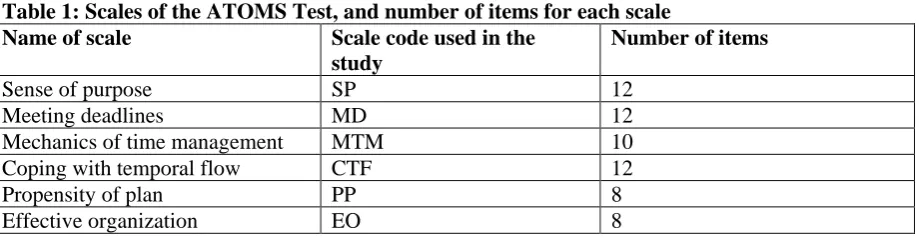
The ATOMS Test used in the study provided a measure on each of six scales. The
scales corresponded to six factors identified by Roberts et al. (2004) in their analysis of the
factor structure of the test. The test consisted of a total of 62 items. The names given to the
scales by Roberts et al. (2004), and the number of test items which provided a measure on
[image:4.595.71.531.546.665.2]each of the scales are shown in Table 1.
Table 1: Scales of the ATOMS Test, and number of items for each scale
Name of scale Scale code used in the
study
Number of items
Sense of purpose SP 12
Meeting deadlines MD 12
Mechanics of time management MTM 10
Coping with temporal flow CTF 12
Propensity of plan PP 8
Effective organization EO 8
Vermunt’s (1994) ILS provided a measure on each of 20 scales. The scales are grouped into four ‘learning components’ identified by Vermunt (1998), The learning components, corresponding scales, and the number of items for each scale are shown in Table 2
Name of learning component
Name of learning component scale
Scale code used in the study
Number of items
Processing strategies
Deep processing – relating and structuring
PS DP R&S 7 Deep processing –
critical processing
PS DP CP 4
Stepwise processing – memorising and rehearsing
PS SP M&R 5
Stepwise processing – analysing
PS SP A 6
Concrete processing PS CP 5
Regulation strategies
Self-regulation – learning process & results
RS SR LP&R 7
Self-regulation – learning content
RS SR LC 4
External regulation RS ER LP 6 External regulation –
learning results
RS ER LR 5
Lack of regulation RS LR 6
Learning orientations
Personally interested LO P 5
Certificate directed LO C 5
Self-test directed LO S 5
Vocation directed LO VD 5
Ambivalent LO A 5
Conceptions of learning
Construction of knowledge
CL CK 9
Intake of knowledge CL IK 9
Use of knowledge CL UK 6
Stimulating education CL SE 8
Co-operation CL C 8
Vermunt (1998) constructed the following four general learning styles by which, he claimed,
people could be characterised on the basis of their scores on the ILS:
Meaning directed
Reproduction directed
Application directed
Undirected
The method used by Vermunt (1998) to identify the general learning style of an individual
was used in the study to identify the general learning style of each respondent to the ILS
pre-test. The results were used in the analysis of the data from the study.
Measures of students’ academic achievement
Students’ academic achievement was measured by the graded assessment items normally
Mathematics tertiary preparation level A.
Data samples
ATOMS Test and Vermunt’s ILS
All students who were enrolled in course TPP7120 in semester 2, 2005 were invited by mail
during the first two weeks of the 15 week semester to complete and return a copy of the
ATOMS Test and the ILS within two weeks of receipt of the mailing. One hundred and
forty-one students returned fully or partially completed copies of the two instruments and a signed
consent to participate form, giving a return rate of approximately 46 percent. Scores
obtained from this first round administration of the instruments are referred to as ‘pre-test
scores’ in the remainder of this document.
During the final three weeks of the semester, all students who had returned
completed or semi-completed survey instruments and a signed consent to participate form
from the first mailing were sent a second copy of the two instruments. Fifty-eight students
returned fully or partially completed copies of the two instruments, giving a return rate of
approximately 37 per cent of the students who had returned the first set of instruments.
Scores obtained from this second round administration of the instruments are referred to as
‘post-test scores’ in the remainder of this document.
Measures of academic achievement
Students’ scores on each of the measures of academic achievement were obtained from the
University’s student administration data base at the end of the semester.
Exploration and analysis of the data
Exploration
The study was essentially exploratory in nature, as indicated by its stated aims. The general
purpose of the study was to explore the data for apparent possible relationships between the
variables, with a view to identifying needs for further research. The following statistical tests
and other procedures were carried out on the data, where appropriate, using SPSS for
Windows 14.0:
1. Paired t-tests for significance of difference between the means of sets of pre-test and post-test data.
2. Independent samples t-tests for significance of difference between means of independent sets of data
3. Linear regression analysis to identify relationships of potential further interest between interval-scale variables
5. Correlation analysis to identify relationships of potential further interest between factor scores corresponding to Vermunt’s (1998) four general learning styles and marks obtained on course TPP7120 and course TPP7181 assessment items
Main findings, discussion, and recommendations
Statistical tests and other statistical procedures could not be used with some of the sets of
scores obtained because the distributions of these sets did not conform to the requirements
of the statistical models, predominantly the requirement that the distributions approximate
normal distributions.
The study provided no definite evidence of any association between students’
experience of studying the study-management component of the TPP and changes in their
study-management-related skills. However, there are difficulties involved in interpreting
these results. No direct measurement of students’ study-management-related skills was
possible in the study. Indirect measures based on scores on ostensibly
study-management-related self-report instruments were obtained. The design of each of the instruments was
based on factor structures derived statistically from data drawn from studies of populations
of people who may have been characteristically different, with regard to the skills measured,
from TPP students. The applicability of these factor structures to the population of TPP
students was unknown. The instruments may not have provided valid measures of the
study-management or learning styles characteristics of TPP students.
Statistically significant differences between commencement and completion of the
course in which study-management skills were taught were interpreted for mean pre-test and
post-test scores on the following four of the six ATOMS Test scales:
Meeting deadlines (MD)
Coping with temporal flow (CTF) Propensity to plan (PP)
Effective organisation (EO)
All of these differences were negative (the mean pre-test score was higher than the
mean post-test score), and were relatively small. These results could be interpreted as
possible minor effects of students’ experience of studying the course. One possible
explanation is that slight, negative changes in students’ self-assessments of their
management-related skills resulted from their experience of studying the course. For
example, the majority of students, being relatively inexperienced in managing a formal study
program, may have tended to over-rate their management-related skills at the time of entry
No statistically significant differences were interpreted mean pre-test and post-test
scores on the following ATOMS Test scales:
Sense of purpose (SP)
Mechanics of time management (MTM)
The ILS scales which appeared to be measures of students’ self-reported
study-management skills were the regulation (of study) strategies scales (RS SR LP&R , RS SR
LC, RS ER LP, RS ER LR, and RS LR). Statistically significant differences were observed
between mean pre-test and post-test scores on the following two ILS scales:
Self-regulation: learning process and results (RS SR LP&R) Lack of regulation (RS LR)
In each case the difference in mean scores on these scales was negative. Apparently,
students revised their ratings of their use of these regulation strategies downwards after their
TPP experience of managing a formal study program.
Statistically significant, relatively small differences between mean pre-test and
post-test scores were interpreted for most of the remaining ILS scales. These scales provided
measures of students’ self-reported skills which appear to be related in various ways to their
academic performance. A significant, relatively large negative difference was observed for
scores on the scale PS DP R&S (Processing strategy: deep processing: relating and
structuring). After studying their TPP studies, students rated their use of this strategy much
lower than before studying. A possible explanation of this finding is that it is an effect of
students’ experience of studying the academic communication skills component of the
course. This component requires students to critically analyse information from various
written academic text sources and to construct a logical synthesis of the information in the
form of an academic essay. Presumably, most of the students were relatively inexperienced
in the formal critical analysis and synthesis of information from academic sources before
commencing the course. Students may have they made a lower rating of their skills of critical
analysis and synthesis of information after attempting to meet this requirement than before
studying the course.
In relation to discussion of differences between pre-test and post-test scores on ILS
scales observed in the study reported here, it is noted that Vermunt and Minnaert (2003)
reported substantial differences between individual undergraduates students’ scores on
some ILS scales over a period of three consecutive semesters of study. These findings
provide some insights into the relationships between students’ experience of studying and
their self-ratings of their study-related skills, concepts of learning, and orientations to
learning. Such insights may provide a basis for academic counselling of entrant TPP and
undergraduate students regarding their approach to study, as well as some information
programs.
The distributions of the samples of pre-test scores on three of the ILS learning
orientation scales were highly skewed. The Certificate-oriented (LO C) and Self-test-oriented
(LO S) samples were negatively skewed, indicating that a disproportionately high number of
students had high pre-test scores on these scales. This result may indicate that the entrant
TPP students tended to perceive the importance of learning in terms of gaining formal
credentials and of self-assessment of personal suitability for formal study. This interpretation
has some intuitive appeal if the following assumptions are made: most people enrol in the
TPP to gain entry to an undergraduate program, and most have a relatively low level of
confidence in their ability to succeed with formal studies. In contrast to the pre-test scores
distributions, the distributions of the post-test scores on these scales were typical of samples
drawn from normal populations. This result may indicate that, generally, students’ belief in
the efficacy of formal study as means of gaining formal credentials and of self-assessment
diminished over the duration of the courses. The vocation-oriented (LO VD) samples of
pre-test and post-pre-test scores were both positively highly skewed. This result may indicate that,
generally, TPP students do not regard vocational achievement to be a major reason for
engaging in formal study. This tentative finding is inconsistent with the assumption that most
people enrol in the TPP to achieve positive change in their vocational situation.
No apparent strong associations were observed between pre-test scores on any of
the ATOMS Test scales or ILS scales and any of the measures of academic achievement
included in the study. The pattern of findings for the associations between the ILS scales
and the measures of students’ academic achievement was generally similar to the pattern of
findings by Boyle et al. (2003) for a sample of students at a British university. Boyle et al.
(2003) found significant associations with only a few ILS scales. All of these associations
were weak. Scores on the ATOMS scale EO (Effective organisation) were statistically
significantly positively associated with marks obtained for three assessment items in course
TPP7120. The skill performances assessed by two of these items appeared to be distinctly
different from each other. One of the items was a course TPP7120 assignment designed to
assess students’ ability to plan and schedule two weeks of their study program, whereas the
other item was designed to measure students’ ability to construct correctly structured
paragraphs from recalled information taught in the course. The apparent relationship
between scores on EO and the two course TPP7120 assessment items discussed here may
indicate that students who performed relatively well on a range of assessment items tended
to be those who initially self-rated their skills of effective organisation relatively highly.
Pre-test scores on the ILS scale LO CD (Learning orientation – certificate-oriented) were
statistically significantly, weakly positively associated with marks obtained on an assignment
No strong statistically significant differences were found between the mean pre-test
scores on any of the ATOMS Test scales or the ILS scales obtained by students who
persisted in the course and those who did not. A statistically significant weak positive
association was observed between the ATOMS Test scale MD (Meeting deadlines) and
students’ non-completion of a course. This result seemed somewhat anomalous; students
who rated themselves relatively highly on their propensity to meet deadlines were less likely
to complete the course than other students. A statistically significant weak negative
association was observed between the ATOMS Test scale CTF (Coping with temporal
flow).and students’ non-completion of a course. This result may indicate that students who
perceived that they coped with change relatively well were more likely to complete the
course than other students. A statistically significant weak positive association observed
between the ILS scale RS LR (Regulation strategy: lack of regulation) and students’
non-completion of a course seemed to be consistent with the intuitive notion that students who
perceive that they lack strategies to regulate their progress with study are less likely than
other students to complete a course of study.
A statistically significant moderate negative correlation was found between Vermunt’s
(1998) undirected learning style and students’ achievement on a test used in the core
mathematics course. This finding was consistent with the finding by Boyle et al. (2003,
p.282) of a moderate negative correlation between the undirected style and students’
achievement on exams. However, in contrast to the findings of Boyle et al. (2003), the
reproduction-directed and the application-directed styles were each found to have
statistically significant modest positive correlations with students’ achievement scores in the
mathematics core course, and the meaning-directed style was found to have no significant
correlation with any of the measures of students’ academic achievement in either of the
courses. No statistically significant correlations were found between any of Vermunt’s (1998)
four general learning styles and students’ achievements in the other (non-mathematics) core
course.
In general, the findings from the study indicated that the ATOMS Test scales and the
scales of the ILS relating to students’ regulation of study did not appear to be useful for the
purpose of evaluating the effectiveness of teaching study-management-related skills to TPP
students. The findings also indicated that the ATOMS Test and the ILS did not appear to be
useful as predictors of TPP students’ academic achievement or persistence with study.
Interpretation of the findings was obfuscated by uncertainty as to whether the
instruments used in the study provided valid measures of the variables, as, arguably, the
study-management and learning styles characteristics of TPP students could be assumed to
be different from the populations of people from whom data was drawn to develop the
factor structures underlying the ATOMS Test and Vermunt’s (1998) ILS for the TPP
population, with a view to further investigate relationships between variables based on the
instruments and student achievement/progress in the TPP, and changes in students’
self-ratings on various scales of the instruments ostensibly associated with experience of
References
Adamson, B. J., Covic, T., & Lincoln, M. (2004). Teaching time and organizational management skills to first year health science students: does training make a difference? Journal of Further and Higher Education, 28(3), 261-276.
Bedford, T. A. (2001, July, 2001). Developing expert learners: A curriculum design strategy for responding to student diversity. Paper presented at the Tertiary Teaching and Learning: Dealing with Diversity, Darwin.
Bennett, N., & Dunne, E. (1999). Patterns of core and generic skills provision in higher education. Higher Education, 37(1), 71-94.
Boud, D. (1981). Toward student responsibility for learning. In D. Boud (Ed.), Developing student autonomy in learning (pp. 21-37). London: Kogan Page.
Boyle, E. A., Duffy, T., & Dunleavy, K. (2003). Learning styles and academic outcome: The validity and utility of Vermunt's Inventory of Learning styles in a British higher education setting. British Journal of Educational Psychology, 73, 267-290.
Fleming, D. (1991). The concept of meta-competence. Competence and Assessment, 16. Hacker, D. J., Dunlosky, J., & Graesser, A. C. (Eds.). (1998). Metacognition in educational
theory and practice. New Jersey: Erlbaum Associates.
Hattie, J., Biggs, J., & Purdie, N. (1996). Effects of learning skills interventions on student learning: A meta-analysis. Review of Educational Research, 66(2), 99-137.
Minnaert, A., & Janssen, P. J. (1999). The additive effect of regulation activities on top of intelligence in relation to academic performance in higher education. Learning and Instruction, 9, 77-91.
Nelson, T. O. (Ed.). (1992). Metacognition: Core readings. Boston: Allyn and Unwin. Olmesdahl, P. J. (1999). The establishment of student needs: an important internal factor
affecting course outcome. Medical Teacher, 21(2), 174-180.
Roberts, R. D., Krause, H., & Suk-Lee, L. (2001). Australian Time Organisation and Management Scales. Sydney: Rightpeople Pty Ltd.
Roberts, R. D., Krause, H., Lee, Covic, & Cruz, P. (2004). Time management: Not much more than conscientiousness. Princeton: ETS (Centre for New constructs). Sweidel, G. B. (1996). Study strategy portfolio: a project to enhance study skills and time
management. Teaching of Psychology, 23(4), 246-249.
University of Southern Queensland. (2006). The qualities of a USQ graduate. Retrieved 25 May, 2007, from http://www.usq.edu.au/resoutces/425.pdf
University of Southern Queensland. (2007). Tertiary Preparation Program. Retrieved 25 May, 2007, from
Vermunt, J. D. (1994). Inventory of learning styles (ILS) in higher education. Tilburg: Tilburg University, Department of Educational Psychology.
Vermunt, J. D. (1998). The regulation of constructive learning processes. The British Journal of Educational Psychology, 68, 149-171.
Vermunt, J. D., & Minnaert, A. (2003). Dissonance in student learning patterns: when to revise thoery? Studies in Higher Education, 28(1), 49-61.