R E S E A R C H
Open Access
On the interchannel interference in digital
communication systems, its impulsive nature, and
its mitigation
Alexei V Nikitin
1,2Abstract
A strong digital communication transmitter located in close physical proximity to a receiver of a weak signal can noticeably interfere with the latter even when the respective channels are tens or hundreds of megahertz apart. When time domain observations are made in the signal chain of the receiver between the first mixer and the baseband, this interference is likely to appear impulsive. Understanding the mechanism of this interference is important for its effective mitigation. In this article, we show that impulsiveness, or a high degree of peakedness, of interchannel interference in communication systems results from the non-smooth nature of any physically
realizable modulation scheme for transmission of a digital (discontinuous) message. Even modulation schemes designed to be‘smooth’, e.g., continuous-phase modulation, are, in fact, not smooth because their higher order time derivatives still contain discontinuities. When observed by an out-of-band receiver, the transmissions from these discontinuities may appear as strong transients with the peak power noticeably exceeding the average power, and the received signal will have a high degree of peakedness. This impulsive nature of the interference provides an opportunity to reduce its power by nonlinear filtering, thus improving quality of the receiver channel.
Keywords:electromagnetic interference, impulsive noise, interchannel interference, nonlinear differential limiters, nonlinear filtering, peakedness
1 Introduction
Nowadays, it is becoming more and more common that multiple digital communication devices, including wire-less, coexist and concurrently operate in close physical proximity. A typical example would be a smartphone equipped with WiFi, Bluetooth, and GPS, and capable of operating at various data protocols and in multiple fre-quency bands. This physical proximity, combined with a wide range of possible transmit and receive powers, cre-ates a variety of challenging interference scenarios. Mul-tiple sources of empirical evidence indicate that such interference often manifests itself as impulsive noise [1,2], which in some instances dominates over the ther-mal noise [1,3]. However, there are many unanswered questions regarding the origins and the particular mani-festations of this type of noise. For example, a strong close transmitter (say, WiFi) can noticeably interfere
with a receiver of a weak signal (say, GPS) even when the separation of their frequency bands exceeds the respective nominal bandwidths of the channels by orders of magnitude. When time domain observations of such far-out-of-band interference are made at the receiver frequency, in a relatively wide bandwidth to avoid excessive broadening of the transients, this inter-ference is likely to appear impulsive. Understanding the mechanism of this interference and its impulsive nature, as initially analyzed in [4], is important for its effective mitigation.
Referring to a signal asimpulsive implies that the dis-tribution of the instantaneous power of the signal has a high degree of peakedness relative to some standard dis-tribution, such as the Gaussian distribution. A common quantifier of peakedness would be, for instance, the
excess kurtosis[5]. In this article, however, we adopt the measure of peakedness relative to a constant signal as
the “excess-to-average power” ratio and use the units
Correspondence: [email protected]
1Avatekh Inc., 900 Masachusetts Street, Suite 409, Lawrence, KS 66044, USA
Full list of author information is available at the end of the article
“decibels relative to constant” or dBc. This measure is explained in Appendix A.
Let us consider the illustrative measurement with the setup shown in Figure 1. In the left-hand panel of the figure, the transmitter emits a 1.045-GHz tone with the
amplitude modulated by a ‘smooth’-looking 1 Mbit/s
message. However, as can be seen in the right-hand panel, the total instantaneous power in an out-of-band
quadrature receiver [6] with the bandwidth of several
megahertz, tuned to 1 GHz, is an impulsivepulse train
with a multiple of 250 ns distance between the pulses. Figure 2 provides a closer look at the time domain sig-nal traces of the modulating sigsig-nal (lower panel) and the observed instantaneous power in the receiver (upper panel) for the setup shown in Figure 1. One can see
that the power trace is impulsive as its peaks signifi-cantly extend above the average power level indicated by the horizontal solid line. Note that some of the peaks of the instantaneous power originate at zero modulation amplitude (at onsets and ends of the modulating pulses), while others originate at the ‘smoothest’, most linear parts of the modulating signal. The next section clarifies the origins of this impulsive nature of the out-of-band interference.
2 Impulsive nature of interchannel interference As shown in more detail in Appendix B, the signal com-ponents induced in a receiver by out-of-band communi-cation transmitters can be impulsive. For example, if the receiver is a quadrature receiver with identical low-pass
6μs
1 Mbit/s modulation
1.045 GHz
1.045 GHz transmitter
W
6μsnotch at 1.045 GHz
1 GHz gain
Out-of-band receiver (Δ
f
= 45 MHz)
Figure 1Illustrative measuring setup for demonstration of impulsive nature of interchannel interference.
0
M e as u re d o u t - o f- b an d p owe r at Δ
f
= 4 5 M H z
pow
e
r
1 1.25 1.75 2.25 2.75 3 3.25 3.75 4 4.25 4.75 5 6 6.25 6.75 7 0
1 M b/ s m o dul at i ng s i g nal
am
pl
it
ude
ti m e (
μ
s)
filters in the channels, the main term of the total instan-taneous power of in-phase and quadrature components resulting from such out-of-band emissions may appear as a pulse train consisting of a linear combination of pulses originating at discrete times and shaped as the squared impulse response of these filters. For a single transmitter, the typical intervals between those discrete times are multiples of the symbol duration (or other dis-crete time intervals used in the designed modulation scheme, for example, chip and guard intervals). The non-idealities in hardware implementation of designed modulation schemes such as the non-smooth behavior of the modulator around zero also contribute to addi-tional discrete origins for the pulses. If the typical value of those discrete time intervals is large in comparison with the inverse bandwidth of the receiver, this pulse train may be highly impulsive.
The above paragraph can be restated using mathema-tical notations as follows. The total emission from var-ious digital transmitters can be written as a linear combination of the terms of the following form:
x(t) =AT(¯t) eiωct, (1)
where ωc is the frequency of a carrier, ¯t= 2Tπ t is
dimensionless time, and AT(¯t) is the desired (or designed) complex-valued modulating signal represent-ing a data signal with symbol durationT. Let us assume that the impulse response of the low-pass filters in both channels of a quadrature receiver is w(t) = 2Tπ h(¯t) and that the order of the filter is larger thann so that all derivatives ofw(t) of order smaller or equal ton- 1 are
continuous.a Now let us assume that all derivatives of
the same order of the modulating signal AT(¯t) are finite, but the derivative of ordern - 1 of AT(¯t) has a counta-ble number of step discontinuitiesbat {¯ti}. Then, ifΔω
= 2πΔf is the difference between the carrier and the
receiver frequencies, and the bandwidth of the low-pass filter w(t) in the receiver is much smaller than Δf, the total power in the quadrature receiver due to x(t) can be expressed asc
Px(t,f) =
1 (Tf)2n
i
αih(¯t− ¯ti)
j
α∗
j h(¯t− ¯ti)
for Tf 1 ,
(2)
where ai is the value of theith discontinuity of the
ordern- 1 derivative of AT(¯t),
αi= lim ε→0
AT(n−1)(¯ti+ε)−AT(n−1)(¯ti−ε)= 0. (3)
A typical value ofti+1-tiwould be of the same order of
magnitude asT. If the reciprocal of this value is small in comparison with the bandwidth of the receiver, the con-tribution of the terms αiα∗jh(¯t− ¯ti)h(¯t− ¯tj) fori≠jis negligible and (2) describes an impulsive pulse train consisting of a linear combination of pulses shaped as
w2(t) and originating at {ti}, namely
Px(t, f) = 1 (Tf)2n
i
|αi|2h2(¯t− ¯ti)
for sufficiently largeTandf.
(4)
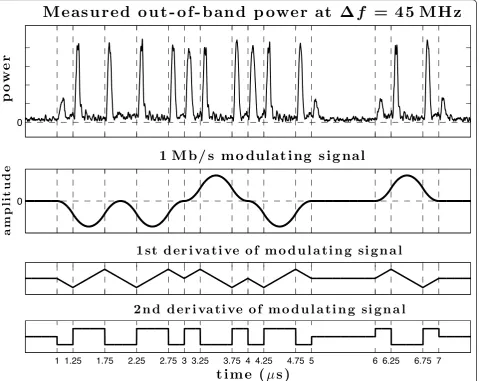
Equipped with (4), let us reexamine the time domain traces of the illustrative measurement outlined in Figure 1. In Figure 3, these traces are expanded to include the first two time derivatives of the modulating signal. It can be seen in the figure that (i) the onsets of the power pulses originate at the discontinuities in the second deri-vative of the modulating signal and (ii) the magnitudes of those pulses are proportional to the squared magni-tudes of the discontinuities. Both observations are com-pliant with (4).
As an additional illustration of a pulse train according to (4), panel I of Figure 4 shows simulated instantaneous total power response of quadrature receivers tuned to 1-and 3-GHz frequencies (green 1-and black lines, respec-tively) to an amplitude-modulated 2-GHz carrier of unit power. The squared impulse response of the low-pass filter in the receiver channels (30 MHz 5th order Butter-worth filter [7] is indicated in the upper right corner of the panel.
The modulating signal is shown in panel II(a) of the figure and represents a random bit sequence at 10
Mbit/s (T = 100 ns). In this example, a highly
over-sampled FIR raised cosine filter [6] with roll-off factor
0.35, and group delay 2T was used for pulse shaping. A
rather small group delay was chosen to make the dis-continuities in the derivative more visible in the figure. Panel II(b) of Figure 4 shows the first derivative of the modulating signal. This derivative exhibits step disconti-nuities at the multiple of T time intervals (at the time ticks), and thusn= 2 in (2).
inter-ference by increasing the order of the first discontinuous derivative by one, does not eliminate the effect alto-gether. This is illustrated in Appendix C.
When viewed as a function of both time and fre-quency, the interpretation of (2) for the total power in a quadrature receiver is aspectrogram[8] in the time win-doww(t) of the termx(t) of the transmitted signal. Such a spectrogram is shown in the lower panel of Figure 4, where the horizontal dashed lines indicate the receiver frequencies 1 and 3GHz used in panel I.
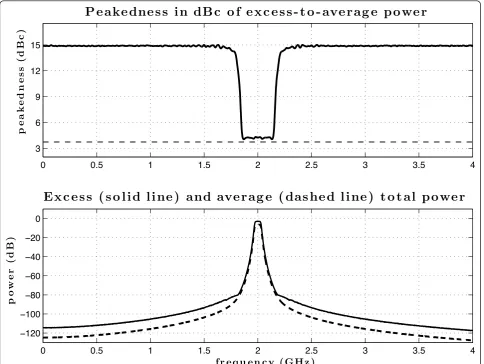
For a quantitative illustration of the impulsive nature of the out-of-band interference, the upper panel of Fig-ure 5 shows the peakedness of the instantaneous total power in a quadrature receiver as a function of fre-quency for the example used in Figure 4. The peaked-ness of the out-of-band signal exceeds the peakedpeaked-ness of the in-band signal by over an order of magnitude.
The lower panel of Figure 5 shows, for the same examples, the total excess (solid line) and average (dashed line) power in the receiver versus frequency. The excess power of the out-of-band emissions is approximately 10 dB higher than the average power.
Given the designed properties of the transmitted sig-nal, the out-of-band emissions can be partially mitigated by additional filtering. For example, one can apply addi-tional high-order low-pass filtering to the modulating signal or band-pass filtering to the modulated carrier. However, the bandwidth of those additional filters must be sufficiently large in comparison with the bandwidth of the pulse shaping filter in the modulator in order to not significantly affect the designed signal. Within that bandwidth, the above analysis still generally holds, and the impulsive disturbances may significantly exceed the thermal noise level in the receiver [3] even when the
0
M e as u re d o u t - o f- b an d p owe r at Δ
f
= 4 5 M H z
pow
e
r
0
1 M b/ s m o dul at i ng s i g nal
am
pl
it
ude
1 st d er i va ti ve o f m o d u l a ti n g si g n a l
1 1.25 1.75 2.25 2.75 3 3.25 3.75 4 4.25 4.75 5 6 6.25 6.75 7
2 n d d er i va ti ve o f m o d u l a ti n g si g n a l
t i m e (
μ
s )
I
2
(
t
)+
Q
2
(
t
)
frequency
(
G
Hz)
Instantaneous total power responses of quadrature receivers at 1 GHz (green)
and 3 GHz (black) to amplitude-modulated 2 GHz tone of unit power
w
2(
t
)
30 MHz 5th order lowpass Butterworth
10 Mbit/s modulating signal
Derivative of modulating signal
Spectrogram in time window
w
(
t
) of amplitude-modulated 2 GHz tone
time (
μ
s)
w
(
t
)
w
w
w
w
(
(
(
(
t
t
t
t
)
)
)
)
I
II(a)
II(b)
average power of the interference remains below that level.
3 Conclusions
Non-smoothness of modulation can be caused by a vari-ety of hardware imperfections and, more fundamentally, by the very nature of any modulation scheme for digital communications. This non-smoothness sets the condi-tions for the interference in out-of-band receivers to appear impulsive.
If the coexistence of multiple communication devices in, say, a smartphone is designed based on the average power of interchannel interference, a high excess-to-average power ratio of impulsive disturbances may degrade performance even when operating within the specifications.
On the other hand, the impulsive nature of the inter-ference provides an opportunity to reduce its power. Since the apparent peakedness for a given transmitter depends on the characteristics of the receiver, in parti-cular its bandwidth, an effective approach to mitigating the out-of-band interference can be as follows: (i) allow the initial stage of the receiver to have a relatively large bandwidth so that the transients are not excessively broadened and the out-of-band interference remains highly impulsive, then (ii) implement the final reduction of the bandwidth to within the specifications through nonlinear means, such as the analog filters described in [9-13]. For instance, the differential over-limiter (DoL) described in Appendix D is effective in mitigation of impulsive noise. Using DoL improves the signal-to-noise ratio and increases the data rates of a communication
p
e
a
k
e
dne
s
s
(
dB
c
)
P e ake dne s s i n dB c o f e x c e s s - t o - ave r ag e p o we r
E x c e s s ( s o l i d l i ne ) and ave r ag e ( das he d l i ne ) t o t al p o we r
po
w
e
r
(
d
B
)
f r e q u e n c y ( G H z )
channel (e.g., GPS or WCDMA) in the presence of interchannel interference, for example, from WiFi trans-missions. An experimental study of the mitigation of the impulsive interference induced in 1.95-GHz High Speed Downlink Packet Access (HSDPA) by 2.4-GHz WiFi transmissions, protocols that coexist in many 3G
smart-phones and mobile hotspots, is presented in “Impulsive
interference in communication channels and its
mitiga-tion by SPART and other nonlinear filters”by AV
Niki-tin, M Epard, JB Lancaster, RL Lutes, and EA Shumaker, currently under consideration for publication in the EURASIP Journal on Advances in Signal Processing.
Appendix A
Excess-to-average power ratio as measure of peakedness Consider a signalx(t). Then, the measureKcof its peak-edness in some time interval can be defined implicitly as theexcess-to-average power ratio
x2(t)θx2(t)−K c
= 1
2, (5)
where θ(x) is the Heaviside unit step function, 〈···〉 denotes averaging over the time interval, and x2(t) =x2(t)/x2(t) is normalized instantaneous signal
power. Kc = 1 forx(t) = const, and thus KdBc = 10 lg (Kc) expresses excess-to-average power ratio in units of
“decibels relative to constant”.
For a Gaussian distribution,Kcis the solution of
3 2, Kc 2 = √ π
4 , (6)
whereΓ(a, x) is the (upper) incomplete gamma func-tion [14], and thusKc≈2.366 (KdBc≈3.74 dBc).
Appendix B
Derivation of equation (2)
Let us examine a short-time Fourier transform of a transmitted signalx(t) in a time window w(t) = 2Tπ h(¯t) which vanishes, along with all its derivatives, outside the interval [0, ∞]. We will let the window functionw(t) represent the impulse response of an analog low-pass filter and be scaled so that 0∞ dt w(t) = 1.
The short-time (windowed) Fourier transform X(t,ω) ofx(t) can be written as
X(t, ω) = ∞
−∞
dτ x(τ)w(t−τ) e−iω τ
= w(t)∗[x(t)e−iωt]
= w(t)∗[x(t) cos(ωt)]−iw(t)∗[x(t) sin(ωt)] = I(t, ω) + iQ(t, ω),
(7)
where the asterisk denotes convolution, and I(t,ω)
and Q (t, ω) can be interpreted as the in-phase and
quadrature components, respectively, of a quadrature
receiver with the local oscillator frequency ω and the
impulse response of low-pass filters in the channelsw(t).
Let us use the notation for dimensionless time as
¯
t= 2Tπ t and consider a transmitted signal x(t) of the form
x(t) =AT(¯t) eiωct, (8)
where ωcis the frequency of the carrier, and AT(¯t) is the desired (or designed) complex-valued modulating signal representing a data signal with symbol durationT. The windowed Fourier transform of x(t) can be writ-ten as
X(t, ω) = ∞
−∞
dτ AT(¯τ)w(t−τ)eiω τ
= 2π T
∞
−∞
dτ[AT(τ¯)h(¯t− ¯τ)]
d dτ
eiω τ
iω
,
(9)
where τ¯= 2Tπ τ and Δω= 2πΔf=ωc- ω. Sincew(t) and all its derivatives vanish outside the interval [0, ∞], consecutive integration by parts leads to
X(t, f) = i n (Tf)n
∞
−∞
dτ¯ei(Tf)τ¯×
dn
dτ¯n[AT(τ¯)h(¯t− ¯τ)] = in (Tf)n
∞
−∞
dτ¯ei(Tf)τ¯×
n m=0 n m
· A(Tn−m)(τ¯) · (−1)mh(m)(¯t− ¯τ) ,
(10) where n m
= (n−mn!)!m! is a binomial coefficient (”n
choosem“).
To analyze the relative contributions of the terms in (10), let us first consider the case where all derivatives
of order smaller or equal to n- 1 of the window
func-tion w(t) are continuous, and all derivatives of the same order of the modulating signal AT(¯t) are finite, but the derivative of ordern- 1 of AT(¯t) has a countable num-ber of step discontinuities at {¯ti}:
αi= lim ε→0
A(Tn−1)(¯ti+ε)−A(Tn−1)(¯ti−ε)
= 0. (11)
A(Tn)(¯t) = i
αiδ(¯t− ¯ti)
+(piecewise continuous function of¯t) , (12)
whereδ(x) is the Diracδ-function [15].
The significance of (12) lies in the sifting (sampling) property of the Diracδ-function:
∞
−∞
dxδ(x−x0)h(x) =h(x0) (13)
for a continuous h(x). Then, substitution of (12) into (10) leads to the following expression:
X(t,f) = i n (Tf)n
i
αih(¯t− ¯ti) ei(Tf)¯ti
+ ∞
−∞
dτ¯ei(Tf)τ¯×(continuous function ofτ¯) ⎤ ⎦.
(14)
The second term in the square brackets is a Fourier transform of a continuous function, and it becomes neg-ligible in comparison with the first term as the product
TΔfincreases. Thus, for the total power P(t,Δf) in a quadrature receiver,
Px(t, f) = |X(t, f)|2≈ 1
(Tf)2n
i
αih(¯t− ¯ti)
j
α∗j h(¯t− ¯tj)
forTf 1,
(15)
which is Equation (2).
Appendix C
Discontinuities in continuous-phase modulation
For continuous-phase modulation (CPM), Equation (1) can be rewritten as
x(t) =AT(¯t) eiωct=A 0ei(Tfc)
¯ t −∞dτaT(τ)
eiωct, (16)
whereΔfcis the frequency deviation. Then, the deriva-tive of AT(¯t) is
AT(¯t) = i(Tfc)AT(¯t)aT(¯t), (17)
and, if a(Tn−2)(¯t) contains discontinuities, so does A(Tn−1)(¯t), and the rest of the analysis of this article holds.
Appendix D
Differential over-limiter (DoL)
A differential limiter can be defined as the following feedback circuit [13]:
ζ(μ, τ)(t) =μ
dt
˜
Fμτ[z(t)−ζ(μ, τ)(t)]
, (18)
wherez(t) is the (complex-valued) input signal,ζ(μ,τ) (t) is the output,μandτare positiverate andtime con-stantparameters, respectively, and F˜α(z) is a compara-torfunction with theresolution(linear range) parameter
a. For a particular differential over-limiter (DoL), the comparator function can be defined as
˜
Fα(z) = z
|z|F˜α(|z|) = z |z|
|z|
α for |z| < α α
|z| otherwise
. (19)
When the condition |z(t)-ζ(μ, τ)(t)| <μτis satisfied, the response of the DoL circuit equals that of an RC inte-grator withRC=τ. Otherwise, the output has a smaller absolute rate of change than the absolute rate of change of the output of the corresponding RC integrator. If a DoL circuit with sufficiently smallτis deployed early in the signal chain of a receiver channel affected by non-Gaussian impulsive noise, it can be shown that there
exists such rate parameterμ that maximizes
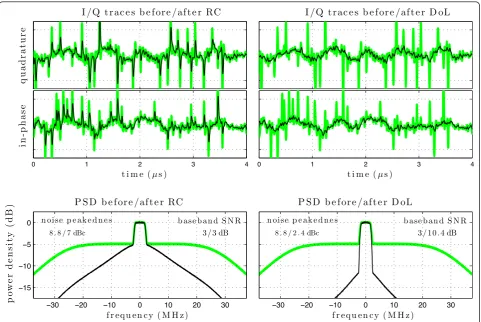
signal-to-noise ratio and improves the quality of the channel. The simplified example shown in Figure 6 illustrates this statement.
In Figure 6, the green lines in all panels show the incoming signal-plus-noise mixture, for both time (sepa-rately for the in-phase and the quadrature traces I/Q) and frequency domains. The incoming signal represents a communication signal with the total bandwidth of 5 MHz, affected by a bandlimited mixture of a thermal (Gaussian) and a white impulsive noises, with the total noise peakedness of 8.8 dBc. The signal-to-noise ratio in the baseband is 3 dB, and the bandwidth of the noise is an order of magnitude greater than the channel bandwidth.
The incoming signal is filtered by (i) an RC integrator with the time constant τ= 16 ns (black lines in the
left-hand panels) and (ii) a DoL circuit with the same τand
appropriately chosen resolution parameter (black lines in the right-hand panels). Note that the RC integrator is just the DoL circuit in the limit of a large resolution parameter.
noise peakedness to 2.4 dBc. By comparing the black lines in the upper panels of the figure, for the RC and the DoL circuits, one can see how the DoL circuit removes the impulsive noise by“trimming”the outliers while following the narrower-bandwidth trend.
Differential limiters can also be viewed asfeedbackRC integrators where the time parameter (τ=RC) is a vari-able that increases when the absolute value of the differ-ence between the input and the feedback of the output exceeds the resolution parametera. The outputζ(τ, a) (t) of such a limiter can be described by
ζ(τ, α)(t) =∫dtz(t)−ζ(τ,α)(t) ˜
τ(τ,α)(|z−ζ|), (20)
and the relationship between the variable time para-meter τ˜(τ,α)(|z|) and the comparator function F˜α(|z|) can be expressed as follows:
˜
τ(τ, α)(|z|) =τ|z|
α
1 ˜
Fα(|z|). (21)
Thus, for the DoL circuit, the time parameter is given by
˜
τ(τ, α)(|z|) =
τ
for |z| < α τ|z|
α
2
otherwise . (22)
A detailed analysis of the DoL filter described by (18) and (19), or by (20) and (22), will be given elsewhere.
Endnotes a
In general, if n is the order of a causal analog filter, thenn- 1 is the order of the first discontinuous
deriva-tive of its impulse response. bOne will encounter
dis-continuities in a derivative of some order in the modulating signal sooner or later, since any physical pulse shaping is implemented using causal filters of finite order.cEquation (2) will still accurately represent the total power in the quadrature receiver if the“real” (physical) modulating signal can be expressed as A(t) =
ψ(t) *AT(t), where the convolution kernelψ(t) is a
low-pass filter of bandwidth much larger thanΔf.
po
w
er
d
en
sit
y
(d
B
)
n oi se p e ak e d n e s
8 . 8 / 7 dBc
b ase b an d S N R 3/3 dB
f r equ en cy ( M H z)
P SD b e f ore /af t e r RC
ï ï ï
ï
ï
ï
n oi se p e ak e d n e s
8 . 8 / 2 . 4 dBc
b ase b an d S N R 3/10. 4 dB
f r equ en cy ( M H z)
P S D b e f ore /af t e r D oL
ï ï ï
I /Q t rac e s b e fore /af te r RC
q
u
a
d
ra
ture
t i m e (μs )
in-pha
se
I /Q t rac e s b e f ore /af t e r D oL
t i m e (μs )
Abbreviations
CPM: continuous-phase modulation; DoL: differential over-limiter; FIR: finite impulse response; I/Q: in-phase/quadrature; GPS: global positioning system; HSDPA: high speed downlink packet access; WCDMA: wideband code division multiple access; WiFi: wireless fidelity (a branded standard for wirelessly connecting electronic devices).
Acknowledgements
I express my sincere appreciation to RL Davidchack of the University of Leicester, UK, and to the reviewers of this manuscript for the valuable suggestions and critical comments, and to JB Lancaster of Horizon Analog Inc. (Lawrence KS, USA) for the experimental setup and the data used in Figures 1 through 3.
Author details
1Avatekh Inc., 900 Masachusetts Street, Suite 409, Lawrence, KS 66044, USA 2
Horizon Analog Inc., Lawrence, KS, USA
Competing interests
The author declares that he has no competing interests.
Received: 26 July 2011 Accepted: 21 December 2011 Published: 21 December 2011
References
1. K Slattery, H Skinner,Platform Interference in Wireless Systems(Elsevier, Amsterdam, 2008)
2. F Leferink, F Silva, J Catrysse, S Batterman, V Beauvois, A Roc’h, Man-made noise in our living environments. Radio Sci Bull.334, 49–57 (2010) 3. X Yang, A Petropulu, Co-channel interference modeling and analysis in a
Poisson field of interferers in wireless communications. IEEE Trans Signal Process.51, 64–76 (2003). doi:10.1109/TSP.2002.806591
4. AV Nikitin, On the impulsive nature of interchannel interference in digital communication systems, inProceedings of IEEE Radio and Wireless
Symposium, Phoenix, AZ, pp. 118–121 (2011)
5. Abramowitz M, Stegun IA (eds.),Handbook of Mathematical Functions with
Formulas, Graphs, and Mathematical Tables, 9th edn. (Dover, New York,
1972)
6. JG Proakis, DG Manolakis,Digital Signal Processing: Principles, Algorithms, and
Applications, 4th edn. (Prentice Hall, New Jersey, 2006)
7. R Schaumann, ME Van Valkenburg,Design of Analog Filters(Oxford University Press, Oxford, 2001)
8. L Cohen,Time-Frequency Analysis(Prentice-Hall, Englewood, NJ, 1995) 9. AV Nikitin, RL Davidchack, Signal analysis through analog representation.
Proc R Soc Lond A.459, 1171–1192 (2033)
10. AV Nikitin, RL Davidchack, Adaptive approximation of feedback rank filters for continuous signals. Signal Process.84(4), 805–811 (2004). doi:10.1016/j. sigpro.2004.01.001
11. AV Nikitin, RL Davidchack, Method and apparatus for analysis of variables. US Patents 7,133,568 (Nov. 7, 2006) and 7,242,808 (July 10, 2007) 12. AV Nikitin, Method and apparatus for real-time signal conditioning,
processing, analysis, quantification, comparison, and control. US Patents 7,107,306 (Sep. 12, 2006), 7,418,469 (Aug. 26, 2008), and 7,617,270 (Nov. 10, 2009)
13. AV Nikitin, Method and apparatus for adaptive real-time signal conditioning and analysis. US Patent Application Publication 2011/0112784 (May 12, 2011)
14. IS Gradshteyn, IM Ryzhik,Table of Integrals, Series, and Products, 5th edn. (Academic Press, New York, 1994)
15. PAM Dirac,The Principles of Quantum Mechanics, 4th edn. (Oxford University Press, London, 1958)
doi:10.1186/1687-6180-2011-137
Cite this article as:Nikitin:On the interchannel interference in digital communication systems, its impulsive nature, and its mitigation.
EURASIP Journal on Advances in Signal Processing20112011:137.
Submit your manuscript to a
journal and benefi t from:
7Convenient online submission
7Rigorous peer review
7Immediate publication on acceptance
7Open access: articles freely available online
7High visibility within the fi eld
7Retaining the copyright to your article